Last Updated September 15, 2026
Manchester has used a worker bee as its official symbol since 1842, when the city’s coat of arms was granted with seven bees circling a globe — a deliberate comparison between the city’s cotton-mill workforce and a hive of industrious, collectively powerful insects, at the exact moment Manchester was becoming the world’s first industrial city. Nearly two centuries later, the same bee turned into something the original heralds could never have anticipated: a citywide symbol of solidarity after tragedy, tattooed on thousands of Mancunians’ skin.
Key Takeaways
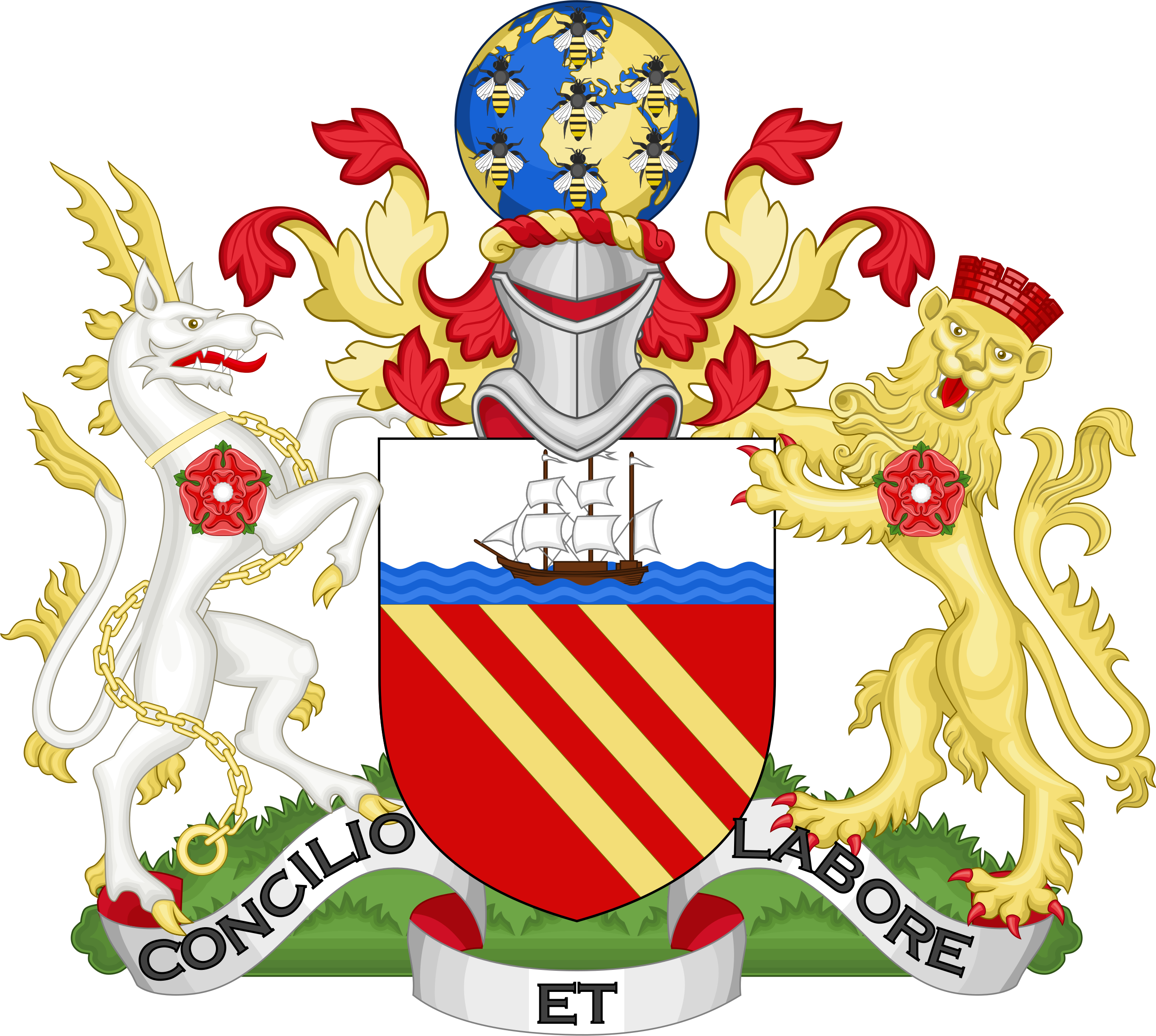
- Manchester’s coat of arms, granted in 1842, placed seven bees on a globe above the shield — the number chosen to represent the city’s trade connections across the world’s seven seas.
- The bee was chosen specifically because 19th-century Manchester’s cotton mills were routinely described as “hives of activity,” with individually replaceable workers functioning collectively like a superorganism — an industrial-age metaphor, not an ancient civic emblem.
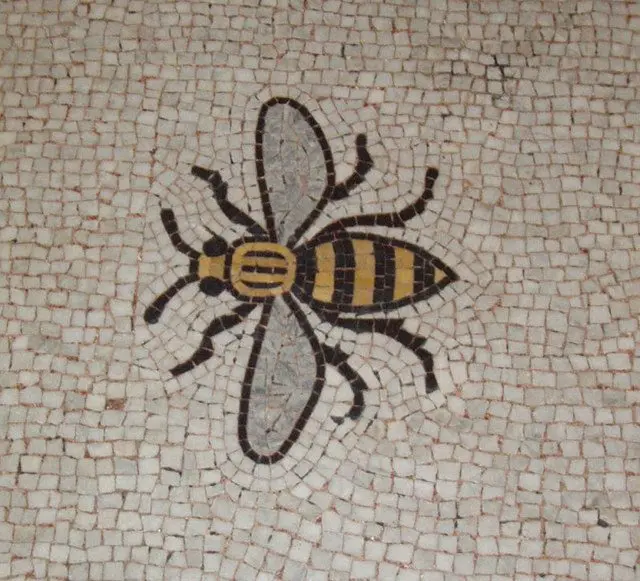
- A bee mosaic set into the floor of Manchester Town Hall, completed in the 1870s, remains one of the most visible historic examples of the symbol still in its original civic context.
- After the May 2017 Manchester Arena bombing, the worker bee was adopted spontaneously as a citywide symbol of unity and resilience, appearing on tattoos, murals, and fundraising merchandise across the city within days.
- The bee today appears on official city signage, the Manchester tram and bus network’s branding, and countless independent business logos — a rare case of a 180-year-old heraldic symbol staying in continuous, genuinely popular use rather than fading into ceremonial obscurity.
Table of Contents
- The 1842 Coat of Arms and Why a Bee
- The Town Hall Mosaic
- 2017: The Symbol Takes On New Meaning
- The Bee in Manchester Today
- Why the Symbol Actually Held Up
- Frequently Asked Questions
The 1842 Coat of Arms and Why a Bee
Manchester was formally incorporated as a borough in 1838 and granted its coat of arms in 1842, at the height of its transformation into the world’s first industrial city. The arms placed seven bees orbiting a globe above the shield — the globe representing Manchester’s importance as a global trading center built on cotton, and the seven bees specifically chosen to represent trade across the world’s seven seas. Contemporary observers routinely described Manchester’s cotton mills as “hives of activity,” and the comparison to a worker bee was deliberate and specific: an individual bee is, on its own, close to insignificant, but a colony of bees working together becomes a genuinely powerful collective force — exactly the framing 19th-century Manchester wanted for its mill workforce and its industrial identity more broadly. It’s a civic symbol born directly out of the Industrial Revolution rather than an older folk or religious tradition, which makes Manchester’s bee a fundamentally different kind of story from most historic bee symbolism.
The Town Hall Mosaic
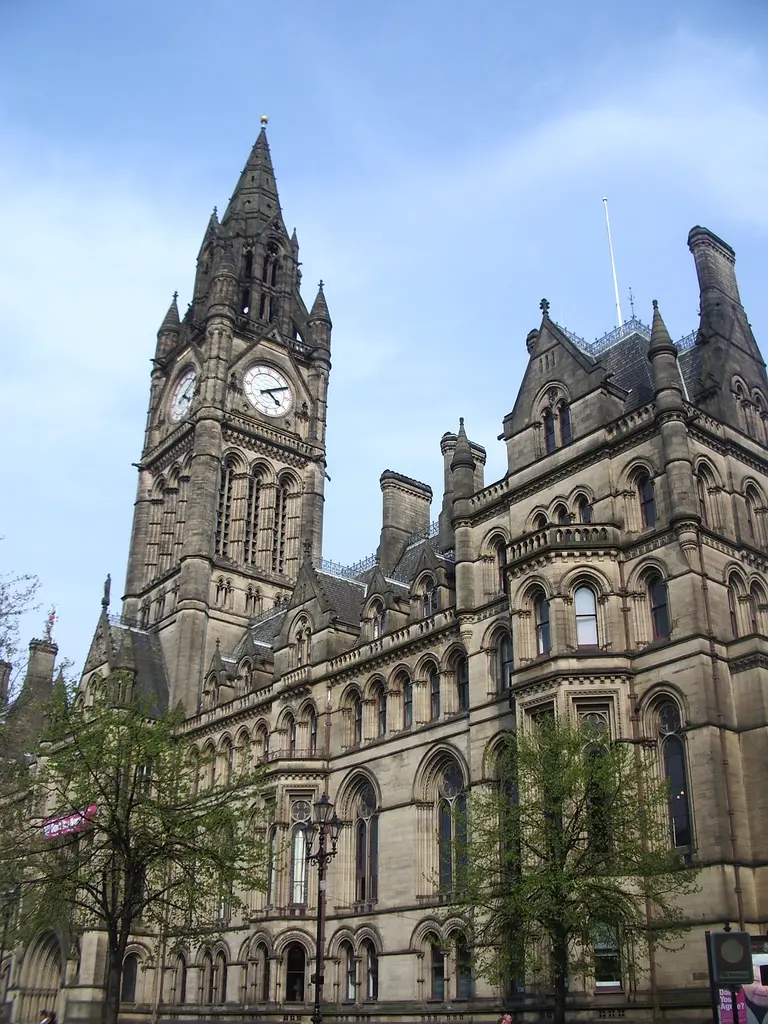
Manchester Town Hall, completed in 1877, still displays one of the clearest surviving examples of the symbol in its original civic setting: a mosaic bee set directly into the floor near the entrance to the Great Hall. It’s a small, easy-to-miss detail relative to the building’s soaring Gothic Revival architecture, but it’s exactly the kind of understated, load-bearing civic symbolism that 19th-century municipal buildings were designed around — the bee wasn’t an afterthought decoration but a genuine statement about what the building, and the city government inside it, represented. The mosaic has survived essentially unchanged for well over a century, making it one of the most direct physical links between the 1842 coat of arms and the bee’s much more recent resurgence in the city’s public identity.
2017: The Symbol Takes On New Meaning
On May 22, 2017, a suicide bombing at an Ariana Grande concert at Manchester Arena killed 22 people and injured hundreds more. In the days that followed, the worker bee — already a recognized but relatively quiet civic emblem — was adopted spontaneously and almost immediately as a symbol of the city’s unity and resilience. Tattoo studios across Manchester began offering bee tattoos with proceeds going to victims’ funds, and thousands of Mancunians got the symbol permanently inked within weeks, an organic grassroots response rather than anything coordinated by the city council. Murals, temporary memorials, and fundraising merchandise carrying the bee appeared across the city, and the symbol’s meaning shifted almost overnight from “historic municipal heraldry most residents could vaguely identify” to “the thing an entire city rallied around after an attack on its own young people.”
The scale of the response is well documented: the Manchester Tattoo Appeal, started the day after the bombing by local tattoo artist Sam Barber, saw studios across and beyond the city offer bee tattoos for a flat donation, and by some estimates more than 50,000 people were tattooed with the bee in the weeks and months that followed, raising several hundred thousand pounds for victims’ funds. A 2021 academic study published in the International Journal of Cultural Studies examined the phenomenon in detail as an example of “post-terror togetherness,” tracing how the bee moved from municipal heraldry to grassroots memorial symbol almost overnight. The full study is available via Taylor & Francis, and contemporary reporting from CNN captured the movement as it happened in the days right after the attack.
The Bee in Manchester Today
The bee now appears well beyond ceremonial contexts: on official city wayfinding signage, on the branding of the Bee Network, Greater Manchester’s integrated public transport system launched in the 2020s, and on the logos of a wide range of independent bars, shops, and cultural venues across the city that have adopted it as informal shorthand for local identity. Manchester City Football Club and Manchester United have both referenced the symbol in kit or branding designs at various points, and the annual “Bee in the City” public art trail — large decorated bee sculptures placed across the city — has become a recurring civic event in its own right. It’s a genuinely unusual trajectory for a 19th-century heraldic device: most municipal coats of arms fade into ceremonial-only use, while Manchester’s bee has done the opposite, becoming more prominent and more emotionally loaded with each passing decade.
Why the Symbol Actually Held Up
Part of what makes Manchester’s bee different from most surviving civic emblems, including plenty of other bee symbols covered in this site’s broader look at bee symbolism across cultures, is that its two defining moments — 1842 and 2017 — both drew on the same underlying idea without either one being forced: a collective of individually small, replaceable units becoming something powerful and worth protecting together. In 1842 that idea was about industrial labor; in 2017 it became about a grieving city refusing to be defined by an attack on it. That the same 180-year-old symbol could carry both meanings without contradiction, purely because the underlying metaphor about bees working together was genuinely sound to begin with, is a large part of why it never needed reinventing.
Frequently Asked Questions
Why does Manchester use a bee as its symbol?
The bee was adopted on Manchester’s 1842 coat of arms to represent the city’s industrious cotton-mill workforce, which contemporaries routinely compared to a hive — individually small workers whose collective output made Manchester the world’s first industrial city.
How many bees are on Manchester’s coat of arms?
Seven bees circle a globe above the shield, the number chosen to represent Manchester’s trading connections across the world’s seven seas.
Why did Manchester bee tattoos become popular?
After the May 2017 Manchester Arena bombing, the bee was spontaneously adopted as a citywide symbol of unity and resilience, with tattoo studios offering bee tattoos and donating proceeds to victims’ funds — thousands of residents got the tattoo within weeks.
Where can you see the Manchester bee symbol today?
On the Manchester Town Hall floor mosaic, city signage, the Bee Network transport branding, numerous independent business logos, and as the recurring theme of the “Bee in the City” public art trail.
Is the Manchester bee connected to real beekeeping?
No — it’s an industrial-age heraldic metaphor about collective labor, unrelated to any actual beekeeping tradition in the city.
Readers interested in the underlying source can consult Visit Manchester.