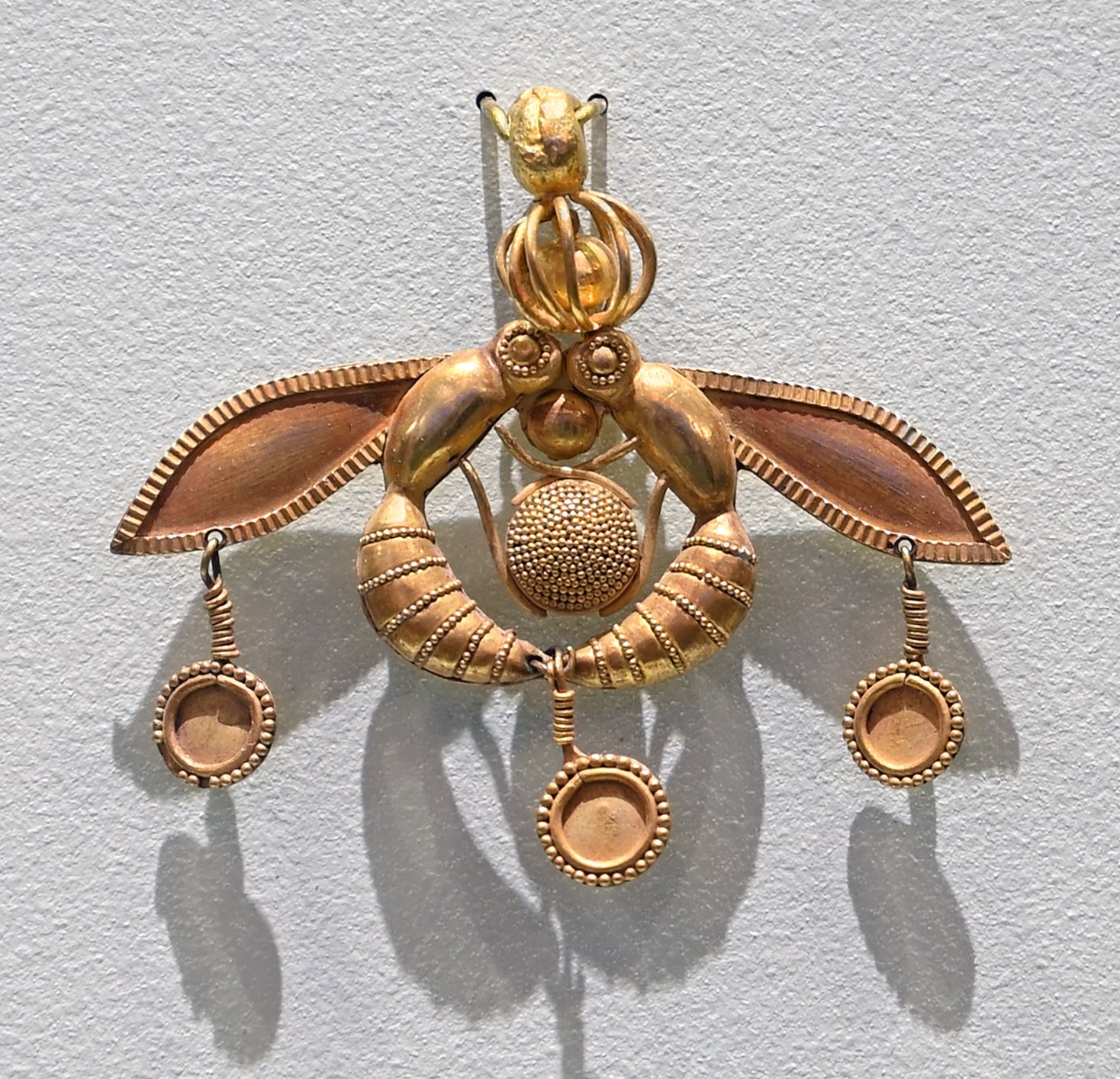
The Malia Pendant is a gold jewel barely the width of a golf ball — two insects facing each other, wings spread, holding a honeycomb between their legs — that has survived nearly 3,700 years to become the single most recognizable piece of Minoan jewelry ever found. Pulled from a Bronze Age cemetery on Crete in 1930, it’s a level of goldsmithing precision that still impresses metalworkers today, and it’s also a genuine, unresolved argument among archaeologists: is it even a bee?
Key Takeaways
- The pendant was excavated in 1930 at Chrysolakkos (“pit of gold”), a monumental Minoan cemetery near the town of Malia on Crete, and is now held in the Heraklion Archaeological Museum.
- It dates to roughly 1800-1650 BC, the Minoan Protopalatial period, making it older than Tutankhamun’s tomb by several centuries.
- The design shows two insects facing each other, joined at the head and stinger, holding a round disc — read by most scholars as a honeycomb — between their legs, with a drop of honey at their mouths.
- Measuring just 4.6 by 4.4 centimeters and weighing about as much as a US quarter, it combines four separate goldsmithing techniques: filigree, granulation, repoussé, and incised detail.
- Despite being universally nicknamed the “Malia bee pendant,” a real scholarly debate continues over whether the insects are actually bees or a large Mediterranean wasp species, based on their elongated bodies and narrow waists.
Table of Contents
- Discovered in the “Pit of Gold”
- Reading the Design
- Bee or Wasp? The Debate That Won’t Settle
- What It Says About Minoan Beekeeping
- Frequently Asked Questions
Discovered in the “Pit of Gold”
The pendant came out of the ground in 1930, unearthed by French archaeologists excavating Chrysolakkos — a name that translates directly to “pit of gold” — a large, elaborate funerary complex near the ancient town of Malia on Crete’s northern coast. The site was one of the wealthiest Minoan burial grounds ever found, and the pendant was one of its standout discoveries, first formally described by the French archaeologist Pierre Demargne.
Nearly a century later, it remains in Crete, on permanent display in the Heraklion Archaeological Museum, where it is routinely described as the single most famous surviving piece of Minoan jewelry — a striking claim for an object smaller than a matchbox, but one the piece has more than earned through sheer repetition in art history surveys, museum branding, and modern jewelry reproductions sold across Greece.
Reading the Design
The pendant depicts two insects in mirrored symmetry, their heads and stingers meeting at the bottom of the composition, wings spread wide above. Between their legs, they hold a round, dotted disc that most archaeologists read as a stylized honeycomb, while a smaller round shape at their mouths is generally interpreted as a drop of honey being deposited into it — a compact visual summary of the entire act of honey-making rendered in miniature gold relief. Above their joined heads sits a delicate wire cage enclosing a single gold bead, and three small dangling discs hang from the wings and stingers, likely once designed to catch the light or add subtle movement when worn.
The technical execution is what elevates the piece beyond a simple gold trinket. The goldsmith combined granulation (tiny fused gold beads used for texture), filigree (twisted gold wire), repoussé (relief hammered from the reverse side), and fine incised linework — a combination of techniques rarely seen together with this level of precision in surviving Bronze Age Aegean jewelry, which is a large part of why the piece is treated as a benchmark object in Minoan art rather than merely an old and lucky find.
Bee or Wasp? The Debate That Won’t Settle
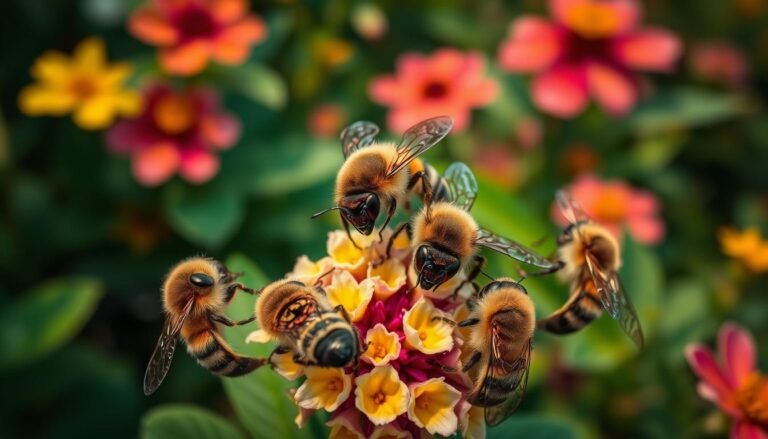
Some scholars argue that the insects depicted may actually be wasps rather than bees, with elongated bodies and narrow waists resembling Megascolia maculata, a type of large Mediterranean wasp.
The “bee pendant” name is so thoroughly embedded in popular and museum use that most visitors never learn there’s a real argument underneath it. The insects’ proportions — a notably slender, wasp-like waist and elongated abdomen — don’t match a honeybee’s stockier body plan especially well, which is exactly what has kept the identification debate alive among specialists for close to a century rather than being settled early on.
In practice, the distinction may matter less than it first appears. Whether the goldsmith was rendering a honeybee, a large solitary wasp, or a composite creature that borrowed features from both to communicate “flying insect associated with honey,” the disc held between the figures’ legs and the honey drop at their mouths make the pendant’s core subject unambiguous: it’s a piece of jewelry about the production of honey, made by a civilization that clearly valued that association enough to render it in solid gold for someone’s burial.
What It Says About Minoan Beekeeping
Honey and beeswax were genuinely significant to the Minoan economy on Crete, used in food, religious offerings, and likely early medicine, and bees carried real symbolic weight in Minoan religious life more broadly — a pattern that shows up again in later Bronze Age Aegean art and, further afield, in the bee-and-stag coinage that would eventually define classical Ephesus more than a thousand years later. The Malia Pendant is the most famous physical evidence of that connection, but it isn’t an isolated curiosity — it sits inside a broader, well-documented Minoan visual tradition connecting bees, honey, and elite burial goods, of which this pendant simply happens to be the finest surviving example.
That the pendant was buried as grave goods at all speaks to the same point from a different angle: whoever commissioned or owned it valued the bee-and-honeycomb motif highly enough to take it into the afterlife, in a tomb complex reserved for Malia’s wealthiest residents.
Frequently Asked Questions
Where can I see the Malia Pendant today?
It’s on permanent public display at the Heraklion Archaeological Museum on Crete, Greece, alongside the broader collection of Minoan artifacts excavated from sites across the island.
How old is the Malia Pendant exactly?
It dates to Crete’s Protopalatial Minoan period, roughly 1800 to 1650 BC — making it over 3,600 years old.
Is the Malia Pendant actually made of solid gold?
Yes. It’s a solid gold object weighing approximately 5.5 grams, crafted using filigree, granulation, repoussé, and incised decoration.
Why is it called a “bee” pendant if the identification is disputed?
The name predates the more detailed anatomical debate and has simply stuck through nearly a century of museum labeling, publications, and popular use, even though some specialists argue the insects’ proportions fit a large wasp species more closely than a honeybee.