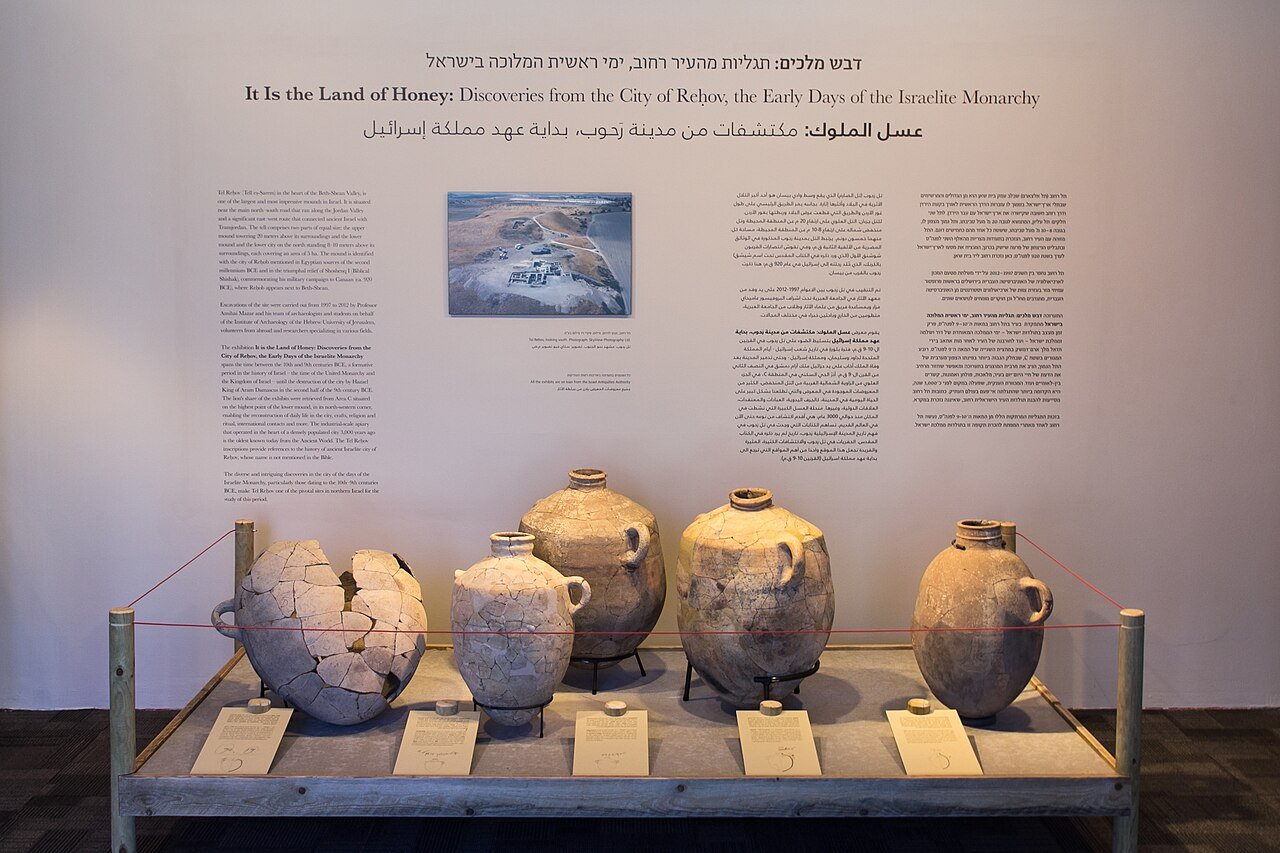
Archaeologists excavating Tel Rehov, an ancient mound in northern Israel’s Beit She’an Valley, uncovered the world’s oldest known managed apiary in 2007 — roughly 30 intact cylindrical clay beehives dating to the 10th and 9th centuries BCE, arranged in orderly rows as part of what researchers estimate was originally a 100-to-200-hive commercial operation. The find didn’t just push back the known history of organized beekeeping by centuries; it also revealed, through analysis of preserved bee remains, that the operation was stocked with bees imported from what is now Turkey.
Key Takeaways
- The apiary was uncovered during excavations led by archaeologist Amihai Mazar, with the beehive discovery announced in 2007, at a mound site called Tel Rehov, about 3 kilometers west of the Jordan River and south of the Sea of Galilee.
- Around 30 intact cylindrical clay hives were found arranged in three rows, with researchers estimating the original apiary held somewhere between 100 and 200 hives — a genuinely industrial scale of operation, not a hobbyist’s few colonies.
- Each hive was an unfired clay cylinder roughly 70-80 cm long and about 40 cm in diameter, with a small entrance hole at one end for the bees and a removable lid at the other for a beekeeper to extract honeycomb.
- The find is dated to the late 10th to early 9th century BCE — the period traditionally associated with the early Israelite monarchy — making it the oldest archaeologically confirmed managed apiary discovered anywhere in the world.
- Analysis of preserved bee remains identified the species as Apis mellifera anatoliaca, a bee native to Anatolia (modern Turkey), not the bee species native to the local region — meaning the operation likely depended on live bees imported over a genuinely long distance for the era.
Table of Contents
- The Discovery
- What the Hives Actually Looked Like
- A Genuinely Industrial Operation
- The Imported Anatolian Bees
- Why This Discovery Matters
- Frequently Asked Questions
The Discovery
Tel Rehov is a large tell — an archaeological mound built up from centuries of successive settlement — located in the Beit She’an Valley of northern Israel, close to the Jordan River and south of the Sea of Galilee. Excavations there, led by archaeologist Amihai Mazar, uncovered the beehive remains and the announcement of the find came in 2007, immediately drawing attention as the oldest confirmed apiary structure ever found by archaeologists anywhere in the world. The hives were found inside a dedicated structure centrally located within the ancient city itself, rather than off to one side or outside the settlement, suggesting beekeeping held a genuinely significant, visible place in the city’s economy rather than being a marginal activity.
What the Hives Actually Looked Like
The individual hives were unfired clay cylinders, each roughly 70 to 80 centimeters long and about 40 centimeters in diameter — dimensions that, notably, aren’t far off from traditional cylindrical clay and woven hives that remained in use around the Mediterranean and Middle East for thousands of years afterward. Each cylinder had a small hole at one end that let bees come and go, and a removable lid at the opposite end that let a beekeeper reach in to harvest honeycomb without destroying the hive itself — a genuinely practical design that let the same hive body be reused season after season, rather than being sacrificed every time honey was collected.
A Genuinely Industrial Operation
Roughly 30 hives survived in a state complete enough to identify clearly, arranged in three parallel rows, several tiers high. Based on the layout and the space available in the structure, researchers estimate the apiary originally held somewhere between 100 and 200 hives at its peak — a scale that puts this squarely in industrial or commercial territory rather than small-scale household beekeeping. Researchers have estimated an apiary of that size could have produced somewhere in the range of half a ton of honey a year, a genuinely significant output for a Bronze-to-Iron-Age economy, and one that implies organized labor, a real market for the honey (and probably the beeswax too), and enough institutional stability in the city to sustain that kind of specialized operation over time.
The Imported Anatolian Bees
The single most surprising detail to come out of the excavation wasn’t the hives themselves — it was what was living inside them. Analysis of preserved bee remains identified the species as Apis mellifera anatoliaca, a honeybee subspecies native to Anatolia, in what is now Turkey, rather than the honeybee population native to the immediate region. That’s a genuinely significant finding: it implies the people running this apiary weren’t just working with whatever wild bees happened to be locally available — they had, in some fashion, obtained and established a foreign bee stock hundreds of kilometers from its native range, presumably because Anatolian bees were considered gentler-tempered or more productive than the local alternative. Moving live bee colonies any real distance is not a trivial logistical undertaking even with modern equipment, so evidence of it happening roughly 3,000 years ago says something concrete about the trade networks and technical knowledge available at the time, not just about beekeeping in isolation. It’s a real point of connection to this site’s own coverage of Anatolian beekeeping’s ancient and modern tradition — the same regional bee stock this Iron Age Israelite operation apparently went out of its way to acquire.
Why This Discovery Matters
Before Tel Rehov, evidence for organized ancient beekeeping came mostly from indirect sources — texts, artistic depictions like those covered in this site’s overview of ancient beekeeping practices, and scattered archaeological hints rather than an intact apiary structure that could be measured, counted, and analyzed directly. Tel Rehov gave researchers something far more concrete: a real industrial-scale operation, with a knowable hive design, an estimable production capacity, and — thanks to the bee-remains analysis — direct physical evidence of a specific, imported bee stock. It reframes ancient Near Eastern beekeeping from something assumed to be small-scale and opportunistic into something that could, in at least this one documented case, be a specialized, technically sophisticated, and economically organized industry.
Frequently Asked Questions
Where is Tel Rehov and when was the apiary found?
Tel Rehov is an archaeological mound in Israel’s Beit She’an Valley, near the Jordan River and south of the Sea of Galilee. The apiary discovery, from excavations led by Amihai Mazar, was announced in 2007.
How old is the Tel Rehov apiary?
It dates to the late 10th to early 9th century BCE, making it the oldest archaeologically confirmed managed apiary discovered anywhere in the world.
How many beehives were found?
About 30 intact clay cylindrical hives were uncovered in three rows, with researchers estimating the original apiary held somewhere between 100 and 200 hives at its peak.
What were the hives made of?
Unfired clay cylinders roughly 70-80 cm long and about 40 cm in diameter, each with a small entrance hole for bees and a removable lid for a beekeeper to harvest honeycomb.
Why is it surprising that the bees were Anatolian?
Because it means the operation used a bee subspecies (Apis mellifera anatoliaca) native to what is now Turkey rather than the locally available bee population — real evidence that people roughly 3,000 years ago transported live bee colonies over a genuinely long distance, implying real trade networks and specialized knowledge.
More detail on this is available from Science News.