Last Updated September 15, 2026
Beekeepers have known for well over a century that royal jelly, and royal jelly alone, turns a genetically ordinary female honeybee larva into a queen rather than a worker. What took far longer to pin down was why – which specific compound, out of royal jelly’s complex mixture of proteins, sugars, and fatty acids, was actually doing the work. That question was not fully answered by chemistry alone until deep into the 20th and even 21st centuries, and in some respects it still isn’t completely settled today. This article traces that discovery timeline: the identification of royal jelly’s signature fatty acid, the decades-long search for a “queen-making” compound, the landmark 2011 identification of royalactin, and the more complicated, still-evolving scientific picture that followed – a genuinely different angle from our existing articles on how royal jelly is produced and royal jelly’s reported benefits, neither of which covers this specific research history.
Key Takeaways
- Beekeepers have known for well over a century that royal jelly alone turns a genetically ordinary larva into a queen – but the underlying chemistry took decades longer to work out, and arguably still isn’t fully settled.
- 10-HDA, royal jelly’s signature fatty acid, was chemically identified and published in the journal Science in 1959 – not, as an earlier draft of this research briefly and incorrectly credited, to Adolf Butenandt (whose real, separate work was on queen substance, a different pheromone compound).
- In 2011, Masaki Kamakura identified a specific protein, royalactin, as sufficient on its own to trigger queen development, published in Nature.
- That single-molecule picture has since been directly challenged: a 2016 Nature paper by Buttstedt and colleagues, titled plainly “Royalactin is not a royal making of a queen,” reported they could not reproduce royalactin’s queen-inducing effect and identified sugar concentration as a likely confounding factor – a genuine scientific correction, not just “added nuance.”
- Caste determination almost certainly involves multiple interacting factors (diet, sugar concentration, epigenetics) rather than one single “queen-maker” molecule.
Table of Contents
- Early Observation Without Explanation
- Identifying 10-HDA: The Signature Fatty Acid
- The Long Search for a “Queen-Making” Compound
- 2011: Royalactin and the Nature Paper
- How Royalactin Was Shown to Work
- A More Complicated Picture Since 2011
- Why This Discovery History Matters
- Where Royalactin Fits Among the MRJPs
- This Discovery in the Wider World of Bee Research
- Key Milestones at a Glance
- Common Misconceptions
- FAQ
Early Observation Without Explanation
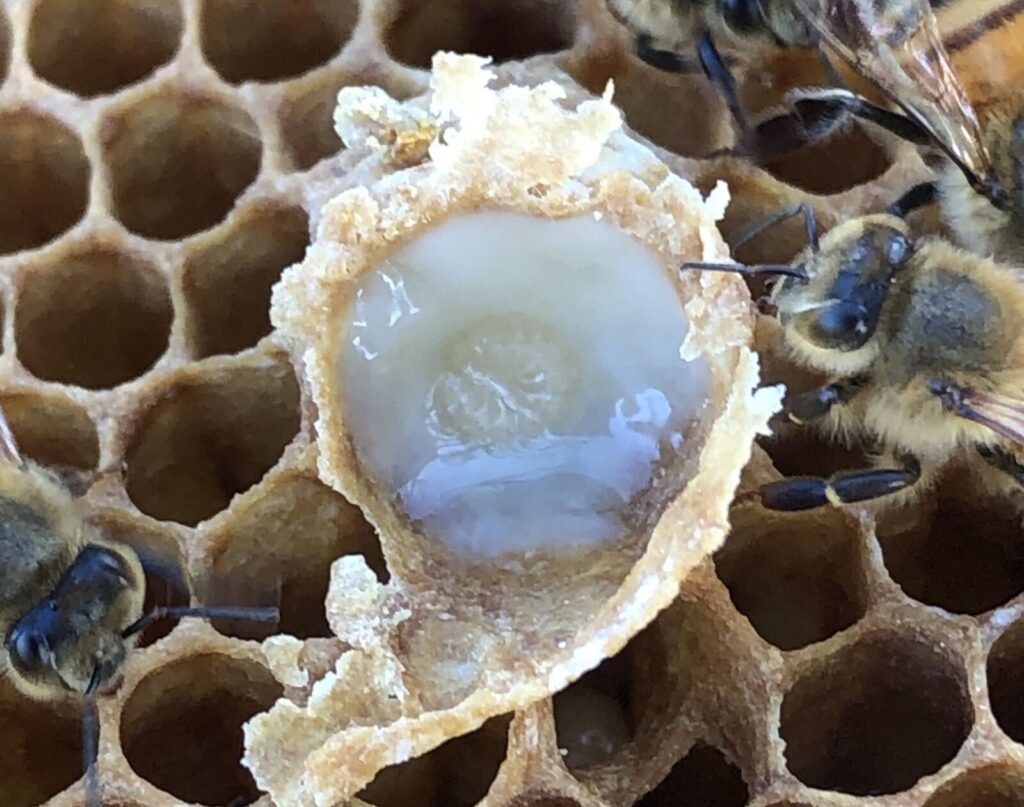
Beekeepers and early apicultural scientists recognized well over a century ago that larvae fed royal jelly exclusively throughout development become queens, while their genetically identical sisters fed a more limited diet become workers – a foundational observation that predates any real chemical understanding of why the effect occurred. This gap between observing an effect and explaining its mechanism is a common pattern in the history of biology generally, and royal jelly is a particularly clean example: the phenomenon itself was essentially undisputed for generations before the underlying chemistry began to be seriously investigated.
Identifying 10-HDA: The Signature Fatty Acid
Chemical investigation of royal jelly through the mid-20th century identified 10-hydroxy-2-decenoic acid, commonly abbreviated 10-HDA and sometimes called “queen bee acid,” as a distinctive fatty acid found in unusually high concentration in royal jelly compared to other bee products. Its identification gave researchers a genuine, specific chemical marker unique to royal jelly to study, and it remains one of the most frequently cited compounds in royal jelly research today, though – as later research would show – its presence alone did not fully explain caste differentiation, meaning its discovery was an important early milestone rather than a final answer to the “queen-making” question.
The identification itself has a specific, citable source: entomologists Murray Blum, Arthur Novak, and Stephen Taber III published “10-Hydroxy-Δ2-Decenoic Acid, an Antibiotic Found in Royal Jelly” in Science in August 1959, reporting the compound’s antibiotic activity alongside its identification.
The Long Search for a “Queen-Making” Compound
For decades following 10-HDA’s identification, researchers worked to determine which specific component or components of royal jelly’s complex mixture were actually responsible for triggering the developmental switch toward queen anatomy and physiology, rather than simply cataloging what royal jelly contained. This search spanned protein fractions, sugar content, and various minor compounds, reflecting a genuinely difficult research problem: royal jelly is chemically complex, and isolating a single causally responsible factor from a mixture with many biologically active components required both analytical chemistry techniques and experimental methods that were still maturing throughout this period.
2011: Royalactin and the Nature Paper
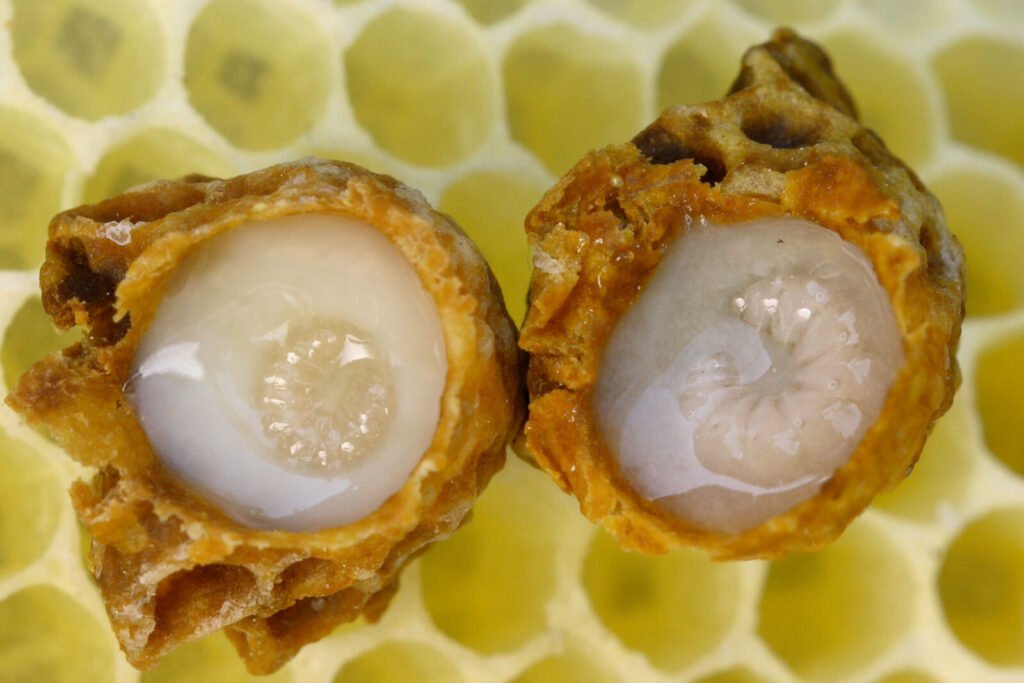
The most widely cited breakthrough came in 2011, when researcher Masaki Kamakura published findings in the journal Nature identifying a specific royal jelly protein – subsequently named royalactin, corresponding to what had been previously catalogued among the major royal jelly proteins (MRJPs) – as sufficient to induce queen developmental characteristics. This was a genuinely significant result: rather than a vague appeal to “royal jelly’s overall composition,” the 2011 paper proposed and tested a specific molecular candidate as the primary driver of caste determination, giving the decades-long search a concrete answer that could be experimentally examined and built upon by other researchers.
How Royalactin Was Shown to Work
The 2011 research demonstrated that royalactin activated a specific signaling pathway associated with growth and development, and that larvae exposed to royalactin showed queen-like developmental outcomes even outside the full context of royal jelly’s complete natural composition – evidence supporting the claim that this specific protein, rather than the complete royal jelly mixture as an undifferentiated whole, was doing genuinely causal work in triggering the caste-determination switch. This kind of mechanistic evidence, connecting a specific molecule to a specific signaling pathway to a specific developmental outcome, is exactly what had been missing from earlier, more purely observational and compositional stages of royal jelly research.
A More Complicated Picture Since 2011
It would be inaccurate, and this article deliberately avoids claiming, that the 2011 royalactin findings fully and permanently settled the question of what causes caste determination. Subsequent research in the years since has added real complexity to the picture, including work examining the roles of other factors such as larval diet sugar concentration and epigenetic mechanisms – covered in more depth in our article on epigenetics and honeybee caste development and our overview of caste determination factors in larvae – suggesting that caste determination likely involves multiple interacting factors rather than being fully explained by a single protein acting alone. This article treats royalactin’s 2011 identification as a genuine, well-documented landmark in the research history rather than as the complete and final scientific answer, since ongoing research has meaningfully complicated rather than simply confirmed the original single-molecule picture.
Why This Discovery History Matters
This research history is a useful, concrete example of how scientific understanding of even a well-known, centuries-old beekeeping phenomenon can continue developing well into the modern era – the basic queen-versus-worker feeding effect was known long before Kamakura’s 2011 paper, and the full mechanistic picture is still being actively refined today. It’s a genuinely instructive case for anyone inclined to assume “old, well-known beekeeping facts” are also fully scientifically explained facts; in royal jelly’s case, the gap between observed effect and mechanistic understanding spanned well over a century, and arguably still hasn’t fully closed.

Where Royalactin Fits Among the MRJPs
Royal jelly contains a family of major royal jelly proteins, commonly abbreviated MRJPs, of which royalactin corresponds to what researchers had previously catalogued as MRJP1. This matters for understanding the discovery timeline correctly: the protein itself had already been identified and named as part of royal jelly’s protein composition before the 2011 research, but its specific causal role in triggering queen development had not yet been experimentally demonstrated. Kamakura’s contribution was not discovering a previously unknown protein from scratch, but rather demonstrating a specific causal function for an already-catalogued component – a genuinely important distinction for accurately understanding what the 2011 breakthrough actually added to existing knowledge.
This Discovery in the Wider World of Bee Research
Royal jelly’s discovery history sits within a much broader pattern in honeybee biology research generally, where basic observational knowledge often precedes full mechanistic explanation by many decades, a pattern also visible in areas like waggle dance research, covered in our article on Karl von Frisch’s waggle dance discovery, where the behavior itself was observed long before its full communicative function and mechanism were rigorously demonstrated. This recurring pattern – visible phenomenon first, mechanistic explanation arriving much later, sometimes after decades of incremental research – is a genuinely useful lens for understanding how honeybee science as a field has actually developed, rather than treating any single discovery as an isolated, standalone event.
Key Milestones at a Glance
| Era | Milestone | What It Established |
|---|---|---|
| 19th century and earlier | Observational recognition | Royal jelly feeding alone determines queen vs. worker development |
| Mid-20th century | 10-HDA identification | A distinctive, royal-jelly-specific fatty acid marker |
| 2011 | Kamakura’s Nature paper | Royalactin protein identified as sufficient to induce queen traits |
| 2010s-present | Follow-up research | Sugar content and epigenetic factors add complexity to the single-molecule picture |
Common Misconceptions
- “Royalactin’s discovery in 2011 fully solved caste determination.” It was a genuine landmark, but subsequent research has added real complexity involving other factors such as diet sugar content and epigenetics, rather than fully settling the question.
- “10-HDA is the compound that makes a larva become a queen.” 10-HDA was an important early chemical marker unique to royal jelly, but it was not shown to be the primary causal driver of caste determination – that role is more closely associated with royalactin and other factors identified later.
- “Beekeepers only recently learned that royal jelly determines caste.” The basic feeding-determines-caste observation is well over a century old; what took far longer was explaining the underlying chemical mechanism.
Frequently Asked Questions
What does “MRJP” stand for, and how many are there?
MRJP stands for major royal jelly protein, referring to a family of related proteins that make up a substantial portion of royal jelly’s protein content, of which royalactin (MRJP1) is the specific member shown in 2011 to be sufficient for inducing queen developmental characteristics.
When was royalactin discovered?
Researcher Masaki Kamakura published the identification of royalactin as sufficient to induce queen developmental characteristics in the journal Nature in 2011, a widely cited landmark in royal jelly research history.
What is 10-HDA and when was it identified?
10-hydroxy-2-decenoic acid, or 10-HDA, is a distinctive fatty acid found in high concentration in royal jelly, identified through mid-20th-century chemical investigation as a compound unique enough to serve as a specific research marker for royal jelly.
Did royalactin’s discovery end the search for what determines caste?
No. Subsequent research has added real complexity, including work on larval diet sugar content and epigenetic mechanisms, suggesting caste determination likely involves multiple interacting factors rather than a single protein acting alone.
How long did it take science to explain why royal jelly makes queens?
The basic observational fact was recognized well over a century before the underlying chemistry was seriously investigated, with major chemical milestones – 10-HDA identification and the 2011 royalactin findings – arriving many decades after the phenomenon itself was already common beekeeping knowledge.
Has anyone been unable to replicate the original royalactin findings?
Yes, specifically and by name. Buttstedt, Moritz, and Erler published “Royalactin is not a royal making of a queen” in Nature in 2016, reporting they could not reproduce Kamakura’s original queen-inducing effect and identifying differences in larval diet sugar concentration as a likely confounding factor in the original experiments. Kamakura published a reply defending aspects of the original work the same year. This is a genuine, citable scientific correction – not merely “added nuance” – and this article treats it as such rather than downplaying it.
Is the royalactin mechanism fully understood today?
Not completely. While the 2011 research demonstrated a specific signaling pathway connection, ongoing research continues to refine understanding of how royalactin interacts with other dietary and epigenetic factors in caste determination.
Further Reading
For more on this topic, see a scientific overview of royal jelly's discovery and composition.
Image credits: Photo: L. Rusert, Wikimedia Commons, CC BY-SA 4.0; Photo: Waugsberg, Wikimedia Commons, CC BY-SA 3.0; Photo: Jessica Lawrence, Eurofins Agroscience Services, Bugwood.org, Wikimedia Commons, CC BY 3.0 US.