Reviewed by Sofia T. · Last Updated October 15, 2026 · How we review
The modern top bar hive was developed in East Africa in the 1960s and 1970s, but no one person invented it. It grew out of Greek top-bar baskets, a hive built by a student from Kenya and his instructor at an English college in the mid-1960s, an Oxfam-funded pilot in Kenya, and a Canadian-sponsored university project that began in 1971. Sources disagree on some names and dates, and this page says where.
For the other hive styles in the story, see types of beehives compared.
Key Takeaways
- The design has a chain of contributors, not one inventor: Greek baskets, a 1966 Rhodesian trial, Peter Paterson and Jack Tredwell’s rectangular hive, an Oxfam pilot in Kenya, then a University of Guelph team in 1971.
- A tub-shaped Greek top-bar basket was drawn by George Wheler in 1682, and Greece also had rectangular top-bar hives before the African designs.
- Despite the name, the Kenyan hive was formalized under a Canadian-sponsored project. The original Tanzanian hive was a separate 1972 design; today’s “Tanzanian” hive is a straight-sided Kenyan variant.
- The sloped sides have a reason: Eva Crane wrote that bees will not attach comb to sides that slope inward toward the bottom.
- The FAO’s 1990 handbook put a frame hive with two supers at three times the cost of a 27-bar Kenyan top bar hive.
Table of Contents
- Greek Roots: From the Anástomo Basket to Rectangular Hives
- Rhodesia and Sparsholt: The 1960s Experiments
- Oxfam and Guelph: How the Kenyan Hive Took Shape
- Top Bar Hive Timeline
- Tanzania and the Naming Mix-Up
- Why the Sides Slope
- Why It Suited Rural Africa
- From Development Projects to Hobbyist Apiaries
- Where the Sources Disagree
- Frequently Asked Questions
- The Bottom Line
Greek Roots: From the Anástomo Basket to Rectangular Hives
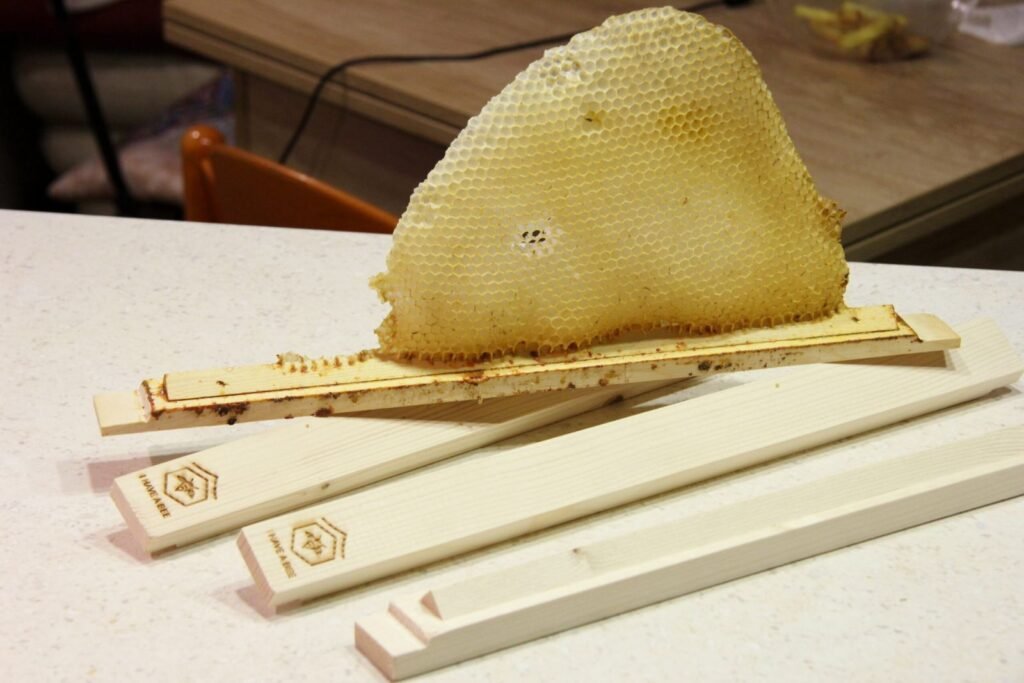
The oldest ancestor is a tub-shaped basket with bars laid across its open top. George Wheler and Jacques Spon saw woven hives of this kind in Greece in 1676, and Wheler published a drawing in 1682, according to Wikipedia’s article on the horizontal top-bar hive. The same article says the earliest known possible mention of a hive with removable top bars is a 1539 poem, Le Api, by Giovanni di Bernardo Rucellai.
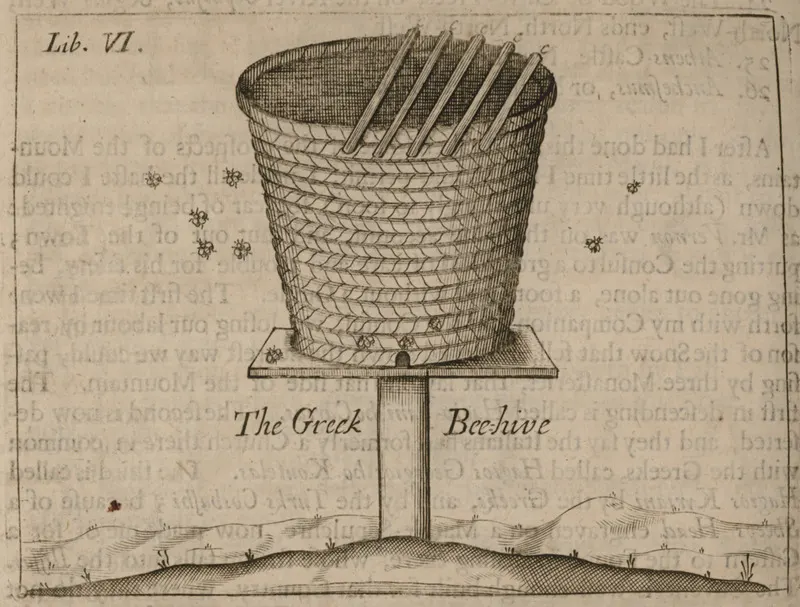
Greek beekeepers called the basket an “Anástomo.” Georgios Mavrofridis and Ioannis Anagnostopoulos, writing in the American Bee Journal in 2012, report that similar clay hives were used in Greece from at least the 3rd century B.C. The round basket had one weakness. Because its mouth is circular, each comb hangs from a bar of a different length, so combs cannot be swapped between positions, as Kenyan beekeeping officer Kirea Kigatiira later noted.
Greece also had rectangular versions. Mavrofridis and Anagnostopoulos describe stone hives on the island of Kythira and a wooden “Kasáki” with sloping long sides, used on nearby Antikythira before the 1940s. Their view is that the later Kenyan hive “shares remarkable common characteristics” with the Kasáki, and that the cost of boards, not ignorance of the idea, kept most Greek beekeepers on cheap wicker before the 1960s. That affordability point comes back in Africa.
Rhodesia and Sparsholt: The 1960s Experiments
Two separate efforts to bring top-bar hives to Africa began in the 1960s. In 1966, Penelope Papadopoulo, working in Rhodesia (now Zimbabwe), introduced the Greek Anástomo to farmers who used bark hives and could not afford frame hives. New baskets were woven locally and were welcomed as a low-cost hive, according to the same American Bee Journal article.
The second effort started in Hampshire, England. Mavrofridis and Anagnostopoulos write:
“In 1964 Crane met through Captain E. Jack Tredwell (Head of Beekeeping at Sparsholt College of Agriculture in Hampshire) his student from Kenya, Mr. Peter D. Paterson.”
Eva Crane, then director of the Bee Research Association, had kept a Greek basket hive at home since 1958. The article says she encouraged Paterson to develop a hive suited to Kenya, using the Greek basket as a model, and that Paterson and Tredwell, helped by John Cossburn, built a rectangular wooden hive with interchangeable top bars of uniform length. Wikipedia dates the Tredwell and Paterson work to 1965, one year later than the 1964 meeting above.
Oxfam and Guelph: How the Kenyan Hive Took Shape
Kigatiira’s own account, “Beekeeping Development Programmes in Kenya” (IBRA, 1976, reprinted in Beekeeping in Rural Development), says Oxfam, through its Freedom from Hunger campaign, funded a two-year pilot beekeeping project in Kenya in 1967. When that exploratory project ended in 1970, Kenya’s government asked Canada for technical help with a new beekeeping section in the Ministry of Agriculture. The American Bee Journal article adds that Paterson began promoting his hive in 1967 under the Oxfam program.
The Canadian project began in 1971, with Professor Gordon F. Townsend of the University of Guelph’s Ontario Agricultural College as director. Its team chose not to use the Greek basket, because combs in it are not interchangeable. Instead they used a transitional approach, which the article describes as “in principle a modification” of the Paterson and Tredwell hive. Kigatiira, who studied under Townsend, Paterson and Benson Muya of the National Beekeeping Institute in Nairobi then promoted the hive that is “known today worldwide as the KTBH.”
The credit varies by source. Wikipedia names Maurice V. Smith and Gordon Townsend of Guelph, sponsored by the Canadian International Development Agency (CIDA) under a four-year project that began in Kenya in 1971. The FAO handbook credits Townsend “and his team of Kenyan bee students.” Kigatiira himself called the Kenyan hive a modification of the Greek basket hive. These accounts overlap more than they conflict, and our own guide to the Kenyan top bar hive’s design and dimensions covers how it is built today.
Kigatiira also records that Kenya’s government wanted a second project phase that would hand operations over to Kenyan management, with a Kenyan already appointed director and Townsend as adviser.
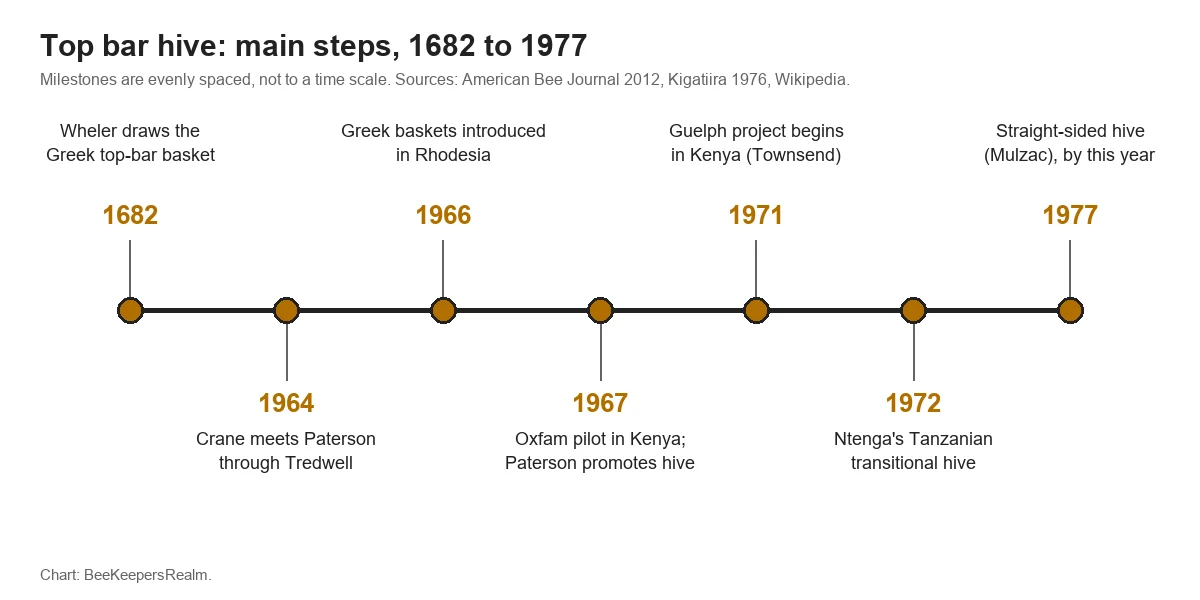
Top Bar Hive Timeline
| Year | Event | Source |
|---|---|---|
| 1676 to 1682 | Wheler and Spon see a Greek top-bar basket; Wheler publishes a drawing | Wikipedia |
| 1958 | Eva Crane begins keeping a Greek basket hive at home | American Bee Journal, 2012 |
| 1964 | Crane meets Peter Paterson through Jack Tredwell at Sparsholt College | American Bee Journal, 2012 |
| 1966 | Penelope Papadopoulo introduces Greek baskets in Rhodesia | American Bee Journal, 2012 |
| 1967 | Oxfam-funded pilot in Kenya; Paterson promotes his hive | Kigatiira, 1976; American Bee Journal, 2012 |
| 1970 | Oxfam pilot ends; Kenya asks Canada for help | Kigatiira, 1976 |
| 1971 | Canadian-sponsored Guelph project begins under Gordon Townsend | American Bee Journal, 2012; Wikipedia |
| 1972 | Ntenga’s Tanzanian transitional hive; “David Hive” and Bielby hive also appear | Kigatiira, 1976; Wikipedia |
| By 1977 | Henry Mulzac’s straight-sided hive with Langstroth-compatible dimensions | Wikipedia |
| 1990 | FAO handbook recommends the Kenyan hive for beginners with aggressive tropical bees | FAO, 1990 |
Tanzania and the Naming Mix-Up
Tanzania took its own route. According to Wikipedia, rural Tanzanians used log hives until the 1960s, and harvesting from the middle of the log destroyed brood comb. The government promoted a log hive that could be harvested from either end and a plank hive that was a simple top-bar hive without movable bars. In 1972 the researcher G. Ntenga designed a transitional hive with movable top bars, now called the Tanzanian Transitional Hive.
Kigatiira describes Ntenga’s bars as 2-1/2 inches (62 mm) wide with double grooves 1-1/4 inches (31 mm) apart, so combs were moved in pairs. In English-speaking countries today, “Tanzanian top bar hive” usually means something else: a Kenyan hive with straight sides instead of sloping ones. Wikipedia says that hive is not the original Tanzanian design. This is why the two names confuse buyers, and our guide to the Tanzanian top-bar hive explains the modern version.
| Kenyan top bar hive | Original Tanzanian hive | Today’s “Tanzanian” hive | |
|---|---|---|---|
| Developed by | Guelph and CIDA project in Kenya, from 1971 | G. Ntenga, 1972 | Straight-sided variant of the Kenyan hive |
| Sides | Sloped inward toward the bottom | Not specified in our sources | Straight |
| Bars | One comb per bar | 62 mm bars; combs moved in pairs | Same as Kenyan |
| Source | Wikipedia; FAO | Kigatiira, 1976 | Wikipedia |
Why the Sides Slope
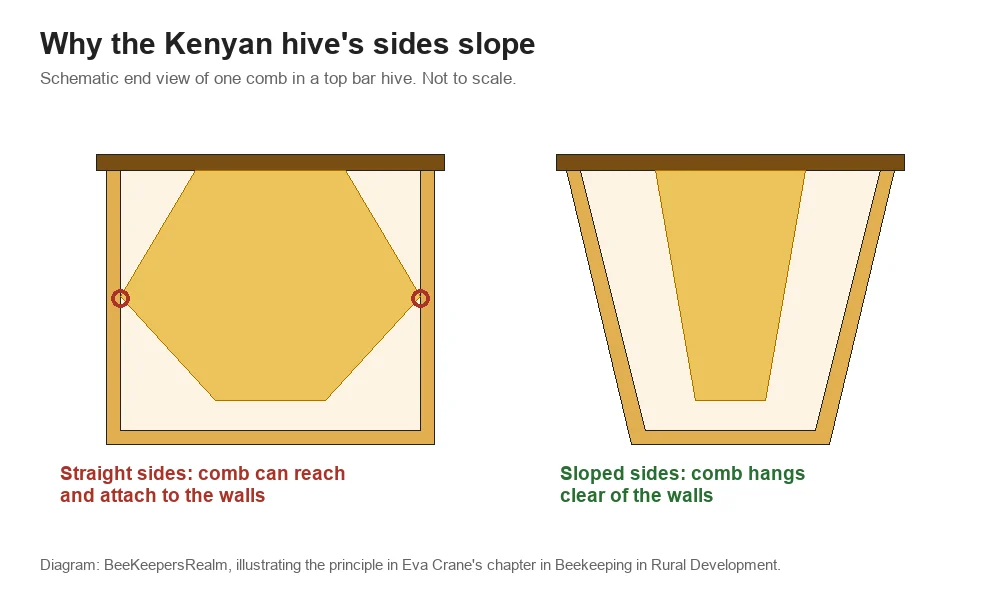
The sloped sides are the Kenyan hive’s most recognizable feature, and Eva Crane explained the reasoning in the opening chapter of Beekeeping in Rural Development (Commonwealth Secretariat and IBRA):
“If boxes of the usual size for frame hives are used, the two long sides must be made to slope inwards towards the bottom, as the bees’ naturally built combs do, and the bees will not then attach their combs to the sides of the hives.”

Crane added that the bar spacing, the bees’ natural distance between combs, is “the only precision measurement.” That is the practical heart of the design: a carpenter has to get one number right, not the dozens a frame hive needs. The FAO handbook gives the bar width for the Kenyan hive as 32 millimeters (1-1/4 inches) and lists three bar shapes in use: V-shaped, grooved and pointed starter. For how bar styles compare today, see grooved versus wedged top bars.
Why It Suited Rural Africa
Cost and craftsmanship decided the matter. In Beekeeping in Africa (FAO Agricultural Services Bulletin 68/6, 1990), Stephen Adjare of Ghana’s Technology Consultancy Centre set the two systems side by side:
“A frame hive with two supers costs three times as much as a Kenyan 27-top-bar hive.”
Adjare added that frame hives need precise dimensions and seasoned wood, and that village carpenters are often not skilled enough for the job. He described the Kenyan hive as “an ideal accommodation for the aggressive tropical bee” and recommended it for beginners. The American Bee Journal article makes the same point, calling top-bar hives low cost and “manageable by the beekeepers in regions with aggressive honey bees.”
The trade-off is comb strength. Adjare noted that top-bar combs are fixed only to the bar, so they break more easily than combs in a four-sided frame, and the combs must be handled carefully when the bar is lifted. Compare the frame-hive logic in our history of the Langstroth hive.
From Development Projects to Hobbyist Apiaries
The American Bee Journal article describes the top bar hive as “used widely in developing countries and also by many amateur beekeepers.” Wikipedia says some beekeepers like it because they see it as more natural and because it does not need the precise measurements of multi-story hives. Nearby European traditions took another path; the Warré hive grew from a different set of motives.
Adoption in Africa is still measurable. A 2024 survey of 180 beekeepers in South Ethiopia in PLOS ONE (Delena and Asfaw) counted 286 Zander frame hives, 476 Kenyan top bar hives, 121 mud-block Ethio-Ribrab hives and 1,494 traditional hives. By our arithmetic, that makes 2,377 hives in total: 20% Kenyan top bar, 12% Zander, 5% Ribrab and 63% traditional. The authors say the Kenyan hive is the most widely adopted transitional design there because it is low-cost and easy to build, which is the same logic the FAO gave in 1990. Harvesting differs from frame hives, too; honey extraction is covered in our history of the honey extractor.
Where the Sources Disagree
- 1964 or 1965. The American Bee Journal gives 1964 for Crane’s meeting with Paterson; Wikipedia says the top-bar work of Tredwell and Paterson began in 1965.
- Who gets the credit. Wikipedia names Smith and Townsend; the FAO names Townsend and his Kenyan students; the American Bee Journal calls the Guelph hive a modification of Paterson and Tredwell’s. Wikipedia and several retail blogs say the Kenyan hive was developed in Canada, which leaves out the Kenyan and British steps.
- What “Tanzanian” means. Wikipedia says today’s straight-sided “Tanzanian” hive differs from the original Ntenga hive. The FAO describes a “Tanzanian transitional long hive” that uses frames rather than top bars, so even handbooks use the name differently.
- Claims we could not verify. An earlier version of this page described a 1964 conversation at the National Honey Show and a Sparsholt prototype test. None of the sources above say that, so we removed it.
Frequently Asked Questions
Who invented the top bar hive?
No single person. Greek top-bar baskets came first, Peter Paterson and Jack Tredwell built a rectangular wooden hive in the 1960s, and a University of Guelph team formalized the Kenyan hive from 1971.
Why is it called the Kenyan top bar hive if it came from Canada?
The Canadian-sponsored Guelph project worked in Kenya, so the design was developed and promoted there. Kenyan staff such as Kirea Kigatiira helped document and spread it.
What is the difference between a Kenyan and a Tanzanian top bar hive?
Today the Kenyan hive has sloped sides and the “Tanzanian” version has straight sides. The original Tanzanian hive was a separate 1972 design by G. Ntenga.
Why does the Kenyan hive have sloped sides?
Eva Crane wrote that sides sloping inward toward the bottom keep bees from attaching comb to the walls, as naturally built combs taper.
Are top bar hives an ancient Greek invention?
Partly. Greek tub-shaped top-bar baskets were drawn in 1682, and clay versions date to at least the 3rd century B.C. per the American Bee Journal. The long rectangular African hive is a 1960s and 1970s development.
Why was the Kenyan hive cheaper than a Langstroth hive?
The FAO found a two-super frame hive cost three times as much as a 27-bar Kenyan hive, and frame hives need precise, seasoned wood that village carpenters often could not supply.
Is the Kenyan top bar hive still used in Africa?
Yes. In a 2024 survey of South Ethiopian beekeepers, 476 of 2,377 counted hives (20%) were Kenyan top bar hives.
The Bottom Line
Treat “who invented it” as a chain, not a name, and check any article that credits one person. For a Western hobbyist, the useful lesson is the one the FAO drew: the bars, not the box, carry the design. To place this hive among others, see our top-bar beehive guide.
Sources
- Mavrofridis, G. and Anagnostopoulos, I. Th., “The First Top Bar Hive With Fully Interchangeable Combs,” American Bee Journal, May 2012.
- Kigatiira, K. I. and Crane, E., chapters in Beekeeping in Rural Development, Commonwealth Secretariat / IBRA.
- Adjare, S. O., Beekeeping in Africa, FAO Agricultural Services Bulletin 68/6, 1990, chapter 4.
- Horizontal top-bar hive, Wikipedia.
- Delena, M. F. and Asfaw, A. D., “Improved beekeeping practices, honey bee flora potential and flowering calendar in South Ethiopia,” PLOS ONE, 2024.