Last Updated September 15, 2026
The Langstroth hive’s movable frames solved half the problem of modern beekeeping. The other half of that same practical challenge — getting bees to reliably build straight, uniform comb within those individual frames rather than irregular, unpredictable natural comb — was solved a few years later by a German beekeeper named Johannes Mehring, whose invention of wax foundation remains a foundational technology, quite literally, in beekeeping today.
Key Takeaways
- Who and when: Johannes Mehring, a German beekeeper, invented the first practical wax foundation press in 1857 — five years after Langstroth’s October 5, 1852 US patent (No. 9,300) for the movable-frame hive.
- What it does: A thin embossed beeswax sheet gives bees a template, guiding them to build straight comb aligned with the frame instead of irregular natural comb.
- Refined by others too: US beekeeper Samuel Wagner developed foundation embossed on both sides; Amos Root and Alva Washburn built the first workable foundation rollers in 1875; Edward Weed developed continuous-roll production in 1895.
- Practical payoff: Combined with Langstroth’s frames, foundation is what actually made routine hive inspection, disease monitoring, and non-destructive honey harvest practical at scale.
- Still debated: “Small-cell” foundation, marketed as a possible varroa control method, remains a contested claim without solid supporting research — not a substitute for tested mite treatments.
Table of Contents
- What Is Wax Foundation?
- Johannes Mehring and the 1857 Foundation Press
- Why This Mattered So Much Alongside the Langstroth Hive
- Controlling Worker vs. Drone Comb
- From Hand Presses to Roller Mills
- Wired Foundation for Extracting Frames
- A.I. Root and Commercial Foundation in America
- Thin Surplus Foundation and Comb Honey Production
- The Small-Cell Foundation Debate
- Wax Foundation vs. Plastic Foundation Today
- Wax Foundation vs. Plastic Foundation vs. Foundationless
- Common Misconceptions
- Frequently Asked Questions
What Is Wax Foundation?
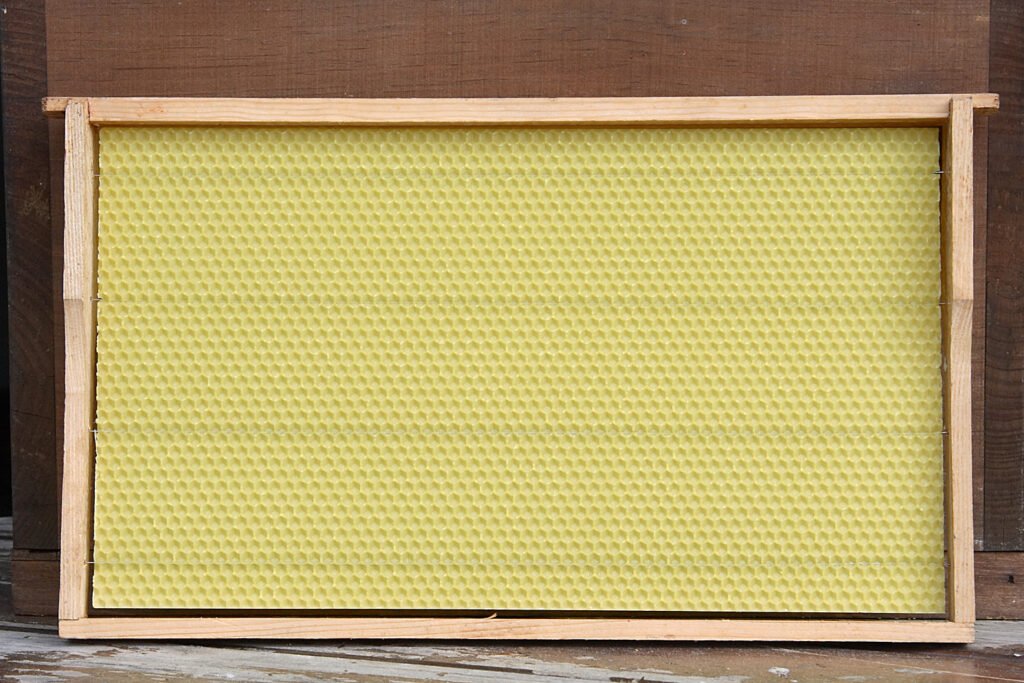
Wax foundation is a thin sheet of beeswax embossed with the hexagonal cell pattern of natural honeycomb, installed inside a hive frame to give bees a template to build comb on. Rather than leaving bees to construct comb entirely from scratch in whatever shape and orientation they choose, foundation guides them to build straight, evenly spaced comb aligned with the frame — a simple concept with genuinely significant practical consequences for beekeeping.
Johannes Mehring and the 1857 Foundation Press
Johannes Mehring, a German beekeeper, is credited with inventing the first practical wax foundation press in 1857. His device stamped the hexagonal comb pattern into sheets of beeswax, creating the first true wax foundation as beekeepers understand it today, though his original press only embossed the base of the cells on one side. This development came just a few short years after Lorenzo Langstroth’s landmark October 5, 1852 US patent (No. 9,300) for the movable-frame hive, and the two inventions together — a frame bees could be removed and inspected without destroying, and a foundation sheet guiding them to build comb correctly within it — form the real technological foundation of modern frame-based beekeeping.
Why This Mattered So Much Alongside the Langstroth Hive
The nature of my invention consists: 1st, in affording the bees a more thorough protection against the bee-moth.
That’s how Lorenzo Langstroth opened the specification of his own original 1852 US Patent No. 9,300 — a reminder that the movable frame wasn’t conceived primarily as an inspection tool, but the removable, individually-accessible frames it created are exactly what made a guiding template like Mehring’s foundation useful in the first place. Movable frames alone didn’t fully solve the comb-building problem: without guidance, bees will readily build comb at odd angles, spanning multiple frames, or in shapes that make frame removal and inspection difficult or destructive. Wax foundation solved this directly, giving beekeepers reliable, straight, easily manageable comb within each frame. This combination — movable frames plus foundation — is what actually made routine hive inspection, disease monitoring, and non-destructive honey harvesting practical at the scale modern beekeeping now takes for granted.
Controlling Worker vs. Drone Comb
Beyond simply guiding comb shape, wax foundation gave beekeepers a genuinely useful additional tool: control over the ratio of worker-sized to drone-sized cells within a colony. Foundation embossed with worker-cell-sized hexagons encourages bees to build worker comb rather than the larger drone comb they might otherwise build more of if left entirely to their own devices, letting beekeepers manage colony composition more deliberately than natural comb-building alone would allow.

From Hand Presses to Roller Mills
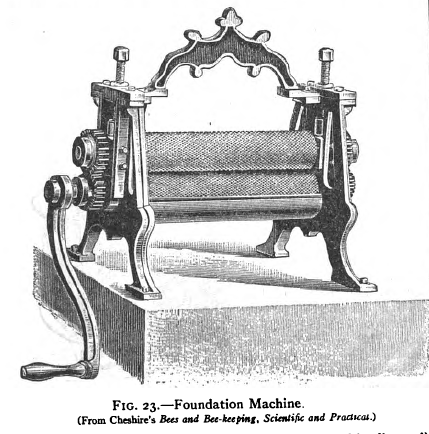
Mehring’s original foundation press worked essentially as a stamp, pressing the hexagonal pattern into a sheet of wax one piece at a time, and embossed only one face of the sheet. US beekeeper Samuel Wagner is credited with developing foundation embossed on both sides, closer to what modern foundation looks like, though his own rollers weren’t fully perfected. It was Amos Root and Alva Washburn who built the first genuinely workable foundation rollers in 1875, and Edward Weed who developed continuous-roll foundation production in 1895 — a real, multi-inventor progression rather than a single breakthrough, with roller mills eventually able to continuously produce embossed wax sheet foundation at a much larger scale than any hand press ever could.
Wired Foundation for Extracting Frames
Beyond the basic embossed wax sheet, beekeeping suppliers developed reinforced foundation options over time, including foundation embedded with fine wire, to give drawn comb enough structural strength to survive the centrifugal force of honey extraction without collapsing. This wired foundation innovation addressed a genuinely practical problem: plain wax comb, especially newer or thinner comb, can be fragile enough to break apart in an extractor, and reinforced foundation became a standard solution for frames intended for repeated extraction use rather than one-time comb honey production.
A.I. Root and Commercial Foundation in America
The A.I. Root Company, a major early American beekeeping supply business, played a significant role in popularizing and commercially producing wax foundation in the United States, helping bring the technology from a European innovation into widespread, practical use across American beekeeping. This commercialization was a genuinely important step in making foundation a standard, broadly accessible piece of beekeeping equipment rather than something only a small number of specialist beekeepers had access to.
Thin Surplus Foundation and Comb Honey Production
Foundation manufacturing also branched to serve a specific niche: thin, unwired “surplus” foundation designed specifically for comb honey production, where the finished wax comb itself is eaten along with the honey rather than being extracted and reused. This thinner foundation prioritizes an appealing, delicate texture and appearance over the structural durability needed for repeated extraction, illustrating how foundation manufacturing diversified over time to serve genuinely different beekeeping goals rather than remaining a single one-size-fits-all product.
The Small-Cell Foundation Debate
Worth addressing honestly: some beekeepers have promoted “small-cell” foundation, with cell dimensions smaller than standard modern foundation, based on the theory that it might help suppress varroa mite reproduction by more closely matching historical or naturally-occurring cell sizes. This remains a genuinely contested claim rather than settled fact, with mixed and inconclusive research results, and most mainstream beekeeping guidance doesn’t treat small-cell foundation as a reliable varroa control method on its own.
Wax Foundation vs. Plastic Foundation Today
Modern beekeepers today choose between traditional wax foundation and more recently developed plastic foundation options, each with distinct tradeoffs in durability, cost, and how readily bees accept and draw comb on them. Wax foundation remains valued by many beekeepers specifically for being all-natural material bees may draw out somewhat more readily, while plastic foundation offers durability advantages that wax alone can’t match, a genuine ongoing choice rather than one option having fully replaced the other.
Wax Foundation vs. Plastic Foundation vs. Foundationless
| Feature | Wax Foundation | Plastic Foundation | Foundationless |
|---|---|---|---|
| Material | All beeswax | Plastic, often wax-coated | No foundation at all |
| Durability | Lower | Higher | N/A |
| Bee acceptance | Generally high | Variable | Natural, but less guided |
| Cell size control | Yes | Yes | No, bees choose freely |
Common Misconceptions
The most common misconception is assuming wax foundation and the Langstroth hive were the same invention or came from the same inventor, when they were in fact separate innovations by different people a few years apart that happened to combine into the modern frame-based beekeeping system together. A second common misconception is assuming foundation has always looked and functioned essentially the same since Mehring’s original 1857 press, when manufacturing methods evolved substantially — from a one-sided hand stamp, to Wagner’s double-sided embossing, to Root and Washburn’s 1875 rollers, to Weed’s 1895 continuous-roll production.
For how beekeepers press their own sheets today, see how to make wax foundation at home.
Frequently Asked Questions
Is wax foundation still commonly used by beekeepers today?
Yes, wax foundation remains widely used and available, even though plastic foundation and foundationless frames have also become common alternative choices depending on a beekeeper’s specific goals and preferences.
Did Johannes Mehring patent his foundation press invention?
Mehring is credited as the inventor of the first practical wax foundation press in 1857, a genuinely documented milestone in beekeeping equipment history, standing alongside Langstroth’s frame patent from five years earlier.
Does using wax foundation guarantee bees will build comb exactly as shown on the sheet?
Generally yes for the great majority of the comb, though bees can still deviate from the foundation pattern in some circumstances, particularly around frame edges or when building burr comb in gaps, so foundation guides rather than absolutely guarantees perfectly uniform comb.
Is small-cell foundation recommended as a varroa control method?
No, this isn’t supported as a reliable standalone method by mainstream research and guidance, and beekeepers concerned about varroa are generally better served by established, tested treatment and monitoring approaches rather than relying on cell size alone.
Did beekeepers before Mehring’s invention have any way to guide comb building at all?
Before wax foundation, beekeepers had no reliable way to guide comb shape within a frame beyond simple wooden starter strips or guide bars offering minimal direction, meaning bees built comb far more irregularly than they do with true embossed foundation, making Mehring’s invention a genuine leap forward rather than a minor refinement of an existing method.
Who improved on Mehring’s original design, and how?
Samuel Wagner developed double-sided embossing; Amos Root and Alva Washburn built the first workable foundation rollers in 1875, allowing continuous rather than one-sheet-at-a-time production; and Edward Weed developed true continuous-roll manufacturing in 1895 — a genuine multi-inventor progression over four decades.
Would modern commercial beekeeping even be possible without foundation of some kind?
Technically yes, since foundationless frames remain a legitimate option some beekeepers use successfully, but at the scale of large commercial operations managing hundreds or thousands of colonies, foundation of some type — wax or plastic — remains the practical standard precisely because of the predictability, uniformity, and management efficiency it provides across that much larger scope of hives.
Further Reading
For additional authoritative detail on this topic, see the Smithsonian’s Lemelson Center account of Langstroth’s invention and Google’s own digitized copy of Langstroth’s original 1852 US Patent No. 9,300.