Last Updated September 15, 2026
More than two full thousand years before Karl von Frisch ever decoded the waggle dance, the ancient Greek philosopher Aristotle was already documenting honeybee social organization, division of labor, and swarming behavior with a level of careful, systematic observation genuinely impressive for his era. His full account, carefully preserved across many centuries within “Historia Animalium,” genuinely got a great deal right — and one very significant, genuinely important thing wrong, in a way that reveals exactly how far bee science as a whole still had to travel before reaching anything approaching modern accuracy.
Key Takeaways
- Aristotle (384-322 BC) documented honeybee division of labor, comb-building, and swarming in “Historia Animalium” with real observational accuracy for his era.
- His central error: he concluded the hive’s leader was a male “king bee,” reasoning that “nature only arms males” with weapons like a sting – a mistake in Western thought that persisted for roughly 1,900 years, into the 1600s.
- In his own words, translated directly from the text: “The ruler is double the size of the working bee” – an accurate physical observation (queens genuinely are larger) wrapped around an incorrect conclusion about the ruler’s sex.
- Bees mattered to Greek culture well before Aristotle: a gold ring found in a Cretan tomb, dated to roughly 1500-1400 BC, depicts hives, bees, and a swarm, and the city of Ephesus put the bee on its coinage.
- Aristotle also correctly noted that drone brood appears even without a ruler bee present – a real, if only partially understood, observation about drone biology.
Table of Contents
- Aristotle’s Broader Role in Natural History
- Historia Animalium and Its Bee Observations
- What He Got Genuinely Right
- The “King Bee” Error
- His Incorrect Theories About Bee Reproduction
- Relying on Real Beekeepers of His Era
- His Influence on Later Roman Writers
- Virgil’s Georgics: Another Ancient Bee Text
- His Method vs. Modern Scientific Practice
- Aristotle’s Claims vs. Modern Understanding
- Common Misconceptions
- Frequently Asked Questions
Aristotle’s Broader Role in Natural History
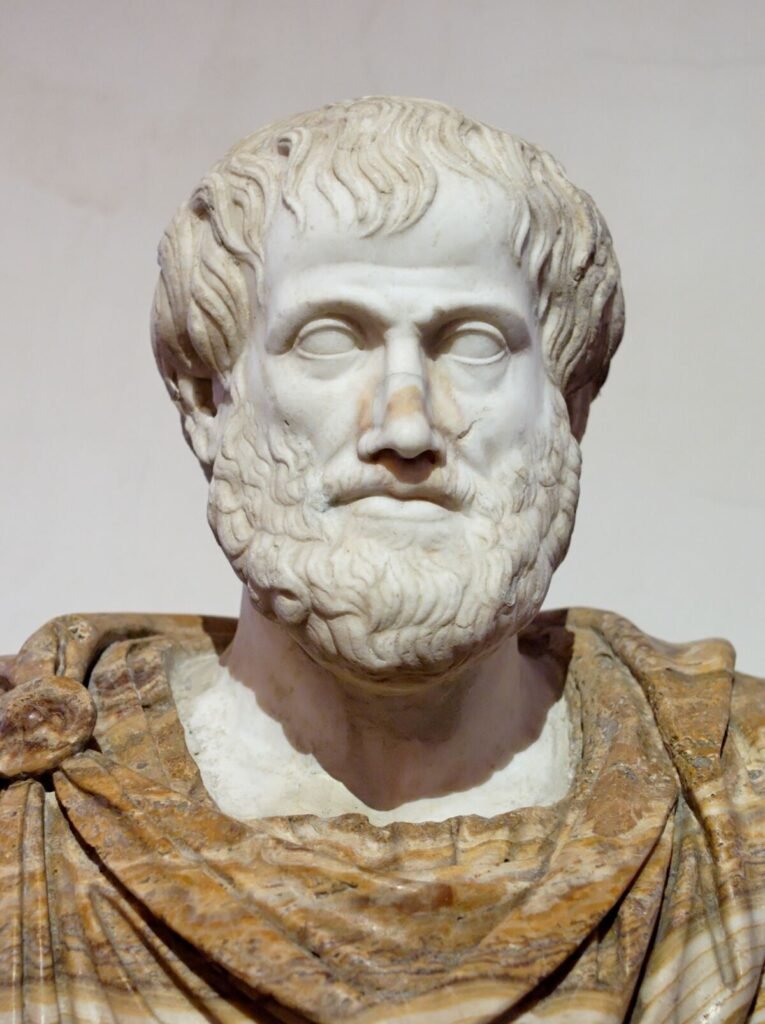
Aristotle (384-322 BC) was an ancient Greek philosopher whose work spanned an extraordinary range of subjects, including a genuinely significant body of natural history writing that treated the systematic observation of animals, including bees, as a legitimate and worthwhile intellectual pursuit. His approach to studying bees reflected this broader methodology: careful, structured observation rather than pure speculation or mythology.
Historia Animalium and Its Bee Observations
Aristotle’s most significant surviving discussion of honeybees appears in “Historia Animalium” (“History of Animals”), a broader work cataloging observations across a wide range of animal species. His bee-specific content within this work represents one of the earliest known systematic scientific treatments of honeybee behavior in the historical record, predating essentially every other figure covered in this site’s beekeeping history content by many centuries. Bees were already culturally significant in Greece well before Aristotle wrote: a gold ring recovered from a tomb in Crete, dated to roughly 1500-1400 BC, depicts a horizontal hive with bees and a swarm, and the city of Ephesus later adopted the bee as a civic emblem on its coinage.
What He Got Genuinely Right
Aristotle accurately documented several real features of honeybee colony life, including the existence of distinct roles within the colony, swarming behavior, and general comb-building activity. He also observed, correctly, that drone brood continues to appear even when no ruler bee is present in the hive – a genuine, specific piece of drone biology he got right, even without understanding the full reproductive mechanism behind it. Given that he was working entirely without modern tools, entirely from direct observation and reports from beekeepers, the genuine accuracy of these specific behavioral observations is worth taking seriously rather than dismissing ancient natural history as purely mythological or unreliable.
The “King Bee” Error
Worth stating plainly and honestly: Aristotle believed the colony was led by a male “king bee” rather than correctly identifying the reproductive leader as a female queen, a genuine and significant error that persisted in Western natural history thinking for centuries after his death – by some accounts from the 300s BC all the way into the 1600s AD. His own reasoning, as translated from the text, was that “nature only arms males” with weapons like a sting, so the large ruler bee couldn’t be female. He did get the physical observation right even while drawing the wrong conclusion from it:
“The ruler is double the size of the working bee.”
Queens genuinely are noticeably larger than worker bees, so Aristotle’s raw observation was accurate; the error was entirely in the inference he drew about sex from it. This misconception wasn’t definitively corrected until much later research, including the foundational work of naturalists like François Huber, helped establish accurate understanding of honeybee reproduction and colony leadership grounded in direct, careful evidence rather than assumption.
His Incorrect Theories About Bee Reproduction
Beyond the king-bee error specifically, Aristotle also held theories about how new bees came into being that don’t hold up to modern scientific understanding – he was genuinely uncertain whether bees reproduced through copulation at all, and repeated some clearly inaccurate claims elsewhere in his broader animal writing (including, in a separate section, the idea that some creatures stored noises in earthen vessels). This honest accounting of what he got wrong, alongside what he got right, offers a more accurate and genuinely useful picture of his contribution than either uncritical praise or dismissive mockery of ancient natural history would provide.
Relying on Real Beekeepers of His Era
Aristotle’s observations weren’t purely the product of his own isolated direct study; ancient Greece was part of a broader world of ancient beekeeping practices that already had an established tradition, and his natural history writing reflects genuine reliance on the practical knowledge and reports of working beekeepers of his time. This collaborative relationship between a philosopher-naturalist and practical craftspeople is a genuinely early example of the same pattern seen much later in figures like Huber, whose own discoveries depended on a trusted collaborator’s direct hive observation.
His Influence on Later Roman Writers
Aristotle’s bee observations remained genuinely influential for centuries after his death, referenced and built upon by later classical writers including Roman authors who covered beekeeping in their own natural history and agricultural writing. This sustained influence across cultures and centuries is itself a real marker of how seriously his observations were taken by later scholars, even where subsequent writers sometimes repeated his specific errors, including the king-bee misconception, rather than independently correcting them.
Virgil’s Georgics: Another Ancient Bee Text
Aristotle wasn’t the only classical writer to treat bees as a genuinely serious subject; the Roman poet Virgil devoted the entire fourth book of his agricultural poem “Georgics” to beekeeping, composed centuries after Aristotle and reflecting the continued, sustained cultural and practical importance of bees across the ancient Mediterranean world. Virgil’s treatment blends genuine practical beekeeping advice with poetic and mythological elements, offering a useful point of comparison to Aristotle’s more strictly observational, naturalist approach within the same broader ancient tradition.
Aristotle’s Claims vs. Modern Understanding
| Claim | Aristotle’s Belief | Modern Understanding |
|---|---|---|
| Colony leadership | Led by a male “king bee,” “double the size” of workers | Led by a female queen, genuinely larger than workers |
| Division of labor | Distinct roles observed accurately | Confirmed accurate |
| Swarming behavior | Documented as real behavior | Confirmed accurate |
| Drone brood without a ruler | Observed drones still appear | Confirmed accurate (unfertilized-egg drone production) |
| Bee reproduction origin | Various now-disproven theories; uncertain if copulation occurred | Understood through modern reproductive biology |
His Method vs. Modern Scientific Practice
Comparing Aristotle’s approach honestly to modern scientific method reveals both genuine similarities and real limitations: he shared the modern emphasis on direct, careful observation over pure speculation, but lacked the tools, controlled experimentation, and systematic peer verification that define science today, and had no reliable way to correct an error like the king-bee misconception once it became broadly accepted. This honest comparison helps explain both why his genuinely observational findings held up reasonably well and why an error requiring more rigorous investigation, like the queen’s actual sex, could persist uncorrected for so long afterward.
Common Misconceptions
The most common misconception is assuming ancient natural history writing about bees was purely mythological or unreliable, when Aristotle’s specific observational work reflects genuine, careful, systematic study that got a meaningful amount right, down to specific physical details like relative body size. A second common misconception is assuming the king-bee error was uniquely Aristotle’s own isolated mistake, when it actually persisted broadly across Western natural history thinking for roughly 1,900 years after him, reflecting a genuinely widespread and long-lived misconception rather than one philosopher’s individual error alone.
For another famous early bee study, see the Lincei's 1625 Apiarium and the Barberini bees.
Frequently Asked Questions
When was the “king bee” misconception finally corrected?
Accurate understanding of the queen’s female sex and reproductive role developed gradually through later naturalist research over the centuries following Aristotle, with figures like François Huber contributing genuinely foundational corrective evidence well into the modern era; by some accounts the misconception lasted into the 1600s.
Did Aristotle personally keep bees, or did he only observe and write about them?
His writing reflects genuine reliance on both direct observation and the practical knowledge of contemporary beekeepers, rather than confirmed evidence that he personally kept and managed hives himself in the way a modern beekeeper would.
Is Historia Animalium still available to read today?
Yes, translated editions of this ancient text remain accessible to modern readers – including free online translations – and are referenced by historians of science studying the development of natural history and biology as fields of study.
Why did Aristotle think the ruler bee had to be male?
He reasoned from a broader (incorrect) assumption that “nature only arms males” with physical weapons like a sting, so a large bee bearing a sting couldn’t, in his reasoning, be female – a conclusion his own accurate size observation didn’t actually require.
Did any other ancient evidence show bees mattered to Greek culture before Aristotle wrote about them?
Yes – a gold ring recovered from a Cretan tomb and dated to roughly 1500-1400 BC depicts hives, bees, and a swarm, and the city of Ephesus later put the bee on its own coinage, showing the insect’s cultural and economic importance predates Aristotle’s writing by many centuries.
Why does it matter that Aristotle got some things right this long ago?
It demonstrates that careful, systematic observation of natural behavior has genuine value even without modern tools, and it helps trace an honest, continuous historical line of increasingly accurate honeybee understanding rather than treating modern bee science as having appeared from nowhere.
Does modern scholarship consider Historia Animalium a reliable primary source?
It’s treated as a genuinely important primary source for understanding ancient Greek natural history and biological thinking specifically, evaluated by modern scholars with the appropriate historical context that separates what was accurate observation from what reflected the genuine scientific limitations of the era.
Sources and further reading: Aristotle’s own History of Animals, hosted by Tufts University’s Perseus Digital Library; History of Animals, Book V, MIT Internet Classics Archive (D’Arcy Wentworth Thompson translation); The Apiarist, on Aristotle’s bee observations and errors.