Reviewed by Elena P. · How we review
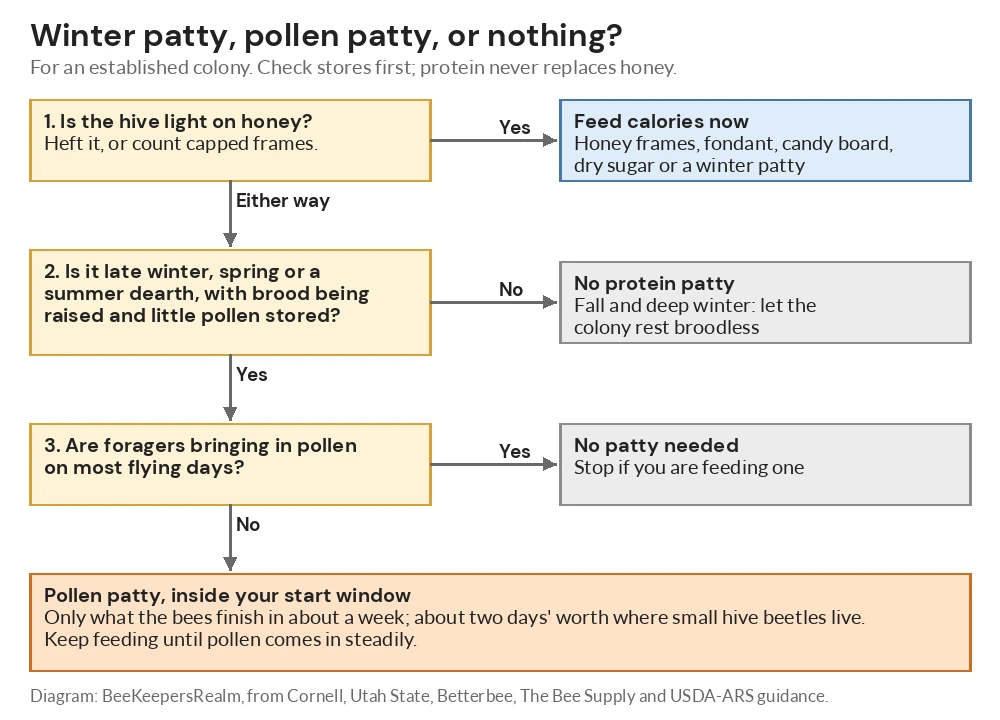
Feed pollen patties in late winter or early spring, starting two to three weeks before the first natural pollen in your area, and stop once foragers are bringing pollen home on most flying days. Most established colonies do not need protein patties in fall or in deep winter. A colony that is light then needs calories, which is what winter patties, fondant and candy boards supply.
This guide covers established, overwintered colonies. For a package or nuc you have just installed, see feeding pollen patties to a new colony. For brands and protein levels, see our comparison of pollen substitute patties.
Key Takeaways
- Pollen patties are protein for raising brood. Winter patties are mostly sugar, with about 2% protein, and serve as emergency food for adult bees.
- Start spring patties two to three weeks before your first natural pollen. The common frost-date shortcut can miss that by weeks; our NOAA table shows where it lands in 14 U.S. cities.
- Once you start, keep feeding until foragers bring in pollen steadily, then stop.
- In a University of Guelph study, fall pollen feeding did not give colonies more or better winter bees. Cornell’s calendar makes September the last month for it.
- Extra brood burns extra honey. Check stores before the first patty and keep checking until the spring flow.
- Where small hive beetles live, give only what the bees finish in a few days.
Table of Contents
- Pollen Patties vs Winter Patties: Protein or Calories
- Spring: Count Back From Your First Pollen
- Frost-Date Start Windows for 14 U.S. Cities
- When to Stop Feeding Pollen Patties
- Fall: Why Most Colonies Can Skip Protein
- Winter: Feed Calories, Not Protein
- Summer Dearths in Hot, Dry Regions
- Small Hive Beetles and Patty Size
- Frequently Asked Questions
- The Bottom Line
Pollen Patties vs Winter Patties: Protein or Calories
The two products look alike, come in the same waxed paper and sit on the same top bars, but they do opposite jobs. A pollen patty gives nurse bees the protein they need to make brood food, so the colony raises more brood. A winter patty feeds the adult bees and is made not to push brood rearing.
| Pollen (protein) patty | Winter patty | |
|---|---|---|
| Main ingredients | Protein from soy, egg, yeast or some real pollen, plus sugar | Sugar, with a little protein and fat |
| Protein | About 40 to 50% in modern substitutes | About 2% |
| What it does | Fuels brood rearing and colony growth | Keeps adult bees fed; does not stimulate brood |
| When it fits | Late winter and spring buildup; pollen dearths | Late fall to early spring, when honey runs low |
| Main risks | Brood the colony cannot feed, early swarming, beetles | Few; remove it if it molds |
Protein figures are from Honey Bee Suite. Betterbee adds that colonies grown fast on protein are “primed to swarm,” so it suggests protein only if you want booming colonies, for example to make splits.
If your question in January is whether the bees will last until spring, the answer is calories: frames of honey, fondant for bees, a candy board, dry sugar or winter patties. Our guide to candy boards vs sugar bricks compares the solid options.
In this 14-minute episode of the University of Florida’s Beekeeping Academy series, Dr. James Ellis explains when beekeepers use pollen subs: weather that keeps foragers home, weak colonies, and little or poor pollen in the landscape. He describes patties on a spacer rim and open-fed powder, says to stop when foragers return with pollen, and notes that research results are mixed and most hobbyists will never need pollen subs.
Spring: Count Back From Your First Pollen
An overwintered colony starts brood long before spring. Cornell’s Beekeeping Calendar for the Northeast has the queen laying a few eggs in January and February and laying at or near full strength by March, when brood is raised if pollen or protein is available. A patty helps most in the gap between that rising brood and the first pollen foragers can collect.
Published timing rules disagree mainly because they count from different events:
| Source | When to start | Counted from |
|---|---|---|
| The Bee Supply (Blake Shook) | 2 to 3 weeks before the late-winter or early-spring pollen flow; about 4 to 6 weeks before the last spring freeze in most areas | First pollen, with frost date as a shortcut |
| Betterbee | As early as 3 weeks before the first natural pollen, if you plan nucs or splits | First pollen |
| Utah State University Extension | Mid-March, with syrup or a fondant patty | Utah calendar |
| Runamuk Acres, Maine | 8 to 9 weeks before the main honey flow | Main nectar flow |
The first-pollen anchor fits what patties actually do. In a trial published in 2014, run in California’s Sierra foothills, Randy Oliver found no gain from pollen sub once good natural pollen was plentiful; colonies largely ignored the patties. And patties do not stock the pantry for later:
“Timing of using pollen substitute patties should respond to colony need for a protein source, as evidence suggests these patties are consumed almost immediately and not used for long term storage.”
Why an early start costs honey
More brood means a warmer, hungrier cluster. Honey Bee Suite, citing Caron and Connor, puts the center of a cluster at about 94°F with brood and about 70°F without. Cornell’s calendar notes that most colonies that starve die in late winter or early spring, when they need more food for brood but cannot yet forage. Before the first patty, heft the hive or measure it against our winter honey targets, and plan to supply carbohydrates as well. A pollen patty is not an energy source.
Starting also commits you. Utah State and Honey Bee Suite both say that once you begin, you keep feeding until natural forage is abundant, or the colony may starve.
Frost-Date Start Windows for 14 U.S. Cities
Few beekeepers know their first-pollen date, which is why The Bee Supply offers the last spring freeze as a stand-in. To see where that shortcut lands, we took the median date of the last 32°F night for 14 stations from NOAA’s 1991–2020 U.S. Climate Normals and counted back four to six weeks.
| Station | Median last spring freeze | Shortcut start window |
|---|---|---|
| Bismarck, ND | May 14 | Apr 2 – Apr 16 |
| Ithaca, NY | May 11 | Mar 30 – Apr 13 |
| Fargo, ND | May 10 | Mar 29 – Apr 12 |
| Denver, CO | May 5 | Mar 24 – Apr 7 |
| Minneapolis–St. Paul, MN | Apr 23 | Mar 12 – Mar 26 |
| Columbus, OH | Apr 18 | Mar 7 – Mar 21 |
| Chicago (O’Hare), IL | Apr 16 | Mar 5 – Mar 19 |
| Salt Lake City, UT | Apr 8 | Feb 25 – Mar 11 |
| Philadelphia, PA | Apr 2 | Feb 19 – Mar 5 |
| Raleigh–Durham, NC | Mar 31 | Feb 17 – Mar 3 |
| Atlanta, GA | Mar 15 | Feb 1 – Feb 15 |
| Dallas–Fort Worth, TX | Mar 8 | Jan 25 – Feb 8 |
| Seattle–Tacoma, WA | Mar 2 | Jan 19 – Feb 2 |
| Sacramento, CA | Feb 2 | Dec 22 – Jan 5 |
Median is NOAA’s 50% date: in half of years the last 32°F night comes later. Stations are airports except Ithaca (Cornell University).
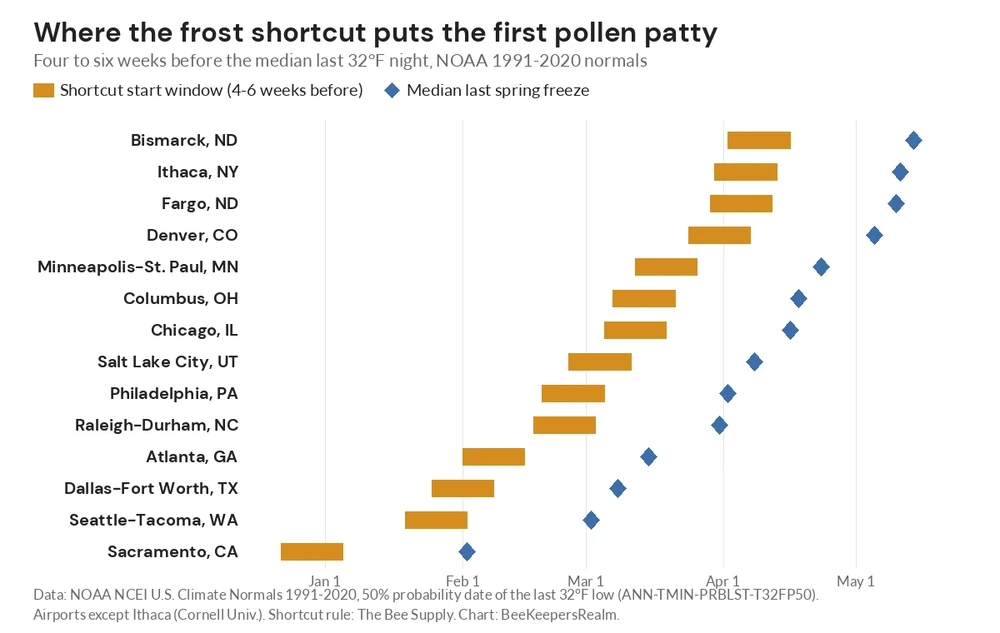
Where an extension calendar documents early pollen, the shortcut can miss by weeks in either direction:
- Ithaca, NY: Cornell lists pussy willow in bloom in March, along with red and silver maples that provide pollen. The shortcut opens March 30, when that bloom is already under way.
- Georgia: University of Georgia’s seasonal synopsis lists red maple among its November to January floral sources. Atlanta’s shortcut, February 1 to 15, comes after it.
- Utah: USU adds a patty in mid-March, when willows bloom. Salt Lake City’s shortcut, February 25 to March 11, runs slightly early.
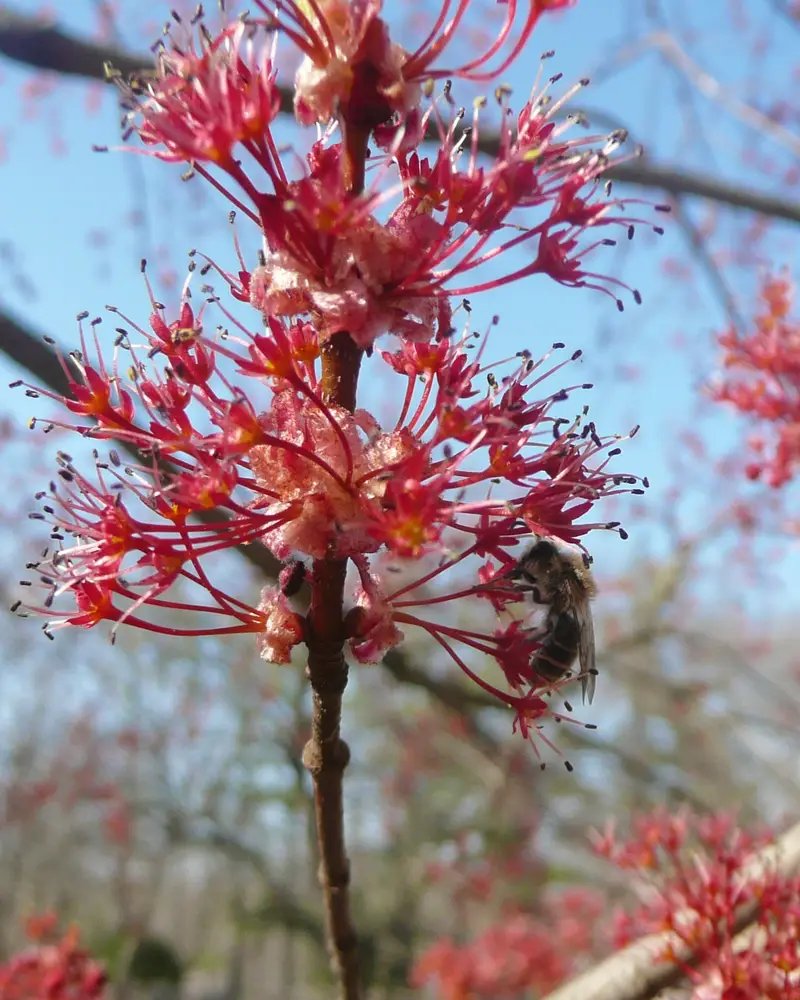
Treat the window as a first guess, then watch the entrance. Note the day steady pollen loads start coming in, often from maples and willows in the North, and next year start two to three weeks before it. Around Fargo, the shortcut falls in late March and early April, before the normal daily high reaches 50°F on April 8, so pick a calm, sunny day to open the lid; see how cold is too cold to open a beehive.
When to Stop Feeding Pollen Patties
- Pollen is coming in. When most returning foragers carry pollen loads on flying days, stop. Ellis gives this as his stop signal, and The Bee Supply ties it to seeing abundant incoming pollen.
- The bees ignore the patty. Oliver’s colonies left their patties largely uneaten once natural pollen was plentiful. Remove leftovers before they dry out or mold.
- The comb holds reserves. The Bee Supply’s rule of thumb is to feed while there is less than half a deep frame of stored pollen.
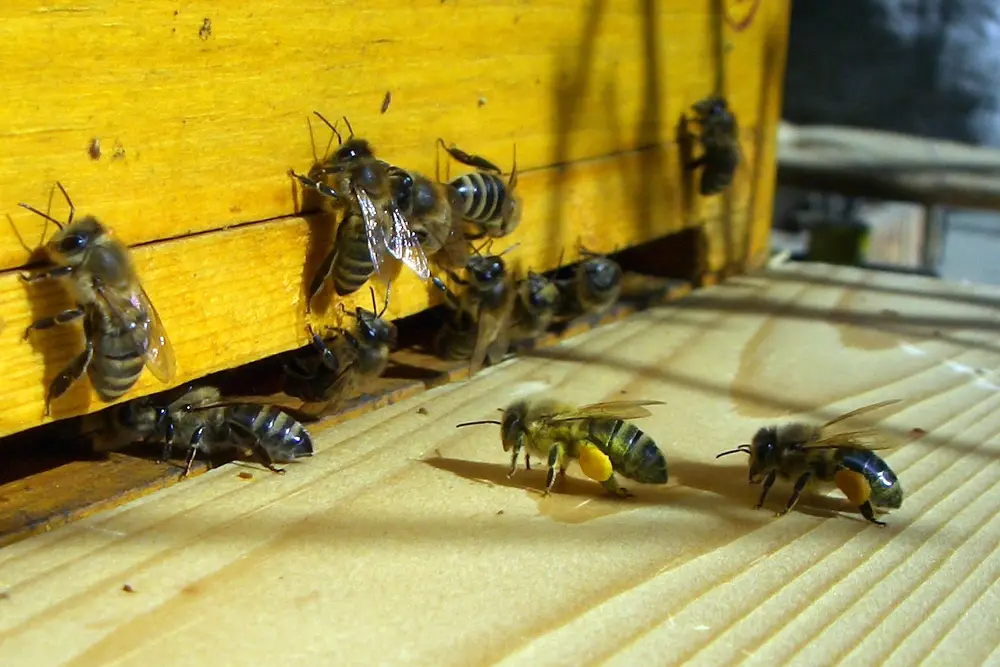
Do not stop because of one warm week. After a late freeze or a cold, wet spell grounds foragers, The Bee Supply suggests one pound per deep box of bees each week for two weeks, or until pollen returns. Oliver’s best check is the brood itself: well-fed nurses leave young larvae floating in jelly, while a protein-short colony shows “dry brood.”
Fall: Why Most Colonies Can Skip Protein
Some suppliers recommend fall patties to raise healthier winter bees; The Bee Supply suggests starting at least two months before your first freeze. The research does not support that for established colonies. At the University of Guelph, Heather Mattila and Gard Otis fed some colonies pollen in fall, restricted pollen in others and left a third group alone. Winter bee numbers, body mass, protein content and spring brood rearing came out similar, and they concluded beekeepers would not benefit from fall supplements aimed at early spring growth.
“This brood-rearing boost delayed the transition in colonies to a population of long-lived winter bees, and didn’t translate into improvements for the winter bee population.”
Cornell’s calendar agrees: September is the last month it recommends pollen or substitute, because falling pollen supply is the bees’ cue to rear winter bees. Exceptions exist. Mattila noted that a fall boost might matter more in smaller colonies, which have not been studied, and Cornell wants at least two double-sided frames of pollen or bee bread on hand by late winter. A colony short of that after a summer drought is a reasonable candidate for late-summer protein.
Winter: Feed Calories, Not Protein
From late fall until brood rearing picks up, a normal colony needs honey, not protein. Honey Bee Suite advises hobbyists to hold pollen substitutes until after the winter solstice at the very least, and suggests a low-protein winter patty around then. If the hive is light, Betterbee places 4 to 10 winter patties on the top bars above the cluster, with wraps left on, and checks again in two to three weeks. Fondant, a candy board or dry sugar does the same job; syrup does not, in the North, until bees can fly regularly.
In late winter the two can overlap: a winter patty for calories and a small pollen patty once you are inside your start window.
Summer Dearths in Hot, Dry Regions
Spring is not the only gap. The Bee Supply, based in Texas, says hot, dry summers often bring a pollen shortage from July through September. When few flowers bloom and the hive holds less than half a frame of stored pollen, it feeds one pound per box of bees every 7 to 10 days until conditions improve, often in September or early October. Oliver starts pollen sub as soon as nurses begin rationing jelly during the late-summer dearth in the Sierra foothills.
Small Hive Beetles and Patty Size
Small hive beetles lay eggs in pollen patties, and their larvae feed on them. USDA researchers call the beetles most serious in the Southeast and note they develop faster in warm weather, so a patty in a mild southern February carries more risk than one in a cold northern hive.
“When feeding colonies with pollen supplement, provide just enough patties to be consumed in two days. Excessive amounts will support SHB reproduction and allow larvae to develop and mature.”
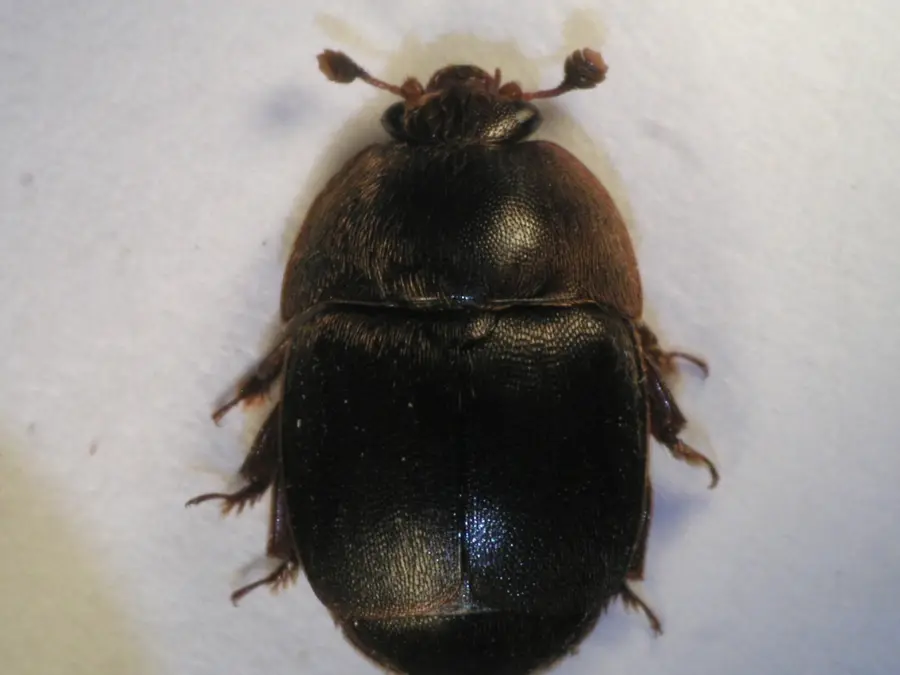
For scale: The Bee Supply says a deep box full of bees eats a one-pound patty in about seven days, so the ARS two-day limit works out to roughly a third of a pound; it suggests bacon-size strips. Ellis recommends a spacer rim, so the patty is not squashed into gaps the bees cannot patrol; see spacer rims vs inner cover shims. If larvae appear, our guide to small hive beetle slime-out covers what comes next.
Frequently Asked Questions
When should I start feeding pollen patties?
Two to three weeks before your first natural pollen. If you do not know that date, the frost shortcut is a first guess; watch the entrance and adjust next year.
Do you feed pollen patties in the fall?
Usually not. In the Guelph study, fall protein did not produce more or better winter bees. Small colonies or those short of stored pollen after a drought are the exceptions.
Can you feed pollen patties in winter?
Not in deep winter for a normal colony. Feed calories instead, and hold protein until brood rearing is under way after the solstice.
How much pollen patty should I feed a hive?
About one pound per deep box full of bees per week, and no more than the bees finish in 7 to 10 days. In beetle country, aim for two days’ worth.
How long does a pollen patty last in the hive?
A deep box full of bees eats a one-pound patty in about a week. Remove leftovers still there after 7 to 10 days, or any that dry out or mold.
When do you stop feeding pollen patties?
When foragers carry in pollen on most flying days, or the bees stop eating the patty. Keep feeding through cold snaps until then.
Can pollen patties cause swarming?
They can contribute. Betterbee warns that colonies grown quickly on protein are primed to swarm, so plan splits or swarm prevention if you feed early.
The Bottom Line
This spring, write down the date the first steady pollen comes in; it is the most useful number for next year’s patties. For a full spring program that pairs protein with syrup, see how to stimulate brood production safely.