

Reviewed by Michael R. · Last Updated October 8, 2026 · How we review
To winterize a beehive in a northern state, start in August, not November. Get mites down by late summer, leave at least 75 pounds of honey with the top box full, and then, once the colony is broodless, fit a mouse guard below, open a small upper entrance, put a moisture board or a 2-inch foam board over the inner cover, wrap the hive and strap the lid. That order follows the University of Minnesota Bee Lab’s guide for northern beekeepers.
This guide adds what most checklists leave out: how long the cold season lasts across the northern states, calculated from NOAA climate normals, and what controlled studies in Iowa and Illinois measured about bottom boards, wraps and top insulation.
Key Takeaways
- Across the northern tier, the normal daily high stays below 50°F for 140 to 179 days, from late October or early November into April (NOAA 1991-2020 normals). Fall work must be done before then.
- The UMN Bee Lab’s northern minimum is 75 pounds of honey or stored syrup, with the top box full.
- A moisture board and a 2-inch foam board are both UMN-approved tops. “Never use Styrofoam” only applies when the board’s job is to absorb water.
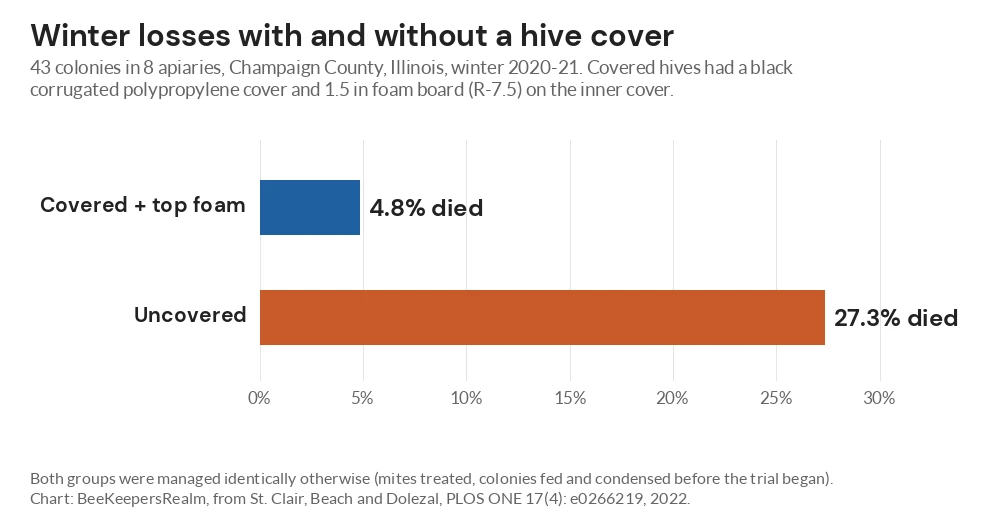
- In an Illinois trial, 4.8% of hives with a black cover and foam top died over winter, against 27.3% of uncovered hives.
- In a USDA study in northeastern Iowa, screened bottom boards raised winter weight loss by 20% compared with solid wooden bottoms.
Table of Contents
- How Long a Northern Winter Lasts for Bees
- A Northern Winterizing Calendar
- Step 1: A Strong Colony With Few Mites
- Step 2: 75 Pounds of Stores, With the Top Box Full
- Step 3: Mouse Guard Below, Small Opening Above
- Step 4: Moisture Board or Foam Board?
- Step 5: Wrap, Windbreak and Strap
- What Controlled Studies Measured
- Midwinter Checks That Keep the Hive Closed
- Frequently Asked Questions
- The Bottom Line
How Long a Northern Winter Lasts for Bees
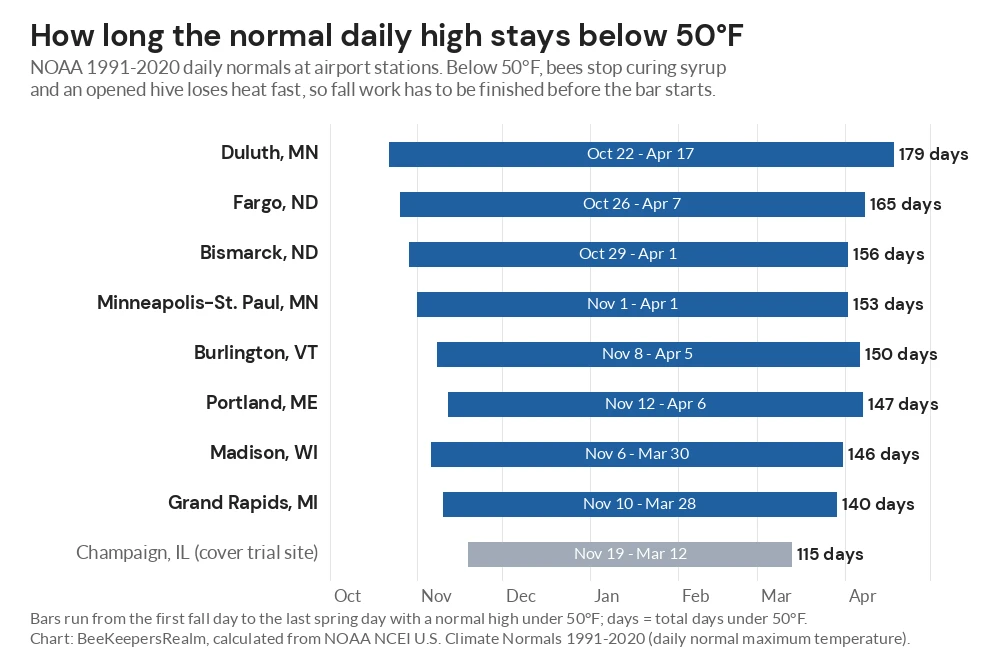
Once highs stay below about 50°F, a colony clusters, stops curing syrup, and loses heat fast whenever the hive is opened. The UMN guide treats daytime temperatures consistently below 50°F as the end of fall management, so the useful question is when that line arrives where you live.
We took NOAA’s 1991-2020 daily normals for nine airport stations and counted the days with a normal high under 50°F. The last two columns are NOAA’s annual averages.
| Station | Normal high under 50°F | Days | Days a year with a high below 32°F | Nights a year below 0°F |
|---|---|---|---|---|
| Duluth, MN | Oct 22 to Apr 17 | 179 | 99 | 38 |
| Fargo, ND | Oct 26 to Apr 7 | 165 | 93 | 42 |
| Bismarck, ND | Oct 29 to Apr 1 | 156 | 77 | 37 |
| Minneapolis-St. Paul, MN | Nov 1 to Apr 1 | 153 | 72 | 22 |
| Burlington, VT | Nov 8 to Apr 5 | 150 | 57 | 16 |
| Portland, ME | Nov 12 to Apr 6 | 147 | 41 | 7 |
| Madison, WI | Nov 6 to Mar 30 | 146 | 59 | 16 |
| Grand Rapids, MI | Nov 10 to Mar 28 | 140 | 51 | 4 |
| Champaign, IL (for comparison) | Nov 19 to Mar 12 | 115 | 35 | 7 |
Season length is similar across the north, so fall deadlines barely change between Michigan and Minnesota. Severity is not: Fargo averages about 42 nights a year below zero, Grand Rapids four. Let that column guide how much insulation you add. Duluth’s season starts around October 22, leaving little October for feeding syrup. Data: NOAA NCEI U.S. Climate Normals; date ranges and day counts are our calculation.
For the coldest yards, see beekeeping in cold-winter, short-summer climates and extreme cold beekeeping strategies.
A Northern Winterizing Calendar
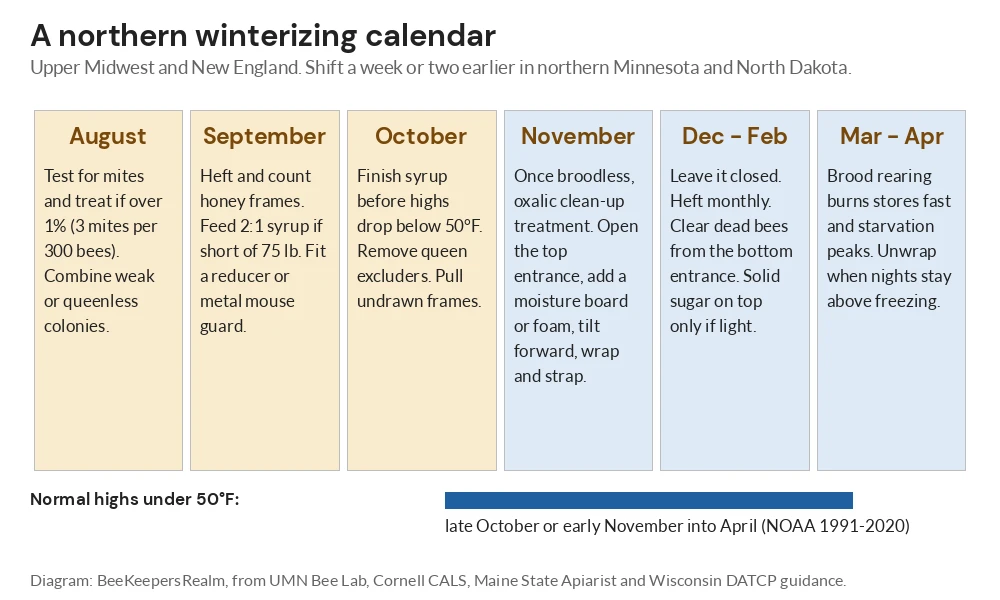
Most winter losses are set up in August and September. This calendar combines UMN, Cornell, Maine State Apiarist and Wisconsin guidance; shift it a week or two earlier in northern Minnesota and North Dakota.
| When | What to do |
|---|---|
| Late July to August | Test for varroa and treat promptly. UMN aims for under 1% (3 mites per 300 bees). Decide which weak colonies to combine. |
| September | Heft and count honey frames; feed 2:1 syrup if short. Entrance reducers on (Maine: by the third week). |
| October | Finish syrup before highs drop below 50°F (Maine: third week at the latest). Remove queen excluders and undrawn frames. |
| November | Once broodless, clean-up mite treatment. Open the top entrance, add the top board, tilt forward, wrap and strap (Maine: once nights freeze). |
| December to February | Leave it closed. Heft monthly, clear dead bees from the bottom entrance, add solid sugar only if light. |
| March to April | Stores drop fastest as brood rearing restarts. Keep checking weight. Unwrap when nights stay above freezing. |
In this September video from Mann Lake’s “Beekeeper’s Buzz” series, Jenna from Mann Lake works through the early-fall half of the calendar.
According to its chapter list, it covers judging colony strength, combining weak colonies or requeening, feeding pollen substitute and 2:1 syrup, fitting mouse guards, and a last-chance mite treatment. Mann Lake sells some products it mentions; check any label for temperature limits.
Step 1: A Strong Colony With Few Mites
A colony survives a northern winter on long-lived winter bees raised in late summer and fall. Varroa mites feed on the fat body of the bees they parasitize and are linked to lower fat reserves going into winter (reviewed by St. Clair and colleagues, 2022). Cornell notes that in Upstate New York mites are still rising in August as the bee population shrinks, so a first treatment in September or October comes too late.
Size matters too. University of Florida/IFAS guidance for northern climates calls 25,000 to 30,000 bees adequate and says colonies under 15,000 are unlikely to survive freezing temperatures. Maine’s State Apiarist looks for six or more frames of bees and a productive queen. Combine smaller colonies in early fall.
Step 2: 75 Pounds of Stores, With the Top Box Full
UMN’s northern minimum is 75 pounds of honey or stored syrup, with the top box full. Its example winter hive has at least 10 frames full of honey and 3 to 5 frames of pollen, placed so the cluster can move up into food; in a three-deep hive the bottom box needs no honey. Wisconsin’s state plan sets a higher bar, adding sugar when a hive has less than 100 pounds in late fall, and warns against powdered sugar, whose starch can cause dysentery.
- Feed 2:1 syrup in September if the top deep has fewer than 8 frames of honey or the hive lacks 10 full deep frames (UMN).
- Stop at 75 to 100 pounds, so syrup doesn’t take the queen’s spring laying space, and before highs drop below 50°F (UMN).
- Remove queen excluders, or the rising cluster can leave the queen behind (UF/IFAS).
For frame counts and closing a shortfall, see how much honey bees need for winter. Flow Hive owners should also read Flow Hive winter prep.
Step 3: Mouse Guard Below, Small Opening Above
Lower entrance. UMN sets the entrance reducer on its larger opening, facing up, or uses a mouse guard. Maine’s State Apiarist recommends metal reducers, because mice chew through wood and plastic, fitted on a warm day so you don’t seal a mouse inside. Don’t use #8 hardware cloth: its 1/8-inch mesh is what screened bottom boards use precisely because bees can’t pass through it. A guard needs openings of about 3/8 inch; see mouse guard hole size.
Upper entrance. In November, UMN uncorks the ventilation hole in the top box and keeps lower holes corked, or opens the inner cover notch facing down. UMN’s equipment list allows a 7/16- to 1-inch hole, and UMN Bee Lab scientist Gary Reuter’s wintering notes center a 1-inch hole 3 inches above the bottom edge of each deep. It lets moist air out and gives bees an exit for cleansing flights; Cornell notes that snow over the lower entrance is not an emergency, since air moves through snow. For the research, see upper vs lower entrances in winter.
Step 4: Moisture Board or Foam Board?
Here northern advice seems to contradict itself, and this page’s earlier version got it wrong. A wintering cluster gives off water vapor; if it condenses on a cold ceiling, it drips back onto the bees.
“A common cause of winter death is not cold but moisture.”
The older Minnesota method absorbs the vapor. Reuter’s notes call for a 3/4-inch fiberboard moisture board (Bildrite, without asphalt) over the inner cover and list plastic, Styrofoam and kraft-faced insulation as things not to use. That is right for a moisture board: foam can’t absorb anything.
The current UMN guide (third edition) offers a second method. Its November checklist says to use a moisture board or “place insulation (e.g., 2-inch foam board) above the inner cover.” Foam keeps the ceiling warm, so damp air doesn’t hit a cold surface over the cluster. Two rules come with it: the sides must be less insulated than the top, so the walls stay the coldest surface, and the hive should tilt slightly forward so water doesn’t pool on the bottom board. Maine’s fact sheet also allows fiberboard or Styrofoam over the inner cover, as long as bees can still get out at the top.
| Moisture board | Foam board (2 in or more) | Quilt box | |
|---|---|---|---|
| How it handles vapor | Absorbs it, releases it outside | Keeps the ceiling warm so vapor doesn’t condense over the cluster | Shavings or straw absorb it |
| Setup rule | 3/4 in fiberboard, no asphalt; one edge open to the air under the wrap (UMN) | Sides less insulated than the top; hive tilted forward (UMN) | Screen over the inner cover hole, shallow rim of straw or chips (Reuter) |
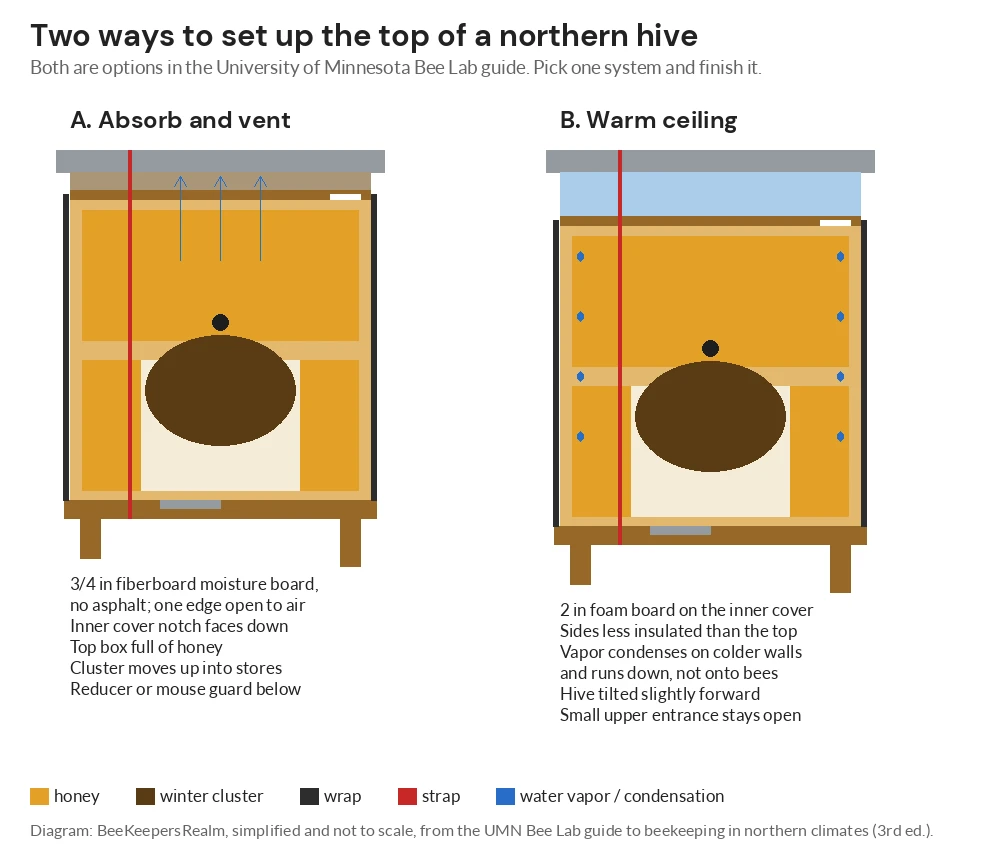
The Illinois cover trial below used 1.5-inch foam on the inner cover with top entrance holes cut in the covers. For the absorbing options, see quilt box vs moisture board.
Step 5: Wrap, Windbreak and Strap
When. After the clean-up mite treatment, with any strips or pads removed first, since UMN warns they may interfere with clustering. In Maine that is early to mid-November, once nights drop to freezing.
How. UMN wraps the hive with a wintering cover, then secures the telescoping cover with a ratchet strap or heavy rock. Cornell’s homemade version wraps roofing paper all the way around with at least an 8-inch overlap, stapled and tied with twine, with the upper entrance cut open and the bottom entrance clear. Tight boxes still matter: Cornell points out that bees heat only their cluster, not the hive. Compare products in the best hive wraps for cold climates and insulated hive bodies in the best beehive for cold climates.
Windbreaks. Wisconsin’s state plan calls for a wind block on the northwest side. Cornell’s guide adds that a windbreak cuts wind speed downwind for up to 30 times its height, works best when 40 to 60% solid, and that a solid wall creates turbulence. It suggests burlap, snow fencing or straw bales, and warns against low spots where cold, damp air pools.
What Controlled Studies Measured
Two US studies tested parts of the standard advice.
| Study | Where and when | What was tested | Result |
|---|---|---|---|
| Villa, Rinderer and Bigalk, USDA-ARS (2009) | Cresco, Iowa; winters 2001 to 2003 | Russian bee lines; screened vs solid bottoms; extra top insulation | 90% survived November to April. Screened bottoms raised weight loss by 20%. Extra top insulation had no effect. |
| St. Clair, Beach and Dolezal, PLOS ONE (2022) | Champaign County, Illinois; winter 2020-21; 43 colonies | Black corrugated polypropylene cover plus 1.5 in foam (R-7.5) on the inner cover vs no cover | 4.8% of covered vs 27.3% of uncovered colonies died. Covered colonies used less food, mainly from late February. |
The Iowa result is often repeated as “screened bottoms cause 20% more winter losses.” The USDA summary reports 20% more weight loss, meaning more stores burned, in colonies that mostly survived. Stores are what run out in late winter, so close or block a screened bottom anyway. The Illinois paper is stronger evidence for covers; its authors note the benefit appeared even without extremely cold winters. It hasn’t been repeated farther north.
Neither study lets wrapping make up for a weak or mite-heavy colony:
“While the health of the colony is the most important factor in overwintering success, insulation can improve chances of colony survival.”
The guide adds that smaller colonies and colonies in very cold regions benefit from heavier insulation, especially on top.
Midwinter Checks That Keep the Hive Closed
Once wrapped, watch the hive without opening it. Heft it from the back about once a month; UF/IFAS says a hive that is hard to tip forward with one hand probably has enough food. On a calm day around 40°F, Cornell suggests lifting the telescoping cover briefly: bees at the inner cover hole are running out of food and need fondant or granulated sugar right away. Cornell also clears dead bees from the lower entrance about monthly with a thin stick.
UMN calls winter feeding problematic, because bees must break cluster to reach it and you must open the hive. If a hive is light anyway, put spare honey frames, sugar patties, a candy board or dry sugar directly above the cluster; see fondant for bees and how cold is too cold to open a beehive. If a severe cold outbreak is forecast, see our polar vortex emergency protocols.
Frequently Asked Questions
When should I winterize my beehive in a northern state?
Test mites in August, finish feeding by mid- to late October (earlier in Duluth and Fargo), and wrap in November once the colony is broodless.
Should I wrap my beehive for winter?
Usually yes. In the Illinois trial, 4.8% of covered hives died against 27.3% of uncovered ones. Keep an upper entrance open.
How do I insulate the top of a beehive for winter?
Use a 3/4-inch fiberboard moisture board or at least 2 inches of foam board over the inner cover. With foam, keep the sides less insulated than the top.
Is it OK to use Styrofoam on a beehive in winter?
Yes, as top insulation in a warm-ceiling setup, which UMN and Maine’s State Apiarist allow. No, as a substitute for a moisture board.
Should I close a screened bottom board for winter?
Yes. In a USDA study in Iowa, screened bottoms raised winter weight loss by 20%.
How cold is too cold for bee hives?
No single air temperature kills a strong, well-fed cluster; opening the hive is the bigger risk. UMN only removes frames with bees above 55°F.
How much honey should I leave my bees for winter up north?
At least 75 pounds with the top box full (UMN). Wisconsin’s plan feeds any hive under 100 pounds.
The Bottom Line
Find when your 50°F season starts and work back from it: mites in August, stores in September, syrup finished in October, and the top, entrances and wrap set in November. Next, work out your winter stores frame by frame.


.jpg)