Reviewed by Elena P. · Last Updated September 24, 2026 · How we review
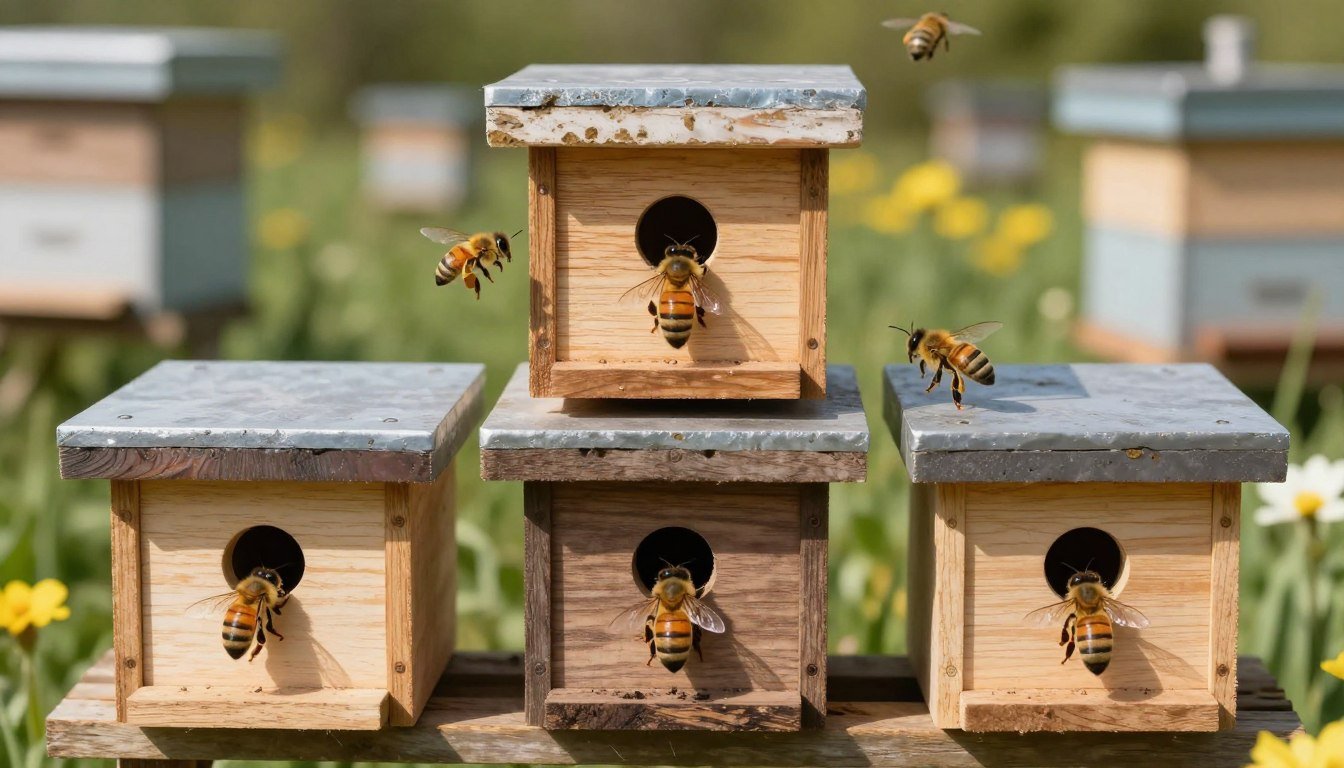
The right mouse guard opening for honey bees is 3/8 inch (about 9.5 mm), either as round holes or as a slot no taller than that. That size clears a worker easily and clears a drone with room to spare. It also sits right at the limit that extension pest-control guides give for what a mouse can squeeze through. Go bigger, as with 1/2-inch hardware cloth, and you’re inside mouse territory. Go much smaller, as with 1/4-inch hardware cloth, and you start pinching drones. Below, we set the bee measurements and the mouse measurements side by side, because that comparison is what the “3/8 inch” rule is really about.
Key Takeaways
- Use 3/8-inch (9.5 mm) round holes or a slot no more than 3/8 inch tall. It’s the standard on commercial stainless guards and on the University of Nebraska’s All-Season Mouse Guard.
- Drones measure about 5.1 to 5.7 mm across the thorax in a 2021 study, so a 9.5 mm hole passes them easily. Pollen loads come through too.
- UC IPM says house mice can get through openings 3/8 inch wide. That makes 3/8 inch the ceiling, not a comfortable margin. Never go bigger.
- Skip 1/2-inch hardware cloth, which is too big. Be careful with 1/4-inch (#4) cloth, whose openings are close to drone thorax width.
- Hole size is only half the job. Metal construction and more than one row of holes matter just as much.
Table of Contents
The Size Window: Bees on One Side, Mice on the Other
A mouse guard only works if there is a gap between the biggest bee that has to get through and the smallest mouse that must not. Here are the numbers we could verify.
Bees. The standard queen excluder gap is about 4.1 to 4.4 mm. Workers get through that. Queens and drones don’t. So any mouse guard opening needs to be comfortably above 4.4 mm. For drones, the best current figure comes from Metz and Tarpy’s 2021 study of commercial drones in the Journal of Insect Science. Drones reared in drone cells averaged 5.73 mm across the thorax. Undersized drones reared in worker cells averaged 5.12 mm. In a hive, drones are the widest bees a winter guard is likely to meet.
Mice. The University of California’s Statewide IPM Program gives this rodent-exclusion figure:
“House mice can squeeze under gaps ¼ inch tall, and through openings 3/8 inch wide.”
UC Statewide IPM Program, “House Mouse” Pest Notes
So the usable window runs from about 6 mm, which clears a drone with a little margin, up to 3/8 inch, the point where mice can get through. That’s a narrow band, which is why beekeepers argue about it.
| Opening | Approx. clear size | Workers | Drones | Mice |
|---|---|---|---|---|
| Queen excluder gap | 4.1–4.4 mm | Pass | Blocked | Blocked |
| #5 hardware cloth | About 4.5 mm (varies with wire) | Pass, but many pollen loads are knocked off | Blocked | Blocked |
| #4 (1/4-inch) hardware cloth | About 5.5–5.8 mm (varies with wire) | Pass | Marginal | Blocked |
| 3/8-inch hole or slot | 9.5 mm | Pass | Pass | At the documented limit |
| 1/2-inch hardware cloth | About 12 mm | Pass | Pass | Can get through |
The hardware-cloth rows are our own calculation from wire pitch and typical wire gauge. Rusty Burlew of Honey Bee Suite makes the same point in her hardware cloth size guide: hole size depends on wire thickness, and bees vary in size too. She notes that #5 cloth stops drones and queens and knocks off many pollen loads.
Why 3/8 Inch Became the Standard
The 3/8-inch figure is built into the stainless guards US suppliers sell now. Miller Bee Supply’s M311 mouse guard is listed with 3/8-inch holes in 8- and 10-frame sizes at $10.95. Mann Lake’s one-piece stainless 10-frame mouse guard (HD591) is $10.99. Both prices were checked on September 24, 2026. For a comparison of ready-made guards, see our roundup of the best mouse guards for Langstroth hives.
The strongest field evidence comes from the University of Nebraska–Lincoln. Its NebGuide G2361 describes the All-Season Mouse Guard (ASMG), a permanent plywood insert designed by Dr. Marion Ellis. The insert sits on 3/8-inch spacers, which leaves a slot 3/8 inch tall across the entrance. The authors report its record directly:
“The UNL Bee Lab has used 105 ASMGs over five years and have experienced zero cases of mice invading the hives equipped with the ASMG.”
Brummel, Kittle, Lynch-O’Brien, Weller and Wu-Smart, Nebraska Extension, NebGuide G2361
Taken together: the building-exclusion figure says a house mouse can fit through 3/8 inch. A lab running more than a hundred hives with 3/8-inch slots saw no invasions in five years. We read that as “3/8 inch works well in practice, but it’s the limit.” It isn’t a size with room to spare, so never enlarge it.
Round Holes, Slots and Hardware Cloth Compared
Round 3/8-inch holes (stamped metal). This is the commercial standard. Stainless or galvanized steel stands up to a winter of wet snow at the entrance without rusting through.
A 3/8-inch slot. The UNL design shows a slot works if its height is held at 3/8 inch along the whole length. A warped or loose strip that opens to 1/2 inch at one end defeats it. That’s why UNL nails and glues its version down.
1/2-inch hardware cloth. This is common in DIY instructions, and it’s the one we’d rule out. Its clear opening is larger than the UC IPM limit. Carolina Honeybees’ Charlotte Anderson, a Master Beekeeper, likewise warns that small mice may squeeze through 1/2-inch cloth.
1/4-inch (#4) hardware cloth. It stops mice with a wide margin, and it’s often used for DIY guards. The trade-off is drones: its opening is right at drone thorax width. It’s a reasonable choice for a guard that goes on after the colony has evicted its drones and comes off before spring drone flights. It’s a poor choice for a guard left on year-round. Our guide to installing a mouse guard without blocking drones covers that timing.
Design Details Beyond Hole Size
- Metal only. UC IPM recommends wire screen or coarse steel wool because mice can’t chew through them. Wood and thin plastic can be chewed wider.
- More than one row of holes. Dead bees collect on the bottom board over winter. A single row at floor level can be sealed by a few bodies, and a second row higher up keeps an exit open.
- Full-width coverage. The guard has to span the whole entrance, corner to corner. A gap at one end makes the hole size irrelevant.
- Pair it with an upper entrance. In our Red River Valley winters, snow and dead bees can block the bottom. A small upper entrance keeps a way out. See upper vs lower entrances in winter.
Mice are one of several fall threats at the entrance. Our overview of bee pests and predators covers the others. Our checklist of signs your bees are preparing for winter helps you tell when the entrance is ready to be closed down.
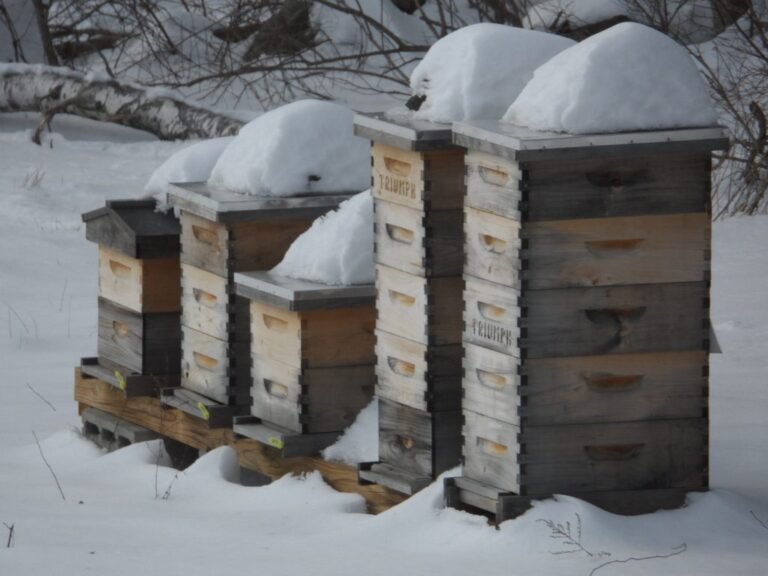
Mouse guards are one step in winterizing a northern hive.
Frequently Asked Questions
What size holes should a mouse guard have?
3/8 inch (about 9.5 mm) round holes, or a slot no taller than 3/8 inch. That’s the size on common commercial stainless guards and on Nebraska Extension’s All-Season Mouse Guard.
Can drones get through a mouse guard?
Through a 3/8-inch guard, yes. Drone thorax width averages roughly 5.1 to 5.7 mm, well under 9.5 mm. Drones struggle with 1/4-inch hardware cloth and can’t pass #5 cloth.
Is 1/2-inch hardware cloth small enough to keep mice out?
No, not reliably. Its opening is about 12 mm, larger than the 3/8-inch opening UC IPM says house mice can squeeze through.
Does a mouse guard knock pollen off returning foragers?
A 3/8-inch guard shouldn’t. Pollen stripping happens at much smaller openings, around #5 hardware cloth, which is how pollen traps work.
Is a 1/4-inch slot better than 3/8-inch holes?
Not clearly. UC IPM says mice can squeeze under gaps 1/4 inch tall, so a 1/4-inch slot doesn’t buy much extra protection. It also pinches drones and clogs faster with dead bees. A 3/8-inch opening is the better all-round compromise.
Do mouse guard hole sizes differ for 8-frame and 10-frame hives?
No. The hole size is the same. Only the guard’s length changes to match the entrance width.
The Bottom Line
Choose 3/8 inch, in metal, across the full entrance, and never larger. It’s the one size that clears every bee in the colony and sits at the documented limit for mice. It’s also backed by a university bee lab’s five-year field record. For when to put the guard on and take it off, see our step-by-step mouse guard installation guide.