Reviewed by Daniel M. · Last Updated September 30, 2026 · How we review
The Cathedral hive is a horizontal top-bar hive with a six-sided (hexagonal) body, designed by Corwin Bell of Colorado-based BackYardHive. Its defining feature is the bar: instead of a single flat top bar, each bar is a three-sided piece that forms the upper half of the hexagon, so the bees hang their comb from three edges rather than one. This guide explains how that works, lists the maker’s published specifications, and weighs the real trade-offs against Kenyan top-bar, Warré, and Langstroth hives.
Looking for the bees kept on cathedral roofs rather than the hive design? See our story on how Notre-Dame Cathedral’s bees survived the 2019 fire.
Key Takeaways
- The Cathedral hive is a proprietary horizontal top-bar design from BackYardHive; in cross-section it looks like a standard top-bar hive with a second, inverted one stacked on top.
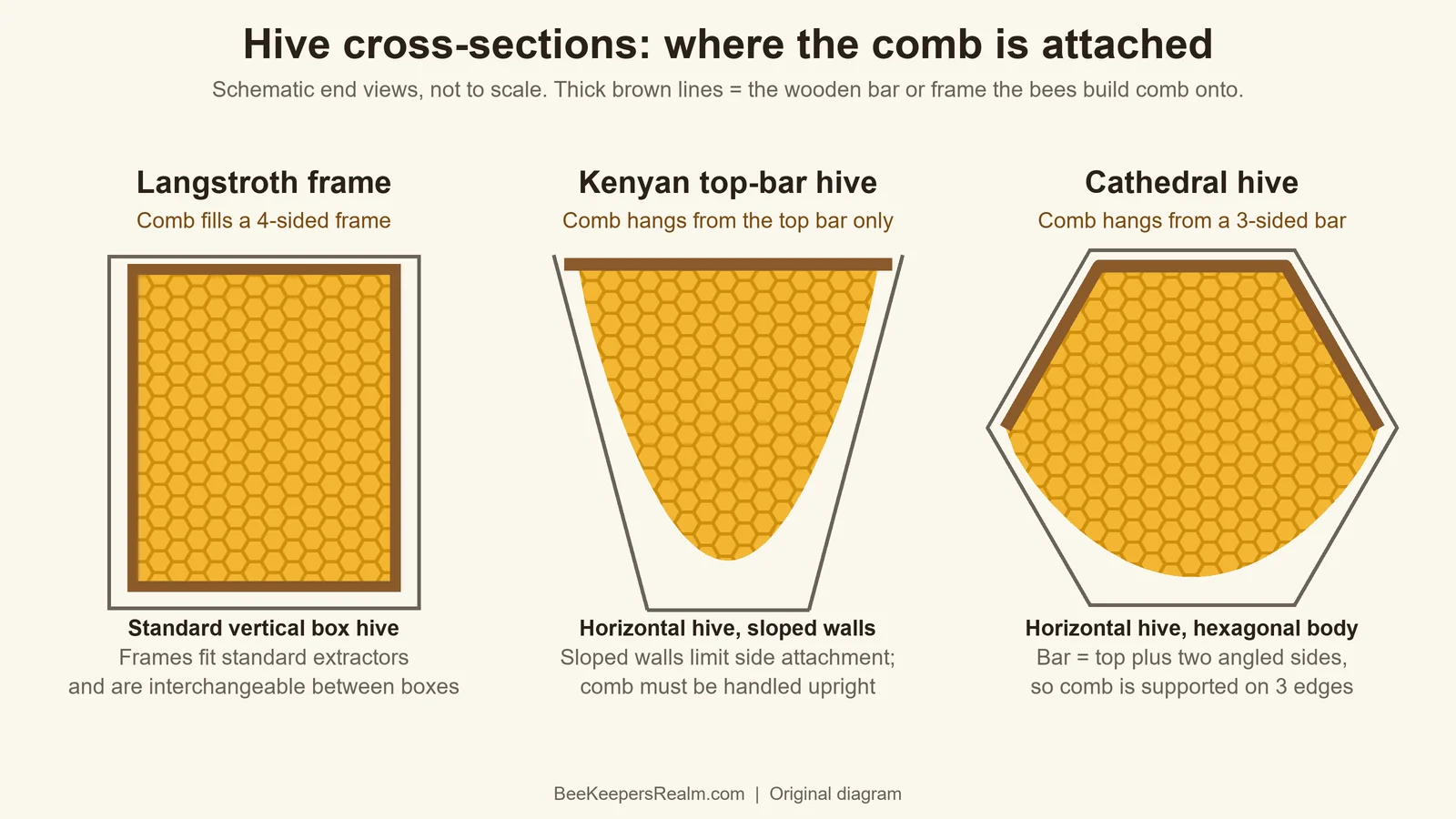
- Each bar has three segments (a top and two angled sides), so comb is supported on three edges, which the maker says gives straighter comb with little or no attachment to the walls.
- The current model lists 18 bars, an upper section 32 inches long, room for 1-1/2 inch insulation all around, and fully drawn honey combs of about 9–10 pounds each.
- It costs far more than a basic Kenyan top-bar hive ($885 assembled or $685 unassembled at the maker’s September 2026 listing), and its bars are not interchangeable with Langstroth or other top-bar equipment.
- As with any top-bar hive, honey is harvested by cutting comb, not by spinning frames in an extractor.
Table of Contents
- What the Cathedral Hive Actually Is
- Design and Functionality
- Cathedral Hive Specifications
- Benefits for the Bees
- Benefits and Trade-offs for the Beekeeper
- Comparisons with Other Hive Designs
- The Cathedral Hive in Different Climates
- Is the Cathedral Hive Right for You?
- Frequently Asked Questions (FAQs)
What the Cathedral Hive Actually Is
Despite the name, the Cathedral hive has nothing to do with churches. The name describes its peaked, six-sided profile. It was developed by Corwin Bell, whose earlier Bee Guardian design is a conventional Kenyan-style top-bar hive. BackYardHive says Bell introduced the original Cathedral Hive about ten years ago and has refined it since; the current version is sold as the Cathedral Northern Lights Hive.
Like other horizontal top-bar hives, it lets the colony build natural comb without foundation and expands sideways, one bar at a time, instead of upward in stacked boxes. What sets it apart is geometry. A standard Kenyan top-bar hive has a trapezoid cross-section with walls sloping inward toward the floor. The Cathedral hive adds a matching, inverted trapezoid on top, producing a hexagon, and the bars themselves take up that upper half.
Design and Functionality
The hexagonal body
The six-sided body gives a tall, rounded interior that roughly follows the U-shaped outline bees give a free-hanging comb. The lower walls slope inward, as in a Kenyan hive, which discourages the bees from gluing comb to the sides.
The three-sided bar
Each bar is a three-segment piece: a horizontal top plus two angled sides that together form the top half of the hexagon. The bees start comb along all three segments. According to the maker, this gives “superior comb stability,” a “greater potential for straight comb,” and “zero to no attachment” to the hive walls. A heavy comb hanging from three edges is less likely to tear off a bar during an inspection than one hanging from a single strip of wood, a well-known weakness of ordinary top-bar hives.
Materials
The current commercial model uses a thick white pine body (the maker describes beetle-kill pine) with reclaimed redwood or pine bars, a hexagonal follower board (“falseback”), a viewing window with a cover, and a ventilated peaked roof. You will sometimes see the Cathedral hive described as a cedar hive; that describes some home-built versions, not the maker’s own specification. One builder on the Flow Hive community forum, for example, documented a 2017 build using 2-inch rough-sawn cedar and full frames modeled on the original bar design.
Passages between combs
The newest bars include ventilation and passage holes on all three segments, which BackYardHive calls a “Super Highway.” The stated purpose is to let bees move from comb to comb without walking around the outer edge, so a winter cluster can stay tight while it moves onto its honey stores.
Cathedral Hive Specifications
The table below lists the figures BackYardHive publishes for the current Cathedral Northern Lights Hive. We could not find independent measurements or trial data, so treat these as the maker’s specifications and check the listing before you buy.
| Specification | Cathedral Northern Lights Hive (maker’s listing) |
|---|---|
| Designer / maker | Corwin Bell / BackYardHive (Colorado, USA) |
| Hive type | Horizontal top-bar hive, hexagonal cross-section |
| Bars included | 18 hexagonal three-segment bars with passage holes |
| Length | Upper section 32 in; ventilated roof 38 in; sides and landing board 31 in |
| Drawn honey comb weight | About 9–10 lb per comb |
| Insulation | Accommodates 1-1/2 in insulation all around |
| Materials | White pine body; reclaimed redwood or pine bars |
| Viewing window | 1, with cover |
| Price (September 2026) | $885 fully assembled; $685 unassembled |
Build-it-yourself plans are also sold, which is how most of the cedar and custom versions come about.
Benefits for the Bees
The case for the design rests on three ideas, all from the maker and from users rather than controlled studies:
- Natural comb building: no foundation, so the colony sets its own cell sizes and comb shape, as in any top-bar hive.
- Stable comb: support on three edges means less comb breakage and fewer crushed bees when bars are lifted and returned.
- Easier movement in winter: passage holes are intended to let the cluster move onto stores without breaking up.
None of these has been tested in a published side-by-side trial that we could find. They are reasonable design goals, but they are not proven outcomes.
Benefits and Trade-offs for the Beekeeper
What you gain
- Calmer inspections: with little or no comb attached to the walls, you lift bars without first cutting comb free, a routine chore in many Kenyan hives. See our guide to handling cross-comb in top-bar hives for what that chore involves.
- No heavy lifting of boxes: like every horizontal hive, it is worked at waist height one bar at a time.
- A viewing window for checking the colony without opening the hive.
What you give up
- Cost: at $685–$885, it costs much more than a basic top-bar hive kit.
- Proprietary parts: the hexagonal bars do not fit Langstroth boxes, standard top-bar hives, or frame extractors, so you cannot easily share or buy equipment locally.
- Heavy combs: a 9–10 lb comb of honey has to be handled carefully and kept upright.
- Harvesting means cutting comb: honey is taken by cutting comb from the bar and crushing and straining it, or selling it as cut comb. The bees then rebuild on that bar. It is not a non-destructive harvest, which is a claim sometimes made about top-bar hives.
- Few mentors: it is an uncommon design, so local clubs and inspectors will know Langstroth hives far better.
Comparisons with Other Hive Designs
| Feature | Cathedral hive | Kenyan top-bar hive | Warré hive | Langstroth hive |
|---|---|---|---|---|
| Orientation | Horizontal | Horizontal | Vertical | Vertical |
| Cross-section | Hexagon | Trapezoid | Square boxes | Rectangular boxes |
| Comb support | Three-segment bar | Single top bar | Single top bar | Four-sided frame |
| Foundation | None | None | None | Usually |
| How it expands | Add bars sideways | Add bars sideways | Add boxes underneath | Add boxes on top |
| Honey harvest | Cut comb | Cut comb | Cut comb | Extract frames |
| Equipment interchangeable | No (proprietary) | Only within the same bar length and width | Within Warré dimensions | Widely |
Langstroth: the standard vertical box hive; frames go into an extractor and can be moved between hives and bought anywhere. See why the Langstroth is the beekeeping standard.
Kenyan top-bar: the Cathedral hive’s closest relative and the cheapest way into horizontal top-bar beekeeping. Our top-bar beehive guide covers it in depth.
Warré: a vertical top-bar hive where new boxes go underneath the colony (nadiring). It shares the natural-comb approach but works very differently; see our Warré hive guide.
For the broader horizontal-hive family, including the Layens, see the horizontal top-bar hive overview and our article on vertical vs horizontal hive airflow.
The Cathedral Hive in Different Climates
BackYardHive says the latest model was built with thicker white pine for winters with large temperature swings over short periods, and that it takes 1-1/2 inch insulation all around. That is a meaningful feature for cold regions, but it is extra insulation you add, not something the bare hive provides. A horizontal hive’s colony also has to move sideways along the bars through winter rather than upward, which is exactly what the passage holes are meant to help with. We found no independent overwintering data comparing Cathedral hives with Langstroth or Kenyan hives, so northern beekeepers should plan on insulating it and checking stores the way they would with any top-bar hive. Our look at whether insulated beehives actually help colonies covers the evidence on insulation generally.
In hot climates the ventilated roof and passage holes help airflow, and the same shade and ventilation rules apply as for any top-bar hive.
Is the Cathedral Hive Right for You?
- Good fit: you want a horizontal, foundationless hive, value calm inspections without cutting comb off the walls, prefer cut-comb or crush-and-strain honey, and don’t mind paying more for a specialist design.
- Poor fit: you want to use a frame extractor, share or buy frames locally, keep costs low, or rely heavily on a local club where everyone runs Langstroth equipment.
- Middle ground: start with a standard Kenyan top-bar hive; if side attachment is your main frustration, the Cathedral hive is the design built to solve it.
Frequently Asked Questions (FAQs)
Who designed the Cathedral hive?
Corwin Bell of BackYardHive, the Colorado company that also makes the Bee Guardian top-bar hive. The maker says the original Cathedral Hive dates back about ten years, and the current version is the Cathedral Northern Lights Hive.
What is the Cathedral hive made of?
The maker’s current model uses a thick white pine body with reclaimed redwood or pine bars. Home-built versions use whatever the builder prefers, and cedar is a popular choice, which is why you will see it described both ways.
How does the Cathedral hive differ from a regular top-bar hive?
A regular Kenyan top-bar hive has a trapezoid cross-section and comb hanging from a single flat bar. The Cathedral hive is hexagonal and each bar has three segments, so comb is supported along three edges, which the maker says produces straighter comb with little or no attachment to the walls.
Is the Cathedral hive suitable for beginners?
It can work for a beginner, but it is not the easiest start. It costs more than a basic top-bar hive, its parts are proprietary, and fewer local beekeepers will be familiar with it. Beginners who want a horizontal hive often start with a standard Kenyan top-bar hive.
How do I harvest honey from the Cathedral hive?
Lift a full honey bar, brush off the bees, and cut the comb away from the bar, usually leaving a strip along the bar as a guide for the bees to rebuild. The comb is then sold as cut comb or crushed and strained. The bars do not fit a frame extractor.
How much does a Cathedral hive cost?
At BackYardHive’s September 2026 listing, the Cathedral Northern Lights Hive was $885 fully assembled and $685 unassembled. Plans are also sold for building your own.
Can the Cathedral hive withstand harsh weather conditions?
It is designed for it: the maker cites thick white pine walls, room for 1-1/2 inch insulation all around, and passage holes to help a winter cluster reach its stores. There is no published independent overwintering data, so in cold regions insulate it and monitor stores as you would any top-bar hive.
Is the Cathedral hive related to the beehives on cathedral roofs?
No. The name refers to the hive’s peaked, six-sided shape. Hives kept on real cathedrals, such as the ones on the roof of Notre-Dame in Paris, are standard beehives that happen to sit on a cathedral.