
Reviewed by Thomas B. · Last Updated September 23, 2026 · How we review
Narrow brood frames are spaced 1 1/4 inches (32 mm) center to center. Standard Hoffman frames are spaced 1 3/8 inches (35 mm). That 1/8-inch difference lets you fit 11 frames in a 10-frame box, or 9 in an 8-frame box, in exactly the same width. The case for narrow frames is that they match the spacing bees choose for worker brood on their own. That means a tighter brood nest that fewer bees can keep warm, and less room for drone comb between frames. The costs are tighter top bars, more careful handling and frames you have to modify or buy specially. For most beekeepers, standard spacing works fine. Narrow frames are a refinement worth trying in one box, especially where springs are cold.
This guide compares the two for the brood nest only. It covers frame width (how far apart combs sit). For frame depth, see our comparison of deep vs medium frames for brood nests. Honey supers are a different story. There, wider spacing is the better choice.
Key Takeaways
- Standard Hoffman frames space combs 1 3/8 inches (35 mm) apart. Narrow frames space them 1 1/4 inches (32 mm) apart.
- Eleven narrow frames take up exactly the same 13 3/4 inches as ten standard frames, so they fit a normal 10-frame box.
- Bees building their own brood comb typically space it about 1 1/4 inches apart, and sometimes closer. Standard spacing was a compromise between brood and honey storage.
- Narrower gaps between brood combs mean fewer bees are needed to cover and warm the same brood. Julius Hoffman, who invented the self-spacing frame, made this argument himself.
- Narrow spacing leaves less room for thick drone comb in the brood nest. Nineteenth-century beekeepers used it for exactly that.
- We found no modern controlled trial comparing the two. The evidence is historical observation and beekeeper experience, so treat claims about yield or disease with caution.
- Don’t use narrow spacing in honey supers. Honey comb works better spaced wider, not narrower.
Table of Contents
Narrow vs Standard: The Numbers
Frame spacing is measured center to center, from the middle of one comb to the middle of the next. On a Hoffman frame, the spacing is set by the width of the end bars where they touch the next frame.
| Standard (Hoffman) | Narrow | |
|---|---|---|
| Center-to-center spacing | 1 3/8 in (35 mm) | 1 1/4 in (32 mm) |
| Frames in a 10-frame box | 10 (13 3/4 in total) | 11 (13 3/4 in total) |
| Frames in an 8-frame box | 8 (11 in total) | 9 (11 1/4 in total) |
| Gap between brood combs | About 1/2 in | About 3/8 in |
| Gap between top bars (1 1/16-in bars) | About 5/16 in | About 3/16 in |
| Where to get them | Every supplier | Specialty frames, or plane standard end bars down |
| Best use | Brood boxes and supers | Brood boxes only |
Inside widths vary by manufacturer. Carolina Honeybees lists a 10-frame box at 14 3/4 inches inside, and other makers run a little narrower. Either way, 11 narrow frames leave the same side clearance as 10 standard ones. The gap figures assume capped worker brood comb about 7/8 inch thick. Actual comb thickness varies with cell size and with how much honey is stored along the top.
Where the 1 3/8-Inch Standard Came From
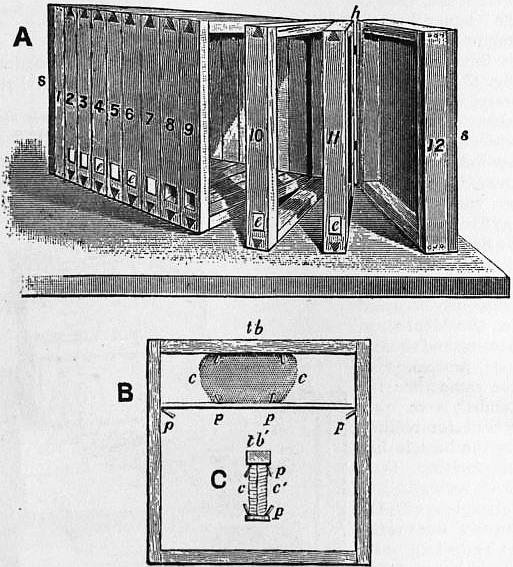
The 1 3/8-inch spacing on today’s frames comes from Julius Hoffman’s self-spacing frame, introduced in the late 1800s. It was never meant as the ideal brood spacing. It was an all-purpose figure, a working compromise for frames that might hold worker brood, drone brood or honey. The same is true of most of the Langstroth hive’s standard dimensions, as our history of the Langstroth hive explains.
Older writers used both figures. Michael Bush has collected many of their original statements on his frame width page, and they’re worth reading in full. A few highlights:
- François Huber (1806) specified frames fifteen “lines” wide in his leaf hive, which works out to 1 1/4 inches. He stressed that the measure must be accurate.
- T.W. Cowan, in the British Bee-keeper’s Guide Book, described slipping frames closer together to 1 1/4 inches “if it is desired to prevent the production of drone brood.”
- The ABC and XYZ of Bee Culture (1917 edition) reported that most beekeepers who had tried both settled on 1 3/8 inches, “or, if anything, a trifle scant,” while some used 1 1/4 inches successfully.
So narrow spacing isn’t a modern fad. It’s one of two spacings beekeepers have used since the frame hive began. Industry standardized on the wider one.
What Bees Do When They Choose the Spacing
Bees building comb without frames, in a tree or a foundationless hive, don’t use one spacing throughout. They vary it by what the comb is for:
| Comb use | Typical natural spacing |
|---|---|
| Worker brood, core of the nest | About 1 1/4 in (32 mm), sometimes as close as 1 1/8 in (30 mm) |
| Drone brood, edges of the nest | About 1 3/8 in (35 mm) |
| Honey storage | About 1 1/2 in (38 mm) or wider |
These figures come from Michael Bush’s measurements of natural comb in his own hives, and they fit the historical record above. The pattern is logical. Drone cells are deeper than worker cells, so drone comb is thicker. Honey cells can be drawn out as deep as the space allows, so storage comb gets thicker still.
Seen that way, standard 1 3/8-inch spacing matches what bees use for drone comb, not worker comb. It gives the colony a little more room between brood combs than it would choose, and that extra room is what lets bees build thicker drone cells on the faces of brood frames. Foundation limits this by embossing worker cells, but on foundationless frames the spacing matters more. See our guide to package bees on foundationless frames for more on drone comb in natural-comb brood boxes.
The Case for Narrow Brood Frames
A warmer, more compact brood nest
Brood has to be kept at about 93–95°F (34–35°C), and nurse bees do it by clustering on the comb. The argument for narrow spacing is simple. When the gap between two brood combs is small enough, the bees on facing combs meet back to back and close the space with a single layer of bodies. When the gap is wider, it takes more bees to fill it.
…more bees will be required to keep up the needed brood-rearing temperature.
Hoffman wrote this about widening his 1 3/8-inch spacing to 1 1/2 inches, which would open the gap between brood combs from 1/2 to 5/8 inch. He noted that the problem mattered most “in a cool spring, when our colonies are still weak in numbers.” Narrow-frame advocates apply the same reasoning one step further. That’s the part most relevant to beekeepers in eastern North Dakota, the Red River Valley and western Minnesota. Our colonies build up through April and May nights that still drop near freezing. Any setup that lets a small spring cluster cover more brood is worth a look there.
More brood comb in the same box
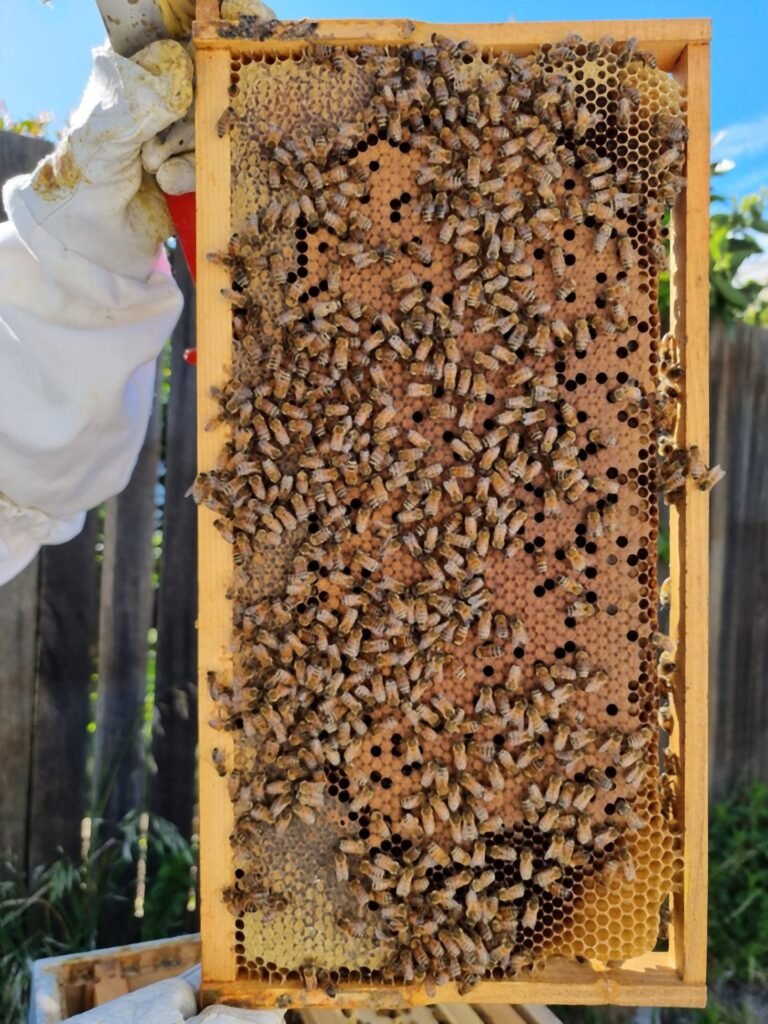
Eleven frames means eleven comb faces’ worth of brood area instead of ten, in the same box. Whether the colony actually fills that extra comb with brood depends on the queen, the season and the bees available to cover it. But the comb is there.
Less drone comb in the brood nest
With less room between combs, bees have less space to draw the deeper drone cells on the faces of brood frames. This is the use Cowan described in the 1800s. You still need to plan for drones, since colonies will raise them somewhere. Narrow spacing simply keeps them to the edges, where a deliberate drone frame can be managed as part of a mite plan. Our guide to drone brood harvesting for mite control covers that approach.
Flatter, more even comb faces
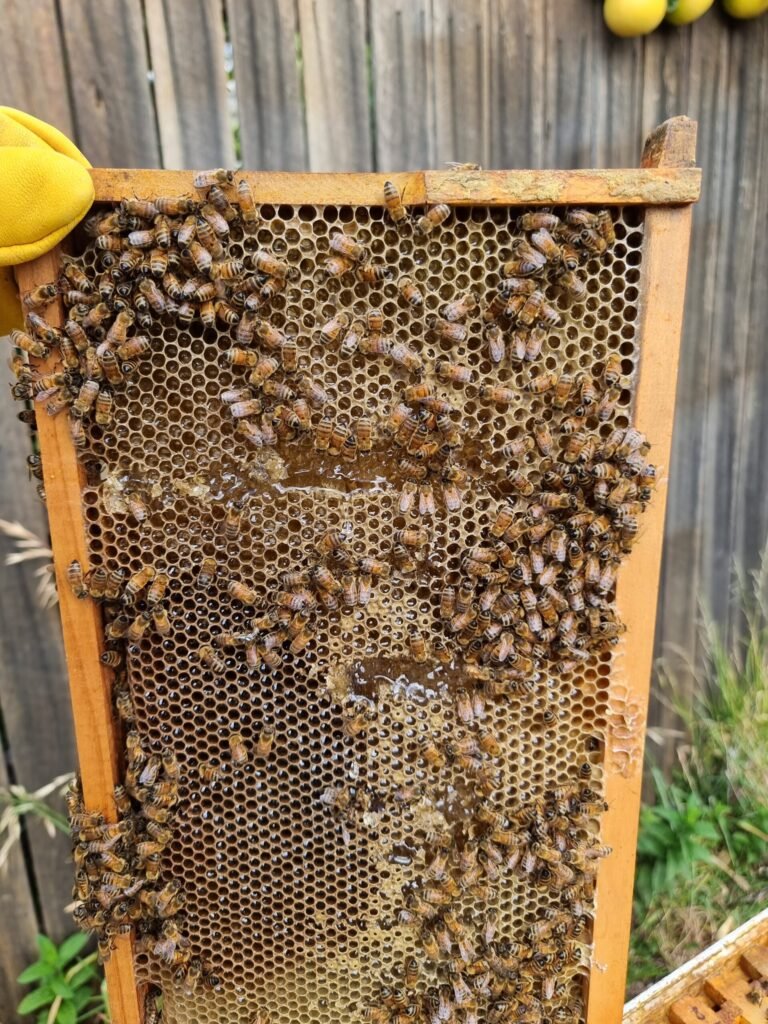
Bush makes a practical point about the alternative many beekeepers try, running 9 frames in a 10-frame brood box. Brood comb stays a fixed thickness while honey along the top gets drawn thicker. That leaves comb faces uneven, which rolls bees when you lift frames. Tight, uniform spacing keeps the faces flat.
The Costs and Catches
- Tight top bars. Standard top bars are 1 1/16 inches wide. At 1 1/4-inch spacing, the gap between them shrinks to about 3/16 inch. Bees can still pass, but there’s less room to see down between frames and more surface for propolis to glue together.
- Harder first frame out. With 11 frames and less side play, the first frame is tighter to lift. Many narrow-frame users run 10 narrow frames plus a follower board, or 11 with no spare room. Pull the outside frame first.
- Special parts. You have to buy narrow frames or modify standard ones by planing the end bars. That’s cheap in time but not in money if you have a lot of frames.
- Existing drawn comb. Comb drawn at 1 3/8-inch spacing, especially comb with honey along the top bar, may be too thick for narrow spacing. The bees will trim or rework it, or you may need to trim bulges yourself.
- Not for supers. In honey supers you want the opposite: fewer, thicker combs for easier uncapping. Many beekeepers run 9 frames in a 10-frame super once the comb is drawn. For spacer options, see our frame spacers for 10-frame boxes.
What the Evidence Does and Doesn’t Show
Here’s what most articles on this topic don’t tell you. We looked for a modern controlled study comparing brood production, honey yield, overwintering or disease between colonies on 32 mm and 35 mm spacing, and didn’t find one. The support for narrow frames comes from three places:
- Observations of how bees space natural brood comb, which are consistent across 200 years of writing.
- The heat-conservation reasoning Hoffman himself gave for keeping brood combs close.
- Experience from beekeepers who run narrow frames, which is real but not the same as a trial.
So claims that narrow frames raise honey yield, reduce disease or control mites should be treated as unproven. What you can count on is the geometry: more comb per box and less space between brood combs. Whether that helps your colonies is something you can test in your own apiary, which is why we suggest trying it in one box first.
How to Try Narrow Frames Without Replacing Everything
Step 1: Choose one colony and one box
Start with a single brood box in one colony, ideally a new split or package building its first brood nest. That way you’re not forcing bees to rework old comb.
Step 2: Get or make the frames
You can buy narrow frames from specialty sellers. Or plane the end bars of standard wooden frames from 1 3/8 inches down to 1 1/4 inches before assembly, as long as no nails go through the outside of the end bars. Bush’s page covers both approaches. Our guide to assembled vs unassembled frames explains why buying unassembled makes this easier.
Step 3: Fill the box
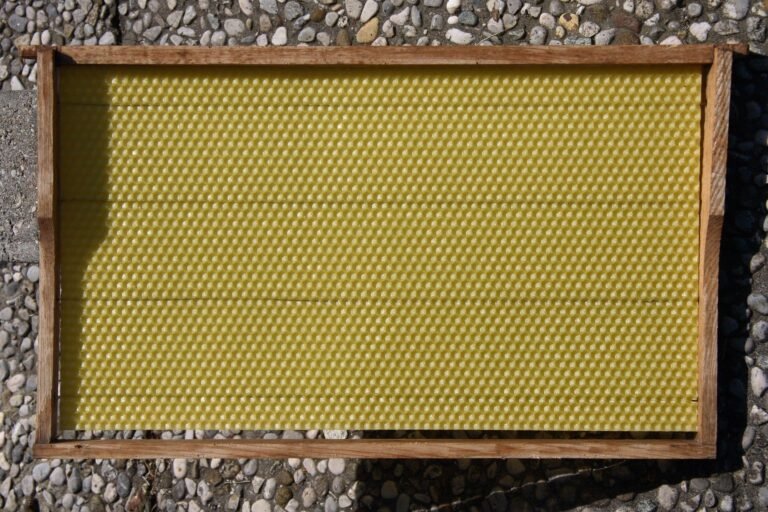
Use foundation, starter strips or clean drawn worker comb. Put 11 frames in a 10-frame box. If they’re too tight to work, use 10 narrow frames and a follower board against one wall.
Step 4: Keep narrow frames in the center
You can mix narrow and standard frames in one box. Put the narrow ones in the middle, where the brood is, and standard ones at the edges. Historical beekeepers often did exactly this.
Step 5: Compare over a season
At each inspection, note how many frames have brood on both sides, how much drone comb is on the brood frames and how the colony comes through spring buildup, compared with a similar colony on standard spacing. Our guide to reading a brood frame shows what to look for.
Frequently Asked Questions
What are narrow frames in beekeeping?
Narrow frames have end bars 1 1/4 inches wide instead of the standard 1 3/8 inches, so combs sit 1 1/4 inches apart center to center. That lets 11 frames fit in a 10-frame box. They’re used in the brood nest, not in honey supers.
Can I put 11 frames in a 10-frame brood box?
Yes, if they’re narrow (1 1/4-inch) frames. Eleven narrow frames take up the same 13 3/4 inches as ten standard frames. Eleven standard Hoffman frames won’t fit.
Do narrow frames reduce drone comb?
They reduce drone comb drawn on the faces of brood frames, because there’s less room for the deeper drone cells. Bees will still raise drones elsewhere in the hive. Plan a place for drone comb rather than expecting none.
Can I mix narrow and standard frames in one box?
Yes. Put the narrow frames in the center of the brood nest and standard frames at the edges. The spacing will simply be a little wider where the two types meet.
Should honey supers use narrow frames?
No. Honey supers work better with wider spacing, so bees draw thick combs that are easier to uncap. Many beekeepers run 9 or even 8 drawn frames in a 10-frame super.
Is 9 frames in a 10-frame brood box the same idea?
It’s the opposite. Nine frames widens the spacing, which gives more room for drone comb and uneven honey arches, and takes more bees to keep brood warm. It’s common in supers but a poor choice for the brood nest.
The Bottom Line
Standard 1 3/8-inch frames are a sensible all-purpose compromise, and plenty of strong colonies live on them. Narrow 1 1/4-inch frames come closer to the spacing bees choose for worker brood. That gives you a more compact brood nest, a bit more brood comb per box and less drone comb on your brood frames. The evidence is observation and experience, not controlled trials. The low-risk way to find out whether narrow frames help your bees is to try them in one brood box, in one colony, for one season.
.jpg)

