Reviewed by Elena P. · Last Updated September 23, 2026 · How we review
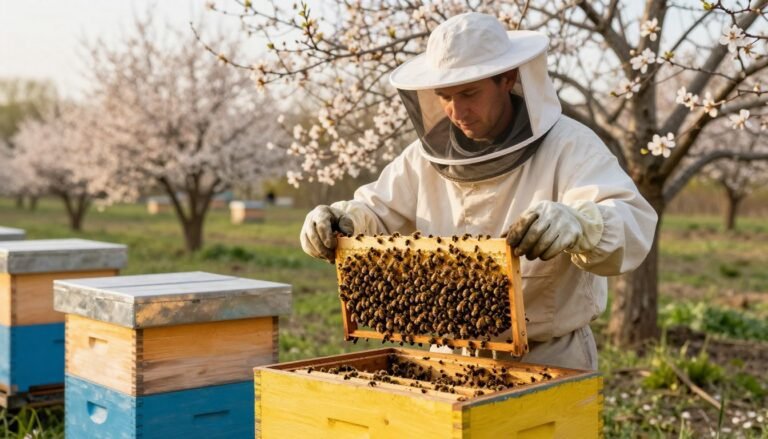
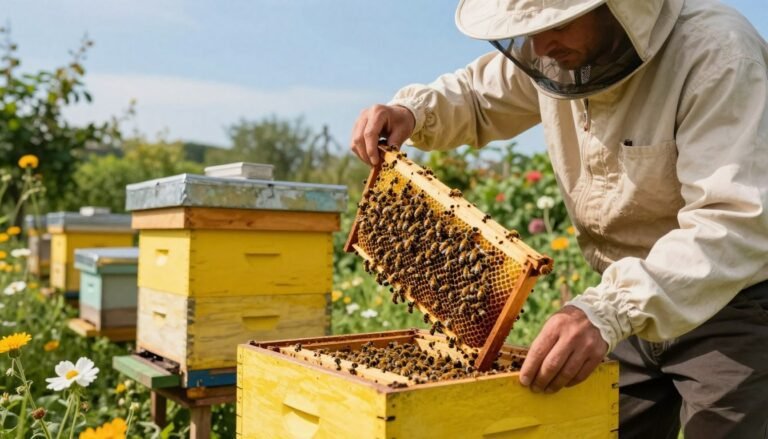
Yes, you can hive a package of bees straight onto foundationless frames, and a package is one of the best times to try it. A package has no comb, no brood and a strong urge to build, so the bees start drawing wax within a day or two. It works when four things are in place: a hive that is level side to side, a real comb guide on every top bar, at least one straight comb or foundation sheet to act as a “ladder” if you have one, and steady feeding until most frames are drawn. Then check the comb at day 7, while it is still soft enough to push back into line.
This guide covers the setup and first three weeks. If you’re still deciding whether to go foundationless, start with foundation in brood boxes vs going foundationless. For the general install steps, see our step-by-step package installation guide. Here we cover only what changes when the frames are empty.
Key Takeaways
- Packages build comb fast because they arrive with young bees, no comb and a swarm-like drive to build. That makes them well suited to foundationless frames.
- Level the hive side to side before the bees arrive. Comb hangs plumb, and a sideways tilt carries it from one frame into the next.
- Every foundationless frame needs a comb guide that sticks down at least 1/4 inch: a wooden strip, a wax strip or a beveled top bar.
- Alternate empty frames with any drawn comb or foundation you have. Each straight comb keeps its neighbors straight.
- Push frames tight together and leave no gaps. Bees fill gaps, including the space beside the queen cage, with comb you’ll have to cut out.
- Feed 1:1 syrup continuously until most frames are drawn. Comb building is where a package’s energy goes in its first month.
- Day 7 is the key inspection. Straighten crooked comb then, before it fills with brood and honey.
Table of Contents
- Why a Package Suits Foundationless Frames
- Prepare the Frames Before the Bees Arrive
- How to Arrange the Box
- Install Day: What Changes Without Foundation
- The First 21 Days, Inspection by Inspection
- Fixing Crooked Comb While It’s Soft
- Northern Packages: Cold Nights and Short Seasons
- Drone Comb, Mites and Wax Quality
- Frequently Asked Questions
Why a Package Suits Foundationless Frames
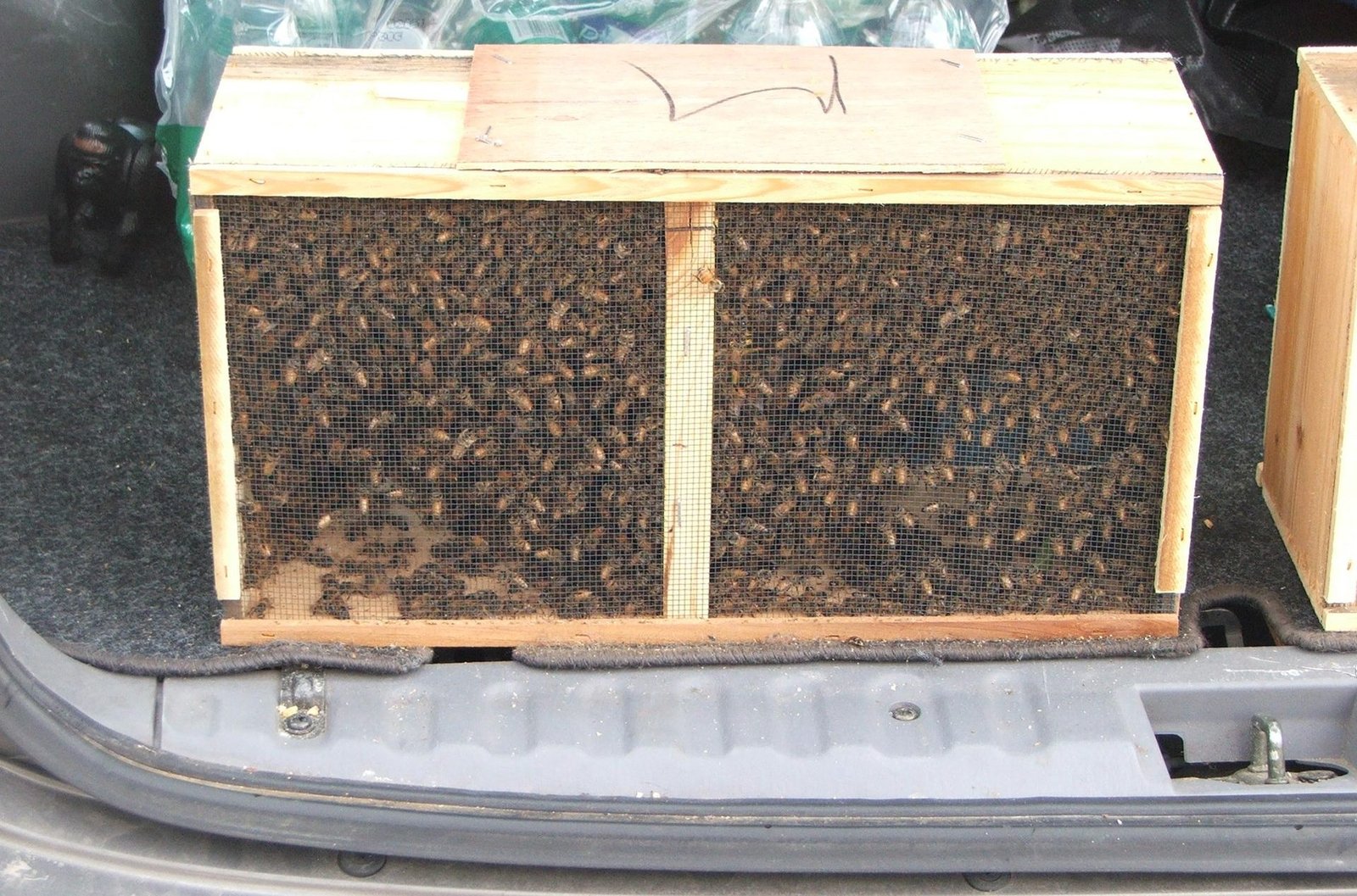
A package is a few pounds of worker bees and a mated queen, shaken from other colonies and shipped with a can of syrup. When you hive it, the colony is in much the same state as a swarm: no comb, no stored food, no brood. With syrup coming in and nowhere to store it or lay eggs, building comb becomes its first job.
Beekeeper and author Michael Bush, who has run his hives on natural comb for decades, writes on his foundationless frames page that empty frames with comb guides usually work fine. He adds that one common failure of empty boxes, bees starting comb up from the bottom bar for lack of a “ladder,” isn’t a problem when installing a package.
What a package cannot do is correct its own mistakes. If the first comb goes in crooked, the bees space the next comb off it, and the error spreads across the box. Bush’s advice is to make sure the last comb built is straight, because it’s always the guide for the next one. That is why the setup and the day-7 check matter more than anything else here.
One good comb leads to another.
Prepare the Frames Before the Bees Arrive
Do all of this a week before pickup. Packages shouldn’t wait in the garage while you glue strips.
Give every frame a comb guide
A bare, flat top bar gives the bees nothing to follow, and they will often start comb at an angle across two frames. A guide is any ridge that sticks down at least 1/4 inch from the underside of the top bar along its center line. The common options:
| Comb guide | How to make it | Notes |
|---|---|---|
| Wooden starter strip | Glue a paint stirrer, craft stick or thin wood strip into the top-bar groove | Cheap and durable. Bees accept bare wood. Waxing it isn’t needed, and Bush advises against it because the bees attach their own wax better. |
| Wax starter strip | Cut a 3/4- to 1-inch strip of wax foundation and fix it in the groove or under the wedge | Well accepted. Can fall out in heat if not secured. |
| Beveled or triangular top bar | Buy foundationless frames with a V-shaped top bar, or rip a wood triangle and glue it on | Strongest guide. Bees start comb on the point. |
| Drawn comb “ladder” | Place a frame of straight drawn comb beside each empty frame | The most reliable guide of all, if you have clean comb to spare |
Whichever you choose, check that the guide runs dead center down the length of the top bar. A guide mounted off to one side produces comb that’s off to one side. For a head-to-head look at strips versus full sheets for a new package, see starter strips vs full foundation for new packages.
Decide on support before, not after
New comb is soft, and a deep comb full of honey is heavy on a hot day. Two or three runs of stainless frame wire or heavy nylon fishing line through the end-bar holes give the bees something to build around. That’s worth doing in deeps that will hold honey; mediums usually manage without. Add it now, because you can’t thread line through a frame once comb is in it.
Level the hive where it will stand
Comb hangs straight down, like a plumb line. In a Langstroth hive the frames run front to back, so the side-to-side level decides whether comb stays inside its own frame. Tilt the box sideways and each comb drifts toward the next frame as it grows. A slight tilt toward the entrance is fine and helps rain drain out.
Use a torpedo level across the top bars of the empty box, side to side, on the actual stand. Then check again after the box is full, because a full colony settles soft ground. For more on why comb goes wrong when spacing and level are off, see what causes cross comb in foundationless hives.
How to Arrange the Box
The layout depends on what you have. A straight comb or a sheet of foundation between empty frames is the strongest guide you can give a package. Here are three workable setups for a 10-frame deep, with positions counted from one side wall:
| What you have | Suggested layout (positions 1–10) | Why |
|---|---|---|
| 2–4 frames of clean drawn comb | Drawn comb at 3, 5 and 7 (and 9 if you have a fourth); foundationless in the rest | Every empty frame has a straight neighbor. The queen can lay in the drawn comb at once. |
| Some foundation sheets, no comb | Foundation at 2, 4, 6 and 8; foundationless between them | A checkerboard. The foundation frames act as straight walls for the empty ones. |
| Foundationless frames only | All 10 foundationless, pushed tight, or 7–8 frames plus a frame feeder and follower board | Workable, but the day-7 check becomes essential. A smaller cavity keeps the cluster building in the center. |
If you’re using drawn comb from another hive, make sure it came from a healthy colony. Our guide to installing a package on old drawn comb covers how to judge it. Don’t give a package comb from a colony that died of unknown causes.
Install Day: What Changes Without Foundation
The basic install is the same as any package. A few details matter far more with empty frames.
Step 1: Keep the frames tight
Push all frames together so the end bars touch, and center the group in the box. With self-spacing Hoffman frames, that sets the 1 3/8-inch center-to-center spacing the bees expect. Any extra gap becomes a place to build a comb of their own.
Step 2: Don’t leave the package cage in the hive for long
Setting the open package inside the hive body means pulling frames, and bees will start comb in that space within a day. Take the package out and replace the frames within 24 hours, or simply shake the bees in and slide the frames back at once.
Step 3: Decide where the queen cage goes
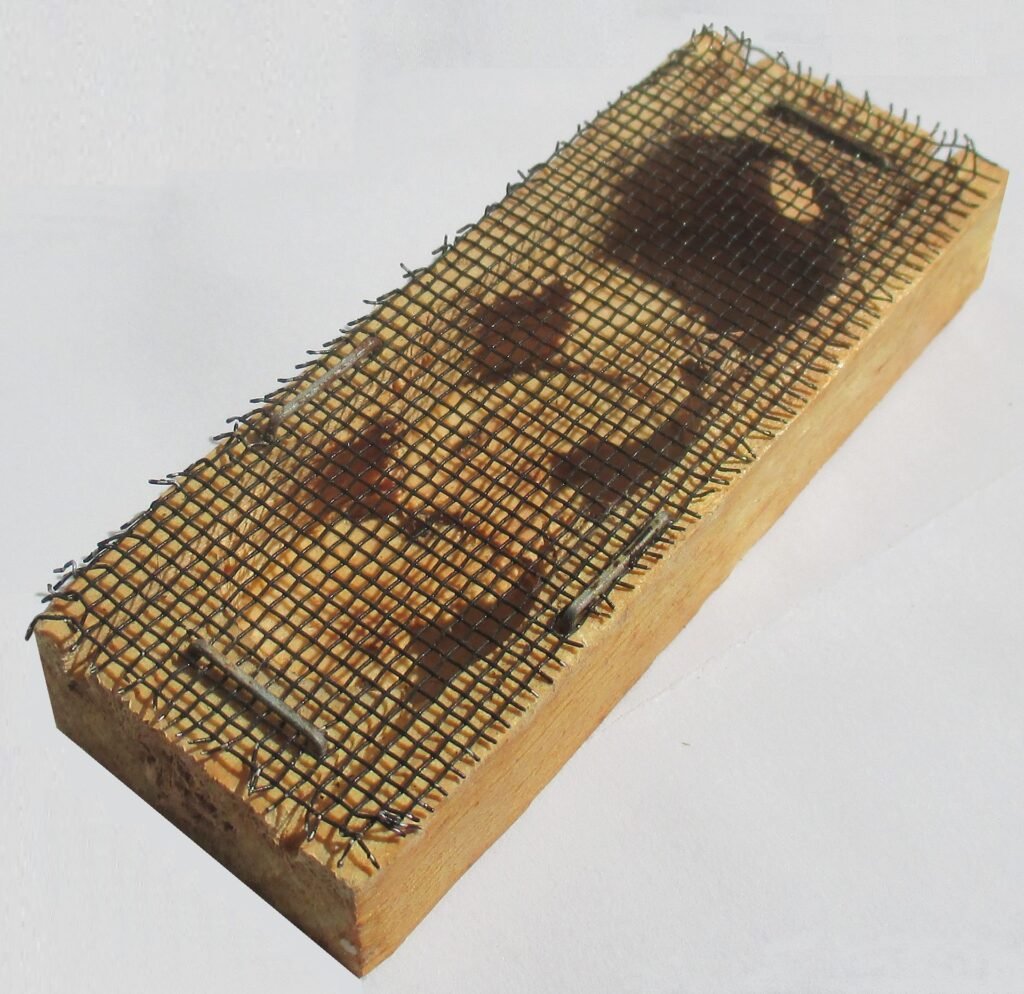
This is the biggest foundationless-specific risk. A cage hung between two frames is the one spot where the frames can’t close up, and bees tend to start their very first comb on it. Bush calls a hung queen cage the most common cause of a comb mess in natural-comb hives, because a crooked first comb sets the pattern for the rest.
You have three options. Experienced beekeepers often release the queen directly onto the frames, which avoids the problem but carries some risk of the bees rejecting her or the package leaving. Others lay the cage flat on the floor of the hive or across the tops of two center frames under a shim, so it isn’t hanging in the comb space. If you do hang it between frames, go back in after two or three days, remove the cage as soon as she’s out, cut off any comb built on it and push the frames together. For handling the cage and the queen safely, see how to install bees without crushing the queen.
Step 4: Start feeding at once
Give 1:1 sugar syrup the same day. Wax is expensive for bees to make, and a package building every cell from scratch needs more sugar than one drawing out foundation. The Mid-Atlantic Apiculture Research and Extension Consortium advises that new packages be fed until they can fend for themselves. Keep syrup on until most of the frames are drawn, even if a flow starts. For quantities, see how much to feed a new package colony.
The First 21 Days, Inspection by Inspection
This is the part most guides leave out: a timeline for what you should see, and what to act on, while the comb goes in.
| When | What to do | What you should see |
|---|---|---|
| Day 1–2 | Refill feeder only. Don’t open the brood area. | Bees clustered on the center top bars; traffic at the entrance |
| Day 2–5 | Check queen release; remove the empty cage; close the gap | Small white tongues of new comb hanging from 2–4 top bars |
| Day 7 | Key check. Lift each built frame straight up. Look down the box for combs that cross frames. | Combs 3–6 inches down, centered on their guides; first eggs in the center comb |
| Day 10–14 | Second comb check. Move any fully drawn frame so an empty frame sits between two drawn ones. | Eggs and larvae across several combs; nectar or syrup stored along top corners |
| Day 21 | Check the brood pattern. Add frames or a second box once 7 of 10 frames are drawn. | Capped worker brood; comb reaching the bottom bars in the center frames |
At every check, keep new comb vertical. It has no cocoons in it yet and little strength, and a frame tipped flat can tear off the top bar under its own weight. To confirm the queen is laying at the day-7 and day-14 checks, see how to check for eggs after package installation.
Fixing Crooked Comb While It’s Soft
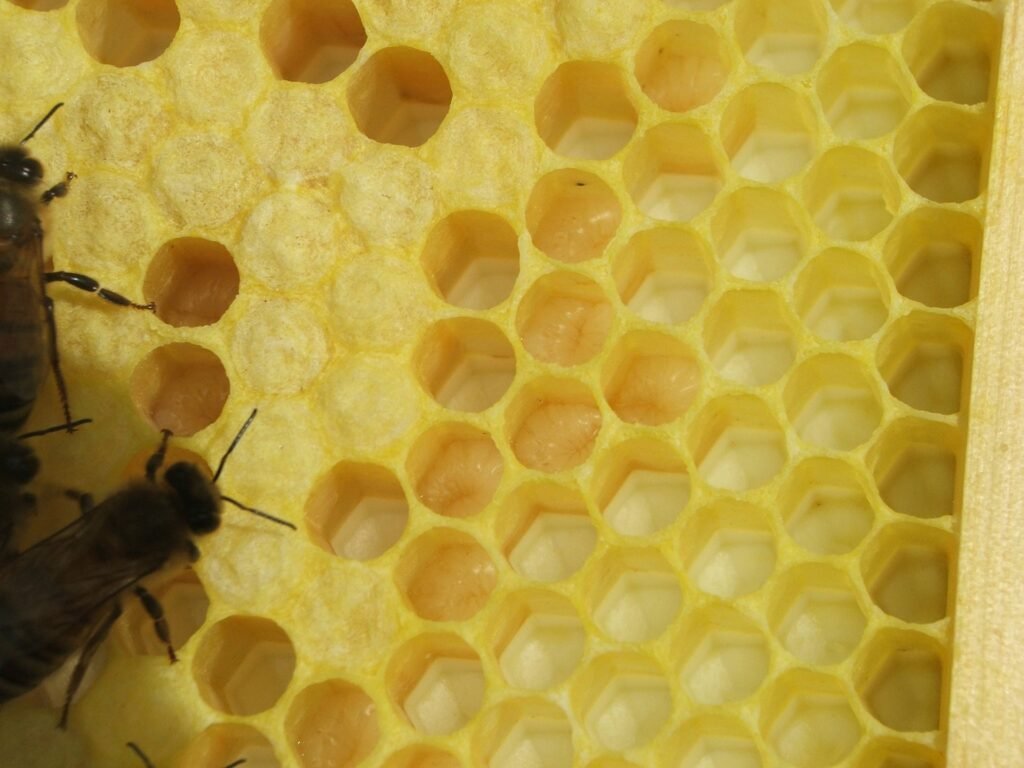
New comb is soft and easy to move. A week later it may be full of eggs and much harder to fix. Deal with problems at the day-7 check.
| What you see | Likely cause | Fix |
|---|---|---|
| Comb starts on the guide but curves toward the next frame | Hive tilted sideways, or a gap beside the frame | Gently push the soft comb back over its top bar with your fingers. Re-level the hive. Close the gap. |
| Comb runs diagonally across two or three top bars | Guide ignored; weak or off-center guide | Cut it free, then tie or rubber-band the pieces into an empty frame. Place that frame between two straight ones. |
| Comb built on the queen cage | Cage hung in the comb space, or left in too long | Remove the cage, cut off the comb, and push the frames together |
| Wavy comb bulging into the next frame | Honey stored thick next to an empty frame | Move the bulging frame beside a straight drawn comb, or trim the bulge back to bee space |
For the cut-and-tie method, see our guide to cutting and rubber-banding wild comb into frames. The bees will attach the pieces to the frame within a few days and chew away the bands.
Northern Packages: Cold Nights and Short Seasons
In eastern North Dakota, the Red River Valley and western Minnesota, most packages arrive between late April and mid-May. Nights can still drop into the 30s. That changes the plan in three ways.
- Comb building slows when the cluster is cold. Bees cluster tighter on cold nights, and wax work drops off. Expect slower progress after a cold snap. It isn’t a sign of a failing package.
- Don’t open the hive to check comb on a cold, windy day. Brood is small and fragile at this stage, and chilled brood costs more than a crooked comb. Wait for a calm afternoon in the upper 50s or warmer.
- The season is short. A package here has roughly three months to build a full brood nest and store enough honey for a long winter. Every frame of comb it doesn’t have to build is a head start. That’s the strongest argument for mixing in drawn comb or foundation if you have it.
For install-day adjustments in cold weather, see installing package bees in a cold spring.
Drone Comb, Mites and Wax Quality
Once the colony grows, it will build some drone comb in empty frames. Foundation is embossed with worker cells, so it holds drone comb down. Empty frames don’t. Betterbee’s guidance, cited in our brood-box foundation guide, is that colonies aim for roughly 10–15% drone cells. In a brood box that can add up to one or two mostly-drone frames.
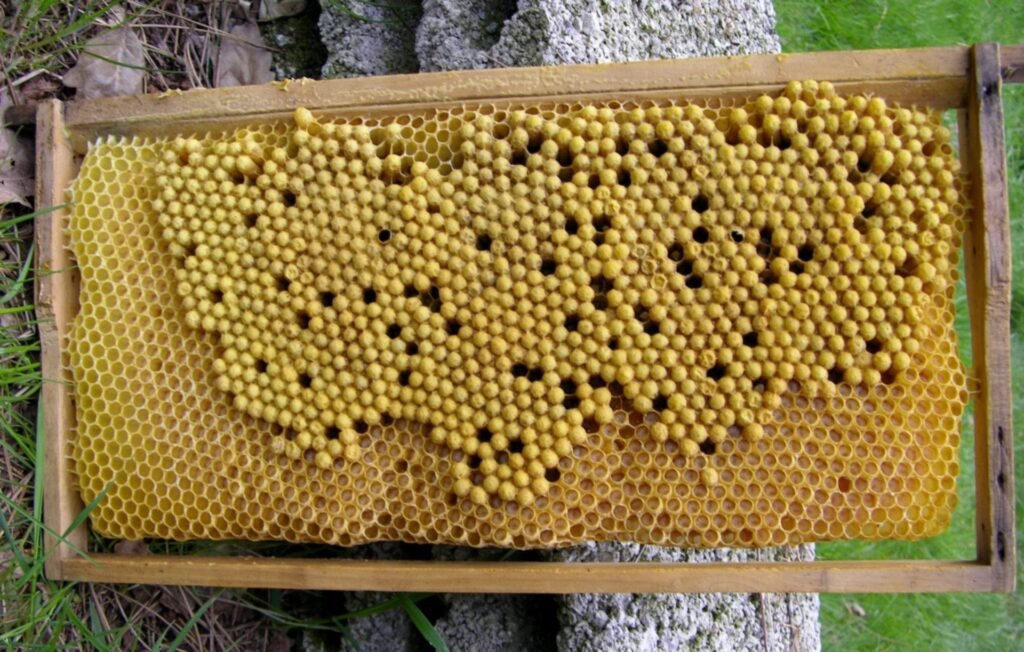
That has two costs you should plan for:
- Honey. Thomas Seeley’s study of drone comb and honey production (Apidologie, 2002) gave some colonies about 20% drone comb and others worker comb only. Over the season, the drone-comb colonies gained about 25 kg against about 49 kg for the worker-comb colonies.
- Varroa. Varroa mites breed preferentially in drone brood. More drone comb can mean faster mite growth. Check mite levels with an alcohol wash or sugar roll from midsummer onward. Our seasonal varroa treatment calendar covers timing.
You can turn the drone comb to your advantage. Keep the mostly-drone frame at the edge of the brood nest. Once its drone brood is capped, remove it and freeze it, which kills the mites breeding inside.
The benefit on the other side is clean wax. In a survey of North American apiaries, Mullin and colleagues found pesticide residues, led by the miticides fluvalinate and coumaphos, in 98% of the comb and foundation wax samples they tested (Mullin et al., PLOS ONE, 2010). Comb a package builds from scratch starts without that carryover. It’s the most solid reason to go foundationless, and it weighs most in the brood nest, where larvae develop in the wax.
Frequently Asked Questions
Can a package of bees be installed on all foundationless frames?
Yes. Packages are in a comb-building state and usually start wax within a day or two. It works best with a level hive, a solid guide on every top bar and a comb check at day 7. Mixing in even two drawn combs or foundation frames makes straight comb much more likely.
How long does a package take to draw foundationless frames?
With steady feeding and mild weather, a strong 3-lb package typically has several combs well started within the first week and a good part of a deep box drawn in three to four weeks. Cold snaps, a small package or a late queen release all slow it down.
Do I need to wire foundationless frames for a package?
Not for comb building. Wire or fishing line adds strength for handling and for heavy honey comb in deep frames on hot days. If you want it, add it before the bees build, because you can’t add it afterward.
Should I put the package on foundationless frames or foundation?
Foundation is the lower-risk choice for a first-year beekeeper in a short northern season. Foundationless suits beekeepers who want clean wax and can inspect weekly while comb goes in. A mix of both is a common middle ground.
What if my package builds comb on the queen cage?
Remove the cage, cut the comb off and push the frames together. Check that the next comb over is straight, since the bees will use it as their guide. To avoid the problem next time, release the queen directly or lay the cage flat instead of hanging it.
Will a package on foundationless frames build a lot of drone comb?
More than on foundation. Bush’s experience is that bees build drone comb until they reach their drone threshold, usually a frame or two, then go back to worker comb. Keep those frames at the edge of the brood nest and manage them as part of your mite plan.
The Bottom Line
A package gives you the cleanest start you’ll get for foundationless comb. Level the hive side to side, put a real guide on every top bar, and alternate empty frames with any straight comb or foundation you have. Feed without a break until most frames are drawn. Above all, do the day-7 check: a crooked comb fixed at one week costs you five minutes, and one left for a month can cost you the box.