Reviewed by Thomas B. · Last Updated September 24, 2026 · How we review
The Almond Board of California’s rule of thumb for mature orchards is an average of two hives per acre, each averaging eight frames of bees, with no hive below six frames. University of California advisors define a strong hive the same way: at least 8 frames covered with bees, a laying queen and one to two frames of brood. They recommend 1 to 3 strong hives per acre depending on bloom weather. Many contracts use a slightly different grade, such as an 8-frame average with a 5-frame minimum. No USDA or state law sets the standard. The number that binds you is the one written in your pollination agreement, and it only matters if colonies are inspected at delivery.
This guide sets out the published standards and the research behind them. It also explains why growers increasingly think in frames of bees per acre rather than hives per acre, and what beekeepers, including those trucking colonies from the northern plains, need to do to arrive at strength.
Key Takeaways
- The common benchmark is 8 frames. The Almond Board, UC advisors and nearly half of surveyed growers use an 8-frame average.
- Minimums vary by contract. The Almond Board cites a 6-frame minimum; a common industry grade uses 5; the Project Apis m. sample uses a 7-frame average with a 5-frame minimum.
- Strength and hive count trade off. Economists found that above 8 frames, fewer hives can deliver the same pollination.
- Weather sets the density. UC suggests 2 to 3 strong hives per acre when cold, wet or windy weather limits flight, and fewer in long spells of good weather.
- Check at delivery. Colonies grow on almond pollen, so a late inspection overstates the strength present at the start of bloom.
Table of Contents
Published Almond Hive Strength Standards
Several sources set out almond strength standards, and they do not all agree. The differences are why the contract wording matters.
| Source | Average strength | Minimum per hive | Hives per acre |
|---|---|---|---|
| Almond Board of California | 8 frames of bees | 6 frames | Average of 2 (rule of thumb) |
| UC Cooperative Extension (Franz Niederholzer, 2021) | Strong hive: at least 8 frames covered, laying queen, 1 to 2 frames of brood | Not stated | 1 to 3 strong hives |
| Industry grading norm described by The Bee Supply | 8 frames | 5 frames | Set by contract |
| Project Apis m. sample almond agreement | 7 deep frames, at least 70% covered | 5 frames | Set by contract |
| Grower survey, Goodrich and Goodhue (2016) | Over 45% of growers specified an 8-frame average | Varied | Varied |
“A general rule of thumb is to place an average of two hives per acre that have an average of eight frames of bees with six-frame minimum hive strength.”
USDA publishes what almond pollination costs, not a strength standard. Its Cost of Pollination report for 2025 recorded 1.63 million colonies on 1,035,800 paid almond acres, at an average of $209 per colony and $310 per acre. That works out to roughly 1.6 colonies per paid acre (the colony count includes unpaid colonies), somewhat below the two-per-acre rule of thumb.
What Counts as a Frame of Bees
Strength is measured in “active frames” of adult bees, not boxes or brood. In the ARE Update article cited above, Goodrich and Goodhue describe the industry definition: bees cover at least 75% of both sides of a standard frame of comb, or there are at least four bees per square inch. The Project Apis m. sample uses Langstroth deep frames with at least 70% coverage of clustering bees. Because definitions differ, write the one you are using into the contract. Our field guide on how to document hive strength covers counting methods and records in detail.
Why Strong Colonies Pollinate More
The research behind the 8-frame benchmark goes back to 1970. Writing in California Agriculture, Sheesley and Poduska measured pollen collected by colonies of different sizes in almond orchards. As summarised by Goodrich and Goodhue, an 8-frame colony collected on average 2.5 times as much pollen as a 4-frame colony. A 12-frame hive collected nearly 60% more pollen than three 4-frame hives. UC Cooperative Extension still cites the 2.5-times figure in its grower advice.
Not everyone reads the data the same way. Beekeeper and researcher Randy Oliver reanalysed the same study in 2018 on ScientificBeekeeping.com. He concluded that an 8-frame colony provides roughly twice the service of a 4-frame colony, and that the relationship is close to linear up to 16 frames. Either way, the direction is the same: a weak colony delivers much less pollination than its box count suggests, and a very strong one delivers more.
Frames per Acre: Strength Versus Hive Count
Goodrich and Goodhue argued that growers are really buying pollination efficacy, and that colony strength and hives per acre substitute for each other. Their conclusion was that above an 8-frame average, fewer hives can achieve the same pollination. David Doll, who writes as The Almond Doctor, summarises their suggestion as roughly 12 to 14 well-covered frames of bees per acre, supplied in 1 or 2 hives.
| Hives per acre | Average frames per hive | Frames of bees per acre | Comment |
|---|---|---|---|
| 2.0 | 8 | 16 | Almond Board rule of thumb |
| 2.0 | 6 | 12 | Same hive count, a quarter fewer bees |
| 1.5 | 10 | 15 | Fewer, stronger hives |
| 3.0 | 4 | 12 | More boxes, weak colonies |
The table is illustrative arithmetic, not a recommendation. It shows why a count of hives tells you little without a strength grade. It also shows why weak colonies cost more than their price suggests, since the Sheesley and Poduska data suggest a 4-frame colony delivers less than half the work of an 8-frame one. How fees can reflect strength is covered in our guide to pricing crop pollination services.
Weather, Varieties and Other Factors
The right density for your orchard depends on more than strength:
- Bloom weather. UC Cooperative Extension defines good bee weather as at least 59°F, no rain and wind under 10 mph. Where cold, rain or wind limit flight, it suggests two to three strong hives per acre. In long spells of good bloom weather, fewer than two may be enough.
- Varieties. Self-fertile varieties still benefit from bees. The Almond Doctor cites research showing yield gains of 20% or more in ‘Independence’ when honey bees were present, while suggesting fewer hives may be needed.
- Orchard age. The Almond Doctor lists orchard age among the factors that change hive needs.
- Crop insurance. The same source notes that most crop insurance requires honey bees to be placed in the orchard, so check your policy’s terms.
- Placement. UC advises placing hives where early morning sun warms them, in groups no more than a quarter mile apart.
Checking Strength at Delivery
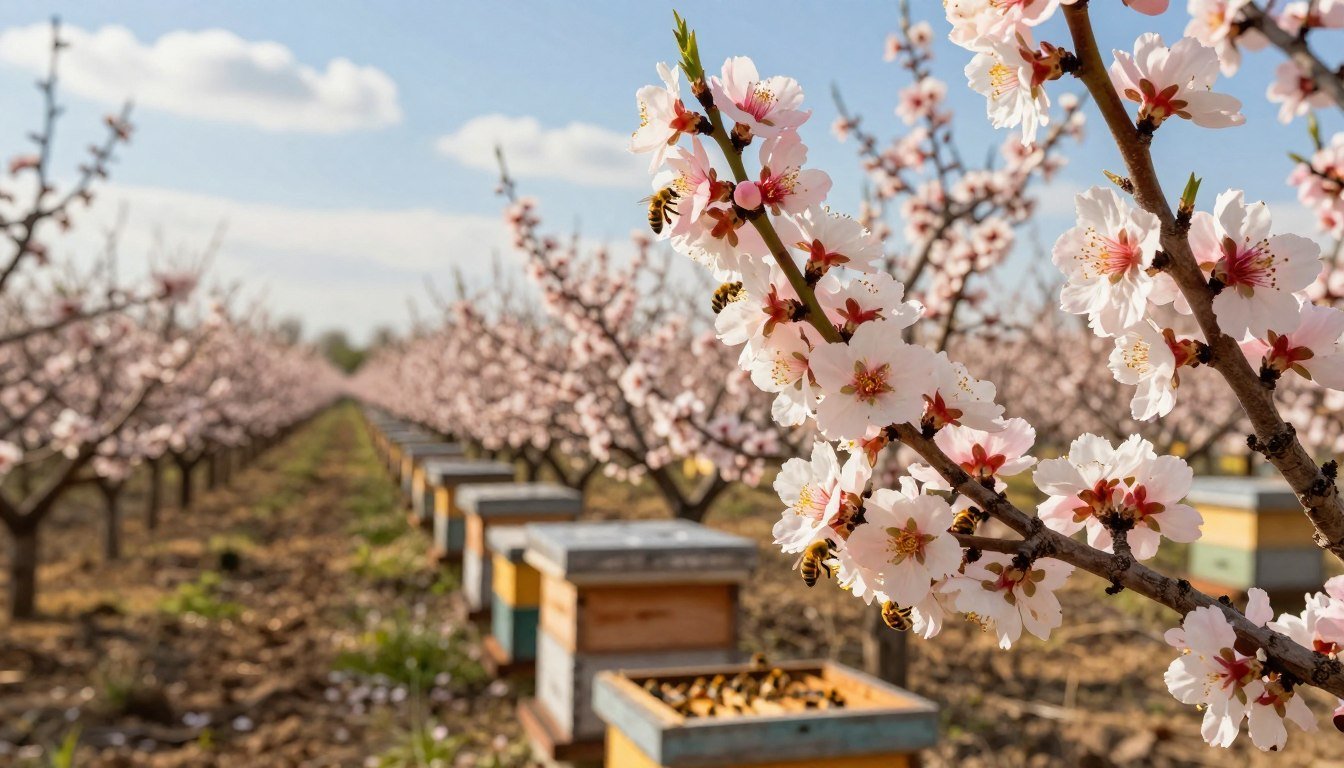
The Almond Board recommends moving hives in at about 10% bloom and inspecting them as they arrive, either by a third-party apiary inspector or by the beekeeper while the grower watches. UC’s Niederholzer explains why timing matters. Almond pollen feeds colonies, so a four-frame hive at delivery can become stronger as bloom goes on, and an end-of-season check overstates the strength present when it was most needed.
The Project Apis m. sample sets out one complete procedure. A neutral inspector checks 10% of colonies at 60°F or warmer and in wind under 10 mph. If colonies fall short, the beekeeper gets 48 hours to add colonies before the fee is reduced in proportion to the shortfall. Growers should agree on the procedure in writing before delivery. Our guide to pollination payment terms for growers shows how to tie the final payment to the result.
For Beekeepers: Arriving at Strength
Almond strength is built months before February. For beekeepers in eastern North Dakota and western Minnesota, colonies bound for California often leave in autumn, as the load in the study below did in October.
- Ship strength, not hope. A USDA and North Dakota State University study of a load trucked from Towner, North Dakota, to California found that smaller colonies lost temperature control in transit and were the most likely to fail. Our article on reducing migratory colony stress covers that study and the transport steps that follow from it.
- Choose the right configuration. Single and double brood boxes carry different populations into winter. See our comparison of double-deep and single-brood hives for pollination.
- Grade before you sign. Count your own colonies in the holding yard before committing to a grade, and leave a margin, because inspectors sample at random.
- Protect the colonies once placed. The Almond Board’s best management practices ask growers to avoid insecticides during bloom and to give beekeepers 48 hours’ notice of any treatment. Theft is a separate risk; see our report on beehive theft in almond pollination.
Removal is part of the bargain too. The Almond Board’s quick guide notes that the University of California recommends removing bees when 90% of the flowers on the latest-blooming variety are at petal fall.
Frequently Asked Questions
How many frames of bees does an almond pollination hive need?
The common benchmark is an 8-frame average. The Almond Board cites a 6-frame minimum, while many contracts use a 5-frame minimum. The Project Apis m. sample uses a 7-frame average.
How many hives per acre do almonds need?
The Almond Board’s rule of thumb is an average of two per acre. UC advisors recommend 1 to 3 strong hives per acre, with more when cold, wet or windy bloom weather limits bee flight.
Is there a USDA standard for almond hive strength?
No. USDA reports pollination fees and colony numbers, but strength standards come from industry guidance and individual contracts.
Can stronger hives reduce the number of hives needed?
Research by Goodrich and Goodhue suggests yes: above an 8-frame average, fewer hives can deliver the same pollination. Agree on the frame count and inspection method before reducing density.
When should almond hives be inspected?
At or soon after delivery. Colonies grow on almond pollen, so a late inspection overstates the strength present early in bloom.
What did almond pollination cost in 2025?
USDA’s Cost of Pollination report put the 2025 average at $209 per colony and $310 per acre in California, Arizona and Hawaii, up from $181 per colony in 2024.
The Bottom Line
Almond hive strength is a contract term, not a legal standard. The widely used benchmark is an 8-frame average with a 5 or 6-frame minimum, at around two hives per acre. Think in frames of bees per acre, adjust density for bloom weather, and inspect at delivery so that everyone is paying for, and delivering, the bees that bloom actually needs.