Reviewed by Thomas B. · Last Updated September 27, 2026 · How we review
To reduce drift in a pollination yard, stop setting hives down as one long line of identical boxes: place pallets in small clusters or arcs with gaps between groups, turn neighboring pallets so their entrances face different directions, give groups distinct colors or landmarks, and avoid reshuffling pallets once the bees have flown. Drift is what happens when a forager returning from the field enters the wrong hive. In a permanent home apiary it is a nuisance; in a pollination yard, where dozens or hundreds of look-alike colonies are unloaded at night onto an unfamiliar site, it can pull bees out of some colonies and pile them into others within days. That matters for pollination work specifically, because rented colonies are judged on strength, and a colony that has lost foragers to its neighbors can fall short of what the grower is paying for. This guide covers why pollination drops are so prone to drift and the layout choices that actually reduce it. For drift in a permanent backyard or home yard, see our broader guide on how to prevent drifting between hives.
Key Takeaways
- Drift is an orientation mistake: a returning bee enters a hive that is not her own, usually because the hives around her look alike and sit in a predictable line.
- Pollination yards stack every major drift risk together: uniform boxes, pallets set in straight rows, high colony density, and a brand-new site the bees have to learn after an overnight move.
- Classic apiary-layout research found drift is greatest along rows of hives facing the same way, with end colonies gaining bees at the expense of those in the middle.
- A controlled study found foragers were more than three times as likely to drift in tightly spaced, identical, single-line apiaries than in spaced, color-marked circles with entrances facing outward.
- The practical fixes are layout fixes: clusters or arcs instead of lines, varied entrance directions, visual markers, gaps between pallet groups, and leaving pallets where they were first set down.
Table of Contents
- What Drift Means in a Pollination Yard
- Why Pollination Yards Are So Prone to Drift
- What the Research on Apiary Layout Shows
- Arranging Pallets in Clusters and Arcs
- Staggering Entrance Directions
- Making Hives Look Different to a Returning Bee
- Spacing and Density Within the Grower’s Limits
- The First Days After Delivery
- Checking for Drift Before Colonies Leave
- Frequently Asked Questions
What Drift Means in a Pollination Yard
In beekeeping, drift means bees returning to a colony other than their own. It is not robbing: a drifting bee is not attacking another hive for its stores, she has simply misjudged which entrance is home. Guard bees usually admit a drifter that arrives loaded with nectar or pollen, so once she is inside she is typically absorbed into the new colony and keeps working for it.
Not every bee is equally likely to drift. Young bees making their first orientation flights and drones drift far more readily than experienced foragers that have already fixed a site in memory. In a pollination yard, though, even experienced foragers are effectively new arrivals, because the entire colony has just been moved to a site none of its bees have seen before.
The effects are uneven rather than random. Drift tends to flow toward particular positions, such as the ends of rows or the first colony a returning bee encounters, so some colonies steadily gain bees while others steadily lose them. Because drifting bees can carry Varroa mites and pathogens with them, drift is also a disease-transfer route between colonies that may have come from different yards or even different owners — a mechanism covered in detail in our guide to how drifting bees spread Varroa mites.
Why Pollination Yards Are So Prone to Drift
A permanent apiary can be laid out once and left alone. A pollination drop is set up quickly, often at night, on a site chosen for the crop rather than the bees. Four features of that setup drive most of the drift problem:
- Uniform hive appearance. Commercial pollination colonies are usually the same box style and often the same color, set on identical pallets. To a returning forager, one white stack looks much like the next.
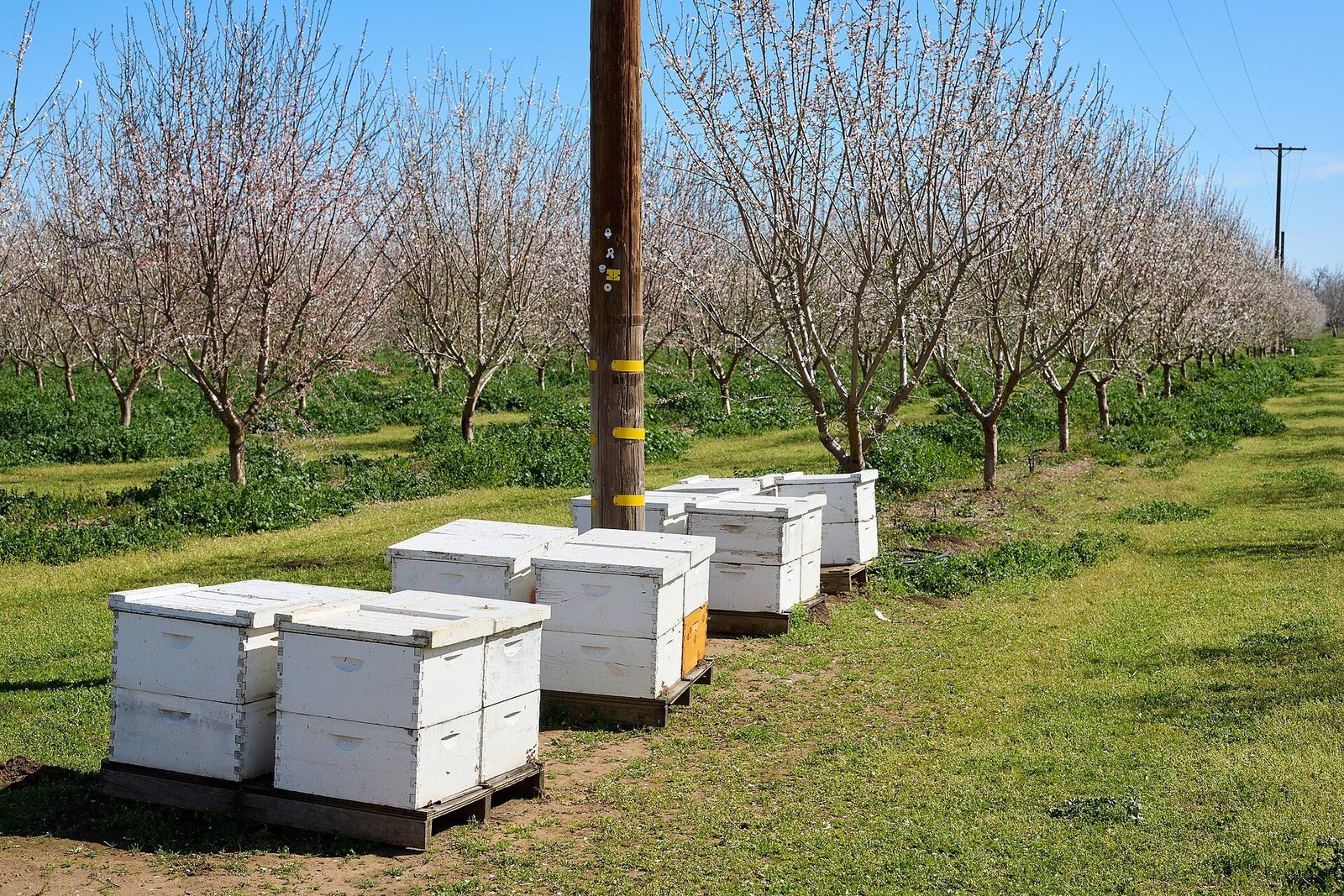
- Straight rows. Pallets are commonly dropped along an orchard edge, a farm road, or a field margin in a single line because that is the easiest way to unload and service them. A long line of evenly spaced, same-facing entrances is the classic high-drift arrangement.
- High colony density. Drop sites concentrate many colonies in a small footprint, so entrances end up close together and a small navigation error still lands a bee in a neighbor’s hive.
- A new site. After an overnight move, every forager has to reorient. Until the bees have learned the new landmarks, they rely heavily on whatever cues the layout gives them, and a featureless row gives them very few.
Exposure adds to this. In Jay’s study of environmental factors, wind direction and speed and the distance of hives from a windbreak strongly affected drift: little drift occurred when hives were within or near a windbreak, but much more when they were 15 m or more away from one. An open, unsheltered drop site in the middle of a block is therefore more drift-prone than one tucked beside a tree line. Moving and staging practices matter too; our guide to loading hives for overnight pollination moves covers the transport side.
What the Research on Apiary Layout Shows
The most detailed work on drift in commercial apiaries comes from a series of studies by S. C. Jay in the Journal of Apicultural Research in the 1960s. In his study of hives arranged in rows, drift was significantly greater along rows than between them, and the end colonies in rows facing the same direction gained more bees and produced more honey than the colonies in the center. Jay reported that drift could be reduced by spacing hives at least 9 m apart, spacing rows at least 18 m apart, facing hives in different directions, placing colored boards above entrances, or combining varied directions with colored boards.
A follow-up study of apiary layout found drift was reduced when hives were set in small squares of four, and when a larger group was arranged so that neighboring hives had different colored entrance boards and faced different directions. The same study found that when hives were placed in four rows forming a large square, bees drifted toward the end colonies of each side, and that rows set perpendicular to a windbreak saw considerable drift forward along the rows.
More recent work tested the same principles directly. Dynes and colleagues (2019, PLOS ONE) compared apiaries of eight colonies set out two ways: same-colored hives 1 m apart in a single line, versus hives 10 m apart, at different heights, facing outward in a circle and marked with colors and symbols. Foragers were more than three times as likely to drift in the single-line layout (25% of tagged bees versus 7.5%), and the spaced, visually distinct layout also had greater honey production and lower overwinter mortality.
| Layout | Drift risk | Why | Pollination-yard use |
|---|---|---|---|
| Single straight line, same color, same direction | Highest | Entrances look identical and sit in a predictable sequence; bees accumulate at the ends | Common along orchard edges and farm roads; avoid for long runs |
| Several parallel rows | High | Drift runs along each row and toward end colonies | Break rows into short groups with gaps |
| Small clusters (e.g., groups of four) with varied entrance directions | Lower | Each entrance has a distinct position and orientation within its group | Fits naturally with palletized colonies |
| Arcs or circles with entrances facing outward, plus color or symbol markers | Lowest of those tested | Every entrance faces a different direction and is visually distinct | Good where the drop site has room |
Arranging Pallets in Clusters and Arcs
The single biggest change most operations can make is to stop dropping pallets in one continuous line. Instead, set them in short groups with visible gaps between groups. Two or three pallets per group, then a gap, then the next group, gives returning bees a pattern of distinct clusters rather than an unbroken row where every position looks the same as the one next to it.
Where the site allows, set a group in a shallow arc or horseshoe rather than a straight run. Curving the line means neighboring entrances are no longer lined up on the same axis, which is exactly the “along the row” drift Jay’s studies identified. If the drop has to follow a field edge, a staggered line, with alternate pallets set a few feet forward or back, is still better than a perfectly straight one.
Keep the forklift or loader path in mind. A layout that makes servicing and pickup awkward will not survive the next move, so plan groups around the access lane rather than fighting it. Our pollination pallet setup guide covers the equipment side, and the trade-offs between pallets and individual stands are compared in hive pallet vs individual stand.
Staggering Entrance Directions
Varying which way entrances face was one of the most consistent drift reducers in the layout research. Many pollination pallets already carry colonies with entrances on opposite sides, which helps within a pallet, but when every pallet in the line is set down the same way, the pattern repeats all the way down the row.
- Rotate alternate pallets. Turning every other pallet a quarter turn means neighboring pallets present entrances in different directions.
- Face groups outward. In a cluster or arc, face entrances away from the center so no two neighboring entrances look straight at each other or down the same line.
- Mind the windbreak. Sheltered positions near a hedge or tree line reduce drift, but rows run out perpendicular to a windbreak saw considerable drift forward along the rows in the layout research, so set groups alongside the shelter rather than in lines leading away from it.
Making Hives Look Different to a Returning Bee
Bees find home partly by learning visual landmarks on their orientation flights, so anything that makes one entrance look different from the next helps. Honey bees see blue, yellow, and white well, and are sensitive to ultraviolet, but they do not see red as a distinct color, so red markings tend to read as dark rather than as a clear cue.
- Color the fronts or entrance areas. Even if the boxes themselves are uniform, a painted board or panel above or beside the entrance — the approach Jay tested — gives each colony a distinguishing mark. Alternating two or three contrasting colors along a group works better than one color for all.
- Add simple shapes. Circles, bars, triangles, or other bold shapes near entrances, varied from hive to hive, add another cue that does not depend on color alone.
- Use natural and placed landmarks. A tree, a post, a vehicle-safe marker, or a clump of vegetation near a group gives foragers something fixed to steer by. Bare, uniform drop sites give them nothing.
These markers matter most in the first days on a new site, when every forager is relearning where home is.
Spacing and Density Within the Grower’s Limits
The distances that cut drift sharply in research apiaries, such as hives 9 to 10 m apart, are rarely achievable in a commercial pollination drop, and the number of colonies placed is set by the pollination contract rather than by the beekeeper’s preference. For almonds, for example, the stocking rate and minimum colony strength are spelled out in advance, as covered in our guide to almond pollination hive strength requirements.
What you can usually control is how that number is distributed. Where the grower allows it:
- Split one large drop into several smaller drops spread along the block rather than stacking every pallet at one spot.
- Leave wider gaps between groups than between pallets within a group, so the site reads as distinct clusters.
- Use shelter where it exists: groups placed near a windbreak drift less than groups on an exposed, open site.
The First Days After Delivery
Drift is most likely right after the colonies arrive, while foragers are still learning the new site. A few habits help:
- Set pallets in their final positions on arrival. Place colonies at night or before flight begins so the bees orient to the layout they will keep.
- Do not shuffle pallets after the bees have flown. Once foragers have oriented, moving a pallet even a short distance sends its returning bees to the old spot and into whichever hive is now nearest to it.
- Put your markers in place from the start. Colored boards or landmarks added a week later help less than those present on the first orientation flights.
- Keep weak colonies out of the middle of long lines. Bees tend to drift from the center of a row toward its ends, and a small colony has the least margin to lose foragers.
Our migratory pollination checklist covers the rest of the move-in routine.
Checking for Drift Before Colonies Leave
You rarely see drift happen directly; you see its results. Signs that drift is unbalancing a drop include colonies at the ends of groups becoming noticeably stronger than their neighbors, a run of colonies in the middle of a line losing field force, and heavy traffic at a few entrances while nearby entrances are quiet.
Where you find a clear imbalance, the usual corrections are the same as in any apiary: equalize by moving frames of bees and brood from a colony that has gained into one that has lost, and adjust entrances if one colony is drawing bees from its neighbors. Because drifting bees carry mites between colonies, check Varroa levels across the whole drop rather than only in the weak colonies before those colonies return home or move on to the next contract. The same layout ideas scale down to smaller setups; for new nucleus colonies, see reducing drifting in new nuc yards.
Frequently Asked Questions
What is drift in a pollination yard?
Drift is when a bee returning from foraging enters a colony other than her own. In pollination yards it is common because many similar-looking colonies are placed close together on a site the bees have never seen before.
Is drifting the same as robbing?
No. A drifting bee has made a navigation mistake and is usually accepted into the colony she enters, especially if she is carrying nectar or pollen. Robbing is bees deliberately raiding another colony’s honey stores.
Which hives gain bees from drift?
Layout research found that colonies at the ends of rows facing the same direction gained bees at the expense of those in the middle, and that bees tended to drift along rows more than between them. More bees drifted from the center of a row toward its ends than the reverse.
Why does drift matter for rented pollination colonies?
Pollination contracts are typically based on colony strength. A colony that loses foragers to its neighbors can end up weaker than expected, while the colonies gaining those bees gain little extra benefit for the crop. Drift also moves mites and pathogens between colonies.
How can I reduce drift if I cannot space hives far apart?
Focus on arrangement rather than distance: set pallets in small groups or arcs instead of a single line, turn neighboring pallets so entrances face different directions, and give groups distinct colors, shapes, or landmarks.
Does painting hives different colors really help?
Yes. Layout studies found that colored boards above entrances reduced drift, especially when combined with varied entrance directions. Blue, yellow, and white are easier cues for bees than red.
Should I move pallets around after they have been set down?
Avoid it once the bees have started flying. Foragers learn the location of their entrance, so moving a pallet even a short distance sends returning bees to the old spot, where they end up in whichever colony is now closest.