A 2020 University of Sussex field study found that strawberries grown alongside borage produced 35% more fruit and 32% more yield by weight than strawberries grown without it — real, peer-reviewed evidence that companion planting for pollinators isn’t just garden folklore. Most companion-planting advice for vegetable gardens repeats the same short list of flowers without much evidence behind it, and some of the most commonly recommended plants turn out to deliver far less pollinator value than their reputation suggests.
Key Takeaways
- A 2020 peer-reviewed study (Griffiths-Lee, Nicholls & Goulson, Ecological Entomology) found borage interplanted with strawberries increased fruit count by 35%, yield by weight by 32%, and pollinator visits by 25%.
- Many vegetable crops — squash, cucumbers, melons, and berries among them — depend on insect pollination to set fruit at all, unlike self-pollinating or wind-pollinated crops such as most beans, peas, and corn.
- Double-flowered marigold cultivars, one of the most commonly recommended companion plants, often provide little to no accessible nectar or pollen — the extra petals replace or hide the reproductive parts pollinators actually need, according to peer-reviewed cultivar-visitation research.
- This is a different goal from an ornamental pollinator garden: the aim here is boosting fruit set on food crops, which changes which plants, placement, and bloom timing actually matter.
- Interplanting flowers directly among vegetable beds, not just around the border, keeps pollinators actively working the same bed the food crop is in.
Table of Contents
- Which Vegetable Crops Actually Need Insect Pollination
- What the Research Actually Shows
- The Marigold Problem: Why a Popular Choice Underdelivers
- Companion Plants Worth Growing for Real Pollinator Value
- Placement and Timing That Actually Matters
- Mistakes That Undercut Companion Planting for Pollination
- Frequently Asked Questions
Which Vegetable Crops Actually Need Insect Pollination
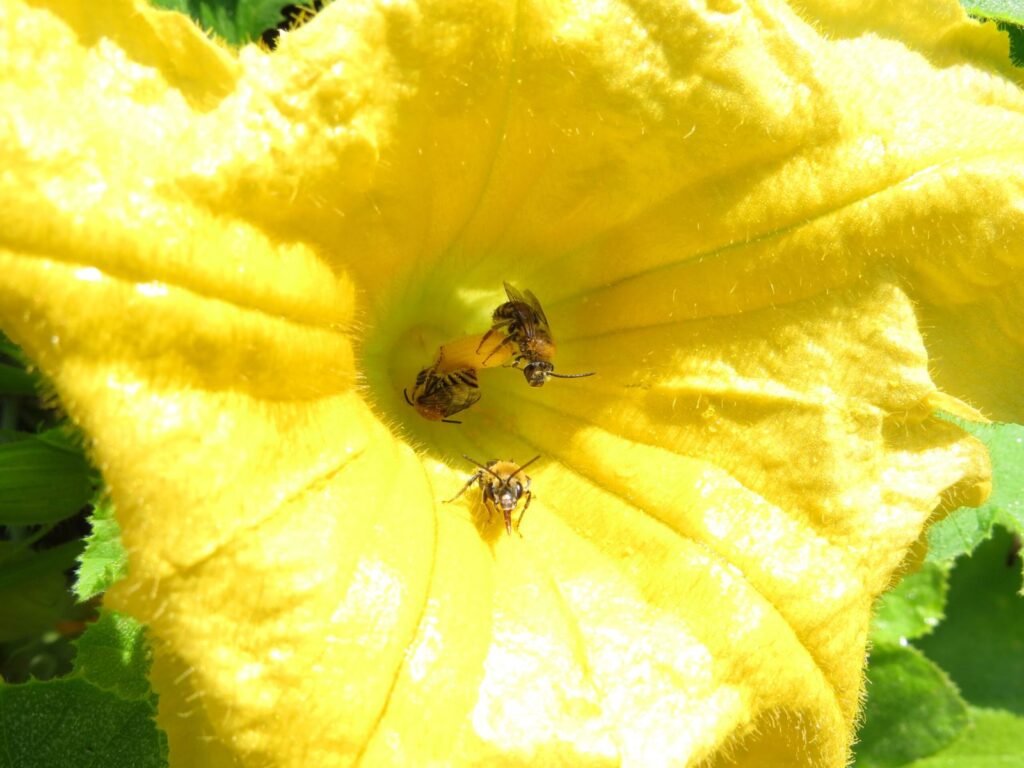
Companion planting for pollinators matters most for crops that genuinely depend on insect visits to set fruit — not every vegetable in the garden benefits equally. Squash, cucumbers, melons, and other cucurbits produce separate male and female flowers on the same plant and rely almost entirely on bees moving pollen between them — including specialist native bees like the squash bee, covered in our dedicated squash bee guide — without enough pollinator visits, female flowers simply fail to set fruit or produce small, misshapen ones. Strawberries and other soft fruits benefit similarly, with well-pollinated flowers producing larger, more uniformly shaped fruit than partially pollinated ones. Tomatoes, peppers, and eggplants are self-fertile and can set some fruit from wind or simple vibration alone, but yield and fruit size still improve measurably with bee visitation, particularly from bumblebees capable of “buzz pollination” — vibrating a flower at a frequency that releases pollen tomato flowers don’t release passively. Beans, peas, lettuce, and most root vegetables, by contrast, are self-pollinating or don’t produce a pollinator-dependent edible fruit at all, so companion planting for pollination matters far less for them.
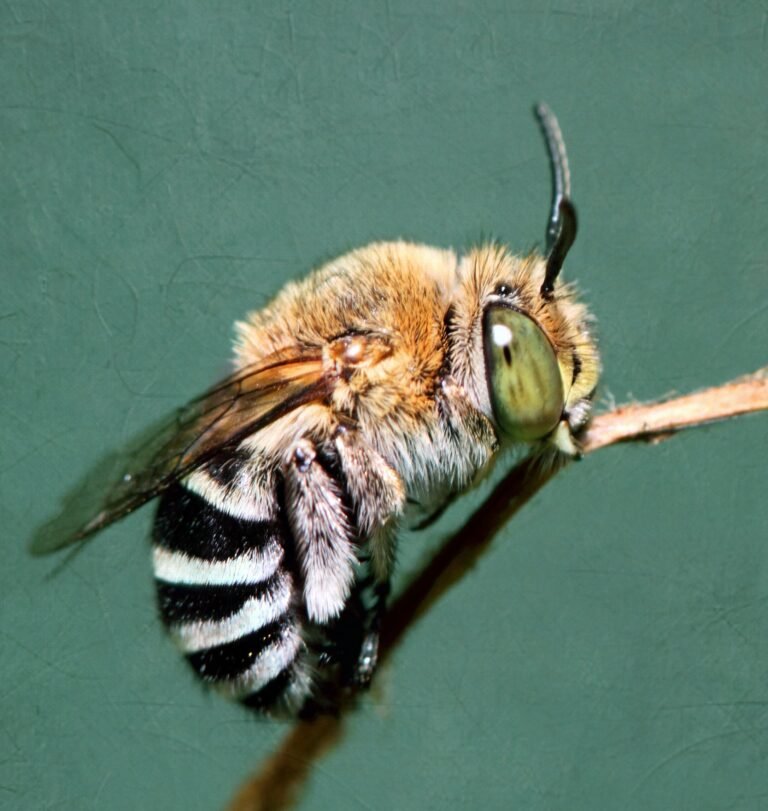
Featured photo: a bee foraging on borage — the specific companion plant behind the strawberry-yield research below. Photo: Roy Egloff, CC BY-SA 4.0, via Wikimedia Commons.
What the Research Actually Shows
A 2020 open-access study published in Ecological Entomology by researchers Janine Griffiths-Lee, Elizabeth Nicholls, and Dave Goulson at the University of Sussex tested borage (Borago officinalis) as a companion plant for garden strawberries, combining controlled experimental plots with citizen-scientist observational data from real home gardens and allotments. The results were concrete: strawberries grown near borage produced 35% more fruit and 32% more total yield by weight than strawberries without it, alongside a 25% increase in measured pollinator visits to the strawberry flowers themselves. This is a genuinely rare thing in companion-planting advice — a controlled, peer-reviewed result with real percentages, rather than a repeated claim with no study behind it.
Separately, broader research on flower strips and insectary plantings near crops — reviewed across multiple studies on crops including cucumbers and red clover — shows a consistent pattern: adding flowering plants near a crop reliably increases pollinator visitation to that crop, though the effect on final yield varies more by crop and growing conditions than the visitation increase does. The practical takeaway isn’t that every companion flower guarantees a yield boost, but that a well-chosen, well-placed companion plant like borage has real documented evidence behind it in exactly the way most items on a generic “plant these near your vegetables” list don’t.
The Marigold Problem: Why a Popular Choice Underdelivers
Marigolds are recommended in nearly every companion-planting list, often for both pest deterrence and pollinator attraction. The pollinator half of that claim needs a real caveat: peer-reviewed research on cultivar visitation (published in the Journal of Economic Entomology) found that double-flowered marigold cultivars — the dense, ruffled, fully-petaled varieties sold at most garden centers — often provide little to no accessible nectar or pollen. Breeding for more petals frequently converts the flower’s reproductive structures into extra petal tissue, and even where some pollen or nectar remains, the dense petals can physically block a pollinator’s access to it. The same research found pollinator visitation rates varying as much as tenfold between different cultivars of the same nominal flower.
This doesn’t mean marigolds are worthless — single-flowered and semi-double marigold cultivars (open-centered, with visible yellow or orange disc florets rather than solid ruffled petals) do get visited reliably by bees and butterflies. It means the specific cultivar matters more than the species name on the seed packet, which is exactly the kind of detail a generic companion-planting list skips.
Companion Plants Worth Growing for Real Pollinator Value
| Plant | Real pollinator value | Good paired with | Note |
|---|---|---|---|
| Borage | Documented in a controlled study (see above) — 35% more fruit, 32% more yield paired with strawberries | Strawberries, tomatoes, squash | Reseeds readily; treat as a returning annual once established |
| Single-flowered marigolds | Reliable, but only in open-centered/single or semi-double cultivars — avoid dense double-flowered types | Tomatoes, squash, cucumbers | Check the cultivar description, not just the species name, before buying |
| Sweet alyssum | Strong — its shallow, open flowers suit small beneficial insects and short-tongued bees especially well | Almost anything; works well as a living groundcover between rows | Low-growing, doesn’t compete for light with taller vegetables |
| Nasturtium | Good — large, open flowers accessible to bees and hummingbirds alike | Squash, cucumbers | Edible flowers and leaves as a secondary benefit |
| Phacelia | Excellent — widely used in commercial insectary strip research for exactly this purpose | Most vegetable beds as a border or interplant | Fast-blooming; can be succession-sown for continuous bloom |
Placement and Timing That Actually Matters
Interplanting — tucking companion flowers directly into the vegetable bed rather than only around its border — keeps pollinators actively foraging in the same physical space as the crop that needs them, rather than making a separate trip from a border planting several feet away. Squash and cucumber hills in particular benefit from a companion flower planted close enough that a forager visiting one is likely to pass over the crop’s own flowers in the same pass. Bloom timing matters just as much as placement: a companion flower needs to be in bloom during the vegetable crop’s own flowering window, not before or after it, so succession planting or choosing a companion with a long bloom period (like sweet alyssum or phacelia) keeps coverage consistent through the weeks when the food crop actually needs pollinator visits.
Avoiding pesticide use on or near companion flowers is a basic but frequently overlooked requirement — a flower bred and placed specifically to draw pollinators into the vegetable bed can turn into a hazard if it’s ever treated with an insecticide, including many products marketed as garden-safe. Our guide to pesticide-free pollinator-safe yard care covers this in more depth for the wider yard beyond just the vegetable bed.
Mistakes That Undercut Companion Planting for Pollination
- Choosing plants by reputation rather than checking the actual cultivar. The marigold research above is the clearest example — the species name alone doesn’t guarantee pollinator value.
- Planting companion flowers only around the garden’s border. This can still help general pollinator abundance nearby, but interplanting directly among the crop keeps foragers moving through the vegetables themselves.
- Missing the bloom-timing window. A companion flower that blooms before or after the vegetable crop’s own flowering period does little to help that crop’s pollination specifically.
- Using pesticides on or near companion flowers. This defeats the purpose by turning an attractant into a hazard for the pollinators it draws in.
- Assuming every companion-planting pairing has research behind it. Very few pairings have been tested as rigorously as borage-and-strawberries — most companion-planting advice is inherited tradition, not measured results, which is worth knowing even when the tradition happens to be right.
Frequently Asked Questions
Does companion planting for pollinators actually work, or is it just folklore?
Some pairings have real evidence behind them — a 2020 University of Sussex study found borage interplanted with strawberries increased fruit count by 35% and yield by 32%. Other commonly repeated pairings have much less rigorous evidence, so it’s worth treating specific claims individually rather than assuming the whole practice is equally well-tested.
Are marigolds actually good for attracting pollinators?
It depends heavily on the cultivar. Single-flowered and semi-double marigolds are visited reliably by bees and butterflies, but many popular double-flowered varieties provide little to no accessible pollen or nectar because breeding for extra petals reduces or blocks the flower’s reproductive structures.
Which vegetables benefit most from companion planting for pollinators?
Squash, cucumbers, melons, and other cucurbits benefit the most, since they depend almost entirely on insect visits to move pollen between separate male and female flowers. Strawberries and other soft fruits also show a clear benefit. Self-pollinating crops like beans, peas, and most root vegetables benefit far less.
Should I plant companion flowers around the border of my vegetable garden or mixed in with the crops?
Interplanting flowers directly among the vegetables keeps pollinators foraging in the same space as the crop that needs them, which is generally more effective than a border planting alone, especially for crops like squash and cucumbers that need frequent visits during a narrow bloom window.
Do tomatoes need pollinators to produce fruit?
Tomatoes are self-fertile and can set some fruit from wind or vibration alone, but bumblebees perform “buzz pollination” — vibrating the flower to release pollen it doesn’t release passively — which measurably improves fruit set and size compared to unassisted pollination.
Is it safe to use pesticides near companion flowers meant to attract pollinators?
No — this directly undermines the purpose of planting them. A companion flower is specifically meant to draw pollinators into the vegetable bed, so any pesticide use on or near it, including products marketed as garden-safe, creates real risk to the pollinators it’s attracting.