Last Updated September 14, 2026
In the alfalfa seed-growing regions of Washington and Idaho, some farmers maintain something most beekeepers have never heard of: a deliberately engineered patch of salty, compacted soil called a “bee bed,” home to millions of individual native bee nests packed into a single acre. Alkali bees are one of the very few wild native bee species actively, intensively managed by commercial agriculture in North America, prized specifically for a pollination trick most honeybees never master. This guide covers what alkali bees actually are, their genuinely unusual salt-tolerant nesting requirement, why they’re so effective at pollinating alfalfa specifically, and how growers actually maintain artificial nesting beds to sustain managed populations.
Table of Contents
- Key Takeaways
- What Alkali Bees Actually Are
- Why Alkaline, Salty Soil Specifically
- The Alfalfa “Tripping” Problem Alkali Bees Solve
- Managed Bee Beds: A Genuinely Unique Agricultural Practice
- Nesting Density That Dwarfs Other Ground-Nesting Bees
- Identification
- Alkali Bees vs. Leafcutter Bees for Alfalfa Pollination
- Where Honeybees Still Matter Alongside Alkali Bees
- Threats to Managed Alkali Bee Populations
- Life Cycle and Emergence Timing
- A Long Research History Behind the Practice
- Common Mistakes
- Frequently Asked Questions
Key Takeaways
- Alkali bees (Nomia melanderi) are among the only native, ground-nesting bee species intensively and commercially managed in North America, specifically for alfalfa seed pollination.
- They nest almost exclusively in compacted, moist, alkaline (salty) soil — a requirement rare enough that growers engineer artificial “bee beds” to sustain populations at commercial scale.
- Unlike honeybees, which often learn to rob alfalfa flowers from the side without tripping the pollen-release mechanism, alkali bees reliably trip the flower on nearly every visit.
- Established bee beds can host several million individual nests per acre, concentrated mainly in Washington State’s Touchet Valley.
- Managed populations face real ongoing threats: pesticide drift, unstable soil salinity/moisture, and parasitic mites such as Sancassania boharti.
- Like every solitary bee on this site, alkali bees produce no honey, rarely sting, and complete one generation per year.
What Alkali Bees Actually Are
Alkali bees (Nomia melanderi) belong specifically to the family Halictidae, the same broader family that includes sweat bees covered elsewhere on this site, though alkali bees are considerably larger and behaviorally distinct in several important ways. Like every other native bee genus covered on this site, alkali bees are solitary, with each female independently digging and provisioning her own nest, but they’re genuinely unusual in nesting at densities and under soil conditions unlike almost any other bee discussed here.
Why Alkaline, Salty Soil Specifically
Alkali bees get their name from a genuinely distinctive nesting requirement: they specifically favor compacted, moist, alkaline (salty) soil, the kind of naturally occurring salt-flat conditions found in certain arid valleys of the American West, particularly in parts of Washington, Idaho, Oregon, Nevada, and California. This genuinely specific soil preference is unusual enough among bees that it effectively limits where wild alkali bee populations can naturally establish, which is precisely why the species has become such a genuinely interesting case study in deliberate agricultural habitat engineering, covered in more detail later in this guide.
The Alfalfa “Tripping” Problem Alkali Bees Solve
Alfalfa flowers have an unusual mechanical pollination trigger: a visiting bee must physically “trip” the flower, releasing a spring-loaded mechanism that strikes the bee and deposits pollen, in order for effective pollination to occur. Honeybees frequently learn to avoid tripping the flower after an initial encounter, instead approaching from the side to rob nectar without triggering the mechanism, which genuinely limits their effectiveness as alfalfa seed pollinators despite otherwise being excellent general-purpose pollinators. Once a honeybee learns that side-approach nectar robbing avoids the jarring trip mechanism, that behavior tends to persist and can even spread within a colony’s foraging population, making it a genuinely difficult, well-documented limitation rather than something that resolves naturally with more exposure to the crop. Alkali bees, by contrast, reliably trip alfalfa flowers on nearly every visit, making them a genuinely superior pollinator specifically for alfalfa seed production, which is exactly why the alfalfa seed industry has invested so heavily in supporting managed alkali bee populations rather than relying on honeybees alone for this particular crop.
Managed Bee Beds: A Genuinely Unique Agricultural Practice
Because natural alkali bee habitat is geographically limited, alfalfa seed growers in key production regions, most notably the Touchet Valley in Washington State, have developed and actively maintain artificial nesting sites called “bee beds,” carefully engineered plots of compacted, salted soil designed to mimic the natural alkaline flats alkali bees prefer. Growers manage soil salinity, moisture, and compaction levels deliberately to sustain these beds year after year, representing a genuinely unusual, hands-on approach to supporting a wild native pollinator at commercial agricultural scale, closer in spirit to livestock husbandry than typical wildlife conservation. Both private and shared arrangements exist in practice: some larger operations maintain their own dedicated beds for their own alfalfa acreage, while other regions have historically relied on cooperative or shared bed arrangements among multiple neighboring growers, reflecting the genuinely significant, multi-year investment required to establish and sustain a productive bed.
Nesting Density That Dwarfs Other Ground-Nesting Bees
Established alkali bee beds can support genuinely staggering nesting densities, with some well-maintained sites hosting several million individual nests per acre, a scale of ground-nesting bee aggregation far beyond what’s typically documented for the mining bees, digger bees, or plasterer bees covered elsewhere on this site. This density is part of what makes managed alkali bee populations commercially viable as a dedicated pollination workforce in the first place, since a single well-maintained bed can supply meaningful pollination coverage across a substantial surrounding acreage of alfalfa seed fields.
Identification
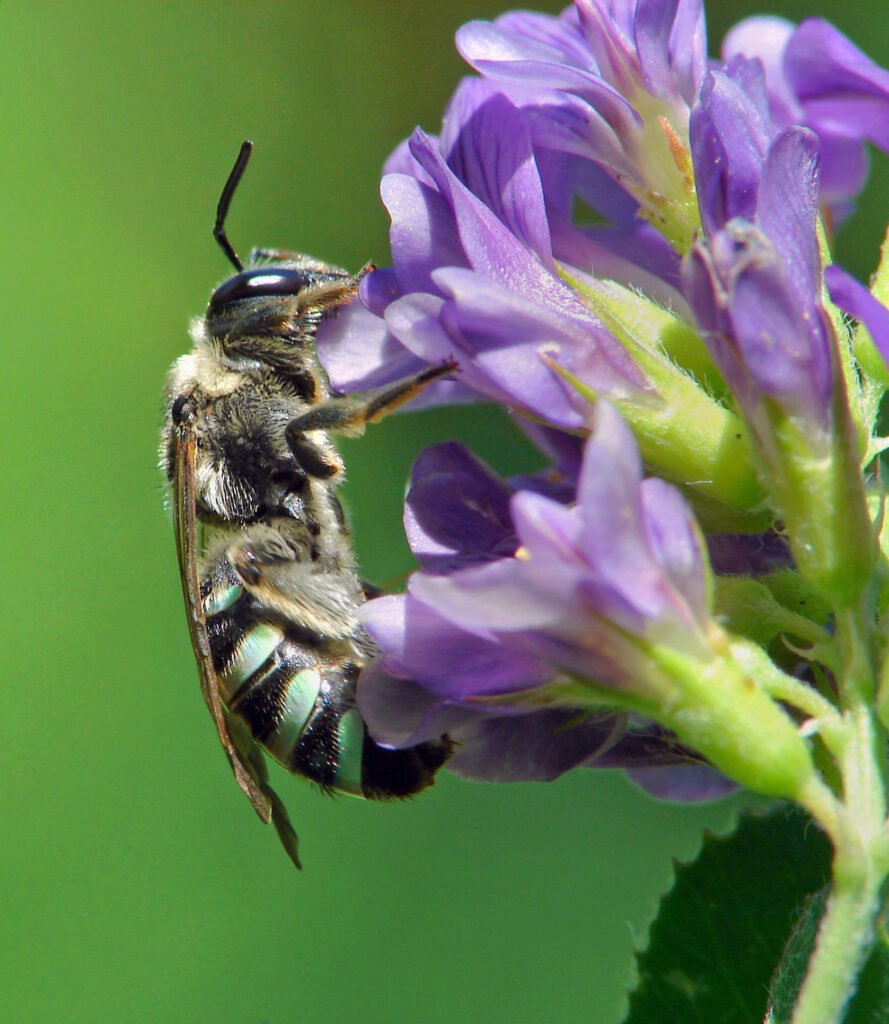
Alkali bees are robust, roughly honeybee-sized, with distinctive greenish-metallic reflections visible on the abdomen under good light, paired with pale horizontal banding, a combination that gives them a genuinely striking appearance compared to the more uniformly colored bees covered elsewhere on this site. Their large nesting aggregations on visibly salt-crusted or compacted bare soil are also a strong practical identification clue in regions where the species is established.
Alkali Bees vs. Leafcutter Bees for Alfalfa Pollination
| Trait | Alkali Bee | Leafcutter Bee |
|---|---|---|
| Nest type | Ground burrows in alkaline soil | Cavity nests lined with cut leaf pieces |
| Management method | Engineered “bee beds” | Commercial nesting boards/shelters |
| Primary managed crop | Alfalfa seed | Alfalfa seed, also blueberries |
| Geographic center of use | Pacific Northwest (esp. Washington) | Widespread across alfalfa-growing regions |
Where Honeybees Still Matter Alongside Alkali Bees
It’s worth being genuinely balanced here rather than overstating the case against honeybees: while alkali bees outperform honeybees specifically on alfalfa tripping efficiency, honeybee colonies remain far easier to transport, scale, and manage across a wide range of other crops where the tripping problem doesn’t apply, and many alfalfa seed operations still use honeybees alongside alkali bees and leafcutter bees for supplemental coverage. The relationship is genuinely complementary rather than a simple case of one species replacing the other, with growers often relying on a combination of managed pollinators tailored to a crop’s specific pollination requirements rather than a single universal solution. No documented evidence links alkali bees to any threat against honeybee colonies kept in the same region; the two groups don’t compete for nesting resources given the alkali bee’s highly specific salty-soil requirement, and in practice they’re often deliberately used alongside each other on the same alfalfa operations.
Threats to Managed Alkali Bee Populations
Managed alkali bee populations face genuine ongoing challenges, including pesticide exposure from nearby agricultural operations, disease, parasitic mites, and the sheer difficulty of maintaining precise soil salinity and moisture conditions in bee beds year after year despite variable weather. Because established alkali bee beds represent years of cumulative population buildup, a significant disruption, whether from pesticide drift, flooding, or drought, can meaningfully set back a bed’s productivity for multiple subsequent seasons, making careful, consistent bee bed management a genuinely high-stakes, long-term commitment for growers who depend on the resource.

Life Cycle and Emergence Timing
Alkali bees complete one generation per year, with adults typically active for a several-week window during the alfalfa bloom season, generally mid-summer across most of their managed range. After a female provisions and seals her nest cells, the developing offspring pass through egg, larval, and pupal stages before entering a dormant period underground that lasts through fall, winter, and spring, emerging the following summer once soil temperatures reach a suitable threshold. Growers managing bee beds often monitor soil temperature carefully during spring specifically to help predict emergence timing relative to alfalfa bloom, since the pollination benefit depends on the two events lining up closely. Washington State University researchers have gone as far as tracking individual bees’ flight paths across a nearby highway to better understand population movement and emergence patterns near managed beds.
A Long Research History Behind the Practice
Alkali bee management for alfalfa pollination has been the subject of sustained agricultural research dating back decades, with entomologists and extension researchers at institutions including Washington State University studying nest density optimization, bed maintenance techniques, and pollination efficiency comparisons extensively enough to build a genuinely mature body of practical knowledge around the species. This research foundation is part of why alkali bee management remains a viable, still-practiced technique today rather than a historical curiosity, with growers able to draw on decades of accumulated, field-tested guidance rather than working from scratch. The species’ broader significance also extends beyond agriculture: deliberately supporting a native species’ specific habitat requirements, in this case alkaline soil, has sustained genuinely massive wild populations, a lesson increasingly referenced in wider native pollinator habitat discussions.
Common Mistakes
The most common mistake is assuming alkali bees are simply a wild, unmanaged curiosity, when they represent one of the most agriculturally significant, actively cultivated native bee species in North America, with a genuine dedicated management industry built around them. Another mistake is assuming any large ground-nesting bee aggregation is an alkali bee colony, when the specific salty, compacted soil preference and characteristic regional distribution are necessary confirming details rather than density alone. People also sometimes assume alkali bees could simply replace honeybees for general crop pollination, when their value is specifically tied to alfalfa’s unusual tripping mechanism rather than broad general-purpose pollination versatility.
Sources and Further Reading
This guide draws on the USDA Agricultural Research Service, Washington State University’s Hortsense fact sheet on Halictidae, and WSU CAHNRS research on alkali bee flight paths near managed beds. This is general educational information, not professional agricultural advice.
Frequently Asked Questions
Can alkali bees sting?
Females are physically capable of stinging but are considered docile and low-risk, consistent with nearly every solitary bee covered on this site, and documented stings even around dense, actively worked commercial bee beds are genuinely uncommon.
Are alkali bees found naturally outside managed agricultural bee beds?
Yes, wild populations exist wherever suitable natural alkaline soil conditions occur across their range in the arid western United States, though the largest, most concentrated populations are specifically the actively managed commercial beds maintained for alfalfa seed pollination.
Do alkali bees produce honey the way honeybees do?
No, like every solitary bee covered on this site, alkali bees don’t produce or store surplus honey; each female collects only enough pollen and nectar to provision her own individual nest cells.
How long has alkali bee management for alfalfa pollination been practiced?
Managed alkali bee use for alfalfa seed pollination dates back several decades in the Pacific Northwest, making it a genuinely well-established, long-running agricultural practice rather than a recent innovation, with growers refining bee bed maintenance techniques over that extended period.
Is the alkali bee’s scientific name, Nomia melanderi, named after a specific person?
Yes, the species name honors Axel Leonard Melander, an American entomologist whose early research contributed meaningfully to the scientific understanding of this species, a naming convention common across many scientifically described insects covered throughout entomological literature.
What happens to alfalfa seed yields in areas without access to alkali bees or other effective pollinators?
Seed yields tend to be measurably lower without adequate access to bees capable of reliably tripping the flower, since alfalfa depends substantially on insect pollination for full seed set, which is precisely why growers in suitable regions have invested so heavily in either alkali bee bed management or leafcutter bee programs specifically to address that pollination gap.
Can alkali bees be established on a new site if a grower wants to start a bee bed from scratch?
Yes, though it’s a genuinely slow, multi-year process; establishing a productive new bee bed typically involves carefully preparing soil conditions to match the species’ salinity and compaction requirements and then introducing or encouraging colonization, with population density building gradually over successive seasons rather than reaching commercially useful levels immediately.