Reviewed by Elena P. · How we review
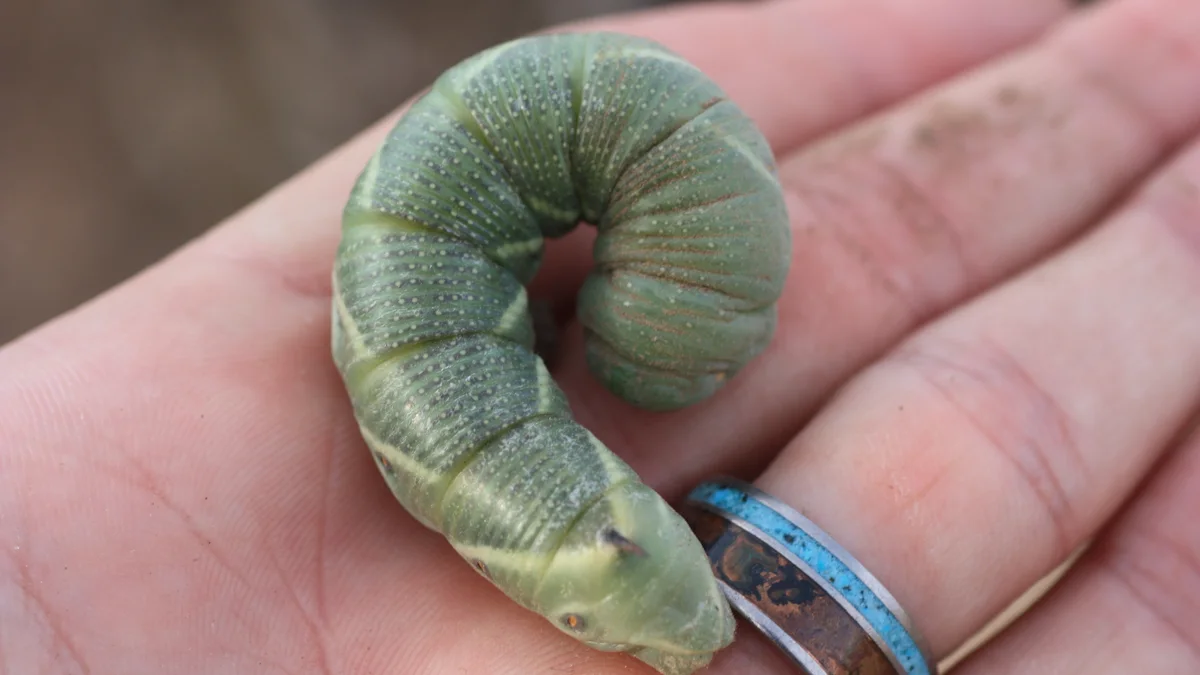
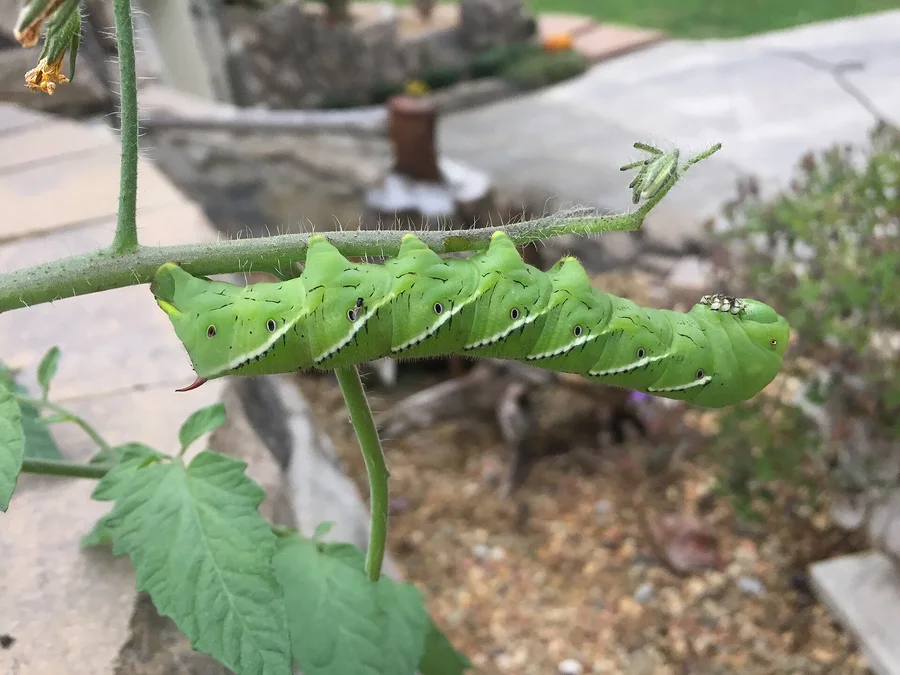
The tomato hornworm (Manduca quinquemaculata) is a green caterpillar, 3 to 4 inches long when grown, with eight white V-shaped marks along its body and a black horn at its tail end. It eats the leaves and green fruit of tomatoes and their relatives, then becomes the five-spotted hawk moth, a night-flying nectar feeder. Hand-picking controls it in a home garden, and any hornworm covered in small white cocoons should be left alone.
Below: how to tell it from the tobacco hornworm, how to find hornworms early, and bee-safe control, plus our count of 36,042 US iNaturalist records showing which species Americans actually find.
Key Takeaways
- Tomato hornworms have eight white V-shaped marks and a black horn. Tobacco hornworms have seven diagonal white stripes and a reddish horn. Both feed on tomatoes.
- In our iNaturalist count, 83.1% of US records of the two species are tobacco hornworms. The tomato hornworm is only 3.8% of records in the Northeast but 23.3% in the West.
- Look for stripped leaves near the top of the plant and dark pellet-like droppings below. Most of the feeding happens in the caterpillar’s last stage.
- Hand-pick, and leave hornworms carrying white cocoons: the parasitoid wasp Cotesia congregata is already killing them.
- If you must spray, use Bt (Bacillus thuringiensis) on small caterpillars; per NPIC, the EPA rates its caterpillar strain low in toxicity to bees. Tilling after harvest destroys pupae.
Table of Contents
- What a Tomato Hornworm Is
- How to Identify a Tomato Hornworm
- Which Hornworm Is on Your Tomatoes? Our US Count
- Life Cycle and When Hornworms Appear
- Signs of Hornworm Damage
- How to Find Hornworms on a Plant
- How to Get Rid of Tomato Hornworms
- The Five-Spotted Hawk Moth: A Night Pollinator
- Hornworm Control and Bees
- Frequently Asked Questions
What a Tomato Hornworm Is
A tomato hornworm is the caterpillar of a sphinx moth, or hawk moth (family Sphingidae), named for the soft horn on its last body segment. UF/IFAS Extension’s tomato hornworm profile, by Morgan Byron and Jennifer Gillett-Kaufman, lists its hosts in the nightshade family: tomato, pepper, eggplant, potato, tobacco and weeds such as jimsonweed (Datura stramonium). The University of Maryland Extension adds petunias and calibrachoa. Only the caterpillar damages plants; UF/IFAS notes that the adult moths visit flowers at night for nectar.
How to Identify a Tomato Hornworm
- Size: 3 to 4 inches long when full grown (Rutgers).
- Color: green, matching tomato leaves, though Colorado State notes that “occasional dark forms” occur.
- Markings: eight white V-shaped marks pointing toward the head (Utah State).
- Horn: black on the tomato hornworm, reddish on the tobacco hornworm (UF/IFAS).
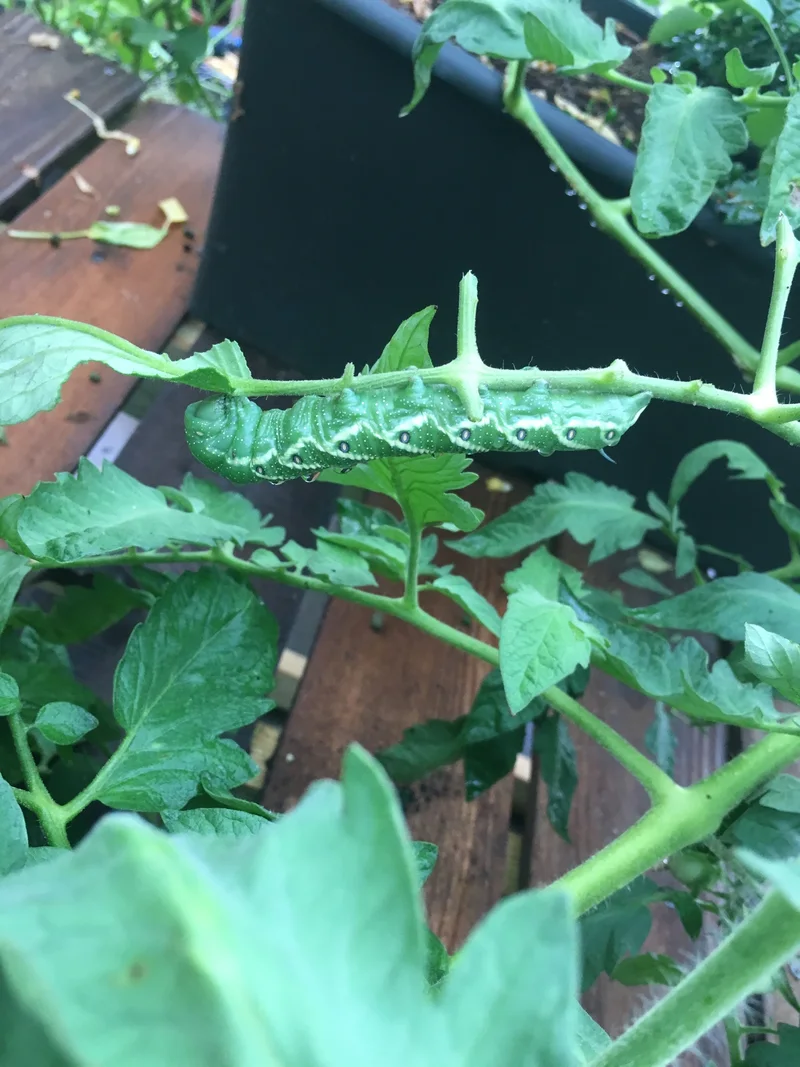
“The horn is harmless and too flexible to stick in skin. Its actual purpose is unknown.”
Tomato hornworm vs tobacco hornworm
The tobacco hornworm (Manduca sexta) has the same hosts, damage and control. Despite its name, the University of Maryland Extension says it “may be more commonly encountered than the tomato hornworm.” The differences:
| Feature | Tomato hornworm | Tobacco hornworm | Source |
|---|---|---|---|
| Scientific name | Manduca quinquemaculata | Manduca sexta | UF/IFAS |
| Side markings | 8 white V-shaped marks pointing toward the head | 7 diagonal white stripes with black edges | Utah State |
| Horn | Black | Reddish or orange-red | UF/IFAS, Utah State |
| Adult moth | Five-spotted hawk moth: 5 pairs of abdominal spots, wingspan up to 5 in | Carolina sphinx: usually 6 pairs, wingspan up to 4 in | UF/IFAS, Rutgers, Utah State |
| Where common | Uncommon in the Southeast; most frequent in the West in our count | Replaces it in the Southeast; 83.1% of US records in our count | UF/IFAS, our iNaturalist count |
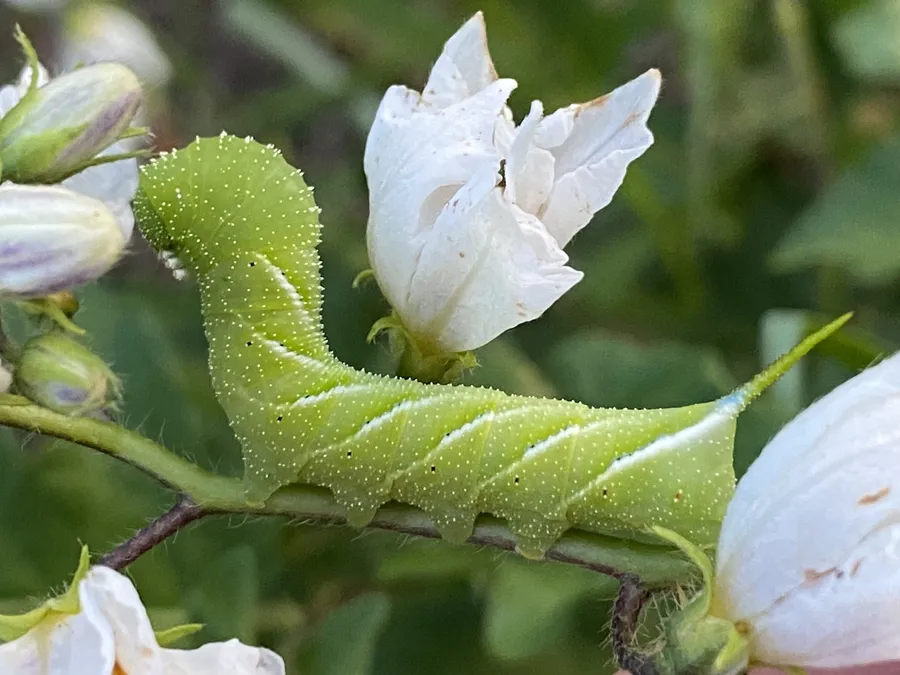
Utah State names the white-lined sphinx (Hyles lineata) caterpillar as the main look-alike. Hummingbird clearwing moths also have horned caterpillars, which our hummingbird moth guide helps you tell apart.
Video: Iowa State University Extension entomologist Donald Lewis talks about the tomato hornworm and the tobacco hornworm. Going by the video’s chapters, he covers telling the species apart, the life cycle and damage, management, pupation and seasonality, and biological control.
Which Hornworm Is on Your Tomatoes? Our US Count
Extension sheets disagree in words about which species is more common, so we counted. On November 22, 2026, we pulled every research-grade (community-confirmed) US observation of both species from the iNaturalist API, which lists the tomato hornworm as Manduca quinquemaculatus.
Of 36,042 records, 29,937 (83.1%) are tobacco hornworms or their adult, the Carolina sphinx, and 6,105 (16.9%) are tomato hornworms or five-spotted hawk moths. For caterpillars the gap is wider: 17,549 tobacco hornworms against 873 tomato hornworms. Most tomato hornworm records (4,180, or 68.5%) are of the adult moth.
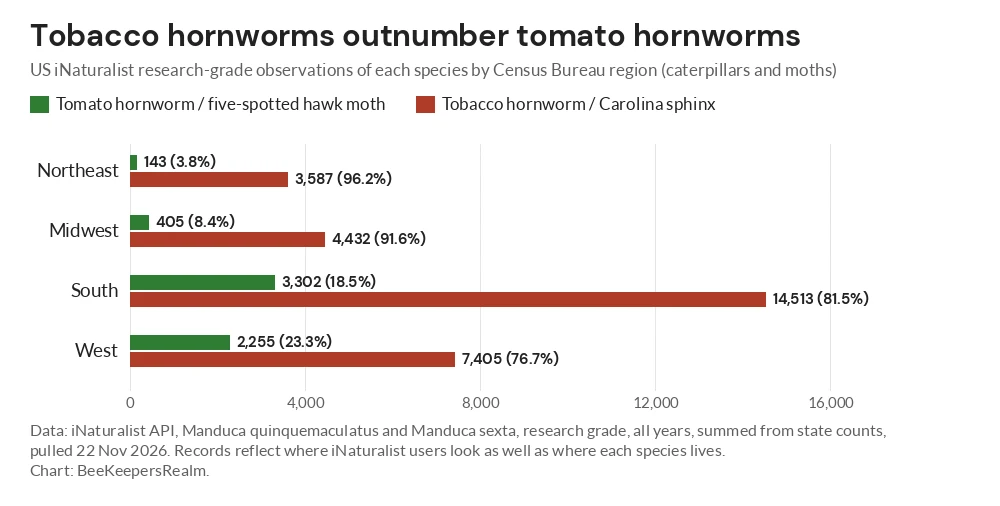
By Census Bureau region, the tomato hornworm is 3.8% of records in the Northeast, 8.4% in the Midwest, 18.5% in the South and 23.3% in the West. It outnumbers the tobacco hornworm in only nine states, led by New Mexico (663 vs 352), Oregon (27 vs 1) and Minnesota (23 vs 4); the other six have 22 or fewer tomato hornworm records each. Texas has the most of both (2,627 tomato, 5,009 tobacco). Florida (5 vs 1,101) fits UF/IFAS’s note that Florida tomato damage is typically from the tobacco hornworm, and Ohio (5 vs 1,052) shows the same farther north. iNaturalist reflects where people look as well as where insects live, but in the East your hornworm is very likely a tobacco hornworm.
Life Cycle and When Hornworms Appear
- Pupae: hornworms spend the winter as dark reddish-brown pupae, 2 to 3 inches long, 4 to 6 inches deep in the soil (Rutgers). A handle-like loop holds the moth’s long tongue (UF/IFAS).
- Adults: moths emerge, fly after dusk and feed at flowers. Utah State says the adult stage lasts 2 to 3 weeks.
- Eggs: laid one at a time in the evening (UF/IFAS), mostly under leaves, about 1/16 inch across. They hatch in about 5 days (Rutgers).
- Caterpillars: five growth stages (instars) over about 20 days, per Rutgers; Utah State says 3 to 4 weeks.
The whole cycle takes about 30 to 50 days, depending on temperature (Rutgers). Illinois Extension reports typically two generations a summer, Utah State one or two, and NC State Extension’s Pamlico County office two or three in North Carolina.
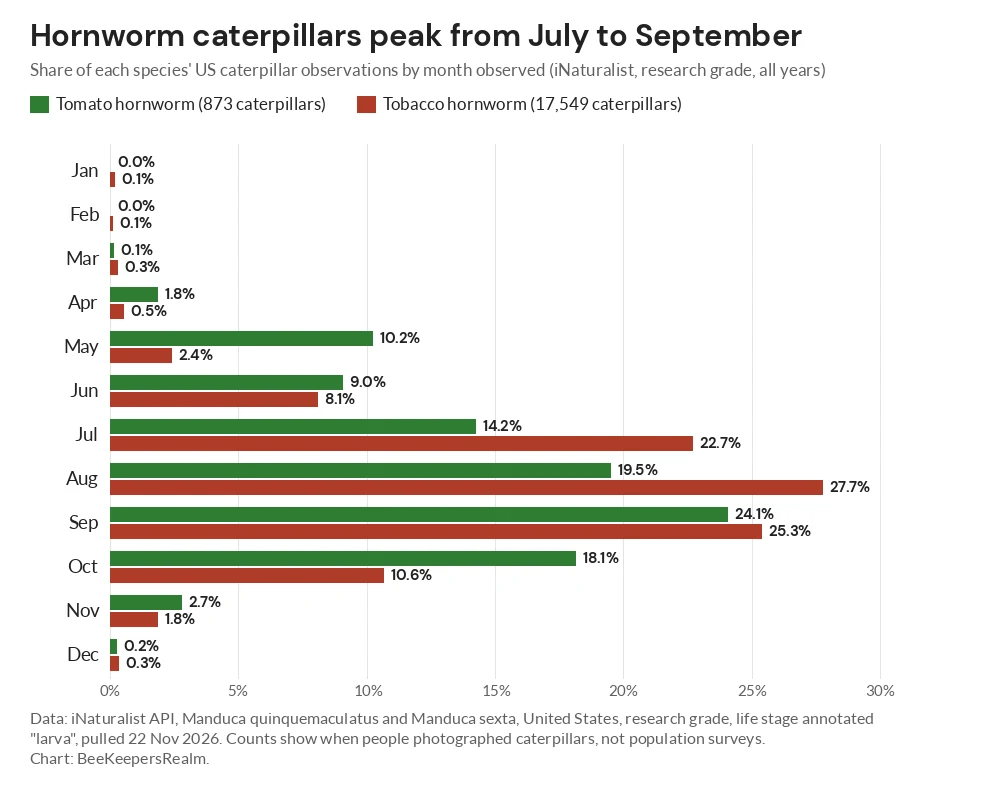
In our count, tobacco hornworm caterpillars peak in August (27.7% of 17,549 records), with 75.8% from July to September. Tomato hornworm caterpillars peak in September (24.1% of 873) and stay common in October (18.1%). Utah State advises checking plants from early July.
Signs of Hornworm Damage
UF/IFAS says hornworms feed high in the plant first, and Illinois Extension says one or two can defoliate a five-foot tomato plant in less than three days. Look for:
- Bare stems and leaf stubs near the top of the plant.
- Chewed fruit: UF/IFAS says green fruit that hornworms have fed on will not mature properly.
- Droppings (frass): dark green-black pellets that Rutgers says “may look like small stars or flowers.” Maryland notes that late-stage caterpillars leave pea-sized frass.
Damage seems to appear overnight because, Maryland Extension says, 90% of the defoliation happens in the final instar.
How to Find Hornworms on a Plant
- Follow the droppings. Utah State says frass is plentiful even when only a few larvae are present. Look straight above fresh pellets.
- Check in early morning or evening, the scouting times Utah State recommends.
- Search at night. Rutgers recommends a flashlight. Illinois Extension describes using a UV (black) light, which makes the foliage look deep red or orange and the caterpillars bright green.
- Spray or shake the plant. Maryland says a spray of water makes hornworms move and show themselves; Rutgers suggests shaking the plant over cardboard.
How to Get Rid of Tomato Hornworms
The University of Maryland says hornworm damage rarely warrants an insecticide. Work through these steps in order.
1. Hand-pick them
In a home garden, picking is usually enough. Drop the caterpillars into soapy water (Rutgers), and check again every few days from July to September. Rutgers says treatment may become necessary only above one larva per 10 plants.
2. Leave the ones with white cocoons
A hornworm carrying small white cocoons has been parasitized by a braconid wasp, usually Cotesia congregata, whose larvae grew inside it. NC State’s David Orr writes that “These cocoons are often mistaken for eggs.” The adult wasps emerge within about a week, and the hornworm dies a day or two later. They are not sold commercially, so the ones in your garden are worth keeping. See our page on braconid wasps for more.
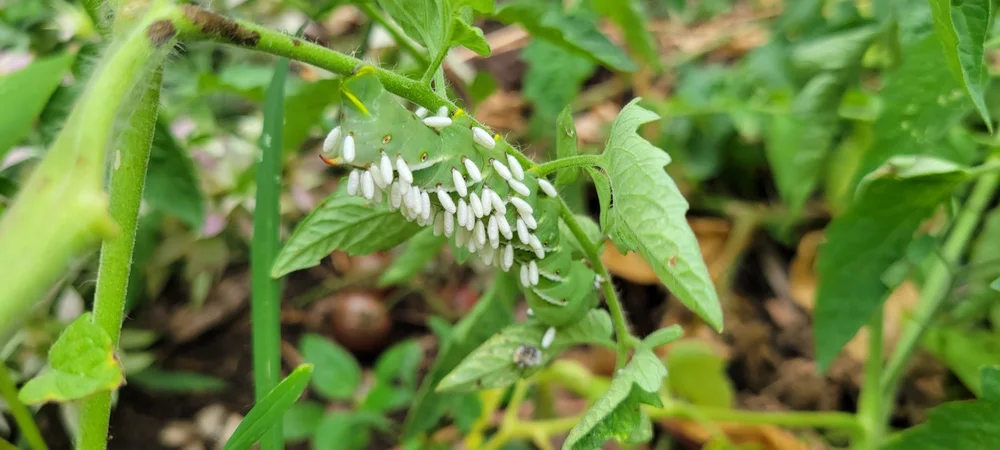
“Do not kill parasitized hornworms: let the wasps complete their life cycle so they can continue to suppress new generations of caterpillars.”
A parasitized hornworm stops eating (Maryland), so leaving it costs nothing. In our count, 75.7% of 2,801 US research-grade records of Cotesia congregata fall in August and September, when hornworm caterpillars peak. The same wasp attacks catalpa worms on catalpa trees.
3. Spray Bt only on small caterpillars
Bt (the kurstaki strain sold for caterpillars) works only after a caterpillar eats it. The University of Georgia’s Nancy Hinkle advises using it while larvae are small, because larger larvae need to consume a lot of it, and UC IPM calls it most effective against newly hatched larvae. UF/IFAS warns that rain or irrigation can wash it off. The National Pesticide Information Center’s Bt fact sheet gives typical half-lives on leaves of 1 to 4 days.
4. Till the soil and manage weeds
Rutgers says tilling after harvest kills 90% of burrowing larvae, and Illinois Extension says tilling can destroy up to 90% of overwintering pupae. UF/IFAS also recommends weed management, conserving natural enemies and crop rotation.
5. Let predators help
Rutgers lists lady beetles, green lacewings, minute pirate bugs, spined soldier bugs and paper wasps as natural enemies, plus tiny Trichogramma wasps that parasitize the eggs. Our ladybug guide covers the lady beetles worth keeping.
The Five-Spotted Hawk Moth: A Night Pollinator
The adult tomato hornworm is a large sphinx moth with a wingspan up to 5 inches (Rutgers) and five pairs of abdominal spots. The Forest Service notes that some hawk moths have tongues longer than their bodies. Colorado State says hornworm moths fly after dusk and “are rarely observed except occasionally at porch lights.”
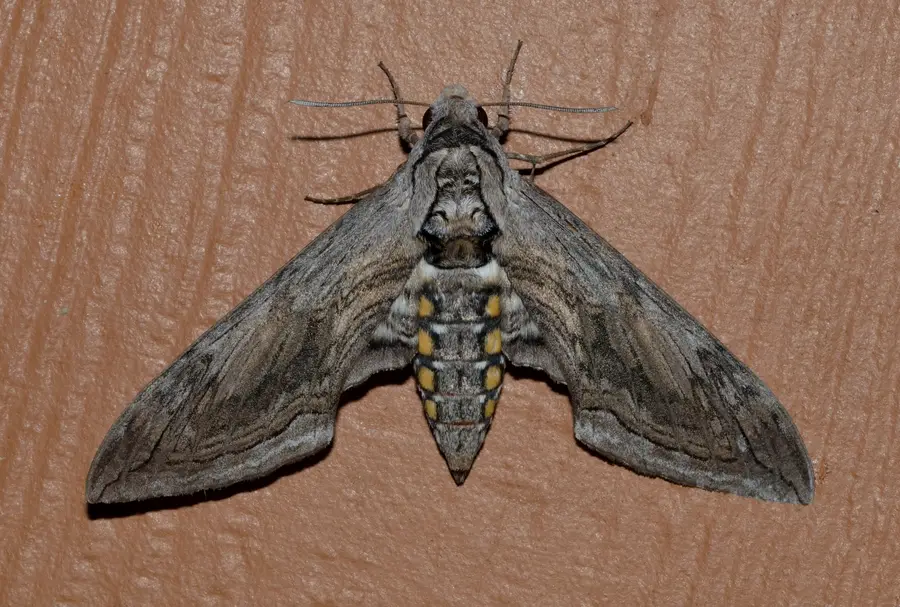
“Their caterpillars, tobacco and tomato hornworms, are well known to gardeners as voracious feeders. If you want to see their colorful adults, sequester these offspring on a few plants in the corner of your garden.”
These moths are real pollinators. In a University of Arizona study of sacred datura (Datura wrightii), Judith Bronstein and colleagues found that the tobacco hornworm’s moth “transferred enough pollen to produce fruit and seed sets comparable to hand-pollination treatments” (Annals of Botany, 2009). Our moon garden guide lists night-blooming plants for these moths, including sacred datura.
Hornworm Control and Bees
Tomato flowers are pollinated by bees that vibrate pollen loose, as our page on buzz pollination explains, so a spray on a flowering tomato can reach them. That is why hand-picking comes first:
- Bt is the bee-safer spray. NPIC reports the EPA’s conclusion that the kurstaki strain is low in toxicity to bees, and that Bt had little to no toxicity to lacewings, predatory beetles or parasitic wasps. It does kill other caterpillars, and a few studies found harm to non-target moths, so spray only infested plants.
- Broad-spectrum insecticides kill the helpers. UC IPM’s tomato hornworm guidelines warn: “Do not spray directly or allow to drift onto blooming crops or weeds where bees are foraging.” They also kill the Cotesia wasps.
- If you use any insecticide, follow the label. NC State Extension suggests applying late in the evening, when bees are not active.
See our guide to pollinator-safe pest control, or browse more garden and household insects.
Frequently Asked Questions
What do tomato hornworms turn into?
The five-spotted hawk moth, a large sphinx moth with five pairs of spots on its abdomen. The tobacco hornworm becomes the Carolina sphinx, which usually has six.
Do tomato hornworms bite or sting?
No. The horn is harmless and too flexible to pierce skin, so hornworms are safe to pick off by hand.
What are the white things on a hornworm’s back?
Cocoons of a tiny braconid wasp, usually Cotesia congregata, not eggs. The caterpillar will soon die; leave it so the new wasps can emerge.
Where do tomato hornworms come from?
From pupae that spent the winter in the soil, often in or near last year’s garden. The moths lay single eggs on tomato-family plants.
Do hornworms eat peppers and other plants?
Yes: peppers, eggplant, potato, tobacco, petunias and nightshade-family weeds such as jimsonweed.
What kills tomato hornworms naturally?
Parasitoid wasps (Cotesia and Trichogramma), paper wasps and predatory insects such as lady beetles and lacewings.
Does Bt hurt bees?
The EPA, as summarized by NPIC, considers the kurstaki strain low in toxicity to bees. It still kills other caterpillars, so spray only plants with hornworms.
How do I keep hornworms away next year?
Till the bed after harvest, manage weeds, rotate crops and check plants for droppings from early July.
The Bottom Line
Check tomatoes for droppings from July on, pick off the hornworms you find, and leave any carrying white cocoons. Save Bt for small caterpillars, and keep broad sprays off flowering plants where bees work.
Image credits: featured photo of a tomato hornworm at City of Rocks State Park, New Mexico, by Andrew Meeds, via iNaturalist, CC BY 4.0, cropped and resized. Other photos are credited in their captions. Charts by BeeKeepersRealm from iNaturalist data. Video: Iowa State University Extension and Outreach (Integrated Pest Management channel), embedded from YouTube.