Reviewed by Thomas B. · How we review
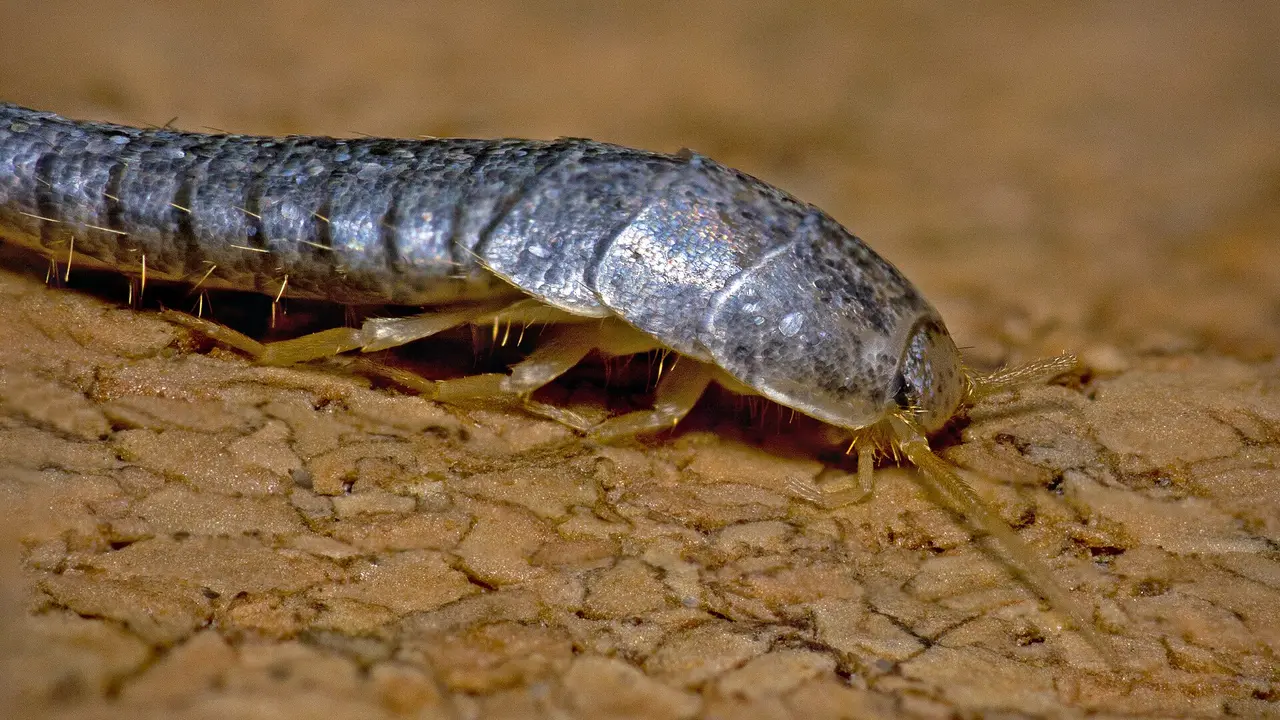
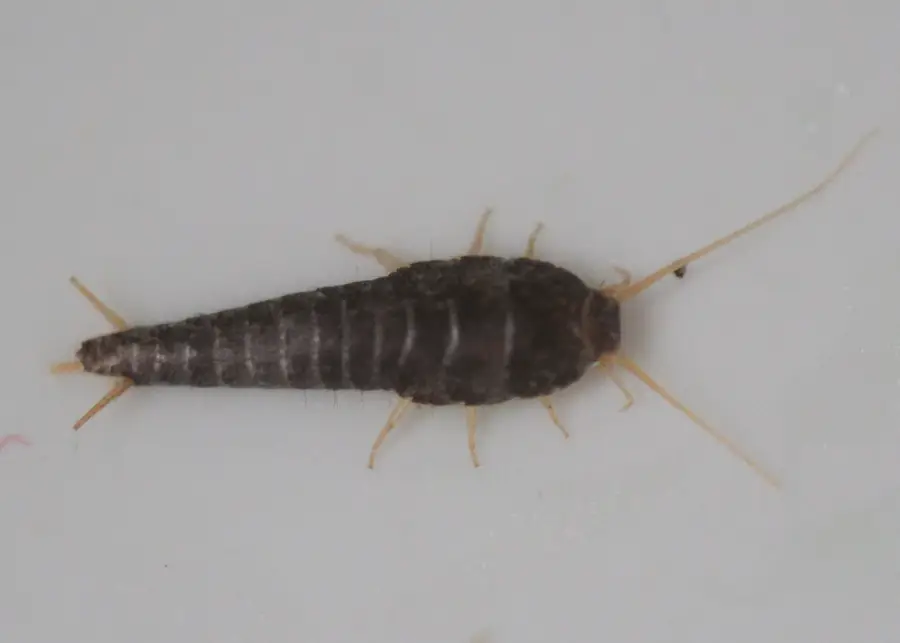
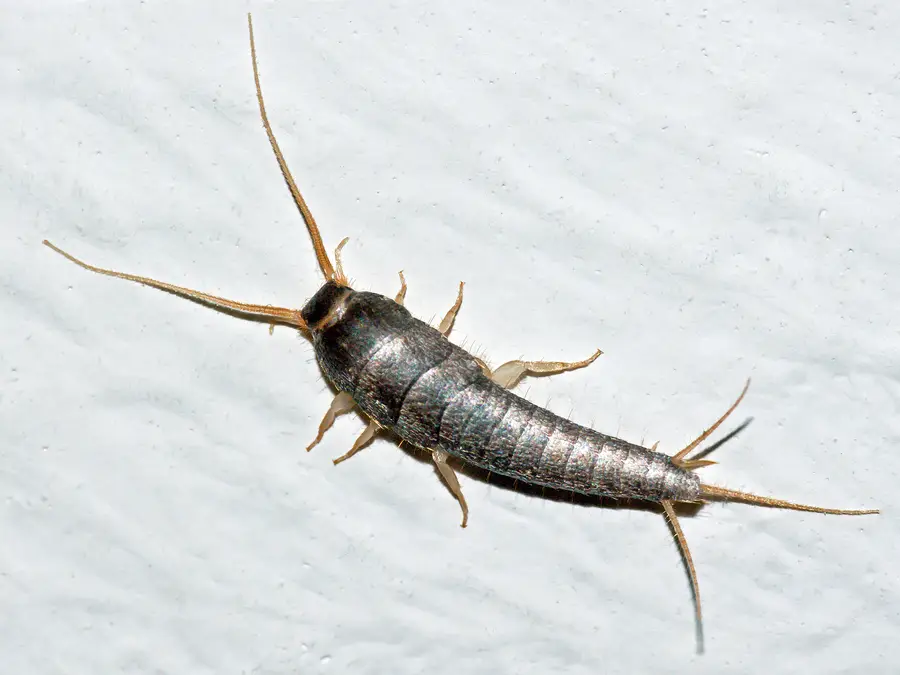
A silverfish is a small, wingless, silvery-gray insect with a carrot-shaped body, two long antennae and three tail filaments. It hides by day in damp spots such as bathrooms, basements and laundry rooms and feeds at night on starch, paper, glue, fabric and dry food. Silverfish do not bite, sting or spread disease. Finding them usually means the area is too humid, so drying it out is the main fix.
Below: how to identify a silverfish and its look-alikes, what attracts them, the damage they do, and the control steps university extension services recommend, plus our count of 6,949 US iNaturalist records showing which silverfish Americans actually find.
Key Takeaways
- Silverfish do not bite, sting or transmit disease (Virginia Tech). They damage paper, book bindings, wallpaper paste, starched or natural-fiber fabric and dry food.
- They need moisture: Ohio State puts their preferred relative humidity at 75 to 95 percent, and the National Pesticide Information Center says their presence “indicates too much moisture in the area.”
- They live about 3 years by UC IPM’s count, or 2 to 8 years by Ohio State’s and Clemson’s, and breed slowly, so a big population means a long-standing problem.
- In our iNaturalist count, four-lined (41.6%) and long-tailed or gray silverfish (24.2%) outnumber the common silverfish (18.1%) in US records.
- Dehumidify, fix leaks, use sealed containers and declutter first. Monitor with sticky traps; use dusts or sprays only for heavy infestations, in indoor cracks and crevices.
Table of Contents
- What a Silverfish Is
- How to Identify a Silverfish
- Which Silverfish Live in US Homes
- How Long Silverfish Live and How Fast They Breed
- Silverfish vs Firebrat and Other Look-Alikes
- What Causes Silverfish in a House
- Are Silverfish Harmful? Bites, Disease and Allergies
- What Silverfish Eat and the Damage They Leave
- How to Get Rid of Silverfish
- Silverfish Control and Bees
- Frequently Asked Questions
What a Silverfish Is
The silverfish (Lepisma saccharinum, often still written Lepisma saccharina) belongs to the insect order Zygentoma, which older references call Thysanura. Virginia Tech’s insect identification lab describes silverfish as primitive insects. Like the bees and other insects on this site, they have six legs and a three-part body, but they never had wings at any point in their evolutionary history. The name comes from the silvery scales and the wriggling, fish-like way they run.
Penn State Extension notes that silverfish and firebrats are also called bristletails, after the three tail-like appendages. Outdoors, silverfish live under rocks and bark, in leaf litter and in animal nests (Virginia Tech). Indoors they are nocturnal and fast, so most people meet one when they lift a box or find it stuck in the bathtub.
How to Identify a Silverfish
UC IPM’s Pest Notes on silverfish and firebrats give the key features:
- Size: about 1/2 inch long, sometimes up to 3/4 inch.
- Color: shiny silver or pearl gray, from a coat of fine scales.
- Shape: slender, flattened and wingless, wide at the head and tapering to the tail, which is why Iowa State Extension calls the body “carrot-shaped.”
- Antennae: two long, slender antennae on the head.
- Tail: three long, thin filaments at the rear.
- Young: nymphs under 1/8 inch are white and have no scales yet; they look like small adults.
Found damage but no insect? UC IPM says silverfish leave delicate, dust-like scales around the items they feed on.
Which Silverfish Live in US Homes
“Silverfish” covers more than one species. Clemson counts three silverfish species and one firebrat in South Carolina alone. To see which ones Americans actually meet, we pulled every research-grade US observation of the order Zygentoma from the iNaturalist API (“research grade” means at least two people agreed on the identification).
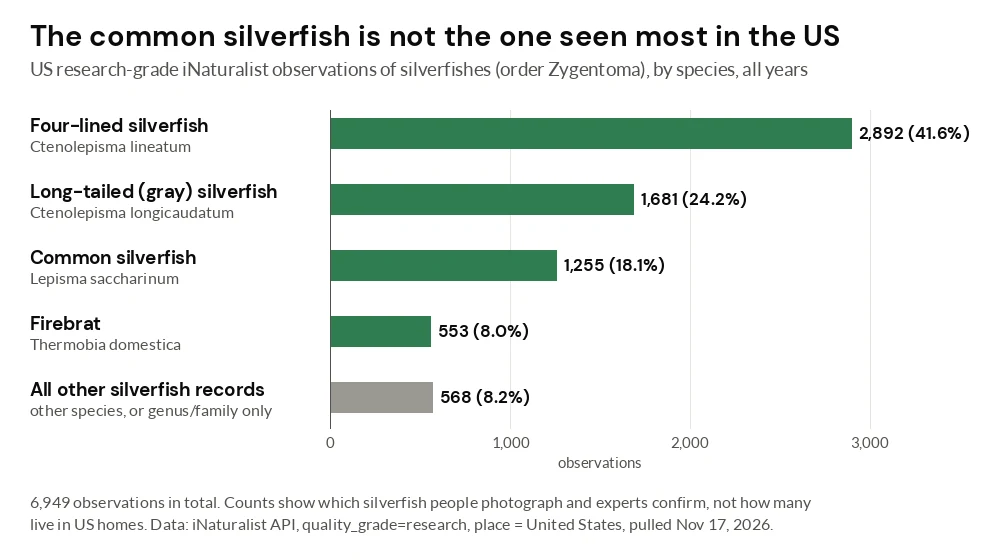
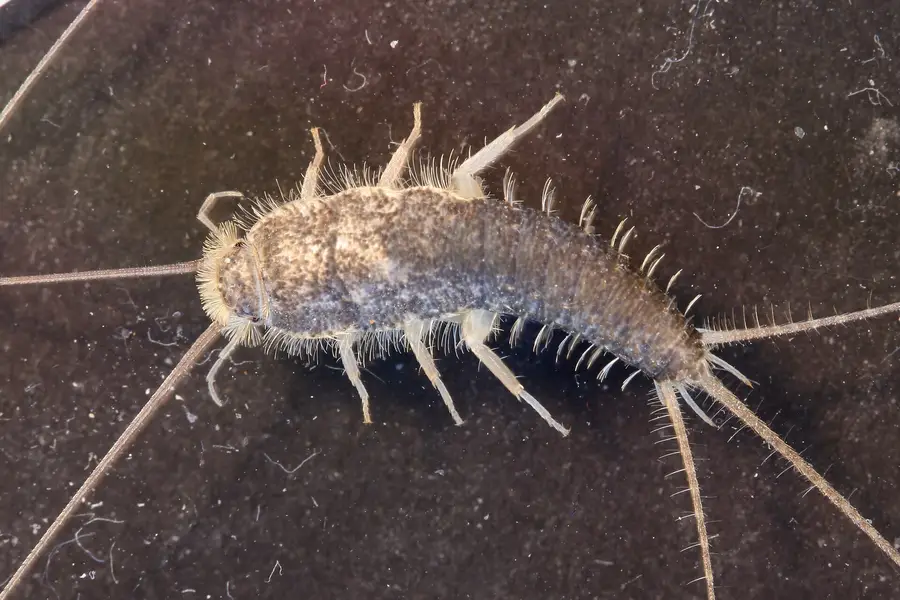
Of the 6,949 observations, 2,892 (41.6%) are four-lined silverfish (Ctenolepisma lineatum), 1,681 (24.2%) are long-tailed or gray silverfish (Ctenolepisma longicaudatum), 1,255 (18.1%) are common silverfish and 553 (8.0%) are firebrats. The remaining 568 records are other species or were identified only to genus or family.
The species also split by region. We tallied every record of the four main species by state:
| Species | US records | Top three states (records) | Share in the South* |
|---|---|---|---|
| Common silverfish | 1,255 | Pennsylvania 116, New York 99, Minnesota 93 | 14.5% |
| Four-lined silverfish | 2,892 | California 564, New York 180, Virginia 178 | 29.2% |
| Long-tailed (gray) silverfish | 1,681 | California 462, Texas 435, Florida 362 | 68.5% |
| Firebrat | 553 | California 102, Arizona 99, Texas 77 | 16.3% |
*US Census Bureau South region (16 states plus Washington, D.C.). In Florida, 362 records are long-tailed silverfish and only 2 are common silverfish. Records also reflect where iNaturalist users live, which is one reason California ranks high for three species.
Whichever species you have, the extension advice is the same: all of them need humidity, shelter and starchy food.
Video: UF/IFAS Extension’s video unit introduces the silverfish, what it eats in books, newspapers and natural-fiber clothing, and the advice of UF/IFAS extension entomologist Faith Oi that getting rid of them takes diligence and patience, going by the companion post UF/IFAS published with the video.
How Long Silverfish Live and How Fast They Breed
Silverfish are slow-growing and long-lived for an insect. A spring or summer worker honey bee lives about 2 to 6 weeks, as our guide to honeybee lifespan explains; a silverfish can live for years. Sources disagree on life span, so the table gives each figure with its source.
| Trait | Silverfish | Source |
|---|---|---|
| Adult length | About 1/2 inch, up to 3/4 inch | UC IPM |
| Life span | About 3 years (firebrats about 2) | UC IPM |
| Life span, adults | 2 to 8 years | Ohio State, Clemson, Virginia Tech |
| Eggs per clutch | Average 50, range 1 to 200 (both species) | UC IPM |
| How eggs are laid | One to three at a time, about 100 in a lifetime | Ohio State, Penn State, Clemson |
| Egg hatch | 19 to 32 days | UC IPM |
| Egg to adult | As little as 60 days above 75°F; as long as 500 days below 50°F | UC IPM |
| Molts | 45 to 60, and they keep molting as adults | UC IPM |
| Preferred humidity | 75 to 95 percent relative humidity | Ohio State |
| Without food | Several months; up to almost a year if water is available | UC IPM, Virginia Tech |
Populations build slowly: Ohio State and Virginia Tech both say a large infestation usually means a long-standing one. And because silverfish can go months without food, starving them out is slow; moisture control is the core of extension advice.
Silverfish vs Firebrat and Other Look-Alikes
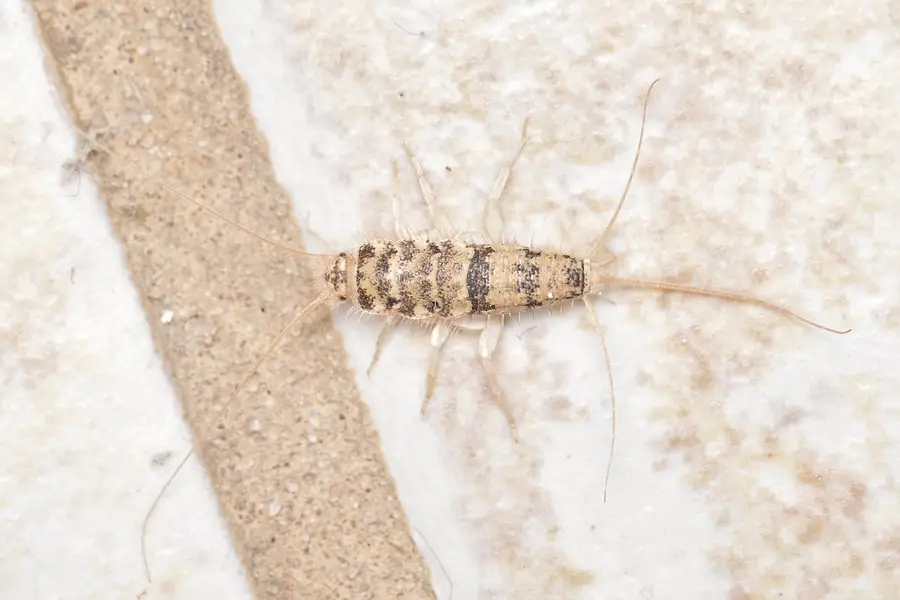
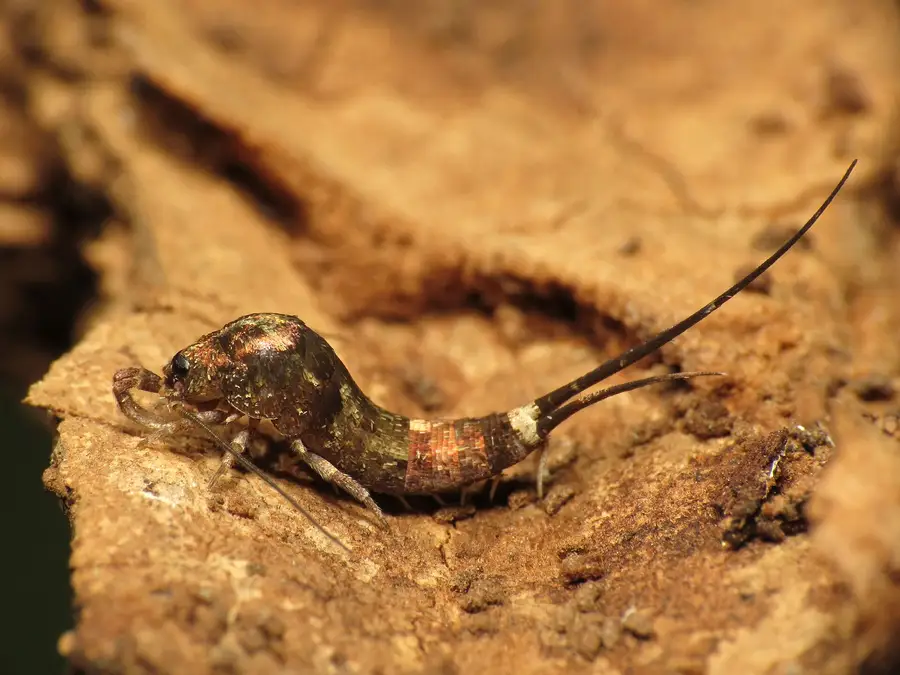
The firebrat (Thermobia domestica) is the insect most often confused with a silverfish. UC IPM describes it as about the same size but mottled gray or brown rather than silver. The bigger difference is where it lives: firebrats thrive in hot spots above 90°F, with relative humidity as low as 30%, near ovens, furnaces, water heaters, hot water pipes and summer attics. Silverfish prefer damp places at lower temperatures. If the insect has wings, it is not a silverfish or a firebrat; a swarm of winged insects indoors is more likely flying ants or termites.
| Insect | Looks | Where found | Harm | Source |
|---|---|---|---|---|
| Silverfish (Lepisma saccharinum and relatives) | 1/2 to 3/4 inch; silver or pearl-gray scales; carrot-shaped; 2 long antennae, 3 tail filaments; wingless | Damp spots indoors: bathrooms, basements, laundry rooms, closets, stored boxes and books | No bite or sting; grazes paper, glue, starch, fabric and dry food | UC IPM, Ohio State, Penn State, Univ. of Minnesota |
| Firebrat (Thermobia domestica) | About 1/2 inch; mottled gray or brown; bristly | Hot places above 90°F: furnaces, boiler rooms, ovens, water heaters, hot pipes, summer attics | Same as silverfish | UC IPM, Penn State, Iowa State, Univ. of Minnesota |
| Jumping bristletail (order Archaeognatha) | Usually under 1/2 inch; scaly and cylindrical; 3 tail filaments; jumps 6 inches or more | Mostly outdoors in leaf litter, under bark, in rock crevices | Not a household pest; eats algae, fungi, lichens and decaying plant matter | University of Wisconsin-Milwaukee Field Station |
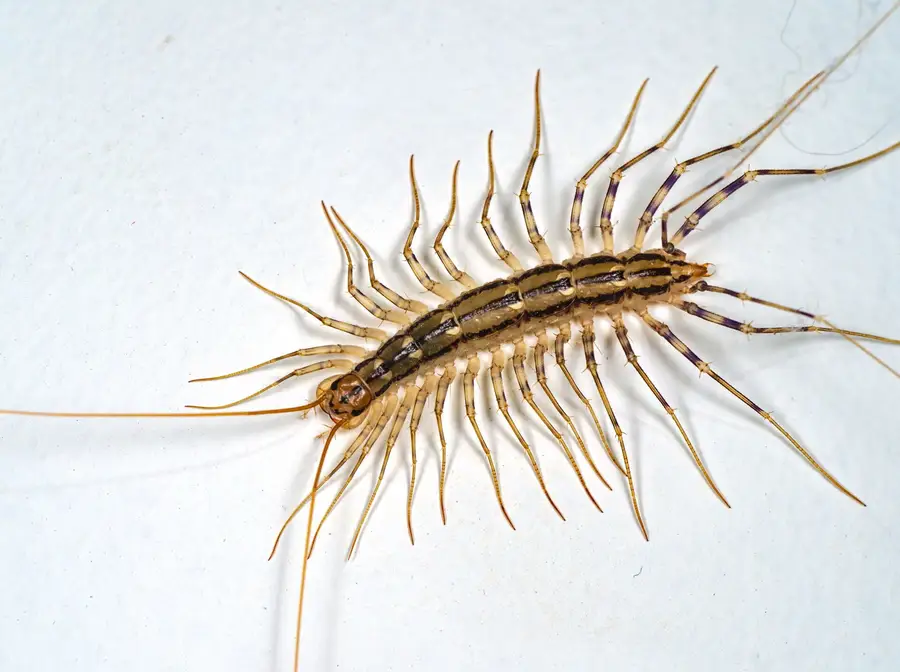
| House centipede (Scutigera coleoptrata) | Body 1 to 1.5 inches; 15 pairs of long, banded legs; yellowish with three dark stripes | Damp, cool places: basements, crawl spaces, floor drains | Harmless; hunts silverfish, firebrats, cockroaches and other small arthropods | Penn State |
| Earwig | About 3/4 inch; reddish brown; pincers at the tail end | Outdoors under mulch and debris; comes inside when it is too dry, hot or cold | Not a health hazard; can bite if trapped in clothing; chews seedlings and soft fruit | UC IPM |
| Booklice (psocids) | 1 to 2 mm; soft, flat, wingless; tan to gray; wide head | Humid, dark spots on moldy paper, books, wallpaper and stored grain | Do not damage paper directly; can contaminate food; signal high humidity | Penn State |
Penn State lists silverfish and firebrats first among the house centipede’s prey and notes that many centipedes usually mean plentiful prey, so a house with lots of centipedes may also have a silverfish problem. A slower, rounder many-legged visitor is the millipede, which eats dead leaves and usually dies within a few days of wandering indoors.
What Causes Silverfish in a House
“The presence of silverfish or firebrats indicates too much moisture in the area.”
Silverfish need three things: humidity, shelter and starchy food. UC IPM says silverfish do best at 71 to 90°F, and that at higher temperatures the relative humidity must be above 75%. The usual sources of that moisture in a house are:
- Leaks and drips: plumbing under sinks, sweating pipes, wet crawl spaces, roof or gutter leaks.
- Rooms without airflow: bathrooms, laundry rooms and basements.
- New construction: UC IPM and Ohio State note that damp plaster, fresh concrete and green lumber can support large numbers.
- Clutter: old newspapers, magazines, books, cardboard boxes and stored clothing give food and hiding places.
Silverfish also hitchhike in food containers, furniture, old books, papers and starched clothing (Ohio State). Damp wood that draws silverfish can also draw carpenter ants, which nest in damp or decayed wood, so it is worth checking for both when you find a leak.
Why they show up in the bathtub and sink
A silverfish in the tub did not come up the drain. UC IPM explains that they cannot crawl up through drains; they fall in while seeking water and cannot climb the slippery sides. It means the bathroom is humid enough to suit them.
When silverfish are most noticed
Because they live indoors, silverfish turn up all year. Our iNaturalist count by month shows that, with a spring peak.
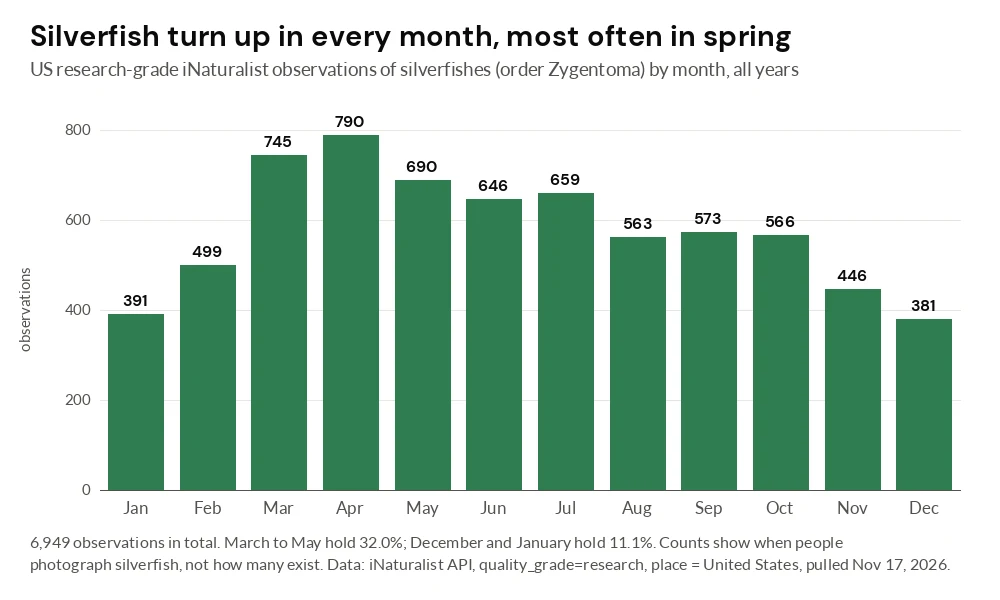
April has the most observations (790) and December the fewest (381). March to May hold 32.0% of the year’s records, while December and January together hold 11.1%. These counts show when people photograph silverfish, not how many exist. One caution: only 456 of the 4,388 US silverfish observations from 2025 had reached research grade when we pulled them, because recent photos are still waiting for identifiers, so we charted all years together.
Are Silverfish Harmful? Bites, Disease and Allergies
To people and pets, no. Virginia Tech says silverfish and firebrats are harmless to humans and do not bite, sting or transmit diseases. UC IPM explains that their jaws are so weak they scrape paper instead of biting it. That sets them apart from the kissing bug, an occasional indoor visitor that does bite and can carry the parasite that causes Chagas disease. Like stink bugs and Asian lady beetles, silverfish are a nuisance, but unlike those fall invaders, which do not breed indoors, silverfish live and breed inside the house.
Allergy is a less settled question. The WHO/IUIS allergen database lists a silverfish protein, the tropomyosin Lep s 1, and records that 9 of 133 arthropod-allergic patients tested had antibodies that bound to it. That shows sensitization is possible, not that silverfish commonly cause allergy or asthma symptoms; no extension fact sheet we reviewed lists them as a health risk.
What Silverfish Eat and the Damage They Leave
UC IPM lists dry foods such as cereals, flour, pasta and pet food; paper with glue or paste; paper sizing, including wallpaper; book bindings; and starch in clothing, plus dust, dead insects and some fungi. Gut enzymes let them digest cellulose. Penn State adds that despite their reputation, silverfish prefer protein-rich foods such as dried beef and dead insects, and do not feed on wool.
- Books and paper: surface grazing, missing letters and irregular holes, often with stains from fungi that grow where they feed (UC IPM). Maryland Extension says newsprint, cardboard and brown wrapping paper are seldom attacked; Virginia Tech says they readily feed on cardboard.
- Wallpaper: holes, or paste eaten from underneath.
- Clothes: Mississippi State says holes in cotton or linen point to silverfish rather than clothes moths or carpet beetles, though all three eat silk.
- Stored food: flour, cereal and pet food can be eaten or soiled.
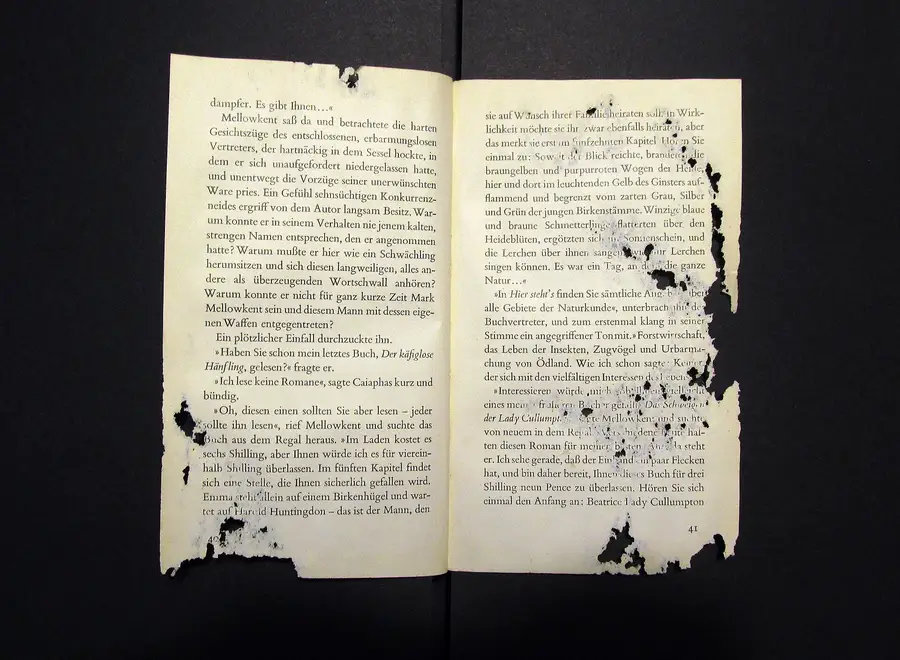
Keep the scale in mind. Iowa State and Texas A&M AgriLife Extension say damage is significant only when a large population has been present for a long time. The University of Kentucky says silverfish rarely cause significant property damage but threaten antique books, historic wallpaper, tapestries and other collectibles, and suggests a pest control professional where such items are kept.
How to Get Rid of Silverfish
The extension sources we reviewed follow the same basic order: confirm the pest, dry the area, remove food and hiding places, and use pesticides last, if at all. UC IPM says insecticides are not needed for light infestations or an occasional insect.
1. Monitor with traps
Because silverfish are nocturnal, UC IPM recommends cockroach sticky traps to detect and monitor them, placed in corners and along edges. A homemade version works too: wrap the outside of a small glass jar in masking tape. The insects climb the tape, fall in and cannot climb the smooth glass, a trick both UC IPM and the National Pesticide Information Center describe. Ohio State says sticky traps can also control small populations.
2. Dry the area out
This step decides whether the others work. Repair leaks and drips, run a dehumidifier in basements, bathrooms and closed rooms, use fans, and insulate sweating pipes (NPIC). Penn State adds plastic sheeting over dirt crawl-space floors, clean gutters and grading that drains water away. UC IPM says fan ventilation can lower humidity to a point silverfish cannot tolerate. Extension sources give no single humidity target for silverfish; for booklice, another moisture-loving pest, Penn State says relative humidity below 50% prevents mold growth and their development. If you keep extracted honey in the house, the dehumidifier helps there too: above about 60% relative humidity, ripe honey starts absorbing water, as our guide to how humidity affects extracted honey explains.
“It is almost impossible to control large populations of silverfish and firebrats unless you have removed dripping water and moist surfaces.”
3. Take away food and hiding places
- Store cereals, flour, pasta, meal and pet food in airtight containers, a step that also helps with sugar ants and other pantry visitors.
- Put photos, important papers and stored clothing in sealed plastic containers instead of cardboard boxes.
- Get rid of old stacks of newspapers, magazines and cardboard, and move books on shelves now and then (UC IPM).
- Vacuum regularly. Ohio State says vacuuming usually clears infestations in carpets where cornstarch-based cosmetics or snacks have fallen.
4. Seal cracks and entry points
Caulk cracks and gaps behind baseboards, around window and door trim, and where pipes pass through walls and floors, as Penn State and NPIC advise. NPIC also suggests moving lumber piles and debris away from the house.
5. Dusts and sprays, only if needed
For heavy infestations, extension sources describe a few options, all applied to cracks, crevices and wall voids rather than open rooms:
- Diatomaceous earth and silica gel: Penn State calls these desiccant dusts and says they work only while they stay dry and best when water sources are reduced. UC IPM says they stay effective indefinitely in dry spots but cake when they get wet. UC IPM says to leave a fine layer with a bulb duster or squeeze bottle, because a thick layer makes the surface slippery.
- Boric acid: Iowa State describes boric acid dust as very low in toxicity and long lasting in dry, undisturbed voids. UC IPM cautions that several boric acid dusts are ineffective against firebrats, so identify your insect first.
- Residual sprays: UC IPM and Penn State list household sprays with synergized pyrethrins or pyrethroids labeled for silverfish, directed in small amounts into cracks and hiding places. Follow the label.
- Skip: UC IPM says foggers are not recommended and baits are not very successful, because silverfish tend not to feed on them.
Expect results in weeks. Ohio State says control can take 10 to 14 days; UC IPM says that if a thorough treatment has not worked in 2 or 3 weeks, the insects are coming from untreated hiding places or an unfixed water source. Ohio State recommends a licensed pest control operator when infestations persist or the source is hard to find.
“They have an amazing ability to live for a very long time without food and water, so you need to expect to battle these for a little while and just be patient with your progress.”
Silverfish Control and Bees
Silverfish are an indoor problem, so nothing in the plan above calls for spraying a yard, garden or flowering plant where bees forage. The pyrethrins and pyrethroids used against silverfish are broad-spectrum and toxic to bees on contact, as our guide to pollinator-safe pest control explains, which is one more reason to start with drying, sealing and storage and to keep any dust or spray inside wall voids and cracks. If silverfish turn up where you store beekeeping equipment, check the stored frames for wax moths as well; our guide to preventing wax moths in stored equipment covers them. For more indoor and garden insects, see our garden and household insects guides.
Frequently Asked Questions
Are silverfish harmful to humans?
No. They do not bite, sting or spread disease. The damage is to paper, books, wallpaper, natural-fiber fabric and dry food, and their presence points to excess moisture.
What do silverfish look like?
A wingless, silver or pearl-gray insect about 1/2 inch long with a body that tapers from head to tail, two long antennae and three long tail filaments.
What do silverfish eat?
Starchy and sugary materials such as paper sizing, book-binding glue, wallpaper paste, starched clothing, cereal, flour and pet food, plus dead insects, dust and some molds.
Do silverfish bite you?
No. Their jaws are too weak to bite skin; on paper they scrape rather than bite, according to UC IPM.
Can silverfish cause breathing problems?
There is no extension guidance that they do. Some arthropod-allergic people show antibodies to a silverfish protein, so sensitization is possible, but a link to breathing problems has not been shown.
Do silverfish eat humans?
No. They feed on starch, paper, glue, fabric fibers, dry food, dust and dead insects, not on people, and their jaws cannot break skin.
Are silverfish poisonous?
No. They have no venom, and Medical News Today’s medically reviewed guide says they are not poisonous. They can soil food they get into, so throw out infested dry goods.
Why do silverfish appear?
Usually because a room is damp: a leak, a sweating pipe, a humid bathroom or basement, or new construction that has not dried out. They can also ride in on boxes, books, furniture and food packages.
How do I get rid of silverfish?
Monitor with sticky traps, lower the humidity, fix leaks, store paper and dry food in sealed containers, declutter and seal cracks. Save dusts and crack-and-crevice sprays for heavy infestations.
The Bottom Line
A silverfish is a harmless but telling houseguest: it says a room is too damp. Dry the room, box up paper and dry food, and save dusts and sprays for heavy infestations, applied indoors in cracks only.
Image credits: Featured image: AJC (ajcann.wordpress.com), Wikimedia Commons, CC BY-SA 2.0, cropped and resized. Common silverfish (top view): Steven Lamonde, CC BY 4.0. Gray silverfish: Rene Sylvestersen, CC BY-SA 4.0. Firebrat: Ryan Hodnett, CC BY-SA 4.0. Jumping bristletail: Katja Schulz, CC BY 2.0. House centipede: Gilles San Martin, CC BY-SA 4.0. Silverfish on a wall: Christian Fischer, CC BY-SA 3.0. Book damage: Micha L. Rieser, attribution licence. All photos via Wikimedia Commons, resized; links to each file page and licence are in the captions. Charts: BeeKeepersRealm, from iNaturalist API data pulled November 2026.