Reviewed by Thomas B. · How we review
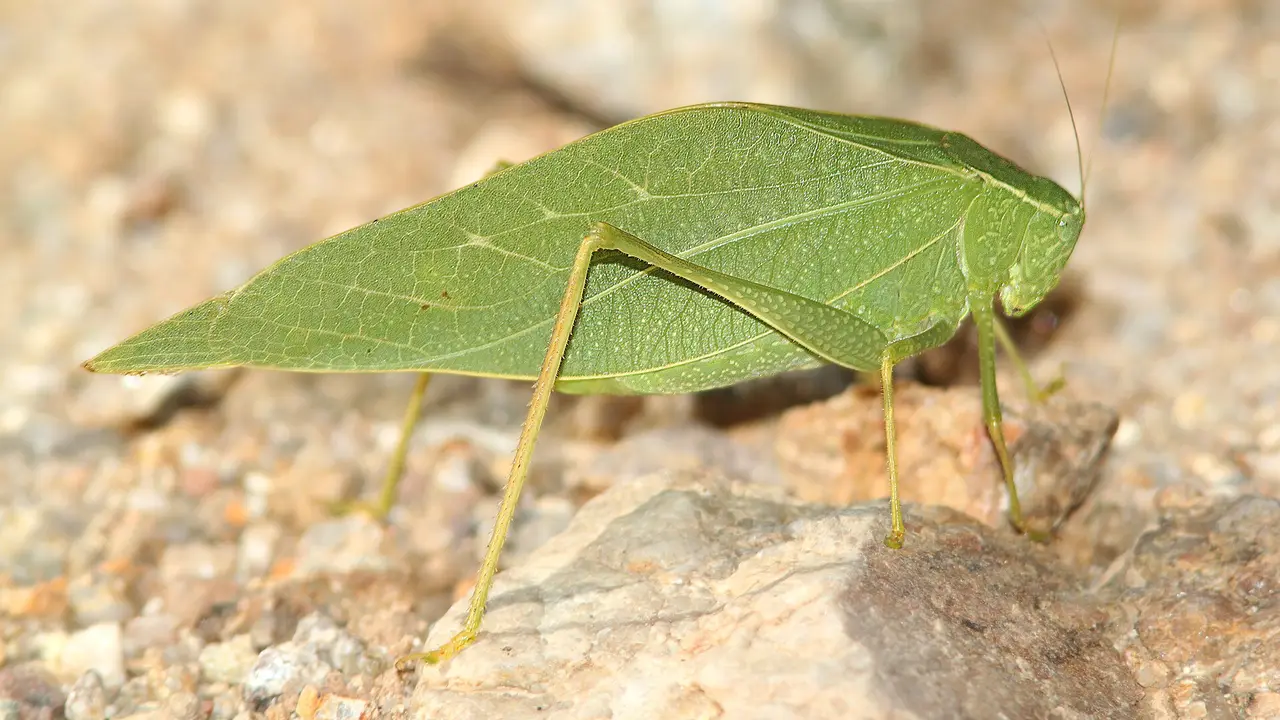
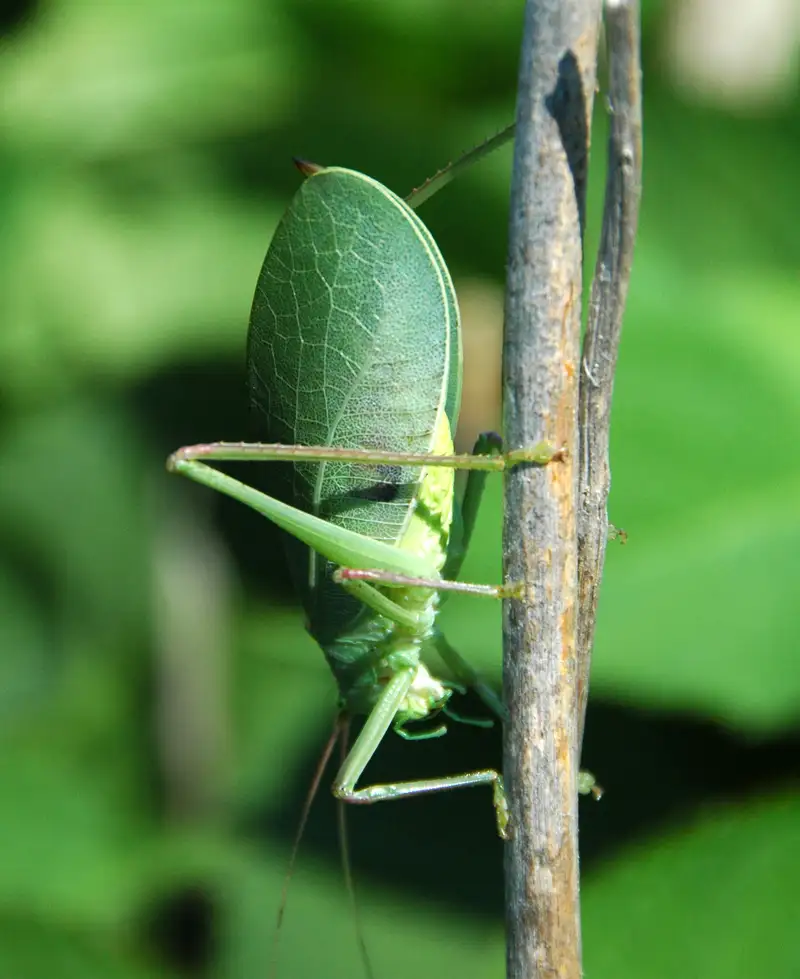
A katydid is a leaf-green, mostly nocturnal insect in the family Tettigoniidae, related to crickets and grasshoppers. You can tell one by its hair-thin antennae, as long as its body or longer, wings held like a peaked roof, and, in females, a flat, blade-shaped egg-layer. Males sing at night by rubbing their wings together. Katydids are harmless apart from a pinch if handled, and their leaf feeding rarely matters in a garden.
Below: how to identify common US katydids and their look-alikes, how and when they sing, their eggs and nymphs, pink katydids, and whether to act. It includes our own count of 123,904 US iNaturalist records showing when katydids are found.
Key Takeaways
- About 250 to 255 katydid species live in North America, out of more than 8,000 worldwide (Missouri Department of Conservation, University of Wisconsin Extension).
- Long, thin antennae separate a katydid from a grasshopper, whose antennae are short and thick.
- The famous “katy-did, katy-didn’t” call comes from one species, the common true katydid, which sings from treetops from about July into fall.
- In our iNaturalist count, July to October hold 72.6% of US katydid records.
- Rows of flat gray eggs on a twig are angle-wing katydid eggs. They do no harm, and extension services generally recommend no control.
Table of Contents
- What a Katydid Is
- The Katydid Sound
- Common US Katydids: Identification Table
- Katydid vs Grasshopper vs Cricket
- Katydid Eggs, Nymphs and Life Cycle
- When Katydids Are Seen: Our iNaturalist Count
- Pink Katydids
- Do Katydids Bite?
- Katydids in the Garden
- What Eats Katydids
- Frequently Asked Questions
What a Katydid Is
Katydids are in the order Orthoptera with grasshoppers and crickets. Older books call them long-horned grasshoppers; in Europe they are bush crickets. University of Wisconsin Extension notes they are closer to crickets than to grasshoppers. Like every insect, they have six legs and three body parts; see how insects are classified.
Wisconsin Extension counts 255 species native to North America; the Missouri Department of Conservation (MDC) gives about 250 north of Mexico. US species run from about 1/2 inch to 4 inches long. Family traits, from both sources:
- Antennae: very long and thin, often longer than the body.
- Wings: held like a roof, often green with leaf-like veins.
- Feet: four segments. Crickets have three.
- Ears: a slit near the top of each front leg.
- Ovipositor: in females, a flat blade at the tip of the abdomen, sickle- or sword-shaped.
Most rest motionless in foliage by day and become active after dark, so they are heard far more often than seen.
The Katydid Sound
A male katydid has a comb-like file on one front wing and a hard scraper on the other, and rubs them together, Wisconsin Extension explains. In the common true katydid (Pterophylla camellifolia), the bowed wings form a hollow chamber that amplifies the sound, says Mississippi State University Extension entomologist Blake Layton. Males sing to attract females and space out rivals.
The Singing Insects of North America species page says the common true katydid’s song varies by region more than any other katydid’s:
- North: two or three pulses per phrase, about 8 pulses a second, roughly one phrase a second.
- Southeast: faster, about 12 pulses a second, three to five pulses per phrase.
- Southwest of the range: mostly one- or two-pulse phrases.
Neighboring males often alternate phrases. Illinois DNR gives the season as July through November. Songs slow as fall nights cool, and Wisconsin Extension says they usually end by October there.
Video: University of Illinois Extension’s “Voice of the Wild” sound key plays the songs of 12 common Illinois katydids, from the common true katydid to buzzing coneheads and meadow katydids.
Other katydid songs
According to MDC, the greater angle-wing gives a sharp “Dzt!” plus a run of 10 to 20 ticks, the fork-tailed bush katydid a simple “tsip!” every few seconds, and the robust conehead an extremely loud, continuous buzz.
Cicada vs katydid sounds
“Cicadas sing during the day; katydids sing at night. Some species of cicadas sing at dusk, and there can be other exceptions, but in most cases, the insects we hear singing at night are katydids or crickets.”
A cicada vibrates drum-like tymbals on its abdomen; a katydid scrapes one wing across the other. A steady daytime whine is usually a cicada, rhythmic rasping after dark a katydid.
Common US Katydids: Identification Table
| Insect | Antennae | Body and wings | Active | Song | Source |
|---|---|---|---|---|---|
| Common true katydid (Pterophylla) | Very long | 1 1/2 to 2 1/2 in; cupped oval wings; treetops | Night | Loud “katy-did” rasps | MDC, SINA |
| Bush katydids (Scudderia) | Very long; banded in nymphs | About 1 1/8 in; slender; narrow wings | Night | Soft “tsip!” | UC IPM, MDC |
| Angle-wing katydids (Microcentrum) | Very long | 2 to 2 1/2 in; broad, angled wings; humped back | Night | Ticks and “Dzt!” | MDC, UC IPM |
| Meadow katydids (Orchelimum, Conocephalus) | Long | 1/2 to 1 in; often short-winged; tall grass | Day and night | Ticks, then a buzz | MDC |
| Coneheads (Neoconocephalus) | Long | Up to about 3 in; pointed cone on head | Night | Loud buzz | MDC, UF/IFAS |
| Grasshopper (look-alike) | Short, thick | Ears on the abdomen | Day | Some, by day | Wisconsin Extension, UC IPM, Eric R. Eaton |
| Cricket (look-alike) | Long | Three foot segments, not four | Often night | Chirps, trills | Wisconsin Extension, Eric R. Eaton |
Sizes are adult body lengths as given by each source.
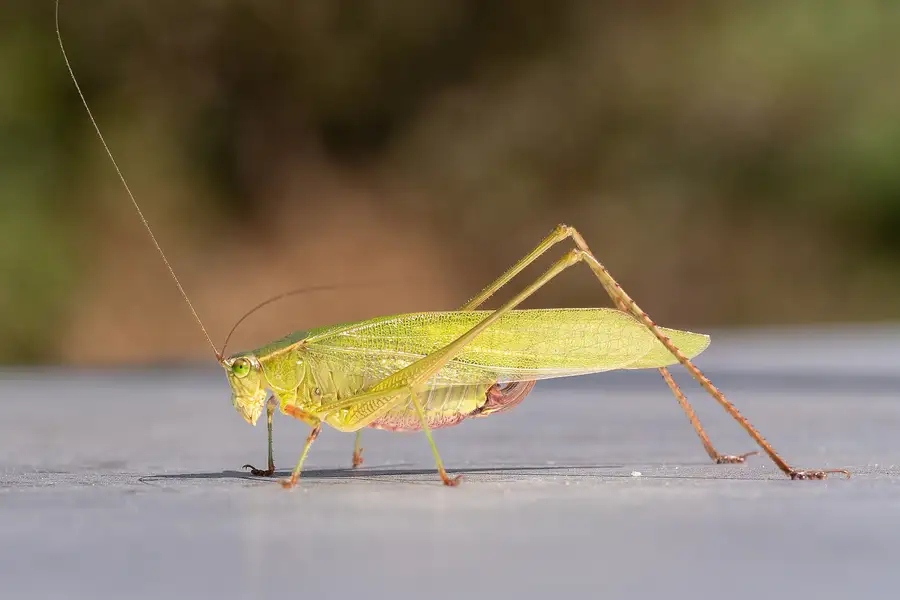
UF/IFAS says a disturbed broad-tipped conehead may dive head first into grass, where its slim body looks like a grass blade.
Katydid vs Grasshopper vs Cricket
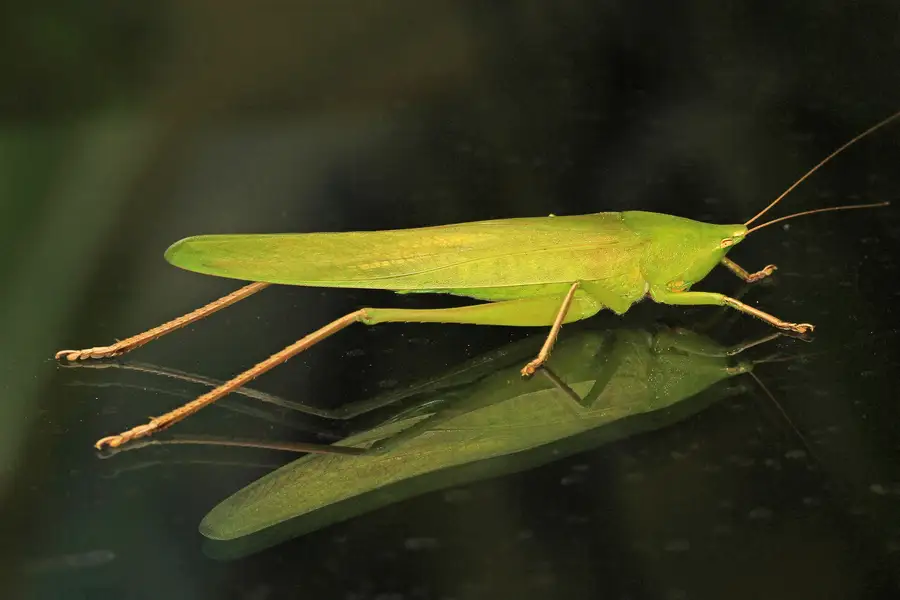
- Katydid vs grasshopper: check the antennae. A grasshopper’s are always short and fairly thick (Wisconsin Extension), and grasshoppers are active by day while katydids feed at night (UC IPM).
- Katydid vs cricket: both have long antennae and sing with their wings. Count the foot segments: four in katydids, three in crickets. Entomologist Eric R. Eaton notes most male katydids are “left-handed,” left wing over right, while most crickets are the reverse.
Katydid Eggs, Nymphs and Life Cycle
Katydids go from egg to nymph to adult, with no pupa. In most of the US they overwinter as eggs, hatch in spring and molt through about five nymph stages before becoming adults in summer. MDC, UC IPM and Colorado State describe one generation a year for the common species.
Katydid eggs
- Angle-wing katydids glue flat, gray, oval eggs in overlapping rows on twigs or leaf midribs, each about 1/5 inch (UC IPM). Colorado State compares the rows to fish scales.
- Fork-tailed bush katydids insert eggs into leaf edges (UC IPM).
- Common true katydids lay in bark crevices (MDC).
- Oblong-winged katydids lay in soil, and eggs can take two years or more to hatch (UF/IFAS).
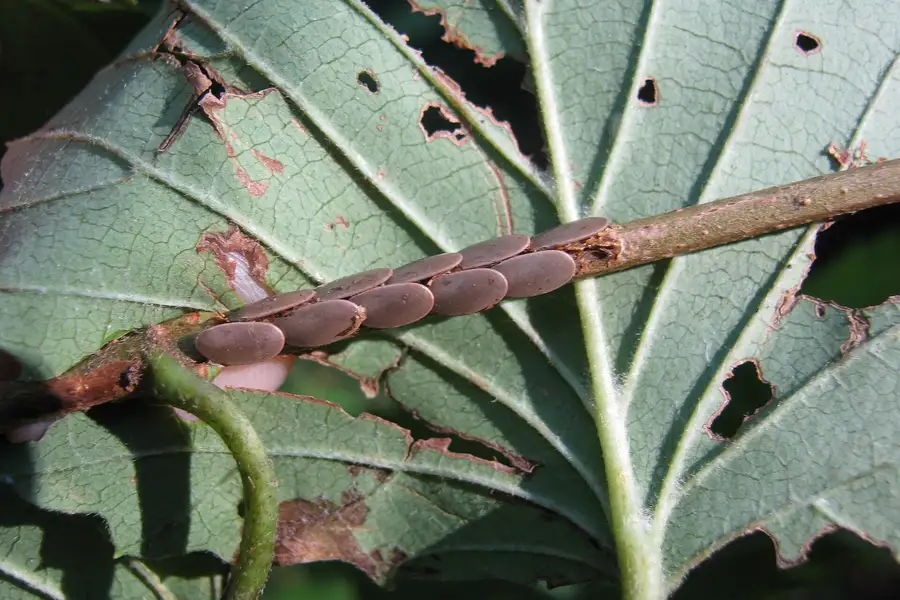
Should you remove katydid eggs? No. None of the extension sources we read recommends it, and Colorado State says katydids are never abundant enough to cause significant plant damage.
Katydid nymphs
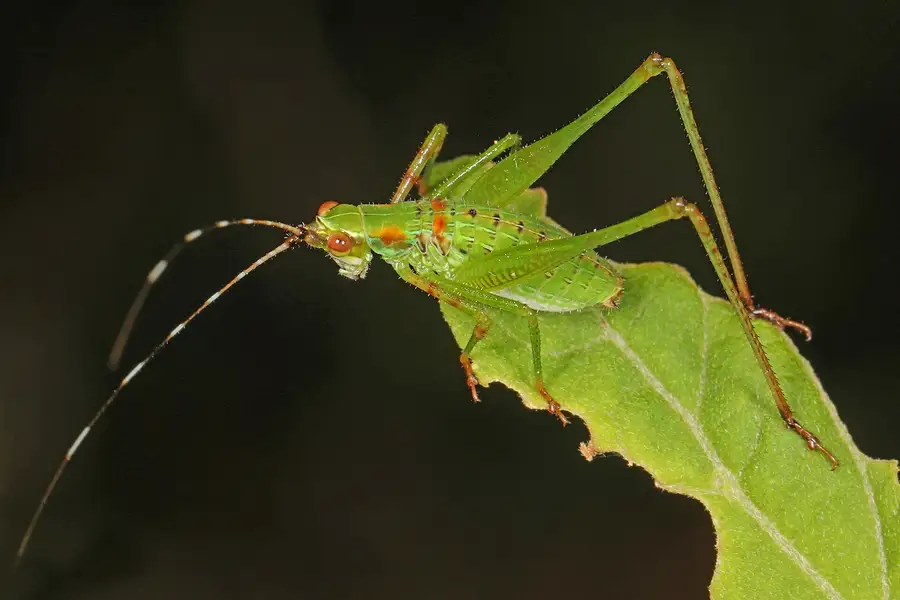
Nymphs look like small, wingless adults. UC IPM notes fork-tailed bush katydid nymphs have black-and-white banded antennae.
When Katydids Are Seen: Our iNaturalist Count
We pulled every research-grade US katydid observation from the iNaturalist API on November 17, 2026: 123,904 records. August (26,928) and September (27,126) are the peak months.
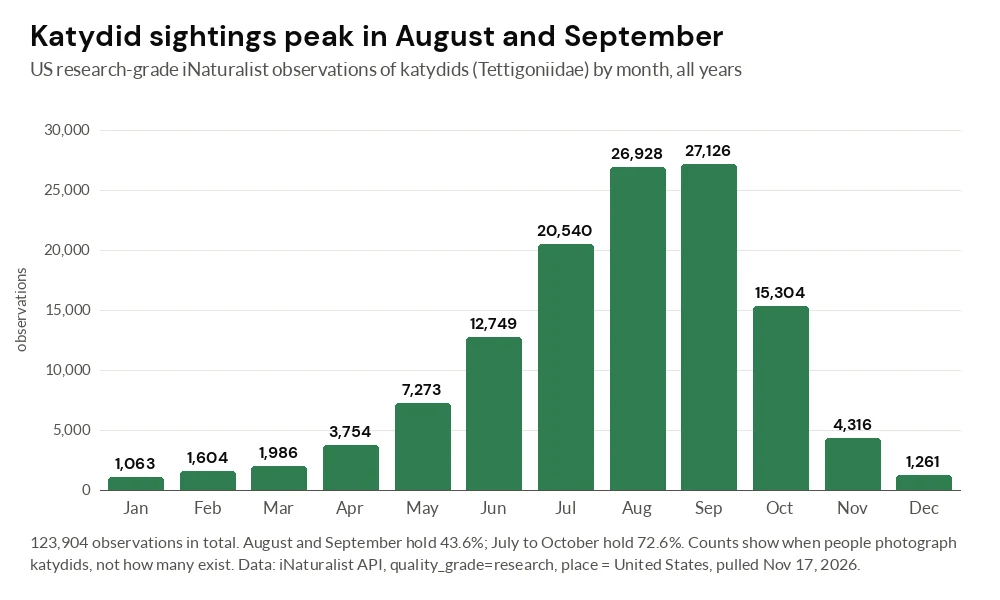
Two caveats. Research grade needs an agreed ID, so these records are about a third of the 393,292 at all quality grades. And winter records are regional: 2,335 of the 2,667 January and February records (87.6%) come from Florida, Texas, California and Hawaii.
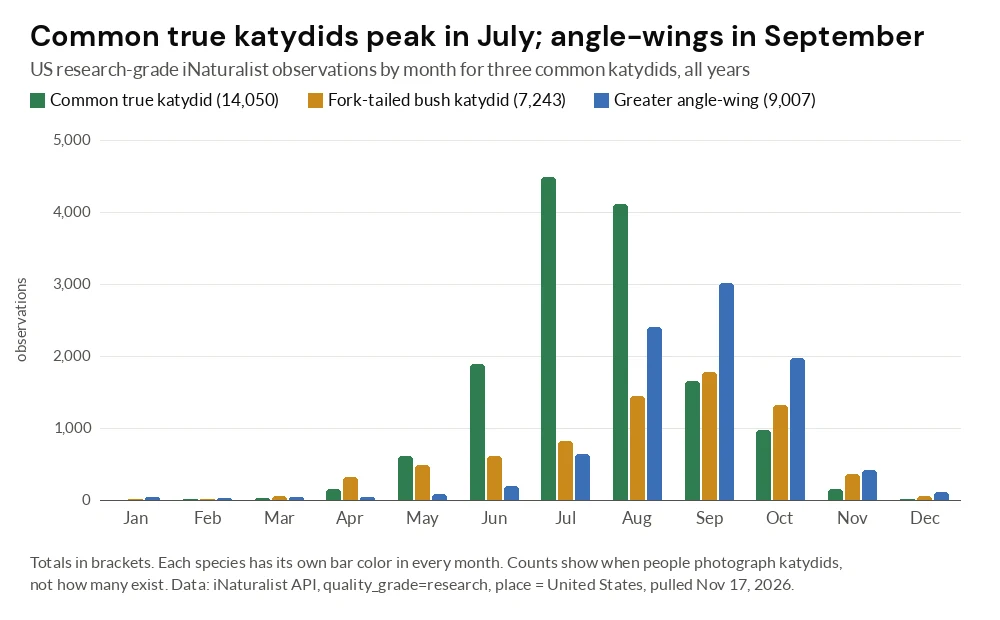
The common true katydid peaks in July (4,490 of 14,050 records). The greater angle-wing peaks in September (3,015 of 9,007), with 82.1% of its records from August to October.
Pink Katydids
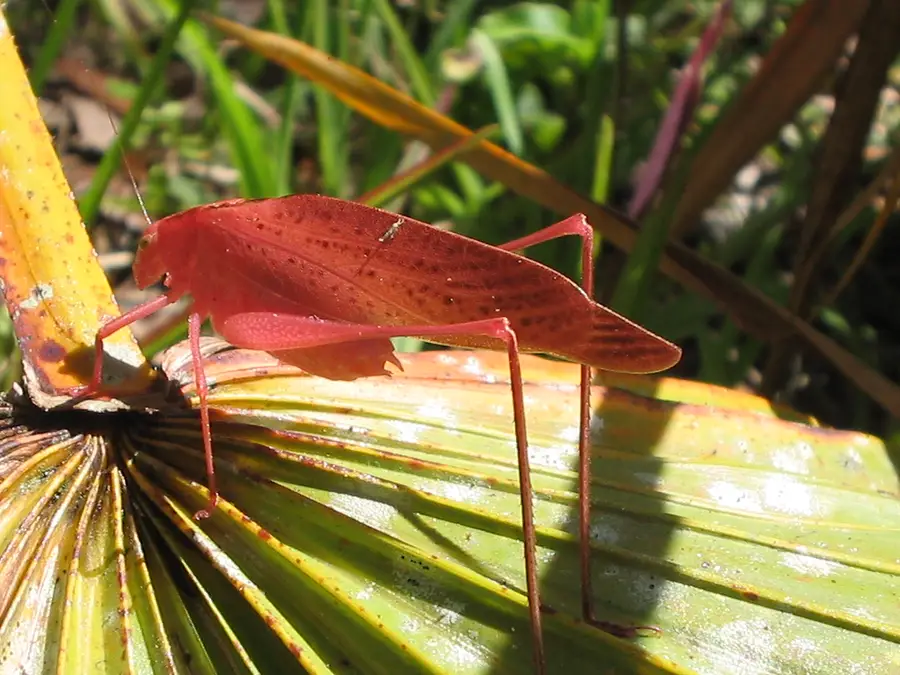
A bright pink katydid turns up now and then, most often the oblong-winged katydid (Amblycorypha oblongifolia). The color comes from a genetic condition called erythrism, not diet. Scientific American credits Chicago entomologist Joseph Hancock with first breeding pink katydids, in 1916, which showed the color is inherited.
Sources disagree on how. Wisconsin Extension calls it recessive, with about one pink katydid in 500. MDC says pink is apparently dominant in this species, a finding from captive breeding at the Audubon Butterfly Garden and Insectarium in New Orleans, reported by Scientific American in 2013. Either way, pink ones stay rare because predators spot them easily.
Do Katydids Bite?
Katydids do not sting and are not aggressive, but large ones can bite if handled.
“Some large species of katydids, including coneheads and meadow katydids, have strong jaws for cracking open seeds and can give you a hearty nip. Handle with care.”
The blade on a female’s abdomen is for laying eggs; MDC says these ovipositors are not harmful to humans. Adults sometimes come to porch lights (UC IPM).
Katydids in the Garden
Most katydids eat leaves, and some take flowers, fruit or seeds. Small nymphs chew holes in leaves; larger ones chew ragged edges.
“Because the katydids chew on only one or a few leaves before moving elsewhere to feed, leaf chewing by these insects is not important to plant health.”
The exception is young fruit. UC IPM says fork-tailed bush katydid nymphs take single bites from young citrus and stone fruit, leaving corky scars, though the fruit inside is little affected. That is far milder than a Japanese beetle infestation, where groups of beetles skeletonize the leaves.
UC IPM generally recommends no control for katydids on home fruit trees; pick off the few you find. UF/IFAS puts it simply: “The best way to deal with these katydids is to tolerate their presence.”
Where fruit scarring is a real problem, UC IPM mentions spinosad after petal fall but warns it is toxic to honey bees for at least several hours after spraying and should never go on plants in flower. Our guide to pollinator-safe pest control explains why even organic sprays can kill bees.
This is educational information, not professional pest-control advice. Follow the label on any pesticide, and see UC IPM’s katydid page for current guidance.
What Eats Katydids
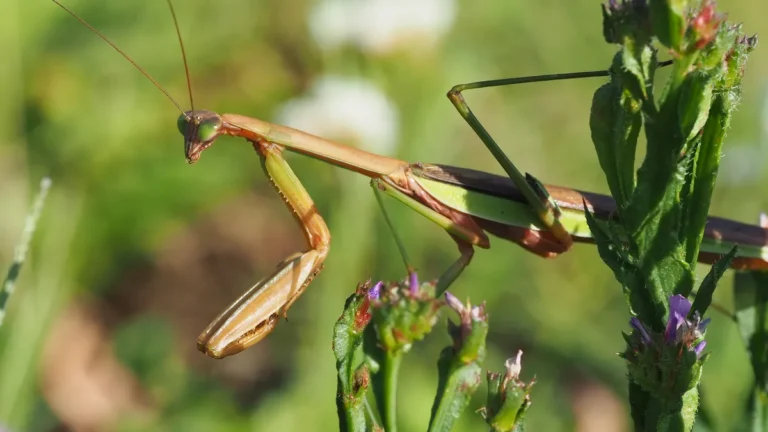
Wisconsin Extension lists birds, bats, rodents, tree frogs, spiders and praying mantises; MDC adds snakes.
The best-known katydid hunter in US yards is the great black wasp. Illinois DNR says the female paralyzes katydids, crickets or grasshoppers with her sting and stocks each underground nest cell with two to six prey and one egg. The adult feeds on nectar and pollen, and Illinois DNR counts it as a pollinator. MDC also lists katydids as important food for the great golden digger wasp. Our predatory wasp comparison chart lists which wasp takes which prey.
For beekeepers, katydids are a low-stakes neighbor: none of our sources describes them as a problem for bees, and the main risk comes from a spray aimed at them.
Frequently Asked Questions
Is a katydid harmless?
To people, yes. Katydids do not sting, and the female’s egg-laying blade is not a stinger. Large species can pinch if handled.
How rare is it to see a katydid?
They are common but hard to spot, because most rest motionless in foliage by day and the common true katydid lives high in trees.
Is the katydid a grasshopper?
No. Both are in the order Orthoptera, but katydids have their own family and are closer to crickets. Grasshoppers have short, thick antennae.
Are cicadas and katydids the same thing?
No. Cicadas are true bugs that sing by day with tymbals. Katydids are related to crickets and sing mostly at night with their wings.
Are katydids good or bad for the garden?
Mostly neutral. They chew a few leaves and move on, they feed birds, bats and wasps, and control is generally not recommended.
What does a katydid sound like?
The common true katydid makes loud, raspy phrases of two or three pulses about once a second. Other species tick, click or buzz.
Do katydids make noise all night?
Often. Wisconsin Extension says they generally start late at night and continue into the early morning in late summer.
Why are katydids so loud?
Many males sing at once, and in the common true katydid the bowed wings form a resonating chamber, according to Mississippi State University Extension.
The Bottom Line
A katydid in your yard is a harmless night singer. Learn the song, leave the eggs on the twig, and keep sprays off anything in bloom.
Featured image: greater angle-wing katydid by Alan Schmierer, Wikimedia Commons, CC0 public domain, cropped. Charts by BeeKeepersRealm from iNaturalist data.