Reviewed by Elena P. · How we review
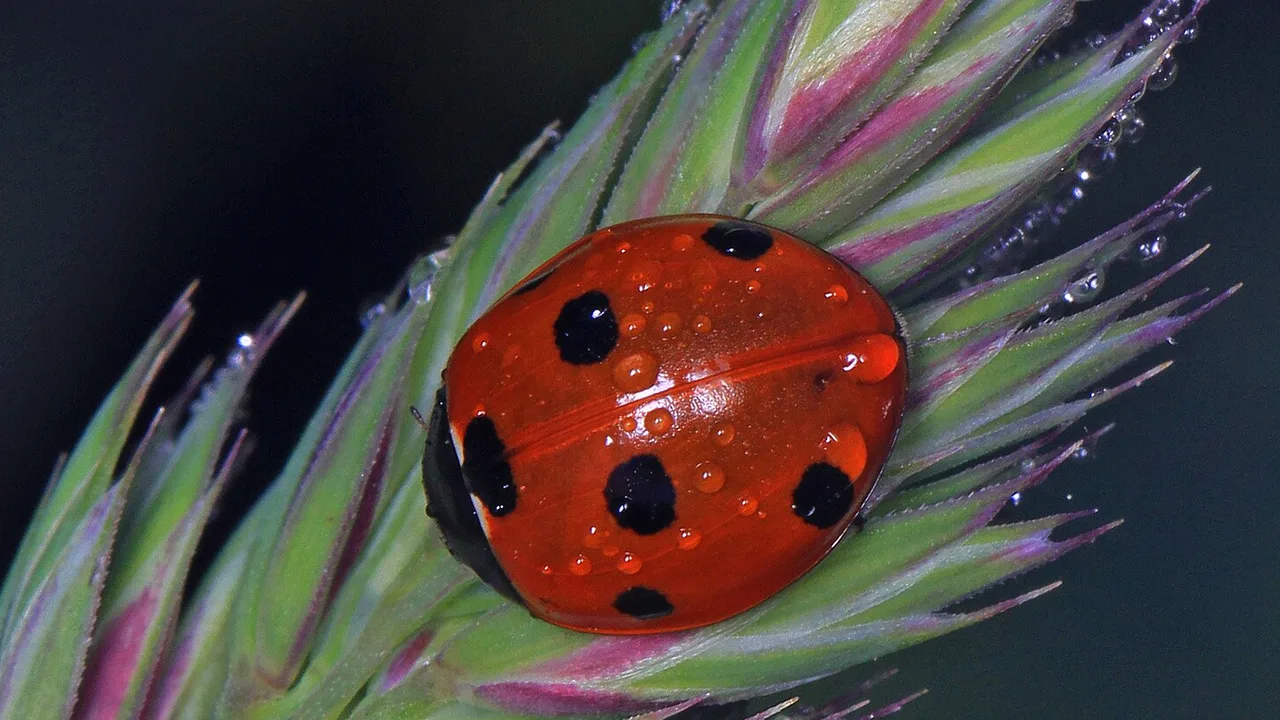
A ladybug is a small, round, usually dome-shaped beetle in the family Coccinellidae, also called a lady beetle or ladybird beetle. Cornell University counts over 450 species in North America, and most eat aphids and other soft-bodied pests as both larvae and adults. The ladybug that piles onto sunny walls and slips indoors each fall is usually the multicolored Asian lady beetle, an introduced species with a black M or W mark behind its head. It does not breed indoors. Seal gaps before fall and vacuum up the beetles that get in.
Below: how to tell US lady beetles apart, what they eat, Asian lady beetles indoors, buying ladybugs, and our own count of 581,112 US iNaturalist observations.
Key Takeaways
- “Ladybug,” “lady beetle” and “ladybird beetle” all name the same beetle family, Penn State Extension notes.
- Two introduced species lead US records: the Asian lady beetle holds 47.0% of research-grade iNaturalist lady beetle observations, and the seven-spotted lady beetle 16.5%.
- The spiny, alligator-like larva is a heavy aphid eater; Illinois Extension says one Asian lady beetle larva eats up to 370 aphids while it develops.
- Asian lady beetles come indoors in fall to overwinter but do not reproduce there. Seal gaps in late spring or summer, vacuum the rest, and skip indoor sprays.
- Store-bought convergent lady beetles are collected from wild winter swarms, and most fly away within a day or two of release, according to UC IPM.
Table of Contents
- What Is a Ladybug?
- How to Identify Common US Ladybugs
- Ladybug Life Cycle: Egg, Larva, Pupa, Adult
- What Do Ladybugs Eat?
- Asian Lady Beetles in the House
- Do Ladybugs Bite? Are They Harmful to People or Pets?
- Should You Buy Ladybugs for Your Garden?
- The Native Ladybugs That Disappeared
- Keeping Ladybugs in a Bee-Friendly Garden
- Frequently Asked Questions
What Is a Ladybug?
Ladybugs are beetles, with hardened front wings (elytra) and chewing mouthparts, not true bugs with a piercing beak. Our page on why a bee is an insect but not a bug explains how these groups fit together. Penn State Extension says “lady beetle,” “ladybug” and “ladybird beetle” are simply different common names for the family Coccinellidae, so memes claiming they are different insects are wrong.
Worldwide counts range from about 5,000 species (National Geographic, San Diego Zoo) to more than 6,000 (BBC Earth). A 2014 Northeastern Naturalist study led by Cornell entomologist John Losey puts North America north of Mexico at more than 500, 26 of them exotics brought in for biological control. Most are predators, but two, the Mexican bean beetle and the squash beetle, eat plants.
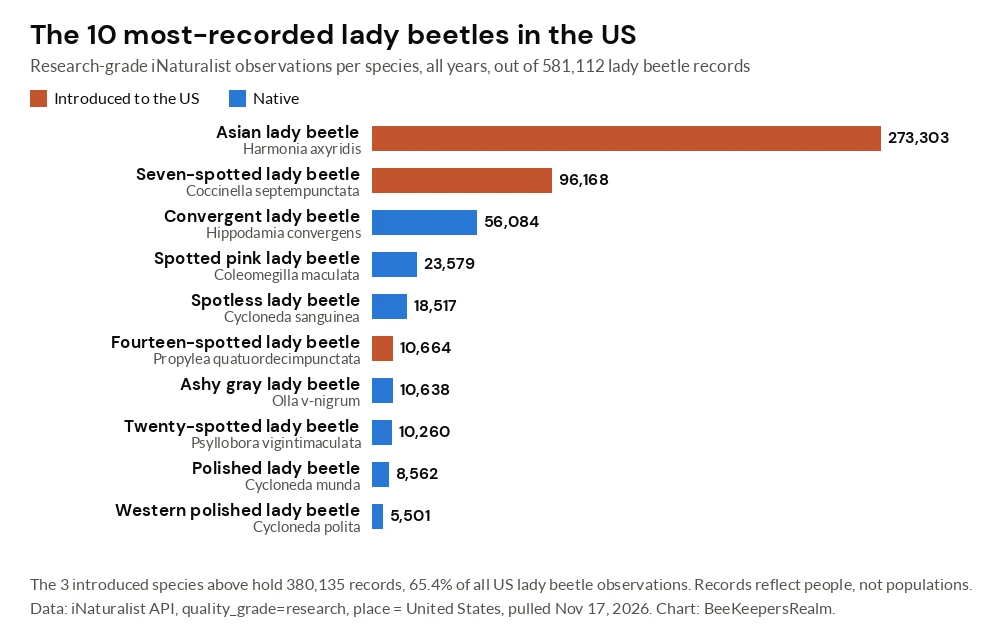
We pulled every research-grade US iNaturalist record of the family: 581,112 observations of 279 species. The multicolored Asian lady beetle accounts for 273,303 (47.0%), the seven-spotted lady beetle 96,168 (16.5%) and the native convergent lady beetle 56,084 (9.7%). The three introduced species in the top 10 hold 65.4% of all records. The counts reflect what people photograph, not population sizes, but the message is clear: two imports are now the ladybugs most Americans meet.
How to Identify Common US Ladybugs
Video: University of Kentucky horticulture agent Jessica Bessin covers Kentucky’s common lady beetles, how to pick out the Asian species and the plant-eating look-alikes, the life cycle, and why Asian lady beetles invade homes and how to keep them out, going by the webinar’s description and chapter list.
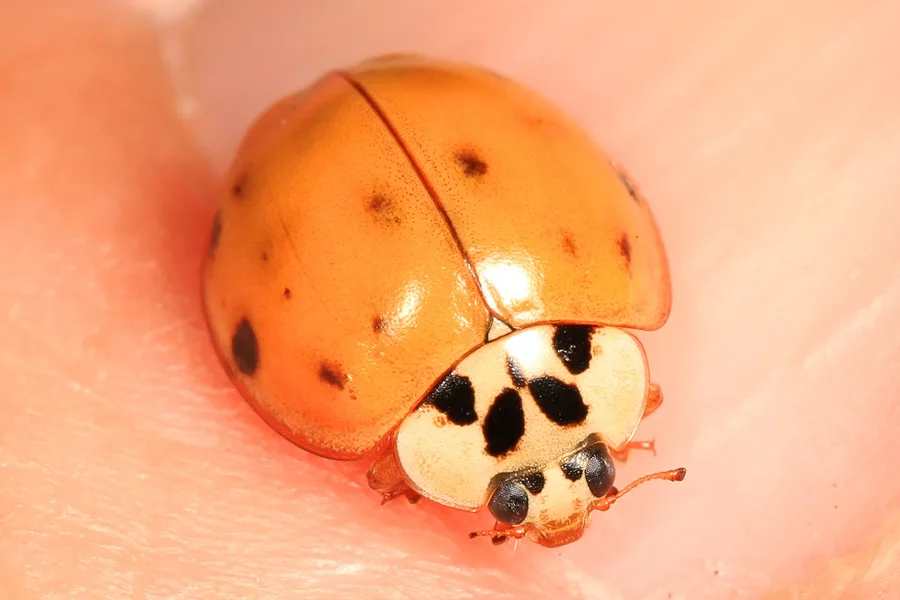
Color alone is a poor guide. Illinois Extension notes that the Asian lady beetle has 0 to 19 spots and that its M mark “isn’t always present.” Check the spot pattern, the area behind the head (the pronotum) and, for the plant feeders, the plant you found it on.
| Beetle | Native? | Color/spots | Key mark | Comes indoors? | Source |
|---|---|---|---|---|---|
| Multicolored Asian lady beetle (Harmonia axyridis) | No; established in Louisiana in 1988 | Highly variable; most red with up to 18 spots, some black with red spots; about 9/32 inch | Black M or W on the whitish area behind the head (not on every beetle) | Yes; the fall home invader | Penn State, UK Entomology, UMaine Extension |
| Seven-spotted lady beetle (Coccinella septempunctata) | No; established in 1973 | Red with seven black spots | Spots in a 1-4-2 pattern | Not named as a home invader in these sources | UMaine Extension, Losey et al. 2014 |
| Convergent lady beetle (Hippodamia convergens) | Yes | Orange to red, commonly 13 spots (UF says usually 12) | Two white lines converging behind the head | No; overwinters in outdoor swarms | UC IPM, UF/IFAS, UMaine Extension |
| Twice-stabbed lady beetle (Chilocorus stigma) | Yes | Shiny black, 3.75 to 5 mm | One large red spot on each wing cover | Not named as a home invader in these sources | Cornell biocontrol guide, UMaine |
| Spotted pink lady beetle (Coleomegilla maculata) | Yes | Pink oval, six spots per wing cover | Pink color; adults eat a lot of pollen | Rarely, per Illinois Extension | Illinois Extension, Cornell, Losey et al. 2014 |
| Mexican bean beetle (Epilachna varivestis) | No (listed as exotic) | Coppery, eight black spots on each wing cover | Chews bean and other legume leaves | No; overwinters under brush or leaves | UMaine Extension, Losey et al. 2014 |
| Squash beetle (Epilachna borealis) | Yes | Yellow or orange, seven large spots per wing cover plus four on the thorax | About twice the size of the Mexican bean beetle; feeds on squash and pumpkins | No; overwinters near field edges | UMaine Extension; native status from iNaturalist |
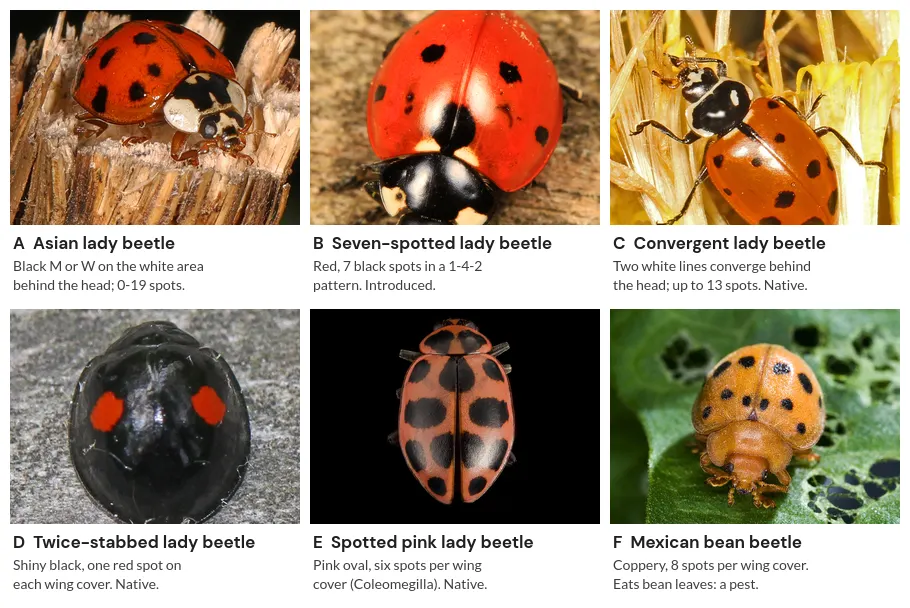
The two plant feeders are the real “bad ladybugs” of a vegetable garden. They chew leaves much like the Japanese beetle, but on a narrow menu: beans for one, squash and pumpkins for the other.
Ladybug Life Cycle: Egg, Larva, Pupa, Adult
Lady beetles go through complete metamorphosis. For the Asian lady beetle, Penn State says eggs hatch in three to five days, larvae feed for 12 to 14 days and the pupa lasts four to five days. The whole cycle takes three to six weeks, with usually four to six generations a year. UF/IFAS says the native convergent lady beetle has two generations a year over most of its range.
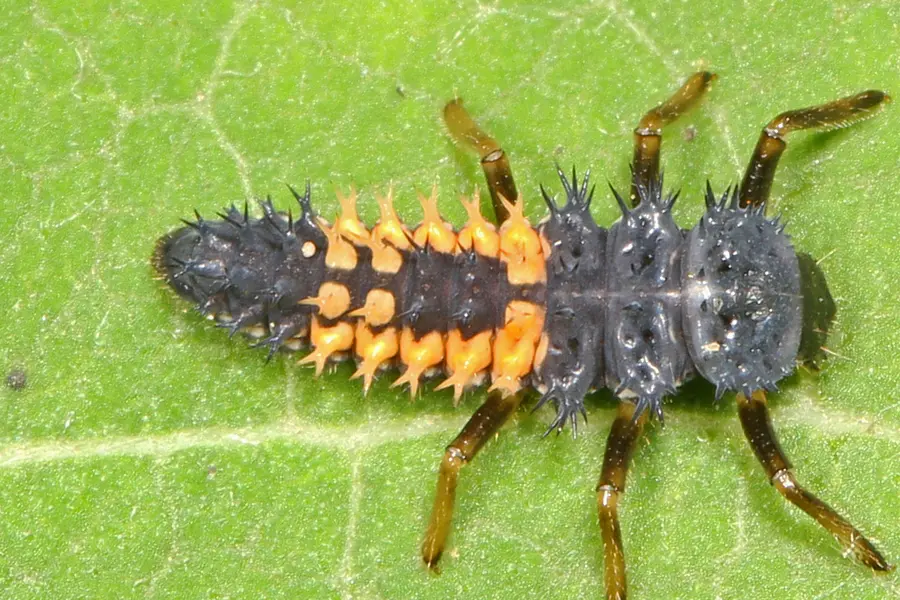
The larva is the stage gardeners most often fail to recognize. UC IPM describes convergent lady beetle larvae as long-legged and resembling “tiny alligators,” blackish with orange blotches and up to 1/4 inch long. They grow through four instars, then attach to a leaf or stem to pupate. Leave them alone.
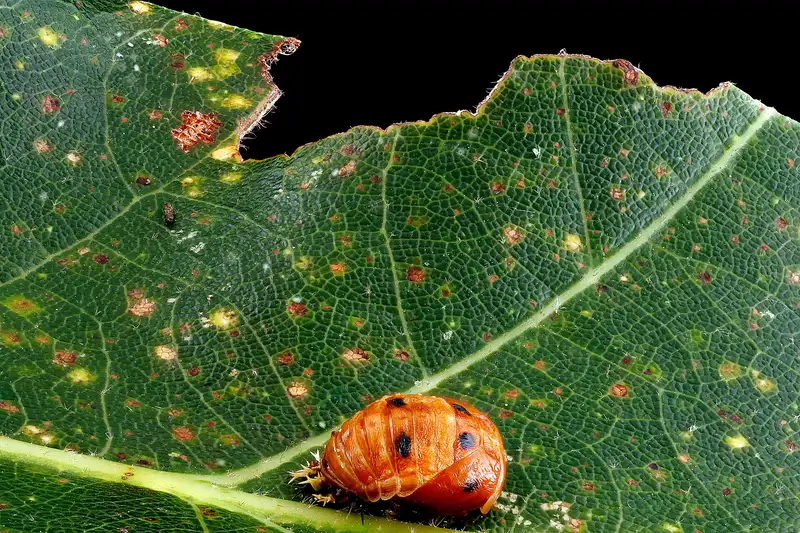
Penn State says Asian lady beetle adults typically live 30 to 90 days but can live up to three years. UC IPM gives the convergent lady beetle a growing-season lifespan of about two months. Lady beetles have enemies too: UF lists the braconid wasp Dinocampus coccinellae as a parasitoid of the convergent lady beetle, one of the tiny braconid wasps that develop inside their hosts.
What Do Ladybugs Eat?
Most lady beetles eat aphids, plus other soft-bodied prey such as scale insects, mealybugs and insect eggs. The twice-stabbed lady beetle mainly hunts scale insects, and many species also feed on pollen and nectar when prey runs short. In each source’s own figures:
| Species and stage | Aphids eaten | Source |
|---|---|---|
| Asian lady beetle, larva | Up to 370 during its development | Illinois Extension |
| Asian lady beetle, adult | Up to 65 per day | Illinois Extension |
| Seven-spotted lady beetle, larva | 200 to 300 as it grows | Cornell biocontrol guide |
| Seven-spotted lady beetle, adult | Several hundred per day | Cornell biocontrol guide |
| Convergent lady beetle, larger larva | 30 to 50 per day | UF/IFAS |
| Convergent lady beetle, adult | As many as 50 per day (Cornell); about 100 per day before dispersing (UC IPM) | Cornell, UC IPM |
The figures differ by species, stage and study, so treat them as a range rather than a precise count.
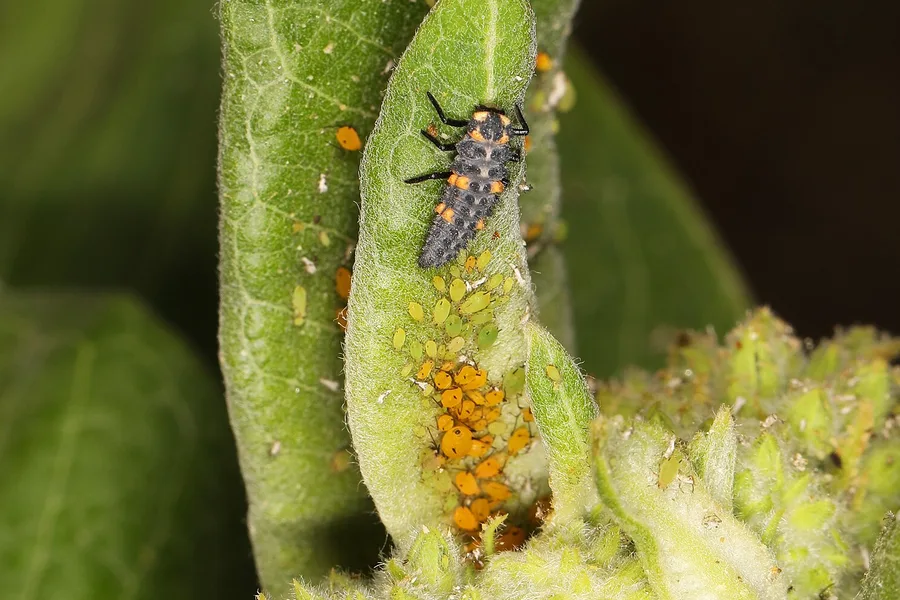
Orange aphids on milkweed are a classic ladybug buffet and a good reason not to spray monarch plants. Lady beetles share the work with other aphid predators, such as hover fly larvae.
Asian Lady Beetles in the House
The multicolored Asian lady beetle is native to East Asia. Illinois Extension says it was first released in California in 1916 to control aphids on pecans, and Penn State dates the first established North American population to Louisiana in 1988. Outdoors it is a useful predator. The trouble starts in fall.
Why they swarm sunny walls
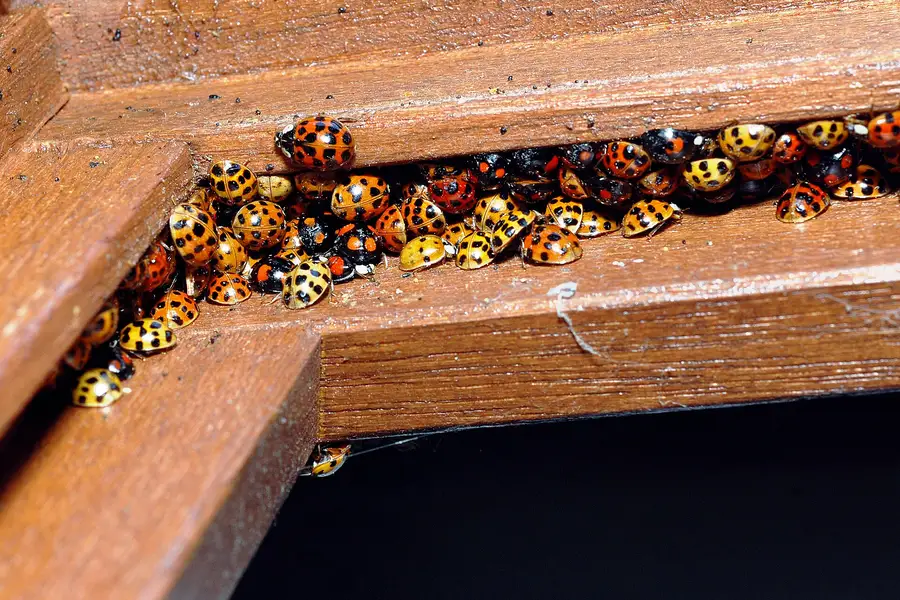
In Japan, Penn State notes, the beetles fly to south-facing rock cliffs for the winter; in North America, houses stand in for the cliffs. Penn State says they are drawn to “the sunlight reflecting off the south or southwest-facing sides” of buildings. The University of Kentucky’s ENTFACT-416 adds that light-dark contrast, such as dark shutters on a light house, matters more than house color, and that flights peak on sunny afternoons after a cold spell, once temperatures return to at least the mid-60s.
Flights run from September through November: October in Kentucky and Michigan, November to January in north Florida, according to UK Entomology and UF. Penn State says tens of thousands can gather in attics and wall voids.
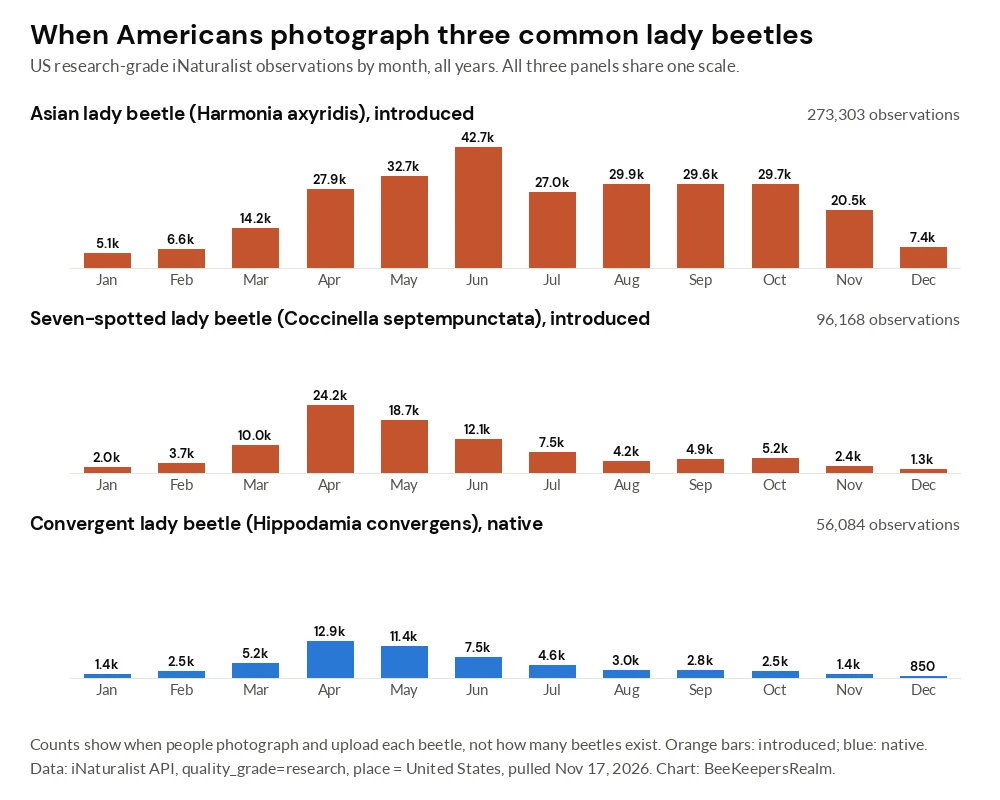
Our iNaturalist count shows the fall pattern. September through November hold 29.2% of US Asian lady beetle observations, against 13.0% for the seven-spotted and 12.0% for the convergent lady beetle, which both peak in April. In October, Asian lady beetles make up 62% of all US lady beetle observations, up from 34% in April.
What they do (and don’t do) indoors
UK Entomology says the beetles “do not reproduce indoors”; those on windows in late winter came in the previous fall. They do not eat wood, food or clothing. Clemson’s Home and Garden Information Center says beetles that find a good spot release a pheromone that draws others, so vacuum promptly. The brown marmorated stink bug uses the same sunny walls and gaps, and the same fixes work for both.
How to get rid of them
- Seal first. UK Entomology calls sealing the most permanent fix and says to do it in late spring or summer; gaps of 1/8 inch or less still let beetles in. Caulk around windows, doors, soffits, fascia boards and utility pipes, add door sweeps, and cover attic, chimney and exhaust vents with number 20 or finer screen, as Penn State advises.
- Vacuum, don’t squash. Crushed or swept beetles release a yellowish fluid that stains and smells. Penn State suggests a nylon stocking in the vacuum hose, held with a rubber band, then tied off and discarded. With a bag vacuum, Clemson says to remove the bag immediately.
- Skip indoor sprays. UK Entomology says foggers, “bug bombs” or sprays “are generally not recommended” indoors; they tend to be ineffective and may stain. Penn State adds that beetles killed inside wall voids can feed carpet beetles.
- Exterior treatment is a last resort. Where sealing is impossible, Penn State says a licensed pest control operator can treat the outside in late September or early October.
Do Ladybugs Bite? Are They Harmful to People or Pets?
Asian lady beetles occasionally bite, Penn State says. Poison Control says native ladybugs are not known to bite people, describes the Asian species’ bite as “a pinching feeling,” and notes the beetles have no venom.
“The bite feels like a pinprick and is seldom serious.”
Sources differ on how hard they pinch: Illinois Extension says they “can’t break skin,” while Clemson says they can draw blood on tender skin. Either way, wash a bite with soap and water.
Allergy is the bigger issue. Disturbed beetles reflex bleed yellow hemolymph from their leg joints, and Penn State says rhinoconjunctivitis, asthma and even facial swelling (angioedema) have been linked to infestations in homes.
Pets face a rare but real risk. A 2008 Toxicon case report from Clemson University described a dog with 16 Asian lady beetles embedded in the roof of its mouth and corrosive burns to the lining. If a pet may have eaten them and seems unwell, call your veterinarian.
Should You Buy Ladybugs for Your Garden?
UC IPM notes that convergent lady beetle adults are sold to control aphids, by mail and in some garden stores, and that they are not reared: “Commercially available Hippodamia are field collected from their overwintering sites using portable vacuum devices.” UF/IFAS adds that wild-collected beetles are usually not yet ready to breed, tend to disperse, and may carry parasites and pathogens.
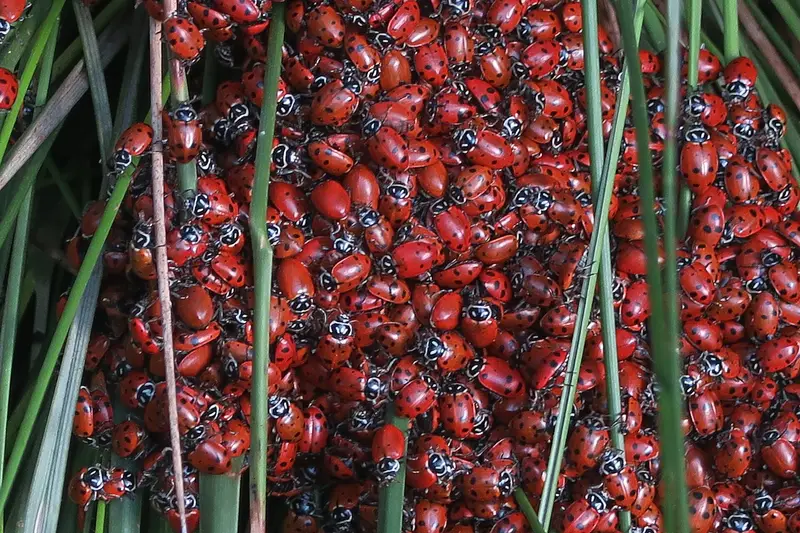
“Most will fly away from the release site within 1 or 2 days after they are released even if aphids are plentiful.”
UC IPM adds that each adult eats about 100 aphids a day before it leaves, and that aphids on roses can take about 1,500 beetles per shrub, released every one to two weeks. If you try it, refrigerate the beetles, wet the plants and release at dusk. Penn State calls it “generally not effective” to buy and release Asian lady beetles in home gardens. Other sold predators have limits too; our praying mantis guide notes that the University of Kentucky rates mantids as a small help next to lady beetles.
The Native Ladybugs That Disappeared
As the imports spread, several natives crashed. The 2014 Northeastern Naturalist study compared New York lady beetle surveys going back to 1924 and found declines in four native species, including the two-spotted, nine-spotted and convergent lady beetles, as the seven-spotted, Asian and fourteen-spotted lady beetles increased. Penn State links the Asian lady beetle to declines of the two-spotted and spotted pink lady beetles through competition for prey.
The best-known case is the nine-spotted lady beetle, Coccinella novemnotata, New York’s state insect since 1989. Cornell says its numbers began declining in the 1980s; it was last seen in the Northeast in 1992 before a 2007 report of one in an Arlington, Virginia, backyard, the first East Coast sighting in 14 years.
“The nine-spotted ladybug was once one of the most common ladybugs in the United States, and it was so revered in New York for its role in suppressing pests that it was named the official state insect in 1989.”
That 2011 find came from a volunteer with the Lost Ladybug Project, a Cornell citizen-science effort begun in 2000: one beetle on July 30 at Quail Hill Organic Farm in Amagansett, then 20 more. The project’s homepage listed 39,139 ladybugs contributed as of November 17, 2026.
It is still scarce in our iNaturalist count: 823 research-grade US records, against 273,303 for the Asian lady beetle, about 332 to 1. Yearly records peaked at 166 in 2024, which may reflect more observers as much as more beetles. If you find a nine-spotted, two-spotted or transverse lady beetle, photograph and report it.
Keeping Ladybugs in a Bee-Friendly Garden
Lady beetles are predators first, but many visit flowers for pollen and nectar. UC IPM suggests growing flowering plants that feed adults and avoiding broad-spectrum, persistent insecticides, which also protects bees.
- Tolerate a few aphids. Lady beetles lay eggs near prey, so a garden sprayed clean gives them no reason to stay.
- Use water first. UC IPM recommends knocking aphids off with a strong stream from a hose.
- Control ants. Ants protect aphids for their honeydew; our page on sugar ants explains the relationship.
- Choose low-impact products. If you must treat, never spray open flowers; our guide to pollinator-safe pest control products compares options.
- Leave winter cover. Cornell notes that lady beetles overwinter as adults along hedgerows, beneath leaf litter and under rocks and bark.
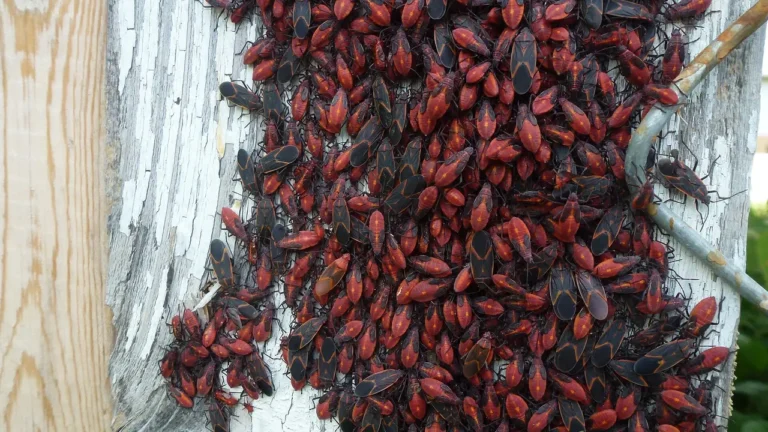
Boxelder bugs crowd onto the same sunny walls each fall; our boxelder bug guide shows how to tell them apart and keep both out.
Frequently Asked Questions
What bug is mistaken for a ladybug?
Usually the multicolored Asian lady beetle, which is itself a ladybug, just an introduced one. The plant-feeding look-alikes are the coppery Mexican bean beetle and the larger yellow-orange squash beetle.
What is the difference between good and bad ladybugs?
All belong to the same family. The “bad” label usually goes to the Asian lady beetle, which invades homes, bites and outcompetes natives, though it still eats aphids outdoors. Only the Mexican bean beetle and squash beetle damage garden plants.
What do ladybugs turn into?
The adult is the final stage. The alligator-like larva becomes a pupa fixed to a leaf, and the adult emerges about four to five days later in the Asian lady beetle, per Penn State.
Do ladybugs bite?
Asian lady beetles occasionally do, usually when trapped against skin. University of Kentucky entomologists say the bite feels like a pinprick and is seldom serious.
Are ladybugs poisonous?
They have no venom, but their yellow defensive fluid stains, smells and can trigger allergies. Pets that eat Asian lady beetles may get chemical burns in the mouth, Penn State says.
How long do ladybugs live?
Asian lady beetle adults typically live 30 to 90 days but can reach three years, per Penn State. UC IPM gives convergent lady beetles about two months in the growing season.
Do ladybugs hibernate?
Yes, as adults, often in groups in leaf litter or under bark. Asian lady beetles pick buildings, and convergent lady beetles form the outdoor swarms that commercial collectors harvest.
What should I do if I see a ladybug in my house?
Move it outdoors without crushing it; Poison Control suggests gently blowing a beetle away. For many beetles, vacuum with a stocking in the hose, then seal the gaps before next fall.
The Bottom Line
The best way to get help from ladybugs is to protect the ones already in your garden: leave them aphids, flowers and winter cover, and skip broad-spectrum sprays. Indoors, the culprit is almost always the Asian lady beetle. Seal it out in summer and vacuum it in fall.
Image credits: featured photo of a seven-spotted lady beetle by Judy Gallagher (CC BY 2.0); lady beetle photos by Judy Gallagher (CC BY 2.0), USGS Native Bee Inventory and Monitoring Laboratory (public domain), Gilles San Martin (CC BY-SA 2.0) and John Rusk (CC BY 2.0); identification panel by Judy Gallagher (CC BY 2.0), Sam Droege, USGS (public domain) and Stephen Ausmus, USDA-ARS (public domain). All via Wikimedia Commons, resized or cropped. Charts by BeeKeepersRealm from iNaturalist data.