Reviewed by Daniel M. · How we review
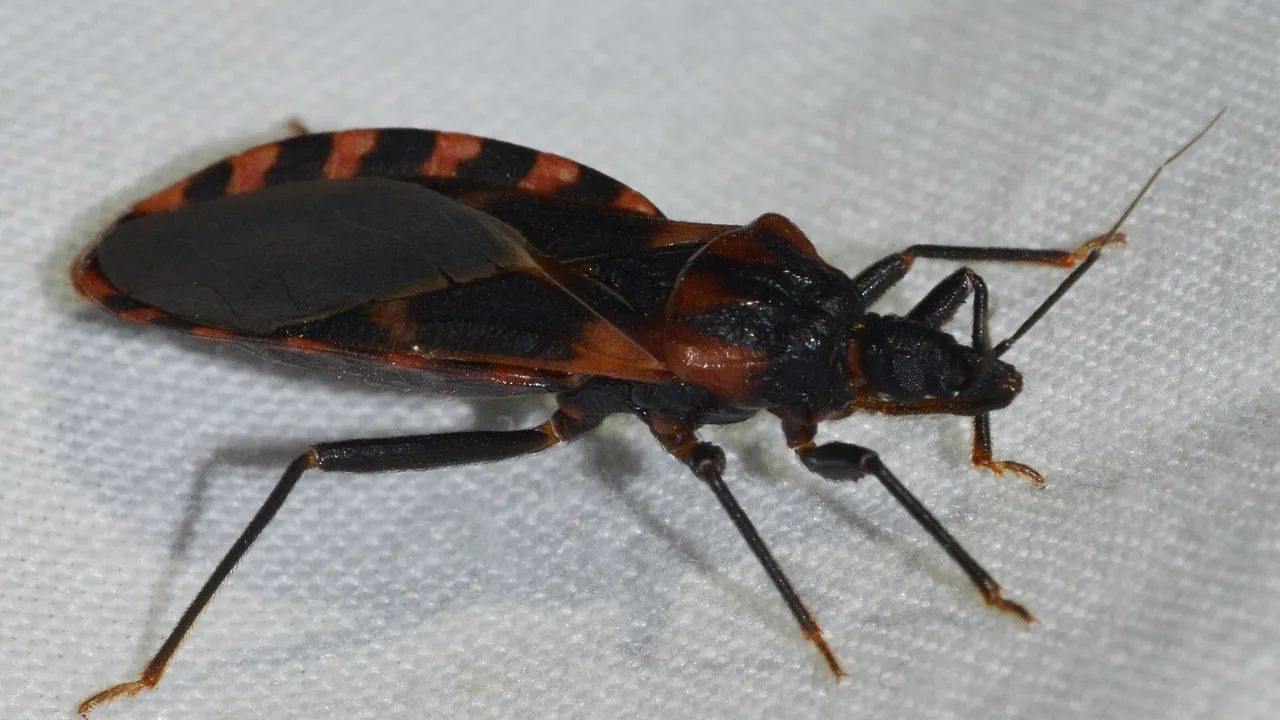
A kissing bug is a blood-feeding insect in the assassin bug family (subfamily Triatominae), also called a conenose bug. Adults are about 1/2 to 1 inch long, dark brown or black, with a long cone-shaped head and red, orange or yellow bands around the edge of the body. They bite at night, usually without pain, and can carry the parasite that causes Chagas disease. The parasite is in the bug’s feces, not its bite, and the National Pesticide Information Center says infection this way happens only rarely in the United States.
Sources are the CDC, Texas A&M, state health departments and extension services, named where used, plus our count of iNaturalist records. Educational information, not medical advice.
Key Takeaways
- Eleven kissing bug species live in the US. Texas A&M records them in 29 states, most of all in Texas, New Mexico and Arizona.
- Look for a narrow cone-shaped head, thin even legs and a striped red, orange or yellow edge. Wheel bugs and leaf-footed bugs are the usual mix-ups.
- Bites are usually painless. For most people the bigger risk is an allergic reaction after repeated bites.
- Chagas spreads through the bug’s droppings. CDC authors count fewer than 100 locally acquired, bug-borne infections ever documented in the US.
- Don’t touch or crush one. Bag it, freeze it and have it identified.
- In our iNaturalist count, 78.8% of US sightings fall between May and August.
Table of Contents
- What Kissing Bugs Are
- What a Kissing Bug Looks Like
- Kissing Bug vs. Look-Alikes
- Where and When They Turn Up
- Bites and Allergic Reactions
- Chagas Disease: How It Spreads and How Common It Is
- Kissing Bugs and Dogs
- What to Do If You Find One
- Keeping Kissing Bugs Out
- Assassin Bugs and Bees
- Frequently Asked Questions
What Kissing Bugs Are
Kissing bugs are true bugs (order Hemiptera), like stink bugs and cicadas, and feed through a slender beak instead of jaws (see what makes an insect a bug). They form the subfamily Triatominae within the assassin bug family, Reduviidae, so you will also see them called triatomine bugs, conenose bugs or “Hualapai tigers,” a name University of Arizona Cooperative Extension records.
Most assassin bugs hunt insects; UC IPM calls kissing bugs “an exception to the family rule” because they suck blood. The nickname comes from an old belief that they bite around the mouth, Texas A&M says, but they bite any exposed skin.
Texas A&M, Penn State and the University of Maryland count 11 US species. Texas has eight and Arizona seven; only the eastern bloodsucking conenose (Triatoma sanguisuga) and Paratriatoma lecticularia are widespread in the East, Penn State says.
What a Kissing Bug Looks Like
Texas A&M’s field marks:
- Head: long, narrow and cone-shaped, with thin antennae.
- Beak: straight and thin, usually tucked under the body. Predatory assassin bugs have thick, curved beaks.
- Legs: thin and long, with no thicker sections.
- Color: black or dark brown, with red, orange or yellow stripes around the abdomen edge.
- Size: about 1/2 to 1 inch as adults.
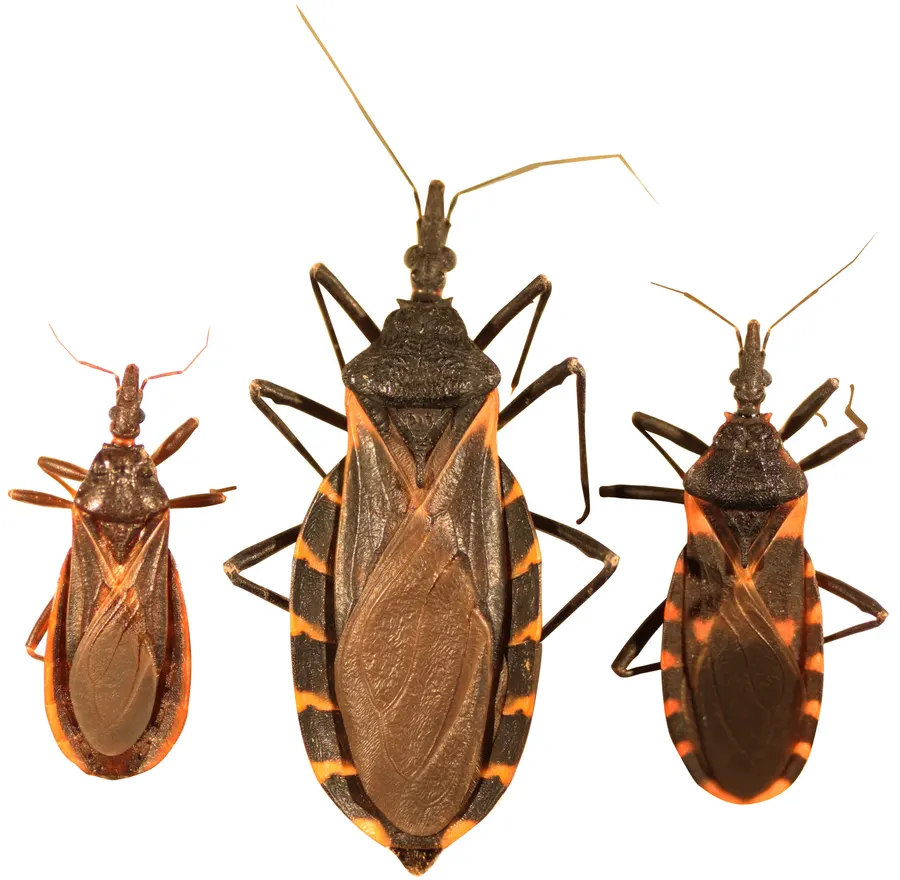
Which species you meet depends on where you live. Sizes and states below are from the CDC’s species page (updated Feb. 10, 2026).
| Species | Where (CDC) | Adult size | Field marks | Source |
|---|---|---|---|---|
| Eastern bloodsucking conenose (T. sanguisuga) | Texas to Pennsylvania | 0.6 to 0.9 in | Orange-red to yellowish edge bands; marked wings | CDC |
| T. gerstaeckeri | TX, NM | 0.9 to 1.1 in | Yellow side markings; plain black shield behind the head | CDC |
| Western bloodsucking conenose (T. protracta) | AZ, CA, CO, NV, NM, TX, UT | 0.5 to 0.9 in | Dark brown to black; edge band may be missing | CDC, Texas A&M |
| T. rubida | AZ, CA, NM, TX | 0.6 to 0.9 in | Reddish to dark brown, pale edge; most abundant in Tucson | CDC, Univ. of Arizona |
iNaturalist now files T. protracta under the genus Hospesneotomae, so searching the genus Triatoma misses it.
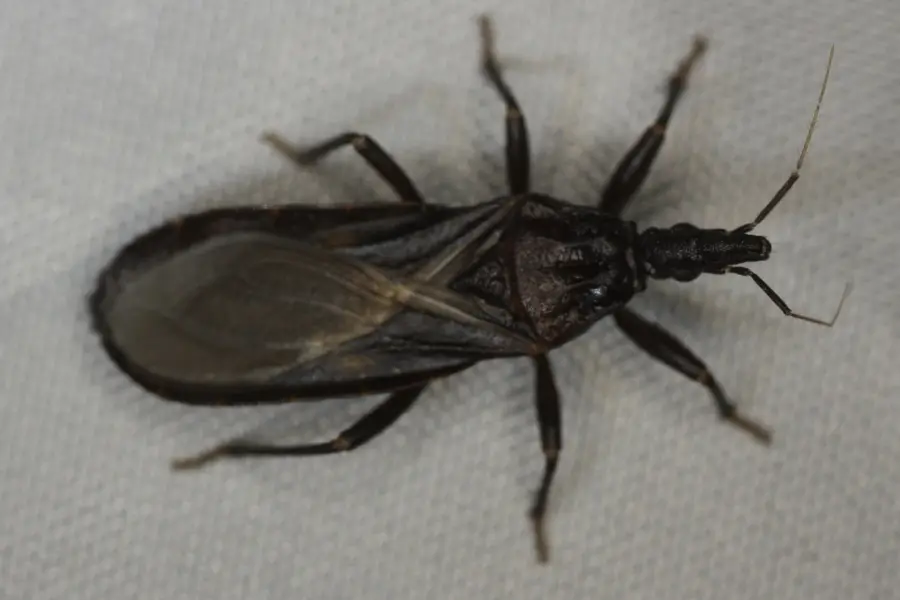
Texas A&M says nymphs pass through five stages and have no wings, and the University of Maryland notes they lack the adults’ red-orange banding. Because nymphs cannot fly in, the CDC says finding them indoors may indicate an infestation.
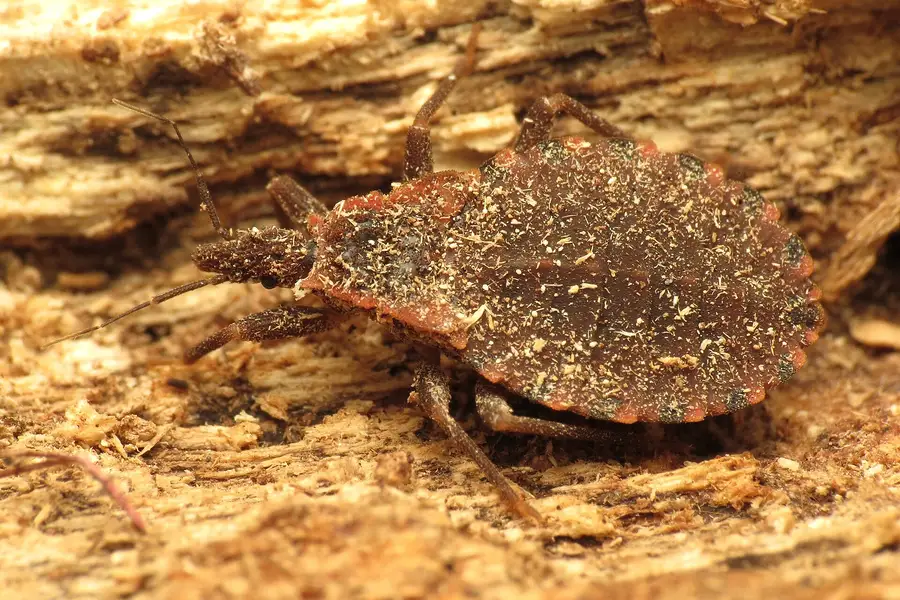
Kissing Bug vs. Look-Alikes
Most “kissing bugs” people find are something else. The CDC names the wheel bug, western corsair and leaf-footed bug as common mix-ups and says they “do not carry the parasite that causes Chagas disease.” Penn State adds the western conifer seed bug and boxelder bug.
| Bug | Head | Body/markings | Bites people? | Disease risk | Source |
|---|---|---|---|---|---|
| Kissing bug (T. sanguisuga, T. gerstaeckeri, T. protracta) | Long narrow cone, thin straight beak | 1/2 to 1 in; dark, striped edge (faint in T. protracta) | Yes, at night; usually painless | Can carry T. cruzi (Chagas) | CDC, Texas A&M |
| Wheel bug | Small head, thick curved beak | 1 to 1 1/2 in; brown, spiked “wheel” crest on the back | Only if handled; “extremely painful” | Not a carrier | Penn State, CDC |
| Other assassin bugs (corsairs, masked hunter) | Short head, thick beak | Western corsair orange and black; black corsair and masked hunter adults black | Only if handled; painful | Western corsair not a carrier | UC IPM, Penn State, CDC |
| Leaf-footed bug | Blunt head | 3/4 to 1 in; white zigzag on wings, leaf-like hind legs | No; plant feeder | Not a carrier | UC IPM, CDC |
| Western conifer seed bug | Blunt head | Up to 3/4 in; drab brown, flared hind legs | Not generally; one bite recorded worldwide | Not a medical risk | Penn State |
| Brown marmorated stink bug | Small head, broad shield | About 0.66 in; shield-shaped, mottled brown | No; plant feeder | None reported | Penn State |
| Boxelder bug | Small head, red eyes | Up to 1/2 in; dark gray, red along front-wing edges | No; feeds mainly on boxelder seeds | None reported | Penn State, Univ. of Maryland |
Quick check: cone head and thin, even legs suggest a kissing bug; a cogwheel crest means wheel bug; flared hind legs mean a leaf-footed or seed bug; a broad shield means a stink bug.
The brown marmorated stink bug turns up indoors most often, but its wide shield sets it apart. Wheel bugs are the closer match; Penn State says handle them only with gloves or a stick.
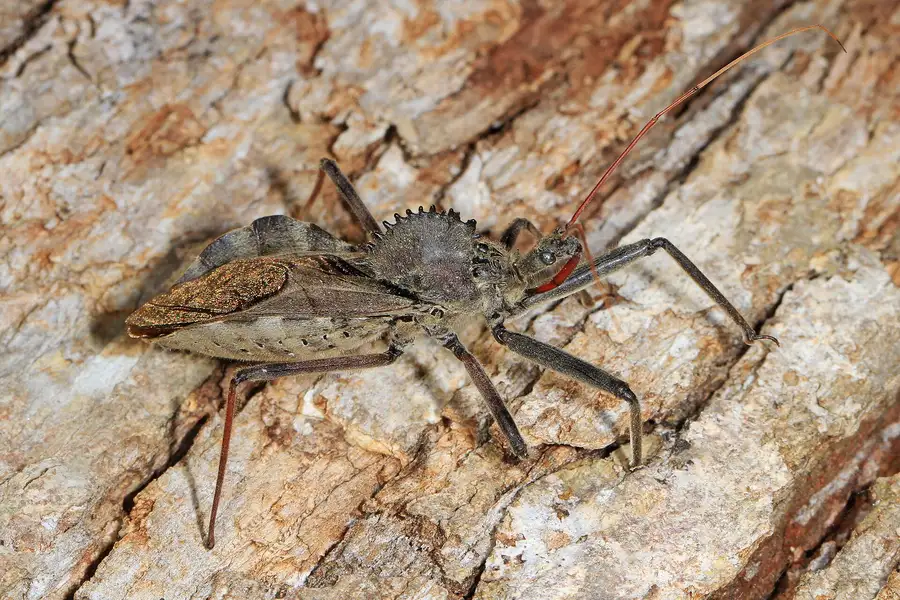
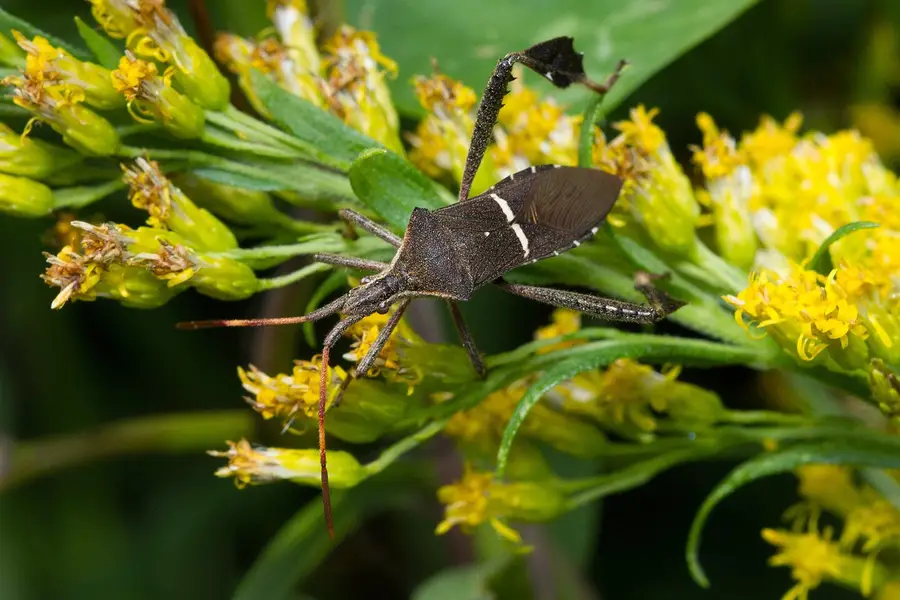
For more predators side by side, see our predatory insect comparison chart.
Where and When They Turn Up
Kissing bugs mostly live outdoors near their hosts. The CDC lists porches, rock piles, spaces under cement, wood and brush piles, loose bark, rodent nests, outdoor dog houses and chicken coops. In Arizona and California they are tied to woodrat (pack rat) nests, say the University of Arizona and UC IPM.
The CDC says they rarely infest US homes because houses are well sealed. Adults fly at night toward lights, and Arizona Extension says they enter through door gaps, cracks around window screens and crawlspaces, or hitchhike on pets, then hide by day; “between mattresses is a favorite hiding place.”
Texas A&M counts 29 states; a 2025 Emerging Infectious Diseases paper, citing the CDC, says 32. To see when and where people find them, we pulled every research-grade US iNaturalist record of the subfamily on November 17, 2026: 5,193 observations from 2,865 people, the same kind of citizen science Texas A&M’s program relies on.
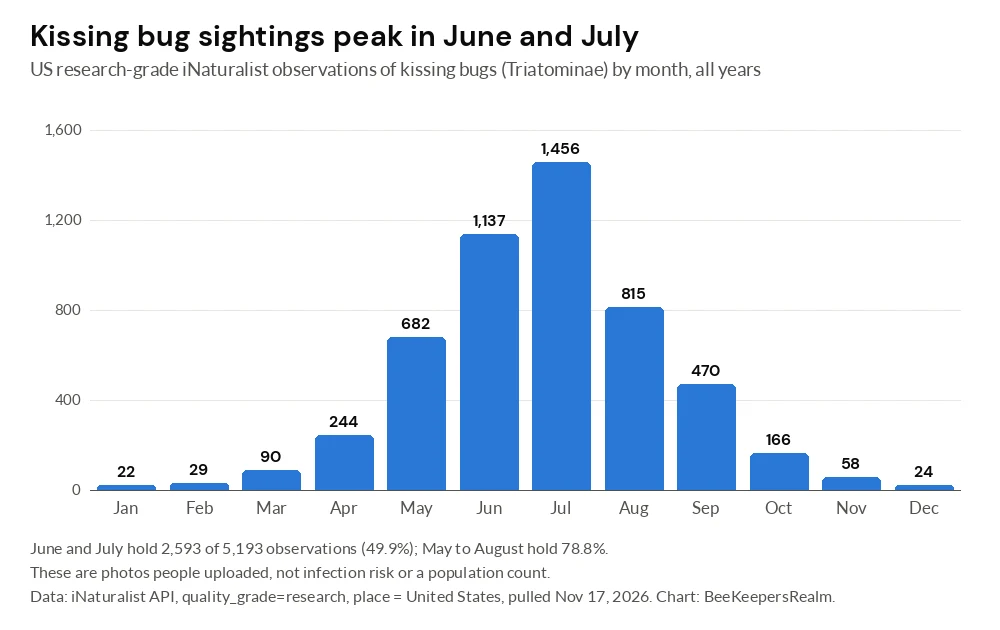
June and July hold 49.9% of records and May through August 78.8%, matching Arizona Extension’s May-to-July dispersal season. December and January together have fewer than 50.
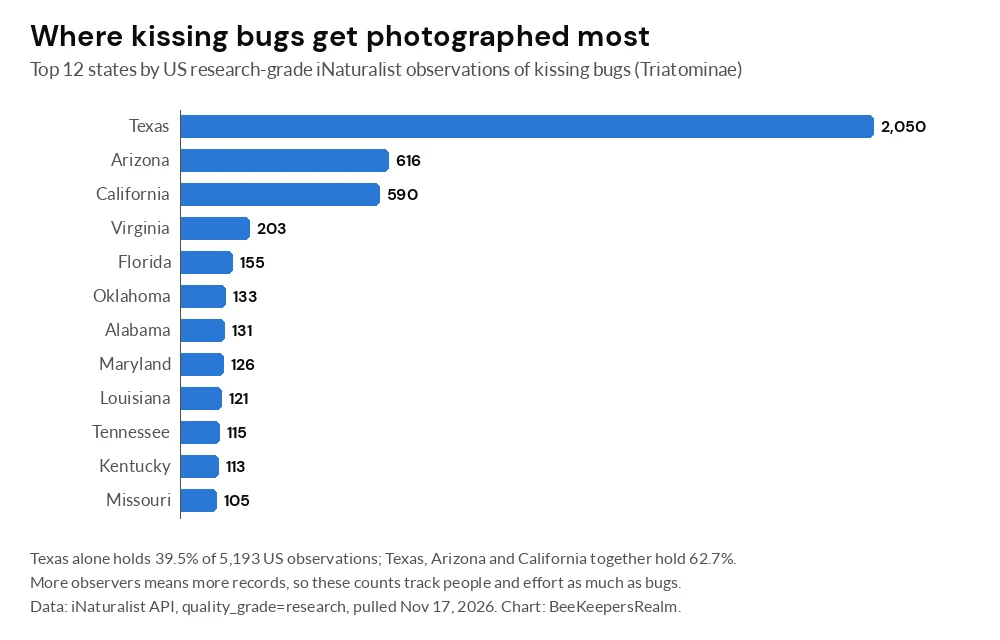
Texas holds 39.5% of records, and Texas, Arizona and California 62.7%. Two cautions from the raw data: 52 of New Jersey’s 65 records come from one observer in Cape May County, and the single “Wyoming” record is a mislocated photo from El Paso, Texas. These are sightings, not risk.
Bites and Allergic Reactions
Kissing bugs often bite people while they sleep, Arizona Extension says. A meal can take several minutes, but they do not attach like ticks (Texas A&M). UC IPM says bites usually come at night in groups on the face, neck, arms and legs, painless at first, then itchy and swollen, sometimes with a welt lasting days.
There is no “typical” reaction, and you usually cannot tell what bit you from the bite alone, Texas A&M says. Penn State lists other culprits with similar bites, including bed bugs, fleas, mosquitoes, ticks, and horse flies and deer flies.
“The biggest health risk kissing bugs pose is one of severe allergic reaction.”
Some people develop a severe allergy after multiple bites, Arizona Extension explains, and UC IPM cites research that about 7% of people tested where the bugs are common could react seriously. Signs include trouble breathing, low blood pressure and a rapid heart rate. Call 911 for a severe reaction, Arizona Extension says; the warning signs match those for bee and wasp stings. For any worrying bite, Texas A&M says to see a healthcare provider.
A reaction is not a sign of infection. The National Pesticide Information Center says, “A rash or allergic reaction to a bite does not mean you’ve been infected.”
Chagas Disease: How It Spreads and How Common It Is
Chagas disease is caused by the parasite Trypanosoma cruzi. Infection happens when infected bug feces get into the bite wound, a cut, the eyes or the mouth, often by scratching, the CDC explains. Texas A&M stresses that the parasite is not in the saliva or bite. Texas DSHS lists other routes: mother to baby, blood transfusion, organ transplant, and food or drinks contaminated with bug feces.
Texas A&M’s lab finds about half of tested kissing bugs infected (10% to 70% by kind), yet human cases from US bugs stay rare. UC IPM cites poor transmission, infrequent human contact and the bugs’ inability to colonize homes. The University of Maryland adds that native species do not defecate on hosts right after feeding, as many Central American species do.
“The risk of Chagas disease for most Americans is small.”
| Figure | What it counts | Source |
|---|---|---|
| About 280,000 | People in the US with Chagas disease, “often without knowing it” | CDC (Sept. 4, 2024) |
| Fewer than 100 | Locally acquired, bug-borne human infections ever documented in the US | Cantey et al., CDC, EID (May 2026) |
| 8 states | With reported locally acquired human cases (CA, AZ, TX, TN, LA, MO, MS, AR) | Beatty et al., EID (Sept. 2025) |
| 62 of 320 | Texas human cases 2013 to 2025 acquired in Texas | Texas DSHS |
| 9 of 11 | US kissing bug species found naturally infected | Beatty et al.; Penn State |
Penn State says “more than 100” locally acquired infections since 2000, against the CDC authors’ “fewer than 100”; we report both.
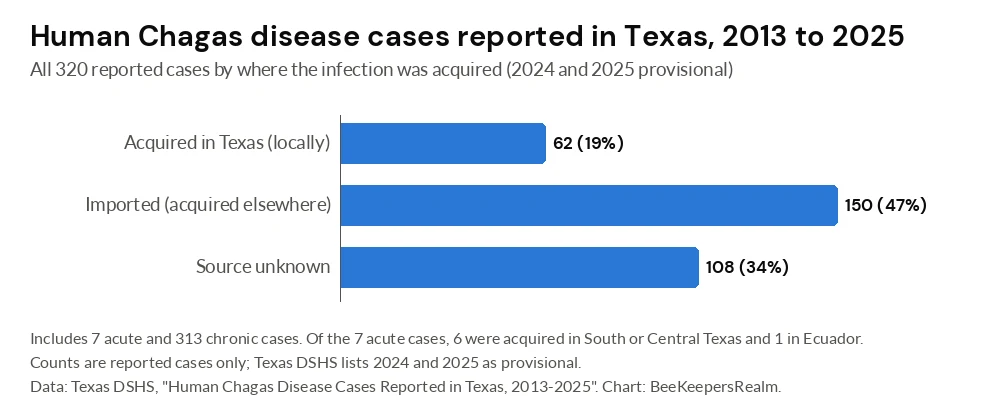
Researchers from Texas A&M, the University of Florida and Texas DSHS argued in 2025 that the US should be called endemic. CDC scientists replied in 2026 that locally acquired human disease is “sporadic, not endemic.” Headlines saying the CDC “declared” Chagas endemic get this wrong.
The acute phase “often causes no symptoms or only mild symptoms,” Texas DSHS says. Texas A&M lists fever, tiredness, body aches, headache and rash; DSHS notes eyelid swelling near the bite (Romaña’s sign) and says 20% to 30% of chronic infections later cause heart or digestive disease. Only a healthcare provider can diagnose Chagas, the CDC says, and early diagnosis and treatment can be lifesaving. If you think you were exposed, ask your provider about testing.
Kissing Bugs and Dogs
Texas A&M says kennels in Texas and other southern states may have kissing bug problems, since the bugs are drawn to the heat and smells of many dogs, and dogs can be infected by eating them. Signs include heart problems, bloat and sometimes sudden death, though many dogs that test positive show none.
A study featured by Texas A&M (Kjos et al., 2008) documented 537 canine Chagas cases in 48 Texas counties from 1993 to 2007. Texas DSHS recorded 439 animal cases from 2013 to 2015, 431 of them dogs, and Penn State reports infection rates in Texas dogs from 10% to more than 50%.
The Texas Veterinary Medical Diagnostic Laboratory offers a blood test; ask your veterinarian. There is no vaccine. The CDC advises pets sleep indoors, and Texas A&M’s veterinary college suggests dim lighting, screened kennels and no wood piles.
What to Do If You Find One
“Do not touch a kissing bug with your bare hands! The T. cruzi parasite may be in the feces of kissing bugs, and their bodies may have the parasite on them.”
- Don’t crush it. Texas A&M says it’s best not to squish one. If you do, pick it up with a plastic bag and discard it where people and animals can’t reach it.
- Catch it without touching it, using a glove or plastic bag, and keep it in a closed container.
- Freeze it for a few hours, which Texas A&M says also preserves DNA for testing. NPIC gives the same advice.
- Note the date, time, location and any possible bites on people or pets.
- Get it identified through Texas A&M’s “Found a Bug?” page, your county extension office or your state health department.
In Texas, the Department of State Health Services tests bugs “implicated in human exposure” free for residents, with the CDC. Send a photo first, use no alcohol or preservatives, and expect results in two to five weeks; outdoor bugs go to Texas A&M. DSHS cautions that an infected bug “does not mean that transmission of the parasite occurred.”
Keeping Kissing Bugs Out
The CDC’s prevention page (updated Feb. 4, 2026) and extension services recommend:
- Seal entry points: cracks and gaps around windows, walls, roofs and doors (CDC); caulk around pipes and utility lines, door brushes or weather strips, screens in good repair (Penn State).
- Manage lights: keep yard lights away from the house (CDC), turn outside lights off at night if safe (Texas A&M), and draw curtains in lit rooms (Univ. of Arizona). UC IPM suggests yellow or lower-wattage bulbs; Arizona Extension suggests LEDs that emit little UV.
- Bring pets in at night and clean pet resting areas regularly (CDC).
- Clear woodpiles, lumber and debris near the house (Texas A&M, UC IPM).
- Deal with nearby rodent nests: UC IPM says within 300 feet; Arizona Extension says have professionals remove nests within 350 feet and leave distant ones alone.
- Check sleeping areas: vacuum mattresses and baseboard crevices (NPIC). Arizona Extension calls a bed net tucked under the mattress the best protection for people at risk of anaphylaxis.
The CDC says no insecticides are approved specifically for triatomine bugs and roach traps don’t work. Penn State calls pesticides usually unnecessary after these steps, except as perimeter or crack-and-crevice treatments in heavily infested buildings. Texas A&M advises working with an extension agent or pest professional and following any label exactly.
Assassin Bugs and Bees
Only the triatomines feed on blood. The University of Maryland calls other assassin bugs beneficial garden insects. Illinois Extension says wheel bugs eat caterpillars, beetles, sawfly larvae, aphids and stink bugs, but also honey bees and wasps, and that their pest control “far outweighs the occasional beneficial insect” eaten. The University of Florida also calls the wheel bug beneficial.
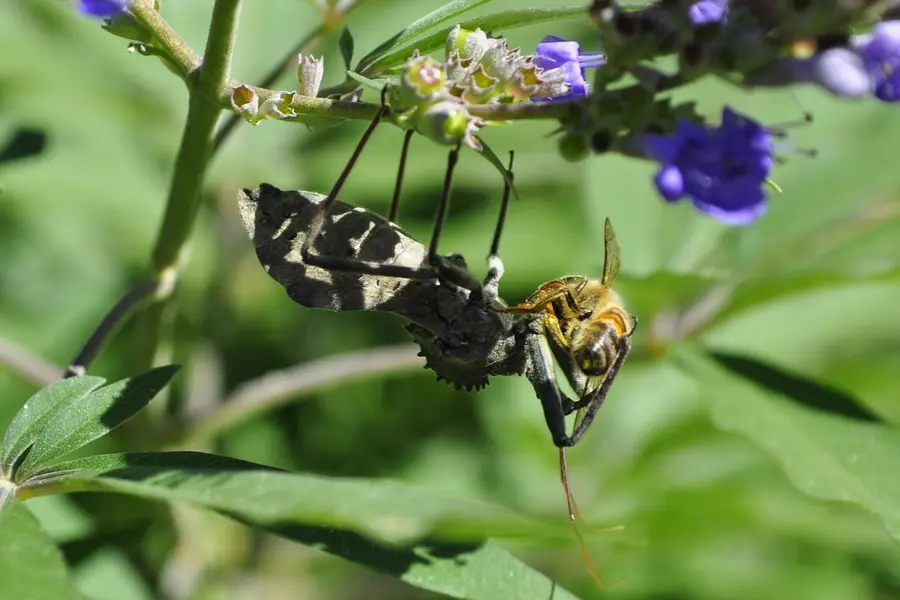
Wheel bugs, like the praying mantis, are ambush predators that take the odd forager; leave them be, and never handle one bare-handed. Kissing bugs have no such garden role.
Frequently Asked Questions
What happens if I get bit by a kissing bug?
Usually a painless bite that later itches; some people have allergic reactions. Infection needs the bug’s droppings to reach the wound, eyes or mouth, which NPIC says happens only rarely in the US.
Why should I not squish a kissing bug?
The parasite may be in its feces and on its body, Texas A&M says. Bag and freeze it instead.
What states is the kissing bug found in?
Texas A&M says 29 states, most of all Texas, New Mexico and Arizona.
How fatal is Chagas disease?
Most infected people never become seriously ill, but Texas DSHS says 20% to 30% of chronic infections cause heart or digestive disease, which can be life-threatening.
Should I be worried if I find a kissing bug in my house?
Act, but don’t panic. One adult drawn to a light is not an infestation; wingless nymphs indoors may indicate one, the CDC says.
What time of year are kissing bugs out?
Mostly late spring and summer; 78.8% of US iNaturalist sightings fall from May to August.
Do kissing bugs fly?
Adults do, at night and toward lights. Nymphs have no wings.
What happens if a dog gets bit by a kissing bug?
Often nothing visible, but infection can cause heart problems. Where kissing bugs are common, ask your veterinarian about a Chagas blood test.
What makes kissing bugs go away?
Sealing gaps, managing outdoor lights, clearing woodpiles and rodent nests, and bringing pets in at night.
The Bottom Line
A kissing bug indoors is worth catching and identifying, not panicking over. Bag it without touching it, freeze it, get it identified through Texas A&M or your health department, and see a healthcare provider if you think you were bitten.
Image credits: featured photo of Triatoma sanguisuga by Andy Reago & Chrissy McClarren, Wikimedia Commons, CC BY 2.0, cropped. Other photos as credited in captions. Charts by BeeKeepersRealm from iNaturalist and Texas DSHS data.