Reviewed by Sofia T. · How we review
A stink bug is a shield-shaped true bug (family Pentatomidae) that gives off a sharp odor when it is disturbed or crushed. The one most Americans find indoors is the brown marmorated stink bug (Halyomorpha halys), an invasive species from East Asia first collected in Allentown, Pennsylvania, in 1998. It does not bite, sting, breed indoors or damage houses, but it feeds on more than 100 kinds of plants. Indoors, the fix is to seal entry points and remove the bugs by hand or vacuum, not to spray.
This guide covers how to identify the brown marmorated stink bug and the insects mistaken for it, why it moves in each fall, what it does to fruit and vegetables, and how to deal with it without hurting bees. It also includes our own count of 61,939 research-grade iNaturalist observations from the US, which shows when people actually run into it.
Key Takeaways
- Brown marmorated stink bugs do not bite or sting, do not reproduce inside houses and do not damage buildings, according to Penn State Extension and the EPA. A small share of sensitive people get allergy symptoms from the odor.
- Look for white bands on the antennae, smooth shoulders and a black-and-white banded edge around the abdomen. A brown stink bug with spiny shoulders may be the spined soldier bug, a native predator worth keeping.
- They move indoors from mid-September to mid-October. In our iNaturalist count, September and October alone hold 38.9% of all US observations.
- Sealing gaps before September works best. Indoor sprays and foggers are not recommended; vacuum the bugs or knock them into soapy water instead.
- In gardens, hand-pick, use netting after pollination, and never spray plants in bloom. A tiny natural enemy, the samurai wasp, is already established in at least 14 states.
Table of Contents
- What a Stink Bug Is and Where the Invasive One Came From
- How to Recognize a Brown Marmorated Stink Bug
- How to Get Rid of Stink Bugs in Your House
- Stink Bug Season: When They Come Inside
- Are Stink Bugs Harmful to People and Pets?
- Stink Bug Look-Alikes, Including the Kissing Bug
- What Stink Bugs Eat and the Damage They Leave
- Protecting a Garden Without Harming Bees
- The Samurai Wasp, a Natural Enemy Already Here
- Frequently Asked Questions
What a Stink Bug Is and Where the Invasive One Came From
Stink bugs are true bugs, members of the insect order Hemiptera, the same order that holds cicadas, aphids and assassin bugs. “Bug” is a precise word here: true bugs have a beak that pierces plant tissue (or prey) and sucks out the fluids, rather than jaws that chew. If you want the bigger picture of how insects are grouped, our page on why a bee is an insect but not a bug lays it out.
NC State University entomologist Matt Bertone describes the stink bug family as thousands of species worldwide, with more than 200 in the United States and Canada. Most are plant feeders, a few hunt other insects, and nearly all share the broad, shield-shaped body and the scent glands that give them their name.
The species behind almost every “stink bugs in the house” complaint is the brown marmorated stink bug, often shortened to BMSB. Penn State Extension says it was first collected in September 1998 in Allentown, Pennsylvania, but that it “probably arrived several years earlier.” That is why many pages give 1996 instead. StopBMSB.org, the USDA-funded research project on this insect, says the specimens were identified as BMSB in 2001 and that genetic evidence points to an origin near Beijing, China.
It has spread a long way since. USDA’s Agricultural Research Service puts it in 47 states and four Canadian provinces, the same count StopBMSB gives, adding that it is a severe farm problem in 10 states and a nuisance in 21 others. The EPA’s page, updated in May 2026, still says 38 states and Washington, D.C., so expect to see both numbers. Like the spotted lanternfly, it is an Asian species that turned up in Pennsylvania first; the EPA says it may have arrived in a shipping container in the mid-1990s.
How to Recognize a Brown Marmorated Stink Bug
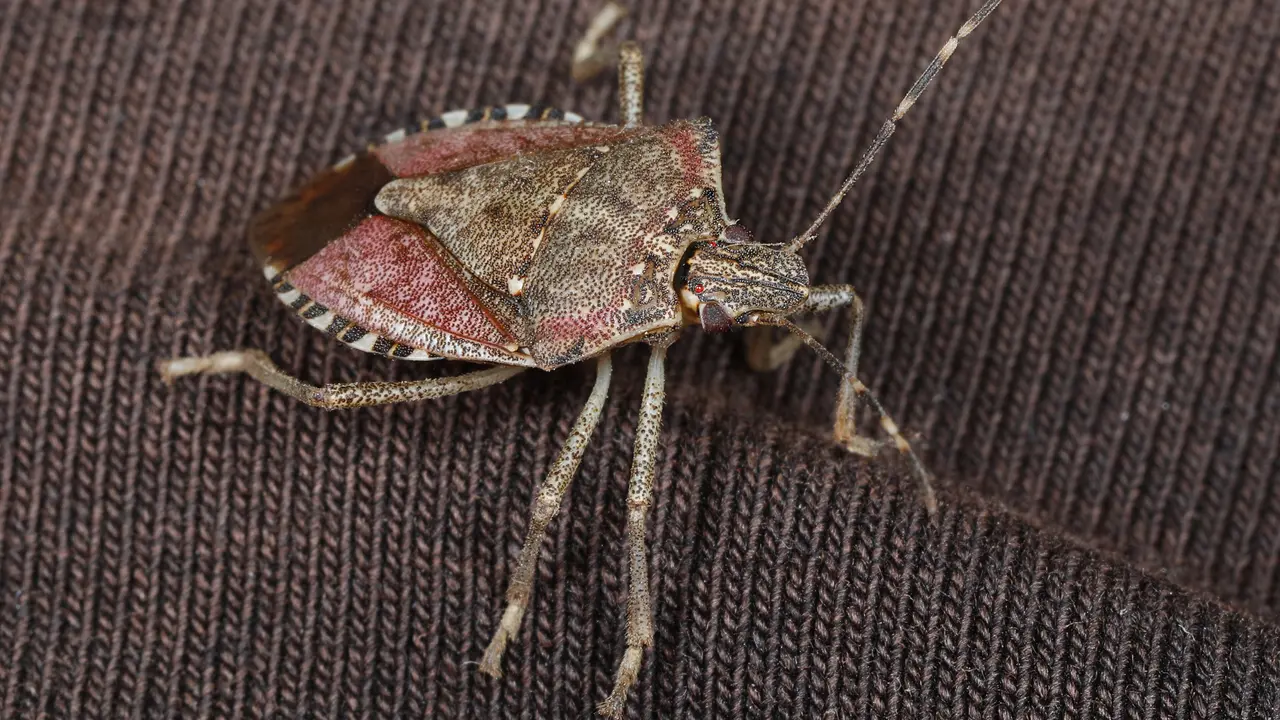
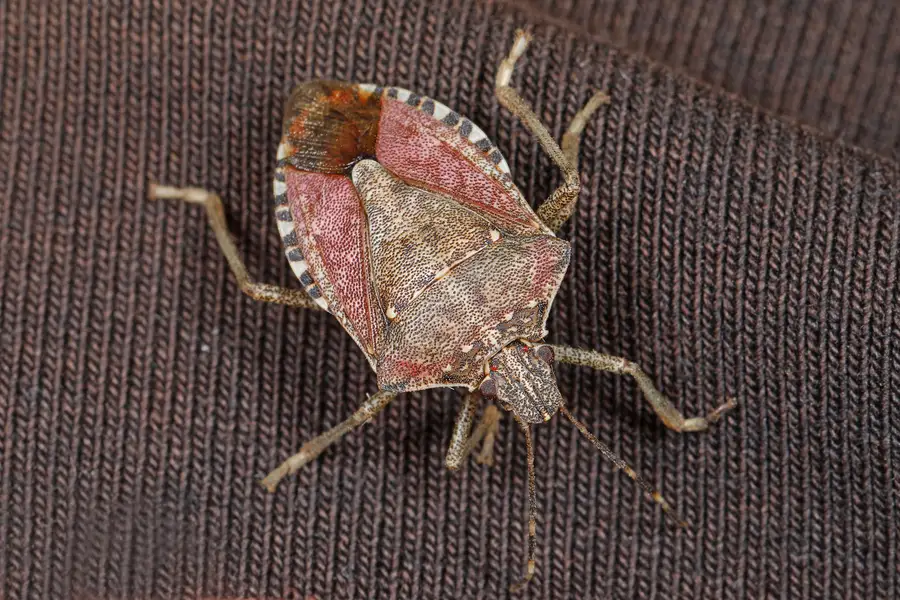
Adults are about 5/8 inch long (14 to 17 mm), mottled brownish gray and shaped like a shield. Penn State and the University of Kentucky list the marks that separate it from native stink bugs:
- Antennae: light, whitish bands on the last segments. This is the quickest field mark.
- Shoulders: smooth and rounded at the front corners, with no teeth or spines.
- Abdomen edge: alternating dark and light bands that stick out beyond the folded wings.
- Wing tips: dark bands on the clear membrane at the rear of the wings.
- Head and front of the body: small coppery or bluish metallic pits, visible up close.
- Underside: pale, with dark markings.
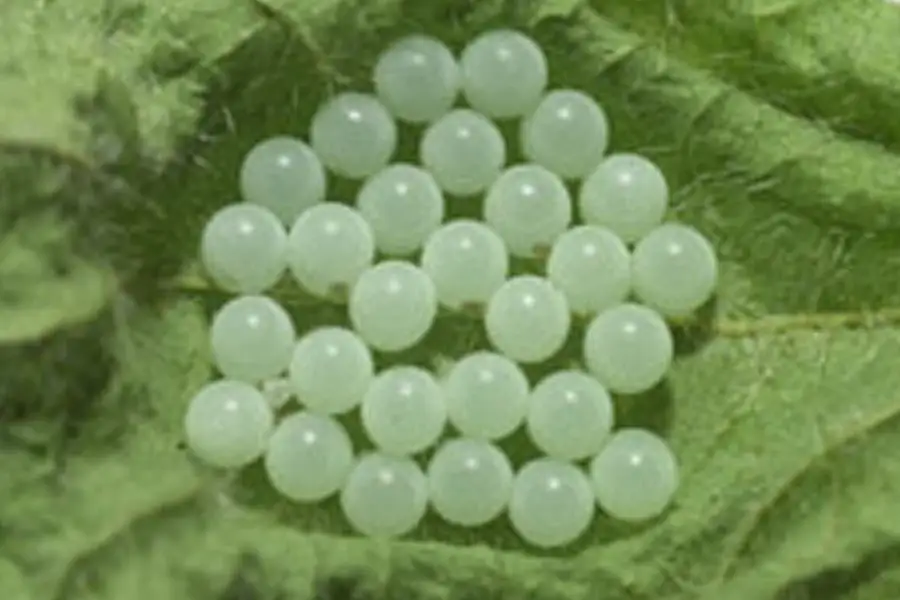
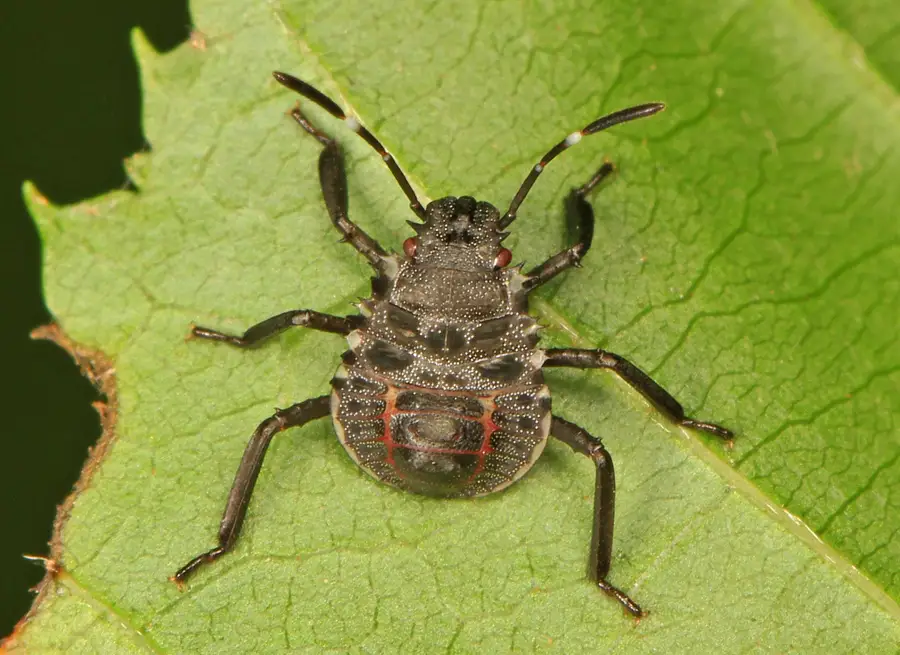
Eggs are tiny (about 1/16 inch), pale yellow to light green and laid side by side in clusters of 20 to 30 on the undersides of leaves from May through August. Nymphs go through five stages, growing from about 1/10 inch to 1/2 inch. Penn State describes deep red eyes, a black head, legs and thorax, and an abdomen that starts yellowish red and turns off-white with reddish spots by the last stage. Penn State reports one generation a year in Pennsylvania, possibly two, and the EPA says warmer regions can see up to five.
How to Get Rid of Stink Bugs in Your House
Video: University of Maryland Extension entomologist Mike Raupp shows where stink bugs get into a house, around utility lines, the attic and window air conditioners, then demonstrates a stink bug trap and ways to kill the ones already inside, going by the video’s description and official chapter list.
Seal them out before September
“Mechanical exclusion is the best method to keep stink bugs from entering homes and buildings.”
Penn State recommends sealing cracks around windows, doors, siding, utility pipes and chimneys, and under the wood fascia, with good quality silicone or silicone-latex caulk, and repairing torn screens. The EPA adds weather stripping, door sweeps, sealing foundation cracks and crawlspace openings, stuffing larger gaps with steel wool, and capping the chimney. The video above also points to window air conditioners as an entry point. Do the work in August or early September, because the bugs start arriving in the second half of September.
Remove the ones already inside
- Vacuum them. The University of Maryland suggests a shop vacuum, emptied into an outdoor trash can. Penn State warns that a household vacuum can pick up the smell if many bugs are crushed in it.
- Knock them into soapy water. The University of Maryland and the University of Kentucky both suggest a container of soapy water, which kills the bugs without crushing them.
- Pick up single bugs by hand. They do not bite, and the National Pesticide Information Center (NPIC) says removing them by hand or vacuum is fine and that killing one does not attract more.
The light-and-water pan trap
NPIC describes a simple trap: a roasting pan of soapy water under a light, set out in a dark room. A Virginia Tech study that recruited homeowners as citizen scientists (Aigner and Kuhar, Journal of Extension, 2014) found an aluminum foil pan of water under a lamp was the most effective indoor trap tested. Note the timing: the traps were tested in late winter and early spring, and NPR’s report on the study said the bugs are drawn to light in spring, not in fall when they first come in. The EPA calls these traps attractive but says you need other steps alongside them.
Why indoor sprays are not recommended
Penn State says it is not advisable to use insecticides once the bugs are in wall voids or attics: killing them there does not stop more from emerging, and the dead bugs can feed carpet beetles that later attack woolens. Foggers kill the bugs in the open but more come out of hiding, and crack-and-crevice sprays are not recommended. NPIC says indoor pesticides are often ineffective. Penn State notes that an exterior treatment by a licensed applicator gives only minor relief because sunlight breaks the product down.
Stink Bug Season: When They Come Inside
Adults spend the winter tucked into protected spaces; the EPA lists cracks behind baseboards and window and door trim, and attics. Penn State says they become active and leave their shelters from late April to mid-May, lay eggs from May to August, and look for winter sites in September and October. The University of Kentucky pins the heaviest movement into homes to the last two weeks of September and the first two weeks of October. Once a bug finds a good winter shelter, NPIC says it releases a scent that draws others to the same spot.
That pattern shows up in what people photograph. We pulled every research-grade iNaturalist observation of the brown marmorated stink bug in the United States (61,939 records) and grouped them by month.
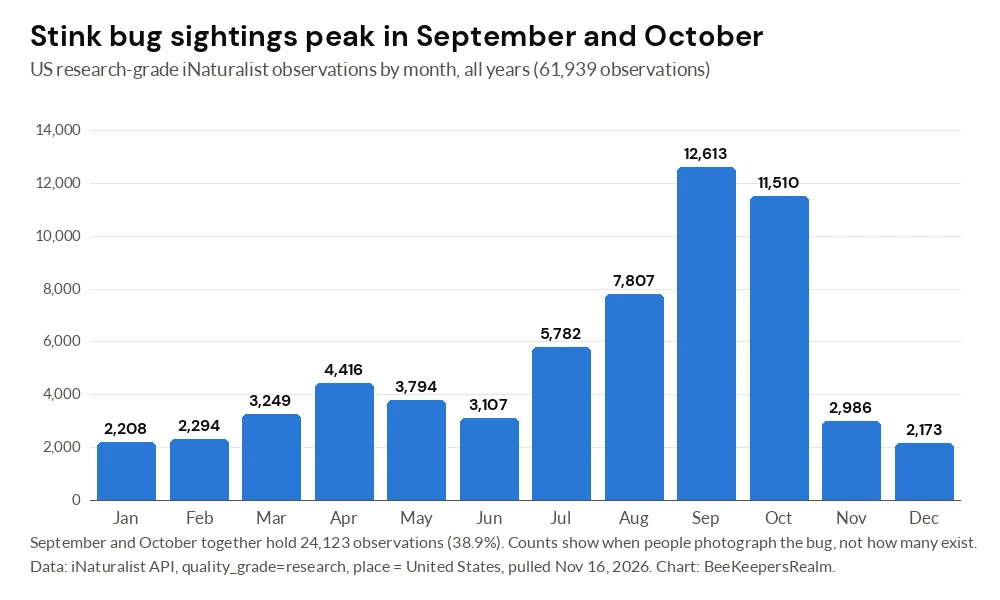
September (12,613) and October (11,510) together hold 38.9% of all observations, more than three times any winter month. A smaller bump comes in April, when overwintered adults become active again; NC State notes they show up again in spring. December and January are the quietest months, with about 2,200 observations each.
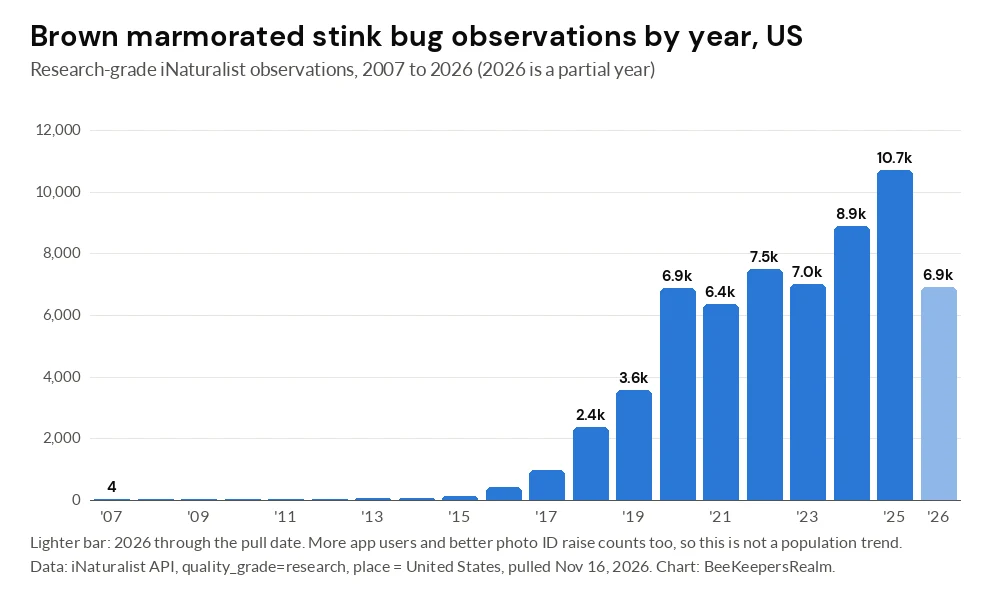
The yearly chart reflects iNaturalist’s growth as an app as much as the bug’s spread: the earliest research-grade US record is from Silver Spring, Maryland, in July 2007, and observations rose from 409 in 2016 to 10,710 in 2025. North Carolina, Virginia, Ohio, New York and Washington each have more than 3,500 records, while Florida has 111 and North Dakota just one.
Are Stink Bugs Harmful to People and Pets?
For people, mostly no. The EPA says brown marmorated stink bugs do not bite people or pets, will not reproduce in homes or cause structural damage, and are not known to transmit disease. Bertone at NC State says that BMSBs, and most stink bugs, do not bite or sting to defend themselves, so unlike a horse fly, a stink bug that lands on you is no threat. The exceptions are allergies and skin irritation: Penn State says the odor can trigger runny nose or eye irritation in people sensitive to it, and crushing the bugs on skin can cause dermatitis, though it appears to affect a small percentage of people.
For pets, the evidence is thin. In a 2016 answer on Ask Extension, an Oregon State University Master Gardener wrote that stink bugs “apparently aren’t poisonous to pets” but that dogs that eat them are likely to drool heavily and vomit, advising a call to the vet if you are concerned. We found no veterinary study on the question.
Why do stink bugs smell?
“Instead, they produce foul odors as both adults and juveniles to discourage predators. Very few predators want to eat something that smells awful.”
Penn State places the scent glands on the upper surface of the abdomen and the underside of the thorax, and Bertone says a stink bug can control when it releases the chemicals. A 2018 study in PLoS ONE identified the main defensive compounds as tridecane, (E)-2-decenal and 4-oxo-(E)-2-hexenal. People compare the smell to cilantro, which is the University of Kentucky’s description. NC State says the fluids are not toxic, though they can sometimes irritate skin.
This is educational information, not medical or veterinary advice. For pest questions, see the EPA’s brown marmorated stink bug page; for symptoms in people or pets, ask a doctor or vet.
Stink Bug Look-Alikes, Including the Kissing Bug
Several native insects get swatted as “stink bugs,” and one of them, the spined soldier bug, eats pests. One look-alike, the kissing bug, is a different family entirely and matters for health. This table pulls the field marks from the extension and federal sources listed in each row.
| Bug | Key marks | Harmful to people? | Plant pest? | Source |
|---|---|---|---|---|
| Brown marmorated stink bug (Halyomorpha halys) | 5/8 inch, mottled gray-brown; white antenna bands; smooth shoulders; banded abdomen edge | No bite or sting; odor can trigger allergies in sensitive people | Yes, over 100 hosts including fruit, vegetables and soybeans | Penn State, EPA, Univ. of Kentucky |
| Brown stink bug (Euschistus servus) | Plain brown; antenna bands faint and yellowish, not white; common in the Southeast | No known risk* | Yes, field crops, vegetables, fruit and nuts | StopBMSB.org |
| Green stink bug (Chinavia hilaris) | Bright green shield shape | No known risk* | Yes, fruit, vegetables and field crops | Field Guide to Stink Bugs (Virginia Tech, Clemson) |
| Spined soldier bug (Podisus maculiventris) | Brown; a sharp spine on each shoulder; short, thick first beak segment | No known risk* | No, it is a predator of pest insects. Do not kill it. | StopBMSB.org, UC IPM |
| Harlequin bug (Murgantia histrionica) | About 1/3 inch; black with bright orange, red or yellow markings | No known risk* | Yes, mainly cabbage-family crops | UC IPM, Univ. of Maryland |
| Kudzu bug (Megacopta cribraria) | Small (4 to 6 mm), round, olive-green with brown speckles | Secretions can stain skin and cause blisters in some people | Yes, soybeans and other legumes | NC State, Clemson |
| Western conifer seed bug (Leptoglossus occidentalis) | 3/4 inch, long, reddish-brown; leaf-like flare on hind legs; buzzes in flight | No; “not considered a medical risk” | Feeds on conifer seeds; not a major pest of yard trees | Penn State |
| Kissing bug (Triatoma, e.g. eastern conenose) | Long, cone-shaped head; slender beak; red-orange marks along the abdomen edge | Yes: can carry the parasite that causes Chagas disease | No, it feeds on blood | CDC, Univ. of Maryland |
*None of the sources we read lists a health risk for these species beyond the odor. The western conifer seed bug is a leaf-footed bug and the kudzu bug a plataspid, not true stink bugs. The kissing bug belongs to the assassin bug family.
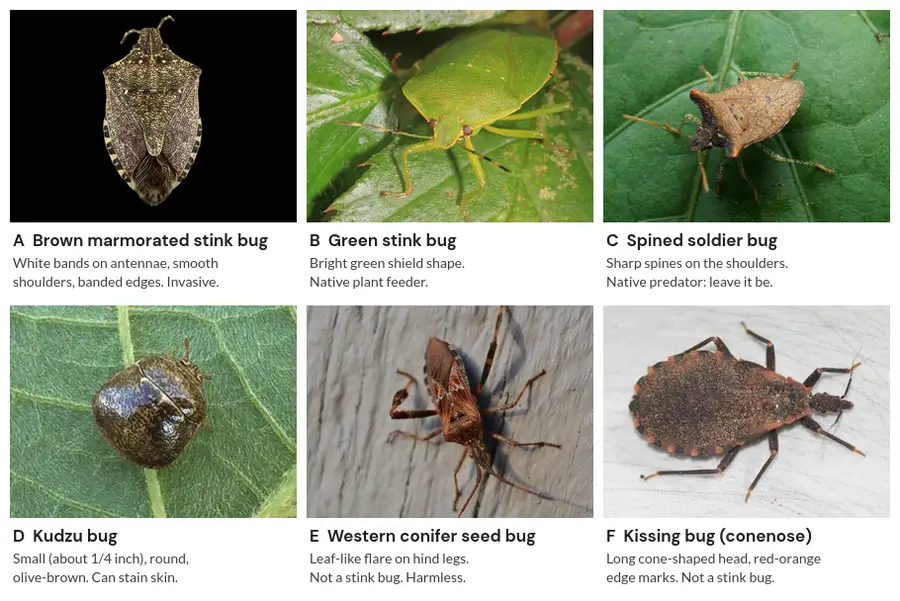
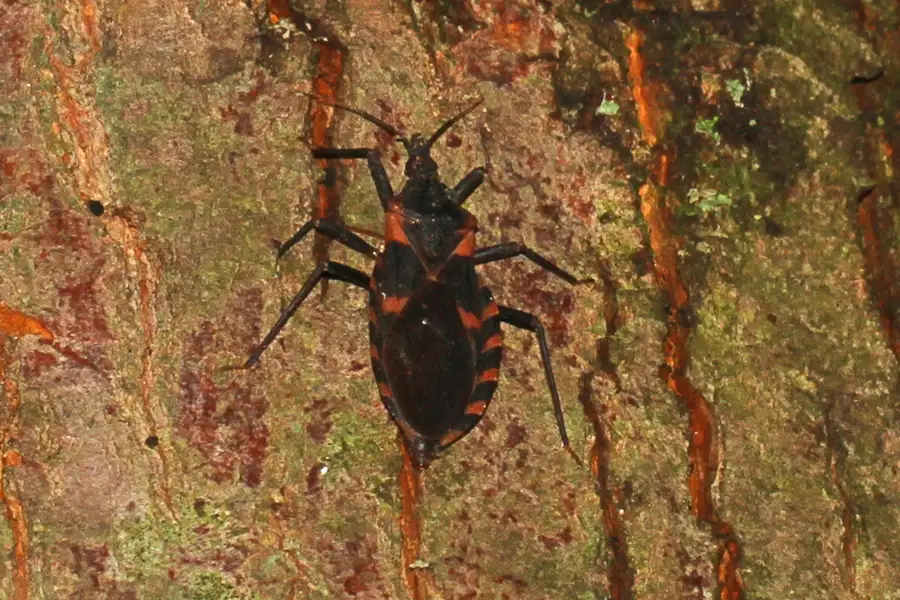
The kissing bug is the one to take seriously. The University of Maryland says 11 species live in the US and that they belong to the assassin bug family; the eastern bloodsucking conenose is the one found in the Mid-Atlantic. The CDC explains that Chagas disease mainly spreads through the bugs’ droppings, not the bite itself. Maryland Extension rates the risk in the US as low. If you find a bug with a long, cone-shaped head and red-orange edge markings, have it identified by your state extension office. For other insects that hunt rather than feed on plants, see our predatory insect comparison chart.
What Stink Bugs Eat and the Damage They Leave
Brown marmorated stink bugs feed on more than 100 host plants. Penn State lists apples, peaches, apricots, figs, mulberries, citrus, persimmons, beans, corn, tomatoes, soybeans and many ornamentals; the EPA adds Asian pears, cherries, grapes, lima beans, nectarines and peppers. They push their beak into fruit, seeds and pods and suck out the juice, and the damage often shows up days later:
- Apples and peaches: sunken, dimpled “catfacing”; Penn State says late-season feeding leaves dead, corky tissue just under the skin.
- Tomatoes and peppers: cloudy, whitish or spongy spots under the skin. The University of Maryland says these can be cut out and the rest of the fruit eaten.
- Beans and okra: scarred, sunken or wart-like spots on the pods.
- Sweet corn: shriveled kernels, because the bugs feed straight through the husk.
- Leaves: small pale stipples about 1/8 inch across.
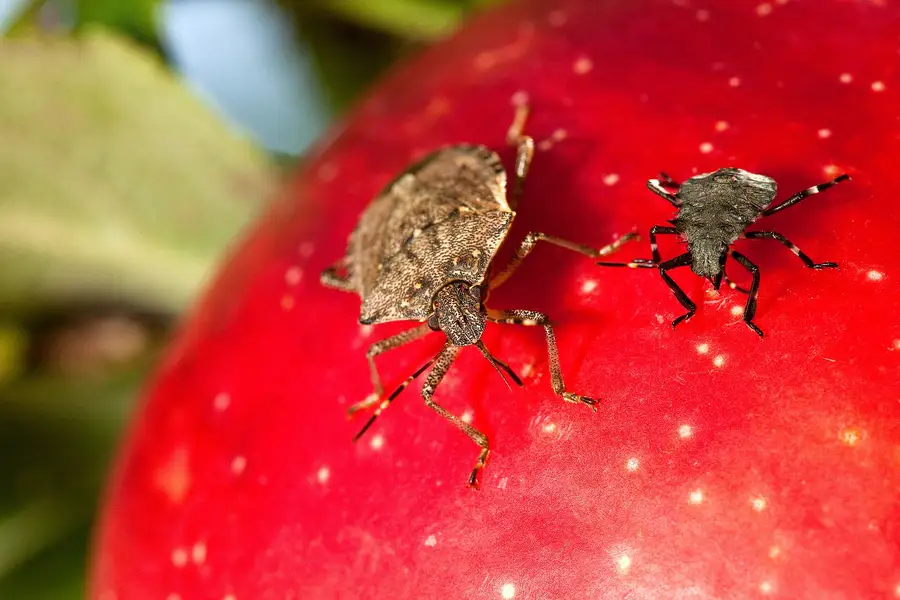
The EPA notes the damage is usually heaviest within 30 to 40 feet of field edges. On farms the losses can be severe: StopBMSB.org says that in 2010, some Mid-Atlantic growers of sweet corn, peppers, tomatoes, apples and peaches reported total losses. Apple orchards are also where many beekeepers place rented colonies (see our guide to hive density in apple orchards), so how growers handle this pest matters to bees.
Protecting a Garden Without Harming Bees
Home gardens rarely need insecticides for stink bugs, and the University of Maryland does not recommend them for brown marmorated stink bugs: most are ineffective, and some are broad-spectrum products that kill honey bees and the predators that eat stink bugs. A layered approach works better:
- Hand-pick in the morning. Kentucky’s extension suggests knocking bugs into a container of soapy water early in the day, when they are sluggish.
- Destroy egg masses on leaf undersides, but check first: UConn notes the spined soldier bug’s eggs have spines and should be left alone.
- Use netting at the right time. Kentucky says mesh of 1/6 inch or smaller keeps adults off, but it must go on before fruit forms and is impractical on crops that need insect pollination during bloom. UConn suggests covering after pollination and fruit set.
- Consider a trap crop, with modest expectations. A Rutgers-led study (Nielsen and colleagues, Environmental Entomology, 2016) found sorghum the most attractive plant, followed by sunflower. A follow-up across eight states (Mathews and colleagues, Journal of Pest Science, 2017) found a sunflower and sorghum border pulled in far more stink bugs and reduced pepper injury, but not by enough to be economically viable. Trap crops are a kind of companion planting, with the same mixed record.
- Grow resistant or early tomatoes. The University of Maryland says some early-season, determinate and grape-type varieties have reportedly fared better.
If you do spray, the rule from the University of Kentucky is plain: products that can harm pollinators “should not be used on plants in bloom” or in the evening when pollinators are not active. Kentucky names pyrethroids and an organophosphate as effective against BMSB and warns in the same passage that they can be detrimental to pollinators. The University of Maryland adds that soaps, neem and pyrethrum work only on young nymphs, not adults. Our pollinator-safe pest control guide explains how to read the EPA pollinator box on a label, and if hives are kept nearby, registering them with DriftWatch and BeeCheck lets local applicators know. The same bloom rule applies to other invasive garden pests such as the Japanese beetle.
The Samurai Wasp, a Natural Enemy Already Here
The best long-term news is a tiny wasp, Trissolcus japonicus, known as the samurai wasp. It lays its eggs inside stink bug eggs, and a wasp, not a stink bug, emerges from each one. StopBMSB.org says it destroys 60 to 90% of brown marmorated stink bug eggs in Asia, that it was found in the wild in Beltsville, Maryland, in 2014, and that the wasp does not sting or otherwise harm humans. USDA’s Agricultural Research Service describes it as about 1.5 mm long, the size of a sesame seed, and as adventive, meaning it arrived without human help. ARS says wild populations are now in 14 states.
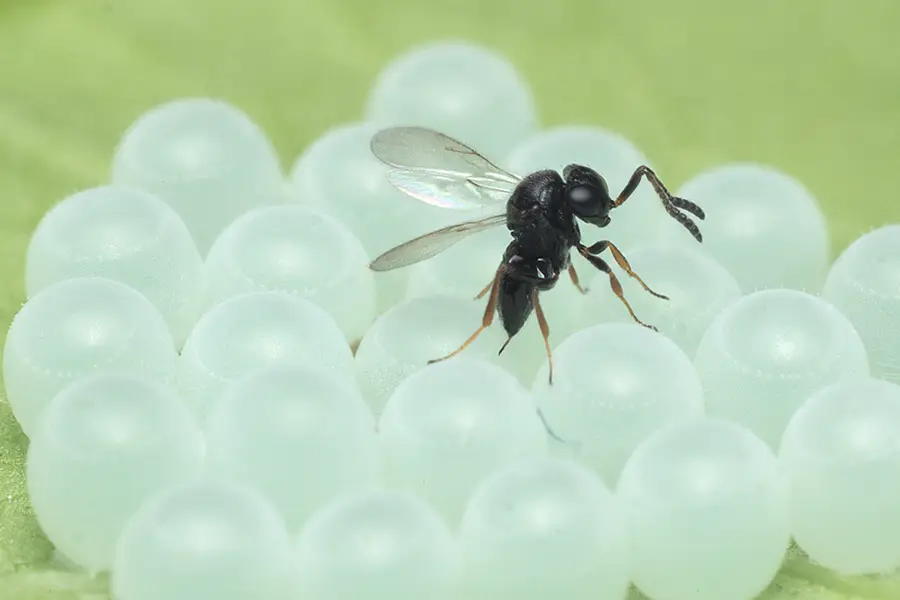
“We hope that samurai wasps can reduce those populations in wild host habitats, so we have less pressure in our agricultural areas”
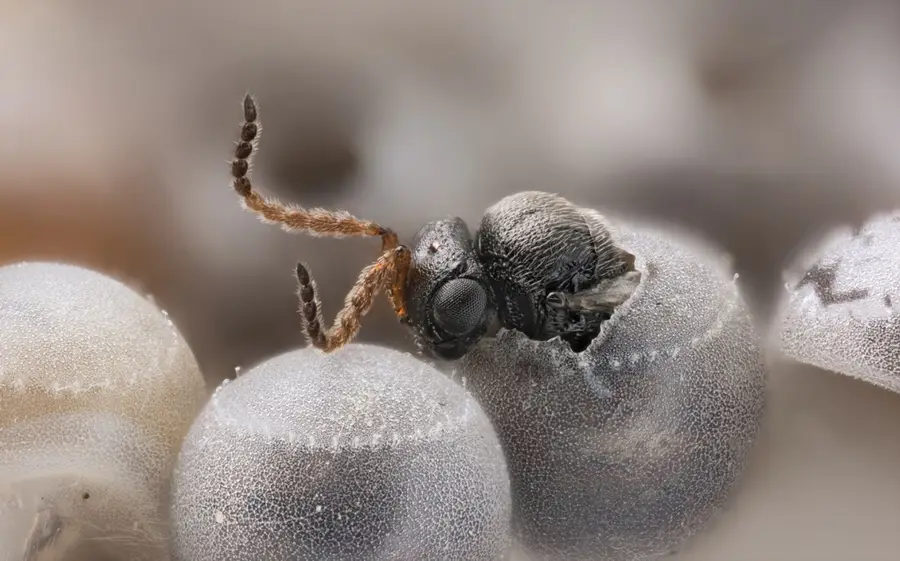
The University of Maryland’s warning that broad-spectrum sprays kill beneficial insects applies here too: a wasp this small is easy to wipe out along with the pest. The samurai wasp is related to the larger ichneumon wasps that also develop inside other insects, and it looks nothing like the yellowjackets in our bee vs. wasp identification guide.
Like stink bugs, katydids feed on garden plants, but their damage is usually limited to a few chewed leaves.
The multicolored Asian lady beetle invades the same sunny walls each fall; our ladybug guide explains how to keep it out without indoor sprays.
If the bug has a long, cone-shaped head and red or orange bands around its edge, compare it with our kissing bug identification guide.
Millipedes also turn up in basements and garages in fall, but they dry out and die within days; see our millipede guide.
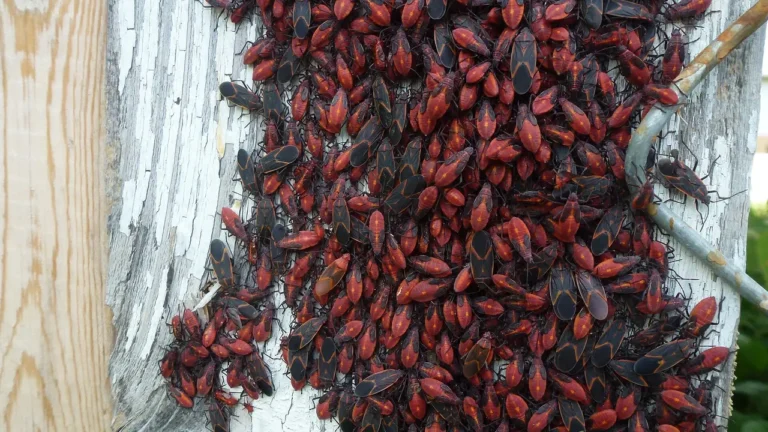
Another red-and-black fall home invader, the harmless boxelder bug, is covered in our boxelder bug guide.
Frequently Asked Questions
Why shouldn’t you squish a stink bug?
Crushing it releases the odor indoors and can stain fabric or irritate skin. It will not attract more stink bugs, according to NPIC, but a jar of soapy water or a shop vacuum is cleaner.
How harmful are stink bugs?
To people, very little. They do not bite, sting, carry disease or damage houses. A small share of sensitive people react to the odor. The real harm is to fruit, vegetables and field crops.
Why are stink bugs stinky?
The smell is a defense. Glands on the thorax of adults release compounds such as tridecane and (E)-2-decenal that make predators back off.
Should I be worried if I find a stink bug in my house?
No. A few bugs in fall or spring are normal and they will not breed indoors. Many bugs mean there are gaps to seal before next September.
Are stink bugs poisonous to pets?
They are not considered poisonous, but a dog that eats them may drool heavily or vomit, per an Oregon State University Master Gardener answer on Ask Extension. Call your vet if symptoms last.
What attracts stink bugs into homes?
In September and October they look for sheltered places to spend the winter, and gaps around windows, doors, siding and chimneys let them in. Once one finds a good spot, NPIC says it releases a scent that attracts others.
What plants do stink bugs attack?
More than 100, including apples, peaches, pears, cherries, grapes, tomatoes, peppers, beans, okra, sweet corn and soybeans, plus many ornamental trees and shrubs.
How do you make stink bugs go away?
Seal cracks, gaps and vents before mid-September, vacuum or drown the bugs already inside, and skip indoor sprays. In the garden, hand-pick, use netting after pollination, and leave the spined soldier bug alone.
The Bottom Line
A stink bug in the house is a nuisance, not a danger. Caulk the gaps in late summer, vacuum the stragglers, and keep sprays off anything in bloom.
Image credits: featured photo by Judy Gallagher (CC BY 2.0); stink bug photos by Judy Gallagher (CC BY 2.0), David R. Lance, USDA APHIS PPQ (CC BY 3.0 US) and Stephen Ausmus, USDA-ARS (public domain); kissing bug photo by Judy Gallagher (CC BY 2.0); look-alike panel by USGS (public domain), Judy Gallagher (CC BY 2.0), Fernando Tessaroli Brandl (CC0), NCBioTeacher (CC0), Andrew C (CC BY 2.0) and Douglas Hooper (CC BY 4.0); samurai wasp photos by Chris Hedstrom, Oregon Department of Agriculture, for Oregon State University (CC BY-SA 2.0). All via Wikimedia Commons, resized or cropped. Charts by BeeKeepersRealm from iNaturalist data.