Reviewed by Sofia T. · How we review
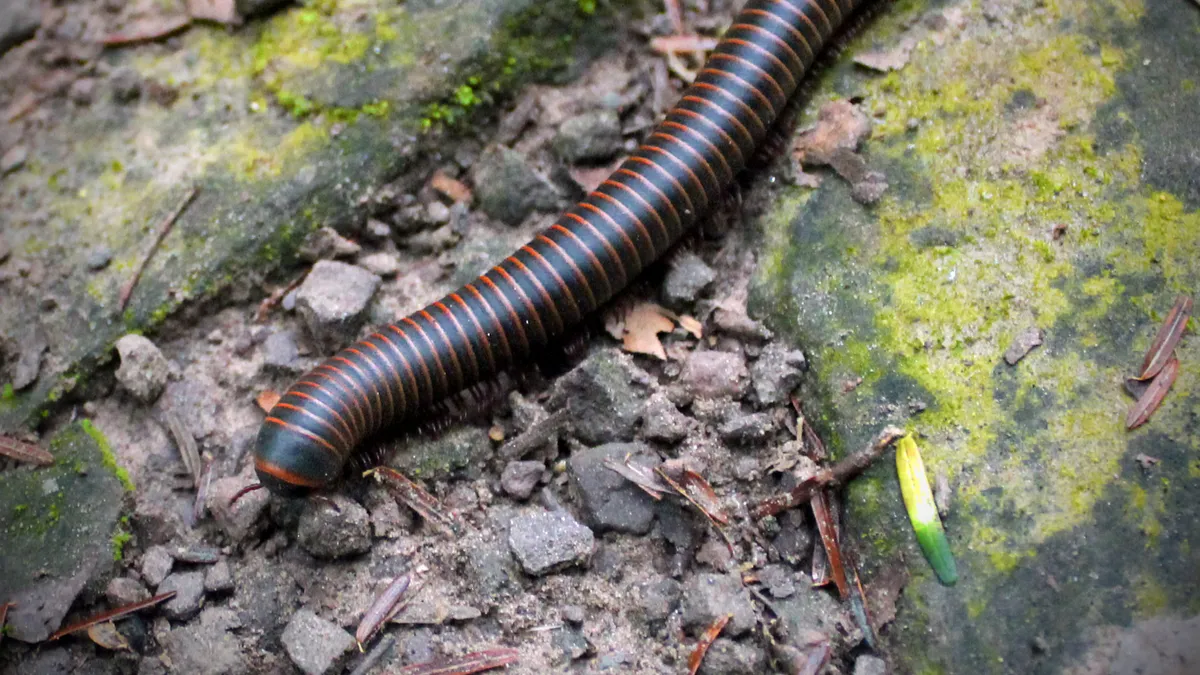
A millipede is a slow, many-legged arthropod in the class Diplopoda, and it is not an insect. Most of its body segments carry two pairs of legs, and most species have between 30 and 300 legs, not 1,000. Millipedes do not bite or sting, but many ooze a defensive fluid that can stain or irritate skin. They eat dead leaves, and when they wander indoors after heavy rain or a dry spell, they usually die within a few days. Sweep them up, seal the gaps and dry out the mulch along the foundation; sprays are rarely needed.
This guide covers US species, the centipede difference, skin effects, why millipedes come indoors and what extension entomologists recommend, plus our own count of 115,064 research-grade iNaturalist observations of US millipedes.
Key Takeaways
- Millipedes are arthropods, not insects. The National Wildlife Federation says they are closer to lobsters and crayfish than to insects.
- The leg record is 1,306, set by Eumillipes persephone in a 2021 Scientific Reports paper. The previous record holder, with 750 legs, lives in California.
- They do not bite or sting. Their fluid can stain, burn or blister skin; wash it off with soap and water.
- Indoors they dry out and die within days. Sweep them up, seal gaps and cut back damp mulch; extension services do not advise indoor sprays.
- The non-native greenhouse millipede (Oxidus gracilis) makes up 27% of US research-grade iNaturalist millipede records, more than the next two species combined.
Table of Contents
- What a Millipede Is, and Why It Is Not an Insect
- Common Millipedes in the US and How to Recognize Them
- Millipede vs Centipede: How to Tell Them Apart
- Are Millipedes Poisonous? Do They Bite?
- Why Millipedes Come Into the House
- How to Get Rid of Millipedes
- Millipedes in the Garden
- Millipede Sprays and Bees
- Frequently Asked Questions
What a Millipede Is, and Why It Is Not an Insect
Millipedes are arthropods, the group of jointed-legged animals that also holds insects, spiders and crustaceans. An insect has six legs and three body sections; a millipede has a head and a long trunk of near-identical segments, so it gets its own class, Diplopoda, named for its double pairs of legs. Our page on why a bee is an insect but not a bug explains how these groups are sorted.
Penn State Extension gives the rule: two pairs of legs on each body segment, except the first three, which have one pair each. Young millipedes hatch with few legs and add segments and legs at each molt. About 12,000 species have been described worldwide, according to The Nature Conservancy. For North America, the Missouri Department of Conservation (MDC) says more than 900 species live north of Mexico, while the National Wildlife Federation counts 1,400 in the US and Canada.
How many legs does a millipede have?
The University of Kentucky says most species have 30 to 300 legs, and South Dakota State University Extension gives 160 for the common millipede around homes. Some pages still say no millipede has more than 750 legs. That changed in 2021.
“However, no millipede has ever been described with more than 750 legs. We discovered a new record-setting species of millipede with 1,306 legs, Eumillipes persephone, from Western Australia.”
The animal is 0.95 mm wide and 95.7 mm (about 3.8 inches) long, with 330 segments, and was found 60 meters underground in a mineral exploration drill hole. The previous champion, Illacme plenipes, with 750 legs, is from California.
Common Millipedes in the US and How to Recognize Them
Most millipedes people meet are brown to black, about an inch long, round and slow; Colorado State University Extension says a common description is “little black worms crawling in the basement windows.” MDC notes that brightly colored species are more likely to have foul or toxic secretions.
| Millipede | How to recognize it | Where it turns up | Defense and notes | Source |
|---|---|---|---|---|
| Greenhouse or garden millipede (Oxidus gracilis) | 1/2 to 3/4 inch; gray to brown and hard-bodied; a flat-backed millipede (order Polydesmida) | Mulch, leaf litter, lawn thatch and potted plants across the US; not native, from Asia | The millipede that most often invades homes in large numbers | Clemson HGIC, Mississippi State Extension |
| Round brown “garden” millipedes (several species) | 1 to 1 1/2 inches; dark brown, cylindrical; coil tightly when disturbed or dead | Under mulch, rocks and thatch; basements and window wells | Harmless; bodies stay intact long after death | Penn State, Colorado State |
| American giant millipede (Narceus americanus) | Up to 4 inches; thick, round and dark | Eastern US woodlands | Releases benzoquinones that smell like chlorine or bleach; no cyanide | Virginia Museum of Natural History, Univ. of Kentucky |
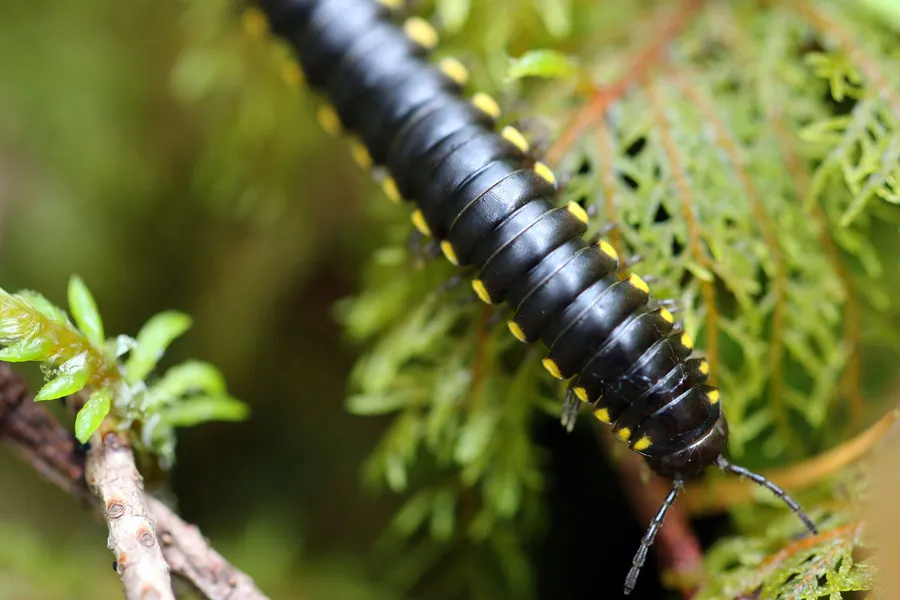
| Yellow-spotted or cyanide millipede (Harpaphe haydeniana) | About 2 inches; black with yellow spots on the side keels | Moist conifer forests of the Pacific Northwest | Releases hydrogen cyanide (toasted-almond smell); too little to seriously harm people, but can stain or blister skin | The Nature Conservancy |
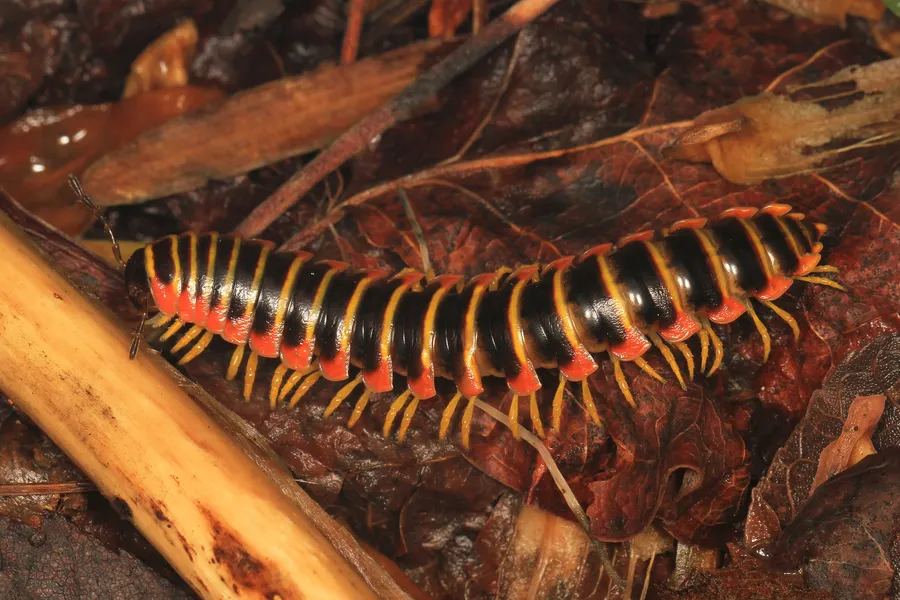
| Cherry millipedes and other flat-backed species (e.g. Sigmoria, Apheloria) | Flat-backed, black with red or other bright markings; Sigmoria arcuata reaches about 2 inches | Eastern forests and leaf litter | Fruity odor when disturbed; no danger as a pest, best left alone | Clemson HGIC, MDC |
| Duff millipede | Only 1/8 inch; bristly, with a tuft of hairs at the rear; looks like a carpet beetle larva | Some Colorado foothills areas | Can invade by the hundreds near bathrooms, kitchen sinks and outdoor hot tubs; no effective insecticide identified | Colorado State |
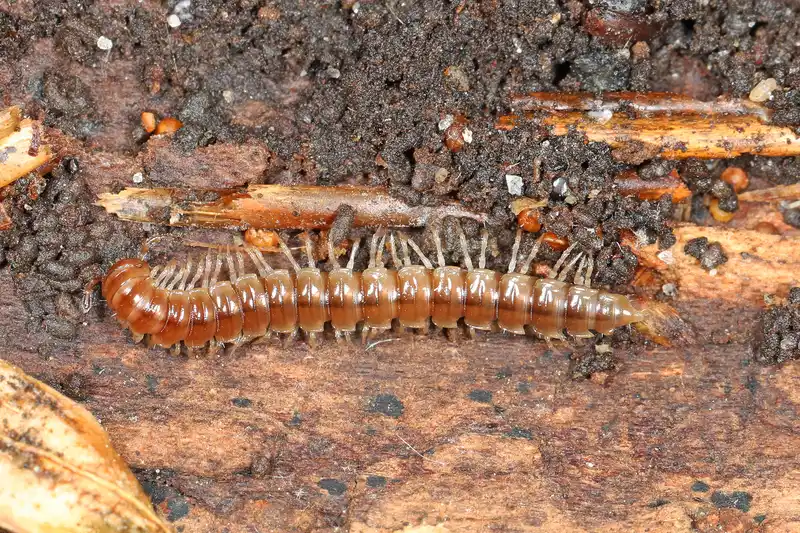
Clemson calls Oxidus gracilis the garden millipede; Mississippi State and iNaturalist call it the greenhouse millipede, an Asian species spread in potted plants and mulch. Of 115,064 US research-grade millipede observations, 31,477 (27.4%) are greenhouse millipedes, ahead of the yellow-spotted millipede (11,925) and the aromatic cherry millipede, Apheloria corrugata (10,455). Research-grade greenhouse millipede records come from 48 of the 50 states, led by California (4,376), Texas (2,651) and North Carolina (2,576). Alaska and North Dakota have none, and none of North Dakota’s 69 millipede observations has reached research grade yet.

Millipede vs Centipede: How to Tell Them Apart
Count the legs on one segment: two pairs means millipede, one pair means centipede.
| Feature | Millipede | Centipede | Source |
|---|---|---|---|
| Legs per body segment | Two pairs on most segments (UC IPM says two or four) | One pair | UC IPM, Penn State |
| Body shape | Mostly round; some flat-backed | Flattened | Univ. of Kentucky, MDC |
| Antennae | Short and elbowed | Long | Univ. of Kentucky |
| Speed | Slow; legs move in a wave | Fast runner | UC IPM, Clemson HGIC |
| Diet | Decaying leaves, wood and other plant matter | Insects, spiders, earthworms and other small animals | Univ. of Kentucky, Utah State |
| Bite | None; does not bite or sting | Venomous fangs (forcipules); can bite if handled | MedlinePlus, Univ. of Kentucky |
| Defense | Curls into a coil; many release an irritating fluid | Never coils; runs, or bites if picked up or crushed | UC IPM, Colorado State |
| Indoors | Dries out and dies within days | The house centipede survives and hunts indoors | Univ. of Kentucky |
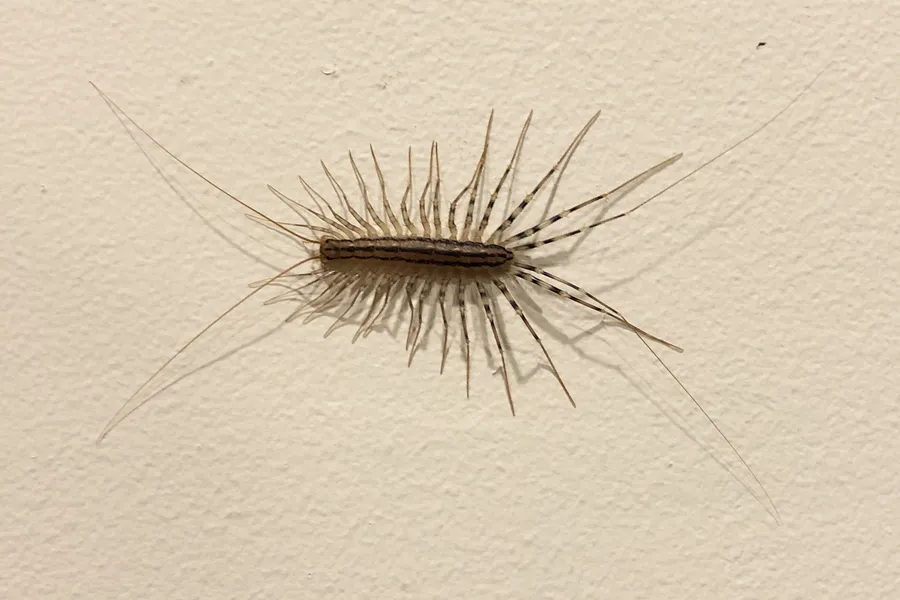
The indoor centipede is usually the house centipede, with up to 15 pairs of long, banded legs. The University of Kentucky says it is the only centipede that survives inside buildings, where it eats cockroaches, crickets and silverfish, and that its fangs struggle to pierce human skin.
Are Millipedes Poisonous? Do They Bite?
“Unlike centipedes, millipedes do not bite or sting.”
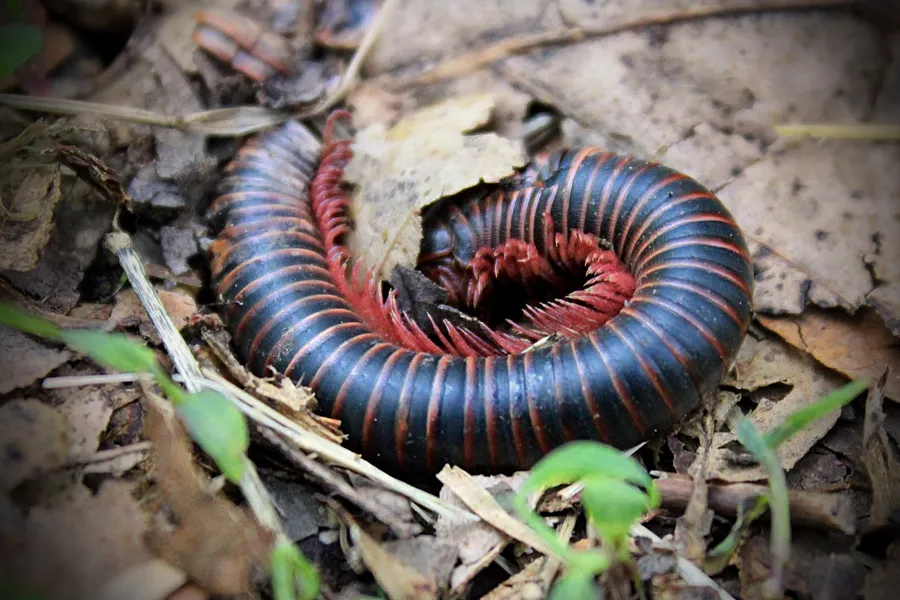
Millipedes are not venomous and, unlike fire ants, have no stinger, but many are distasteful. When threatened they curl up and release a defensive fluid. MedlinePlus lists hydrochloric acid, hydrogen cyanide, organic acids, phenol, cresols, benzoquinones and, in some species, hydroquinones, and says some large species can spray it as far as 32 inches. The University of Kentucky adds that the cyanide is not enough to harm people.
Millipede burns and stains on skin
MedlinePlus lists brown staining, intense burning or itching and blisters on skin, and pain, tearing, conjunctivitis and, rarely, blindness in the eyes. Most symptoms fade within 24 hours, but a brown stain can last for months; severe reactions come mainly from tropical species.
What to do after contact
- Wash the skin with plenty of soap and water. Do not use alcohol.
- If fluid gets in an eye, flush it with water for at least 20 minutes and get medical care right away.
- For questions, call the national Poison Help line at 1-800-222-1222.
This is educational information, not medical or veterinary advice. For an exposure, follow the MedlinePlus millipede toxin page and call a doctor, Poison Help or your vet.
Why Millipedes Come Into the House
Millipedes live under damp mulch, leaf litter, rocks and logs. Every so often large numbers move at once, and some end up inside.
- When: Colorado State says most movement happens in September and October and again in midspring, shortly after wet weather. Clemson notes mass migrations after heavy spring rains.
- Why: UC IPM says they move, often uphill, when food runs low or their habitat gets too wet or too dry. Penn State links migrations to cooler weather or heavy rain. Kentucky’s entomologists say the exact trigger is unclear.
- How many: Mississippi State says homes near breeding sites can see hundreds or thousands during long warm, wet spells.
- What happens next: Colorado State says they usually die indoors within a day or two, but the hard bodies stay intact, which is why people find piles of dead, curled millipedes.
Clemson says a large indoor invasion usually means a large population around the home; Utah State says it points to a moisture problem.
What our iNaturalist count shows
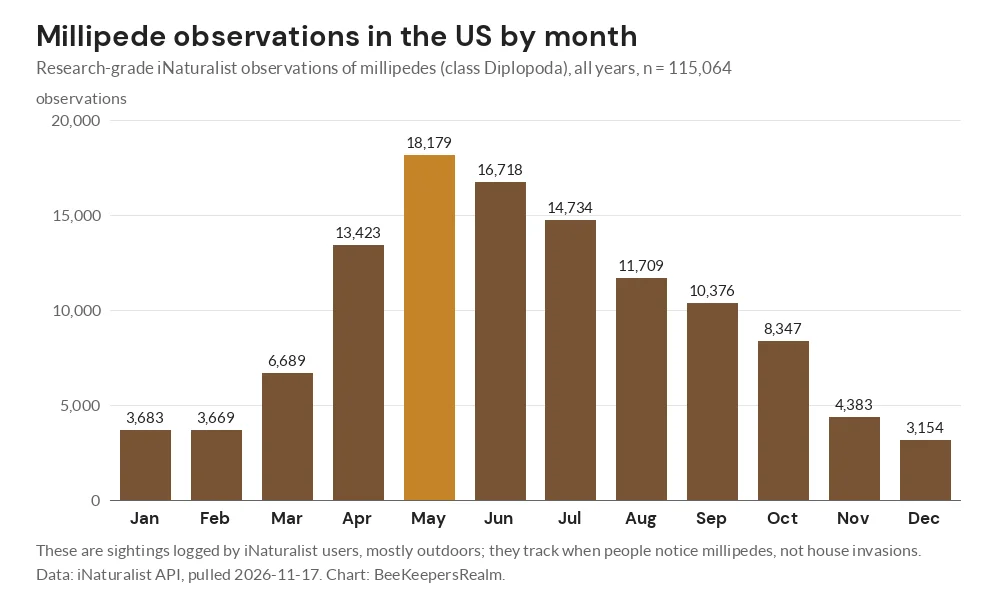
May is the busiest month (18,179, or 15.8%), and April through June hold 42.0% of records; September and October hold 16.3%. That does not contradict the extension advice: iNaturalist logs millipedes people photograph, mostly outdoors, not house invasions.
Species differ: greenhouse millipede records peak in July, with June through August holding 57.6%, while the American giant millipede group peaks in September (1,446 of 6,628).
How to Get Rid of Millipedes
Indoors: sweep, vacuum and wait
Penn State says indoor treatment is not necessary because millipedes do not live more than a few days inside; vacuum or sweep them up. Colorado State suggests waiting for an invasion to end, then vacuuming the bodies.
Outdoors: take away the damp
- Remove or thin mulch, leaf litter, woodpiles, boards and paving stones next to the foundation (Kentucky, Clemson).
- Pull up plastic weed barrier under gravel or mulch borders; Penn State says removing it dries and warms the soil.
- Fix leaks at hose bibs, sprinklers and air-conditioning units, keep gutters and downspouts draining away (Kentucky), and dry out damp crawl spaces (UC IPM).
- Dethatch the lawn, mow close and water in the morning (Clemson).
Seal the way in
Caulk gaps in the foundation, door thresholds and windowsills, and add door sweeps and weather stripping (Kentucky). Clemson warns that millipedes climb walls and can enter high as easily as low.
What about insecticides?
“Although some pesticides are labeled for controlling centipedes, the use of such products is rarely justified for centipede or millipede control.”
Where extension sources mention sprays, it is a foundation band for persistent, severe problems; Colorado State says whole-yard treatments are unnecessary and not recommended. South Dakota State calls perimeter sprays of limited effectiveness, and Mississippi State says, “Dry weather is the best cure for millipede problems.”
Millipedes in the Garden
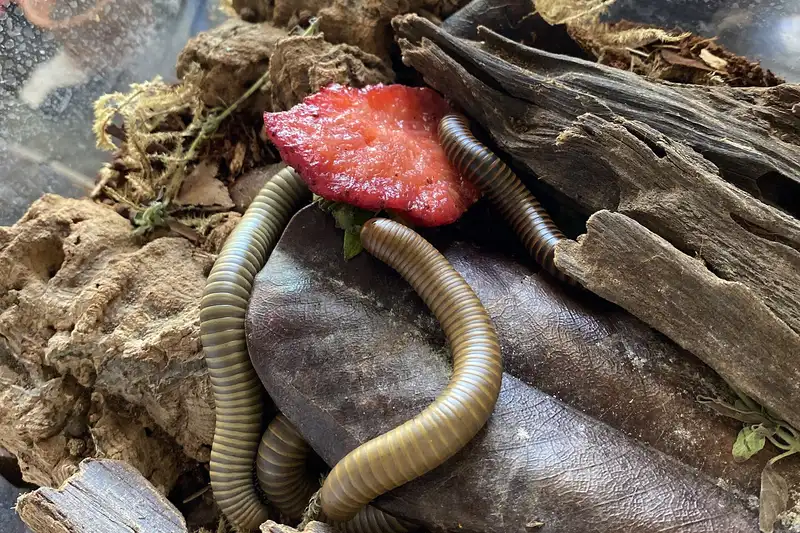
In beds and compost, millipedes are mostly helpers: UC IPM calls their role beneficial because they break down dead plant matter. When very numerous, it says, they may damage sprouting seeds, seedlings, and strawberries or other ripening fruit lying on the soil, though Mississippi State says the greenhouse millipede does not damage plants. Colorado State suggests lifting ripening fruit off the soil and trapping millipedes under fruit rinds or damp newspaper. Compared with a true garden pest like the Japanese beetle, the damage is small.
Millipede Sprays and Bees
Millipedes do not harm people, pets or houses, so a broadcast yard spray against them rarely makes sense, and it can hurt bees visiting lawn weeds and flowers. Bifenthrin, lambda-cyhalothrin and carbaryl, active ingredients Colorado State and Mississippi State name for millipede control, are all on the University of Arkansas Extension’s Group 1 list of pesticides “highly toxic” to honey bees. If a foundation band is ever justified, keep it off anything in bloom; our guide to pollinator-safe pest control explains the bee warnings on labels.
The stink bug is kept out the same way, by sealing gaps, while sugar ants need baits. Unlike carpenter ants, millipedes never damage wood. See more in our garden and household insects section.
Frequently Asked Questions
Is a millipede harmful to humans?
Not seriously. Millipedes cannot bite or sting, but their fluid can stain, burn or blister skin and hurts in the eyes.
Is it bad if I have millipedes in my house?
No. They do not breed indoors, eat food or damage the house, and they die within days. Many at once means a big population in damp mulch by the foundation.
Why am I suddenly finding millipedes in my house?
Millipedes migrate in large numbers, usually after heavy rain or a weather change in spring and fall, and some slip in through gaps.
What does it mean when you see millipedes in your house?
Usually that there is moist habitat close to the house: thick mulch, leaf litter, a leak or a damp crawl space.
What gets rid of millipedes in a house?
A broom or vacuum, then sealing the gaps and drying out the foundation area. Indoor sprays are not needed.
Why shouldn’t you kill millipedes?
Outdoors they recycle dead leaves into soil, and Clemson notes that crushed millipedes can leave stains.
What should you do if you see a millipede?
Leave it alone outdoors. Indoors, sweep it up or carry it out on paper.
Are millipedes harmful to pets?
Clemson says they do not bite pets, but the National Wildlife Federation notes that some species’ cyanide is toxic to small animals. Call your vet if a pet drools heavily or vomits after chewing one.
What do millipedes eat?
Mostly rotting leaves, decaying wood and other dead plant matter. MDC notes that a few species eat living plants.
The Bottom Line
A millipede in the house signals damp ground outside, not danger inside. Sweep it up, seal the gap and thin the mulch.
Image credits: featured photo by Nicholas A. Tonelli (CC0, Wikimedia Commons); other photos as credited in their captions. Charts by BeeKeepersRealm.