Reviewed by Thomas B. · How we review
A praying mantis is a large ambush predator in the insect order Mantodea, named for the way it holds its spiny front legs folded as if in prayer. About 20 mantis species live in the US, and the three most often seen are the native Carolina mantis and the introduced Chinese and European mantises. They eat almost any insect they can catch, including bees, butterflies and other mantises, and large ones sometimes catch hummingbirds. They are harmless to people, no US law protects them, and extension entomologists say they do little to control garden pests.
Every fact below is credited to a named university, extension program or peer-reviewed paper; the observation counts are our own pull of iNaturalist records. We make no claim of first-hand experience raising or studying mantises.
Key Takeaways
- The Carolina mantis is native; the Chinese and European mantises were introduced in the late 1890s (Illinois Extension).
- Mantises eat bees: Kansas State University says they catch honey bees entering and leaving hives, and UC IPM lists bees, butterflies and hover flies as common prey.
- A 2017 review compiled 147 cases of mantises catching small birds; more than 70% were in the USA, often hummingbirds at feeders.
- Buying egg cases for pest control is not recommended (Kansas State); most sold are the non-native Chinese mantis.
- Sexual cannibalism occurred in 31% of matings in a field study of the European mantis, not in every mating.
- Mantises are not venomous, and no law protects them.
- In 135,132 US iNaturalist records for the three common species, September is the peak month for all three.
Table of Contents
- What Is a Praying Mantis?
- Praying Mantis Species in the US
- Praying Mantis Egg Cases (Oothecae)
- Life Cycle and Lifespan
- When Mantises Are Seen in the US
- What Praying Mantises Eat, Including Each Other
- Praying Mantises, Bees and Other Pollinators
- Do Praying Mantises Eat Hummingbirds?
- Are Praying Mantises Good for the Garden?
- Do Praying Mantises Bite?
- Is It Illegal to Kill a Praying Mantis?
- Praying Mantis Myths Checked
- Frequently Asked Questions
- Sources
What Is a Praying Mantis?
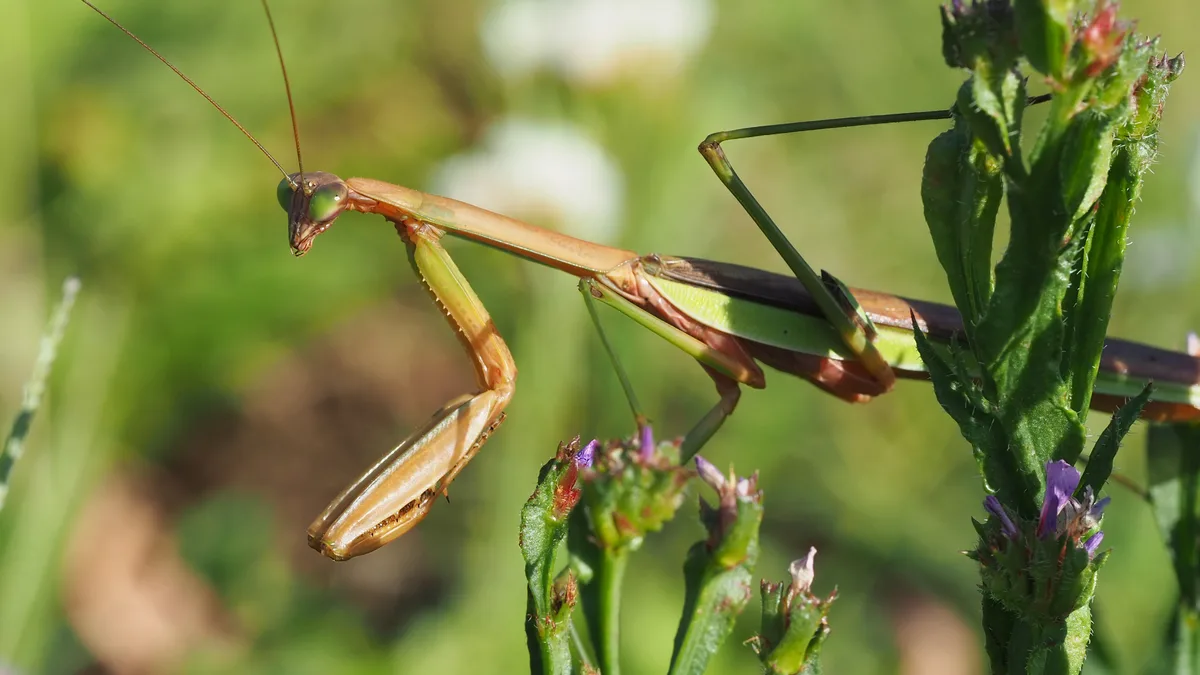
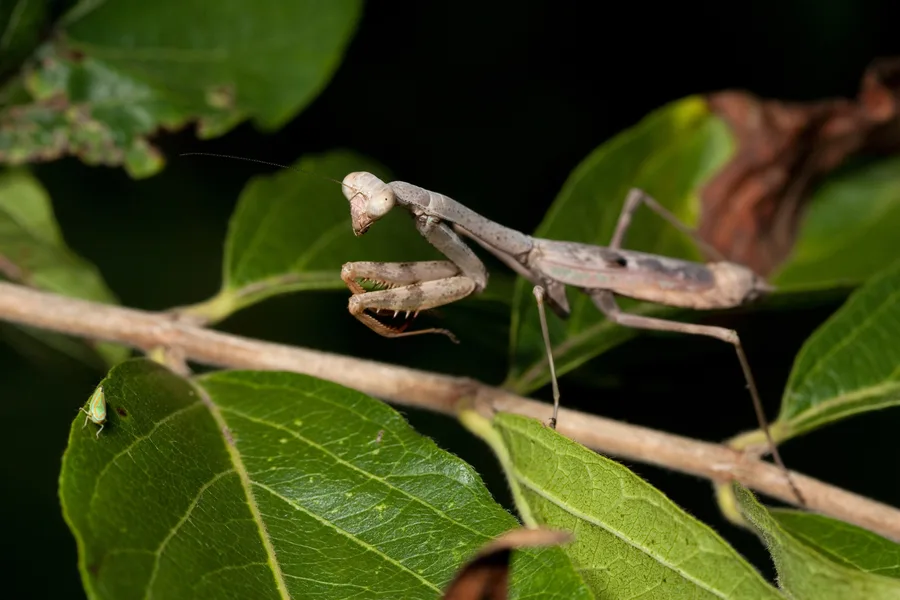
Praying mantises, also called mantids, are insects in the order Mantodea. Adults are generally 2 to 5 inches long, with a triangular head and large, bulging eyes (UC Statewide IPM Program, UC IPM). The front legs are raptorial: they carry rows of sharp spines that grip prey, and they fold into a groove when not in use (University of Kentucky, UKy). The head can turn about 180 degrees, which lets a mantis follow prey without moving its body (UC IPM; Kansas State University, KSU). Besides two compound eyes, mantises have three simple eyes called ocelli (Britannica).
Source estimates of the number of species range from about 1,500 (Wisconsin Extension) to more than 2,000 (UC IPM), most of them tropical. About 20 occur in the US (Wisconsin Extension; Colorado State University). Mantises hunt by waiting motionless, often on flowers, and striking at insects that come within reach. That makes them part of the same garden predator guild as the insects in our comparison chart of predatory wasps and insects.
Praying Mantis Species in the US
Three species account for most US sightings. Illinois Extension says the Chinese mantis was first noticed in the Mount Airy area of Philadelphia in 1897 (some sources give 1896) and the European mantis in Rochester, New York, in 1899. Their egg cases were later collected and shipped to other states for pest control. California also has native species such as the bordered mantis (Stagmomantis limbata) and an introduced Mediterranean mantis (UC IPM).
| Mantis | Native? | Size | Color / key mark | Egg case | Source |
|---|---|---|---|---|---|
| Carolina mantis (Stagmomantis carolina) | Native | 2 to 2.5 in | Gray, brown or green, often mottled; dark spot on the front wings; female wings cover only part of the abdomen | Slender, 0.5 to 1 in, tan with a whitish center and a ribbed top | Illinois Extension; KSU |
| Chinese mantis (Tenodera sinensis) | Introduced, Philadelphia, 1890s | 3 to 5 in | Green or tan-brown; light green or yellow stripe along the wing edges | Rounded and foamy, about 1 to 1.25 in, “ping-pong ball” size | Illinois Extension; UMD Extension; KSU |
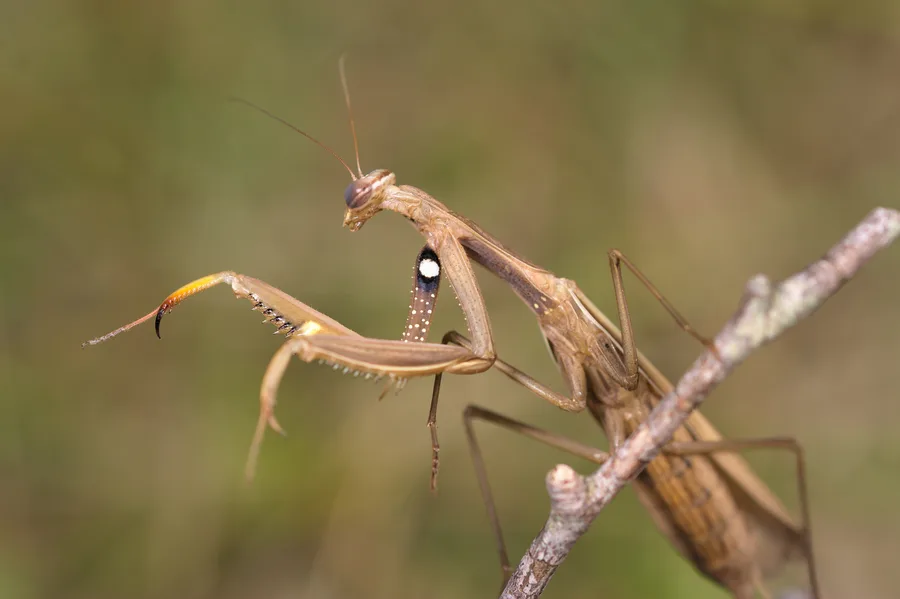
| European mantis (Mantis religiosa) | Introduced, New York, 1899 | About 3 in | Green or tan; black or black-ringed white spot on the inside base of each front leg | 1.5 to 2 in, like the Carolina case but larger and more even in color | Illinois Extension; UMD Extension |
| Narrow-winged mantis (Tenodera angustipennis) | Introduced, Maryland, 1921 | 2.6 to 3.3 in (65 to 85 mm) | Brown or green, narrower wings than the Chinese mantis; orange spot between the front legs (yellow in the Chinese mantis) | Long and slim, 1.6 to 2.4 in (40 to 60 mm); often mistaken for a Carolina case | Wikipedia, citing published records |
| Grizzled mantis (Gonatista grisea) | Range: southern Florida to Georgia and South Carolina, plus the Caribbean (origin not stated) | 1.4 to 1.6 in (36 to 40 mm) | Flattened, mottled gray-green; mimics lichen on tree trunks | Not described in the UF/IFAS profile | UF/IFAS EDIS IN1188 |
For a quick ID, look for the European mantis’s eyespot on the inner front leg; of the three common species, the Chinese mantis is the largest and the Carolina the smallest (UMD Extension).
Praying Mantis Egg Cases (Oothecae)
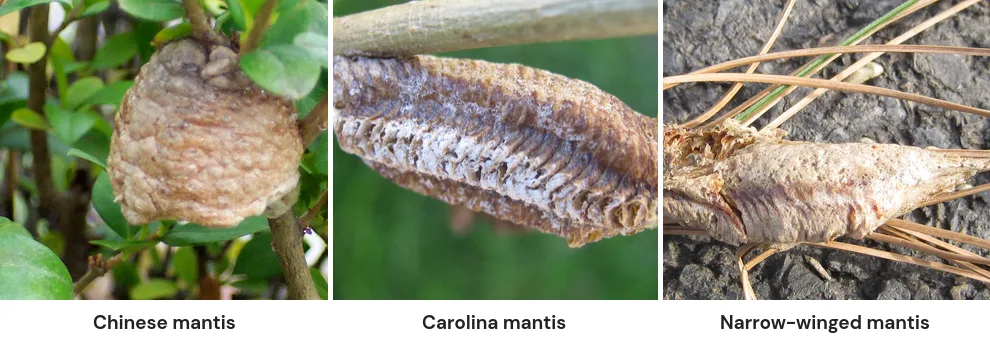
After mating in fall, a female lays her eggs in a frothy mass that hardens into a foam-like case called an ootheca. Kansas State says a female lays 200 to 300 eggs and that egg cases can be found from November through April on branches, plant stems, walls, fences, posts, sides of houses and eaves. The eggs spend the winter inside the case.
The shape tells you the species. A Chinese case is a rounded, tan lump that Illinois Extension compares to a toasted marshmallow. A Carolina case is slender, with a pale center band and dark stripes on each side. European cases look like Carolina cases but are larger and more even in color. Narrow-winged cases are long and slim and are often mistaken for Carolina cases.
If you find one, leave it outdoors: UKy warns that egg cases brought inside in fall hatch during winter. Some people destroy the cases of non-native species to protect the native Carolina mantis, while Illinois Extension notes that some research has found the non-native species have little negative impact on insect populations.
Life Cycle and Lifespan
Mantises have three life stages: egg, nymph and adult, with no pupa. In spring, Kansas State says nymphs emerge in three to 10 weeks depending on temperature, and 50 to 200 nymphs can come out of one case. UKy gives a wider range of 12 to 400 eggs per case and notes that a nymph’s first meal is often a sibling. Birds, toads, lizards and other predators eat many of the rest (KSU).
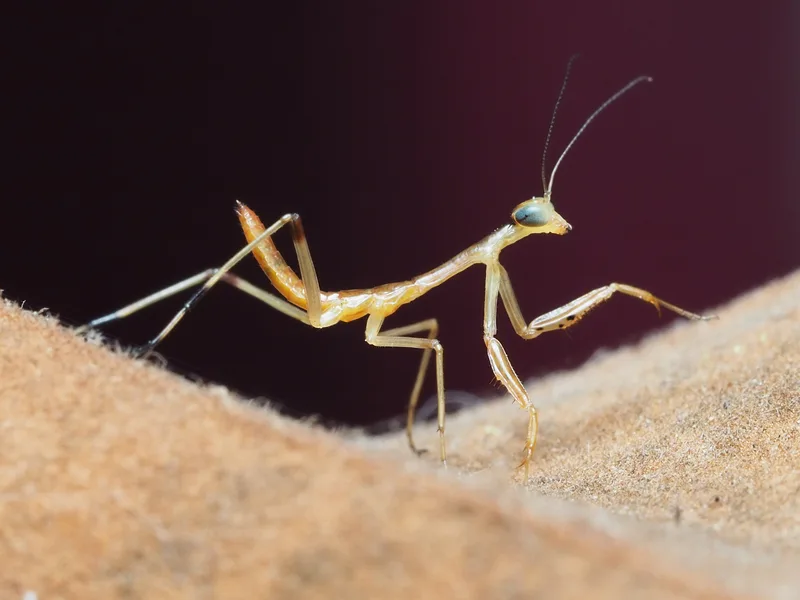
Nymphs look like small wingless adults and molt about six or seven times before they mature (UC IPM). There is one generation a year (KSU; UC IPM). Adults appear in late summer, mate, and die a few weeks after the eggs are laid (Wisconsin Extension); in Colorado all mantids are dead by late September or early October (CSU). UF/IFAS puts the typical wild lifespan of most mantis species at about one year; in cold-winter states much of that year is spent as an egg inside the case.
When Mantises Are Seen in the US
We pulled every US research-grade iNaturalist observation for the three common species on 17 November 2026: 54,323 Carolina, 43,823 Chinese and 36,986 European mantis records. iNaturalist is one of the citizen science programs that track pollinators and other insects; the counts are photos people uploaded, not population estimates.
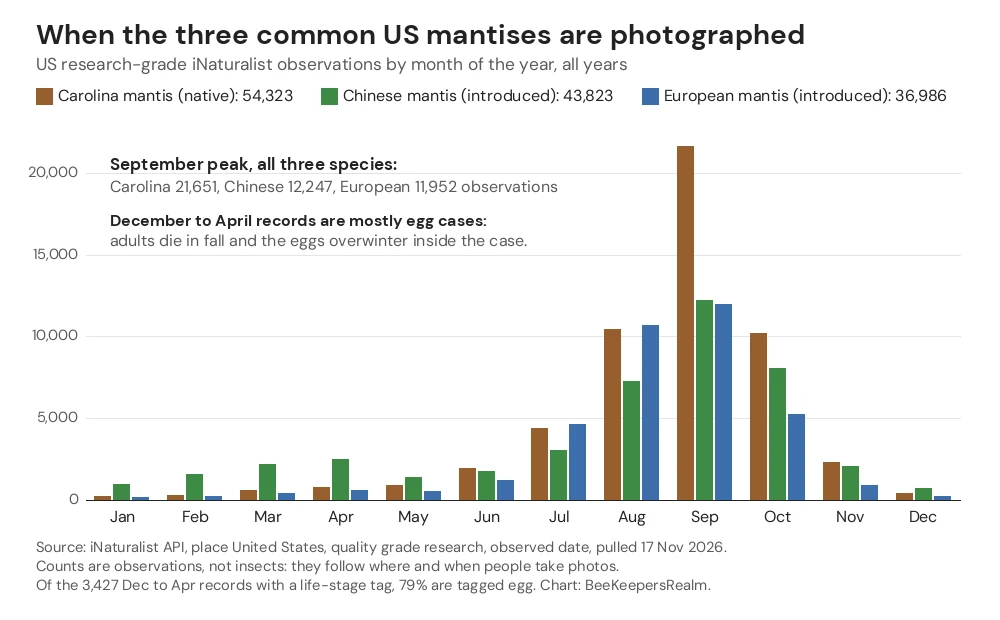
- September is the peak for all three: 39.9% of Carolina, 32.3% of European and 27.9% of Chinese records.
- August to October holds 77.9% of Carolina and 75.5% of European records, but only 62.9% of Chinese records.
- January to April holds 16.7% of Chinese records, against 3.6% for Carolina and 4.1% for European.
- Of the 3,427 December-to-April records with a life-stage tag, 79% are tagged as eggs, which matches the egg cases KSU says are present from November through April.
The tagged Chinese records also include 408 nymphs in January and February. These are most likely egg cases that hatched indoors, which is exactly what UKy warns about.
What Praying Mantises Eat, Including Each Other
Mantises are generalists. UC IPM describes their prey as almost any medium-sized, active insect, especially winged adults. Kansas State lists butterflies, caterpillars, crickets, flies, grasshoppers, moths and wasps, and Wisconsin Extension shows mantids eating a leafhopper, a caterpillar, a grasshopper and a horse fly. Large mantises also take small vertebrates such as lizards, frogs and hummingbirds (KSU).
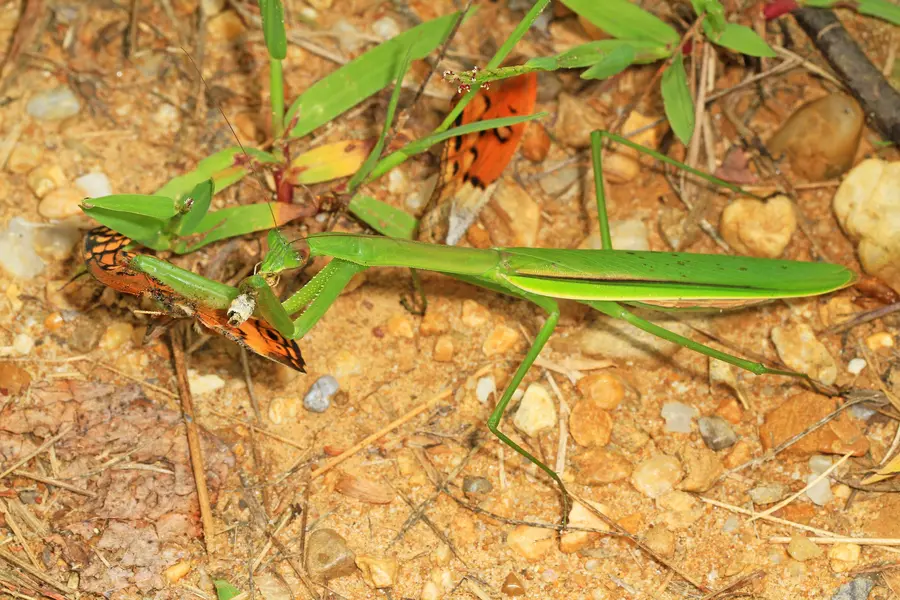
They also eat each other. Females sometimes eat males during courtship or mating, but it does not happen in most matings and is not needed for egg production (UC IPM). In a field study of the European mantis, Lawrence (1992, Animal Behaviour) recorded sexual cannibalism in 31% of matings observed in the wild. Wisconsin Extension says it is more common in captivity than in the wild.
Praying Mantises, Bees and Other Pollinators
Flowers are a favorite hunting post. UC IPM says mantids commonly wait on flowers for flying insects to arrive, and Colorado State says they are often seen on flowers waiting for foraging insects. That puts them where bees, butterflies and hover flies feed. Kansas State is direct about honey bees:
“Praying mantids also feed on honey bee, Apis mellifera, adults entering and leaving hives during the day.”
Illinois Extension says mantids are just as likely to eat butterflies or bees as the caterpillars a gardener wants gone, and the University of New Hampshire says the same of a butterfly or bumble bee. Colorado State goes further: most of what mantids eat are flies, gnats, bees and other insects that do not harm plants. Native bees that forage alone on open flowers are exposed in the same way.
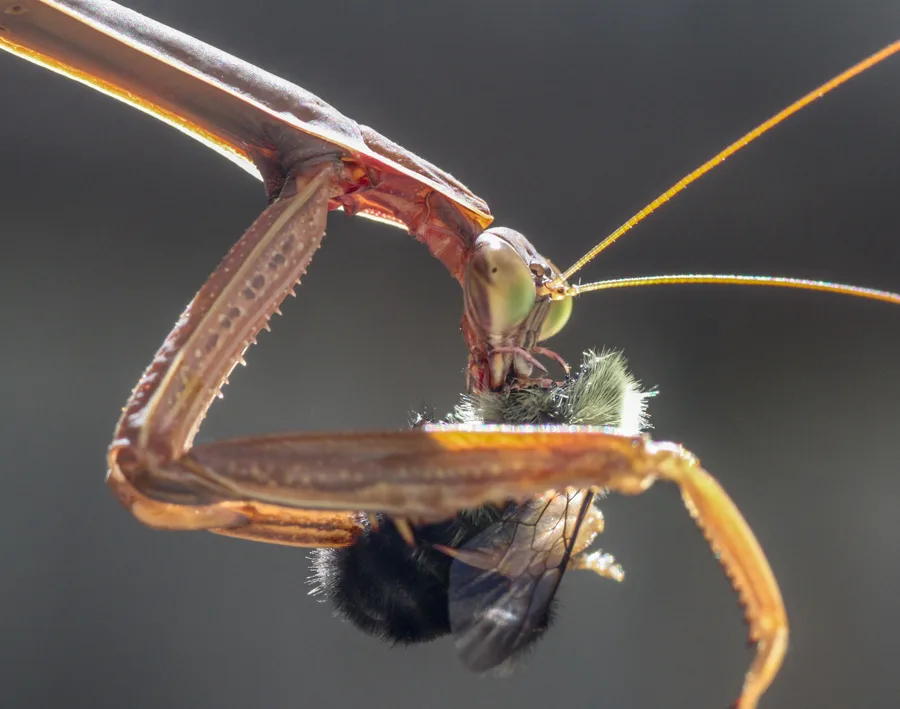
For beekeepers, a mantis takes bees one at a time. None of the extension sources we read describes mantises as a threat to whole honey bee colonies; they are one of many general predators, alongside robber flies that catch bees in flight. Our guide to bee pests and predators covers the ones that do damage colonies.
Do Praying Mantises Eat Hummingbirds?
Yes, occasionally. Martin Nyffeler, Michael Maxwell and J. V. Remsen Jr. reviewed 147 reported cases of mantids catching small birds, published in the Wilson Journal of Ornithology (2017). The records came from 13 countries on every continent except Antarctica and involved 12 mantid species and 24 bird species. More than 70% were from the USA, where mantids were often seen catching hummingbirds at feeders or at hummingbird-pollinated plants. The Ruby-throated Hummingbird was the species caught most often.
Of the captured birds, 78% were killed and eaten, 2% escaped on their own and 18% were freed by people. In North America both native and introduced mantids were involved.
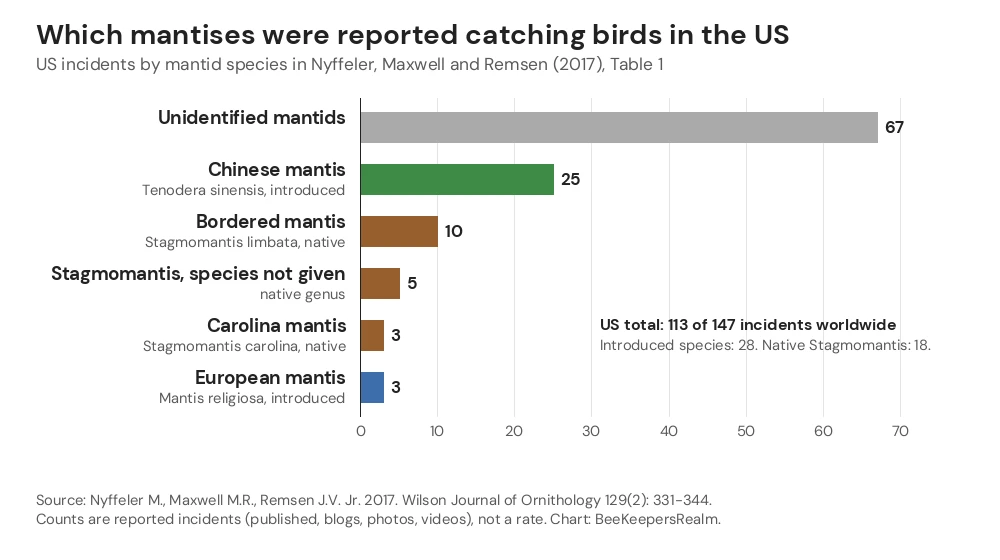
In the paper’s US records, the Chinese mantis was named in 25 cases, native Stagmomantis species in 18 and the European mantis in 3; the other 67 were not identified to species. These are reports collected over many decades, not a rate. The authors drew a practical conclusion:
“Our compilation suggests that praying mantises frequently prey on hummingbirds in gardens in North America; therefore, we suggest caution in use of large-sized mantids, particularly non-native mantids, in gardens for insect pest control.”
If you keep a feeder, late summer and early fall are when adult mantises are biggest and most often recorded, as the observation chart above shows.
Are Praying Mantises Good for the Garden?
Not as pest control. Every extension source we checked reaches the same verdict, and UC IPM says it most plainly:
“Although mantids are fascinating creatures, they are of no benefit for biological pest control. Mantids feed on any insect they can catch, and commonly prey indiscriminately on beneficial and nonpest species including bees, butterflies, and syrphids.”
Kansas State says buying egg cases for pest management is not recommended because nymphs and adults do not kill enough pests to prevent plant damage, and that most egg cases sold are of the non-native Chinese mantis. UKy rates their value as small compared with lady beetles and green lacewings, because cannibalism limits their numbers and they wander off to find cover. The University of New Hampshire’s answer to whether releasing them is worthwhile is “probably not”.
A mantis that turns up on its own does little harm. If pests are the real problem, see our guide to pollinator-safe pest control products. Kansas State also notes that mantids are susceptible to broad-spectrum insecticides.
Do Praying Mantises Bite?
Rarely, and only when handled. The University of Florida’s Online Entomology program says mantises may nip if handled roughly but carry no venom and pose no health risk. UKy’s Critter Files say they do not sting or bite; the two statements fit together, since a mantis does not attack people but may pinch a finger that grabs it. Wash a nip like any small scratch.
UF/IFAS adds that mantids bought as pets should never be released, and that Florida requires a state permit to keep a species not native to Florida.
Is It Illegal to Kill a Praying Mantis?
No. The University of Kentucky says US praying mantids are not in danger of extinction and are not protected by any specific laws, though killing any animal can be illegal inside certain nature preserves and wildlife sanctuaries. The UC Davis Bohart Museum lists “it is illegal to catch preying mantids” among urban myths and says there are no laws against it. Snopes says the rumor, which often mentions a $50 fine, has circulated since the 1950s, and that there has never been a federal or state law against killing mantises.
Praying Mantis Myths Checked
| Claim | What the evidence says | Source |
|---|---|---|
| It is illegal to kill a praying mantis | False. No federal or state law protects them, and they are not endangered. Only nature-preserve rules on killing any animal apply. | UKy Critter Files; UC Davis Bohart Museum; Snopes |
| The female always eats the male | False. It happens in a minority of matings: 31% in a wild European mantis study. UC IPM says it does not occur in most matings. | Lawrence 1992; UC IPM |
| Mantises are good garden pest control | Not supported. They eat bees, butterflies, hover flies and each other, and kill too few pests to prevent damage. | UC IPM; KSU; UNH |
| Praying mantises are venomous | False. They have no venom and may only nip if handled roughly. | UF Online Entomology |
| Mantises eat hummingbirds | True but uncommon: 147 cases compiled worldwide, 113 of them in the US. | Nyffeler et al. 2017 |
| US praying mantises are all introduced | False. The Carolina mantis is native; the Chinese, European and narrow-winged mantises were introduced. | Illinois Extension; Wikipedia |
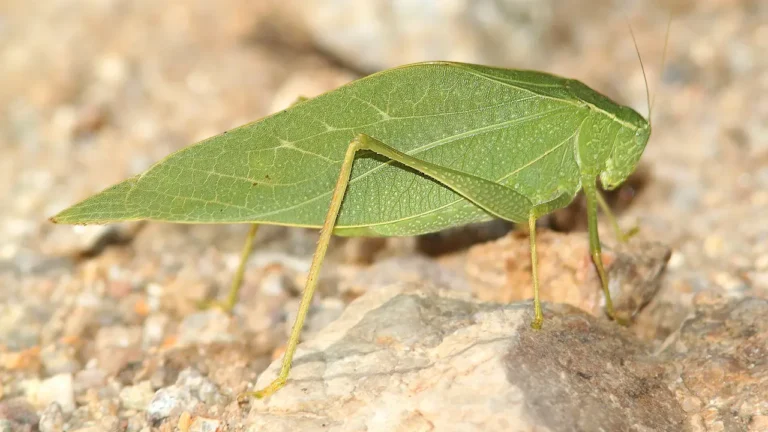
Katydids are on the menu too; Wisconsin Extension lists praying mantids among the animals that eat katydids.
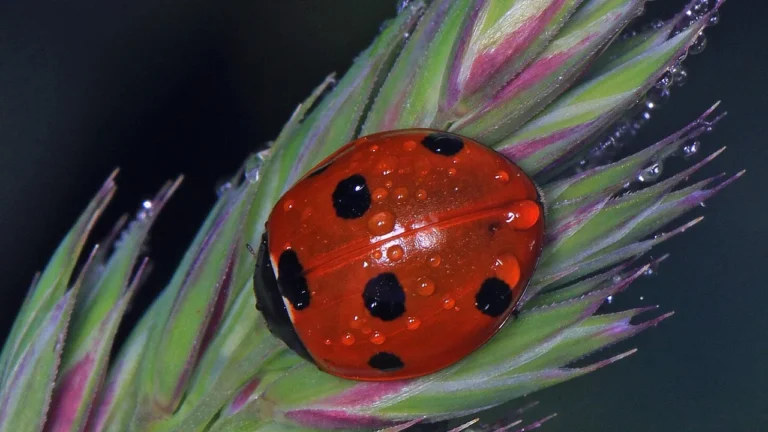
Lady beetles, which UKy rates as more useful than mantids, are covered species by species in our ladybug guide.
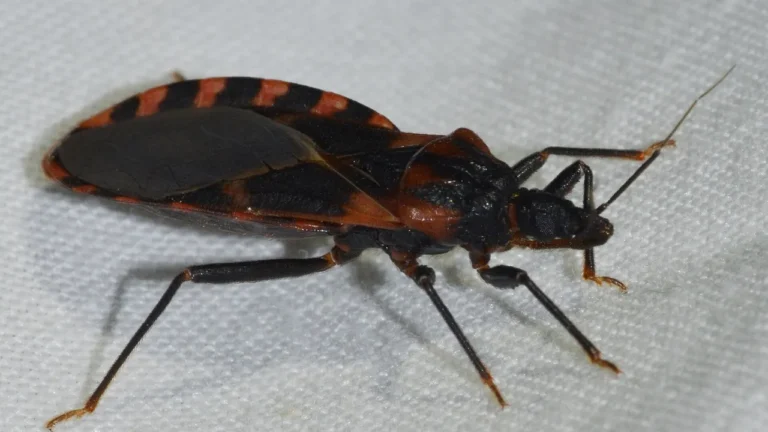
Unlike the praying mantis, the kissing bug feeds on the blood of mammals, not on other insects.
Frequently Asked Questions
Is it good to have praying mantises in your yard?
They are harmless to people, but they are not a pest-control tool. Extension programs say they eat bees and butterflies as readily as pests, so leave wild ones be rather than buying more.
What should you do if you see a praying mantis?
Leave it where it is; it is not dangerous to people. If it is waiting on a hummingbird feeder, moving it to a shrub away from the feeder is reasonable.
What will happen if a praying mantis bites you?
Very little. A mantis may nip if handled roughly, but it has no venom and poses no health risk (UF Online Entomology). Clean the spot like any small scratch.
How long does it take for a praying mantis egg case to hatch?
Outdoors, the eggs spend the winter in the case and the nymphs come out in spring, in three to 10 weeks depending on temperature. Indoors at 70°F or above, they emerge in four to six weeks (KSU).
How many praying mantises are in one egg case?
Kansas State says 50 to 200 nymphs can emerge from a single case. UKy gives a range of 12 to 400 eggs per case.
What to do if you find a praying mantis egg sack?
Leave it outdoors where you found it. A case brought inside will hatch in winter and release dozens of tiny nymphs into the house (UKy; Illinois Extension).
In what states is it illegal to kill a praying mantis?
None. No federal or state law protects praying mantises. The only limits are general rules against killing animals inside some nature preserves and wildlife sanctuaries (UKy).
The Bottom Line
Enjoy the mantises that show up on their own, but do not buy egg cases to fight pests, especially if you keep bees or feed hummingbirds. Flowers that feed pollinators, such as native plants for pollinators, will draw mantises too, and that is part of a working garden food web.
Image credits: Featured photo: Chinese mantis in Pennsylvania, Kaldari, CC0, via Wikimedia Commons (cropped). Charts use US research-grade iNaturalist observations and Table 1 of Nyffeler et al. 2017. Other credits are in the captions.
Sources: UC Statewide IPM Program, mantids; Kansas State University MF3593; University of Illinois Extension; University of Maryland Extension; University of Kentucky ENTFACT-418; Wisconsin Horticulture; Colorado State University Extension; UNH Extension; UF/IFAS EDIS IN1188; Nyffeler, Maxwell and Remsen 2017; Lawrence 1992, Animal Behaviour; UC Davis Bohart Museum, urban myths; iNaturalist.