
Reviewed by Michael R. · How we review
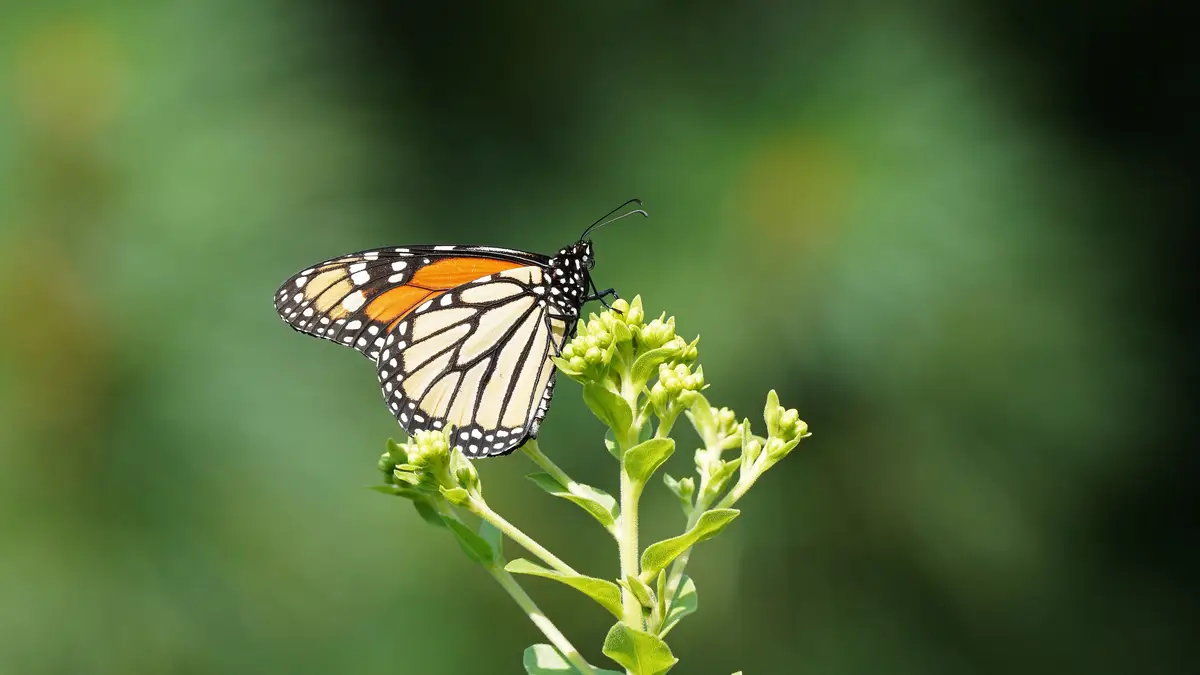
The monarch butterfly (Danaus plexippus) is a large orange butterfly with black veins and white-spotted black wing borders, known for a migration of up to 3,000 miles to central Mexico. Its caterpillars eat only milkweed, which makes them toxic to birds. As of November 17, 2026, the monarch is proposed as threatened in the US but not listed, and the IUCN lists the migratory monarch as Vulnerable.
Educational information only. Listing status and population counts change, so each figure below names its source and the date or season it covers.
Key Takeaways
- In summer a monarch goes from egg to adult in about a month: 2 to 5 days as an egg, about two weeks as a caterpillar and 6 to 14 days as a chrysalis, per the US Fish and Wildlife Service.
- Summer adults live about 2 to 5 weeks; the migratory generation can live 6 to 9 months.
- Eastern monarchs covered 2.93 hectares of forest in Mexico in winter 2025-26, up 64% but under the roughly 6 hectares linked to a stable population.
- Volunteers counted about 12,260 western monarchs in California in late 2025, the third-lowest total since 1997.
- There is no final federal listing rule. A proposed settlement would require a decision by June 6, 2030 if a court approves it.
- The IUCN now lists the migratory monarch as Vulnerable, not Endangered, though many AI answers still say Endangered.
- Native milkweed plus fall asters and goldenrods feeds monarchs and bees at the same time.
Table of Contents
- What Is a Monarch Butterfly?
- Male vs Female Monarchs
- Monarch Butterfly Life Cycle
- Monarch Butterfly Migration, East and West
- How Many Monarchs Are Left?
- Are Monarch Butterflies Endangered?
- What Do Monarch Butterflies Eat?
- A Monarch Garden That Also Feeds Bees
- Should You Raise Monarchs at Home?
- Monarch Look-Alikes: Viceroy, Queen and Soldier
- Monarchs, Bees and Milkweed Pollination
- Monarch Predators and Parasites
- Can You Touch a Monarch?
- Frequently Asked Questions
- The Bottom Line
What Is a Monarch Butterfly?
The monarch is a milkweed butterfly in the brush-footed family, Nymphalidae. The US Fish and Wildlife Service (FWS) gives its wingspan as 3 to 4 inches (7 to 10 cm) and its weight as about half a gram. The upper wings are orange with black veins, and the black border carries a double row of white spots.
Butterflies and Moths of North America (BAMONA) gives the range as southern Canada through the whole US, Central America and most of South America, plus Australia, Hawaii and other Pacific islands. North American monarchs are best known for migrating, though FWS notes that where milkweed grows year-round, some live and breed all year.
“Their bright coloration serves as a warning to predators that eating them can be toxic, and monarchs obtain these toxins (called cardenolides) by consuming milkweed plants.”
Monarch Watch, a University of Kansas program, describes the classic test: a blue jay that ate a monarch vomited and then avoided monarchs. The toxins deter birds and other vertebrates but may not deter insects and spiders, which is why caterpillars still have many predators.
Male vs Female Monarchs
If a monarch opens its wings, you can sex it in seconds. Monarch Watch says males have a black spot on a vein on each hindwing, made of specialized scales, and thinner black veins. Females have no spots and thicker veins, so they often look darker. BAMONA describes the female’s upper side as orange-brown with “blurred black veins.”
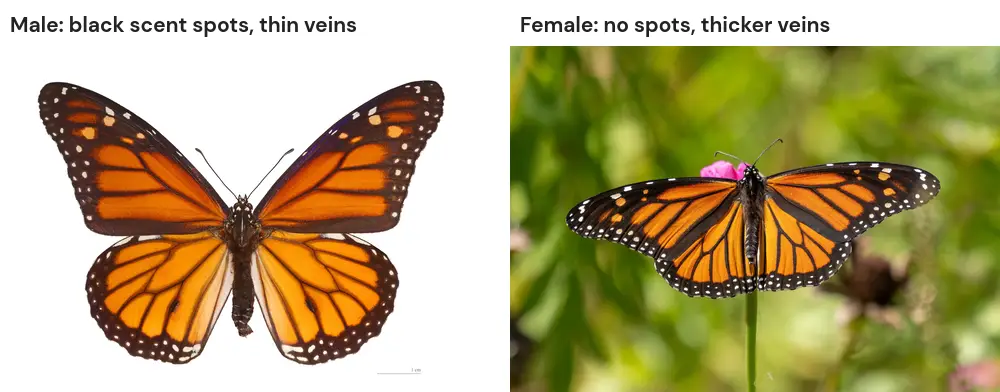
The spots are scent patches, but Monarch Watch says their chemical “does not seem to be important in Monarch courtship,” unlike in many other butterflies.
Monarch Butterfly Life Cycle
Monarchs go through complete metamorphosis: egg, caterpillar (larva), chrysalis (pupa) and adult. Every stage runs faster in heat and slower in cool weather, so the ranges below are what each source gives for normal summer conditions.
| Stage | How long | What it looks like | Source |
|---|---|---|---|
| Egg | 2 to 5 days (MJV: 3 to 5, temperature dependent) | Off-white or yellow with lengthwise ridges, about 1.2 mm tall; usually one per leaf, on the underside near the top of the plant | FWS; Monarch Joint Venture |
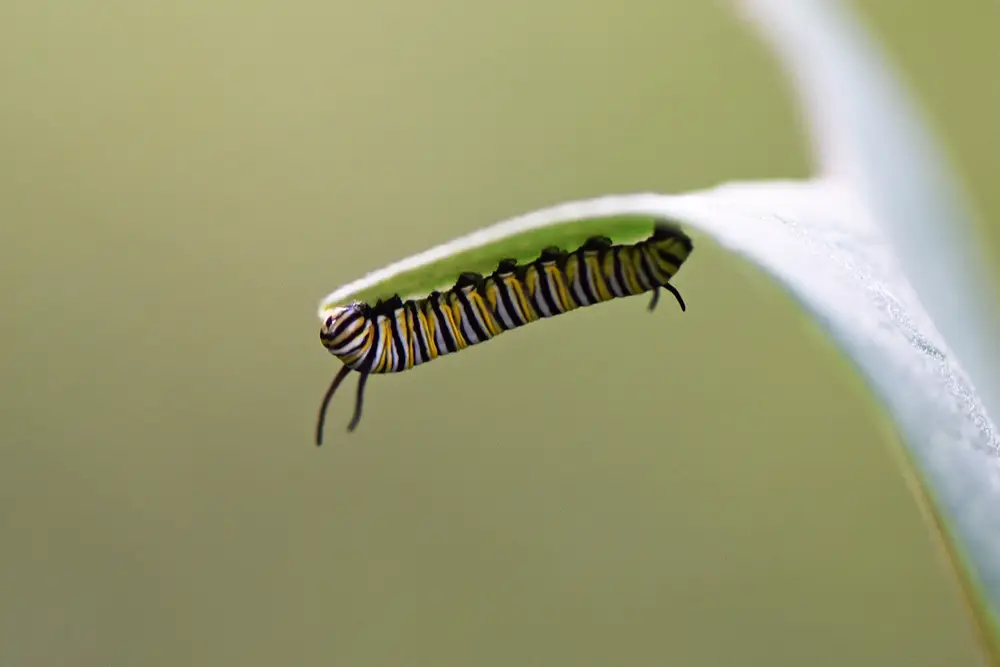
| Caterpillar (5 instars) | About 2 weeks (MJV: 9 to 14 days) | Black, yellow and white bands, with fleshy tentacles at the front and rear; reaches about 2 inches | FWS; Monarch Joint Venture |
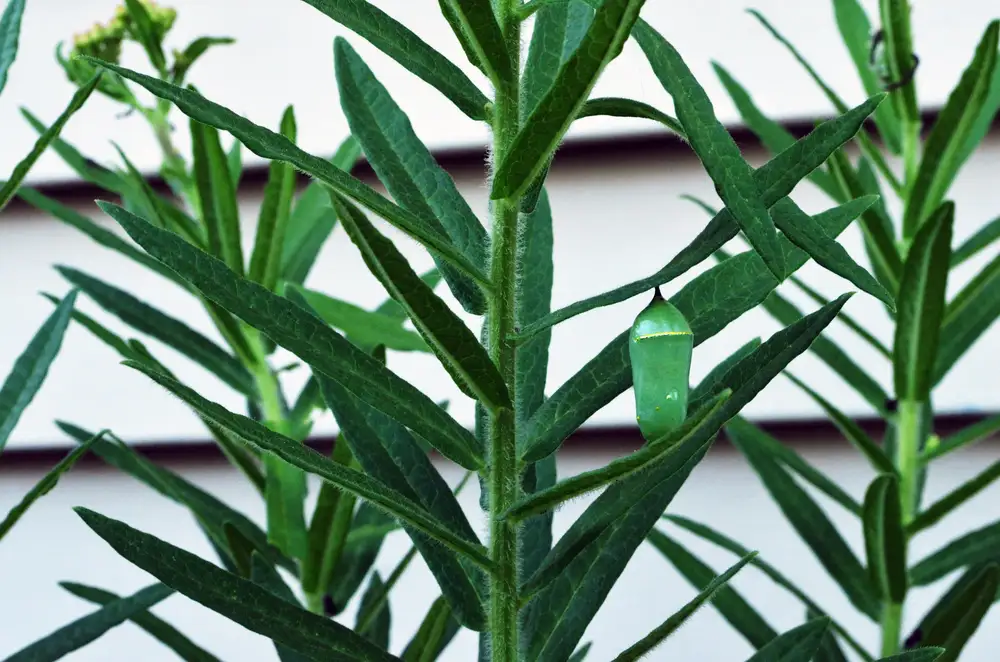
| Chrysalis | 6 to 14 days (MJV: 8 to 15 days) | Bright green with gold markings, hanging from a silk pad | FWS; Monarch Joint Venture |
| Adult (summer) | About 2 to 5 weeks | Orange wings, black veins, white-spotted black borders; mates at 3 to 8 days old | FWS; Monarch Joint Venture |
| Adult (migratory) | 6 to 9 months | Same look; in reproductive diapause, so it does not breed until late winter or spring | FWS; Monarch Joint Venture |
FWS figures are from its species profile; MJV ranges are from the Monarch Joint Venture life cycle page, which notes a cool-spring generation can take 40 to 50 days or more from egg to adult.
Egg
The Monarch Joint Venture (MJV) says a female usually lays a single egg under a leaf near the top of the plant, and 300 to 500 eggs over 2 to 5 weeks. In summer heat the egg hatches in about four days.
Caterpillar
The new caterpillar eats its eggshell, then milkweed, molting between five stages called instars. MJV says it grows almost 2,000 times its starting mass, and the fifth instar measures 25 to 45 mm, which is why one large caterpillar can strip a small plant.
Chrysalis
MJV says a late fifth-instar caterpillar generally crawls away from its milkweed, forms a silk pad, hangs upside down in a J shape and sheds its skin one last time to expose the bright green chrysalis. Monarch Watch notes that pupae rely on camouflage.
How Long Do Monarch Butterflies Live?
FWS says most breeding adults live about 2 to 5 weeks, while overwintering adults in reproductive diapause can live 6 to 9 months. MJV describes four eastern generations a year: generation 1 from March to May, 2 from May to July, 3 from July to August, and a long-lived generation 4 whose adults fly from August to the next spring, often called the “super generation.”
When Each Stage Shows Up: iNaturalist Data
BeeKeepersRealm pulled every US research-grade iNaturalist monarch observation with a life stage annotation on November 17, 2026. Egg records peak in July (28.4% of all egg records), caterpillars in August (27.8%), chrysalises in September (28.4%) and adults in August (20.0%).
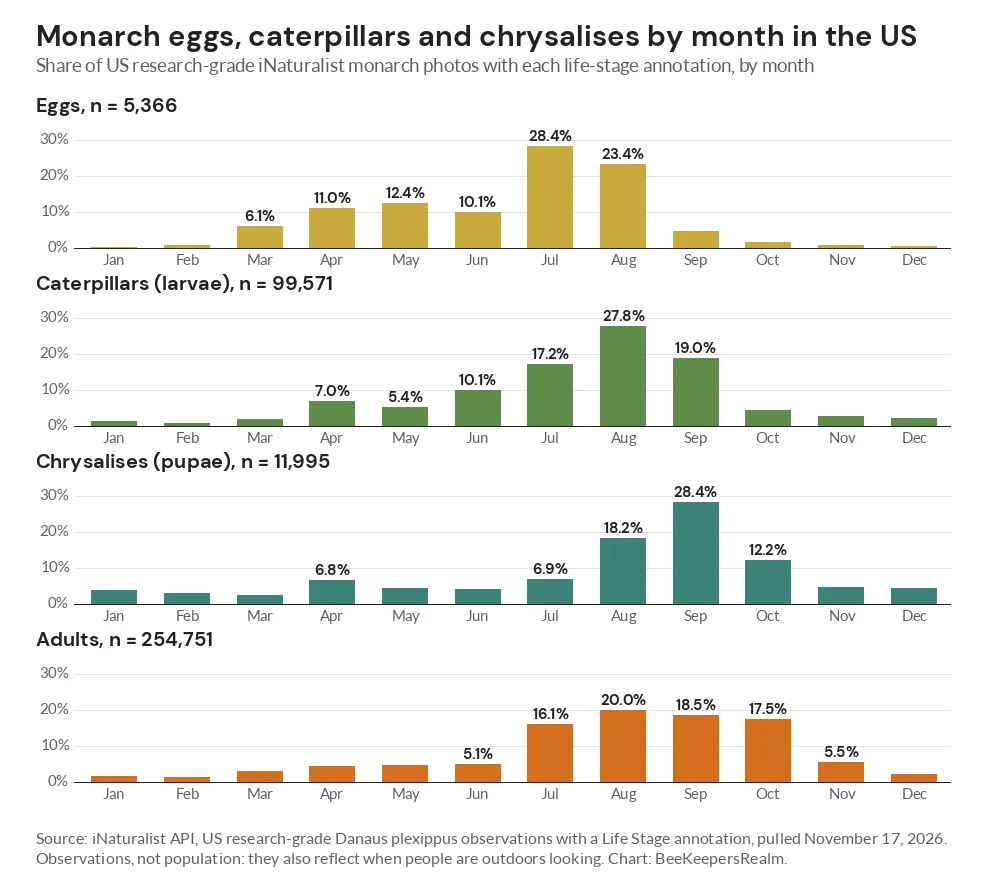
These are photo counts, not a census; they also reflect when people are outdoors. US monarch records doubled from 2024 (36,735) to 2025 (76,373) while all insect records rose about 12%, and more observers did not fully explain it, so yearly totals are not charted here.
Monarch Butterfly Migration, East and West
North America has two main migratory populations, split roughly by the Rocky Mountains. MJV says shorter days, cooler temperatures, aging milkweed and fewer flowers trigger the migratory generation, which delays breeding and builds fat from nectar.
Eastern Monarchs: To Central Mexico
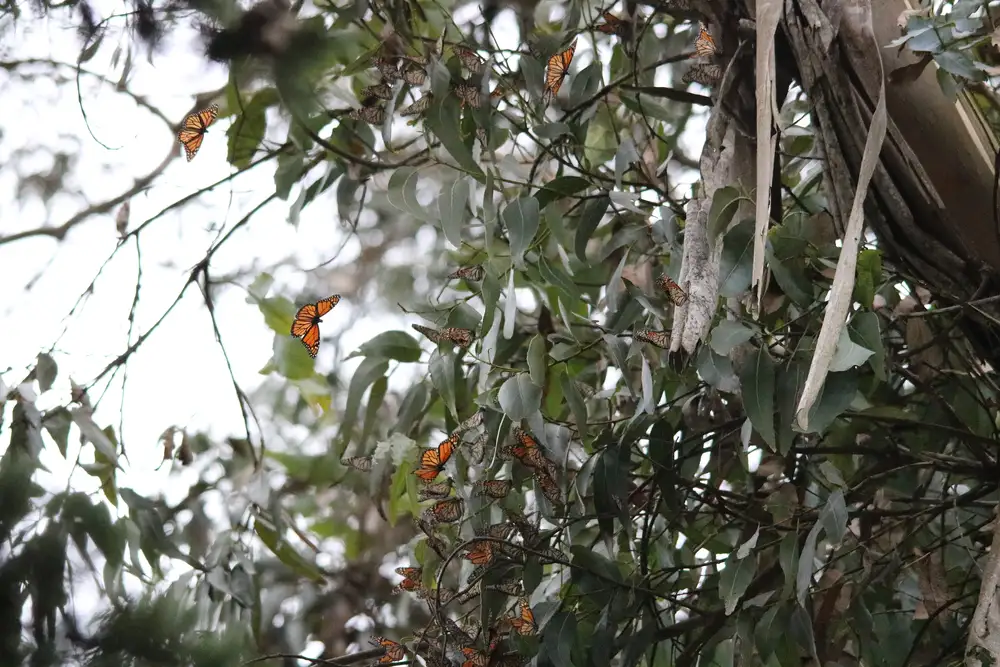
East of the Rockies, monarchs travel up to 3,000 miles. FWS says tagged monarchs can cover about 70 to 75 miles a day, with a record single-day flight of 265 miles. They cluster in oyamel fir forests at about 8,000 to nearly 12,000 feet in the states of Michoacán and México. The US Forest Service says they stay from about October to late March, and Mexico created the Monarch Butterfly Biosphere Reserve there in 1986.
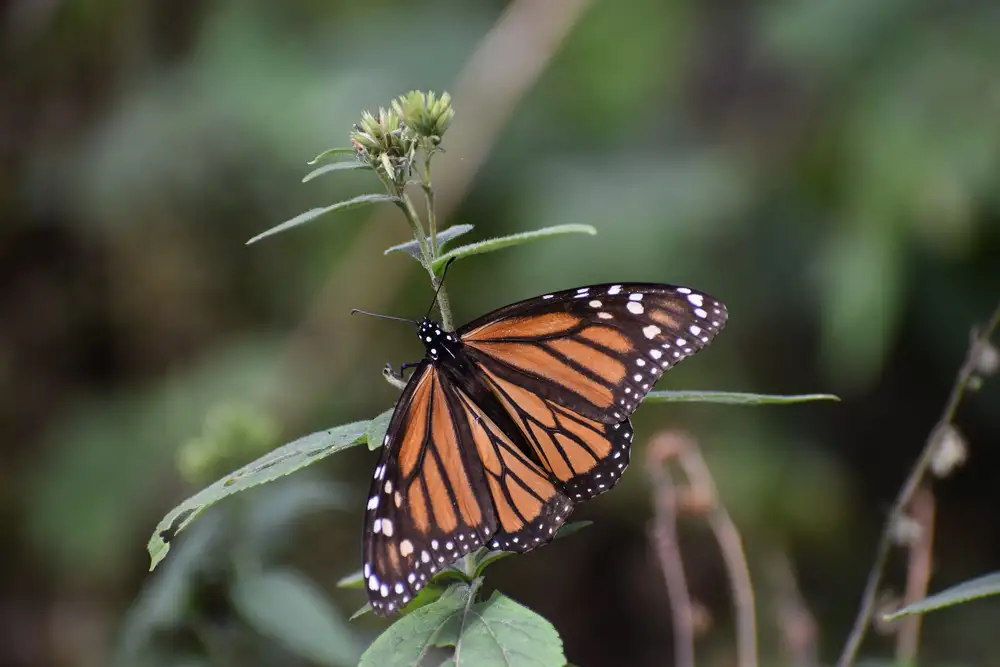
No single butterfly makes the round trip. MJV says the overwintering generation starts north in March and lays eggs in Texas and the southern states, and the US Forest Service says it takes three to four generations to reach the northern US and Canada.
Western Monarchs: The California Coast
FWS says western monarchs migrate about 300 to 1,000 miles. Most overwinter along the California coast in eucalyptus, Monterey pine and Monterey cypress groves, arriving around late October, and MJV notes a few sites in Baja California and Arizona.
How Tagging Tracks the Trip
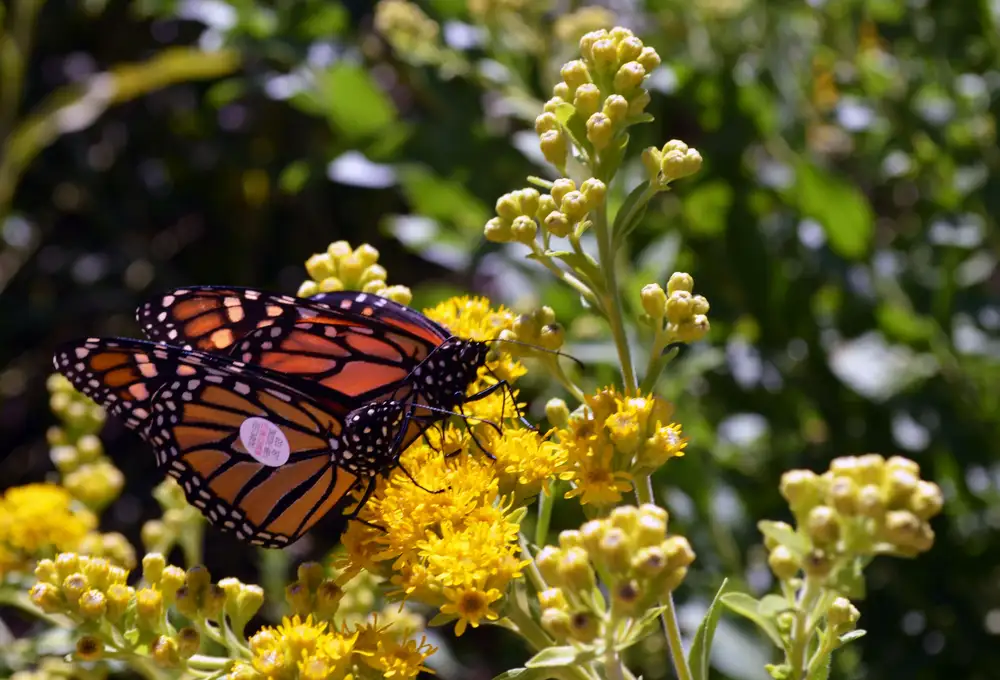
Much of what is known about routes comes from tiny numbered wing tags applied in fall and reported when found, sometimes in Mexico. Our citizen science for pollinators guide explains how Monarch Watch tagging and iNaturalist reporting work.
When Monarchs Pass Through Your State
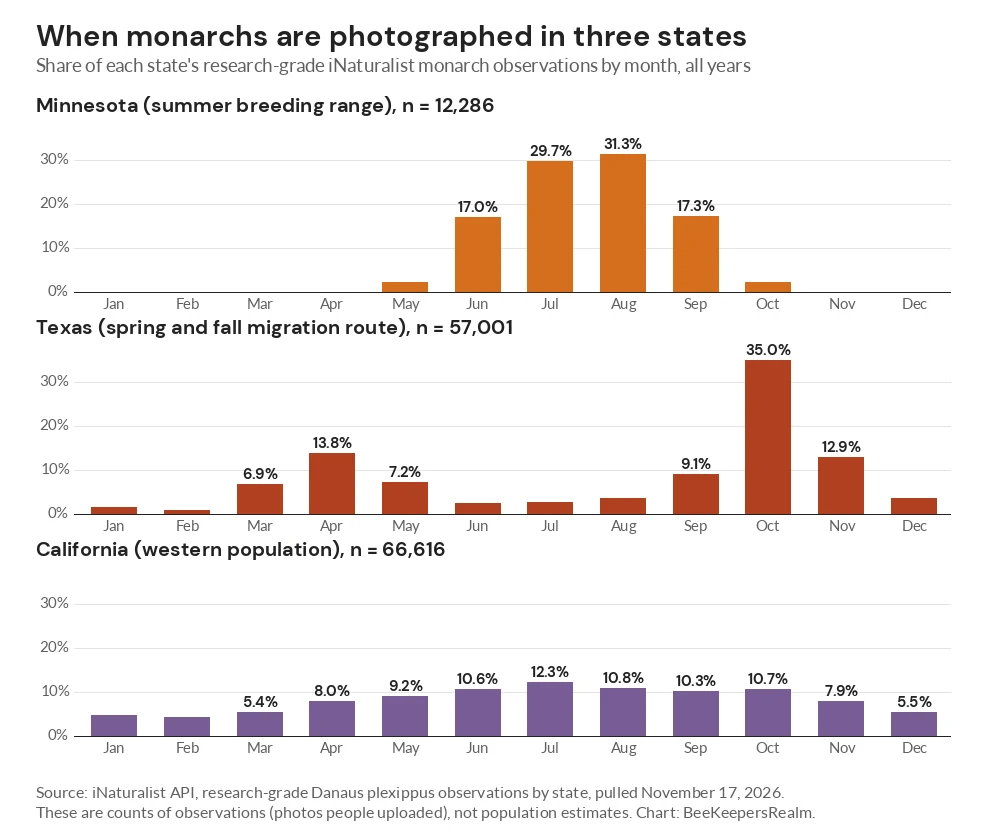
The same iNaturalist data shows three different calendars. In Minnesota, a summer breeding state, 31.3% of records fall in August and only 6 of 12,286 fall between November and April. Texas, on the main flyway, peaks twice: April (13.8%) heading north and October (35.0%) heading south. California’s records spread across the year because the western population overwinters there.
How Many Monarchs Are Left?
Both populations are counted in winter, when they bunch together. Mexico measures the forest area the colonies cover; California volunteers count butterflies.
| Population | Latest season published | Figure | Context | Source |
|---|---|---|---|---|
| Eastern (Mexico) | Winter 2025-26 | 2.93 ha (7.24 acres) of forest, nine colonies | Up 64% from 1.79 ha (4.42 acres) in 2024-25; record low 1.66 acres in 2013-14; high 44.95 acres in 1996-97 | WWF-Mexico and CONANP; MJV |
| Western (California) | Late Nov to early Dec 2025 | About 12,260 monarchs at 249 sites | Third-lowest since 1997; lowest were 1,901 (2020) and 9,119 (2024) | Xerces Society Western Monarch Count |
Eastern figures are from the WWF-Mexico 2025-26 report (March 2026), which reports in acres; hectares are from MJV’s summary of the same survey.
Eastern Population
The WWF-Mexico report found three colonies in Michoacán and six in the State of México; the largest, in Ejido El Rosario, covered 4.008 acres. MJV puts density at roughly 20 to 30 million monarchs per hectare, median 21.1 million. At that median, 2.93 hectares works out to about 62 million butterflies, a rough figure because density varies. MJV says research suggests at least 6 hectares are needed for a stable population, and quotes Dr. Karen Oberhauser that 2025 breeding conditions were better than 2024’s. Neither source credits the increase to backyard gardens, though some news coverage did.
Western Population
The Xerces Society’s January 2026 release says western monarchs regularly numbered in the low millions in the 1980s and have declined about 10% per year since, per research by Cheryl Schultz and Elizabeth Crone.
“When populations get this small, they become far more vulnerable to both short-term stress and long-term pressures,”
Our history of the Xerces Society and the extinct butterfly it is named for covers how the group started.
Are Monarch Butterflies Endangered?
Not under US law, and not on the current IUCN Red List. Here is what the primary pages said when checked on November 17, 2026.
- US Endangered Species Act: FWS proposed listing the monarch as threatened on December 12, 2024 (89 FR 100662), with a 4(d) rule and about 4,395 acres of proposed critical habitat in seven California counties. The FWS Save the Monarch page (updated September 21, 2026) says, “There has not yet been a final ruling.” A Federal Register search found only the proposed rule.
- Since then: MJV reports the rule was moved to “long-term action” in the Spring 2025 Unified Agenda, the Center for Biological Diversity and the Center for Food Safety sued in February 2026, and a proposed settlement was filed September 30, 2026. If the court approves it, FWS must submit a final determination by June 6, 2030.
- IUCN Red List: The IUCN assessment of the migratory monarch (Danaus plexippus plexippus) says Vulnerable, last assessed September 27, 2023, amending the 2022 assessment that listed it as Endangered. The trend is decreasing.
FWS cites its latest Species Status Assessment: by 2080, the probability of extinction is 56% to 74% for eastern monarchs and greater than 95% for western monarchs. It names habitat loss, insecticide exposure and climate change as the threats. By comparison, the rusty patched bumble bee went through the whole process and became the first bumble bee listed as endangered.
Search tools often get this wrong. On November 17, 2026, the Google AI Overview for “are monarch butterflies endangered” said the IUCN classifies the monarch as Endangered, and the Bing AI answer cited the 2022 listing without the 2023 change.
What Do Monarch Butterflies Eat?
Caterpillars eat only milkweeds (Asclepias), plus milkweed vines in the tropics. Adults drink nectar from many flowers. BAMONA lists dogbane, lilac, red clover, lantana and thistles before milkweeds bloom, and goldenrods, blazing stars, ironweed and tickseed sunflower in fall, when migrants need nectar to build fat for winter.
The Xerces Society’s milkweed guide says fewer than half of the 72 milkweeds native to the US are documented monarch host plants. Our milkweed growing guide compares common species, bloom times and seed starting.
Tropical Milkweed and the OE Parasite
Tropical milkweed (Asclepias curassavica) is not native to the US and stays green all year in mild climates. MJV warns that this keeps monarchs breeding in winter and lets spores of Ophryocystis elektroscirrha (OE), a parasite, build up on the leaves, where caterpillars swallow them. Severe infections can leave adults unable to emerge from the chrysalis or with malformed wings.
MJV cites Project Monarch Health data: 49% of winter-breeding monarchs were infected, against 9% of migrants sampled in Mexico and 15% in the northern US. If you grow tropical milkweed, MJV advises pruning it before the fall migration and re-cutting every few weeks through February, except in South Florida, south of Orlando, where a non-migratory population lives.
A Monarch Garden That Also Feeds Bees
A monarch garden needs native milkweed for caterpillars and a long run of nectar flowers for adults. Most of those flowers also feed native bees, honey bees and bumble bees. The Xerces Society’s milkweed guide names these priority species for each region:
| Region | Xerces priority milkweeds |
|---|---|
| Northeast | Swamp milkweed (A. incarnata), common milkweed (A. syriaca), butterfly weed (A. tuberosa) |
| Great Lakes | Poke milkweed (A. exaltata), swamp, common, butterfly weed, whorled milkweed (A. verticillata) |
| Midwest | Swamp, prairie milkweed (A. sullivantii), common, butterfly weed, whorled |
| Northern Plains | Swamp, showy milkweed (A. speciosa), common, whorled |
| Southeast | Butterfly weed, whorled milkweed |
| Florida | Pinewoods milkweed (A. humistrata), aquatic milkweed (A. perennis), butterfly weed |
| Southern Plains | Antelope horns (A. asperula ssp. capricornu), butterfly weed, green antelopehorn (A. viridis), whorled |
| Rocky Mountains | Showy, butterfly weed |
| Southwest | Antelope horns (A. asperula), broadleaf milkweed (A. latifolia), showy, rush milkweed (A. subulata) |
| Great Basin | Antelope horns, narrowleaf milkweed (A. fascicularis), showy |
| California | Heartleaf milkweed (A. cordifolia), woollypod milkweed (A. eriocarpa), narrowleaf, showy |
| Pacific Northwest and Inland Northwest | Narrowleaf, showy |
Source: Xerces Society, Milkweeds: A Conservation Practitioner’s Guide, priority species for habitat restoration by region. A state native plant society or extension office can narrow this to your county.
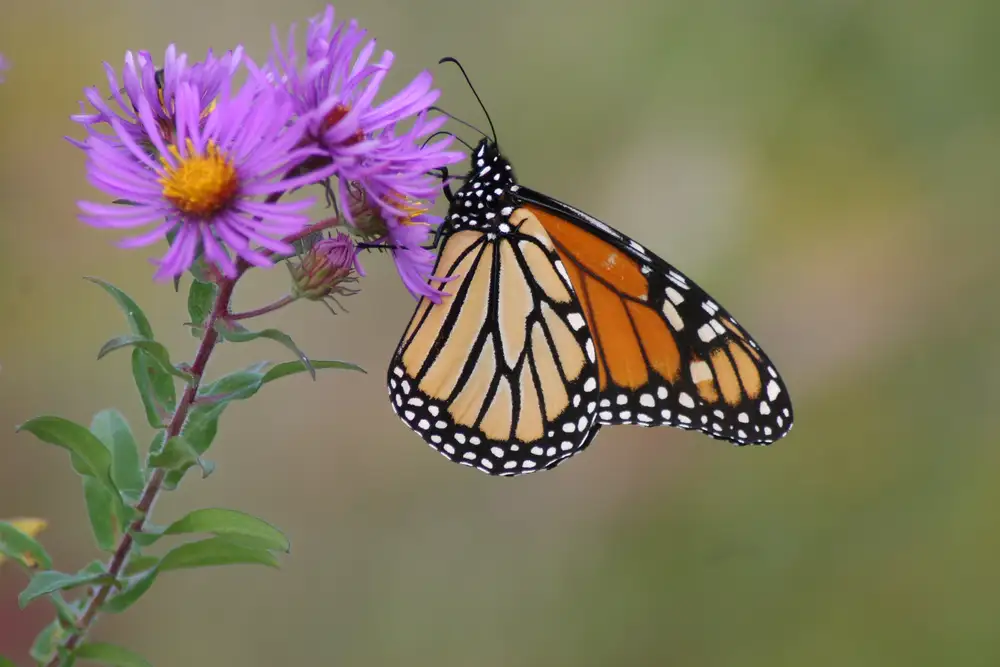
For nectar, the Xerces Society’s Great Lakes monarch nectar plant guide says monarchs are present there from June through October. It lists aromatic aster, Maximilian sunflower and New England aster for fall, calling New England aster “one of the latest fall-blooming plants,” and showy and stiff goldenrods, Joe Pye weeds, wild bergamot and spotted beebalm for summer into fall. See our fall-blooming flowers for bees and the bee balm growing guide for those plants.
For wider plant lists, see our best US native plants for pollinators and the regional table in our pollinator-friendly gardening guide.
Pesticides: Keep Them Off Milkweed and Flowers
The Xerces nectar guide warns that “most insecticides have the potential to poison or kill monarchs and other pollinators,” and that some neonicotinoids make treated leaves toxic to caterpillars. Ask nurseries whether plants were treated with systemic insecticides. If you must treat a pest elsewhere, our pollinator-safe pest control guide covers lower-risk options and timing.
Should You Raise Monarchs at Home?
A few is fine; mass rearing is what researchers object to. The Xerces Society’s “Keep Monarchs Wild” article (August 2025) asks home rearers to:
- Rear no more than ten monarchs per year, per person or family.
- Collect locally from the wild, follow rules on public land, and never buy or ship monarchs.
- Raise each caterpillar separately and clean containers with a 20% bleach solution between them.
- Feed fresh milkweed daily and release adults where they were collected.
Xerces says no studies show that releasing captive-reared monarchs boosts the population. In California, MJV notes that handling monarchs at any life stage requires a permit.
Monarch Look-Alikes: Viceroy, Queen and Soldier
FWS names three butterflies that resemble the adult monarch: the viceroy, the queen and the soldier. Check for a black line across the hindwing, then compare the shade of orange or brown.
| Butterfly | Key mark | Range | Source |
|---|---|---|---|
| Monarch (Danaus plexippus) | Orange with black veins; double row of white spots in the black border; no line across the hindwing | Southern Canada and all of the US, south into South America | FWS; BAMONA |
| Viceroy (Limenitis archippus) | Black line across the hindwing; single row of white dots in the border; smaller (wingspan 2 1/2 to 3 3/8 in) | East of the Cascades and Sierra Nevada to central Mexico and Florida; a brown, queen-like form in Florida, Georgia and the Southwest | BAMONA; UF/IFAS |
| Queen (Danaus gilippus) | Chestnut brown, with less defined veins; white spots scattered near the forewing tip | Resident in the extreme southern US; strays into the Plains | BAMONA |
| Soldier (Danaus eresimus) | Brownish orange with thin, defined veins; band of pale blotches under the hindwing | Southern Florida and South Texas; rare stray to southern Arizona and New Mexico | BAMONA |
From Butterflies and Moths of North America species pages and University of Florida IFAS Featured Creatures fact sheets.
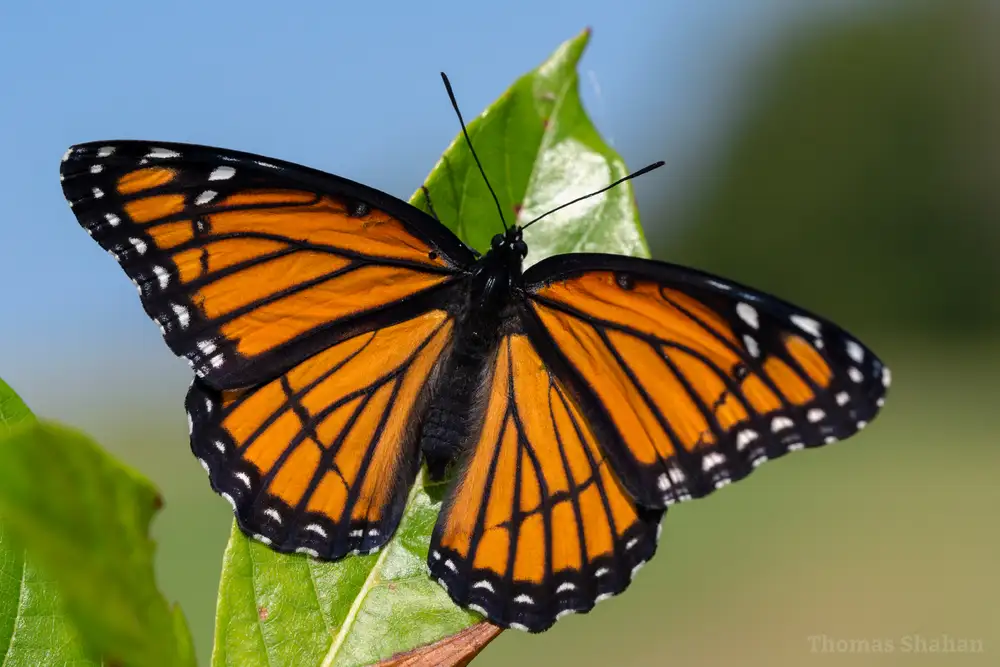
The viceroy was long taught as a harmless copycat. The University of Florida fact sheet says research by Ritland and Brower in 1991 showed the relationship is Müllerian: both species taste bad, so each helps protect the other from birds. Viceroy caterpillars feed on willows, poplars and cottonwoods, not milkweed.
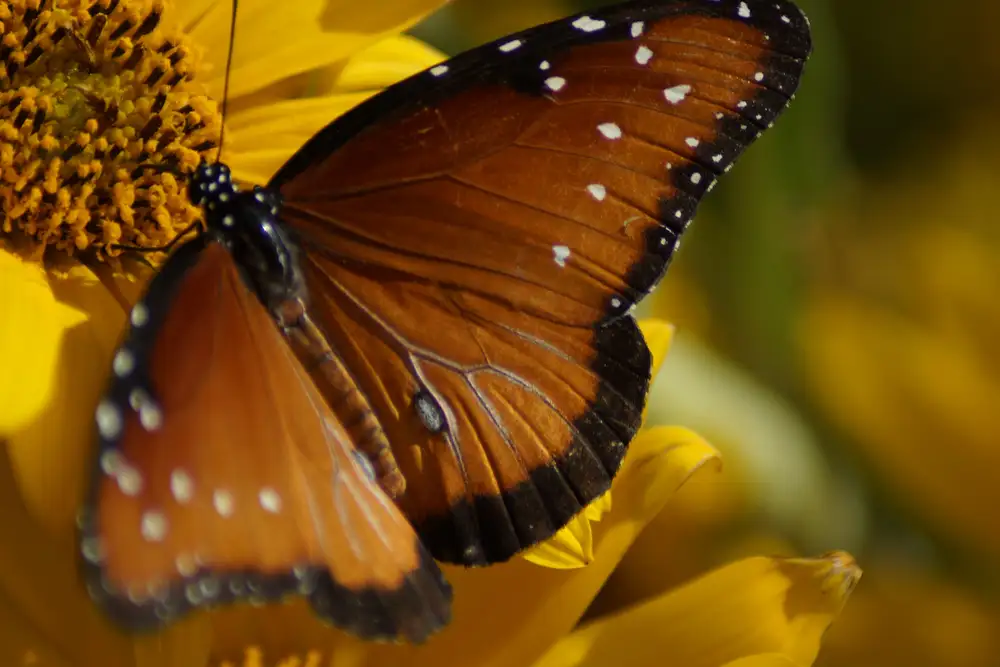
Queens and soldiers are close relatives that also use milkweeds as host plants. In most of the US the monarch is the one you will see: US research-grade iNaturalist records pulled November 17, 2026 numbered 411,659 for the monarch, 60,137 for the queen, 40,180 for the viceroy and 1,941 for the soldier.
Monarchs, Bees and Milkweed Pollination
Monarchs visit milkweed constantly, but they are not its best pollinators. Milkweed packs pollen into sacs called pollinia that must be pulled out and carried to another flower. The Xerces Society’s milkweed guide says monarchs “often do not effectively transfer pollinia,” and that butterflies and moths typically move fewer pollinia than bees and wasps. It names bumble bees, carpenter bees, honey bees and large wasps among milkweed’s important pollinators.
Our guides to bumblebees, whether wasps are pollinators, interactions between bees and butterflies and pollination syndromes explain how these visitors share the same flowers.
Monarch Predators and Parasites
Monarch Watch says most predation and death probably happen in the caterpillar stage, and that invertebrates are probably more important predators than birds. The University of Florida fact sheet lists ants, spiders and wasps as predators of caterpillars, and tachinid flies and braconid wasps as parasitoids.
- Wasps: Monarch Watch reports a common wasp (Vespula vulgaris) feeding on an adult at a California overwintering site, and other wasps taking caterpillars. Our guide to the invasive European paper wasp covers a study of its toll on monarch caterpillars, and types of wasps helps tell the groups apart.
- Birds and mice in Mexico: Monarch Watch says black-backed orioles and black-headed grosbeaks cause more than 60% of monarch deaths at many Mexican roosts, and one mouse, Peromyscus melanotis, eats an average of 37 monarchs a night.
- Mantises: Extension services list butterflies and caterpillars among praying mantis prey; our praying mantis guide covers which species you will meet in US gardens.
- Disease: Besides OE, Monarch Watch names nuclear polyhedrosis virus as probably the most important viral pathogen; infected caterpillars turn brown, then black.
Yellowjackets and paper wasps also harass beehives late in the season, as our page on bee pests and predators describes.
Can You Touch a Monarch?
A monarch is poisonous to eat, not to touch. Brooklyn Botanic Garden says even the caterpillar, “though toxic if eaten, does nothing more than tickle you when held.” The wing powder on your fingers is scales, though, and the garden warns that losing too many makes a wing more likely to tear or fail. Be extremely gentle, and remember California’s permit rule.
Frequently Asked Questions
What is so special about the monarch butterfly?
Its migration: eastern monarchs fly up to 3,000 miles to a few mountain forests in central Mexico, and the trip north takes several generations. It also turns its host plant’s toxins into a defense.
What butterfly is mistaken for a monarch?
Usually the viceroy, which has a black line across each hindwing. In the far southern US, the browner queen and soldier also look similar.
What is the lifespan of a monarch butterfly?
About 2 to 5 weeks for summer adults and 6 to 9 months for the migratory generation, per FWS.
Is it okay to touch a monarch butterfly?
A gentle touch will not poison you, but rubbing the wings removes scales. Handle them as little as possible; California requires a permit.
What part of a monarch butterfly is poisonous?
Monarch Watch says the cardenolides from milkweed are stored in the cuticle, the outer body covering, and that females average about 30% higher concentrations than males.
Why shouldn’t you raise monarchs?
Researchers object to large numbers, not one or two. The Xerces Society says mass rearing can spread parasites and that no study shows releases boost the population.
Are monarchs making a comeback?
Not yet. The eastern population rose 64% in 2025-26 to 2.93 hectares, still under half the roughly 6 hectares linked to stability, and the 2025 western count was the third-lowest on record.
What is causing the decline of monarch butterflies?
FWS names loss of breeding, migratory and overwintering habitat, insecticides and climate change. WWF-Mexico adds milkweed loss in farm fields from herbicides.
Why don’t I see monarch butterflies anymore?
Timing and numbers. Monarchs leave northern states by late fall; Minnesota’s iNaturalist records drop to zero from November through April. Both migratory populations are also far below historic levels.
The Bottom Line
Plant a milkweed native to your region, add asters and goldenrods for fall, and keep insecticides off both. That one bed feeds monarch caterpillars, migrating adults and local bees. Recheck the FWS and IUCN pages before quoting the monarch’s status, since a federal decision is due by 2030 if the settlement is approved.
Image credits: Featured photo: a monarch on stiff goldenrod in Hennepin County, Minnesota, by Courtney Celley/USFWS, public domain, via Wikimedia Commons. Charts use US research-grade iNaturalist observations pulled November 17, 2026. Other credits are in the captions.
Sources: US Fish and Wildlife Service; Federal Register, 89 FR 100662; IUCN Red List; Monarch Joint Venture; WWF-Mexico (Rendón-Salinas et al., 2026); Xerces Society; US Forest Service; Monarch Watch; University of Florida IFAS; Butterflies and Moths of North America; Brooklyn Botanic Garden.