Reviewed by Daniel M. · How we review
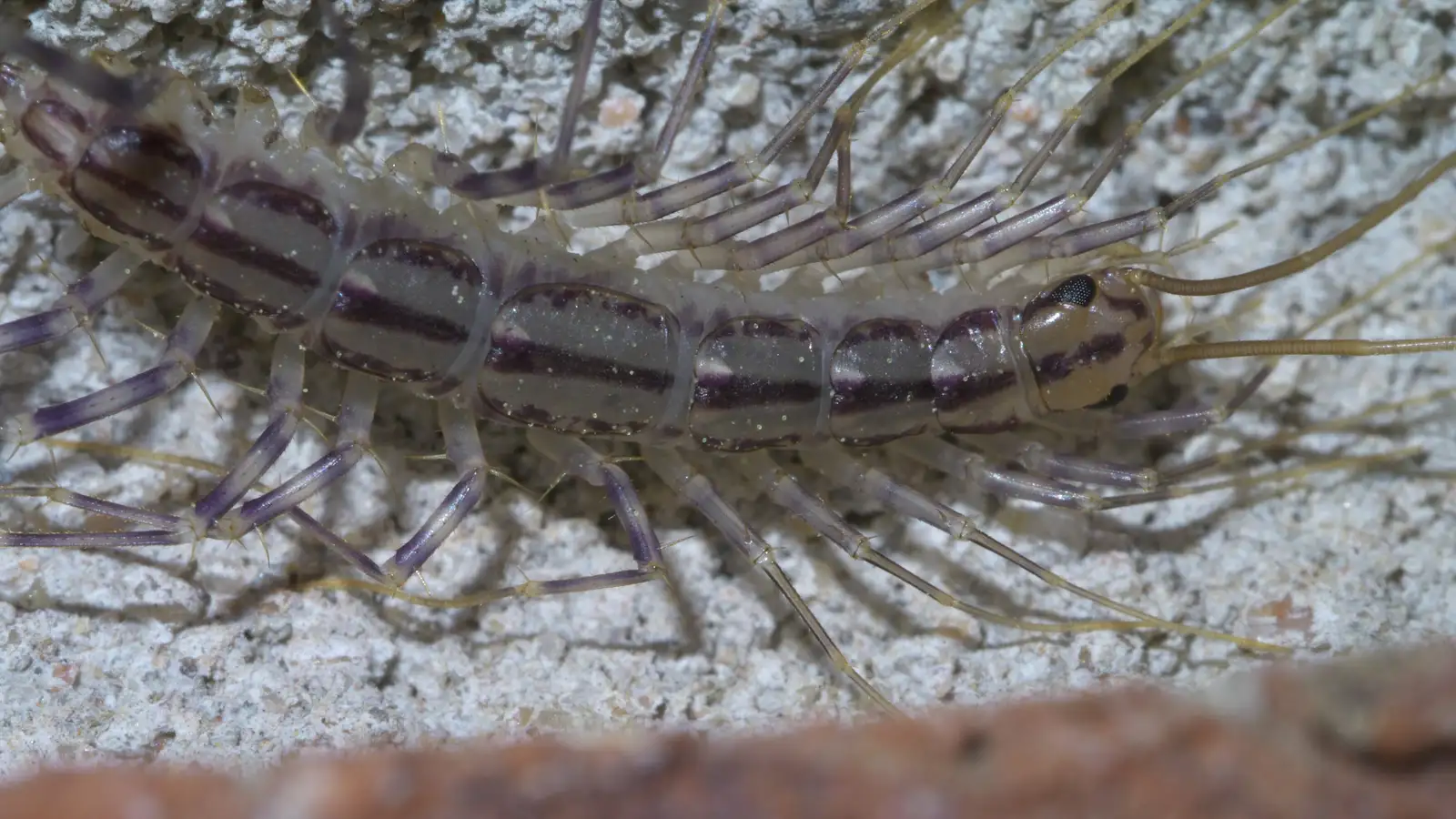
A centipede is a fast, venomous predator in the class Chilopoda with one pair of legs on each body segment. Centipedes are not insects. The one most US homeowners meet is the house centipede (Scutigera coleoptrata), a gray-yellow hunter with 15 pairs of long legs that lives in damp basements and bathrooms and eats silverfish, cockroaches and spiders. Its bite is rare and usually no worse than a bee sting. To get rid of house centipedes, dry out damp rooms, seal cracks and cut down the insects they hunt.
This guide draws on university extension entomologists, a poison center and our own count of iNaturalist records. Looking for centipede grass or the arcade game? This page covers the animal.
Key Takeaways
- Centipedes have one pair of legs per segment; millipedes have two. Adult centipedes always have an odd number of leg pairs, from 15 to 191.
- The house centipede is the only centipede that lives and breeds indoors. Frequent sightings point to moisture and to other pests it is eating.
- Centipedes are venomous, not poisonous. House centipedes rarely bite; the giant desert centipede of the Southwest bites painfully.
- Extension advice puts moisture control, sealing and decluttering ahead of pesticides, which are rarely needed.
- Of 20,071 US research-grade iNaturalist observations of house centipedes we counted, 82.3% fall between April and October.
Table of Contents
- What Is a Centipede?
- Common Centipedes in the US
- Centipede vs Millipede
- Do Centipedes Bite? Are They Poisonous?
- Why Centipedes Come Into the House
- How to Get Rid of Centipedes
- Centipedes, Bees and the Garden
- Frequently Asked Questions
- The Bottom Line
What Is a Centipede?
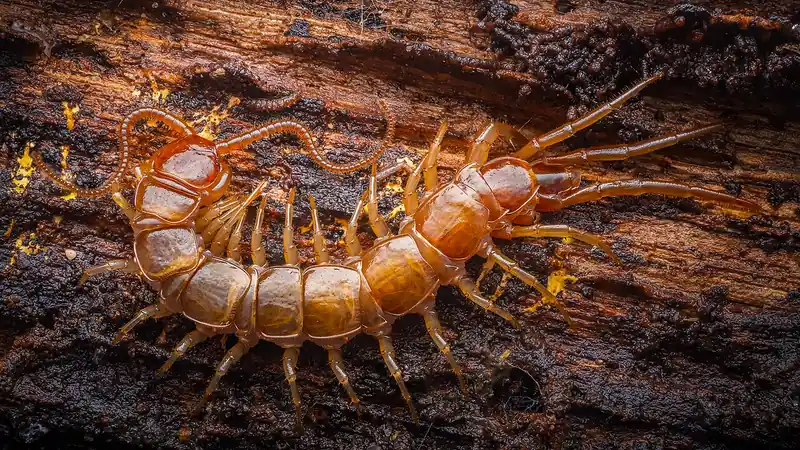
Centipedes are arthropods, like insects and spiders, but they form their own class, Chilopoda. An insect has three body sections and six legs (see what makes an animal an insect); a centipede has a head and a long trunk of similar segments, each with one pair of legs. The first pair of trunk limbs are the forcipules: hollow, pincer-like venom claws under the head. For other home and yard visitors, see our garden and household insects section.
How many legs does a centipede have?
Never exactly 100. Adults have 15 to 191 pairs, and the number of pairs is always odd. Developmental biologist Wallace Arthur wrote in Heredity that if you count the leg-bearing segments of 100 individuals of a centipede species, “these numbers will all be odd.” Some species add legs as they grow: Penn State says a newly hatched house centipede has 4 pairs and reaches 15 after several molts.
Common Centipedes in the US
| Centipede | Size (body) | Legs (pairs) | How to recognize it | Where you find it | Source |
|---|---|---|---|---|---|
| House centipede (Scutigera coleoptrata) | 1 to 1.5 in; 3 to 4 in with legs | 15 | Dirty yellow with three dark stripes; very long banded legs; runs fast | Basements, bathrooms, closets, crawl spaces; the only centipede that breeds indoors | Penn State; Clemson |
| Stone centipedes (Lithobiomorpha) | Small, about ½ to 1 in | 15 | Flattened, yellow to brown; some back plates much longer than others | Under mulch, leaf litter, logs and rocks | MDC; Clemson; Kentucky |
| Soil centipedes (Geophilomorpha) | Varies; slender | 27 to 191 | Pale, eyeless, wormlike and slow | Burrowing in soil, nearly 30 in deep | MDC |
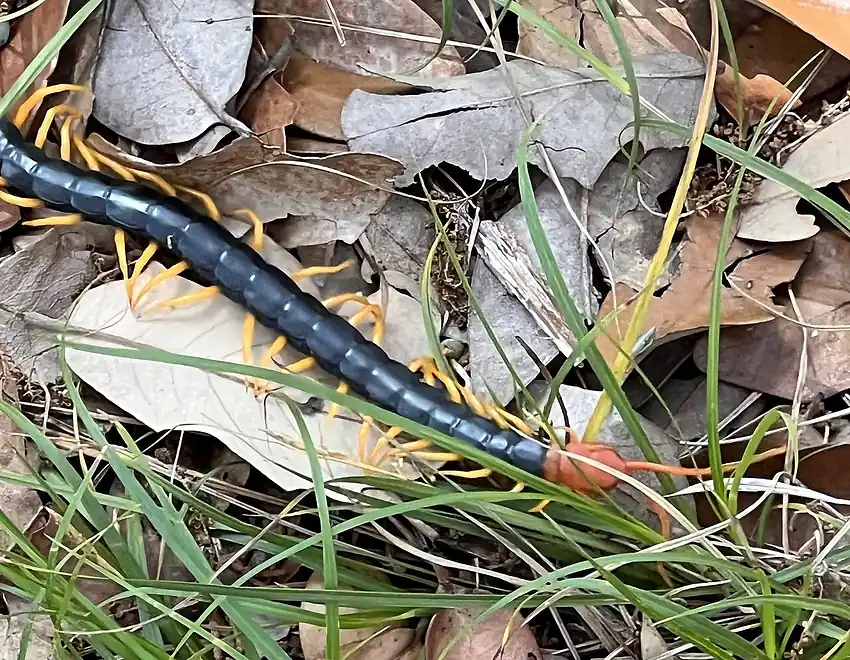
| Giant desert or Texas redheaded centipede (Scolopendra heros) | Usually 6 to 8 in | 21 | Bright warning colors, often a rusty-red head, black body and yellow legs | Southwest and south-central US, east to southern Missouri | Desert Museum; MDC |
| Eastern bark centipede (Hemiscolopendra marginata) | Up to 3 in | 21 | Bluish cast; Kentucky’s largest centipede | Eastern US | Kentucky; MDC |
MDC is the Missouri Department of Conservation. Outdoor centipedes that wander indoors usually die soon from lack of moisture (University of Kentucky).
The house centipede
House centipedes are native to the Mediterranean and were first recorded in Pennsylvania in 1849, Penn State says. They cannot survive Pennsylvania winters outdoors but breed readily in heated buildings, and females can live several years and produce up to 150 young.
What the video covers: KQED’s Deep Look shows a house centipede growing from 8 legs to 30 through repeated molts and using its finely segmented leg tips to lasso prey such as a cricket. It also explains that the venom claws double as grooming tools and that house centipedes rarely bite people. (Summarized from the PBS transcript.)
The giant desert centipede in the Southwest
Scolopendra heros is North America’s largest centipede. The Arizona-Sonora Desert Museum says it is usually 6 to 8 inches long and ranges across the southern United States into Mexico; in Missouri it occurs only in a few southern counties near the Arkansas line (MDC). The University of Arizona says desert centipedes eat insects and also frogs, small lizards, snakes and rodents.
Centipede vs Millipede
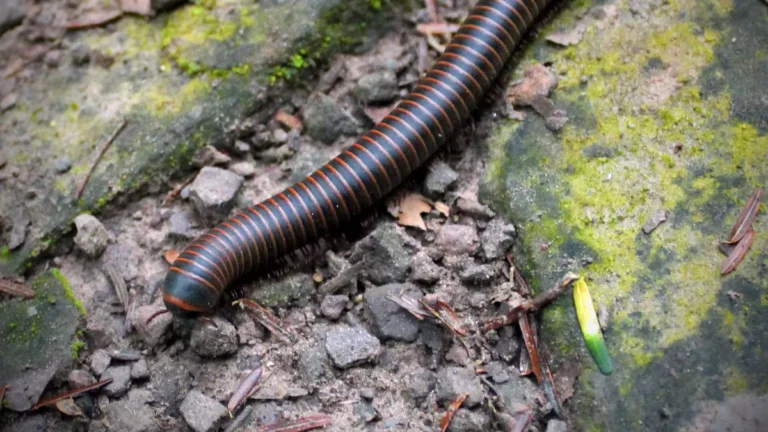
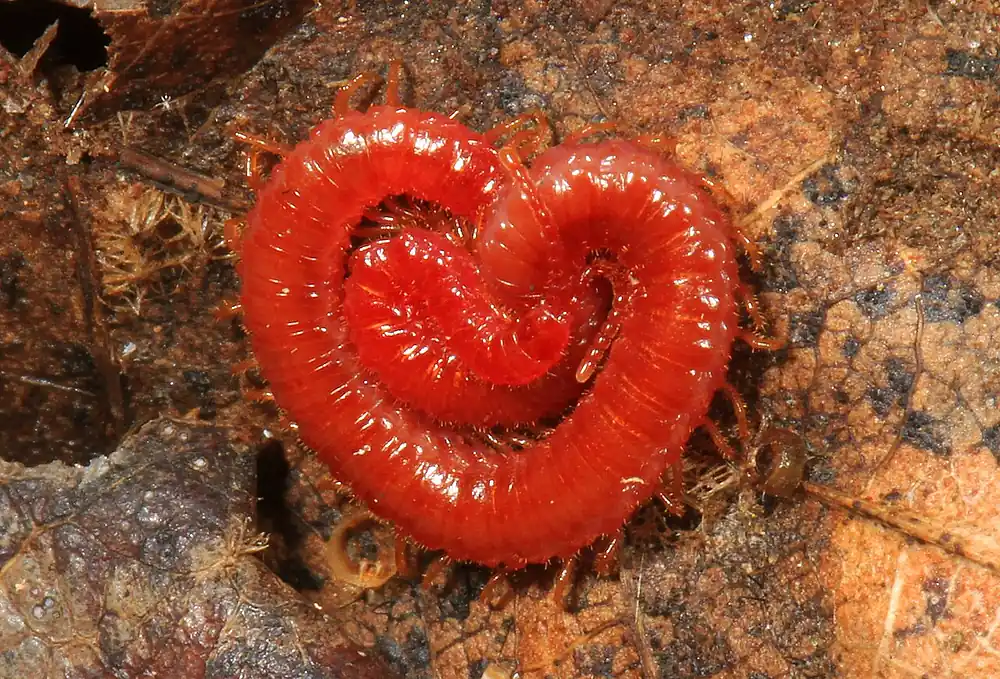
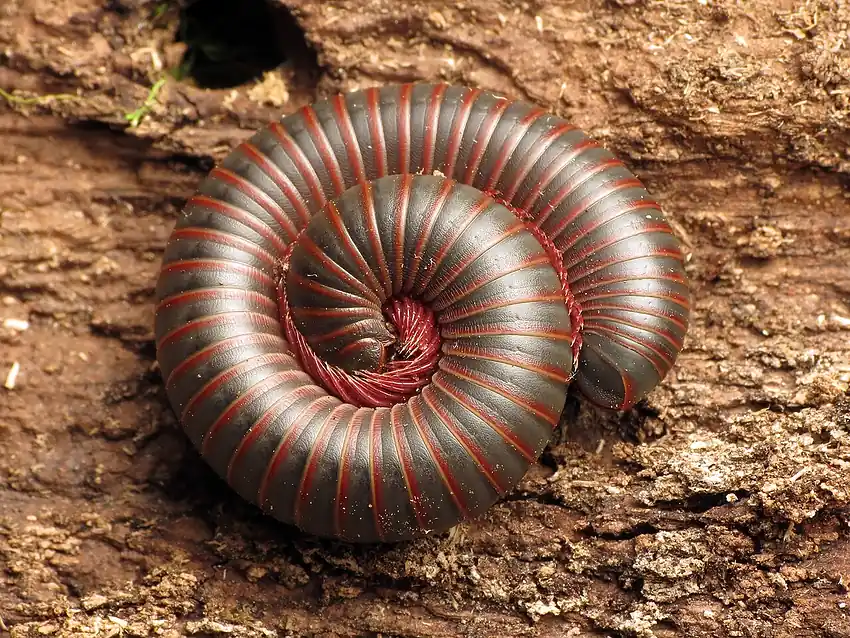
Count the legs on one segment. Centipedes hunt; millipedes eat rotting plant matter. Our millipede guide covers the millipede side in full.
| Feature | Centipede | Millipede | Source |
|---|---|---|---|
| Legs per body segment | One pair | Two pairs on most segments | University of Kentucky; MDC |
| Speed | Fast runner | Slow; legs move in a wave | Clemson; UC IPM |
| Body shape | Flattened; long antennae | Round in cross-section; short, elbowed antennae | MDC; University of Kentucky |
| Diet | Insects and other small invertebrates | Decaying leaves and wood; a few eat seedlings | Clemson; UC IPM |
| Defense | Bites with venom claws; never coils | Curls up; some ooze irritating fluid; does not bite | UC IPM; Clemson |
| Indoors | House centipede lives and breeds inside | Wanders in and usually dies quickly | Clemson; UC IPM |
Do Centipedes Bite? Are They Poisonous?
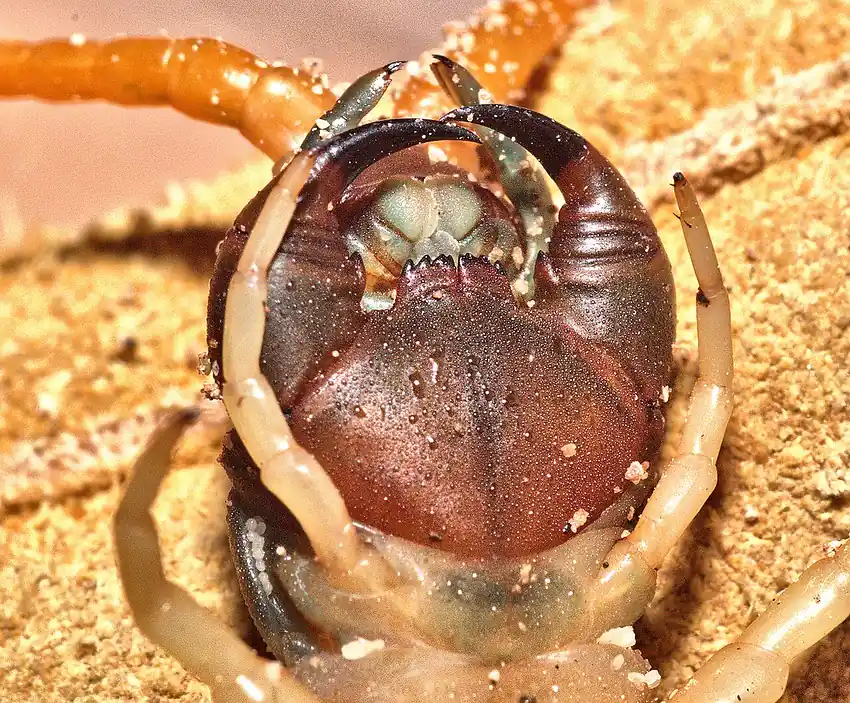
Centipedes are venomous, not poisonous: they inject venom through their forcipules but are not toxic to touch. Most bites happen when one is handled or trapped against skin.
This section is educational information, not medical advice. For a bite, call Poison Control at 1-800-222-1222 or use its online tool.
“House centipedes, the most frequently encountered centipede inside the home, pose a minimal bite hazard as their forcipules are so small, that it is difficult for them to successfully pierce human skin.”
- House centipede: if one does bite, MDC says it is generally no worse than a bee sting. Clemson says US centipedes are not toxic enough to kill adults or children.
- Giant desert centipede: MDC describes intense pain and swelling in healthy adults, usually no worse than a wasp or scorpion sting, and says infants, older adults and people in poor health may need treatment.
The National Capital Poison Center says only about 15 of an estimated 3,500 centipede species are thought to pose a danger to people. Most bites cause symptoms only at the bite site, and deaths are very rare, mainly in the tropics outside the US.
What to do after a centipede bite
Poison Control’s guide to centipede bites advises:
- Wash the bite with soap and water; take an over-the-counter pain reliever if needed.
- Soak it in warm water, since the venom is sensitive to heat, or use an ice pack.
- Make sure your last tetanus shot was within 10 years.
- See a doctor if the bite looks infected: spreading redness and swelling, fever or pus.
- For hives, dizziness, mouth or throat swelling or trouble breathing, use an epinephrine auto-injector if you have one and get medical help.
Our first-aid guide lists the signs of a serious allergic reaction to stings.
Why Centipedes Come Into the House
Centipedes lose water easily, so they need damp hiding places, and they follow their prey. Penn State lists the house centipede’s indoor refuges: under concrete slabs, inside block walls, in floor drains without water traps, under boxes stored on slabs and in crawl spaces. Indoors they eat silverfish, firebrats, carpet beetle larvae, cockroaches and spiders, and Poison Control adds ants such as sugar ants.
“If house centipedes are seen frequently, this indicates that some prey arthropod is in abundance, and may signify a greater problem than the presence of the centipedes”
Clemson says centipedes do not damage food or belongings and carry no serious diseases. Unlike stink bugs, which come in to wait out winter, house centipedes can live indoors all year.
When people see centipedes: what iNaturalist records show
We pulled every US research-grade, non-captive iNaturalist observation of the two centipedes people photograph most (pulled 17 November 2026): 20,071 house centipede observations and 5,100 giant desert centipede observations.
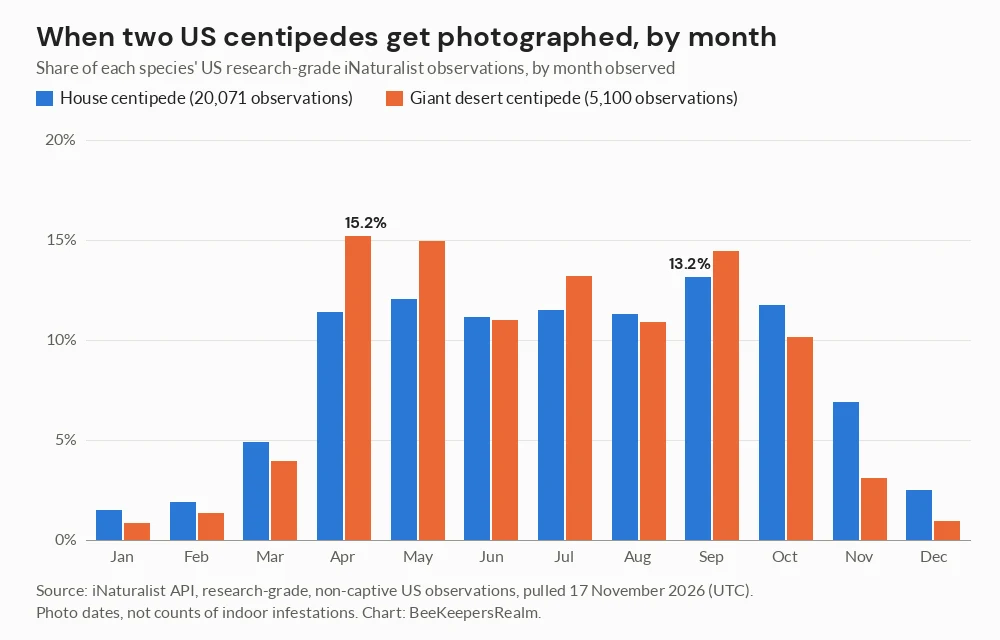
- House centipede: 82.3% of observations fall from April through October, with a high of 13.2% in September. December through February holds only 5.8%.
- Giant desert centipede: observations peak in April (15.2%) and May (15.0%), with a second rise in September (14.4%). December through February holds 3.2%.
| Species | Top states (observations) | Where recorded | Source |
|---|---|---|---|
| House centipede | California 3,289; Pennsylvania 1,831; New York 1,555; Ohio 1,252; Virginia 1,163 | 48 states and DC; none in Alaska or Wyoming | iNaturalist, our count |
| Giant desert centipede | Texas 3,497; Arizona 800; Oklahoma 398; Arkansas 158; New Mexico 152 | 10 states; Texas holds 68.6% | iNaturalist, our count |
These are photo records, not a census: they follow where and when people use iNaturalist as well as where centipedes live, so populous states rank high. Research grade needs a community-agreed species ID, which most stone and soil centipede photos never get (only 1,458 of 32,305 US stone centipede observations and 761 of 21,010 soil centipede observations qualify), so we left those groups out. One oddity: Florida has just 9 house centipede observations at any grade, against 1,893 research-grade centipede observations in the state.
How to Get Rid of Centipedes
Extension entomologists agree that centipedes rarely need pesticides. UC IPM says household numbers drop when their food, other household pests, is reduced. Work in this order:
- Find out what they eat. Penn State’s first step is sticky traps (monitors) around the house to show which pests are feeding the centipedes.
- Dry the house out. Run a dehumidifier in damp basements, fix leaks and air out damp rooms (Penn State, Clemson, UC IPM). Check crawl spaces, gutters and downspouts for standing water (Kentucky). The same fixes help against carpenter ants, which nest in damp wood.
- Seal the way in. Caulk cracks in slabs and block walls, fit door sweeps and weather stripping, and lay window screen over floor drains (Penn State, Kentucky).
- Remove hiding places. Store boxes off the floor and away from walls (Clemson). Outside, pull mulch, leaf litter, woodpiles and boards back from the foundation (Kentucky, Clemson).
- Remove the ones you see. Use a broom or vacuum (Clemson), or escort one outdoors (University of Maryland). Glue traps also catch house centipedes (Kentucky).
- Pesticides last. Penn State and Clemson mention boric acid or diatomaceous earth dusts in cracks and wall voids, and Kentucky mentions residual insecticides in cracks around the foundation. Clemson warns that pesticides give only temporary control without the steps above. Follow the label.
For a giant desert centipede, the University of Arizona suggests kitchen tongs or heavy gloves and a covered jar to carry it outside.
Centipedes, Bees and the Garden
Outdoors, centipedes hunt small insects, earthworms and other invertebrates in soil, mulch and leaf litter (University of Kentucky), and UC IPM says their activities should be encouraged in the yard. Like ladybugs and the praying mantis, they are garden predators, not a reason to spray the lawn or flower beds.
“Most insecticides can hurt bees and butterflies. Minimize the need for insecticides by tolerating harmless pests and trying alternative methods first.”
A broadcast yard spray coats the clover and flowers that bees visit while centipedes stay sheltered under mulch. If treatment is truly needed, keep it to foundation cracks and entry points, as the extension guides describe, and never spray blooms. Our guide to pollinator-safe pest control explains how to read a label’s bee hazard statement.
Frequently Asked Questions
Are centipedes insects?
No. They are arthropods in their own class, Chilopoda, with one pair of legs on each of many segments. Insects have three body sections and six legs.
Are house centipedes dangerous?
Not to most people. Penn State calls them harmless, and Kentucky says their claws can rarely pierce skin. Anyone with allergies should still watch for hives or swelling after a bite.
What do centipedes eat?
Other small animals: silverfish, cockroaches, spiders and carpet beetle larvae indoors. Desert centipedes also take small lizards, snakes and rodents.
How long do centipedes live?
One to 6 years, according to Texas A&M AgriLife. UC IPM says centipedes need 2 to 3 years to mature.
Why do I have centipedes in my house?
Usually because the house is damp and holds other bugs for them to eat. Fix moisture first, then look for the silverfish, cockroaches or spiders feeding them.
Should I kill house centipedes?
You don’t have to. UC IPM says centipedes generally play a beneficial role, and the University of Maryland suggests escorting one outdoors. Killing them without fixing moisture and prey won’t stop more from appearing.
Can centipedes climb walls?
Yes. Kentucky notes that house centipedes run quickly across floors and up walls to hunt.
The Bottom Line
A centipede in the house signals damp rooms and other pests, not a danger in itself. Dry the space, seal cracks and clear clutter. Call a licensed pest professional only if centipedes keep coming after those fixes, and see a doctor for any bite with signs of infection or allergy.
Image credits: featured photo of a house centipede in Mayes County, Oklahoma, by xpda (Wikimedia Commons), CC BY-SA 4.0, cropped and resized. Other photos are credited in their captions; all via Wikimedia Commons, resized. Chart by BeeKeepersRealm from iNaturalist data.