Reviewed by Sofia T. · How we review
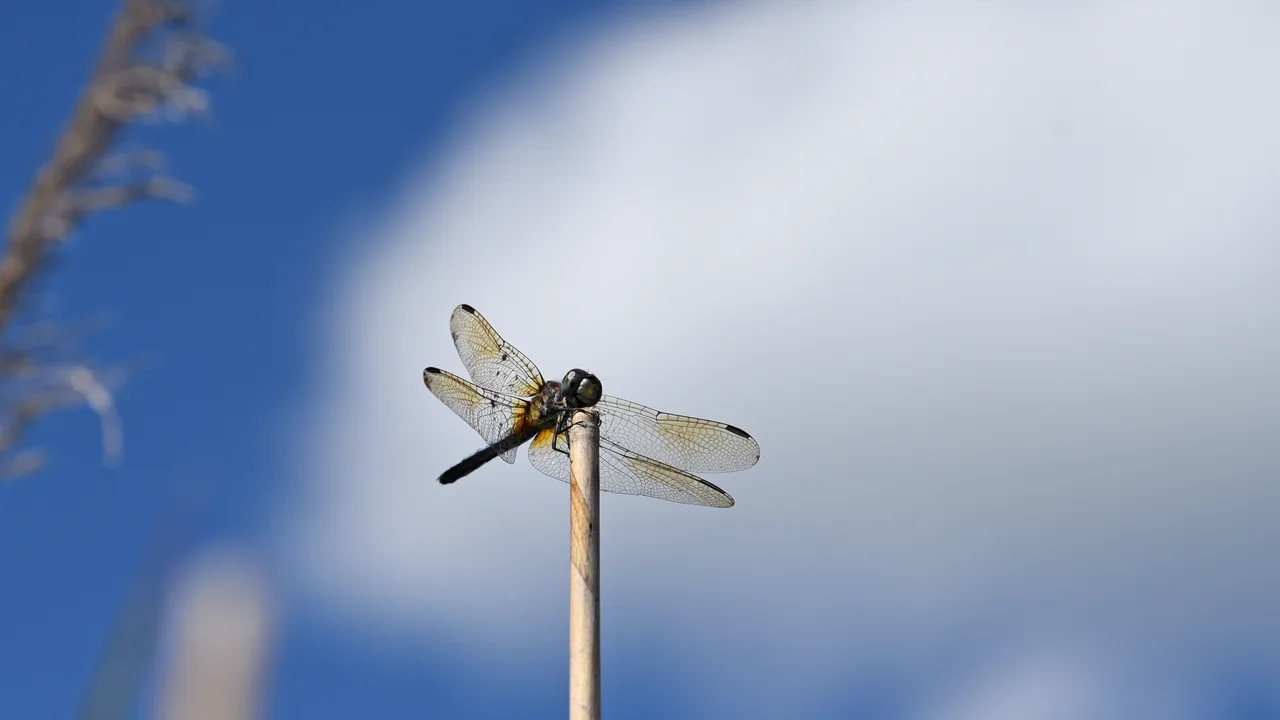
A dragonfly is a fast, predatory flying insect in the order Odonata, suborder Anisoptera. Adults perch with all four wings held flat out to the sides, have huge eyes that meet or nearly meet on top of the head, and catch other flying insects, from mosquitoes and midges to flies and the occasional bee. Dragonflies have no stinger and are harmless to people. Most of their life is spent underwater as a nymph, which lasts from several months to several years; the winged adult usually lives only weeks.
About 3,000 dragonfly species are known worldwide, and the 2024 checklist of North American Odonata counts 331 in the continental US and Canada. This guide covers how to tell a dragonfly from a damselfly, the species you are most likely to see, the life cycle, bites, diet, migration and what dragonflies mean for beekeepers. It also adds our own analysis of 1.36 million iNaturalist records, part of our garden and household insects series.
Key Takeaways
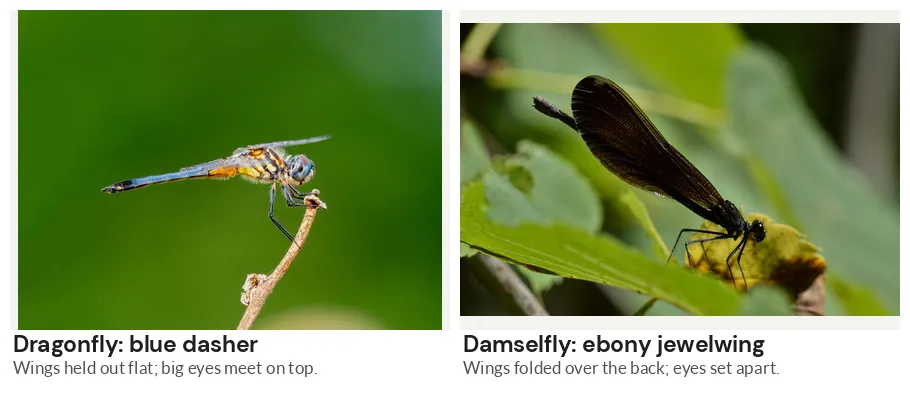
- Dragonflies rest with their wings spread flat and have eyes that touch or nearly touch. Damselflies, their slimmer relatives, usually fold their wings over the back and have widely separated eyes.
- The most-recorded US dragonflies on iNaturalist are the blue dasher, eastern pondhawk, common whitetail and widow skimmer.
- Dragonflies cannot sting. A large one held in the fingers may give a pinching bite, but it cannot harm you.
- They do eat mosquitoes, but the evidence says they do not control them: in a Maine field experiment, adding dragonfly nymphs to pools made no difference to mosquito larvae counts.
- Dragonflies also eat bees. The American Bee Journal lists them among the risks a virgin queen faces on her mating flights, but no study we found measures how many queens they take.
- In our iNaturalist analysis, two of every three April dragonfly records in seven northern states were common green darners, the migrant that flies north before most local species have emerged.
Table of Contents
- What Is a Dragonfly?
- Dragonfly vs Damselfly
- Common Dragonflies in the US
- When Dragonflies Are Out: iNaturalist Records by Month
- Dragonfly Life Cycle: Egg, Nymph and Adult
- Do Dragonflies Bite or Sting?
- What Do Dragonflies Eat?
- Dragonflies and Honey Bees
- Dragonfly Migration
- Dragonflies as Clean-Water Indicators
- How to Attract Dragonflies to a Yard or Pond
- What Dragonflies Mean in Different Cultures
- Frequently Asked Questions
What Is a Dragonfly?
Dragonflies and damselflies make up the insect order Odonata, a Greek name meaning “toothed ones,” a reference to their strong, cutting mandibles, as the U.S. Fish and Wildlife Service explains. True dragonflies form the suborder Anisoptera and damselflies the suborder Zygoptera. Worldwide there are around 6,000 odonate species, about 3,000 of them dragonflies. The 2024 Checklist of North American Odonata by Dennis Paulson, Sidney Dunkle and Jim Johnson lists 471 species for Canada and the continental US: 331 dragonflies and 140 damselflies.
They are old insects. The National Park Service traces their ancestors back about 300 million years, to the griffenflies, whose wingspans reached about 2.5 feet. Modern dragonflies are smaller but just as specialized for hunting on the wing:
- Eyes: two compound eyes of about 30,000 facets each, plus three simple eyes, giving a nearly 360-degree view (NPS).
- Wings: each of the four wings can be controlled on its own, a Missouri Department of Conservation biologist says. A honey bee, by contrast, hooks its front and hind wings together in flight, as our guide to how bee wings work explains.
- Speed and accuracy: NPS puts the top speed of some species at about 37 mph and their success rate at 97% of hunting attempts.
In this 11-minute PBS Terra episode of Insectarium, produced for PBS by the American Museum of Natural History, entomologist Jessica Ware explains why dragonflies are among the strongest fliers of all insects. Its chapters cover the history of flight, how dragonflies hunt, wing design and speed, the difference between “flyers” and “perchers,” and how researchers are mapping the dragonfly family tree. This summary is from the video’s description and official chapter list.
Dragonfly vs Damselfly
The quickest test is to wait until it lands and look at the wings. Missouri’s conservation department notes one exception to watch for: spreadwing damselflies, which, as the name suggests, rest with their wings spread.
| Feature | Dragonfly (Anisoptera) | Damselfly (Zygoptera) | Source |
|---|---|---|---|
| Wings at rest | Held out flat, horizontally | Most hold them together above the body; spreadwings are the exception | Missouri Department of Conservation (MDC), Illinois DNR |
| Wing shape | Hind wings larger and broader at the base than the front wings | Front and hind wings nearly the same size and shape | MDC, Illinois DNR |
| Eyes | Large, touching or nearly touching | Separated, with a clear gap between them | MDC |
| Body | Stouter, “a little brawnier” | Slender; abdomen extremely thin | MDC, Illinois DNR |
| Flight | Strong, fast and maneuverable | Weaker, often fluttery | MDC; ebony jewelwing entry |
| Nymph gills | Internal, inside the rectum | Three external gills at the tip of the abdomen | Illinois DNR, Wikipedia |
Common Dragonflies in the US
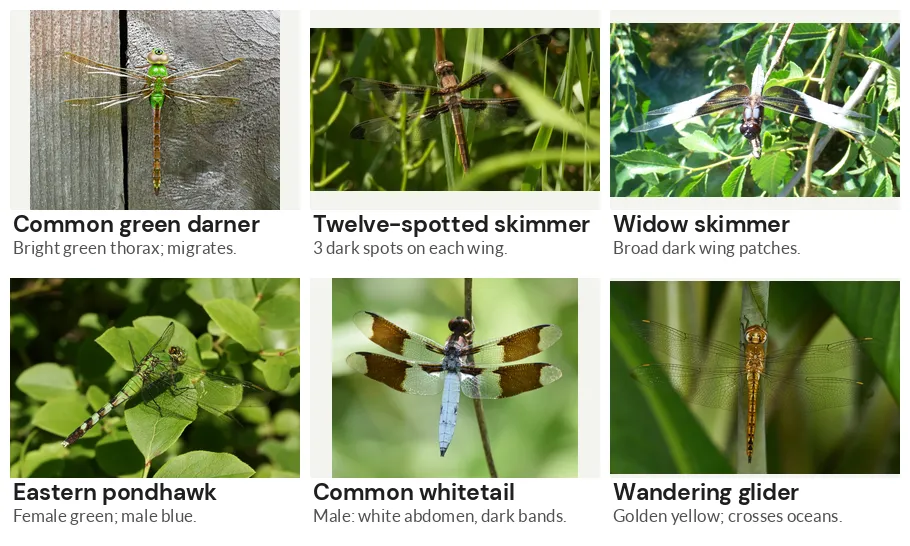
To find out which dragonflies Americans actually see, we pulled iNaturalist’s research-grade US records for the suborder Anisoptera. The six below are the most-recorded species plus the wandering glider, the long-distance migrant. Identification marks come from the Missouri Department of Conservation field guide unless noted.
| Species | How to recognize it | US iNaturalist records (rank) | Source |
|---|---|---|---|
| Blue dasher (Pachydiplax longipennis) | White face; mature males chalky blue with a dark abdomen tip and turquoise eyes; females striped black and yellow | 151,530 (1) | MDC |
| Eastern pondhawk (Erythemis simplicicollis) | Females and young males green with squarish black abdomen spots; older males blue with a green face and thorax | 136,682 (2) | MDC |
| Common whitetail (Plathemis lydia) | Short, stout abdomen; males chalky bluish-white with one broad dark band per wing; females brown with three dark blotches per wing | 113,433 (3) | MDC |
| Widow skimmer (Libellula luctuosa) | Dark “mourning” patches on the inner wings; mature males have white patches beside them | 77,743 (4) | MDC |
| Eastern amberwing (Perithemis tenera) | Tiny, about 1 inch; males have clear amber wings, females blotched wings | 56,496 (5) | MDC |
| Common green darner (Anax junius) | Up to 3 inches; bright green thorax; bullseye mark in front of the eyes; migratory | 53,334 (6) | MDC |
| Twelve-spotted skimmer (Libellula pulchella) | Twelve brown wing spots; males add eight white spots | 24,149 (11) | MDC |
| Wandering glider (Pantala flavescens) | Yellow to golden thorax; up to about 4.5 cm (1.8 in) long; flies for hours without perching | 12,250 (21) | Wikipedia |
Records: iNaturalist API, quality grade “research,” place = United States, all years, pulled November 18, 2026. Counts reflect what people photograph and upload, so common species of ponds and backyards near cities rank high.
Watching how a dragonfly hunts also narrows it down. The Natural History Museum in London sorts dragonflies into two groups: perchers, which sit and wait for prey to pass, and hawkers, generally larger species that patrol a territory on the wing. The wandering glider is an extreme hawker; Wikipedia notes it can fly for hours without perching.
When Dragonflies Are Out: iNaturalist Records by Month
Across the US, 63.4% of research-grade dragonfly records fall in June, July and August, with July the peak month at 330,782 records. Only 1.2% come from December through February.
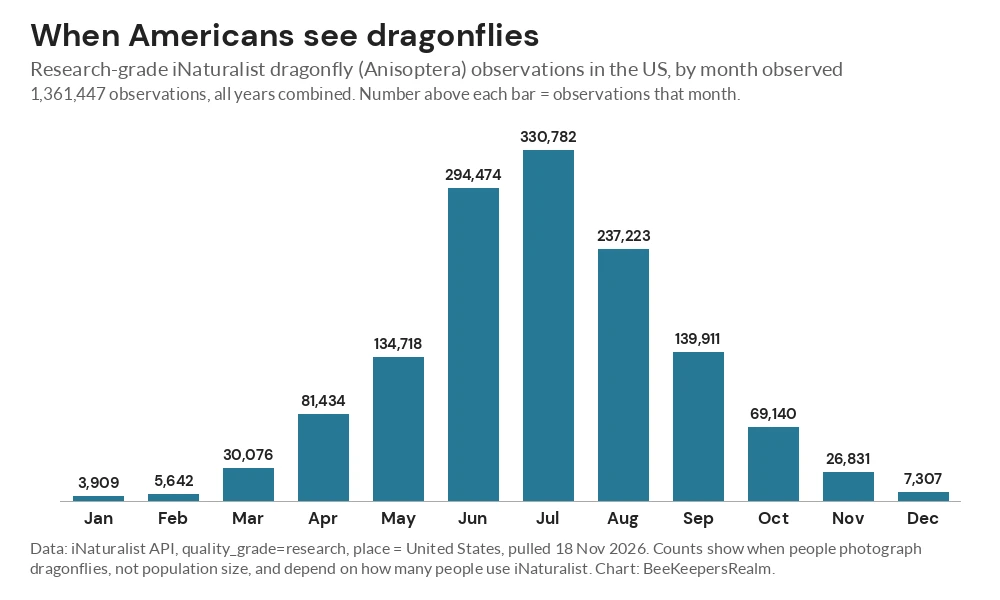
These counts measure when people photograph dragonflies, not how many dragonflies exist, and they depend on how many people use iNaturalist in each place. The seasonal shape is still useful: in most of the country, late spring through early fall is dragonfly season.
Dragonfly Life Cycle: Egg, Nymph and Adult
Dragonflies have three stages: egg, nymph and adult. They skip the pupa stage that butterflies and bees go through, so the nymph turns straight into the winged adult.
Eggs
Females lay eggs around the edges of ponds, on or in aquatic plants, or directly into the water, the National Park Service says. Penn State Extension adds rotting logs and other material near water. Depending on water temperature, the San Diego Zoo says eggs take from 5 days to several months to hatch.
Nymphs (naiads)
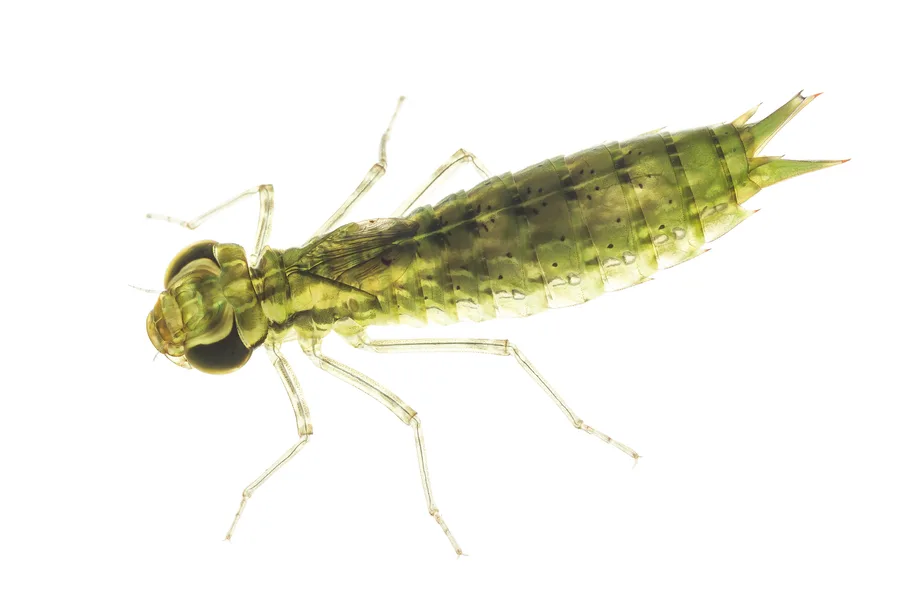
The young, called nymphs, larvae or naiads, live underwater and breathe through gills inside the rectum. They are ambush predators that shoot out a hinged lower lip to grab prey. NPS says the aquatic stage lasts from several months to several years and includes 6 to 15 molts, depending on species. Wikipedia notes that some species stay nymphs for up to five years.
Emergence and the shed skin
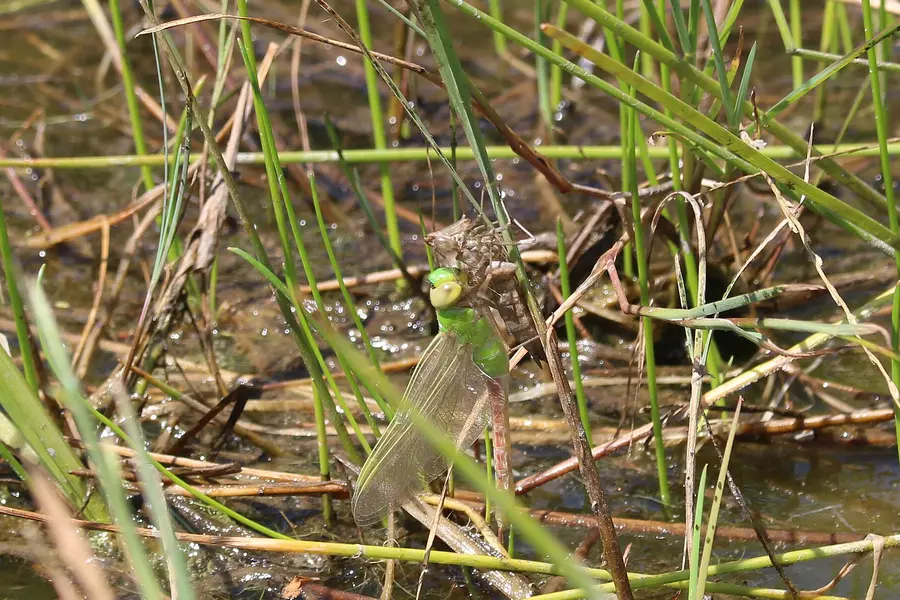
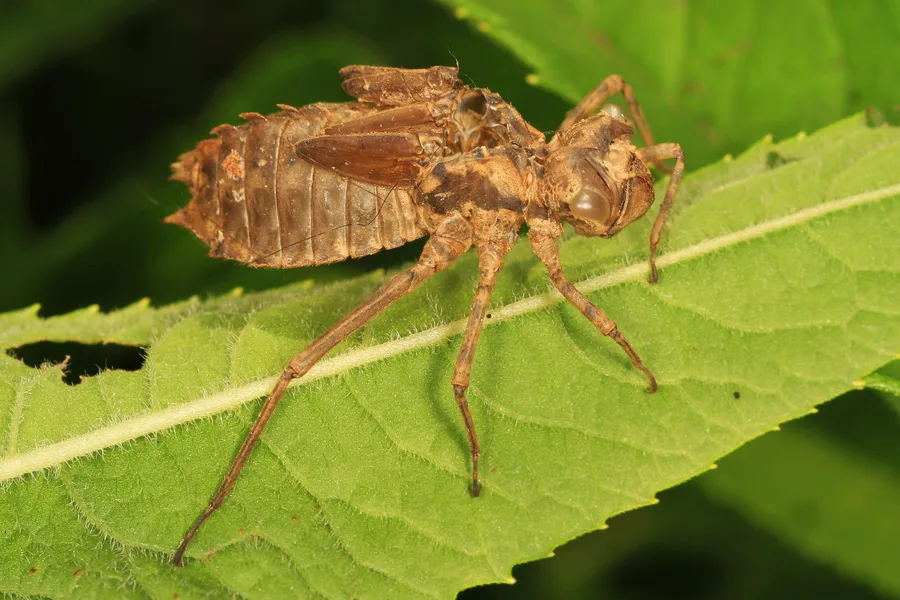
When it is ready, the nymph climbs a plant stem or other object at the water’s edge, splits its skin and crawls out as an adult. NPS says it then takes several hours to pump up its wings and harden. Penn State Extension says a new adult may fly 30 minutes after emerging but stays soft and vulnerable to fish, frogs, spiders and birds for 24 to 48 hours. The empty skin left clinging to the stem is called an exuvia.
How long do dragonflies live?
The whole life cycle can take a year or more, but the flying adult is short-lived. NPS gives about one month. Wikipedia says most species live five weeks or less as adults, a few up to 10 weeks, and some only a few days. Smithsonian Magazine gives a typical one to three weeks, with some living more than two months.
Do Dragonflies Bite or Sting?
Dragonflies do not sting. They have no stinger and no venom, according to the Natural History Museum in London, even though the long abdomen can look like one. They can bite: they kill prey with their jaws, and a dragonfly held roughly may bite in self-defense. The museum says small species cannot break the skin, while large ones can bite hard enough to draw blood.
“These large dragonflies can indeed deliver a pinching bite when handled, but they cannot harm people.”
What Do Dragonflies Eat?
Adults
Adult dragonflies eat other flying insects, caught in the air. NPS lists butterflies, moths, bees, flies and even other dragonflies, but says mosquitoes and midges are targeted most often. University of Maine Extension names dragonflies among the natural predators of horse flies and deer flies.
Nymphs
Underwater, nymphs take mosquito larvae, newly hatched tadpoles, tiny fish and other insect larvae, NPS says. Penn State Extension adds snails and other odonates; large nymphs will eat almost anything they can catch.
Do dragonflies control mosquitoes?
Not in any useful way, according to the evidence. Dragonflies eat mosquitoes, but NPS notes that about 12 mosquitoes fill a large dragonfly’s stomach, so of the online claims that range from “several dozen” to hundreds a day, the true number is likely at the low end. In lab tests where mosquito larvae were the only food, a single nymph ate about 40 a day, the Collier Mosquito Control District in Florida reports, but larval densities in its wetlands can top 2 billion per acre, and most mosquito species go from egg to biting adult in under a week. Rutgers entomologist Michael May, reviewing the research in 2019, found “substantial doubt” that dragonflies materially reduce mosquito numbers “except perhaps very locally.” In a closed enclosure, one study found dragonflies 90 to 95 percent efficient at clearing mosquitoes, a Missouri Department of Conservation article notes. Field results are another matter. The clearest US field test came from Maine, where a long-standing program promotes stocking dragonfly nymphs.
“In an experiment of stocking efficacy, we introduced 4, 2, or 0 dragonfly nymphs into artificial pools in a forest habitat and found no differences in mosquito larvae counts among treatments.”
The same study checked two shipments from suppliers in Massachusetts and North Carolina and found that 6.8% and 38.5% of the species in them were not native to Maine. Enjoy dragonflies for their own sake, and use standing-water control and repellent for mosquitoes.
Dragonflies and Honey Bees
Dragonflies do catch bees. The Natural History Museum lists bees among the winged insects adults feed on, and NPS includes bees in its list of prey. For a beekeeper the question is scale.
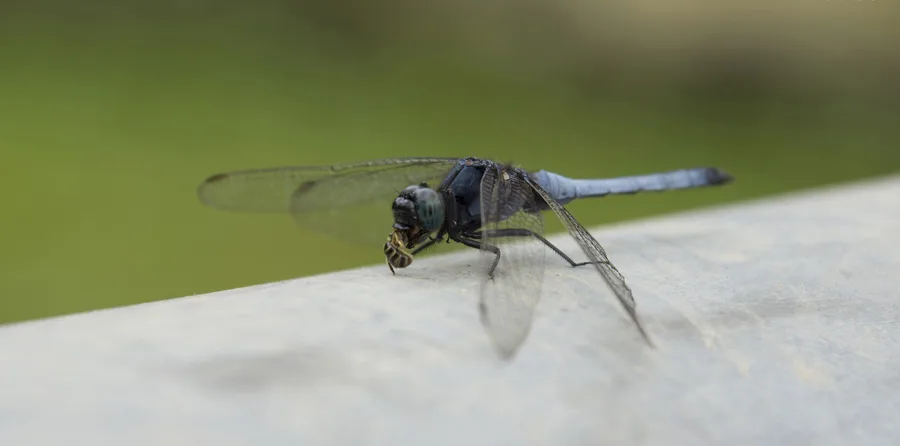
Workers. A dragonfly catches bees one at a time, in flight. We found no study that measures what this does to colony strength. For the pests and predators known to weaken colonies, see our guide to bee pests and predators.
Queens. The real concern is the virgin queen, who leaves the hive on one or more mating flights. Writing in the American Bee Journal in 2020 about research on those flights, bee scientist Alison McAfee listed “predators like birds or dragonflies, a turn in weather, or the added energy expenditure” as the costs that balance the benefit of extra flights. Our article on virgin queen mating flights covers their timing. We found no study that measures how many queens dragonflies take, so treat any loss figure you see online with caution.
Other insects that hunt bees on the wing or on flowers include robber flies and the praying mantis.
Dragonfly Migration
Some dragonflies migrate, and the two best-studied migrants are common in the US. A 2026 global review of odonate migration in Biological Reviews notes that most of what is known about odonate migration comes from just these two species.
Common green darner
A 2018 study led by Michael Hallworth used chemical signatures in 852 darner wings from eight countries, spanning 140 years, to work out where each one grew up. It found a three-generation cycle: one generation flies north in spring, its offspring fly south in fall, and a third, non-migratory generation emerges in the south in November and breeds there, producing the darners that fly north the next spring. The Vermont Center for Ecostudies summarizes the trips as over 600 km (373 miles) on average, with some individuals covering more than 2,500 km (1,553 miles). Like the monarch butterfly, no single darner completes the whole circuit.
“We demonstrate that darners undertake complex long-distance annual migrations governed largely by temperature that involve at least three generations.”
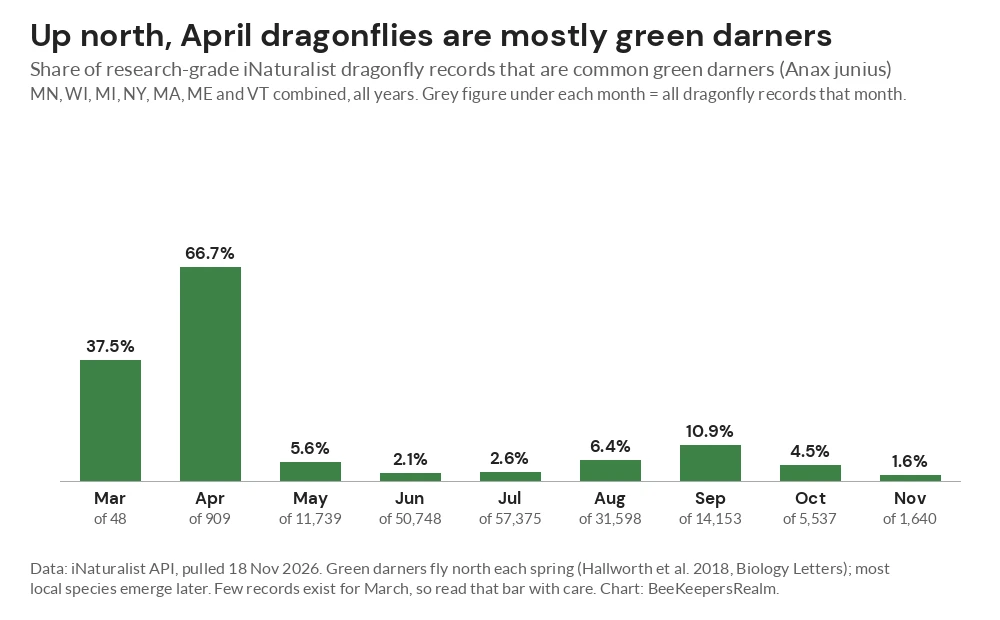
Our iNaturalist pull shows that spring arrival. In Minnesota, Wisconsin, Michigan, New York, Massachusetts, Maine and Vermont combined, 606 of the 909 April dragonfly records, or 66.7%, are green darners. By June, when local species have emerged, darners are 2.1% of records, and across the whole year they are 4.4%. In the South the darner peak comes in fall: Texas records are highest in October (3,555) and September (3,291), when the southbound generation passes through.
Wandering glider
The wandering glider, also called the globe skimmer, has “the longest known migration not just of any dragonfly, but of any known insect,” according to a 2016 genetic study in PLOS ONE. The same study found that gliders from North America, South America and Asia mix their genes so freely that the species behaves like one global population. Wikipedia puts its multigenerational round trip at about 18,000 km (11,200 miles). In the US it is a late-summer insect: 3,974 of its 12,250 US records come from August.
Dragonflies as Clean-Water Indicators
Because nymphs live in water for months or years, they reflect what is in it. Penn State Extension says odonate species range from very sensitive to very tolerant of pollution, excess nutrients and habitat disturbance, and that dragonfly nymphs are generally more sensitive to pollution than damselfly nymphs, so which species turn up says something about a pond or stream. Since 2011, more than 100 national parks and over 4,500 citizen scientists have taken part in the National Park Service’s Dragonfly Mercury Project, which collects dragonfly larvae for mercury analysis.
How to Attract Dragonflies to a Yard or Pond
The key to attracting dragonflies is water, because that is where they breed. Penn State Extension’s advice for backyard ponds comes down to a few steps:
- Plant a mix of submerged, emergent and floating native plants in and around the pond for egg-laying, emergence and perches.
- Give it plenty of sun for basking, with shrubs nearby to break the wind.
- Vary the depth; larger ponds with more plant variety attract more species.
- Add flat stones for basking and sticks in the water as perches.
Penn State Extension adds that strong fliers that breed in small ponds, such as green darners, wandering gliders, common whitetails and blue dashers, are the most likely to find a new pond first.
The Natural History Museum advises leaving fish out of a dragonfly pond, because fish eat the nymphs. The Old Farmer’s Almanac warns that pesticides aimed at mosquitoes can also harm dragonflies. Flowering native plants for pollinators around the pond bring in the small insects dragonflies hunt, and a shallow edge also serves as a water source for bees.
What Dragonflies Mean in Different Cultures
Dragonfly symbolism varies by culture, and none of it is a scientific claim. In Japan, dragonflies are symbols of courage, strength and happiness, are linked with autumn, and appear often in art and haiku; Wikipedia notes that one interpretation of Akitsushima, a classical name for Japan, is “Dragonfly Island,” and that Zuni pottery and Hopi rock art use the dragonfly as a motif. NPS says the Navajo have long seen dragonflies as a symbol of water purity. European folklore was darker: English folk names such as “devil’s darning needle” and “horse-stinger” linked dragonflies with evil and injury.
Frequently Asked Questions
Will a dragonfly bite or sting you?
It will not sting; dragonflies have no stinger or venom. A large one may give a pinching bite if you grab it, which can occasionally break the skin, but it is harmless (Missouri Department of Conservation, Natural History Museum).
Is it good to have dragonflies in your yard?
Yes. They are harmless, eat small flying insects, and their presence suggests nearby water that supports aquatic life. They will not rid a yard of mosquitoes, though.
What is a dragonfly’s biggest enemy?
Birds, fish, frogs and spiders all eat dragonflies, especially newly emerged adults, which stay soft for a day or two (Penn State Extension). Underwater, the San Diego Zoo lists fish (especially bass), water beetles, ducks, water shrews and water bugs as nymph predators.
What does it mean when you see a dragonfly?
Biologically, it usually means water with breeding habitat is nearby, since nymphs grow up in ponds, lakes and streams. Culturally, meanings differ: courage and strength in Japan, water purity for the Navajo, and something sinister in old European folklore.
What is the old wives’ tale about dragonflies?
A common one in the US is that a dragonfly will sew your lips shut, which biologist Jeanne Tinsman remembered hearing as a child in a U.S. Fish and Wildlife Service story. Another is “snake doctor,” from a Southern folk belief that dragonflies follow snakes and stitch them back together when they are hurt. Neither is true.
What is special about the dragonfly?
Few insects can match its flight and vision: four independently controlled wings, speeds of about 30 to 37 mph by PBS and NPS estimates, eyes with about 30,000 facets each, and a reported 97% hunting success rate. The wandering glider also has the longest known migration of any insect.
The Bottom Line
Dragonflies are harmless, worth having around and easy to attract if you have or can build a fish-free, plant-rich pond. They will not solve a mosquito problem. For beekeepers they matter mainly during queen mating flights, although no study has yet measured how many queens they take.
Image credits: featured photo of a blue dasher by Courtney Celley/USFWS, public domain, via Wikimedia Commons, cropped. Other photos as credited in their captions, all via Wikimedia Commons, resized or combined. Charts by BeeKeepersRealm from iNaturalist data.