Reviewed by Elena P. · How we review
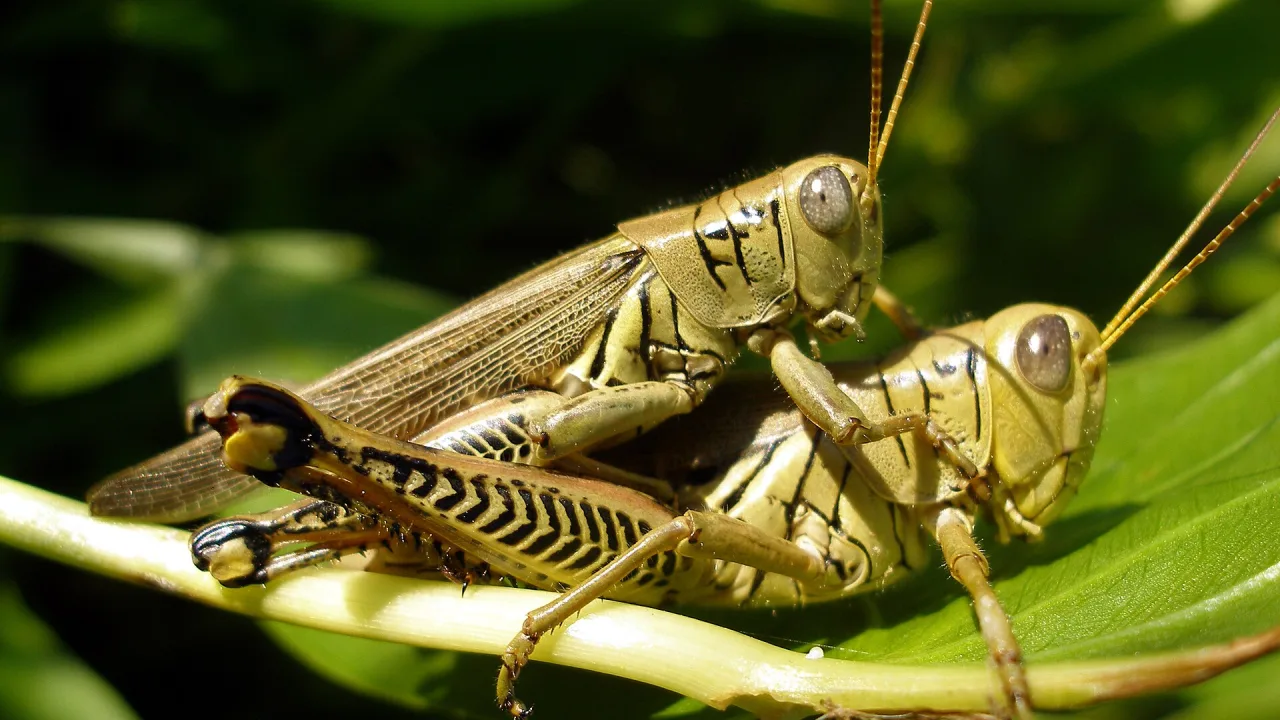
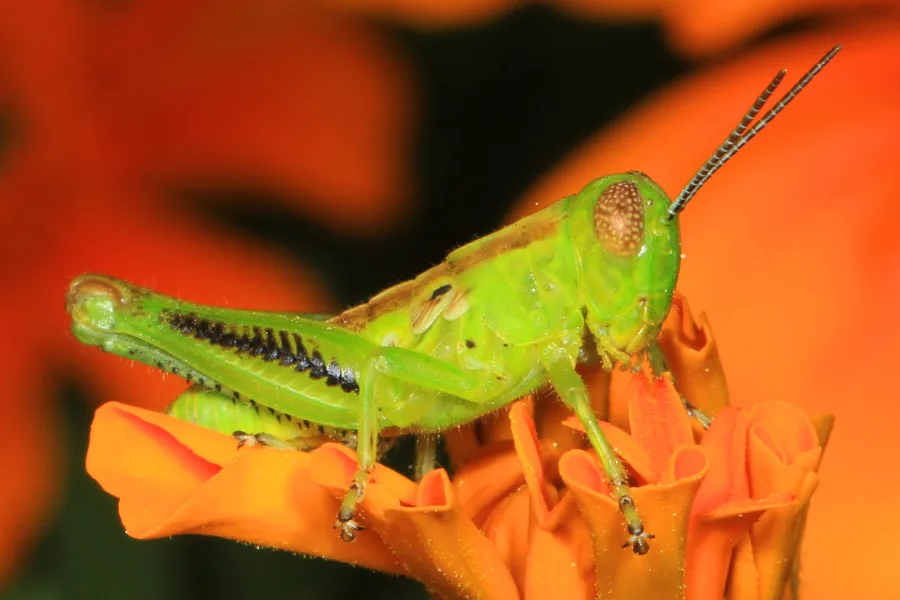
A grasshopper is a plant-eating jumping insect in the order Orthoptera, suborder Caelifera, told apart from crickets and katydids by its short antennae. USDA APHIS counts nearly 400 species in the western US alone, but only a small number are pests; the differential, two-striped, red-legged and migratory grasshoppers do much of the crop and garden damage. Most US species have one generation a year: eggs spend the winter in soil pods, nymphs hatch in spring and adults peak in late summer. A grasshopper can nip if handled and may spit a brown fluid, but neither is dangerous.
This page is about the insect, not the phone service, design plug-in or mower brand of the same name. Every fact below is credited to a named university, extension program or government agency, and the observation counts are our own pull of iNaturalist records. We make no claim of first-hand experience raising or controlling grasshoppers.
Key Takeaways
- Short antennae, usually less than half the body length, separate grasshoppers from crickets and katydids (Missouri Department of Conservation).
- APHIS lists 12 pest species among the nearly 400 grasshoppers of the western US; Colorado State’s list of the main garden pests there includes the differential, migratory, two-striped and red-legged grasshoppers.
- A locust is a grasshopper that changes form and swarms when crowded. North America’s only locust, the Rocky Mountain locust, is extinct; the last living specimen was collected in 1902.
- Garden control works best while nymphs are small. UC IPM calls grasshoppers among the most difficult garden pests, and its listed sprays are very toxic to bees.
- In 391,899 US research-grade iNaturalist records, July to October hold 65.2% of grasshopper sightings and September is the peak month. Of eight common species we checked, only the eastern lubber peaks outside August and September: in May.
Table of Contents
- What Is a Grasshopper?
- Grasshopper vs Cricket, Katydid, Locust and Other Look-Alikes
- Common US Grasshoppers and How to Identify Them
- Grasshoppers and Locusts: Swarms and an Extinct US Locust
- Grasshopper Life Cycle: Eggs, Nymphs and Adults
- When Grasshoppers Are Seen: Our iNaturalist Count
- What Do Grasshoppers Eat?
- Do Grasshoppers Bite? Spit and Other Defenses
- How to Get Rid of Grasshoppers in the Garden
- Grasshoppers, Bees and Other Pollinators
- Frequently Asked Questions
- Sources
What Is a Grasshopper?
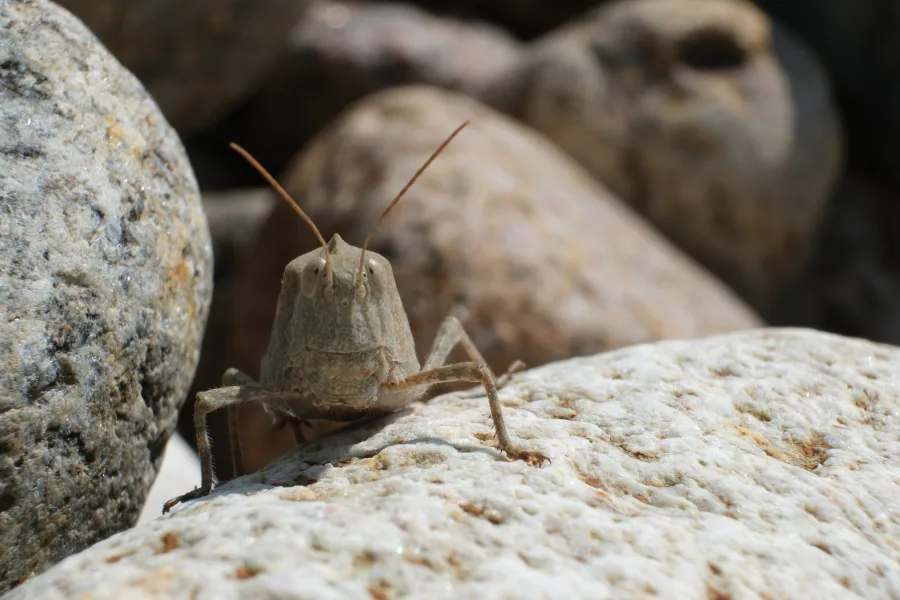
Grasshoppers are insects in the order Orthoptera, which they share with crickets and katydids. They make up the suborder Caelifera, the “short-horned” group (Britannica; Missouri Department of Conservation, MDC). MDC describes their antennae as usually less than half the length of the body, with fewer than 30 segments. The hind legs have greatly enlarged femurs built for jumping (UC Statewide IPM Program, UC IPM), the mouthparts are made for chewing, and most adults have wings and fly well.
Grasshoppers hear through a tympanal organ, a membrane on the first segment of the abdomen, not on the head or legs (Britannica). Males of many species “sing” by rubbing a row of pegs on the hind leg against the edge of the forewing, and band-winged species crackle their wings in flight (MDC). Unlike most crickets and katydids, grasshoppers are active by day (Wikipedia).
Counts vary by source: about 11,000 species worldwide (Britannica), nearly 400 in the western US (APHIS) and about 400 native to North America (Utah State University Extension, USU). USU’s 4-minute video gives a quick overview of grasshoppers as garden and crop pests.
Video summary: USU Extension explains that grasshoppers move from weedy fence rows and roadsides into crops as that vegetation dries. It compares sprays, dusts and baits, says treatments work best on nymphs rather than adults, and advises homeowners to treat as a neighborhood because adults travel too far for a single-yard treatment to last.
Grasshopper vs Cricket, Katydid, Locust and Other Look-Alikes
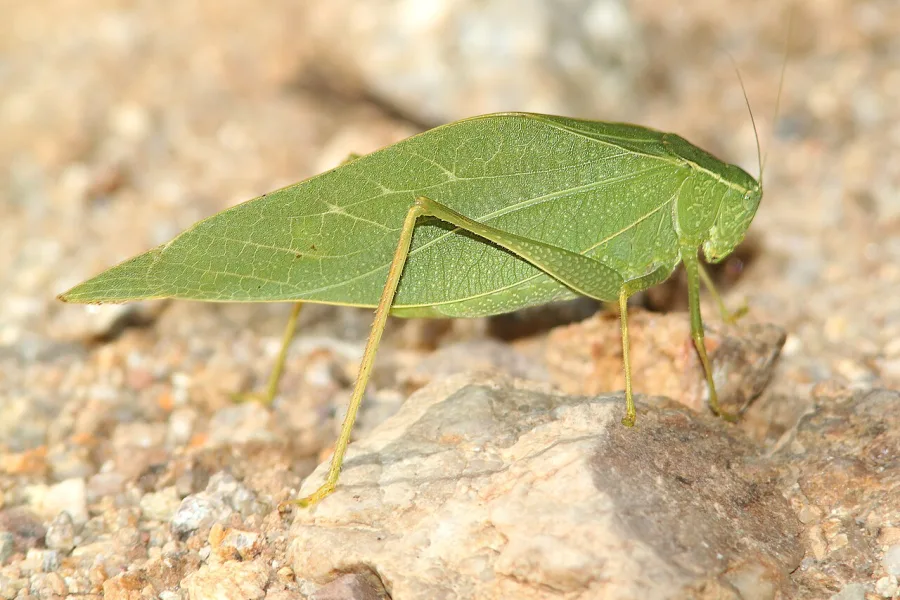
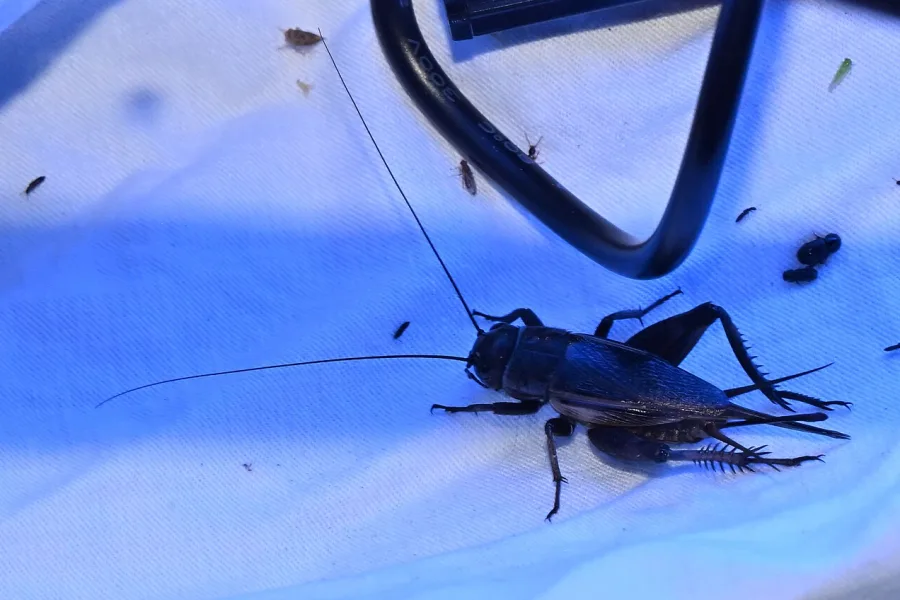
Start with the antennae, then the time of day you hear it. Crickets and katydids belong to the other Orthoptera suborder, Ensifera, the long-horned group. Cicadas and praying mantises are not Orthoptera at all, but their nymphs and sounds get mixed up with grasshoppers.
| Insect | Antennae | Sound / when active | Ears | Bites? | Source |
|---|---|---|---|---|---|
| Grasshopper | Short, usually under half the body length | Males rub hind legs on wings, or crackle wings in flight; active by day | On the first abdominal segment | Can nip if handled; not venomous | MDC; Britannica; Wikipedia; Healthline |
| Cricket | Long and thin | Males chirp; mainly at night | On the front leg tibiae | Some have a weak bite | UC IPM; Wikipedia |
| Katydid | Very long, often past the tip of the abdomen | Males rasp their wings; many sing in the evening or at night | On the front leg tibiae | May pinch if handled | MDC; our katydid guide |
| Locust | Short (a locust is a grasshopper) | Same as grasshoppers; forms swarms when crowded | On the abdomen | Same as grasshoppers | Britannica; MDC |
| Cicada (not Orthoptera) | Short | Males sing with drum-like tymbals; by day | Not a field mark | No; sucks sap | Wikipedia; our cicada guide (US Forest Service) |
| Praying mantis nymph (not Orthoptera) | Thin | Silent; ambushes prey | Hearing organ on the thorax | May nip if handled; no venom | Wikipedia; our mantis guide |
A katydid also differs in its feet and egg-layer: four segments on each foot and a flat, sword-like ovipositor in females (MDC). A cicada is a true bug that pierces plants and sucks sap instead of chewing leaves. A young praying mantis has spiny, folded front legs for grabbing prey instead of thick jumping hind legs.
Common US Grasshoppers and How to Identify Them
Most grasshoppers you meet are harmless to gardens. The table covers the four spur-throated Melanoplus species that extension services name as the main crop and garden pests, plus three conspicuous species people often ask about. The last column is the number of US research-grade iNaturalist records for each species in our pull.
| Species | Key ID marks | Where and when | Pest status | US iNaturalist records | Source |
|---|---|---|---|---|---|
| Differential grasshopper (Melanoplus differentialis) | About 1¾ in; shiny brownish-yellow to olive; black chevron (herringbone) marks on the hind femurs | Fields, open woods, water edges; gardens | Often one of the first species to move into gardens | 51,886 | USU; CSU; MDC |
| Two-striped grasshopper (M. bivittatus) | 1¼ to 2 in; two pale yellow stripes down the back that meet in a triangle at the end of the forewings; black band on the hind leg | Ditch banks, roadsides, crop borders | Often the most common species damaging gardens in Colorado | 20,007 | USU; CSU |
| Red-legged grasshopper (M. femurrubrum) | 1 to 1½ in; brown, with red hind tibiae | The most widely distributed species; moist sites | Feeds on many garden plants; hatches late | 8,542 | USU; CSU |
| Migratory grasshopper (M. sanguinipes) | About 1 in; reddish brown | Grasslands and meadows; capable of long migration flights | Causes more crop damage than any other US grasshopper | 1,249 | USU; CSU |
| Eastern lubber (Romalea microptera) | Males 1.7 to 2.2 in, females 2 to 2.8 in; yellow or tawny with black; cannot fly | Southeast: North Carolina to Florida and west to central Texas | Damages citrus, vegetables and ornamentals in Florida | 33,803 | UF/IFAS EDIS |
| Carolina grasshopper (Dissosteira carolina) | Black hindwings with a pale yellow border, like a mourning cloak butterfly; crackles in flight | Dirt roads, vacant lots, bare ground | Rarely abundant enough to do serious damage | 17,188 | MDC; CSU |
| Obscure bird grasshopper (Schistocerca obscura) | Large; reddish-brown forewings, green legs, pale stripe down the back | One of about six bird grasshoppers in Missouri; flies almost like a bird | Not named as a garden pest by these sources | 19,969 | MDC |
The migratory grasshopper’s low count does not mean it is rare: it is hard to identify from a photo, and iNaturalist groups it in a “species complex” with the red-legged grasshopper and ten other Melanoplus species. We counted only records identified to species.
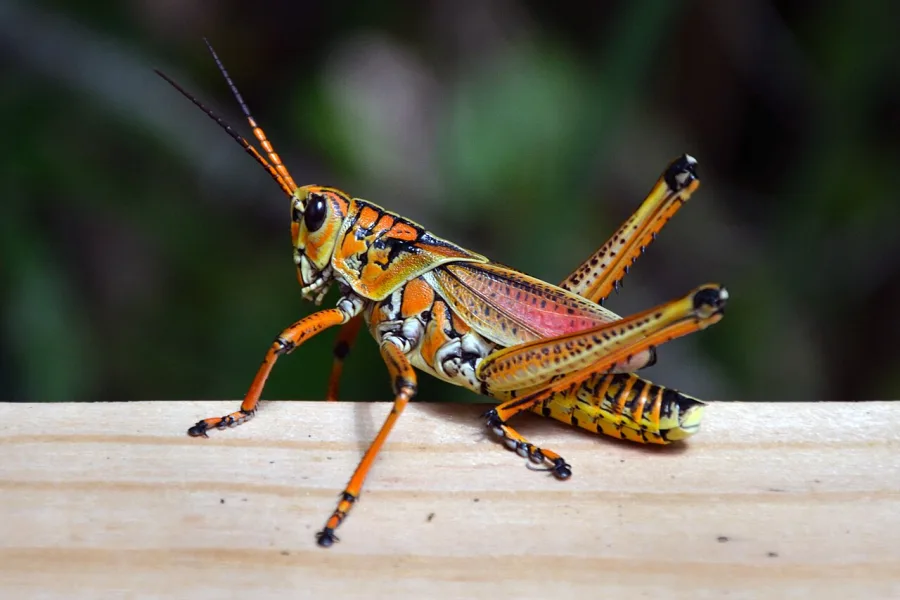
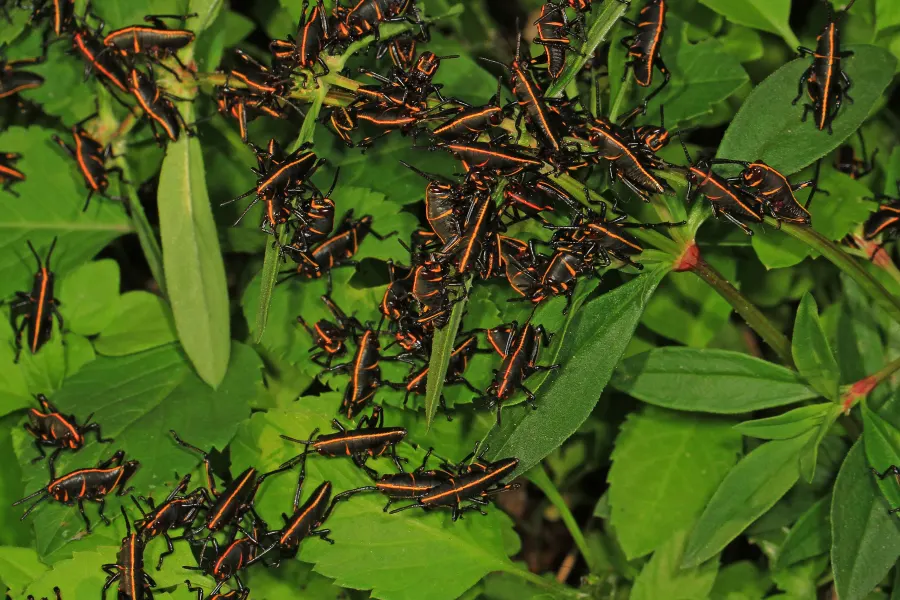
The eastern lubber deserves a note of its own. When alarmed it spreads its wings, hisses and releases a foul-smelling froth, and the University of Florida (UF/IFAS EDIS IN132) says its chemical defense is aimed at vertebrates such as birds and lizards.
“Many vertebrate, but not invertebrate, predators are affected (Jones et al. 1987, 1989; Whitman et al. 1992). Their bright color pattern is believed to be a warning to vertebrate predators that lubber grasshoppers are not palatable.”
Grasshoppers and Locusts: Swarms and an Extinct US Locust
A locust is not a separate kind of insect. Britannica describes locusts as short-horned grasshoppers with two phases: a solitary phase and a gregarious phase that forms when nymphs grow up crowded. Gregarious nymphs change color, gather in groups and become restless, and the adults have longer wings for migration. Desert locust swarms in Africa and Asia are the famous modern example.
North America had one locust, the Rocky Mountain locust (Melanoplus spretus). In the University of Nebraska’s Encyclopedia of the Great Plains, Jeffrey Lockwood says its outbreaks spread over nearly two million square miles, with famous swarms from 1873 to 1878; the last living specimen was collected in 1902, and MDC lists it as extinct. The “17-year locusts” of the East are periodical cicadas, not locusts.
Grasshopper Life Cycle: Eggs, Nymphs and Adults
Grasshoppers go through simple metamorphosis: egg, nymph and adult (USU), with no pupal stage (MDC). Most US species have one generation a year.
- Eggs. In late summer and fall, females lay eggs in the upper 2 inches of soil in pods of 20 to more than 100 eggs, usually in undisturbed ground such as ditch banks, roadsides, fencerows and pastures (UC IPM). Colorado State University (CSU) adds that dry soil undisturbed by tillage or irrigation is preferred, and that egg laying can concentrate in “egg beds.” The egg is the overwintering stage for most species.
- Nymphs. Most species hatch in mid to late spring as the soil warms (Colorado State University Extension, Fact Sheet 5.536). Nymphs look like small adults with wing buds and molt five or six times over several weeks. They cannot fly, so this is when they are easiest to control.
- Adults. Adults can live two to three months (UC IPM) and die out in late summer and fall when food runs short or frost arrives. A few species break the pattern: the speckled-winged grasshopper spends the winter as a nymph and is the one seen on warm winter days in Colorado (CSU).
Eastern lubber nymphs look nothing like their parents. UF/IFAS describes them as almost completely black with a yellow, orange or red stripe, so they are often mistaken for a different species. Young lubber nymphs are highly gregarious, which is why they turn up in clusters.
Why some years are grasshopper years
Weather around egg hatch matters most. CSU says cold, wet weather kills newly hatched nymphs, and USU links outbreaks to warm, dry springs. In California, UC IPM says severe outbreaks normally come every 8 to 10 years and can last two or three. In August 2026, a USU Extension agronomist reported surprisingly low numbers across much of Utah after a mild winter.
When Grasshoppers Are Seen: Our iNaturalist Count
To show when grasshoppers turn up across the US, we pulled every research-grade iNaturalist observation of the suborder Caelifera with a US location, all years, in November 2026. These counts measure when people photograph grasshoppers, not how many grasshoppers exist, and yearly totals have grown more than fivefold, from 9,406 records in 2017 to 51,048 in 2025.
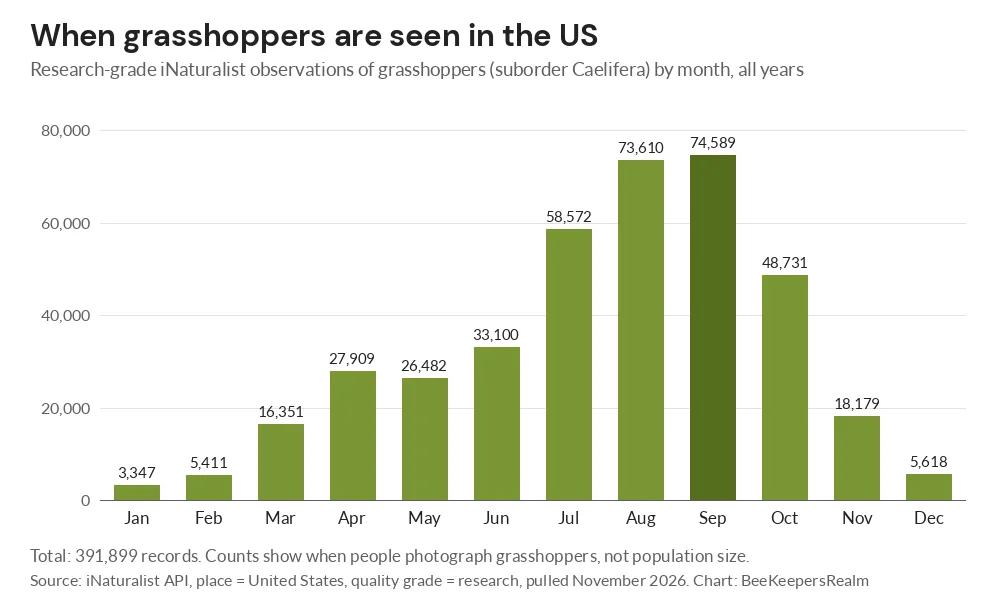
Of 391,899 records, July through October hold 255,502 (65.2%). September is the busiest month with 74,589 records, just ahead of August with 73,610, while December to February together hold only 14,376 (3.7%). That matches the extension timeline above: spring hatch, a summer of growing nymphs and the most adults in late summer and early fall.
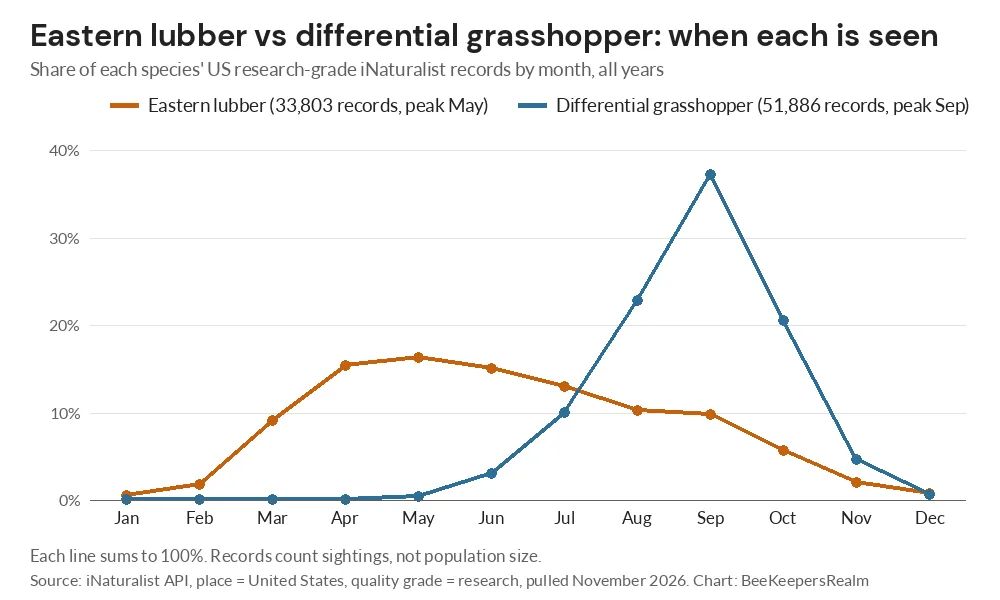
The eastern lubber runs on a different clock. Its records peak in May, and March to June hold 56.0% of them, while the differential grasshopper, the most-recorded US species, peaks in September with 90.7% of its records from July to October. UF/IFAS Gardening Solutions puts peak lubber numbers in north Florida and along the Gulf Coast in July and August, so read the May peak as when lubbers are most often noticed, not necessarily most numerous.
What Do Grasshoppers Eat?
Most grasshoppers eat leaves, and many species are picky. Some feed mainly on grasses or sedges, others on broadleaf plants, and a few on weeds (CSU). The garden pests are general feeders that prefer young green plants (UC IPM).
- Favored: lettuce, carrots, beans, sweet corn and onions (CSU; UC IPM), plus some annual flowers. USU adds melons, zinnias, marigolds and cosmos.
- Usually avoided: squash, peas and tomato foliage (CSU). UC IPM also lists squash and tomatoes as least favored.
- Eastern lubber: at least 100 plant species from 38 families; peas, lettuce, kale, beans and cabbage are favorites, and in flower beds it strips amaryllis, crinum, canna, lantana and butterfly weed (UF/IFAS Gardening Solutions).
Damage looks like large sections chewed out of leaves and flowers, sometimes whole plants eaten (UC IPM). Grasshoppers also feed on fruit, seed heads and stems (USU), and in outbreak years they gnaw bark on shelterbelt twigs (CSU). That chewing differs from Japanese beetles, whose adults skeletonize leaves.
Do Grasshoppers Bite? Spit and Other Defenses
Rarely, and harmlessly. Healthline says grasshoppers don’t usually bite people but may if they feel threatened, that they are not poisonous, and that their bites are not dangerous. It adds that a handled grasshopper may kick and dig the spikes on its hind legs into your skin, which is not dangerous either. Grasshoppers eat plants and never seek people out, unlike a blood-feeding kissing bug.
The brown “spit” is defensive regurgitation: partly digested plant matter released from the mouth when the insect is handled or attacked. People call it tobacco juice because of its color. Healthline notes it can stain skin for a while but is not dangerous, and Louisiana State University’s AgCenter describes the same dark brown liquid from eastern lubbers, along with froth from their breathing pores. Wash it off with soap and water.
How to Get Rid of Grasshoppers in the Garden
“Grasshoppers are among the most difficult insect pests to manage in the garden. When numbers are low, they can be handpicked and squashed.”
The hardest fact for gardeners is that most garden grasshoppers hatch somewhere else. UC IPM says cultivated gardens are not a common egg-laying site. Nymphs grow up in weedy borders, roadsides and pastures, then move in when that vegetation dries, often for a few weeks in early summer. Plan for that, in this order:
- Watch early. Check weedy edges in late spring for small nymphs. CSU says the number of grasshoppers in late summer and fall is a good predictor of the next year’s problem.
- Hand-pick and use barriers. Handpick when numbers are low. Row covers, cones and screens help, but hungry grasshoppers chew through cloth and plastic, so UC IPM suggests metal window screening.
- Change the borders. USU suggests clearing weeds in fall and late spring, keeping a bare strip several feet wide around the garden, and shallow fall cultivation to disturb egg masses. UC IPM offers the opposite tactic on migration routes: a lush border of tall grass as a trap crop, never mowed or allowed to dry.
- Let predators help. Chickens and guinea hens eat grasshoppers readily but can damage plants too (UC IPM); if you also keep hives, see bees and backyard chickens. Blister beetle larvae eat egg pods, and robber flies, birds such as kestrels and horned larks, and coyotes take nymphs and adults (CSU).
- Use a microbial bait only early. Nosema locustae, a single-celled microsporidian parasite, is sold as a bait (USU). CSU says it works only on young nymphs, acts slowly and does not infect all species equally, and UC IPM says it is unlikely to work in California home gardens.
- Treat insecticides as a last resort. UC IPM suggests a carbaryl bait around the garden border before grasshoppers arrive, reapplied after rain (carbaryl has been restricted-use in California since 2020). CSU lists carbaryl and permethrin for many food crops, and USU stresses using only products labeled for the crop. Sprays work on small nymphs; adults are very hard to kill.
Whatever you use, keep sprays off any plant in bloom, because the sprays most used on grasshoppers are highly toxic to bees (see below). For lower-risk options, see our guide to pollinator-safe pest control products. Grasshoppers are one of many leaf-eaters covered in our garden and household insects guides.
Grasshoppers, Bees and Other Pollinators
Grasshoppers and bees meet in two places: shared forage and shared sprays. On rangeland, the losses fall on beekeepers too.
“Grasshopper outbreaks can cause significant losses to beekeepers, and their colonies can suffer losses as well when grasshoppers destroy bee rangeland food sources.”
APHIS adds that beekeepers may have to move hives or buy feed and may see reduced honey production. Its rangeland program in 17 western states treats only on request, mostly with diflubenzuron, an insect growth regulator aimed at young grasshoppers, sprayed in alternating swaths (Reduced Agent and Area Treatments) that usually cut the treated area by at least 50 percent.

In gardens the risk runs the other way. UC IPM says carbaryl, cyfluthrin and other pyrethroid sprays used on grasshoppers are very toxic to bees, to the natural enemies of grasshoppers and to aquatic life, while carbaryl in bait form is less hazardous to bees. If you keep hives near cropland where grasshopper spraying is likely, registering them with DriftWatch and BeeCheck lets applicators see where they are.
Grasshoppers also feed beneficial insects. CSU names robber flies as common summer predators, and large digger wasps stock their nests with paralyzed Orthoptera: the great golden digger wasp takes crickets, katydids and grasshoppers, while its cousin the great black wasp mostly hunts katydids.
Frequently Asked Questions
What is a grasshopper’s enemy?
Many animals eat them. CSU lists blister beetles (on egg pods), robber flies, parasitic flies, birds such as kestrels and horned larks, and coyotes, plus a fungus and a large nematode that kill grasshoppers in wet years. MDC adds spiders, fish, amphibians, reptiles and mammals.
Is a grasshopper good or bad?
Both. Most species do no harm and feed a long list of wildlife (MDC), but a few, mainly spur-throated Melanoplus species, damage crops, rangeland and gardens in outbreak years (APHIS; CSU).
Is it safe to touch a grasshopper?
Yes. Grasshoppers are not poisonous, and a bite is rare and mild (Healthline). Expect a spiny kick from the hind legs and possibly some brown spit, which can stain skin but washes off.
Will a grasshopper jump on you?
Not to attack. Grasshoppers leap to escape threats (APHIS; Wikipedia), and they do not bite or sting in a way that harms people (Healthline), so there is no need to swat one that lands on you.
What kills grasshoppers instantly?
Nothing safe does it instantly. Hand-picking is the immediate option. Labeled insecticides work best on small nymphs and poorly on adults, and they must be reapplied while invasions continue (UC IPM), so timing matters more than strength.
Are grasshoppers poisonous?
Not to people. The eastern lubber is the notable exception for predators: its chemical defense affects many vertebrates, and its bright colors are believed to warn them off (UF/IFAS). Keep pets and poultry from eating lubbers.
Can you eat grasshoppers?
Yes, in many cultures. In southern Mexico, grasshoppers called chapulines are eaten in dishes such as tortillas with chili sauce (Wikipedia), and Britannica notes they are dried, roasted or ground into meal elsewhere. Never eat grasshoppers from areas that may have been sprayed.
The Bottom Line
Check the antennae to tell a grasshopper from a katydid or cricket, expect the most grasshoppers from July to October, and act on nymphs in spring rather than adults in August. If you spray, choose a labeled product, treat borders, and keep it away from anything in bloom.
Image credits: Featured photo: differential grasshoppers mating in Mount Gilead State Park, Ohio, by Rkitko, CC BY 3.0, via Wikimedia Commons (cropped, resized). Charts use US research-grade iNaturalist observations pulled November 17, 2026. Other credits are in the captions.
Sources: UC Statewide IPM Program, Pest Notes: Grasshoppers; Colorado State University Extension Fact Sheet 5.536; USDA APHIS grasshopper and Mormon cricket FAQ; UF/IFAS EDIS IN132, eastern lubber grasshopper; Utah State University Extension grasshopper fact sheet (Evans and Hodgson) and “Where Have All the Grasshoppers Gone?” (Greenhalgh, 2026); UF/IFAS Gardening Solutions, eastern lubber grasshoppers; Missouri Department of Conservation field guide; University of Nebraska–Lincoln EC1569; Encyclopedia of the Great Plains, “Insect Lore” (Lockwood); LSU AgCenter; Britannica; Wikipedia; Healthline; iNaturalist.