Reviewed by Elena P. · How we review
A marigold is a plant in the genus Tagetes, part of the aster family, native to the Americas from the southwestern United States to South America. The three garden types are African (T. erecta), French (T. patula) and signet (T. tenuifolia), grown as warm-season annuals in full sun after the last frost. For bees, pick open-centered flowers. Of the pest claims, only root-knot nematode control holds up, and only with French marigolds grown as a dense cover crop.
Educational information only, not veterinary or medical advice. Call a vet or doctor about a real exposure.
Key Takeaways
- In a Michigan State trial of six marigold cultivars, hoverflies were 43.4% of pollinators collected and honey bees 26.8%. A single-flowered French cultivar drew the most visits in 2020.
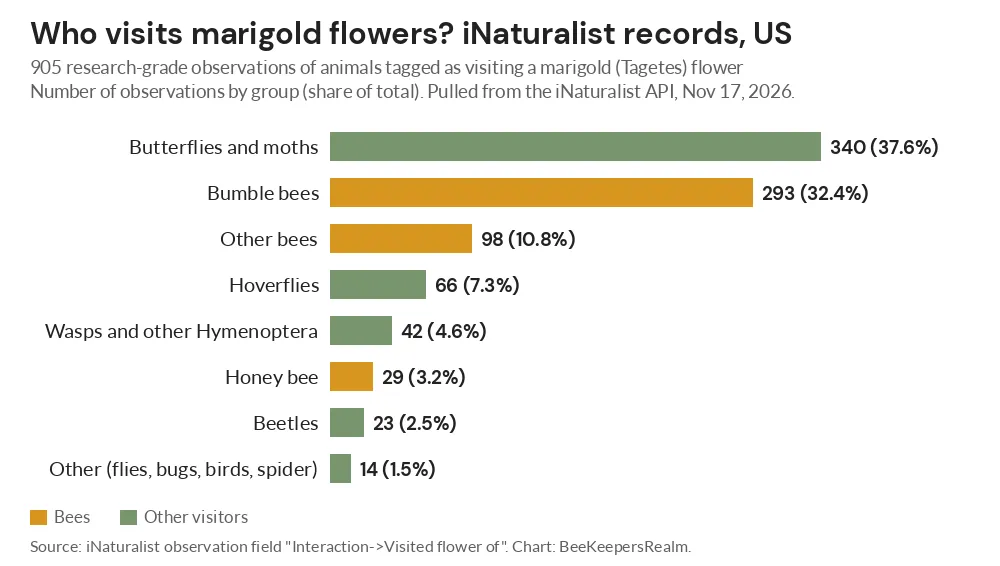
- In 905 US iNaturalist records of animals on marigold flowers, butterflies and moths led (37.6%), then bumble bees (32.4%).
- No study cited by Clemson Extension tested whether planted marigolds repel mosquitoes.
- Against root-knot nematodes, French marigolds work only as a dense cover crop grown at least two months before the next crop.
- Pet Poison Helpline rates Tagetes as mildly toxic to dogs and cats. Calendula, the “pot marigold,” is a different, non-toxic plant.
Table of Contents
- What Is a Marigold?
- Types of Marigolds Compared
- Are Marigolds Good for Bees?
- Do Marigolds Repel Pests? The Evidence
- How to Grow Marigolds
- Are Marigolds Toxic to Dogs, Cats or People?
- Frequently Asked Questions
- The Bottom Line
What Is a Marigold?
Marigolds are the roughly 50 species of Tagetes, annual and perennial plants in the aster family (Asteraceae). Penn State Extension says they are native to the Americas, and Clemson Extension says they have been cultivated in Mexico for over 2,000 years. Despite its name, the African marigold comes from Mexico and Guatemala, according to NC State. Penn State notes that during Mexico’s Día de los Muertos, marigold garlands decorate graves and home altars.
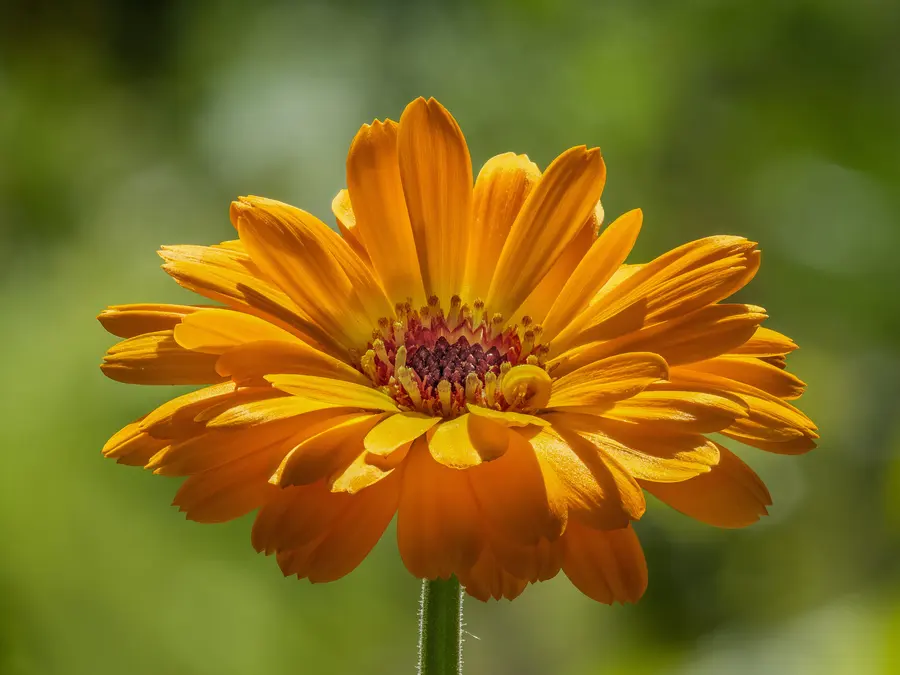
Marigold vs calendula
Calendula (Calendula officinalis), sold as pot marigold, is a separate genus from the Mediterranean, per NC State. Clemson calls it a cool-season annual and “not a true marigold.” Penn State advises care with edible-flower lists: the edible “marigold” is calendula, and Tagetes flowers are generally considered inedible.
Types of Marigolds Compared
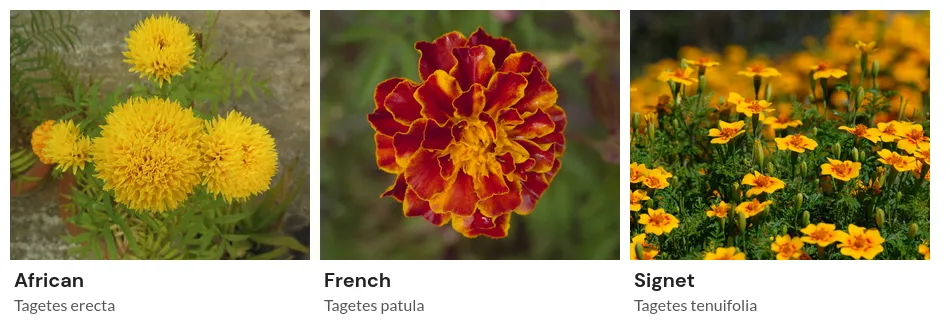
| Type | Species | Height / flower | Best use | Pollinator value | Source |
|---|---|---|---|---|---|
| African (Aztec) | Tagetes erecta | 1 to 4 ft; double flowers 3 to 6 in | Back of borders, cut flowers | Varies: 1 of 4 African cultivars drew high visits in the MSU trial | NC State; Browning et al. 2023 |
| French | Tagetes patula | 6 to 12 in; single to double, 1 to 3 in | Edging, containers, nematode cover crops | Best as singles: ‘Single Disco Marietta’ led the MSU trial in 2020 | NC State; Browning et al. 2023 |
| Signet | Tagetes tenuifolia | Rarely over 12 in; small single flowers | Edging, hot dry spots | NC State: attractive to bees, butterflies and birds | Penn State; NC State |
| Mexican mint marigold | Tagetes lucida | 6 in to 2.5 ft; flowers under 1 in, late summer and fall | Tarragon substitute; perennial in zone 8 and warmer | Texas A&M: “strong late-season pollinator support” | NC State; Texas A&M AgriLife |
| Pot marigold (not Tagetes) | Calendula officinalis | 1 to 2 ft; flowers 3 to 4 in | Cool-season beds, edible petals | NC State: attracts butterflies and pollinators | NC State; Clemson |
Are Marigolds Good for Bees?
Some are, and the cultivar matters more than the species. Michigan State University entomologists netted pollinators on six marigold cultivars in 2020 and 2021, with bumble bee and honey bee hives nearby (Browning et al., Journal of Economic Entomology, 2023). Marigolds averaged 0.13 pollinators per minute, against 0.39 for bidens and 0.63 for portulaca, though the authors note their design only compares cultivars within each flower. The single-flowered French ‘Single Disco Marietta’ (0.37 visits per minute in 2020) and the African ‘Taishan Orange’ (0.22 and 0.23) beat the other four cultivars, all below 0.10.
“Marigold flowers did not produce enough nectar to be measured.”
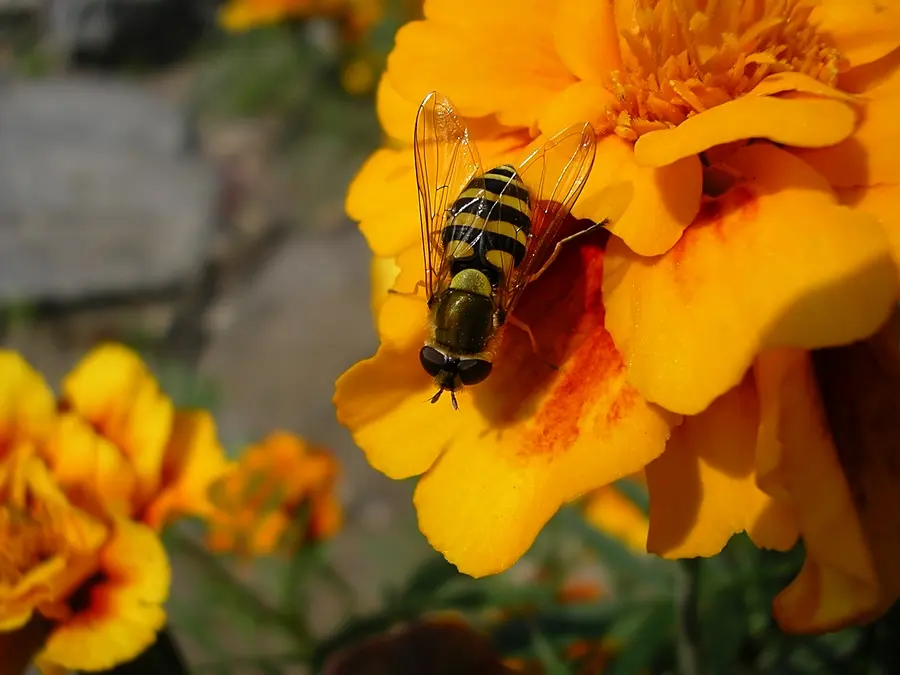
Hoverflies made up 43.4% of pollinators collected on marigolds, honey bees 26.8%, wild bees 25.9% and common eastern bumble bees 3.9%. Many hoverfly larvae eat aphids; see our hoverfly identification guide.
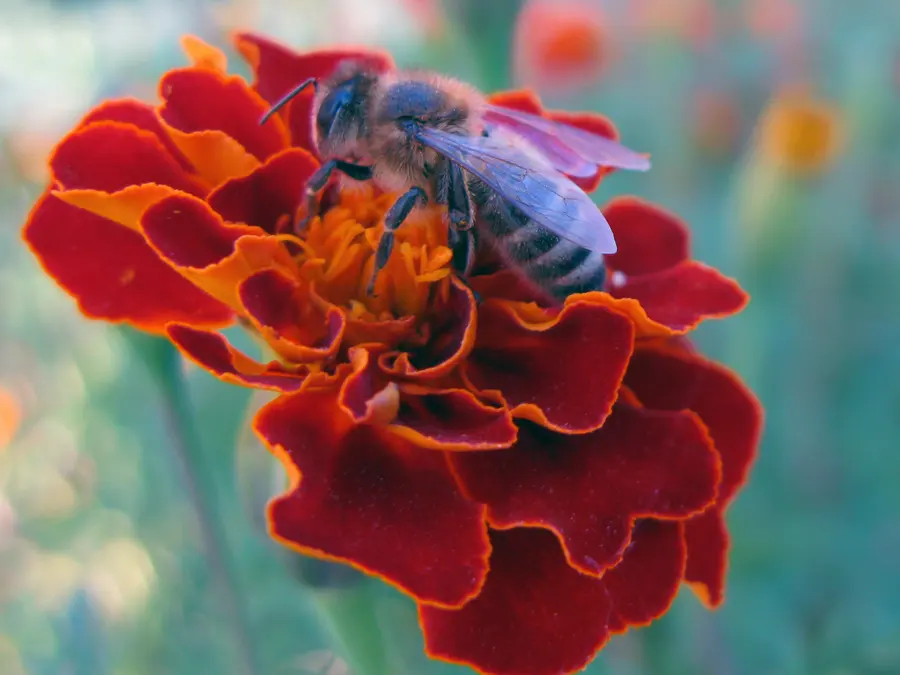
Choose open-centered flowers where you can see the small yellow florets, such as signets and single French types. Our companion planting guide for pollinators gives the same advice: check the cultivar, not just the species. For more bee forage, pair marigolds with native bee balm, milkweed or coral honeysuckle.
What iNaturalist records show
We pulled every research-grade iNaturalist observation tagged as visiting a marigold flower on November 17, 2026: 1,186 records from 634 observers, 905 in the US. In the US set, butterflies and moths led (340), then bumble bees (293), other bees (98) and hoverflies (66); honey bees were 29. Netting catches small flies, while photographers favor large, showy visitors, and the plant name in each tag is the observer’s own. Both data sets show marigolds feed more than bees.
Do Marigolds Repel Pests? The Evidence
| Claim | What research shows | Source |
|---|---|---|
| Repels mosquitoes | Unsupported for planted marigolds. Of 62 plant-oil studies in one review, 56 were lab and 6 field studies, and none tested landscape plantings. One study cut biting in tents where marigold material had been stored. | Clemson HGIC; Rutgers Center for Vector Biology |
| Deters deer | Rated deer-resistant for its strongly scented foliage; “seldom damaged by deer” | Clemson HGIC; NC State |
| Deters rabbits | Not rated for Tagetes by the extension sources cited here | None found |
| Kills root-knot nematodes | Supported only as a dense cover crop of resistant cultivars, mostly French; roots release alpha-terthienyl. Interplanting does not work. | UF/IFAS EDIS; Clemson HGIC; Penn State |
| Traps Japanese beetles | Marigold is on the University of Minnesota list of plants adults feed on. No source here tested it as a trap crop. | UMN, via our Japanese beetle guide |
| Attracts beneficial insects | Supported: hoverflies were 43.4% of pollinators collected in the MSU trial | Browning et al. 2023 |
| Masks crops from pests | Scent-masking claims “haven’t held up to scientific scrutiny,” though mixed plantings can slow pests | Clemson HGIC |
“None of the studies examined landscape plantings and their ability to repel mosquitoes.”
Rutgers vector biologists add that any effect “will likely require large numbers and strategic placement,” and their first step is removing standing water.
Root-knot nematodes: the claim with evidence
The University of Florida’s EDIS guide to marigolds for nematode management says French cultivars appear most effective against the widest range of nematodes. Plant densely, under 7 inches apart, at least two months before a susceptible crop in the same bed, then hoe or disk the plants in. Repeat every season; marigolds cannot eradicate nematodes. ‘Cracker Jack’ can host stubby-root and reniform nematodes, while Clemson names French ‘Tangerine’ and ‘Single Gold’ as resistant to several root-knot species.
“Interplanting with marigolds does not impact root-knot nematode populations.”
How to Grow Marigolds
| Task | What to do | Source |
|---|---|---|
| Sun | Full sun, 6 or more hours a day | Clemson |
| Soil | Well-drained, pH 5.5 to 7.0; below 5.5, leaves can show bronze speckling | Clemson |
| Sow outdoors | After the last frost, once soil is above 65°F; ¼ in deep; sprouts in 5 to 7 days | Wisconsin; Clemson |
| Start indoors | 4 to 6 weeks before planting out; 8 weeks for African types | Clemson |
| Spacing | French 8 to 10 in; African 12 to 16 in | Clemson |
| Water | About 1 in a week; let soil dry between waterings | Clemson |
| Feed | Skip high-nitrogen fertilizer, which favors leaves over flowers | Penn State |
| Maintain | Pinch young tips; deadhead; stake tall African types | Wisconsin; Clemson |
Common problems and pollinator-safe fixes
Clemson lists spider mites in hot, dry weather, slugs in damp spots and gray mold (botrytis); Penn State adds powdery mildew in wet, shady beds. Water at the base and give plants room. Penn State says insecticidal soap usually handles mites and aphids; if you spray, do it in the evening when bees are not foraging, as our pollinator-safe pest control guide explains.
Annual or perennial?
Garden marigolds are warm-season annuals that bloom from early summer to frost. Lemmon’s marigold (T. lemmonii), a southwestern US native shrub, is perennial in zones 8 to 11, and Mexican mint marigold in zone 8 and warmer. In our iNaturalist pull, Lemmon’s marigold led US records not marked as cultivated (756 of 3,703). Save seed only from open-pollinated cultivars; Clemson warns hybrid seed may be sterile or differ from the parent.
Are Marigolds Toxic to Dogs, Cats or People?
Mildly. Pet Poison Helpline rates Tagetes as mildly toxic to dogs and cats: eating it may irritate the gut, and the sap can irritate skin. It calls calendula non-toxic, as does the ASPCA’s garden marigold (Calendula officinalis) listing; we found no separate Tagetes entry in the ASPCA database. NC State lists phototoxic thiophene derivatives in Tagetes and says the plants can cause contact dermatitis, so wear gloves if your skin reacts.
Zinnias get the same billing in companion-planting advice, with the same cultivar caveats; see our zinnia guide.
Frequently Asked Questions
Is marigold a perennial?
Most garden marigolds are annuals. Lemmon’s marigold and Mexican mint marigold are perennial in zone 8 and warmer.
What is a Mexican marigold?
NC State uses the name for both African marigold and T. lucida, while Clemson uses it for Lemmon’s marigold. Check the botanical name.
What are marigold flowers used for?
Beds, edging, containers, cut and dried flowers, nematode cover crops and festival garlands. Mexican mint marigold leaves stand in for tarragon.
Will marigolds keep bees away?
No. Bees, hoverflies and butterflies all visit them, especially single-flowered types.
Which marigold is best for pest control?
For root-knot nematodes, a resistant French cultivar such as ‘Tangerine’ or ‘Single Gold’ grown as a dense cover crop. No marigold is proven against mosquitoes.
The Bottom Line
Grow marigolds for long color and late food for insects, pick open single flowers if pollinators are the goal, and keep the pest promise to one job: a dense French marigold cover crop against root-knot nematodes. Browse more plants in our pollinator gardening section.
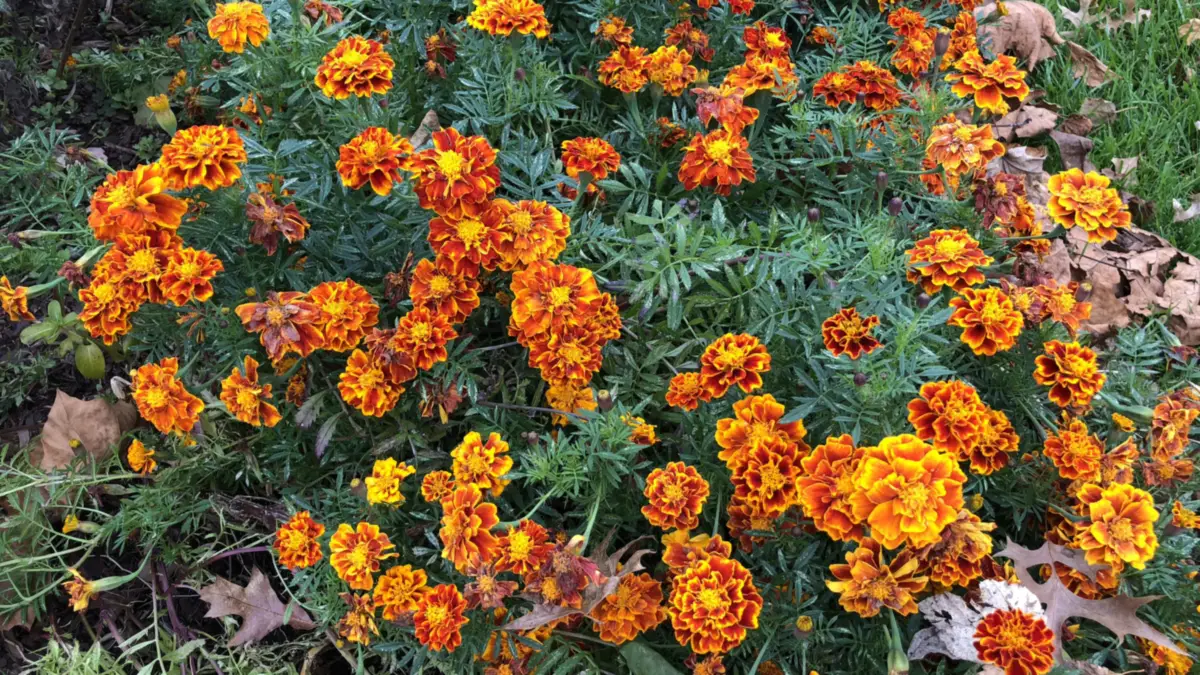
Featured photo: marigolds in Fairfax County, Virginia, by Famartin, via Wikimedia Commons, CC BY-SA 4.0, cropped.