Reviewed by Thomas B. · How we review
A zinnia is a sun-loving annual in the daisy family (Asteraceae), native to Mexico and the southwestern US. Sow the seeds outdoors after your last frost, once the soil is about 70°F; plants bloom 8 to 12 weeks later and keep going until frost. Zinnias feed butterflies and bees, but the cultivar matters: in a Texas A&M trial, two of the zinnias tested had no observed pollinator visits.
Key Takeaways
- Garden zinnias are annuals. The prairie zinnia (Zinnia grandiflora), native from Kansas to Arizona, is a perennial.
- Spacing and watering at the base prevent most powdery mildew. Resistant choices include Profusion, Zahara, ‘State Fair’ and ‘Oklahoma’.
- Of 4,373 US research-grade iNaturalist records of animals visiting zinnias, 2,737 were butterflies and 1,311 were bees.
- Bumble bees made up 1,086 of the bee records; the monarch was the most-recorded species, with 594.
- Seed saved from hybrid zinnias will not come true.
Table of Contents
- What Is a Zinnia?
- Types of Zinnias Compared
- How to Grow Zinnias
- Powdery Mildew and Other Problems
- Do Zinnias Attract Bees, Butterflies and Hummingbirds?
- Zinnias in the Vegetable Garden
- Frequently Asked Questions
- The Bottom Line
What Is a Zinnia?
Zinnia is a genus with 22 species native to North America, per the Texas A&M researchers cited below; Clemson Cooperative Extension places the wild ancestors of garden zinnias in the Southwest, Mexico and Central America. Each “flower” is a head of florets: colorful ray florets around a center of small disk florets, where bees find pollen and nectar. Double types add ray florets that can hide the disk.
Most zinnias are frost-tender annuals. The exception is the prairie or Rocky Mountain zinnia, Z. grandiflora, which the University of Wisconsin–Madison Extension calls a zone 4a hardy perennial native to Arizona, Colorado, Kansas, New Mexico, Oklahoma and Texas. It belongs among US native plants for pollinators; the common garden zinnia does not, since it comes from Mexico.
Types of Zinnias Compared
Disease and pollinator notes are only what each named source states.
| Type | Species / series | Height | Flower form | Mildew resistance | Pollinator value | Source |
|---|---|---|---|---|---|---|
| Tall cut-flower | Z. elegans ‘Benary’s Giant’ | 36 to 42 in | Double, about 5 in | Not rated; Z. elegans is susceptible | Not tested; Z. elegans cultivars drew the most visits in the Texas trial | UW–Madison; NC State; Merrell et al. |
| Tall cut-flower | Z. elegans ‘State Fair’ | 3 to 4 ft | Single to double, 4 to 6 in | Good tolerance | Not tested | Clemson; UW–Madison |
| Tall cut-flower | Z. elegans Queeny (‘Queen Lime’) | 30 to 40 in | Semi-double to double | Not rated | Not tested | UW–Madison |
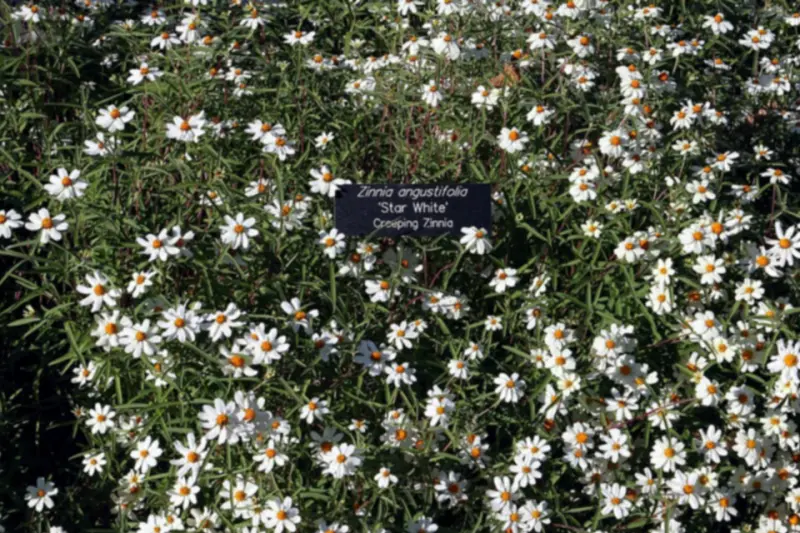
| Narrowleaf | Z. angustifolia ‘Star’, ‘Crystal’ | 6 to 18 in | Single, daisy-like | ‘Crystal’ good | Attracts butterflies and honey bees | NC State; UW–Madison |
| Hybrid | Z. × marylandica Profusion | 12 to 18 in | Single or semi-double | Higher resistance | Less attractive than double ‘Lilliput’ in a Kentucky study | Clemson; Grissell |
| Hybrid | Z. × marylandica Zahara | 12 to 18 in | Single; Double Zahara double | Strong disease resistance | ‘Zahara Double Brilliant Mix’ had no observed visits | UW–Madison; Merrell et al. |
| Mexican | Z. haageana ‘Persian Carpet’ | 12 to 16 in | Small single and bicolor | Not rated | Rated attractive to pollinators, though one gardener’s butterflies avoided it | UW–Madison; Grissell |
| Native perennial | Z. grandiflora | 4 to 8 in | Single, yellow, 3 to 6 rays | Tagged mildew resistant | Special value to native bees (Xerces Society) | NC State; Wildflower Center |
‘Queen Lime’ is now sold as Queeny ‘Lime’. ‘Cut and Come Again’ is another name for ‘Pumila Mix’, a semi-double to double cutting zinnia 18 to 24 inches tall (UW–Madison).
How to Grow Zinnias
Zinnias need six or more hours of sun and well-drained soil, per Clemson’s zinnia growing factsheet. Narrowleaf types are also among the better drought-resistant flowers for bees.
When to plant zinnia seeds
Sow outdoors 1/4 inch deep after the last spring frost, when soil and air are around 70°F. NC State recommends direct sowing; Wisconsin’s Extension adds that you can start seeds indoors 4 to 6 weeks earlier at 65 to 70°F.
Spacing, sun and water
When seedlings reach 3 inches, thin dwarfs to 8 to 9 inches apart and 2- to 3-foot types to a foot; overcrowding raises disease. Give about 1 inch of water a week at the base, through a soaker hose or drip line.
Pinching, deadheading and cutting
Pinch leggy young plants and deadhead to keep flowers coming; Profusion types need no deadheading. For bouquets, cut in the cool morning just above a leaf node, choosing flowers whose centers are just opening. Clemson gives a vase life of a week or more.
Saving zinnia seeds
Let a few heads dry on the plant. The Royal Horticultural Society notes that many zinnias are F1 hybrids, whose saved seed will not produce plants identical to the parent. Clemson adds: never save seed from plants that had leaf spot.
Powdery Mildew and Other Problems
Powdery mildew (Golovinomyces cichoracearum) is the gray-white coating on zinnia leaves in humid weather. Prevent it with spacing, full sun, base or early-morning watering and resistant series, and clear debris at season’s end. Alternaria, bacterial and Cercospora leaf spots also thrive on wet leaves.
Aphids, spider mites and whiteflies are the main pests in hot, dry weather; hose them off. NC State also lists Japanese beetles on common zinnias, which you can hand-pick into soapy water.
“Zinnias are excellent sources of pollen and nectar for many beneficial insects; therefore, it is not recommended that insecticides, other than insecticidal soap, be used to control damaging mite and insect pests.”
If you do spray soap or a fungicide, Clemson says to do it in the late evening to protect beneficial insects and hummingbirds.
Do Zinnias Attract Bees, Butterflies and Hummingbirds?
Yes, all three. To see who turns up, we pulled every US research-grade iNaturalist observation of an animal tagged as visiting a zinnia flower.
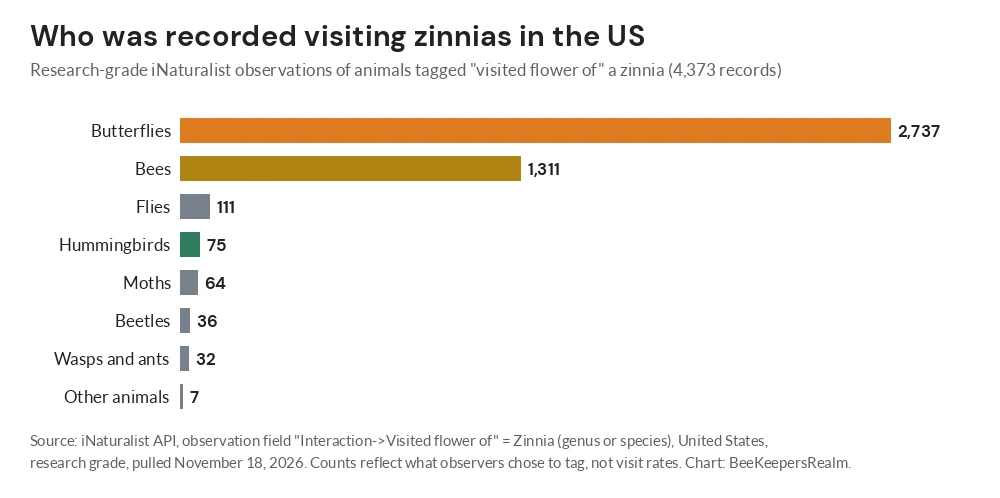
Of 4,373 records, 2,737 (63%) were butterflies, 1,311 (30%) bees and 75 hummingbirds; 4,240 fell between July and October. These are tags observers chose to add, so they show who people notice, not how often each visitor feeds.
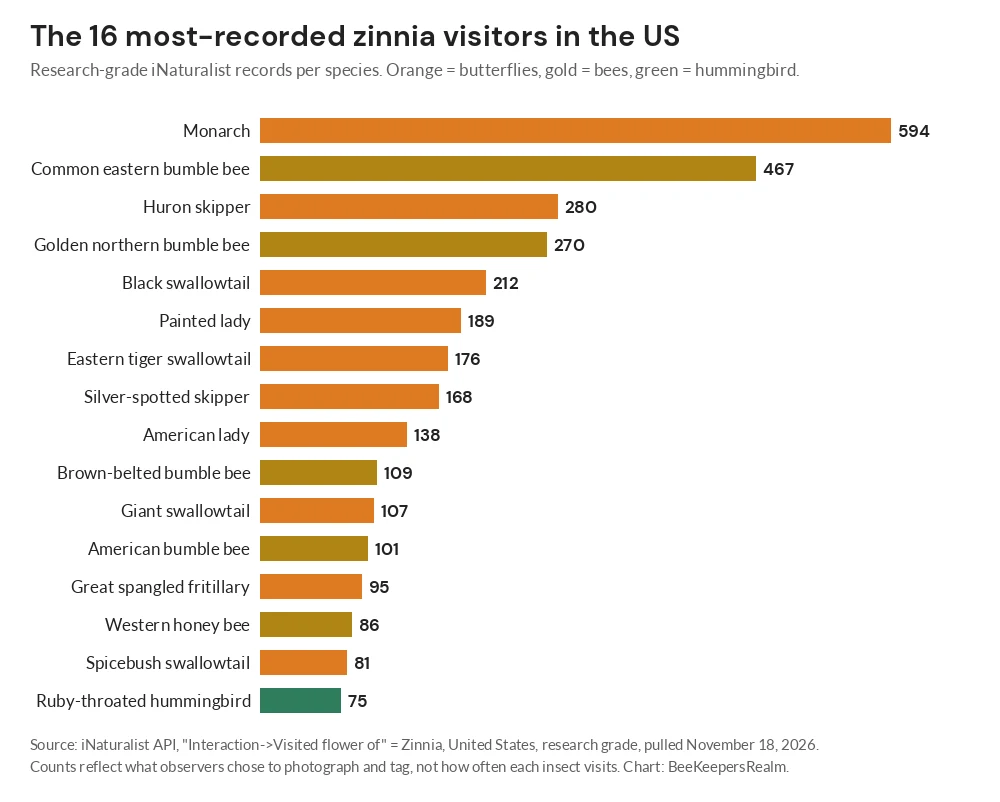
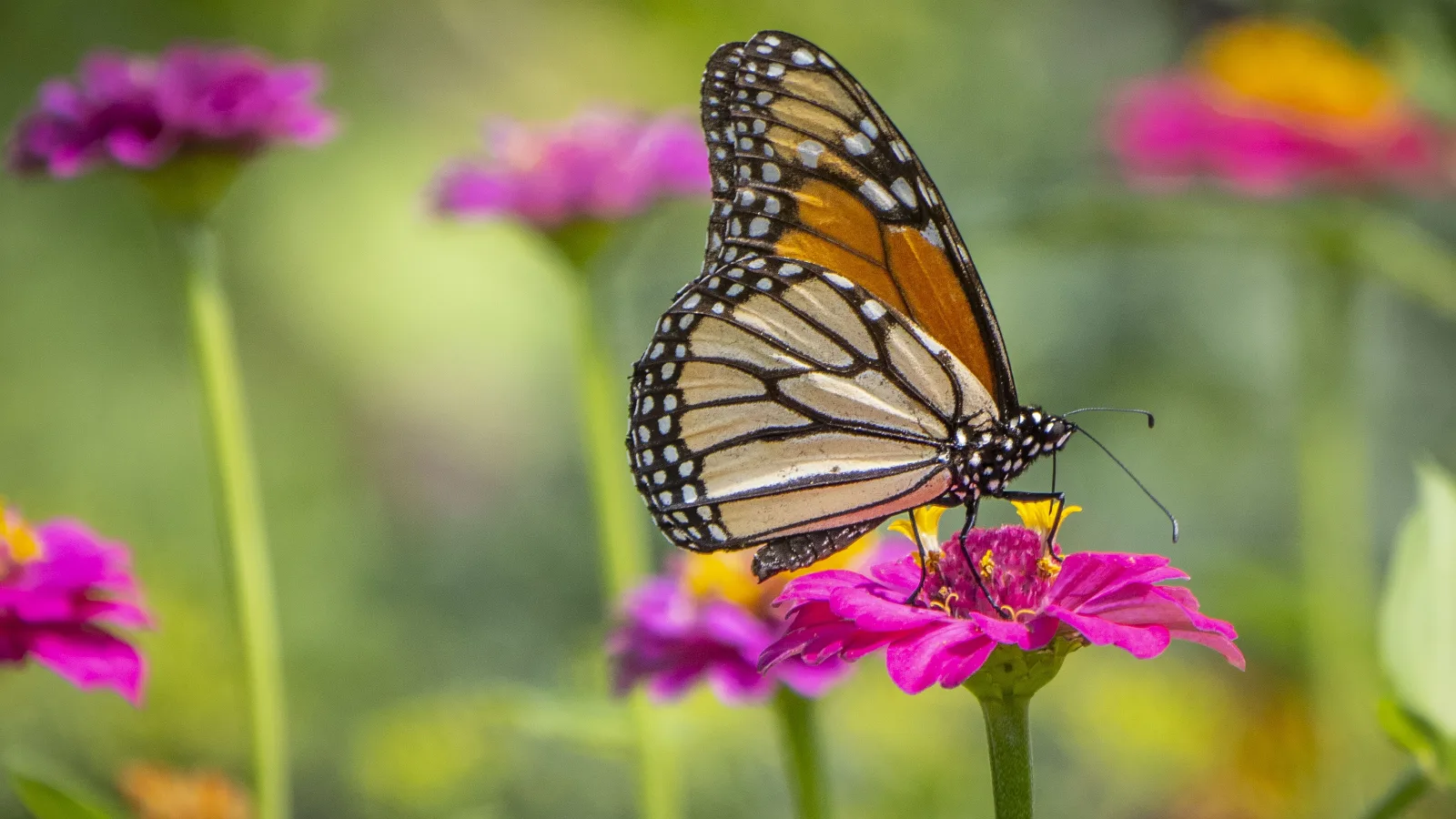
The monarch butterfly led with 594 records, then the common eastern bumble bee with 467. By family, brush-footed butterflies such as ladies and fritillaries had 1,215 records, skippers 707, swallowtails 643 and sulphurs and whites 162.
Which bees visit zinnias?
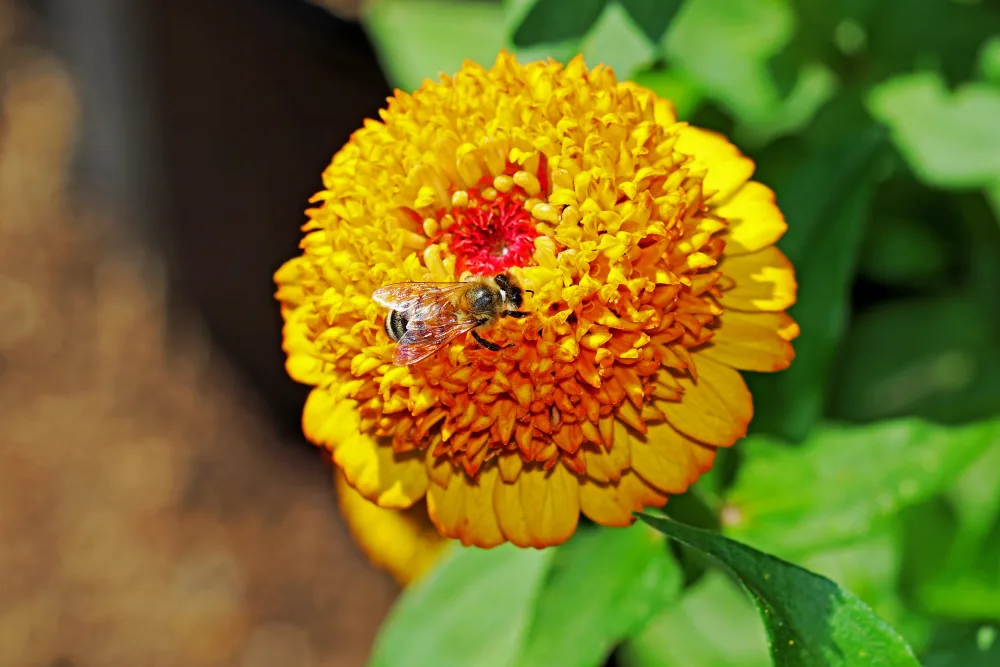
Bumble bees made up 1,086 of the 1,311 bee records. Honey bees had 86, the two-spotted longhorn bee 63, sweat bees 17 and leafcutter bees and their relatives 9. Entomologist Eric Grissell notes that tiny bees on the disk are “easily overlooked.”
Which zinnias feed pollinators best?
In a 2020 Texas A&M field trial by Danielle Merrell and colleagues, only Z. elegans cultivars drew more pollinators than the rest, led by ‘Zinderella’. ‘Red Spider’ and ‘Zahara Double Brilliant Mix’ had no observed visits and no clear nectar guides under UV light. Taller plants got more visits, petal layers did not predict visits, and heads with more disk florets tended to be busier. Hummingbirds also competed with the insects for nectar.
“There is scant experimental evidence for zinnia attractiveness, and it turns out to be more contradictory than expected.”
Grissell describes a University of Kentucky study in which small double ‘Lilliput’ was much more attractive than single Profusion or larger double Oklahoma zinnias. So “singles only” is too simple: choose cultivars with a visible center and plant several kinds.
Zinnias in the Vegetable Garden
The evidence for zinnias as companion plants is thin. In a Texas A&M project with cucumbers and habanero peppers, the zinnia hybrid “did not perform well” at drawing pollinators, which prompted the Merrell trial. A USDA SARE farm trial in Iowa interplanted zinnias with squash and melons, but wet weather and herbicide drift spoiled its yield data. As our guide to companion planting for pollinators explains, flowers near crops raise visits, but yield gains vary. Marigolds get the same billing, with the same cultivar caveats.
Frequently Asked Questions
Do zinnias come back every year?
Garden zinnias do not; they die at the first frost, and next year’s seedlings come from dropped seed. The prairie zinnia is the perennial exception.
Do zinnias reseed themselves?
Sometimes, if late flowers dry on the plant and seed falls on bare soil. Hybrid seedlings will not match the parent.
How far apart should you plant zinnias?
About 8 to 9 inches for dwarfs and 12 inches for 2- to 3-foot types, per Clemson.
Can you just scatter zinnia seeds?
Yes. Scatter them on loose soil after frost, cover lightly, keep moist and thin.
Do zinnias need full sun?
Yes, six or more hours. Clemson notes more leaf spot in partial shade.
Should you deadhead zinnias?
Yes for most types; Profusion zinnias skip it.
Do zinnias attract hummingbirds?
Yes. Clemson photographed a ruby-throated hummingbird feeding on red, orange and pink zinnias, and iNaturalist users tagged 75 such visits.
Are zinnias good for bees?
Yes, especially bumble bees, if you pick cultivars with an open center.
The Bottom Line
Direct-sow a tall Z. elegans with visible centers after frost, give it room and keep sprays off the flowers. In dry western gardens, add the native prairie zinnia.
Image credits: Featured photo: a monarch visiting zinnias at Goldpetal Farms in Chaptico, Maryland, by Preston Keres, USDA, public domain, via Wikimedia Commons. Other credits are in the captions. Charts: US research-grade iNaturalist observations pulled November 18, 2026 (our own analysis).
Sources: Clemson HGIC 1149 and 2110; UW–Madison Extension; NC State Extension; Lady Bird Johnson Wildflower Center; Merrell et al., Subtropical Agriculture and Environments 72 (2021); Texas A&M AgriLife Today; USDA SARE FNC18-1122; RHS; Eric Grissell, Horticulture; iNaturalist.