Reviewed by Elena P. · How we review
A lavender plant is a small, woody, evergreen shrub in the genus Lavandula, part of the mint family (Lamiaceae) and native to the Mediterranean. In the US it grows best in full sun and fast-draining, lean, neutral to alkaline soil. English lavender is hardy in USDA zones 5 to 9, lavandin in 5 to 8 and Spanish lavender only in 8 to 9. Wet winter soil, not cold, is what usually kills it. Prune it in spring once new leaves appear, never into bare wood. Bees visit it heavily, bumble bees most of all.
Key Takeaways
- Pick the type by your winter: English lavender (L. angustifolia) for zones 5 to 9, lavandin (L. × intermedia) for 5 to 8, Spanish (L. stoechas) for 8 to 9, per NC State Extension. French or fringed lavender (L. dentata) is rated 8 to 11 by UF/IFAS.
- Drainage decides whether it lives: dampness kills more lavender than cold, says Illinois Extension. In clay, use a raised bed or a pot.
- Prune once a year in spring when green shoots appear, removing about a third (Colorado State). Cut only into leafy green stems; bare wood rarely regrows.
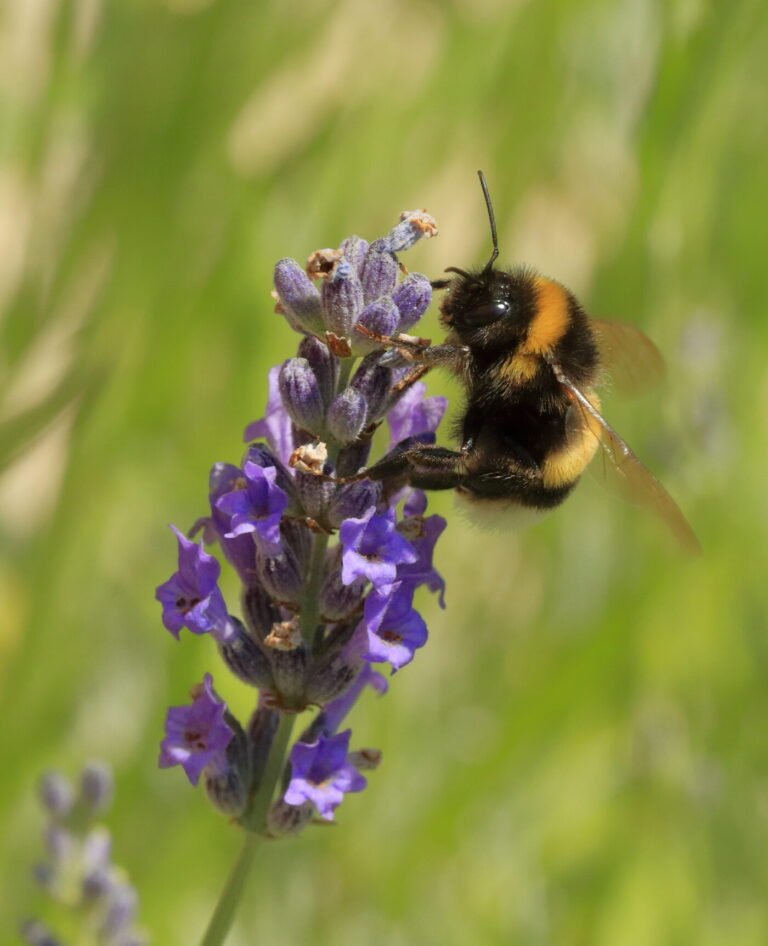
- In 852 research-grade US iNaturalist records of animals visiting lavender, which we pulled on November 18, 2026, bees made up 57%. Bumble bees alone made up 35%; honey bees made up 8%.
- University of Sussex researchers counted about ten bumble bees for every honey bee on lavender.
- The ASPCA lists lavender as toxic to dogs, cats and horses, with nausea, vomiting and loss of appetite as the signs.
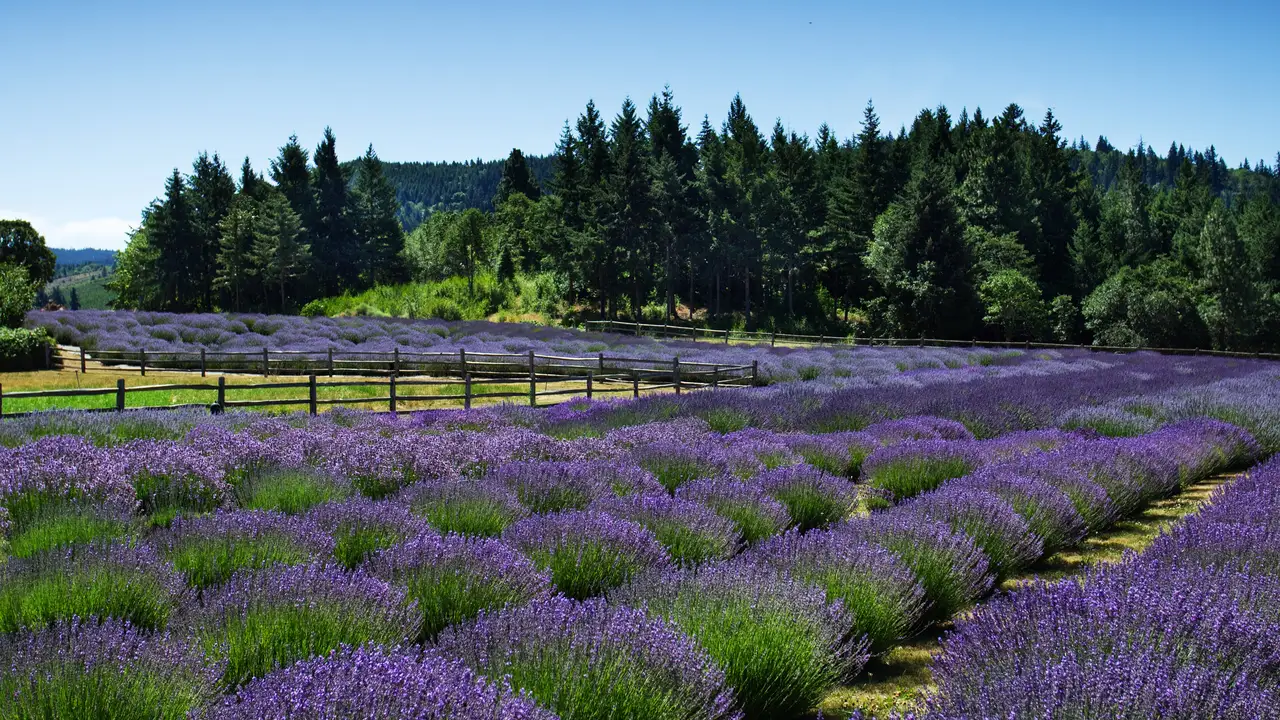
Table of Contents
- What a Lavender Plant Is
- Types of Lavender Compared
- Bees and Lavender: Who Visits and Why
- Which Lavender to Plant Where in the US
- How to Grow Lavender: Sun, Soil and Water
- When and How to Prune Lavender
- Lavender in Pots and Over Winter
- Common Problems and Pollinator-Safe Fixes
- Lavender Honey
- Is Lavender Toxic to Cats, Dogs or Horses?
- Good Companion Plants for Lavender
- Frequently Asked Questions
- The Bottom Line
What a Lavender Plant Is
Lavender is the common name for the genus Lavandula, a group of aromatic sub-shrubs in the mint family. NC State Extension describes English lavender as an evergreen perennial shrub native to Mediterranean areas. Colorado State University (CSU) Extension calls it a semi-woody perennial sub-shrub whose grey-green leaves can stay evergreen, depending on location and weather.
So lavender is a perennial, but a woody one. That matters for pruning, because it does not die back to the ground like a hosta. It also means lavender is not native anywhere in the United States. It is an introduced garden and farm plant. CSU notes it is grown as a cash crop in Washington State, New Mexico and Texas.
The flowers sit in whorls on long spikes. In English lavender and lavandin the spikes are slim and wand-like. In Spanish lavender each flower head is topped by showy bracts, described by NC State as looking like “rabbit ears” or “flags.”
Types of Lavender Compared
Garden centers sell several species as “lavender,” and they differ most in cold hardiness, so read the botanical name on the tag. The table uses only figures from extension and research sources; where none gave a figure, we say so.
| Type | Species (example cultivars) | Hardiness (USDA zones) | Bloom | Best for | Bee value | Source |
|---|---|---|---|---|---|---|
| English lavender | L. angustifolia (‘Hidcote’, ‘Munstead’) | 5 to 9 | Summer; often blooms twice in a season in Colorado | Cold winters, low hedges, edging, culinary use | Good, but fewer visits than lavandin in the Sussex trial | NC State; CSU; RHS summary of Sussex trial |
| Lavandin | L. × intermedia (‘Grosso’, ‘Provence’, ‘Phenomenal’) | 5 to 8 | July to September, once, later than English | Big mounds 2 to 4 ft, cut and dried flowers, oil; ‘Provence’ for humid summers | Highest in the Sussex trial; ‘Grosso’ highly attractive to honey bees in an Oregon State study | NC State; CSU; RHS; Pacific Horticulture |
| Spanish lavender | L. stoechas (‘Anouk’, ‘Ballerina’) | 8 to 9 | Mid-spring to late summer | Hot, dry gardens and containers; annual in cold states | Nectar and pollen draw many pollinators; fewer visits than lavandin in UK trials | NC State; RHS |
| French or fringed lavender | L. dentata | 8 to 11 | Not stated in the UF guide | Borders in Florida and other hot, humid areas | No trial data in our sources | UF/IFAS Extension, Pasco County |
| Spike or Portuguese lavender | L. latifolia | Not rated in the US sources we checked | Not stated | Mainly known as a parent of lavandin | No trial data in our sources | CSU; NC State |
Zone ranges are the published ranges from the NC State Extension Plant Toolbox (English, lavandin, Spanish) and UF/IFAS (fringed). Individual cultivars can differ; NC State lists Spanish ‘Anouk’ as hardy in zones 6 to 10, for example.
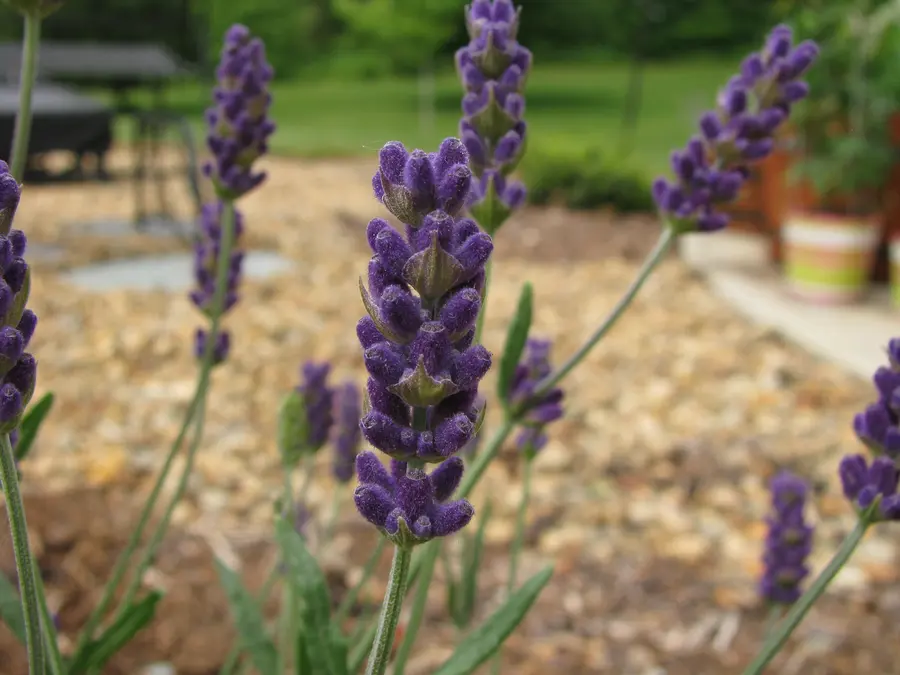
Lavandin is a hybrid of English and spike lavender. CSU says lavandins are larger, bloom once later in summer, produce sterile seed and yield more essential oil, though of lower quality than English lavender. CSU also warns that English lavender does not always come true from seed, so buy plants grown from cuttings.
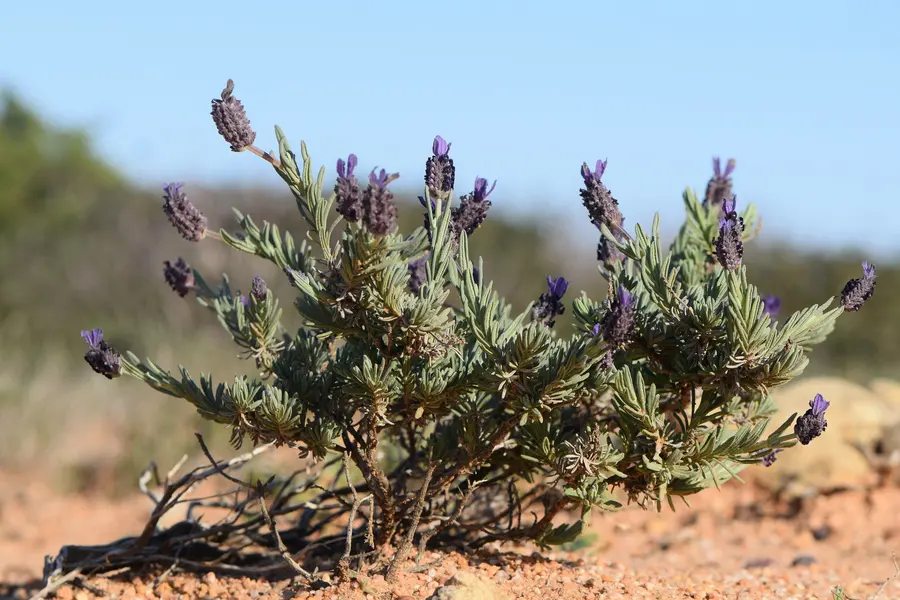
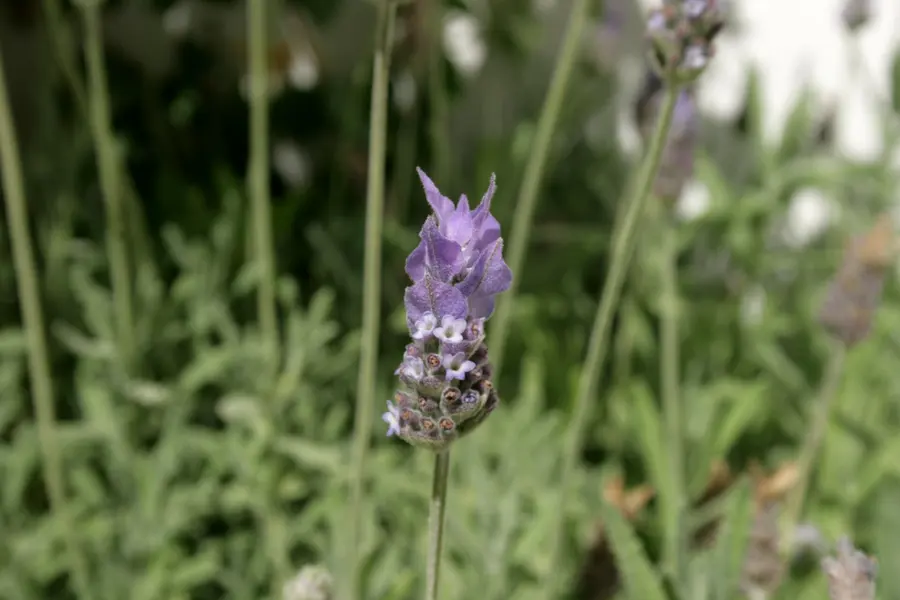
“French lavender” is used for both L. dentata and L. stoechas on plant tags, so go by the Latin name. Both are tender: CSU says French and Spanish lavenders are not cold hardy in Colorado and can be grown as annuals in containers and beds.
Bees and Lavender: Who Visits and Why
Which bees show up on lavender, and how many, depends on the type of lavender and on which other bees are already working it.
What US iNaturalist records show
To see which animals Americans actually photograph on lavender, we pulled every US observation on iNaturalist whose “Interaction: visited flower of” field names Lavandula or one of four lavender species. On November 18, 2026, 852 of those records were research grade, meaning the community agreed on the visitor’s identity.
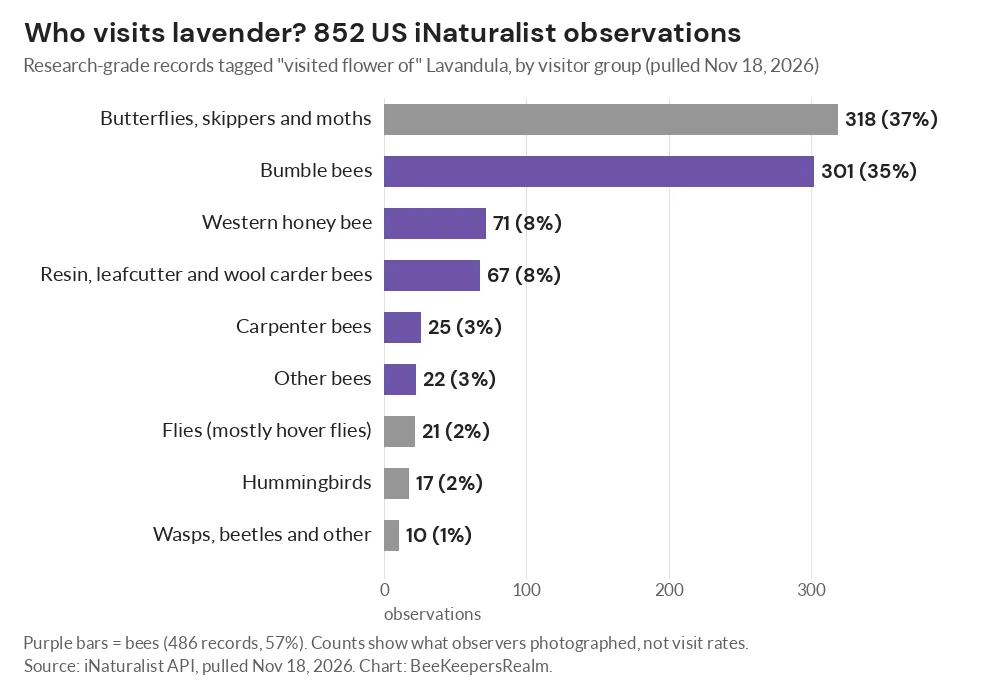
Bees made up 486 of the 852 records (57%). Butterflies, skippers and moths made up 318 (37%), led by the cabbage white butterfly with 82 records. The rest were flies (21, mostly hover flies), hummingbirds (17) and 10 other animals, mostly insects such as grasshoppers, wasps and beetles. Among the bees:
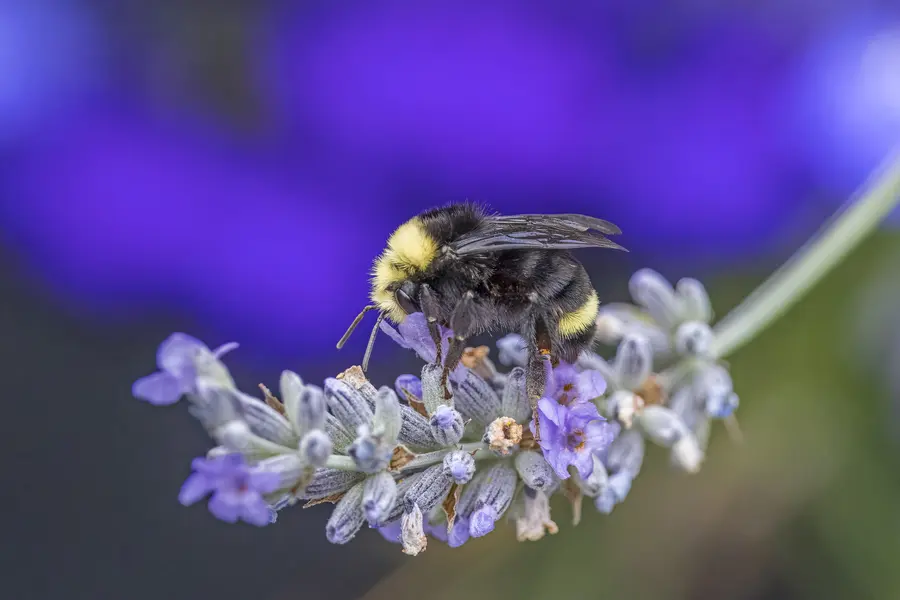
- Bumble bees: 301 records covering 20 species. The two-spotted (79), brown-belted (69) and common eastern bumble bee (59) led. See our bumblebee identification guide for telling them apart.
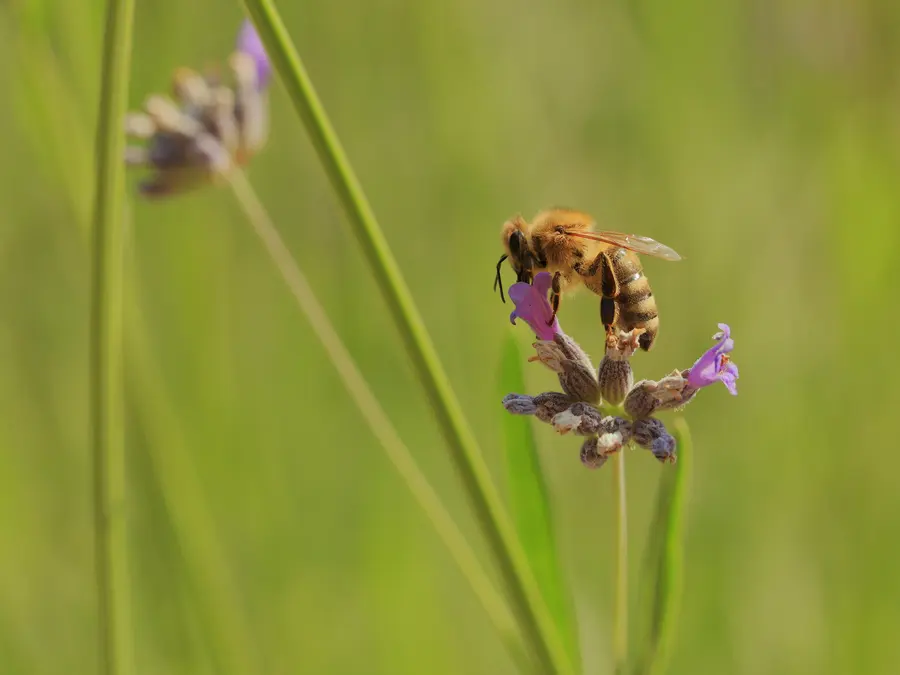
- Western honey bee: 71 records.
- Resin, leafcutter and wool carder bees: 67, including the sculptured resin bee (36) and the European wool carder bee (25). Both are introduced species.
- Carpenter bees: 25, mostly the eastern carpenter bee; see how to identify carpenter bees.
- Other bees: 22, including longhorn bees, digger bees and sweat bees.
In all, 33 bee species were identified to species level. These counts show what volunteers chose to photograph, not visit rates. Still, the pattern matches the research below.
Why bumble bees outnumber honey bees
Researchers at the University of Sussex Laboratory of Apiculture and Social Insects (LASI) studied this on an experimental lavender garden. Their 2013 paper in Ecological Entomology found that bumble bees spent 1.1 to 1.4 seconds per lavender flower against 3.5 seconds for honey bees, which have shorter tongues and have to push their heads into each narrow flower. A later abstract from the same group says bumble bees outnumbered honey bee foragers on lavender “consistently ten to one.” When the team kept bumble bees off the plants, honey bee numbers rose about 20-fold. Keeping honey bees off had no effect on the bumble bees.
“We estimate it would take a bee one week and 300,000 flower visits to collect just one teaspoon of lavender nectar.”
So in a garden full of bumble bees, lavender is a modest honey bee plant: one part of the summer forage mix, not the whole of it. Our list of the best plants for honey production covers the heavier hitters.
Which lavender draws the most bees
Variety matters. In a Sussex trial of lavender cultivars planted side by side, the Royal Horticultural Society (RHS) reports that lavandin cultivars were four times more popular with pollinators than English lavender cultivars such as ‘Hidcote’ and ‘Munstead’. Even within lavandin, ‘Gros Bleu’ was over twice as popular as ‘Old English’. A 2019 review in the Journal of Insect Conservation by Rosi Rollings and Dave Goulson cites the same research group’s finding that lavender cultivars vary tenfold in the bees they attract. Goulson told the RHS that flower color, purple or white, made no difference to visits in those trials.
The US picture adds a twist. In an Oregon State University Garden Ecology Lab study, written up by Aaron Anderson in Pacific Horticulture, ‘Grosso’ lavandin was highly attractive to honey bees but not to most wild bees, except bumble bees. If you keep bees, a lavandin such as ‘Grosso’ is the better-supported choice; if you garden for native bees, pair any lavender with native plants (see companion plants below).
When lavender feeds bees
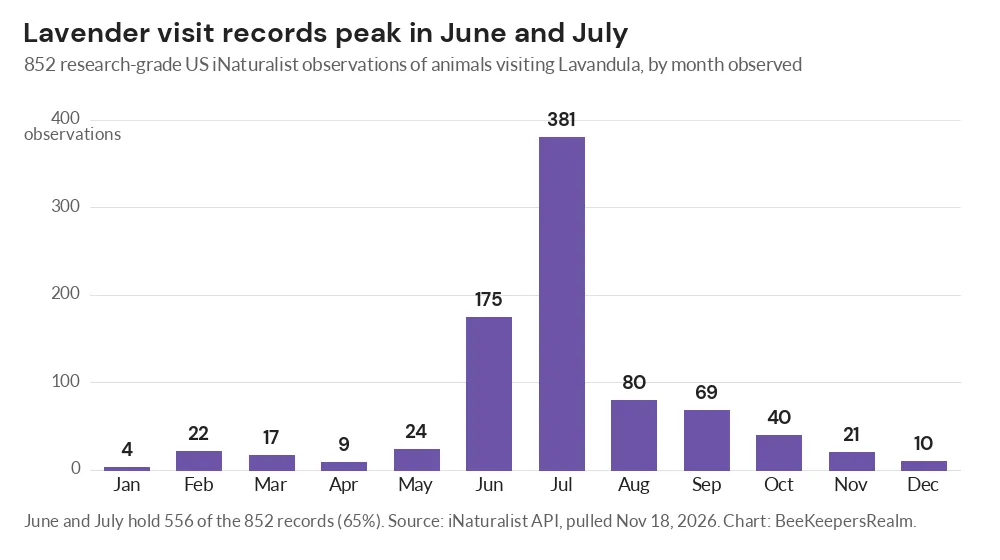
The visit records peak in July (381) and June (175). LASI chose lavender for its research partly for its late flowering, because its earlier work showed late summer and autumn are hard times for honey bees to find forage. In much of the US that lands lavender in or near the summer nectar dearth; our guide to nectar dearth solutions explains why that gap matters to a colony.
Wool carder bees, butterflies and other visitors
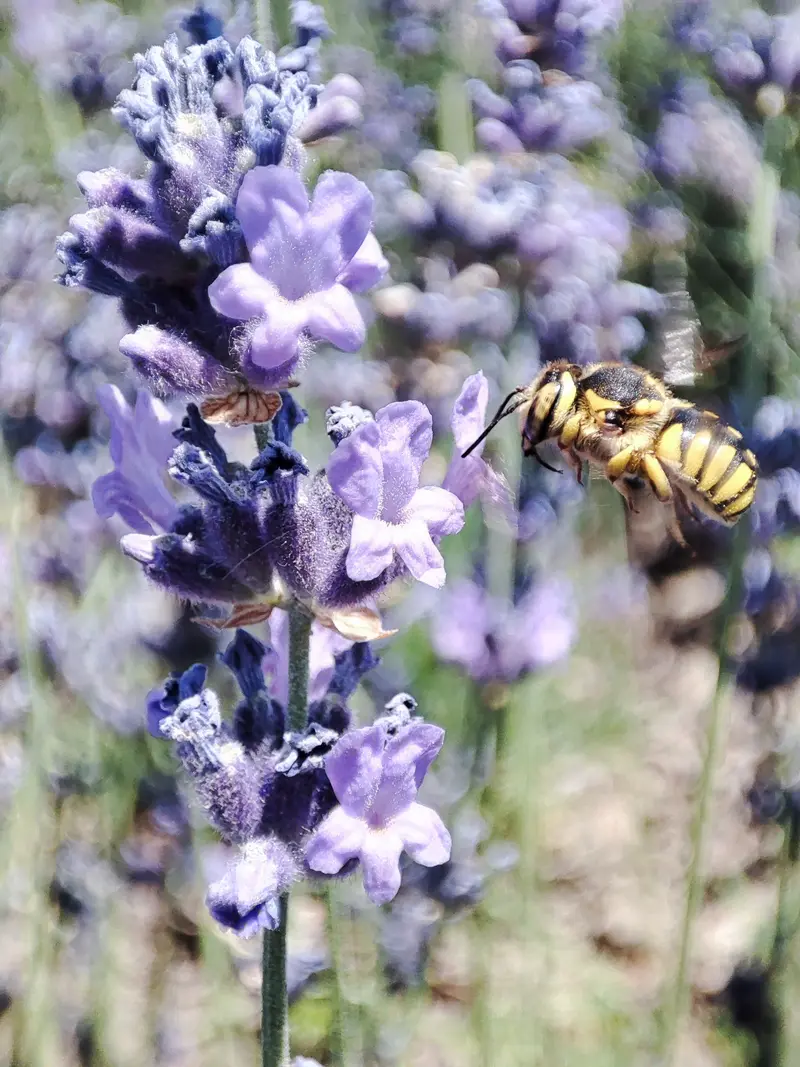
The yellow-spotted European wool carder bee is a regular on lavender and other mint-family plants, and the males chase other bees away from their patch. Butterflies come too: the US records include skippers, 15 records of the painted lady and 7 of the monarch butterfly. If a “bee” on your lavender hovers in place and has short antennae, it may be a hover fly. For how bees choose flowers, see bees and flowers.
Which Lavender to Plant Where in the US
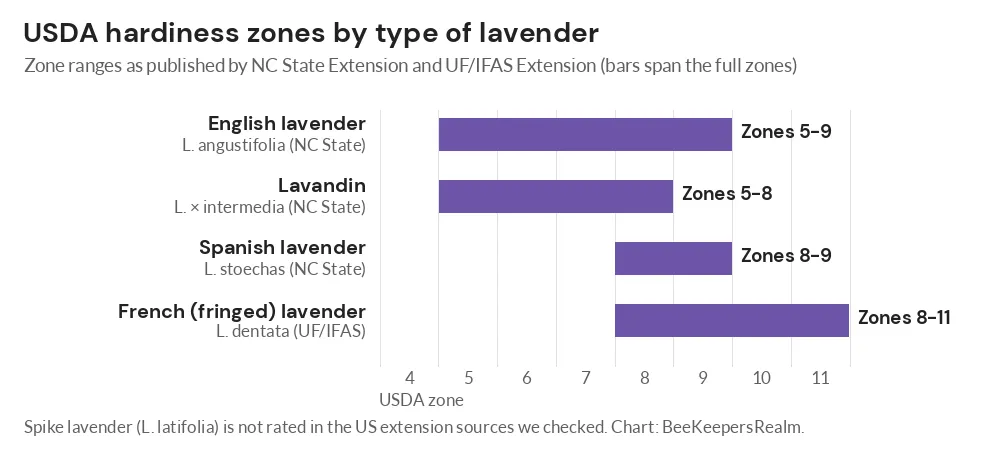
- Cold North, Midwest and Rockies (zones 5 to 7): English lavender and lavandin. Illinois Extension calls these two groups the preferred choices for the Midwest. CSU says hardy varieties thrive in Colorado’s zones 5 through 7, and Illinois Extension lists ‘Hidcote’ and ‘Munstead’ among popular English varieties.
- Humid Southeast and Mid-Atlantic: NC State calls English lavender well loved but at times difficult to grow in North Carolina. Its lavandin page lists ‘Provence’ as best for humid conditions, and Illinois Extension describes ‘Phenomenal’ as highly tolerant of heat and humidity.
- Florida and the Gulf Coast: UF/IFAS Extension in Pasco County rates Spanish lavender best for Central Florida and fringed lavender as appropriate. It calls English lavender the most difficult there because of summer heat and humidity, and suggests raised beds or containers and some afternoon shade.
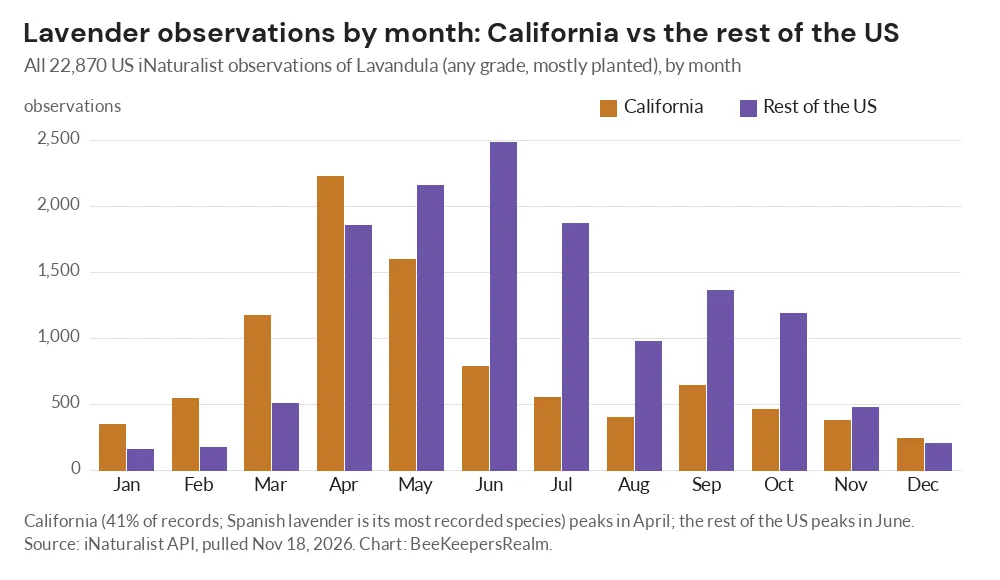
- Pacific Northwest and the arid West: lavender is a farm crop in Washington and Oregon. In California, Spanish and fringed lavender are common garden plants; together they account for 3,422 of California’s 9,388 iNaturalist lavender records.
Of 22,870 US iNaturalist lavender observations (any grade, about 97% marked as planted), 41% come from California, where they peak in April. In the rest of the US they peak in June, a rough guide to when gardeners there see lavender at its best.
How to Grow Lavender: Sun, Soil and Water
Sun
Give lavender full sun, which NC State defines as six or more hours of direct sun a day. NC State notes that lavandin will not grow in a shady area, and that too little sun is a cause of poor flowering in Spanish lavender.
Soil and drainage
Lavender wants lean, fast-draining soil. CSU recommends a slightly alkaline soil with very little organic matter; Utah State University (USU) Extension gives a pH of 6.5 to 7.5. NC State warns that English lavender “will die out in heavy clays.”
“It is dampness more than cold that is responsible for killing lavender plants.”
In clay, plant on a raised bed or mound. CSU suggests tilling 1 inch of small (one-quarter-inch) bark mulch into the top 6 to 8 inches and warns that sand or gravel mixed into clay can make drainage worse. Illinois Extension recommends a gravel or rock mulch on top to keep the crown dry.
Planting time and spacing
CSU says lavender can go in from spring through fall in Colorado and cites New Mexico State University research showing fall-planted lavender survived better and flowered more the next season, as long as plants are in pots 4 inches or larger with established roots. USU advises fall planting only where there are about two months of good weather before winter. Space plants 18 to 24 inches apart in gardens (USU). Oregon State University (OSU) Extension suggests 2 to 3 feet, because crowding cuts air flow and invites fungal disease.
Watering
USU suggests about 1 gallon per plant per week until plants are established, then half a gallon every two weeks until flower buds form, and once or twice a week during flowering. CSU adds that the root zone should not dry out completely in winter.
Fertilizer
Skip it. USU says lavender has low nutritional needs and that over-fertilized plants produce more leaves but fewer flowers, which also means less nectar for bees.
When and How to Prune Lavender
Prune every year, or the plant splits open and turns woody. CSU’s rule is the simplest: prune in spring when green leaves start to emerge from the base, removing about one third of the top. OSU Extension puts that at about early March in Oregon, after all chance of frost. Lavender flowers on the current year’s growth, so a spring cut does not cost you blooms.
- After flowering: deadhead and lightly shape the plant. The University of Maryland (UMD) Extension says this can encourage a second bloom, and USU recommends cutting back after flowering every year.
- Late summer and fall: stop. UMD says not to prune after mid-August, and both Illinois Extension and NC State advise against fall trimming, which pushes tender growth before winter.
- Never cut into bare wood. UMD notes lavender is a sub-shrub and that severe cutting can kill it. Spanish lavender, NC State says, does not tolerate being cut back to the ground.
“In general, we recommend waiting until you see new growth before pruning so you can make sure you’re staying above that line.”
The “line” is where green, leafy stem meets brown wood. UMaine explains that the woody part supports the plant but is not where new shoots form. A spring cut also happens before bees need the flowers.
Lavender in Pots and Over Winter
Pots solve the drainage problem and let tender types come indoors. Use a coarse, fast-draining mix and a pot with drainage holes. USU advises repotting lavender kept permanently in containers every spring into a larger pot with fresh potting soil. Check potted lavender more often than plants in the ground, but let the mix dry a little between waterings, as UF/IFAS advises for all lavender.
For plants in the ground in cold regions:
- Illinois Extension suggests a winter mulch of evergreen boughs or straw, laid on after the plant is fully dormant and the ground first freezes.
- NC State advises mulch or another cover for lavandin where winter temperatures fall to 0°F, and mulch or burlap for Spanish lavender in harsh winters.
- CSU recommends fabric row covers to protect young plants from wind and heavy snow.
Common Problems and Pollinator-Safe Fixes
CSU says lavender has very few pest or disease problems; most failures come from the site. Since bees use it while it blooms, fix conditions rather than spraying flowers.
| Problem | Likely cause | Fix | Source |
|---|---|---|---|
| Plant wilts, browns or dies, especially after winter | Root rot (Phytophthora) from wet soil or overwatering | Replant on a raised bed or in a pot; water less | CSU; NC State |
| Spotted leaves | Leaf spot, a fungal disease | Space plants for air flow; avoid overhead watering | NC State; UF/IFAS |
| Woody, leggy plant that splits in the middle | Skipped annual pruning | Prune each spring into green growth; replace very old plants | CSU; UMaine |
| Lots of leaves, few flowers | Shade or too much nitrogen fertilizer | Move to full sun; stop feeding | NC State; USU |
| Spittle foam, aphids or whiteflies | Sap-feeding insects | Usually minor; NC State lists them as pests to monitor | UD Extension; NC State |
Lavender’s main pests in Colorado are grasshoppers, which CSU says can reduce yields but probably will not kill plants. NC State lists lavandin and Spanish lavender as deer and rabbit resistant.
Lavender Honey
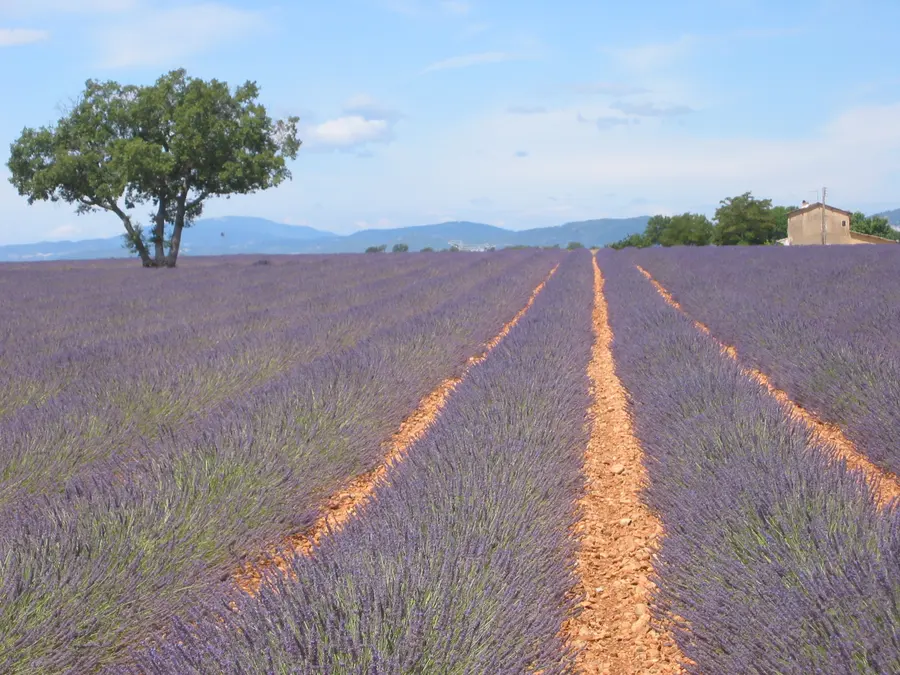
Varietal lavender honey comes from fields like these, not from a few garden shrubs. France’s national appellation body, INAO, protects Miel de Provence as a geographical indication (IGP) since 2005. A separate Label Rouge quality label for “Miel de lavande et de lavandin,” honey from lavender and lavandin, dates from 1989. A colony forages over a wide area, so a garden planting will not turn its honey into lavender honey. For other single-flower honeys, see our guide to popular US honey varieties.
Is Lavender Toxic to Cats, Dogs or Horses?
Yes, according to the ASPCA’s toxic plant list. Its entry for English lavender says it is toxic to dogs, cats and horses. It names linalool and linalyl acetate as the toxic compounds and nausea, vomiting (not in horses) and loss of appetite as the signs. NC State rates the poison severity as low and, on its lavandin page, describes mild nausea and vomiting when large quantities are eaten.
The ASPCA entry covers the plant, not lavender essential oil. If you think a pet has eaten lavender, call your veterinarian or the ASPCA Animal Poison Control Center at (888) 426-4435; the ASPCA says a fee may apply. This section is educational information, not veterinary advice.
Good Companion Plants for Lavender
The best partners share lavender’s taste for sun and dry, lean soil, so they can be watered and left alone together. NC State suggests lavender for herb, rock, pollinator and butterfly gardens. Our list of drought-resistant flowers for bees includes good neighbors such as blanketflower, penstemon and butterfly weed, a milkweed that thrives in dry soil.
Because lavender is not native to the US, add native plants that bloom before and after it, especially for the wild bees other than bumble bees that, in the Oregon State study, largely ignored ‘Grosso’; see our native plants for pollinators. In a vegetable garden, a sunny, well-drained edge is the natural place for it; our guide to companion planting for pollinators covers what the evidence supports. More plant guides sit in our pollinator gardening section.
If lavender struggles in your soil, salvia offers similar blue-purple spikes for bees, with types hardy to zone 4.
Frequently Asked Questions
Is lavender a perennial?
Yes. Lavender is a woody perennial sub-shrub that can stay evergreen, per CSU. Hardy types come back every year in their zones, and USU says plants can live 10 to 15 years.
Can lavender grow in shade?
Not well. It needs full sun, six or more hours a day (NC State), and flowers poorly in shade. The one exception is Florida, where UF/IFAS suggests some shade in the hottest part of the afternoon.
Why is my lavender dying?
Usually wet roots: CSU and NC State name root rot from poor drainage or overwatering as the main disease. Hard pruning into old wood is the other common cause.
How often should you water lavender?
Weekly while it establishes, then rarely. USU suggests about 1 gallon a week after planting, then half a gallon every two weeks for mature plants until buds form. Potted lavender needs checking more often.
Can lavender grow in clay soil?
Only if you fix the drainage. NC State says English lavender will die out in heavy clay, so plant on a raised bed or mound.
Can lavender survive winter in pots?
Hardy English lavender and lavandin can, if the pot drains freely and the plant is sheltered from wind. Tender Spanish and fringed lavender should come indoors or be treated as annuals in cold states (CSU).
Is lavender native to the US?
No. Lavender is native to the Mediterranean region (NC State), so it is not native to Ohio, Texas, California or any other state.
Does lavender grow in Florida or Texas?
Yes, with the right type. UF/IFAS rates Spanish lavender best and fringed lavender appropriate for Central Florida, while English lavender struggles with the humidity. CSU notes that Texas is one of the states where lavender is grown as a cash crop.
Is lavender toxic to cats and dogs?
The ASPCA lists English lavender as toxic to cats, dogs and horses. Call a vet or the ASPCA Animal Poison Control Center if a pet eats it.
The Bottom Line
Choose the lavender that matches your winter, give it sun and sharp drainage, and prune it in spring above the wood. If you want the most bees, a lavandin such as ‘Grosso’ has the best support; then add native plants for the bees that lavender does not feed.
Image credits: Oregon lavender field by Bonnie Moreland, CC0; ‘Hidcote Blue’ by Captain-tucker, CC BY-SA 3.0; Spanish lavender by Krzysztof Ziarnek (Kenraiz), CC BY-SA 4.0; fringed lavender by Sten, CC BY-SA 3.0; honey bee by Martin Falbisoner, CC BY-SA 4.0; yellow-faced bumble bee by Charles J. Sharp, CC BY-SA 4.0; European wool carder bee by Humoyun Mehridinov, CC BY-SA 4.0; Valensole lavandin field by Jddmano, CC BY-SA 3.0. All via Wikimedia Commons, cropped or resized. Charts by BeeKeepersRealm from iNaturalist, NC State Extension and UF/IFAS data.