Reviewed by Elena P. · How we review
The honey locust tree (Gleditsia triacanthos) is a fast-growing native legume of the central and eastern United States, 70 to 80 feet tall in the wild, with feathery compound leaves, branched thorns and long, twisted pods. The “honey” in its name comes from the sweet pulp inside those pods, not from bees. Thornless forms such as ‘Shademaster’, ‘Skyline’ and ‘Sunburst’ are common street trees because they tolerate salt, drought and paving. Its small greenish flowers do feed bees for about two weeks in late spring, but it is a minor honey plant, and it is a different tree from black locust.
Key Takeaways
- Honey locust and black locust are different genera. Black locust (Robinia pseudoacacia) has showy white pea flowers and short paired spines, and NC State rates its bark, leaves and seeds as highly poisonous. Honey locust has small greenish flowers and long branched thorns.
- Bees do work honey locust, but beekeeping writer Frank Pellett noted in 1920 that it was “seldom regarded as a source of surplus,” unlike black locust.
- In our pull of US iNaturalist data, only 3 records tag an insect visiting honey locust flowers, against 48 for black locust (41 of them bees). Those counts are small; they show how rarely people record honey locust flowers, not that bees ignore them.
- Thornless, mostly podless cultivars are 35 to 40 feet tall (University of Connecticut). About 10% of wild trees lack thorns (Iowa State).
- Most pests are cosmetic. Purdue advises against routine broad-spectrum sprays, which kill the beneficial insects that keep mites and plant bugs in check.
- It is native in the US, but the Missouri Department of Conservation calls it highly aggressive and invasive where it was introduced in Australia and South America.
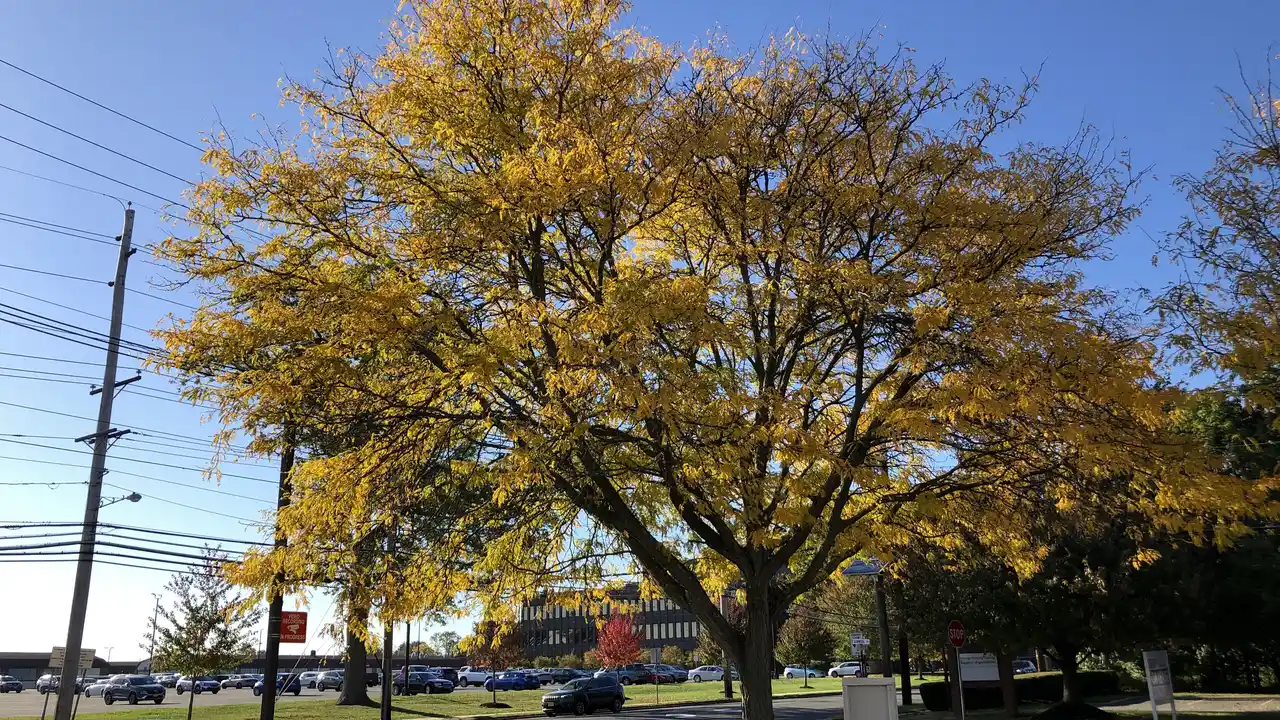
Table of Contents
- What a Honey Locust Is and Where the Name Comes From
- How to Identify a Honey Locust Tree
- Native Range and Hardiness
- Honey Locust vs Black Locust
- Is Honey Locust Good for Bees?
- Thornless Honey Locust Cultivars Compared
- Growing Honey Locust: Site, Growth Rate and Roots
- Honey Locust Tree Pros and Cons
- Pests and Diseases, With Pollinator-Safe Fixes
- Honey Locust Pods: Sweet Pulp, Livestock Feed and Safety
- Is Honey Locust Invasive?
- Frequently Asked Questions
- The Bottom Line
What a Honey Locust Is and Where the Name Comes From
Honey locust is a deciduous tree in the legume family (Fabaceae), the same family as peas, clover and black locust. The USDA Forest Service’s Silvics of North America describes it as a “moderately fast growing tree” of moist bottomlands and limestone soils that reaches about 125 years. Older names include sweet-locust and thorny-locust.
Each part of the scientific name has a story. NC State Extension notes that Gleditsia honors Johann Gottlieb Gleditsch, an 18th-century director of the Berlin botanical garden. MDC explains that triacanthos means “three thorns,” for the thorns that often fork into three points. The thornless form is inermis, which NC State says “is Latin for unarmed.”
“The sweet pulp around the seeds account for the “honey” in the tree’s name.”
So the name has nothing to do with beehives. That matters to beekeepers, because in the classic honey-plant literature plain “locust” means black locust: Frank Pellett’s 1920 American Honey Plants lists it under the heading “Locust,” with the Latin name Robinia pseudo-acacia. It is a different plant, covered in the comparison below.
How to Identify a Honey Locust Tree
Five features separate honey locust from other trees. The measurements come from the Missouri Department of Conservation (MDC), Illinois Wildflowers and NC State Extension.
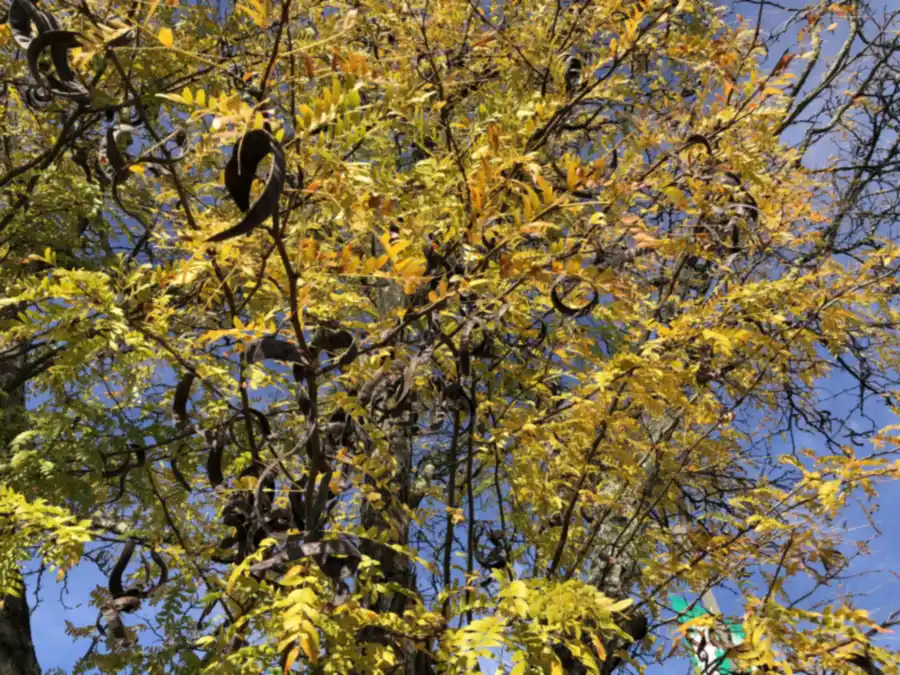
- Leaves: alternate and compound, 5 to 10 inches long, with 15 to 30 small leaflets of ¾ to 2 inches (MDC). Young, vigorous growth often has bipinnate (twice-divided) leaves, while mature leaves are mostly once-pinnate, and both kinds can grow on the same tree. The leaflets turn yellow in fall.
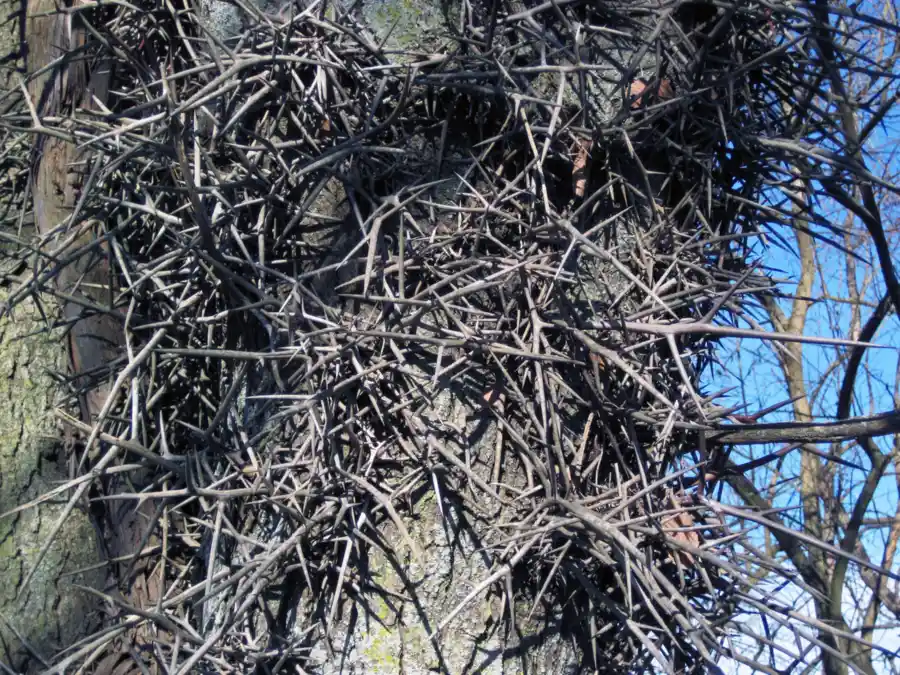
- Thorns: stiff, shiny, purplish-brown spines on the trunk and branches, single or branched, up to 8 inches long on the trunk according to Illinois Wildflowers and up to 12 inches according to MDC. Thornless trees still occur naturally: Iowa State Extension puts them at about 10% of wild trees.
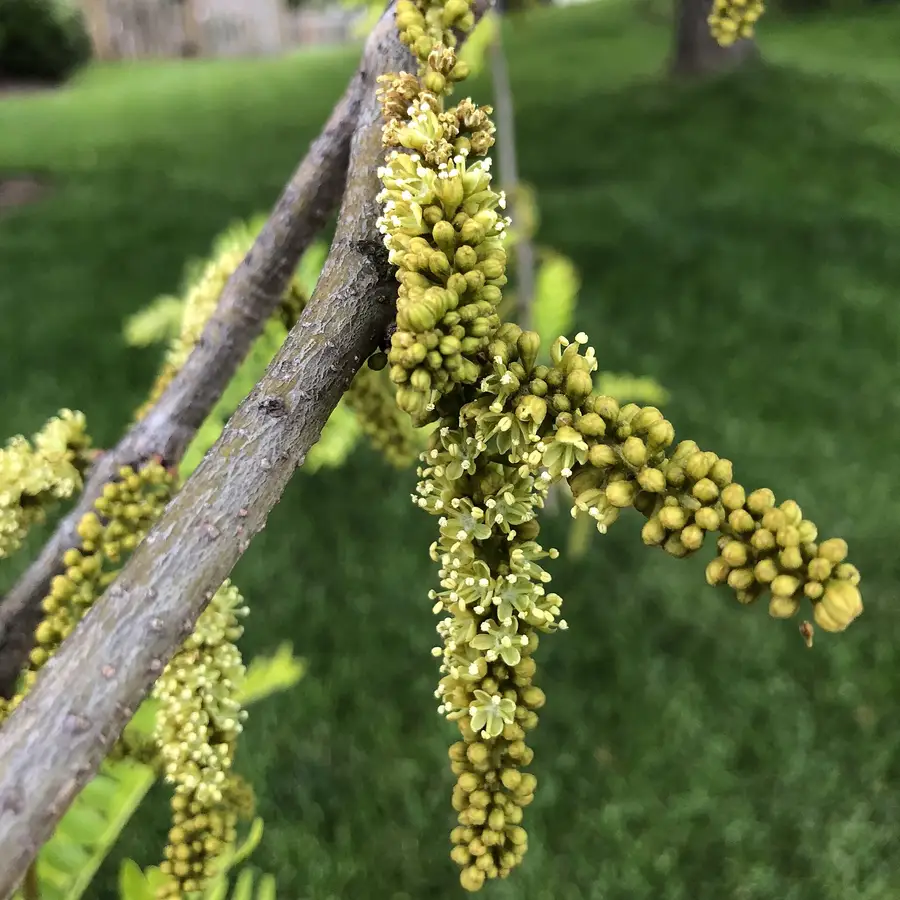
- Flowers: small, greenish-yellow and sweetly fragrant, in slender clusters (racemes) 2 to 5 inches long. Individual flowers are usually either male or female.
- Pods: flat, leathery, dark brown pods 6 to 18 inches long that twist at maturity and fall unopened from late fall into winter.
- Bark: gray-brown to nearly black, breaking into long plates with curled edges on older trunks.
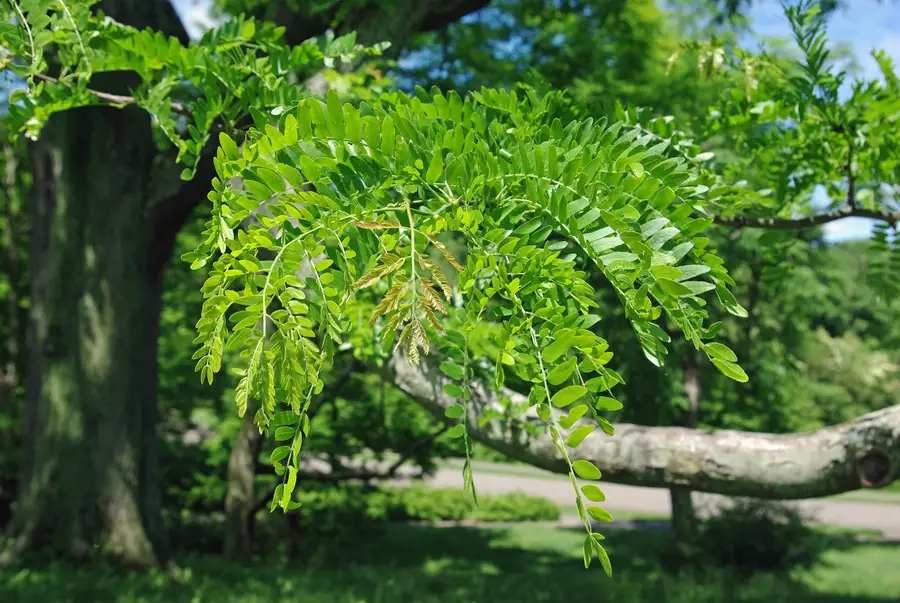
The thorns are honey locust’s signature. MDC and Illinois Wildflowers both suggest they may have evolved against now-extinct Ice Age browsers such as mastodons. On wild trees they can cluster thickly on the trunk; as a tree ages they stop forming in the upper and outer crown, and cuttings taken from that thornless growth generally stay thornless (USDA Forest Service).
Native Range and Hardiness
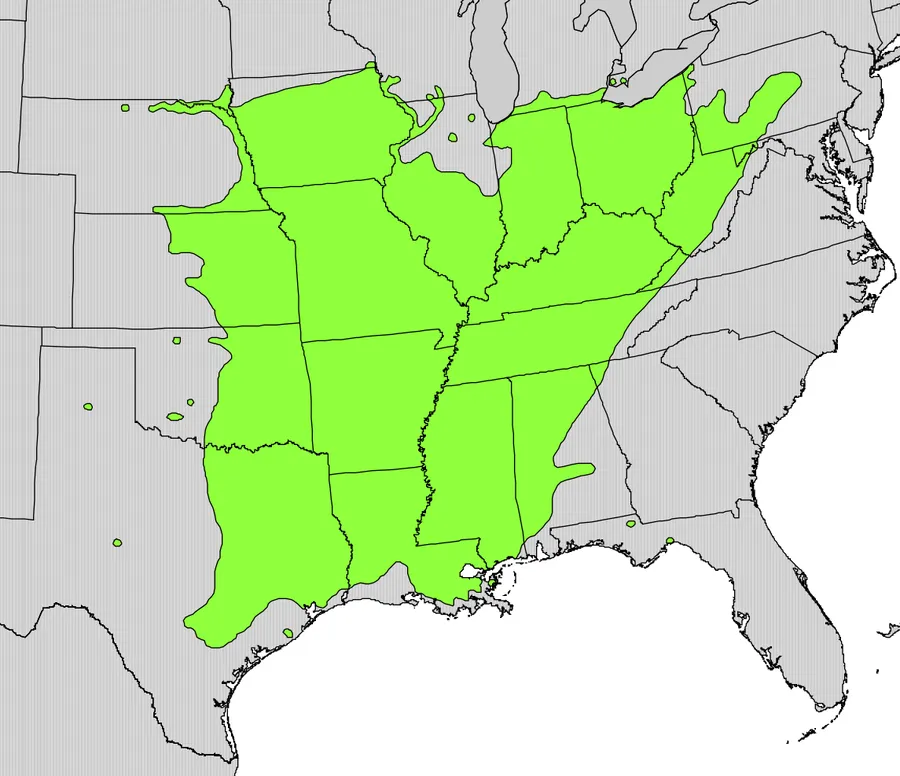
According to the USDA Forest Service Silvics manual, honey locust grows wild from central Pennsylvania west to southeastern South Dakota, south to central and southeastern Texas, and east to southern Alabama. Outlying stands occur in northwestern Florida, west Texas and west-central Oklahoma. It is naturalized east of the Appalachians from South Carolina to New England, and it reaches its best size along small stream valleys in southern Indiana and Illinois.
The same source rates it hardy to -20 to -30°F in the North, and Iowa State Extension lists USDA zones 4 through 9. Seed source matters: trees grown from southern seed are prone to frost damage when planted in the North.
Honey Locust vs Black Locust
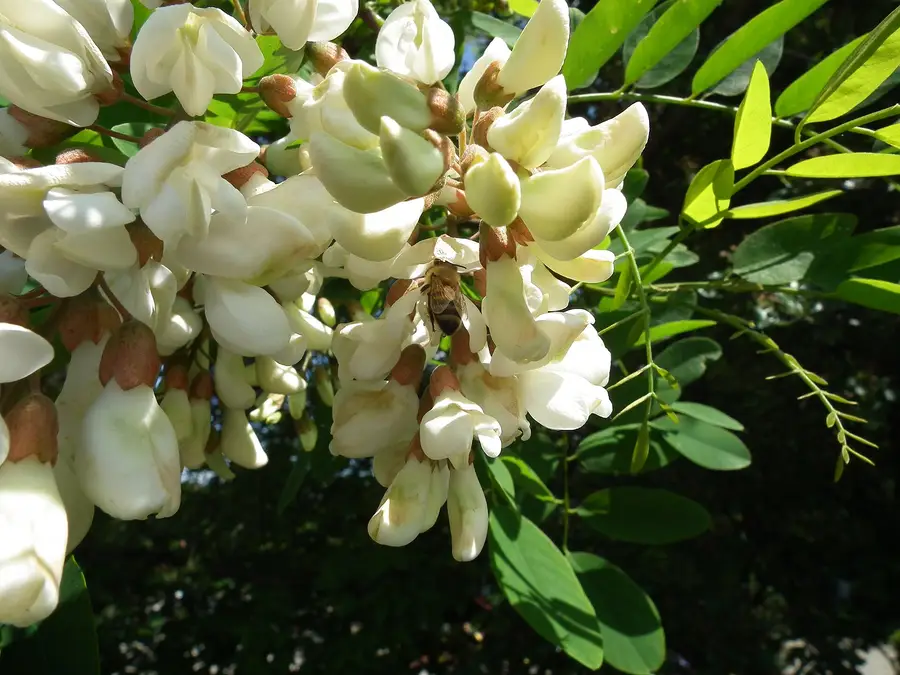
Both are fast-growing legume trees with compound leaves, and Illinois Wildflowers calls black locust the only tree honey locust is likely to be confused with in the Midwest. Up close they differ in almost every part.
| Feature | Honey locust (Gleditsia triacanthos) | Black locust (Robinia pseudoacacia) | Source |
|---|---|---|---|
| Leaves | 5 to 10 in, 15 to 30 small leaflets; often bipinnate on young growth | 8 to 14 in, once-pinnate, 7 to 19 leaflets | MDC |
| Thorns | Long, often branched, on trunk and branches; up to 8 to 12 in | Short paired spines (to about 1.25 in) at each leaf base | Illinois Wildflowers, MDC, NC State |
| Flowers | Small, greenish-yellow, fragrant racemes 2 to 5 in | Showy white, pea-shaped, fragrant, drooping clusters 4 to 5 in | Illinois Wildflowers, MDC |
| Pods | 6 to 18 in, leathery, twisted, sweet pulp, fall unopened | 3 to 5 in, smooth, split along both sides, 4 to 8 seeds | MDC |
| Toxicity | Listed non-toxic to cats, dogs and horses; pod pulp eaten by people and livestock | High-severity poison; bark, leaves and seeds | NC State Extension |
| Nitrogen fixing | No | Yes | Iowa State, NC State |
| Nectar value | “Considerable nectar,” bees “work freely” | “A good nectar source for bees” | Pellett (1920); MDC |
| Honey | “Seldom regarded as a source of surplus” | “Yields abundantly for a short period” | Pellett (1920) |
MDC = Missouri Department of Conservation field guide. NC State toxicity ratings come from its Extension Gardener Plant Toolbox pages for each species.
Black locust is the famous one in beekeeping. Our guide to nectar-producing trees for bees covers it alongside tulip poplar, basswood and sourwood.
Is Honey Locust Good for Bees?
Yes, but modestly. Honey locust gives bees nectar and pollen for a short window in late spring, and the sources agree it is not a major honey tree.
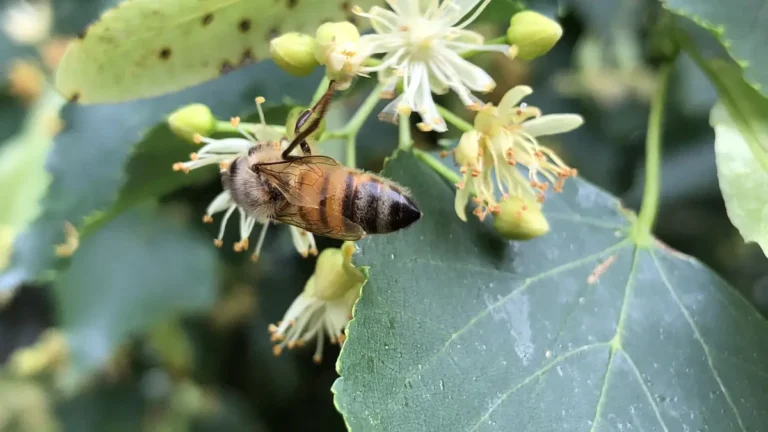
Illinois Wildflowers, citing the botanist Charles Robertson’s 1929 flower-visitor records, says the flowers are cross-pollinated by honey bees, bumble bees, sweat bees (Lasioglossum and Agapostemon), mining bees (Andrena) and hover flies, with bees drinking nectar or gathering pollen. NC State lists the flowers as a nectar source for bees, and the Nebraska Forest Service calls them “incredibly attractive to pollinating insects.” Small native bees such as sweat bees and mining bees are exactly the visitors Robertson recorded.
For honey, the verdict is more cautious. The USDA Forest Service says only that the tree is “a source of honey during the short flowering period in spring.” The fullest beekeeping assessment is in Frank C. Pellett’s American Honey Plants, published by the American Bee Journal in 1920. He wrote that the tree is “the source of considerable nectar” but “not equal to the black locust.”
“There are numerous reports to the effect that the bees work freely on honey locust, but it is seldom regarded as a source of surplus, while the black locust yields abundantly for a short period, under favorable conditions.”
What community-science records show
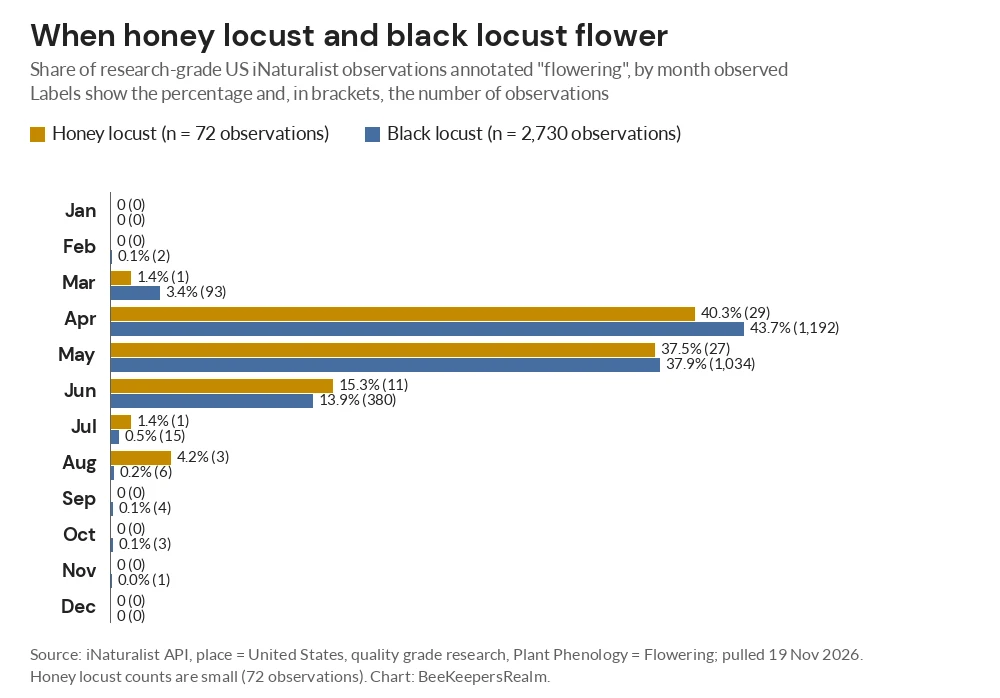
We pulled US records from iNaturalist on 19 November 2026 to see how often people document honey locust flowers and their visitors. The table compares it with black locust. “Research grade” means the community has confirmed the species.
| US iNaturalist observations | Honey locust | Black locust |
|---|---|---|
| All verifiable observations of the tree | 52,939 | 66,635 |
| Research-grade observations | 33,435 | 37,912 |
| Research-grade observations annotated “flowering” | 72 | 2,730 |
| Insect records tagged “Visited flower of” the tree (all grades) | 3 | 48 |
| Of those, bees | 0 | 41 (32 bumble bees, 7 honey bees) |
Source: iNaturalist API, place = United States, pulled 19 November 2026. Visitor records use the observation field “Interaction: Visited flower of.” All counts are observations, not numbers of insects or trees.
Both trees are observed in similar numbers, yet black locust has 38 times as many flowering records. Illinois Wildflowers calls honey locust’s greenish flowers “seemingly inconspicuous,” and people rarely photograph or tag them. With only 3 visitor records (a plant bug, a moth and a skin beetle), the data cannot say which bees use honey locust; it shows a gap in the record, not a lack of bees. If honey locusts bloom near you, photographing their visitors and uploading them to iNaturalist helps close that gap; our guide to citizen science for pollinators explains how.
The 72 flowering records do show timing. They peak in April (29 records) and May (27), with 11 in June, the same window as black locust. In the North, the Forest Service puts the average bloom near June 25; in the South, near May 10.
For a beekeeper, a street of honey locusts within foraging range of the hive is a useful spring snack for colonies, not a reason to add supers. Our list of plants for honey production covers the trees and flowers that do fill supers, and our trees for bees guide covers spring bloomers by region. If you want a common street tree that does yield a named honey, look at linden; our basswood honey guide explains its short, heavy flow.
Thornless Honey Locust Cultivars Compared
Nearly every honey locust sold today is a named selection of the thornless variety inermis. Many are also podless or nearly so, which removes the fall mess. Sizes below are mature heights from the University of Connecticut Plant Database.
| Cultivar | Mature size | Pods | Notes | Source |
|---|---|---|---|---|
| ‘Moraine’ | 40 ft tall, wider than tall | Fruitless | First thornless form patented (1949); good pest resistance | UConn; NC State |
| ‘Shademaster’ | To 40 ft, upright, symmetrical | Some pods | Deep green leaves; very good drought tolerance reported | UConn |
| ‘Skycole’ (Skyline) | 40 ft tall and wide, broadly pyramidal | Few | Cold-hardy; a good street tree | UConn; NC State |
| ‘Impcole’ (Imperial) | 35 ft, compact, spreading | Few | Very fine-textured foliage | UConn |
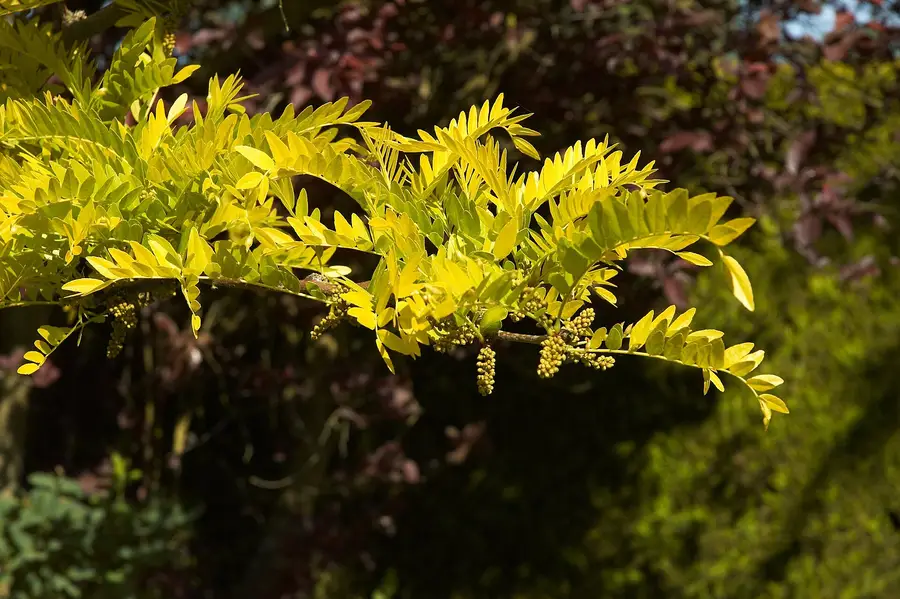
| ‘Suncole’ (Sunburst) | 35 ft, irregular | Fruitless | Gold new leaves fade to green; “supposedly susceptible to a canker disease” | UConn |
| ‘Christie’ (Halka) | 40 ft tall and wide, round-headed | Rarely fruits | Sturdy trunk | UConn |
| ‘Emerald Kascade’ | Weeping; size not given | Fruitless | Weeping form | NC State |
| ‘Northern Acclaim’ | Not given | Not given | Recommended for Nebraska with ‘Imperial’, ‘Moraine’, ‘Shademaster’ and ‘Skyline’ | Nebraska Forest Service |
“Thornless” and “podless” are not absolute. The Forest Service notes that only about 60% of seedlings grown from thornless trees are thornless, so buy grafted, named trees rather than seedlings. NC State adds that some podless cultivars occasionally bear heavy crops of pods. Podless trees still flower, as the ‘Sunburst’ flower photo above shows.
Growing Honey Locust: Site, Growth Rate and Roots
- Sun and soil: full sun. The Forest Service classes honey locust as shade-intolerant. It grows best in deep, moist soils with a pH of 6.0 to 8.0 and does poorly on shallow, gravelly or heavy clay sites, yet NC State lists it as tolerant of compaction, flooding and poor soil.
- Salt and drought: young trees tolerated salinized soil in tests, and the species is “very resistant to drought” (Forest Service). Purdue calls it “remarkably tolerant to salt,” which is why it lines salted streets and parking lots. Our list of drought-resistant flowers for bees pairs well with it.
- Growth rate: fast. Iowa State Extension says young trees grow 2 feet or more per year over their first ten years; shelterbelt plantings from North Dakota to Texas averaged 19.2 inches a year for seven years (Forest Service).
- Size: 70 to 80 feet in natural stands and up to 140 feet on the best sites (Forest Service). Most landscape cultivars stay at 35 to 40 feet.
- Roots: deep, with a strong taproot and a widely spreading, branched lateral system that can reach 10 to 20 feet down (Forest Service).
- Shade: the small leaflets cast light, dappled shade, so lawn grass grows underneath, and the small fallen leaflets make fall cleanup easy (MDC, Purdue).
Seedlings are easy. Seeds have hard coats, so the Forest Service recommends scarifying them or soaking them in water near boiling (about 190°F) and letting it cool. Iowa State Extension’s method is to place the seeds in boiling water and let them cool overnight.
Honey Locust Tree Pros and Cons
| Pros | Cons |
|---|---|
| Native to much of the central and eastern US; hosts the silver-spotted skipper and several moths (NC State, MDC) | Wild trees carry long thorns that MDC says can puncture tractor tires |
| Tolerates salt, drought, compaction and pollution | Pods on fruiting trees are heavy and messy in fall |
| Light shade lets grass grow; small leaflets need little cleanup | Many insect pests, especially in streets planted with nothing else (Purdue) |
| Fast growth and yellow fall color | Cankers can kill trees; ‘Sunburst’ is reported canker-prone (Forest Service, UConn) |
| Spring nectar and pollen for bees | A minor honey source, not a nectar-flow tree (Pellett) |
| Pods feed deer, squirrels, rabbits and livestock | Spreads into pastures; mowing increases sprouts (NC State) |
The University of Connecticut adds a caution about overuse. The Forest Service notes that thornless honey locust replaced the American elm in many cities, and UConn says its use should be tempered by that history of urban monoculture. Planting a mix of trees spreads the risk. Our guide to native plants for pollinators suggests companions.
Pests and Diseases, With Pollinator-Safe Fixes
The Forest Service notes that insect attacks rose as thornless cultivars spread, though most weaken rather than kill trees. Purdue Extension entomologist Cliff Sadof, writing in the Purdue Landscape Report, names four main pests.
- Honeylocust plant bug: active in May and June, it distorts young, expanding leaves. Sadof says “control is rarely needed.”
- Mimosa webworm: caterpillars that tie leaves into brown webs, with two generations a year (June and August). MDC notes that this nonnative moth was first recorded in the US in 1943. Prune out webs you can reach and target the first generation.
- Spider mites: mid-summer leaf damage, worst in hot, dry weather. Sadof warns that early broad-spectrum sprays (neonicotinoids and pyrethroids) “often set the stage for mite problems” by killing their predators.
- Soft scales: calico and European fruit lecanium scales drip honeydew that turns black with sooty mold. Purdue suggests an insect growth regulator timed to the crawler stage in late May.
“Although these insects can be found every year, they rarely cause enough damage to significantly thin tree canopies.”
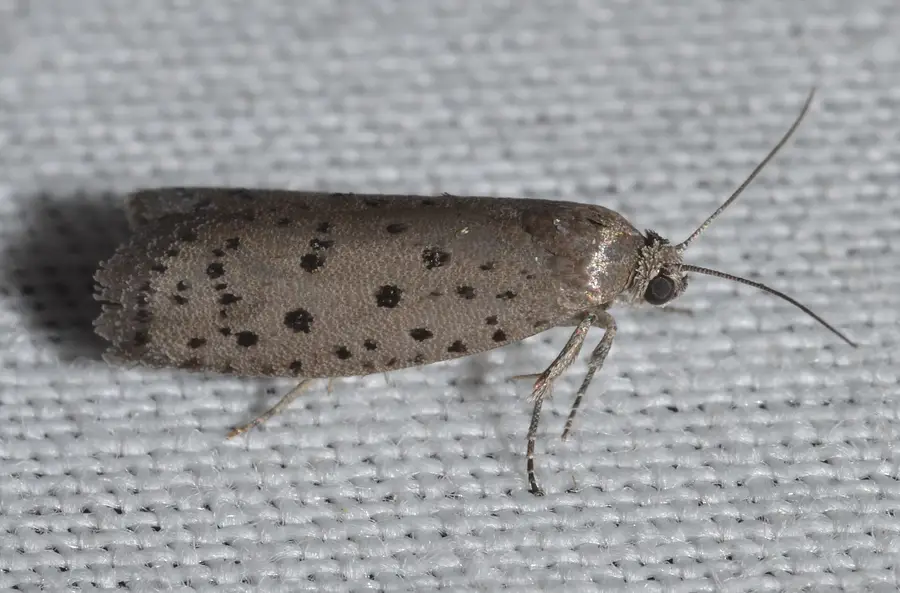
For diseases, the Forest Service names Thyronectria canker as the most important and notes it can be fatal; Iowa State lists Cytospora canker, powdery mildew and leaf spot. Ganoderma root rots occur but are uncommon.
The pollinator-safe plan follows from Purdue’s advice. Accept cosmetic damage, prune out reachable webworm nests, and plant honey locusts in small groups rather than whole streets. If a treatment is unavoidable, choose targeted products over the broad-spectrum sprays Purdue says kill beneficial insects, and never spray while the tree is in bloom and bees are working it. The Nebraska Forest Service agrees that these problems are “usually cosmetic.” Our pollinator-safe pest control guide explains which product types are lower risk for bees.
Honey Locust Pods: Sweet Pulp, Livestock Feed and Safety
The pods ripen from mid-September in the South to mid-October in the North and drop through late winter (Forest Service). The hard seeds sit in a thick, sweet pulp (Illinois Wildflowers). MDC says Native Americans ate the pulp of young pods, and NC State notes the dried pulp was used as a sweetener and minor food.
Livestock and wildlife eat the pods too. The Forest Service reports that the beans of some cultivars contain 12 to 13% protein and the pods up to 42% carbohydrates. Cattle, hogs, deer, squirrels, rabbits, bobwhite and opossum eat them, and cattle spread the seeds in their dung, one reason honey locust moves into pastures.
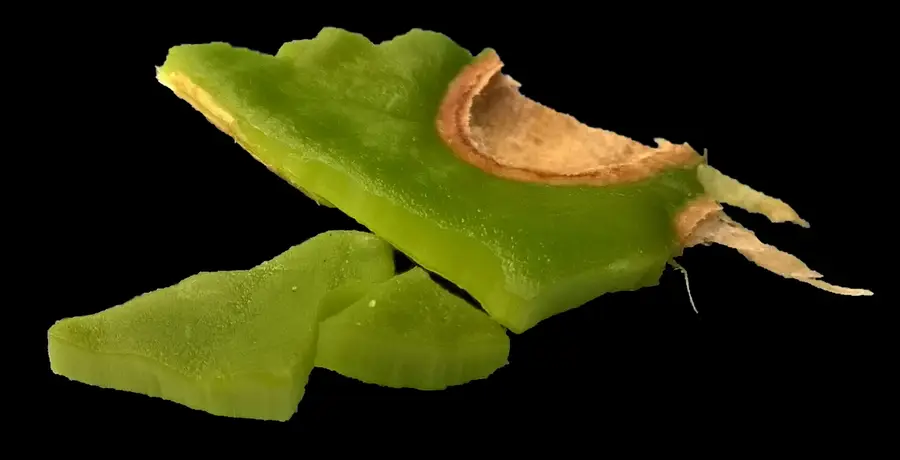
Safety note: this is educational information, not medical or veterinary advice. Black locust also bears flat pods, and NC State rates its seeds, bark and leaves as poisonous, so be certain of the tree before tasting anything. We make no health claims for the pods, seeds or bark.
Is Honey Locust Invasive?
Not in its native US range, though it can be a nuisance there. MDC calls it a common invader of pastures and idle fields. Iowa State says most landowners manage against it in woodlands, and NC State warns that it can become a pasture weed.
Outside North America the picture is different. MDC writes that in Australia and South America honey locust “has proven to be highly aggressive and invasive.” In New South Wales, the state’s NSW WeedWise profile lists it as a regional priority weed in several regions. The Central Tablelands listing excludes garden varieties derived from thornless inermis cultivars, but says rootstock wildings should be controlled if the grafted top dies.
Frequently Asked Questions
Are honey locust pods edible?
The sweet pulp around the seeds has been eaten: MDC says Native Americans ate the pulp of young pods, and NC State notes the dried pulp was used as a sweetener. Livestock and deer eat whole pods. Do not confuse them with black locust pods, which NC State rates as poisonous.
Is honey locust toxic to dogs or other pets?
NC State Extension lists honey locust as non-toxic for cats, dogs and horses. Black locust is the dangerous look-alike, with poisonous bark, leaves and seeds.
Do honey locust trees have invasive roots?
The sources describe a deep system rather than a shallow one. The Forest Service reports a strong taproot reaching 10 to 20 feet and widely spreading laterals, and the Nebraska Forest Service says the tree tolerates restricted root zones, which is why it is planted along sidewalks and in parking lot islands.
How fast does a honey locust grow?
Fast. Iowa State Extension says young trees add 2 feet or more per year over their first ten years.
Does honey locust fix nitrogen?
No. Iowa State Extension and Illinois Wildflowers both say honey locust does not fix nitrogen, unlike many legumes, including black locust.
When does honey locust bloom?
Late spring to early summer, for about two weeks (Illinois Wildflowers). The Forest Service gives an average date of about May 10 in the South and June 25 in the North.
Are honey locust trees messy?
Fruiting trees drop heavy pods in fall and winter. The small leaflets break down quickly, and podless cultivars such as ‘Moraine’ and ‘Sunburst’ avoid most of the mess.
Is honey locust good firewood?
The Forest Service describes the wood as dense, very heavy, very hard and durable, and NC State and Iowa State both list fuel among its traditional uses.
The Bottom Line
Plant a grafted, thornless, podless honey locust where you need tough, light shade over a lawn or street, and treat its spring flowers as a bonus for bees, not a honey crop. If you want a locust tree for honey, that is black locust, and it brings its own invasiveness and toxicity questions. More options are in our pollinator gardening section.
Image credits: Famartin (CC BY-SA 4.0, three photos); Bostonian13 (CC BY-SA 3.0); James St. John (CC BY 2.0); Pinethicket, after Elbert L. Little Jr., US Geological Survey (public domain); 4028mdk09 (CC BY-SA 3.0); Wouter Hagens (public domain); Wildreturn (CC BY 2.0); Eiku (CC BY-SA 4.0). All via Wikimedia Commons, cropped or resized. Chart by BeeKeepersRealm from iNaturalist data.