Reviewed by Michael R. · How we review
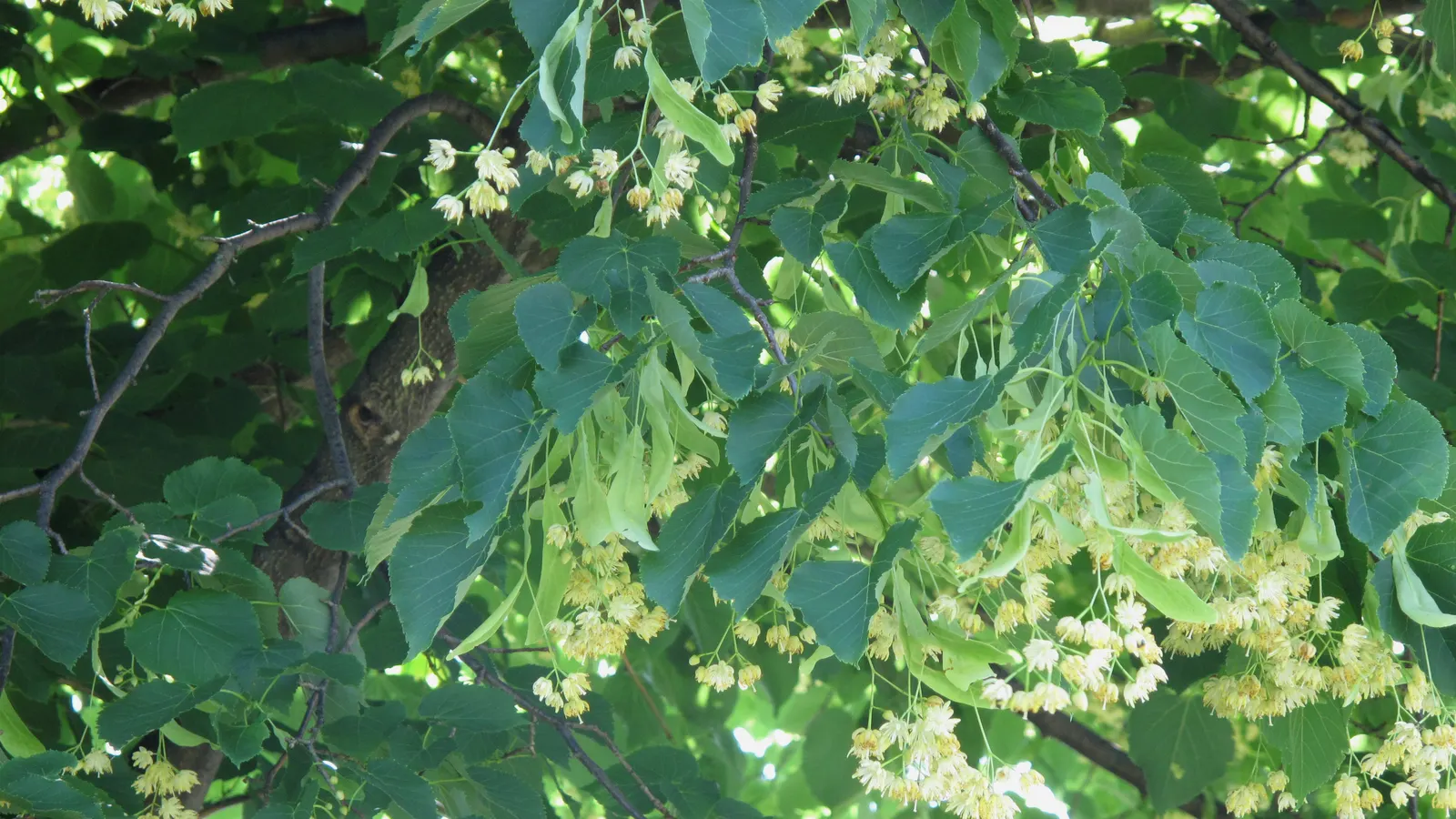
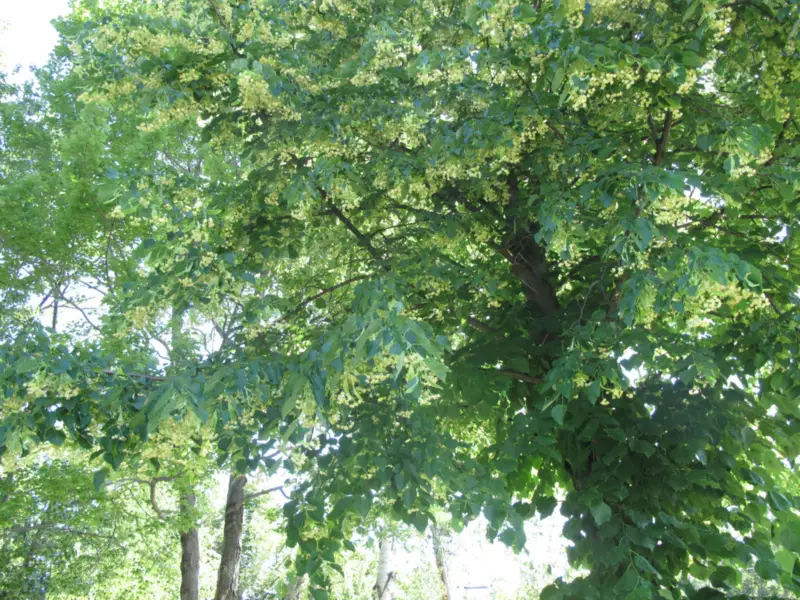
A basswood tree is American linden (Tilia americana), a large native shade tree of eastern and central North America. Look for big, lopsided heart-shaped leaves and, in June, drooping clusters of fragrant cream flowers hanging from a pale, strap-like leafy bract. Basswood reaches 60 to 80 feet in yards and up to 130 feet in forests, grows in USDA zones 3 to 8, and gives honey bees one of the heaviest, shortest nectar flows of the year. “Linden” and the British “lime tree” are names for the same genus.
The bloom and bee figures below include our own counts of US iNaturalist observations, pulled in November 2026.
Key Takeaways
- Basswood and American linden are the same tree, Tilia americana. Littleleaf, silver and Crimean lindens are European or Asian trees planted in US towns.
- The surest ID clue is the flower stalk joined to a long, pale green bract, which stays on the tree with the pea-sized fruit.
- Basswood flowers for about two weeks, usually in June, and the USDA Forest Service says the flowers make “an abundance of nectar.”
- Weather decides the crop: cold, cloudy or windy days during bloom can mean no surplus honey at all.
- Dead bumble bees under lindens are most often linked to late-blooming silver linden. Reviews of the research found no evidence of toxic nectar; late-season starvation fits best, and insecticides caused at least one major US kill.
- Japanese beetles, aphids (and the sticky honeydew they drip) and storm breakage are the main problems for planted lindens.
Table of Contents
- What Is a Basswood Tree?
- How to Identify Basswood
- Basswood and Linden Species Compared
- Where Basswood Grows
- Basswood and Bees
- Do Linden Trees Kill Bumble Bees?
- How to Grow a Basswood Tree
- Basswood Wood and Other Uses
- Frequently Asked Questions
- The Bottom Line
What Is a Basswood Tree?
Basswood is the North American member of Tilia, a genus of roughly 30 species of trees from the temperate Northern Hemisphere. Lindens used to have their own family, Tiliaceae; botanists now place them in the mallow family, Malvaceae.
- Basswood is the usual forestry name. It comes from “bast”, the tough, stringy inner bark once used for rope, mats, baskets and fish nets.
- Linden is the usual nursery and street-tree name. The USDA Forest Service notes that basswood is called American linden when planted as a city shade tree.
- Lime tree is the British name. It is an altered form of the old English word lind and has nothing to do with the citrus fruit.
- Bee tree or honey-tree are old regional names that tell you why beekeepers value it.
One species or several? Older manuals split eastern basswoods into American basswood, Carolina basswood (T. caroliniana) and white basswood (T. heterophylla), whose leaf undersides are whitened by fine hairs. The Forest Service’s Silvics of North America reports that sampling from Quebec to Florida found no clear breaks between populations, so eastern North American Tilia may be one highly variable species. Many sources now treat the others as varieties of T. americana.
How to Identify Basswood
Basswood is easy to recognize once you know three features: oversized heart-shaped leaves, the strap-shaped bract on every flower or fruit cluster, and zigzag twigs with plump, lopsided buds.
Leaves
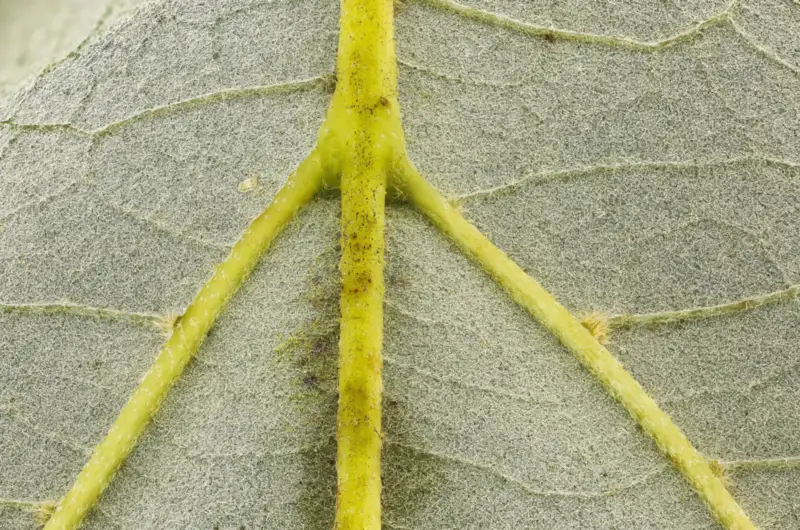
Leaves are alternate, simple and coarsely toothed, with a heart-shaped base that is lopsided (one side of the base sits lower than the other). Illinois Wildflowers gives mature blades as 4 to 6 inches long and 3 to 4½ inches wide; shaded saplings can carry leaves up to 8 inches. Illinois Wildflowers describes the upper surface as medium to dark green and the underside as pale green and mostly smooth, with small tufts of hair where the veins meet. Fall color is pale yellow-green.
Flowers and the bract
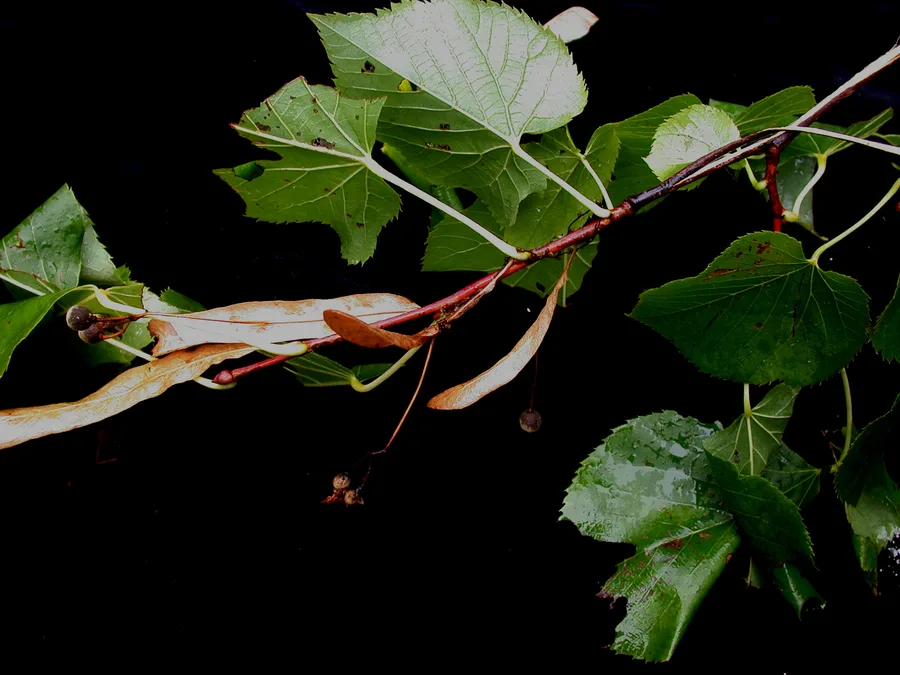
Each drooping cyme of fragrant, pale yellow flowers hangs from a stalk that is fused for about half its length to a narrow, light green bract around 4 inches long. Illinois Wildflowers counts 5 to 20 flowers per cluster, each about half an inch across with five cream petals and many stamens. The bract stays attached when the fruit ripens and acts as a wing, though the Forest Service notes the fruit rarely travels more than one or two tree lengths.
Fruit, bark and twigs
- Fruit: a hard, downy, gray-brown nutlet about the size of a pea (5 to 10 mm), ripening in September and October.
- Bark: smooth and gray on young trees; on mature trunks, long furrows with flat-topped ridges.
- Twigs and buds: twigs zigzag between buds, and the plump winter buds bulge to one side.
- Form: basswood sprouts freely from the stump, so it often grows as a clump of several trunks.
Basswood vs littleleaf, silver and bigleaf linden
- Littleleaf linden (T. cordata): leaves 3 inches long or less, glossy, on a neat pyramidal tree widely planted for shade and along US streets.
- Silver linden (T. tomentosa): leaves dark green above and fuzzy silvery-white beneath.
- Bigleaf linden (T. platyphyllos): leaves nearly as big as basswood’s but hairy, like its leaf stalks, with only 3 to 7 flowers per cluster.
- Basswood: the largest leaves, 4 to 6 inches or more, green on both sides and mostly smooth.
Purdue Extension’s field video walks through the same features on a standing tree.
What the video covers: In this episode of Purdue Extension’s ID That Tree series, Purdue Extension forester Lenny Farlee introduces American basswood. Purdue’s description says he covers how to identify the species, where you are likely to find it and its common uses.
Basswood and Linden Species Compared
Heights and zones are typical landscape figures from NC State Extension’s Plant Toolbox unless noted. Bloom months are for the US; local timing shifts with latitude and spring weather.
| Tree | Species | Native range | Typical height | Bloom time | Hardiness (USDA zones) | Bee notes | Source |
|---|---|---|---|---|---|---|---|
| American basswood (American linden) | Tilia americana | Eastern and central North America | 60 to 80 ft; 75 to 130 ft in forests | June, from late May to early July; about 2 weeks | 3 to 8 | Abundant nectar; classic northern honey tree | NC State; USDA Forest Service Silvics |
| Littleleaf linden (small-leaved lime) | T. cordata | Europe to Siberia and northern Iran | 50 to 60 ft | June to early July | 3b to 7b | Rich nectar; honey bees and bumble bees | NC State; Jacquemart et al. 2018 |
| Silver linden (silver lime) | T. tomentosa | Southeastern Europe and western Asia | 50 to 70 ft | June to July; typically the last linden to flower | 4 to 7 | Most often linked to dead bumble bees; nectar tests found no mannose | NC State; Morton Arboretum; Koch & Stevenson 2017 |
| Bigleaf linden (large-leaved lime) | T. platyphyllos | Central and southern Europe to southwest Asia | 60 to 80 ft | June; first of the European lindens | 3 to 7 | Nectar-rich flowers; generally not linked to bee deaths | NC State; Jacquemart et al. 2018 |
| Crimean (Caucasian) linden | T. × euchlora | Hybrid of Crimean origin; sterile | 40 to 60 ft | May to June | 3 to 7 | Nectar-rich; sometimes linked to bee deaths | NC State; Koch & Stevenson 2017 |
In iNaturalist, US research-grade observations of lindens are overwhelmingly the native tree: 22,823 basswood records against 449 for littleleaf linden, 160 for silver linden and 13 for bigleaf linden. Planted European lindens are common in US towns, but they show up far less often in these volunteer records.
Where Basswood Grows
The USDA Forest Service Silvics of North America account (T. R. Crow, 1990) maps the native range from southwestern New Brunswick and New England west through Quebec and Ontario to southeastern Manitoba, south through the eastern Dakotas, Nebraska and Kansas to northeastern Oklahoma, and east across northern Arkansas and Tennessee to western North Carolina and New Jersey.
- Climate: cold winters and warm, humid summers. The northern edge follows a mean January minimum of about 0 to 2°F.
- Soils: best on deep, moist sandy loams, loams and silt loams, from pH 4.5 to 7.5, and often on calcium-rich soils. It is a nitrogen-hungry tree.
- Forests: it rarely forms pure stands. Its home forest type is sugar maple-basswood, most common in central Minnesota and western Wisconsin.
- Towns: the Forest Service notes that basswood is frequently planted along city streets throughout the eastern United States.
Basswood and Bees
Basswood is the tree a northern beekeeper waits for. The Forest Service sums it up in one line:
“Basswood flowers produce an abundance of nectar from which choice honey is made.”
A short, heavy nectar flow
According to the Forest Service, basswood flowers soon after leaf-out, generally in June, and each tree blooms for about two weeks. John H. Lovell’s 1926 Honey Plants of North America recorded flows of 5 to 25 days and noted that the flowers open 10 to 15 days earlier in a hot season than a cold one. Where basswood grows on both valley floors and hilltops, the low trees bloom first, which stretches the season. Lovell also passes on beekeeper E. R. Root’s view that no other northern honey plant yields so much nectar in so short a time, and a one-day gain of 66 pounds that Doolittle recorded on a hive scale.
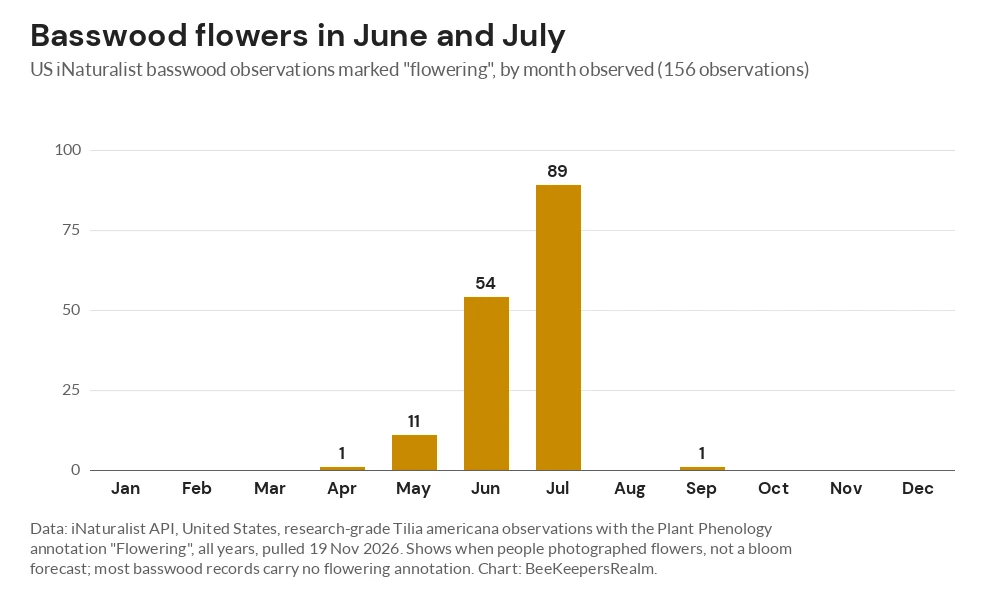
Our own count of iNaturalist records points the same way. Of 156 research-grade US basswood observations that volunteers tagged as flowering, 143 (92%) were made in June or July: 54 in June and 89 in July. May had 11, and April and September had one each. July edging out June may partly reflect when and where people photograph trees, so treat the chart as a guide to the season, not a bloom forecast; most of the 22,823 research-grade US basswood records carry no flowering tag at all.
Weather makes or breaks the flow
“Even when the trees are laden with flowers, if the weather is cold, cloudy, or windy, no surplus will be obtained.”
Lovell called basswood “a variable source of nectar” that “is not reliable every year.” Hot, clear, humid weather favors nectar secretion; on rare occasions in eastern New York, a hard spring frost killed every flower bud on low ground. A University of Wisconsin beekeeping thesis by Carl W. Aeppler made the same point: trees usually shrug off bad weather better than small plants, but basswood is an exception. It cites cases where a single colony stored 40 to 60 pounds of basswood honey in three days.
The practical lesson is to have strong colonies with room to store honey before the trees open, and to plan for the dearth that often follows. Our guide to nectar dearth solutions for beekeepers covers that gap, and a hive scale shows when the flow starts and stops; see our guide to wireless hive scales for nectar flow tracking.
Which insects visit basswood
The Forest Service cites a pollination study that identified 66 species of insects from 29 families as pollinators of Tilia flowers: bees and flies by day, moths at night. The long bracts may act as flags that help night visitors find the flowers. Illinois Wildflowers lists honey bees, bumble bees, sweat bees, wasps, hover flies, blow flies and moths. In Belgium, Jacquemart and colleagues found that honey bees were the main visitors on three of the four lindens they watched.
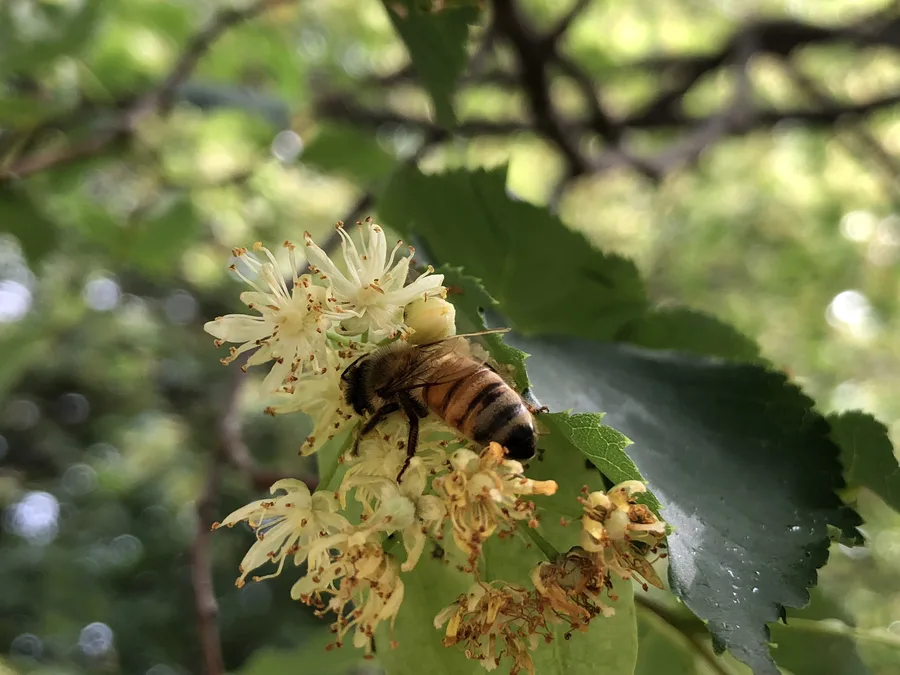
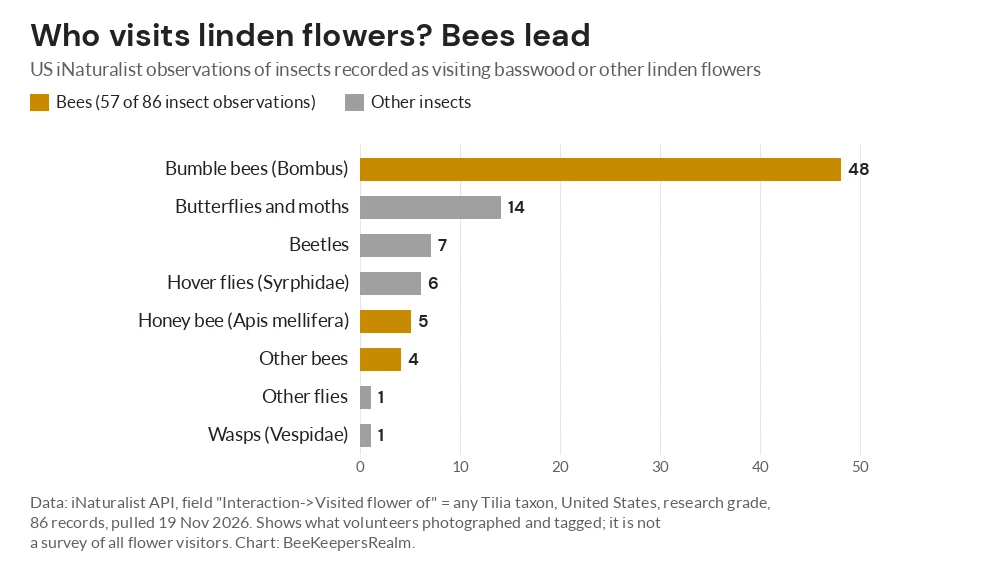
We also counted US iNaturalist observations in which volunteers recorded an insect visiting basswood or another linden. Of 86 research-grade records, 57 were bees, and 48 of those were bumble bees, led on basswood itself by the common eastern bumble bee (16 records) and the two-spotted bumble bee (13). One basswood record shows the federally endangered rusty patched bumble bee. Honey bees appear in only 5 records. These are volunteer photos, not a survey, so the mix shows what people chose to photograph and tag. Butterflies and moths made up 14 records, beetles 7 and hover flies 6.
Basswood honey, in brief
Lovell described basswood honey as white with a slightly aromatic flavor, and noted that honey extracted before it is capped tastes noticeably stronger. Flavor, color, crystallization and where to buy it are covered in our basswood (linden) honey guide, and basswood sits alongside tuliptree, sourwood and tupelo in our list of the best nectar-producing trees for bees.
Do Linden Trees Kill Bumble Bees?
Sometimes you will find dozens of dead or twitching bumble bees on the pavement under a flowering linden in midsummer. Hauke Koch and Philip Stevenson of the Royal Botanic Gardens, Kew, reviewed the evidence in Biology Letters in 2017. Their reports came from the UK, Switzerland, Germany, Norway, Poland, Austria and the USA. Bumble bees made up over 75% of the dead bees, mostly short-tongued species such as the buff-tailed bumble bee, and fewer honey bees died even though they visit the trees just as heavily.
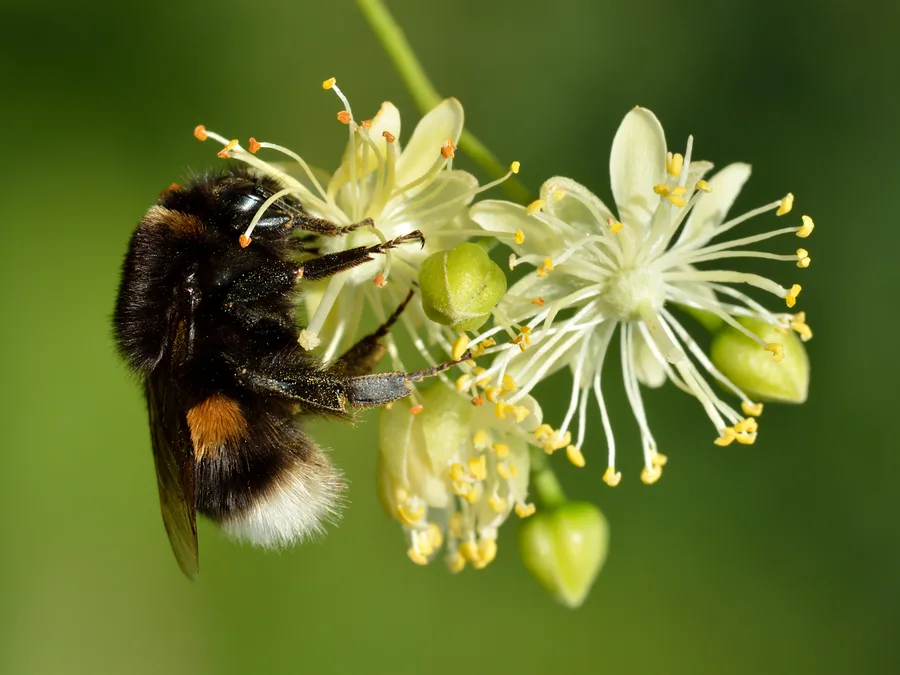
The mannose theory did not hold up
For decades, books blamed the sugar mannose, which is toxic to bees, for linden nectar deaths. Koch and Stevenson traced the idea to tentative identifications from the 1960s and 1970s, including a feeding trial in which 8 bumble bees were caged with just 7 silver linden flowers, less than 2% of what they needed to eat. Later gas chromatography work found no mannose in the nectar of 36 silver linden trees, 20 bigleaf, 12 littleleaf and 14 Crimean lindens, and none in 80 dying bumble bees collected under the trees.
Jacquemart and colleagues reached the same result in 2018 in Apidologie: no trace of mannose or nicotine in the nectar of four lindens. Bumble bees fed only on littleleaf or silver linden flowers did not die more than controls, and in 80 hours of collecting under flowering trees they found only eight dead insects.
Late-season starvation is the best-supported explanation
“Bee deaths on Tilia probably result from starvation, owing to insufficient nectar resources late in the tree’s flowering period.”
The evidence they assembled:
- Timing. Silver linden flowers later than other lindens (mid-July to early August in Europe), after the more common lindens have finished, so bees crowd onto a few trees.
- Empty flowers. In one study, a silver linden stopped making nectar on day 8 of its 11-day bloom. Foragers from a nearby bumble bee colony came home empty, marked workers were found dying under the tree, and the colony starved.
- Empty bees. Bumble bees dying under silver linden had less than a third of the energy reserves of foragers on littleleaf or bigleaf linden.
- Quick recovery. Paralyzed bumble bees recovered fully within 30 to 40 minutes when given silver linden nectar.
- Not old age. In one count, only 6% of 4,116 dead bumble bees under silver linden looked old; most were young, including young queens.
Honey bees can draw on stored honey in the hive, which may explain why fewer of them die. Koch and Stevenson also flagged open questions: why bees keep visiting nearly empty flowers, and whether scent compounds or the caffeine reported in littleleaf linden nectar steer bees into poor foraging choices.
Insecticides on lindens
The review is blunt that silver linden nectar does not poison bees, but insecticide applied to the tree can. Lindens are sometimes sprayed against aphids. In June 2013, more than 50,000 bumble bees died under littleleaf lindens in Wilsonville, Oregon, and the Oregon Department of Agriculture judged the cause to be dinotefuran, a neonicotinoid that had been applied to the trees beforehand. Neonicotinoids can persist in plant tissue and turn up in nectar and pollen even when sprayed outside bloom. Bee deaths under lindens predate neonicotinoids, though, so pesticides explain isolated cases rather than the whole pattern.
What gardeners can do
- Do not cut down lindens. The review notes that felling silver linden would remove nectar and could increase bee losses.
- Plant late-summer flowers nearby, which Koch and Stevenson name as the best fix. Our lists of fall-blooming flowers for bees and goldenrod are good places to start.
- Never treat a linden with a systemic insecticide; ask your tree service what it plans to apply and when.
- If you are choosing a new linden, know that silver and Crimean lindens are the ones most often linked to bee deaths; native basswood blooms earlier, in June.
Our bumblebee identification guide covers the species you are likely to see on lindens in the US.
How to Grow a Basswood Tree
Basswood suits large yards, parks and woodland edges more than tight streets. NC State Extension notes that it does not tolerate urban conditions well, and that littleleaf linden has often been planted inappropriately as a street tree, leading to stunted growth, leaf scorch and windthrow.
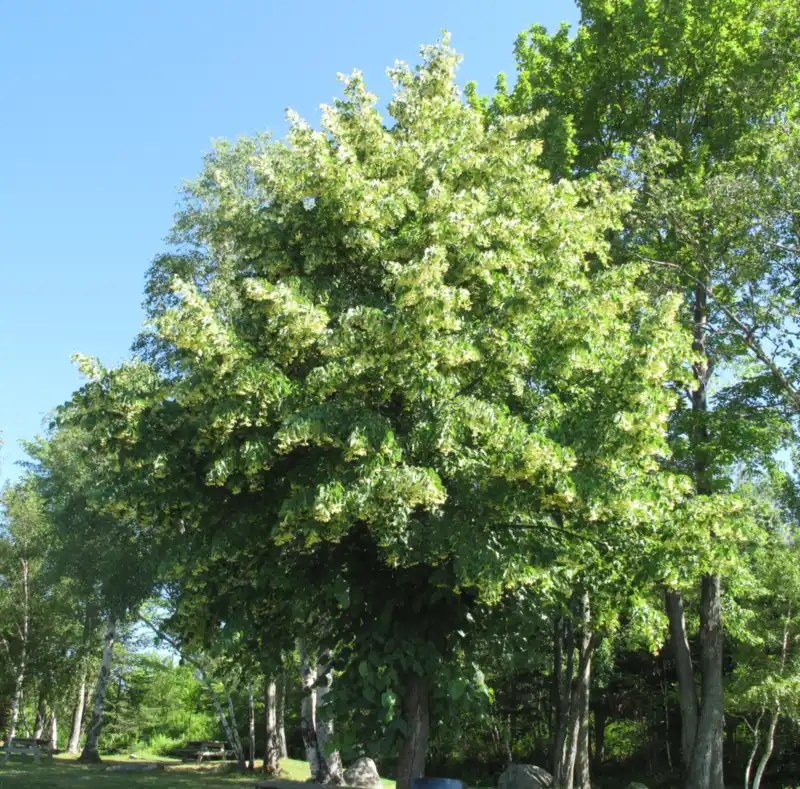
Site, soil and size
- Light: full sun to part shade. Young trees tolerate shade; a mature tree casts enough shade to thin grass beneath it.
- Soil: rich, moist, well-drained loam is ideal. Basswood tolerates clay and alkaline soil, and NC State says it adapts to dry, rocky soils once established.
- Space: plan for 60 to 80 feet tall and 30 to 60 feet wide (Morton Arboretum). Keep it well clear of buildings and power lines.
- Weather risk: the Morton Arboretum rates American basswood highly susceptible to ice damage, and the University of Kentucky notes that its narrow crotches and soft wood make it prone to storm damage.
- Cultivars: NC State lists ‘Redmond’, ‘Boulevard’, ‘Bailyard’ and ‘Continental Appeal’.
Planting, pruning and growth
Most people plant a nursery tree, because seed is slow: the Forest Service says seeds are deeply dormant because of a hard seed coat, and properly treated seed still averages only 20 to 30% germination after 110 to 130 days of cold stratification.
Remove root suckers if you want a single trunk; the University of Kentucky warns that unchecked suckers give you a clump of small trees instead. Basswood grows faster than most other northern hardwoods, the Forest Service says, while the Morton Arboretum calls its growth rate moderate. It is long-lived: estimates of maximum age generally exceed 200 years, and decay becomes more common after about 120 years.
Pests, honeydew and other problems
- Japanese beetles skeletonize linden leaves in summer, and NC State warns that heavy infestations have destroyed mature littleleaf lindens. See our Japanese beetle guide for bee-safe control; silver linden is reportedly less susceptible.
- Aphids and honeydew: linden aphids drip sugary honeydew, and the dark sooty mold that grows on it can coat leaves, cars and patios under the tree. Our aphid guide covers bee-safe options.
- Others: linden borer, lace bugs, scale, leafminers and caterpillars; spider mites in hot, dry weather. Verticillium wilt is rare but can kill a tree.
- Wildlife damage: rabbits, mice and voles girdle young trees, and deer browse twigs.
Basswood belongs on any list of native plants for pollinators for eastern yards. For summer flowers that keep feeding bees after it, pair it with black-eyed Susan.
Basswood Wood and Other Uses
The Forest Service calls basswood wood relatively soft and says it “works exceptionally well and is valued for hand carving.” Illinois Wildflowers lists hand-carved articles, boxes, wooden toys, electric guitar bodies, inexpensive furniture and paper pulp, and the University of Kentucky notes that the white wood is often used for beehive honey frames.
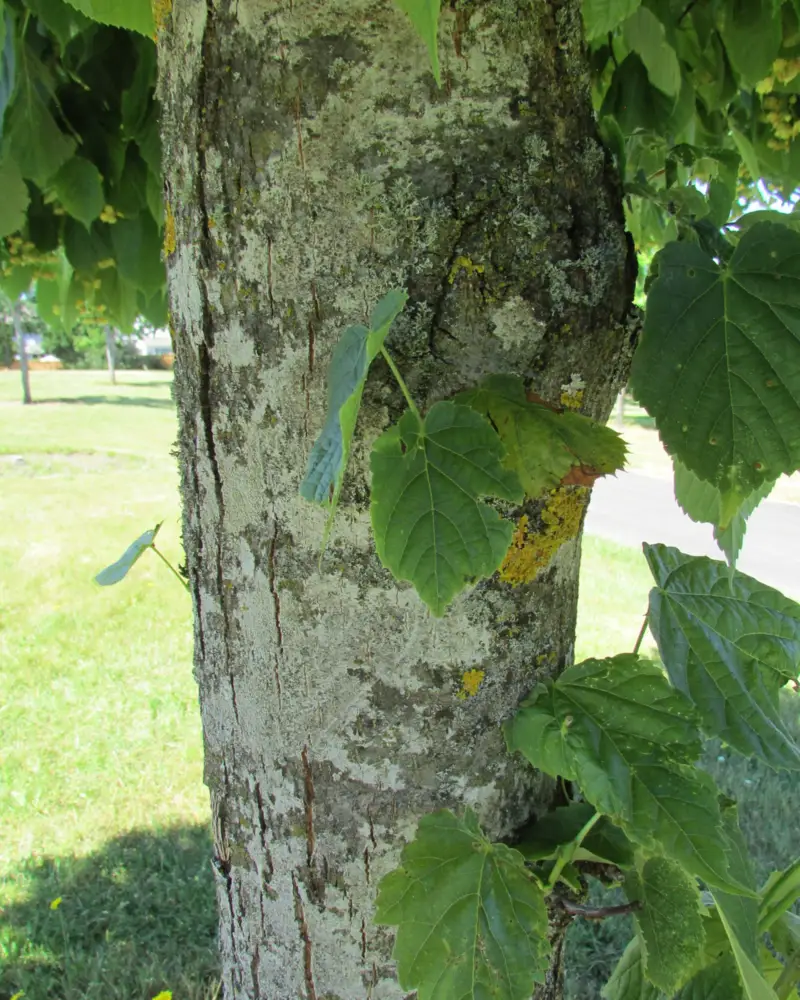
- Bast fiber: the inner bark was stripped for rope, cords, mats, nets and baskets, which is where the name basswood comes from.
- Leaves: the University of Kentucky says the leaves have been eaten by livestock and people, and Ontario’s tree guide notes that the fallen leaves are rich in nutrients.
- Flowers: in Central, Southern and Western Europe, dried linden flowers are a traditional herbal tea (lime or linden tea, tilleul in France), and the University of Kentucky notes they are distilled for perfume. This is traditional use, not medical advice; Koch and Stevenson cite a study that detected caffeine in Tilia flower tea.
For other plants that fill honey supers, see our guide to the best plants for honey production in the USA.
Frequently Asked Questions
When do linden trees bloom?
American basswood blooms for about two weeks, generally in June, sometimes from late May to early July depending on latitude and spring warmth. Littleleaf linden blooms in June to early July, and silver linden is usually the last linden to flower.
How tall does a basswood tree get?
About 60 to 80 feet in landscapes, 30 to 60 feet wide. Forest trees reach 75 to 130 feet, and the Forest Service records exceptional trees of 140 feet.
Is basswood the same as linden?
Yes. Basswood is American linden, Tilia americana. “Linden” also covers the European and Asian species, such as littleleaf and silver linden, which are planted in the US but not native.
Why are linden trees called lime trees?
“Lime” is the British name, an altered form of the Middle English word lind. It is unrelated to the citrus lime.
Are linden trees messy?
They can be. Aphids on lindens drip sticky honeydew that turns black with sooty mold, and the trees shed flowers, bracts and small nutlets. Avoid planting one over a driveway or patio.
How fast do basswood trees grow?
Moderately to fast. The Forest Service says basswood grows faster than most other northern hardwoods; landscape sources such as the Morton Arboretum rate it moderate. Rich, moist soil speeds it up.
Is basswood a hardwood?
Yes. It is a broadleaf hardwood tree, but its wood is light, soft and fine-grained, which is why carvers prize it.
Do bees like linden trees?
Very much. Honey bees, bumble bees, sweat bees, flies and night-flying moths all visit linden flowers, and basswood is one of the most important nectar trees in the northern US.
The Bottom Line
If you have room for a big tree, native basswood is one of the best gifts you can give local bees: two weeks of heavy nectar in early summer and a tree that can outlive you by a century or more. Give it space, keep systemic insecticides off it, and plant late-summer flowers nearby. For more bee trees, see our list of the best trees for bees in the USA, or browse our pollinator gardening and native bee guides.
Image credits: featured photo of American basswood flower clusters by Gilles Ayotte (Université Laval botanical collection), via Wikimedia Commons, CC BY-SA 4.0, cropped. Other photos are credited in their captions. Charts by BeeKeepersRealm from iNaturalist data.