Reviewed by Thomas B. · How we review
Aphids are tiny, soft-bodied insects, 1.5 to 5 mm long, that suck sap from new shoots, buds and the undersides of leaves. They multiply fast, curl leaves and drip sticky honeydew, yet in most gardens they do little lasting harm, and lady beetles, lacewing larvae, hover fly larvae and tiny parasitic wasps eat them. To get rid of aphids, hose them off, prune out the worst shoots, stop the ants that guard them and, only if needed, spot-spray insecticidal soap or horticultural oil. Never use systemic insecticides on plants that are in bloom or about to bloom.
This guide draws on university extension entomologists, published bee research and our own count of iNaturalist records. It is educational information, not professional pest-control advice.
Key Takeaways
- Aphids are true bugs in the family Aphididae. A pair of small tubes on the rear end, called cornicles, sets them apart from every other insect.
- Females can give birth to live young without mating, so a few aphids become a colony within weeks.
- In most cases they cause little or no damage, and the aphids you tolerate feed the predators that protect your garden.
- Work from least toxic up: check, hose, prune, stop the ants, cut back nitrogen, then spot-treat with soap or oil.
- UC IPM gives insecticidal soap no bee precaution, while neonicotinoids such as imidacloprid get its strictest rating.
- In US iNaturalist records, the oleander aphid of milkweed makes up 42% of research-grade aphid observations, and records peak in August.
Table of Contents
- What Are Aphids?
- Aphid Life Cycle: How Fast They Multiply
- Common Aphids in US Gardens
- Signs of Aphids and the Damage They Do
- What US iNaturalist Records Show
- Natural Enemies That Eat Aphids
- How to Get Rid of Aphids
- Aphid Sprays and Bees
- Honeydew, Sooty Mold and Honeydew Honey
- Aphids and Ants
- Aphids on Milkweed and Monarchs
- Woolly Aphids
- Frequently Asked Questions
- The Bottom Line
What Are Aphids?
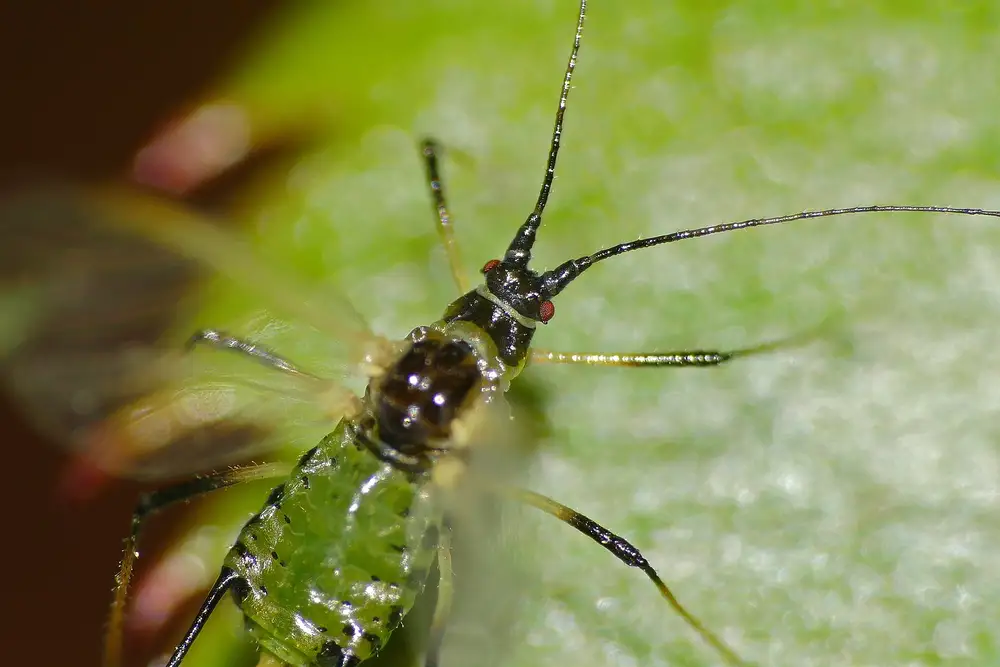
Aphids are small sap-feeding insects in the family Aphididae. They belong to the true bug order Hemiptera, which also holds cicadas and stink bugs. Missouri Botanical Garden counts at least 4,000 aphid species, and Colorado State University Extension says Colorado alone has over 350. All are small, from 1.5 to 5.0 mm, but the garden notes that their color, size and appearance vary too much to generalize.
Every aphid feeds the same way. UC IPM’s Pest Notes: Aphids describes long, slender mouthparts that pierce stems, leaves and other tender plant parts to suck out fluids. Most species also carry a pair of tubelike cornicles that point backward from the hind end.
“The presence of cornicles distinguishes aphids from all other insects.”
Most aphids you see are wingless. Winged adults, called alates, appear when they are needed: Colorado State says more winged forms are produced when colonies get overcrowded, plants decline in quality, or other cues favor moving to new plants. That is how aphids reach a clean plant in the first place.
Aphid Life Cycle: How Fast They Multiply
For most of the season, an aphid colony is all female. UC IPM says that in California’s mild climate most aphids reproduce asexually for most or all of the year, with adult females giving birth to live offspring, often as many as 12 per day, without mating. Nymphs molt about four times and have no pupal stage. In warm weather many species go from newborn nymph to reproducing adult in seven to eight days, and each adult can produce up to 80 offspring in a week.
Other extension figures point the same way. The University of Kentucky says nymphs mature in 7 to 10 days and that less than a dozen aphid “colonizers” can produce hundreds to thousands of aphids on a plant in a few weeks. University of Wisconsin entomologists put a female’s reproductive life at 20 to 30 days and 60 to 100 live nymphs. The University of Minnesota says cabbage aphids can complete up to 15 generations per season.
Outside mild climates, Penn State Extension says aphids generally overwinter as fertilized eggs, laid in fall by mated females. Some species alternate between two host plants, which is why a woolly aphid can vanish from a maple in spring and turn up on alder in summer.
What the video covers: KQED’s Deep Look films an aphid mother pushing out five or six nymphs a day, clones whose own babies are already developing inside them, so they are “born pregnant.” It shows winged clones (alates) forming when the plant gets crowded, ants that treat aphids like dairy cows and guard them, a ladybug attack, and a wasp larva hollowing out an aphid into a mummy. (Summarized from the transcript.)
Common Aphids in US Gardens
Hundreds of species live in the US, but a handful turn up on garden plants again and again. Many are tied to one plant group, so the host is a strong clue to the species.
| Aphid | Scientific name | Typical hosts | Source |
|---|---|---|---|
| Green peach aphid | Myzus persicae | Hundreds of plants, including potato, pepper, cabbage, spinach and many flowers | UMN Extension |
| Melon (cotton) aphid | Aphis gossypii | Cucurbits such as watermelon and cucumber, plus pepper, eggplant and lily | UC IPM; UMN Extension |
| Cabbage aphid | Brevicoryne brassicae | Only cabbage-family plants, such as cabbage and mustard | UMN Extension |
| Potato aphid | Macrosiphum euphorbiae | Potato, spinach, lettuce, tomato and many others | UC IPM |
| Rose aphid | Macrosiphum rosae | Rose | UC IPM |
| Oleander aphid | Aphis nerii | Oleander and milkweed | UC IPM |
| Woolly apple aphid | Eriosoma lanigerum | Apple, pear, pyracantha, hawthorn; often on wood or roots | UC IPM |
Hosts as listed by UC IPM Pest Notes: Aphids and University of Minnesota Extension. Clemson’s Home & Garden Information Center calls the green peach aphid the most common aphid feeding on garden and landscape plants.
Signs of Aphids and the Damage They Do
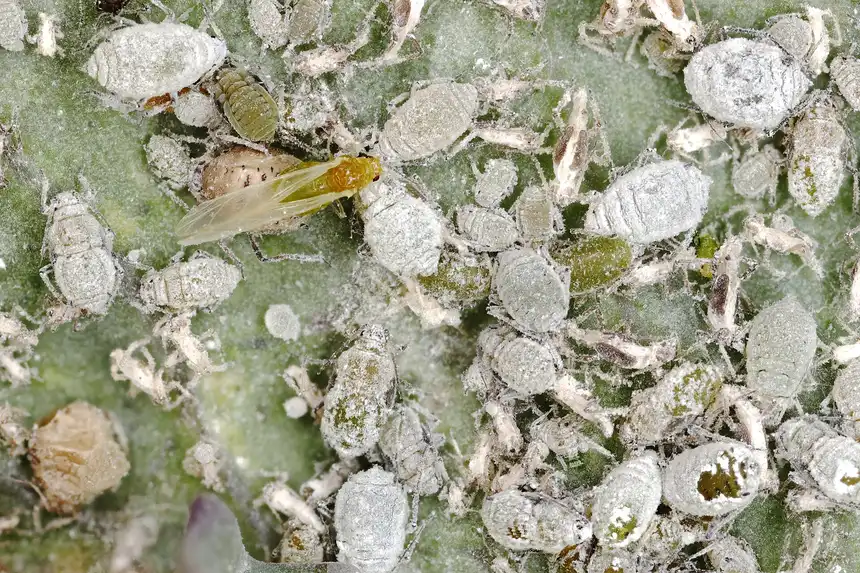
You usually notice aphids in clusters on the newest growth, on flower buds or under leaves. Other signs show up before you spot the insects:
- Sticky, shiny leaves: honeydew, the sugary waste aphids excrete, often with black sooty mold growing on it.
- White flakes: the cast skins aphids shed as they grow, stuck to leaves or honeydew.
- Ants climbing the plant: they come for the honeydew.
- Twisted and curled leaves, yellowed foliage, stunted or dead shoots and poor growth: the symptoms of severe feeding that the University of Minnesota lists.
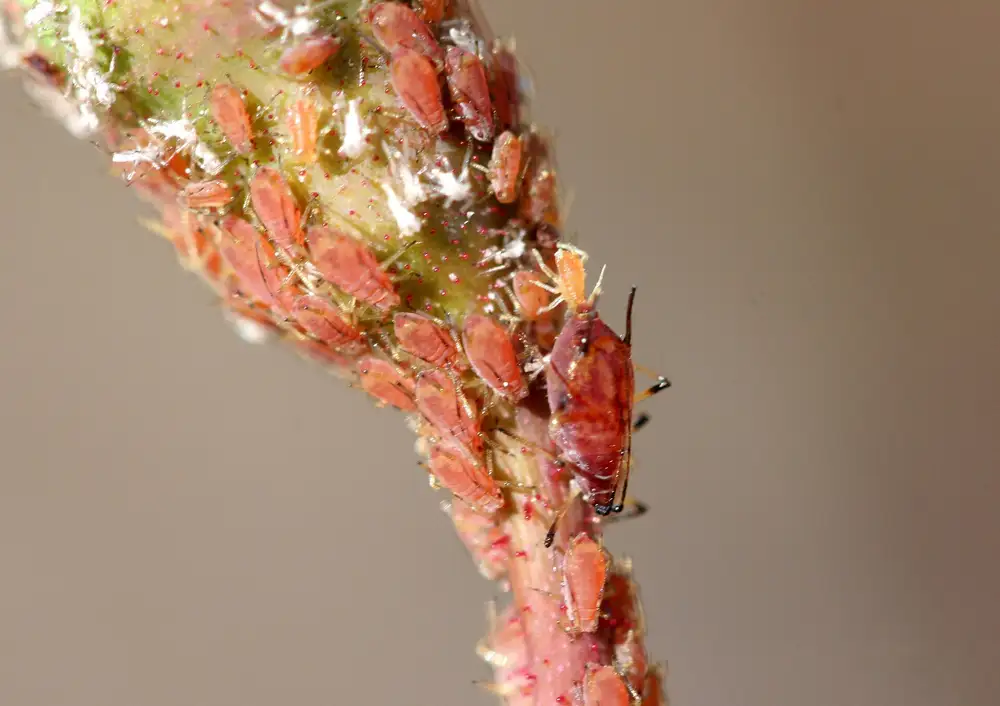
Most of that damage is cosmetic. The University of Minnesota says that in most cases aphids cause little or no damage to the health of plants and that treating them for plant health is usually unnecessary. UC IPM notes that many species do their worst in late spring, when it is warm but not hot (65° to 80°F), and that some heat-intolerant aphids are gone by mid-summer.
Plant viruses are the real exception. UC IPM says it takes only a few minutes for an aphid to transmit a virus, far less time than an insecticide needs to kill it, so spraying rarely prevents infection. Minnesota lists cucumber mosaic virus among those aphids spread, affecting squash, cucumber, melon, beans, tomato and flowers such as petunia and phlox.
What US iNaturalist Records Show
To see which aphids Americans actually notice, we pulled every research-grade aphid (Aphididae) observation in the United States from the iNaturalist API on November 17, 2026: 70,654 records covering 330 species. These are photos people uploaded, not population counts, but the timing and the mix of species are telling.
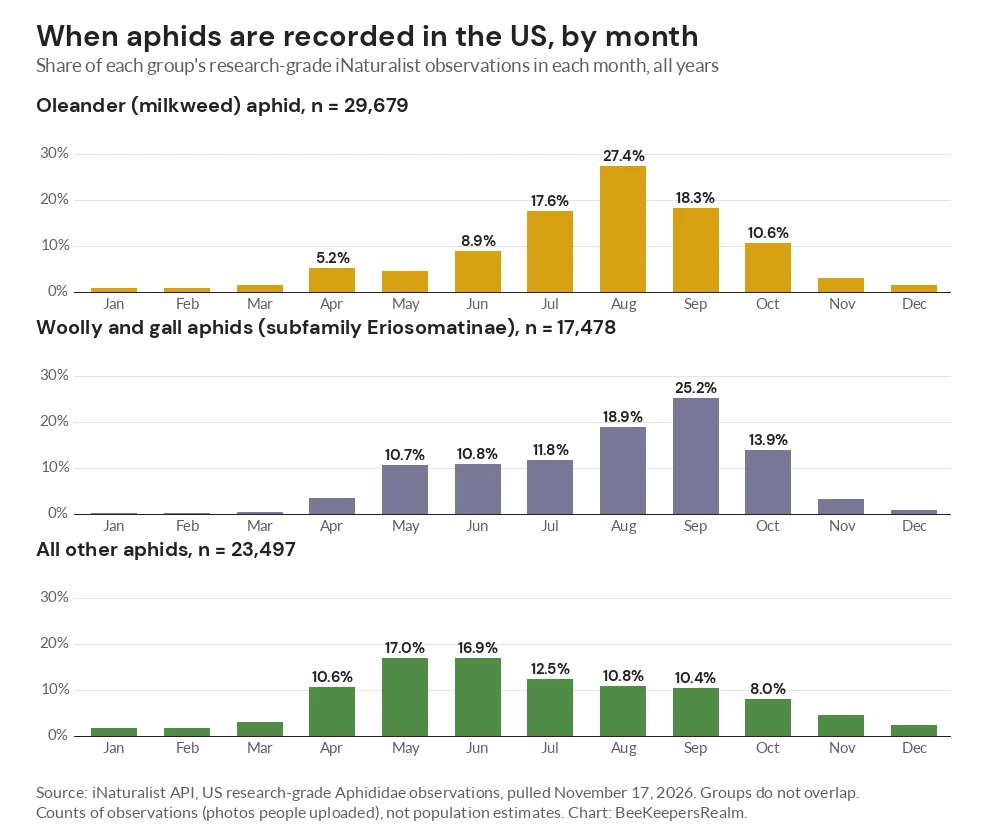
Aphid records climb from April and peak in August, when 13,972 observations were made, against 712 in January. The groups differ, though. Oleander aphid records peak in August (27.4% of the year’s total), woolly and gall aphids in September (25.2%), and all other aphids in May and June (17.0% and 16.9%), which matches extension advice that garden aphids build up in late spring.
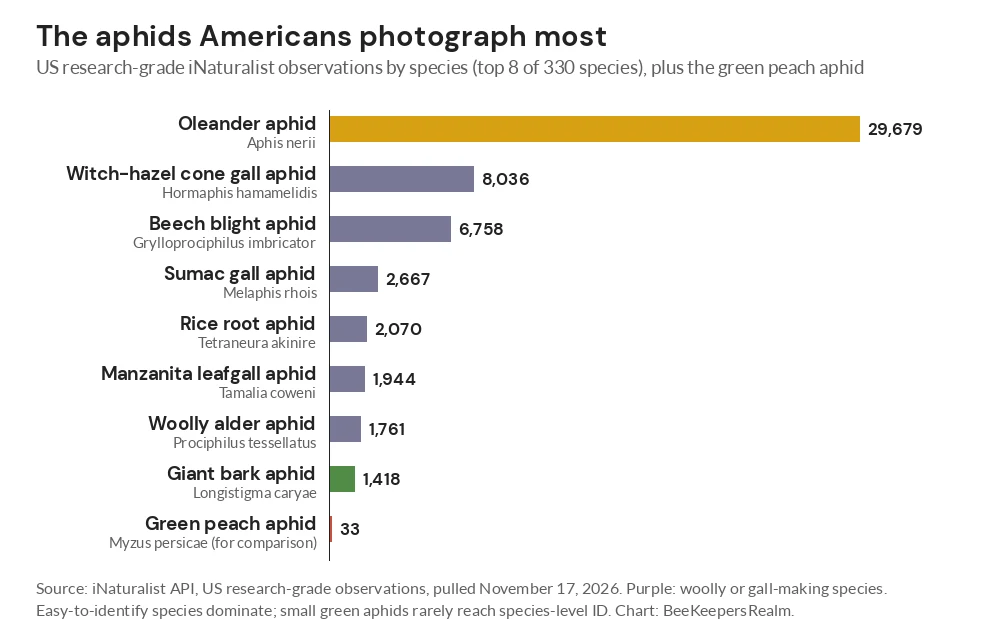
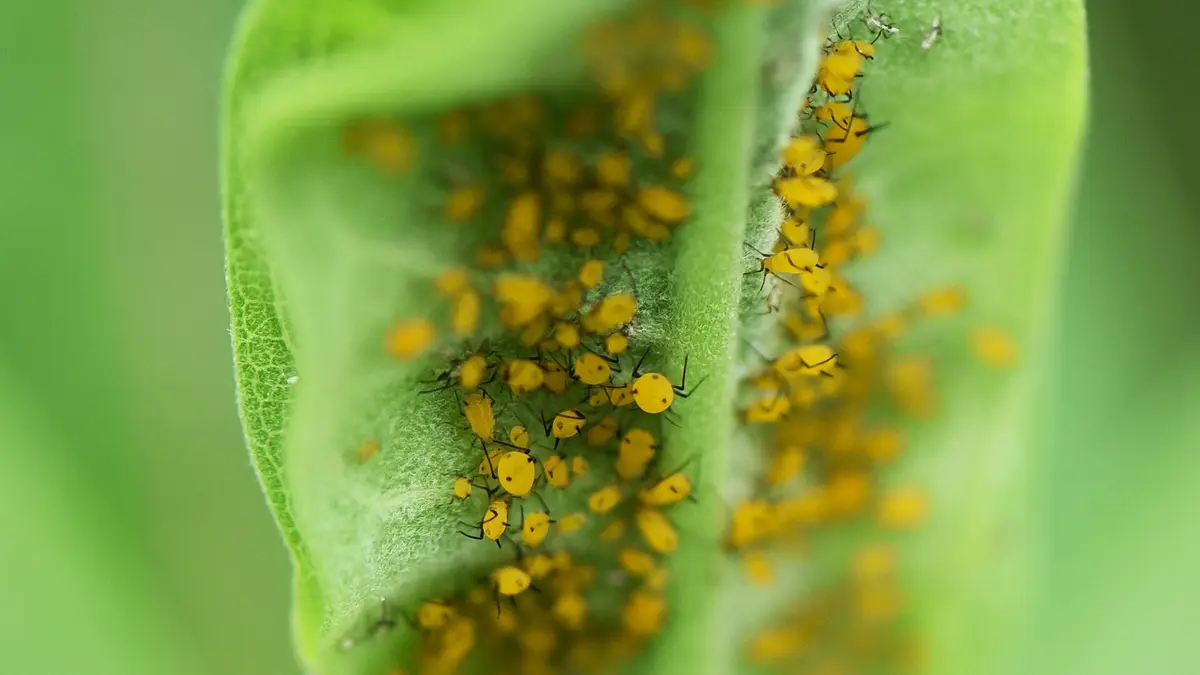
One aphid dominates: the bright yellow oleander aphid, with 29,679 records, or 42% of the total. Six of the next seven are woolly or gall-making species, such as the witch-hazel cone gall aphid (8,036) and the beech blight aphid (6,758). The green peach aphid, which Clemson calls the most common garden aphid, has just 33 research-grade records.
That gap looked implausible, so we checked it. Only 29% of all US aphid observations (70,654 of 242,272) reach research grade, and small green aphids are hard to name from a photo, so most likely stay at genus or family level. Conspicuous colors, galls and wax get identified; plain green aphids do not. Yearly totals also rose from 727 in 2016 to 10,057 in 2023, which reflects more people using the app, not more aphids.
Natural Enemies That Eat Aphids
Aphids are food for a long list of predators and parasites. The University of Maryland Extension notes that “Many predatory insects and songbirds eat aphids and help to lower their populations naturally.”
| Enemy | Which stage eats aphids | How to recognise it | Source |
|---|---|---|---|
| Lady beetles (ladybugs) | Larvae and adults | Larvae have long legs and look like tiny alligators; adults are the familiar ladybugs | UC IPM; UW–Madison |
| Green lacewings | Larvae (adults of some species also hunt) | Elongate, flattened larvae with paired, curved, tubelike mouthparts | UC IPM |
| Hover flies | Larvae | Slug-like, pale green to yellow maggots; adults look like small bees or wasps | UW–Madison |
| Parasitoid wasps (braconids and aphelinids) | Larva, inside the aphid | Crusty, golden brown “mummies,” some with a circular exit hole | UC IPM; UW–Madison |
| Aphid midge | Larvae | Bright orange, slug-like larvae | UW–Madison |
| Soldier beetles | Adults of some genera, such as Cantharis | Soft, flexible wing covers (hence the name leatherwings) | UC IPM |
| Birds | Adults | Small songbirds such as goldfinches and sparrows | UW–Madison |
UW–Madison is the University of Wisconsin–Madison Extension. Not every soldier beetle hunts: UC IPM says adults of Chauliognathus feed only on honeydew, nectar and pollen.
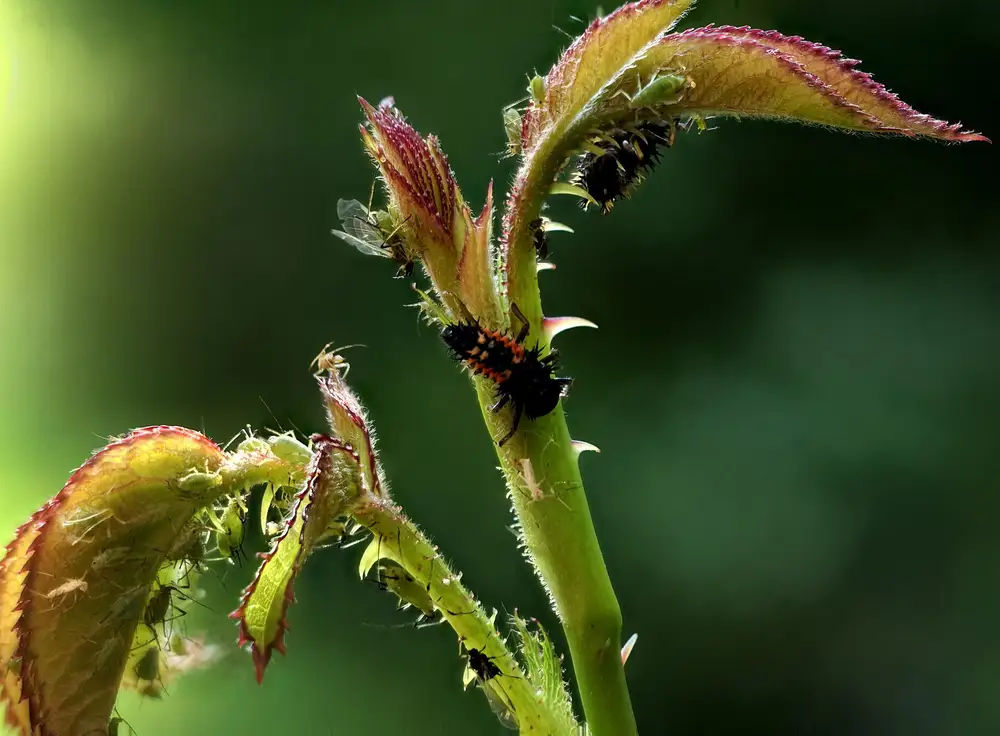
Buying ladybugs rarely pays off. UC IPM says most released convergent lady beetles fly away within 1 or 2 days, even if aphids are plentiful, although each adult can eat about 100 aphids a day before it leaves. Clemson’s advice is to skip the purchase and grow plants that attract lady beetles, such as sunflowers, clovers, liatris and coreopsis.
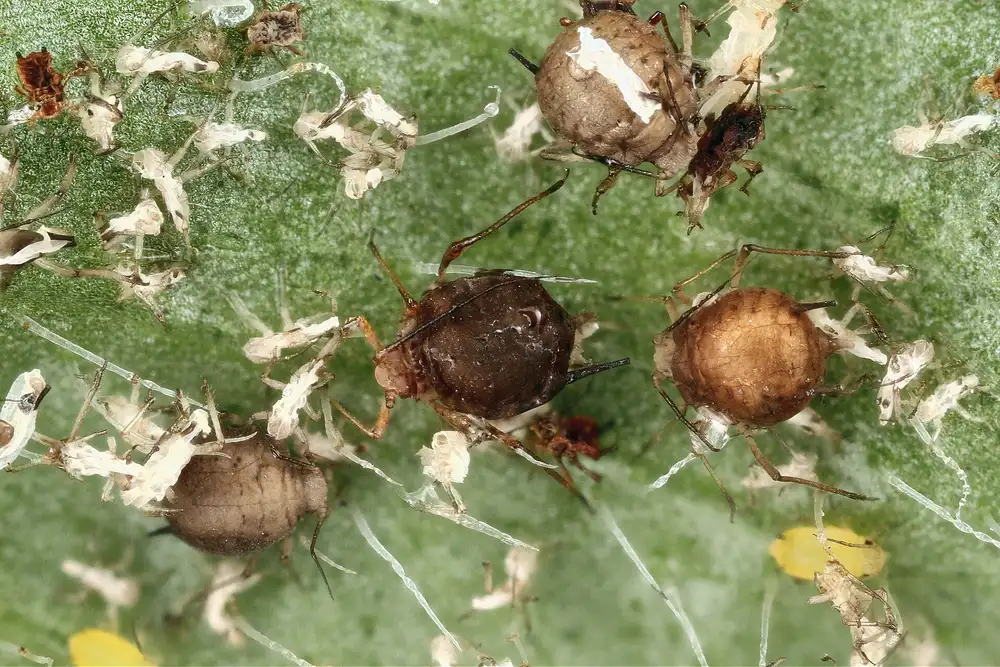
Mummies are good news. UC IPM says that once you begin to see them, the aphid population is likely to be reduced substantially within a week or two, so leave mummified leaves on the plant.
How to Get Rid of Aphids
Extension guides agree on the order: start with the gentlest step and stop as soon as the plant is coping.
1. Check twice a week and tolerate a few
UC IPM suggests checking at least twice a week when plants are growing fast, so you can catch colonies early. The University of Kentucky suggests acting when aphid colonies are on about 5% or more of foliage tips. Below that, let predators work.
2. Knock them off with water
A strong spray from a garden hose knocks aphids off and washes away honeydew. Clemson notes that aphids that fall cannot climb back up and often starve. UC IPM recommends spraying early in the day so leaves dry quickly. Skip this on milkweed that may hold monarch caterpillars.
3. Prune out the worst shoots
Where aphids are confined to a few curled leaves or new shoots, UC IPM says the best control may be to cut those parts off and dispose of them.
4. Stop the ants
Ants guard aphids from predators. UC IPM suggests a sticky band on a trunk wrap (never directly on young or thin bark) or ant stakes and containerized baits on the ground. Our guides to sugar ants and carpenter ants cover baiting.
5. Go easy on nitrogen
UC IPM says high levels of nitrogen fertilizer favor aphid reproduction. Use a less soluble form and apply small amounts through the season.
6. Spot-treat with insecticidal soap or horticultural oil
Insecticidal soap (potassium salts of fatty acids) and narrow-range horticultural oil kill aphids on contact and leave no residue, so they spare predators that arrive later. Spray the aphids directly, since UC IPM says they kill only the aphids present that day. Don’t use them on water-stressed plants or above 90°F, and Clemson suggests mid- to late evening to avoid leaf damage. The University of Maryland warns against home remedies made with household soap or detergent.
7. Avoid broad-spectrum sprays
UC IPM says products such as malathion and permethrin kill the natural enemies that provide long-term control and are associated with bee kills. Kentucky adds that carbaryl may reduce lady beetles and increase the potential for aphid outbreaks.
Aphid Sprays and Bees
Aphid control is where gardeners most often harm bees by accident. UC IPM rates pesticides for bee safety, and the gentle aphid options sit at the safe end.
| Active ingredient | Type | UC IPM bee precaution rating |
|---|---|---|
| Insecticidal soap (potassium laurate) | Contact, no residue | III: no bee precaution unless the label says so |
| Narrow-range oil | Contact, smothering | II: not on flowering plants, except sunset to midnight if the label allows |
| Neem oil and azadirachtin | Botanical | II |
| Beauveria bassiana | Insect-killing fungus | II |
| Pyrethrins | Botanical, broad-spectrum | I: never on or drifting onto flowering plants, including weeds |
| Malathion, carbaryl, bifenthrin | Synthetic, broad-spectrum | I |
| Imidacloprid, dinotefuran, acetamiprid | Neonicotinoid, systemic | I |
Ratings from UC IPM’s Bee Precaution Pesticide Ratings, checked November 2026. The label is the law; follow it where it is stricter.
Systemic insecticides deserve extra caution because the plant spreads them into its flowers. The EPA lists dietary exposure through contaminated pollen or nectar as a main route by which pesticides reach bees. The Xerces Society says imidacloprid can remain active in flowers, shrubs or trees for a year or more, and that residues have been found in woody plants up to six years after a soil drench. UC IPM’s rule is simple: don’t apply imidacloprid or other systemic insecticides to plants in bloom or prior to bloom.
A field study shows why the timing matters. Researchers at the University of Kentucky placed bumble bee colonies on turf with blooming white clover sprayed with the neonicotinoid clothianidin. Nectar from the sprayed clover held 171±44 ppb, and the colonies had delayed weight gain and produced no new queens. The authors found the hazard transitory and note it can be mitigated by mowing off contaminated blooms (Larson, Redmond and Potter, 2013).
In practice: never spray open flowers, including flowering weeds under the plant (the Pacific Northwest Pest Management Handbook advises mowing blooming weeds), treat only the infested shoots, and save any rating II product for dusk. The same handbook notes that some bee-toxic pesticides dissipate over an evening and can be used at bloom if sprayed at dusk, once bees have returned to the hive. Our pollinator-safe pest control guide compares product types.
Honeydew, Sooty Mold and Honeydew Honey
Honeydew is the sticky, shiny waste aphids produce after feeding on sap. The University of Minnesota says it attracts ants, yellowjackets and other insects, and Colorado State adds flies and bees. Honeydew itself does not harm plants, but sooty mold, a black fungus, grows on it, and the drip coats whatever sits below, from leaves to cars. Minnesota says a strong water spray washes off both honeydew and sooty mold.
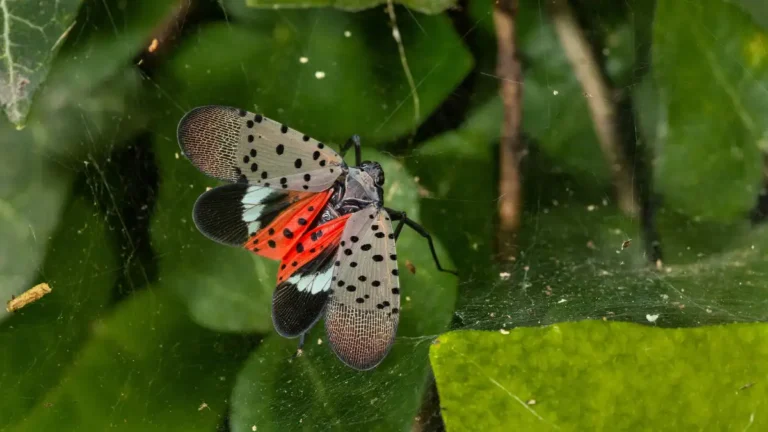
Honey bees sometimes collect honeydew and turn it into honey. The EU honey directive defines honeydew honey as “Honey obtained mainly from excretions of plant sucking insects (Hemiptera) on the living part of plants or secretions of living parts of plants.” Our guide to how bees make honey explains how it differs from blossom honey, and in the eastern US bees make it from the honeydew of the spotted lanternfly, another sap-sucking bug.
Aphids and Ants
Many ants farm aphids for honeydew. They guard colonies from predators, and Texas A&M AgriLife Extension notes that ants also carry aphids to uninfested parts of plants and prey on natural enemies. Wisconsin’s entomologists add that when aphid numbers get high, ants feed some aphids to their larvae, and that ants protect their herds better from ladybugs than from lacewings or hover fly larvae.
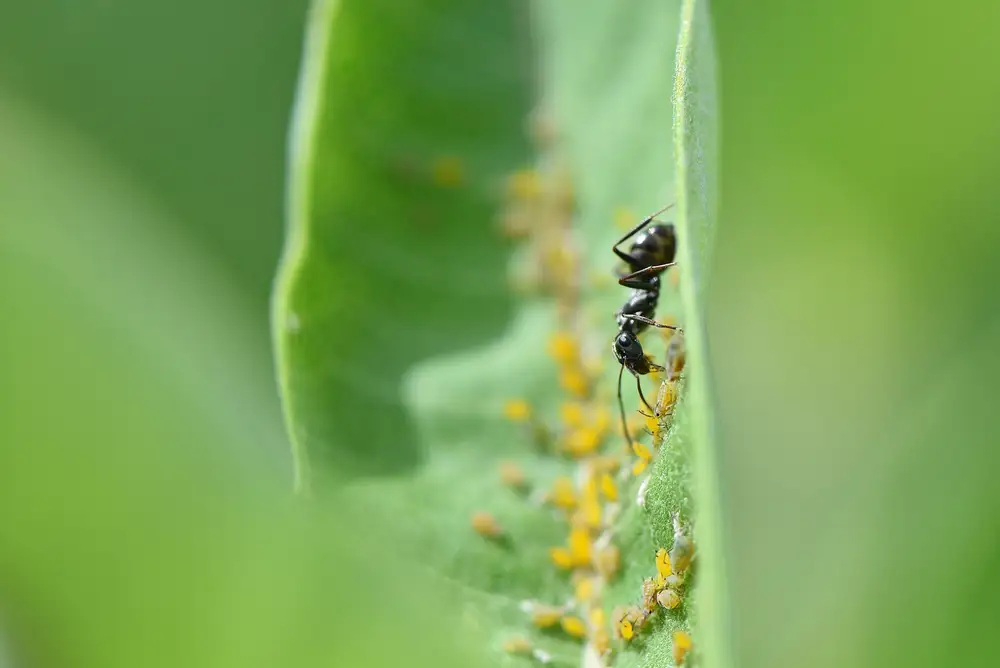
That is why stopping the ants is a real control step. Once the guards are gone, lady beetles and parasitoid wasps can reach the colony.
Aphids on Milkweed and Monarchs
Bright yellow aphids with black legs packed onto milkweed stems are usually oleander aphids. Purdue University calls them a non-native insect commonly found on milkweed and butterfly weed. They take up the plant’s cardenolide toxins, according to South Dakota State University Extension, and the University of Minnesota says they do not cause any damage to the plants.
They don’t eat monarch caterpillars either. The Monarch Joint Venture says aphids harm monarchs only at extremely high densities, though tending ants can sometimes attack small caterpillars. Heavy infestations still matter: a University of Florida study found monarchs laid three times as many eggs on aphid-free tropical milkweed, and caterpillars there ate twice as much leaf material.
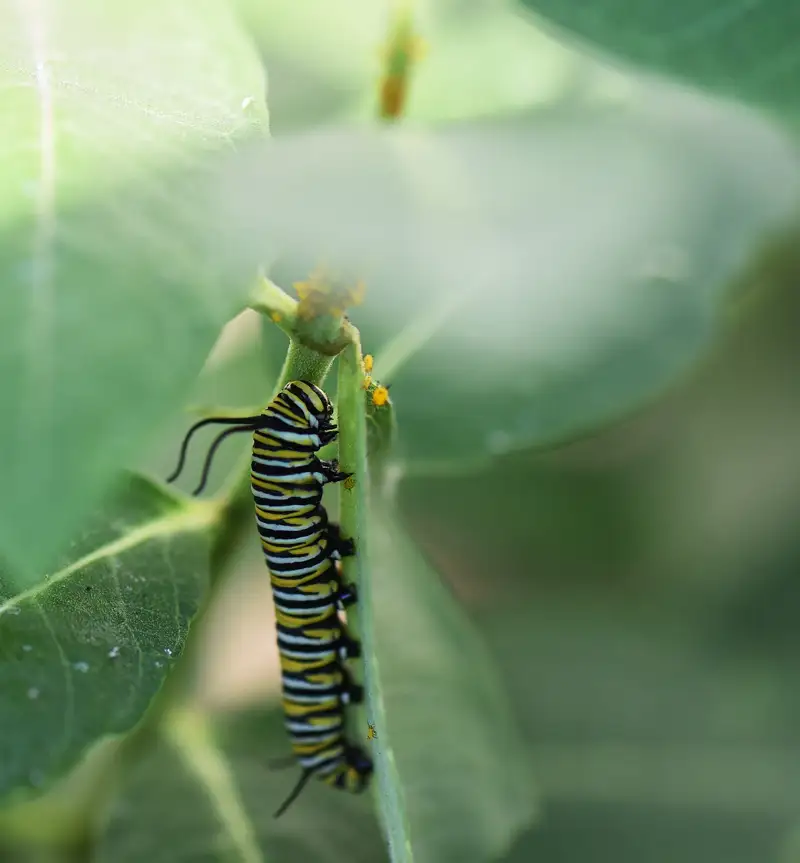
“Overall, it’s more likely that monarchs will be harmed by efforts to remove the aphids than that they will be harmed by the aphids themselves.”
If you must act, check every leaf for monarch eggs and caterpillars first, then squish aphids by hand. South Dakota State advises against high-pressure water because it can wash off caterpillars. The Florida researchers suggest spraying aphids directly with insecticidal soap while avoiding caterpillars and butterflies. South Dakota State notes that spraying the plants would be detrimental to the caterpillars.
Woolly Aphids
Woolly aphids cover themselves in white, waxy filaments that look like cotton. Many alternate between two host plants: the University of Minnesota says the woolly alder aphid forms dense white masses on silver maple in early spring and on alder twigs in summer. They produce large amounts of honeydew, but the damage mostly affects a plant’s appearance.
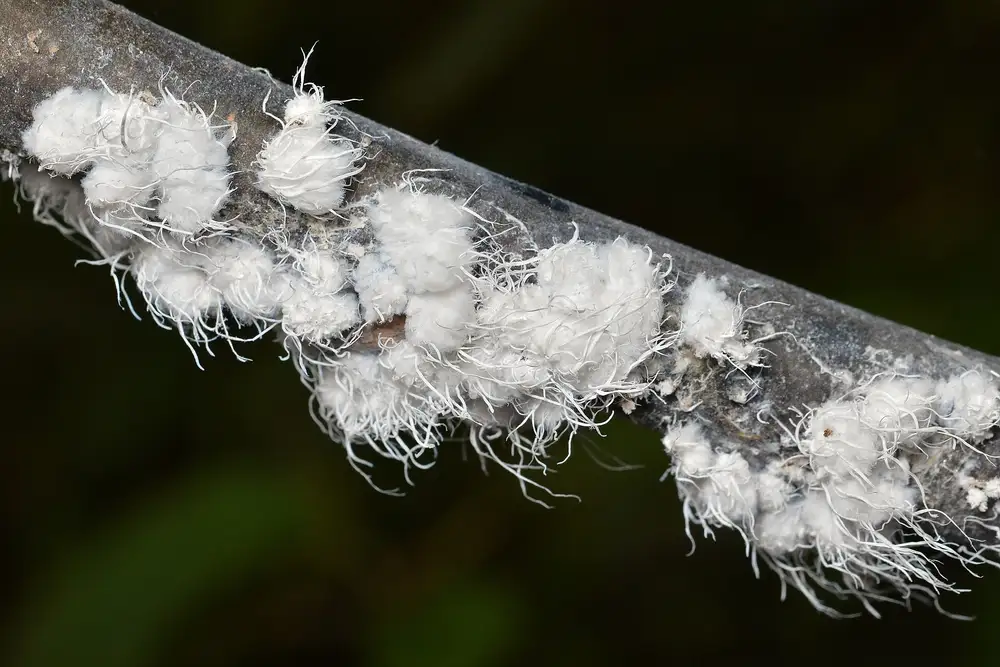
The wax protects them. Minnesota says woolly aphids are not affected by horticultural oils and soaps the way other aphids are, and UC IPM notes that contact sprays also fail on aphids sheltered in galls or curled leaves. Minnesota names systemic insecticides as the most effective option when treatment is truly needed, so the bee rules above apply: never on trees or shrubs in bloom or about to bloom. For most woolly aphids, pruning or simply waiting is enough.
Frequently Asked Questions
What causes aphids on plants?
Winged aphids fly in from other plants, often when their home colony gets crowded. Soft, fast-growing shoots attract them, and UC IPM says high nitrogen fertilizer favors their reproduction. Ants that protect them from predators let colonies grow larger.
Do ladybugs really eat aphids?
Yes. Both larvae and adults eat aphids, and UC IPM estimates a convergent lady beetle adult eats about 100 a day. Store-bought ladybugs mostly fly away within 1 or 2 days of release, so the wild ones already in your garden do more of the work.
Will aphids go away on their own?
Often, yes. Predators and parasitic wasps usually catch up, and UC IPM notes that some heat-intolerant aphids are gone by mid-summer. Mummies on the leaves mean the colony is likely to drop within a week or two.
Is dish soap safe for killing aphids?
Extension specialists advise against it. The University of Maryland warns against home remedies made with household soap or detergent. Use a labeled insecticidal soap, which is made for plants.
Can aphids kill a plant?
Rarely. Minnesota says aphids usually cause little or no damage, but severe feeding can stunt or kill shoots. Some aphids spread plant viruses, which can be more serious than the feeding itself.
Are aphids bad for bees?
Not directly. Bees may even collect their honeydew. The risk to bees comes from aphid sprays, especially systemic neonicotinoids, which can reach pollen and nectar.
What is the white fuzzy stuff on my tree?
White cottony masses on twigs, leaves or bark are often woolly aphids, which coat themselves in wax. They make lots of honeydew but mostly affect the plant’s appearance.
The Bottom Line
Aphids look alarming because they breed so fast, but most plants shrug them off, and the predators they feed are the garden’s best defense. Check often, hose and prune first, stop the ants and save soap or oil for spot treatments. Keep systemic insecticides away from anything in flower, and leave the yellow aphids on milkweed alone unless monarchs are losing out. Browse more garden and household insects in our guides.
Image credits: featured photo of oleander aphids on common milkweed by Courtney Celley, U.S. Fish and Wildlife Service (Wikimedia Commons), public domain, cropped. Other photos are credited in their captions; all via Wikimedia Commons, resized. Charts by BeeKeepersRealm from iNaturalist data.