Reviewed by Michael R. · How we review
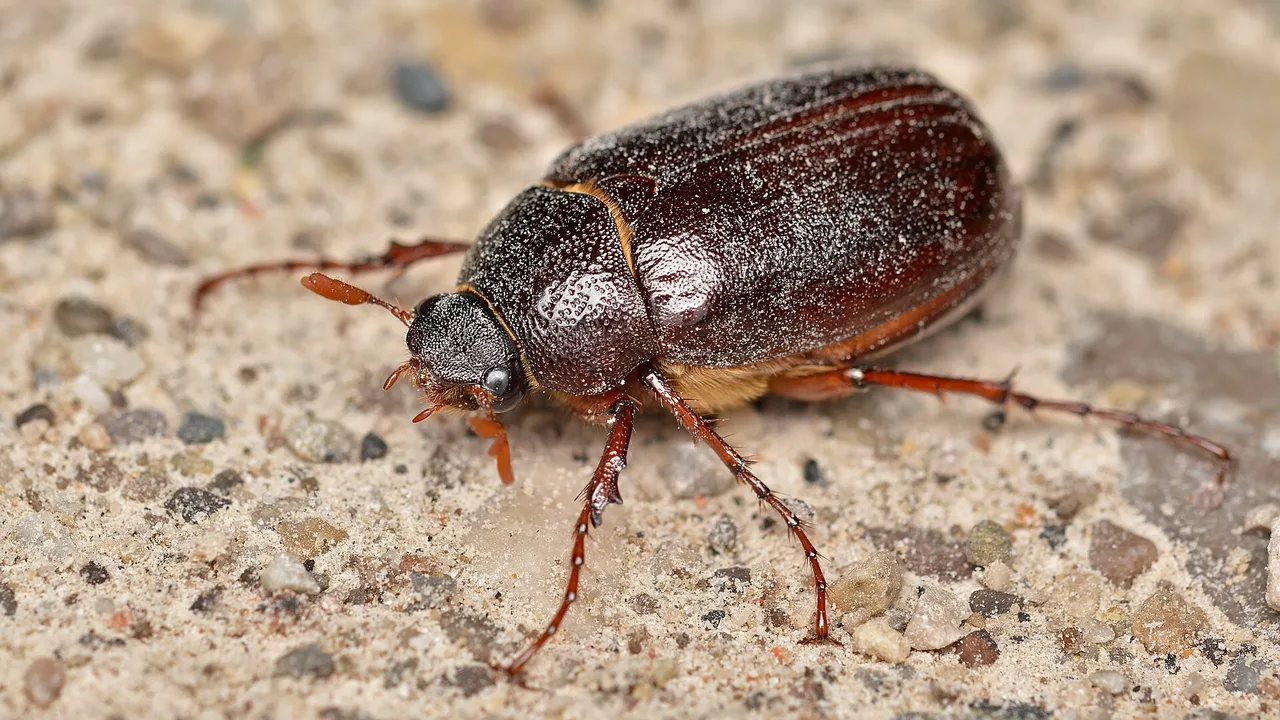
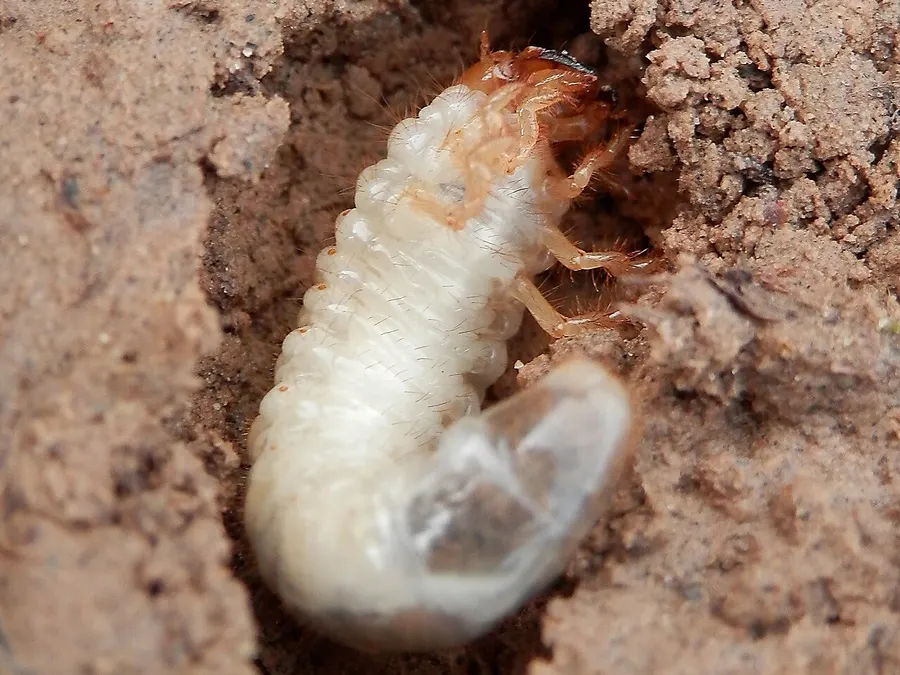
A June bug is not one insect: it is the common name for several brown or green scarab beetles that appear in late spring and summer, mostly the May/June beetles of the genus Phyllophaga. The adults blunder into lit windows at night and cannot hurt people. Their C-shaped larvae, called white grubs, live in the soil and can kill patches of lawn once they reach about four or five per square foot.
Every fact below is credited to a named extension service or state agency; the monthly counts are our own pull of iNaturalist records. We make no claim of first-hand experience, and the pesticide notes are general information, not label instructions.
Key Takeaways
- “June bug” covers hundreds of Phyllophaga species plus the green June beetle (East), the figeater (Southwest) and the ten-lined June beetle (West).
- They cannot hurt people (Missouri Department of Conservation), and adult leaf feeding is infrequent (UW–Madison Extension).
- The name runs late: 52% of 26,665 US iNaturalist records of Phyllophaga fall in April and May. Green June beetles peak in July.
- Count before you treat. Clemson’s usual threshold for May/June beetle grubs is four to five per square foot.
- Milky spore does not work on May or June beetle grubs (University of Kentucky).
- Before any grub insecticide, mow off clover and dandelion flowers so bees are not foraging on treated turf (Purdue).
Table of Contents
- What Is a June Bug?
- Which June Bug Did You Find?
- When June Bugs Are Seen: Records by Month
- June Bug Life Cycle
- Are June Bugs Harmful?
- June Bug Grubs in the Lawn
- How to Control June Bug Grubs
- Protecting Bees When You Treat for Grubs
- Frequently Asked Questions
What Is a June Bug?
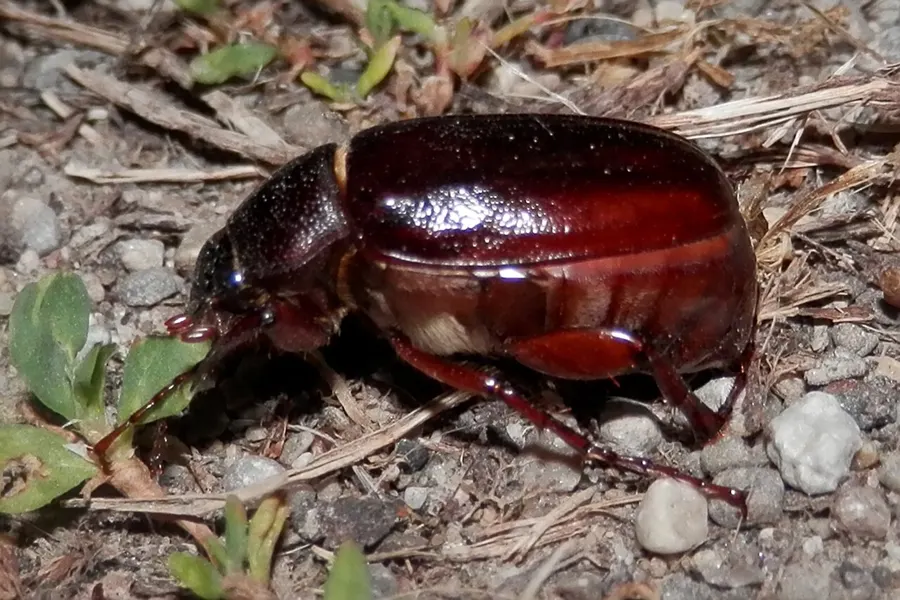
“June bug,” “June beetle” and “May beetle” are folk names for heavy-bodied scarab beetles (family Scarabaeidae), mostly in Phyllophaga, a genus whose name means “leaf eater.” The Missouri Department of Conservation (MDC) counts more than 400 species north of Mexico and says they are hard to tell apart; UW–Madison Extension says over 200. They are beetles, not true bugs, which is why entomologists avoid the name; it is the same muddle that explains why a bee is an insect but not a bug.
Which June Bug Did You Find?
| Beetle | Size / colour | Where in the US | When adults fly | Adult damage | Grub damage | Source |
|---|---|---|---|---|---|---|
| May/June beetles (Phyllophaga spp.) | 1/2 to 1 in; brown, no spots or stripes | Throughout the US | Night, mainly May and June; drawn to lights | Tree and shrub leaves; infrequent | Roots for 2 to 3 years; over 7 per sq ft can strip roots | Clemson, MDC, UW–Madison |
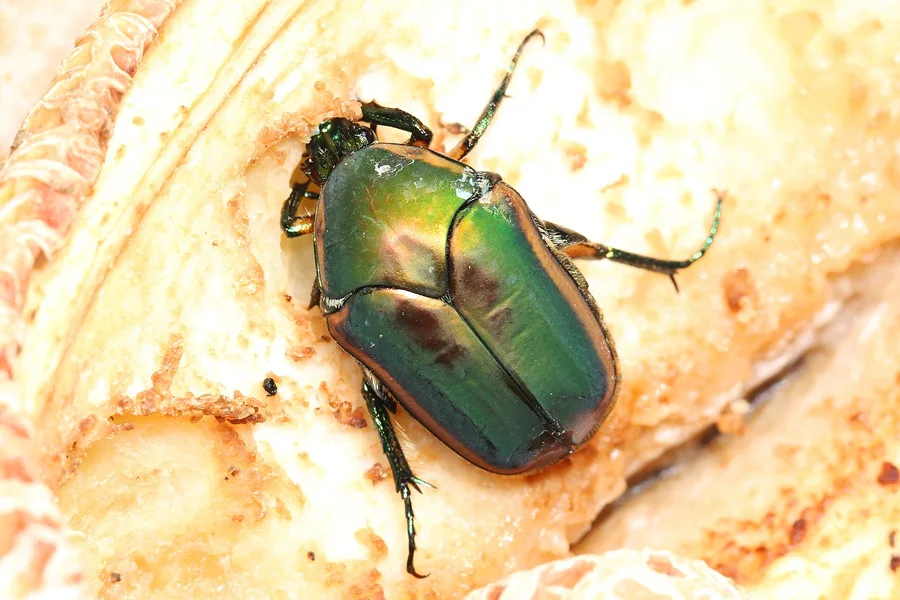
| Green June beetle (Cotinis nitida) | 3/4 to 1 in; forest green, tan edges, metallic green underside | Eastern half | Day, mid-June to early August | Ripe soft fruit such as figs and peaches | Mostly eats organic matter; tunnels and soil mounds | Clemson, Texas A&M, UKy |
| Figeater (Cotinis mutabilis) | 3/4 to 1 1/3 in; metallic green, tan edges | California and the Southwest | Late spring to early fall | Occasional pest of ripe figs, grapes, peaches | None; grubs live in compost and manure | UC IPM, Wikipedia |
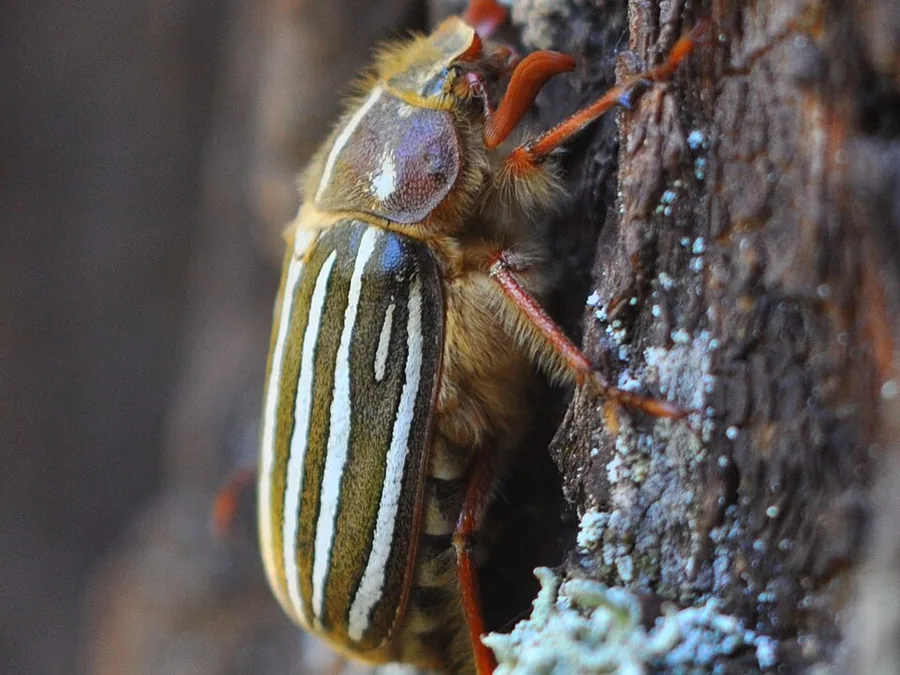
| Ten-lined June beetle (Polyphylla decemlineata) | 22 to 30 mm; white-striped wing covers | West | Late June to early August; males to lights | Rarely noticeable | Roots; rarely serious | Colorado State, Wikipedia |
| Japanese beetle (Popillia japonica) | 3/8 to 7/16 in; metallic green, coppery wing covers, white tufts | Most states east of the Mississippi | Day, from late June | Leaves, flowers, fruit of 300+ plants | A top lawn grub in Kentucky | UKy, Clemson |
| Masked chafers (Cyclocephala spp.) | About 1/2 in; red-brown, darker head | Eastern lawns | Dusk and night, late June to early August | None; adults do not feed | Major lawn grub; 40+ per sq ft is fairly common | UKy, Clemson |
Green versus brown is the quickest split. A big green beetle buzzing low over the lawn by day is a green June beetle or a figeater; a small green-and-copper one with white side tufts is a Japanese beetle, covered in our Japanese beetle guide. Brown beetles at night are Phyllophaga or the half-size masked chafers.
When June Bugs Are Seen: Records by Month
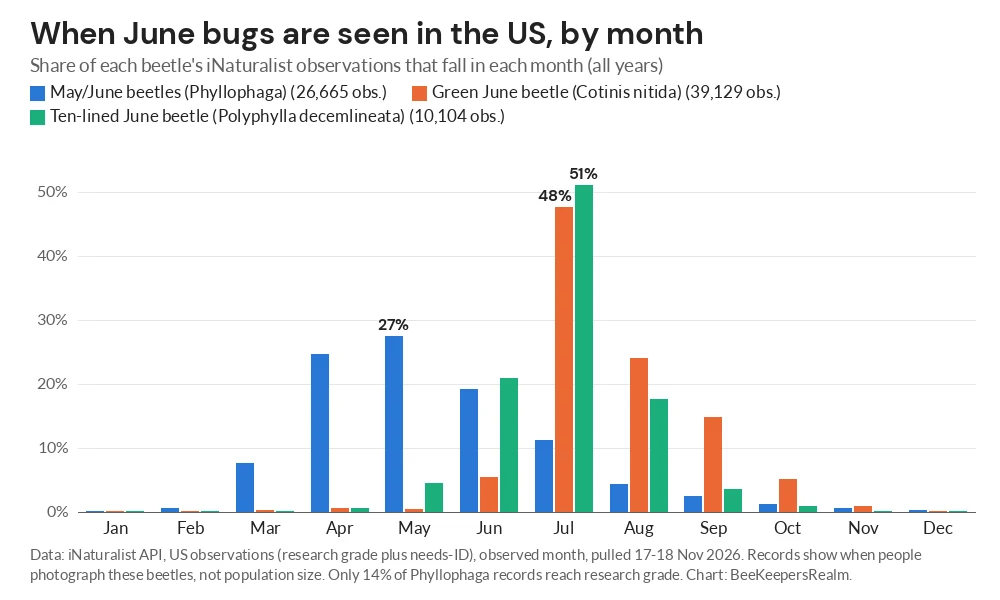
We pulled every verifiable US iNaturalist observation of the three native June beetles (17 November 2026). Phyllophaga is mostly a spring insect: 52% of 26,665 records fall in April and May, only 19% in June. Green June beetles (39,129 records) and ten-lined June beetles (10,104) peak in July, with 48% and 51% of records. Of 1,516 green June beetle records annotated as larvae, 57% are from September and October, when the big grubs surface at night (Clemson).
We used all verifiable records because only 3,859 Phyllophaga records (14%) reach research grade; most May beetles cannot be named to species from a photo, and in a sample of 200 recent research-grade records, more than 60% came from Colorado or Texas. Records show when people photograph beetles, not how many there are.
June Bug Life Cycle
Phyllophaga females lay 15 to 20 eggs 1 to 8 inches deep, mostly in sod near wooded areas. Grubs hatch in about three weeks, eat roots and decaying plants, and sink as deep as 5 feet for winter (University of Florida, UF). The cycle takes two to three years, mostly as a third-stage grub (Clemson); UF says one to four, depending on species. Green June beetles, masked chafers and Japanese beetles need one year (UKy), as does the figeater (UC IPM).
Are June Bugs Harmful?
“Though they chew plants, they cannot hurt people.”
A handled ten-lined June beetle may hiss by forcing air from its breathing pores, but Colorado State still calls it harmless. Phyllophaga adults can chew oak leaves, though UW–Madison says that is infrequent and local. Green June beetles cluster on ripe peaches and plums; Texas A&M calls them mostly harmless in town unless you grow figs or peaches. The real damage is underground.
June Bug Grubs in the Lawn
The University of Kentucky (UKy) lists the signs: grass thins and yellows in August and September, the turf feels spongy and sod lifts like a carpet. Skunks, raccoons or moles digging can point to grubs. So can dark wasps hovering over the lawn in late summer, especially for green June beetle grubs; they include scoliid wasps hunting the grubs, which normally will not sting people (UKy).
To check, cut three sides of a 12-inch square, fold the sod back and count grubs in the top 1 to 3 inches of soil. Repeat in several spots and average (Clemson HGIC). A few grubs are normal (UKy).
| Grub | Level that calls for action (per sq ft) | Notes | Source |
|---|---|---|---|
| May/June beetle | 4 to 5 | More than 7 can cause complete root loss | Clemson |
| Masked chafer | 8 in stressed turf | Well-managed turf may tolerate 20 | Clemson |
| Japanese beetle | 6 to 8 | Healthy turf usually tolerates 10 | Clemson |
| Green June beetle | More than 5 to 7 | Damage comes from tunneling | Clemson |
| Mixed or unknown | 5 to 10 | Depends on species | Penn State |
How to Control June Bug Grubs
UW–Madison says control is rarely warranted without a history of damage, and the multi-year cycle means not every year. These notes are educational, not professional advice; follow the product label.
Lawn care and timing. Deep watering helps damaged turf recover, and fall nitrogen builds roots (UKy). For green June beetles, reduce thatch (Ohio State); for figeaters, UC IPM recommends no insecticide, only managing compost and manure. Treat small grubs, in early to mid August in Kentucky (UKy) or August to mid-September in Pennsylvania (Penn State). Spring treatment usually fails because overwintered grubs are large (UKy).
Biological options. UKy advises nematode products with Heterorhabditis bacteriophora, applied to moist soil; Penn State calls results inconsistent. Milky spore is the wrong tool:
“Other grub species (e.g., masked chafers, May beetles, June beetles) are unaffected by the strain of bacteria contained in the products, which further reduces their usefulness.”
Insecticides. Clemson lists imidacloprid, chlorantraniliprole, clothianidin and trichlorfon as active ingredients labelled for lawn grubs. Water them in with 1/2 to 1 inch of water and keep people and pets off until the grass is dry (UKy).
Protecting Bees When You Treat for Grubs
Grass is not the bee risk; flowering weeds in the lawn are. Purdue’s turfgrass entomology specialist gives the simplest fix:
“Mow the turf immediately before spraying any insecticide. Mowing will remove ≥ 90% of the flowers and reduce pollinator foraging.”
Purdue adds that neonicotinoids can move into nectar and pollen, so keep the flowers mowed, and leave a 2 to 3 foot untreated strip beside flower beds. Toxicity to honey bees varies widely:
| Active ingredient | Class | Honey bee LD50 (µg per bee) |
|---|---|---|
| Imidacloprid | Neonicotinoid | 0.0037 |
| Clothianidin | Neonicotinoid | 0.004 |
| Trichlorfon | Organophosphate | >0.4 |
| Chlorantraniliprole | Diamide | >4 |
Lower numbers mean more toxic (Purdue E-267, Table 1, IUPAC data). For product choice in general, see our pollinator-safe pest control guide. Treating less also spares grub enemies such as Tiphia wasps and the pelecinid wasp (UF).
Frequently Asked Questions
Do June bugs bite or sting?
No. MDC says they cannot hurt people. A ten-lined June beetle may hiss when picked up, but it is harmless (Colorado State).
Why are June bugs attracted to lights?
Extension sources record the habit without explaining it. May beetles and masked chafers fly to porch and street lights (UKy); in ten-lined June beetles it is mainly males (Colorado State). Green June beetles fly by day.
How long do June bugs live?
Mostly underground: one to four years for Phyllophaga, most of it as a grub (UF, Clemson). Green June beetles and figeaters take one year.
Why are they called June bugs?
MDC says they are named for the months they are most numerous. In our iNaturalist pull, May is the Phyllophaga peak.
What do June bugs eat?
Adult May beetles eat leaves and flowers; grubs eat roots and decaying plants (MDC). Green June beetles eat ripe fruit and tree sap (Texas A&M).
Where do June bugs lay their eggs?
In soil: Phyllophaga 1 to 8 inches deep, often near wooded areas (UF). Green June beetles favor soil rich in compost or manure (Texas A&M).
Is a June bug the same as a Japanese beetle?
No. A Japanese beetle is smaller, with white hair tufts along its sides (UKy). Both have lawn-damaging grubs, but milky spore products target only Japanese beetle grubs (Penn State).
The Bottom Line
A June bug at the window is harmless; the grubs are what to watch. Count before you treat and mow flowers first. Browse more garden and household insects, or see how to turn part of a lawn into pollinator habitat.
Image credits: Featured photo: May beetle (Phyllophaga sp.), Guelph, Ontario, by Ryan Hodnett, CC BY-SA 4.0, via Wikimedia Commons. Photos were cropped and resized.
Sources: Missouri Department of Conservation; UW–Madison Extension; University of Kentucky ENT-10; Clemson HGIC; Penn State Extension; Purdue Extension E-267; Ohio State BYGL; Texas A&M Insects in the City; UC IPM; Colorado State University (via Bugwood); University of Florida EENY-045; iNaturalist.