Reviewed by Daniel M. · How we review
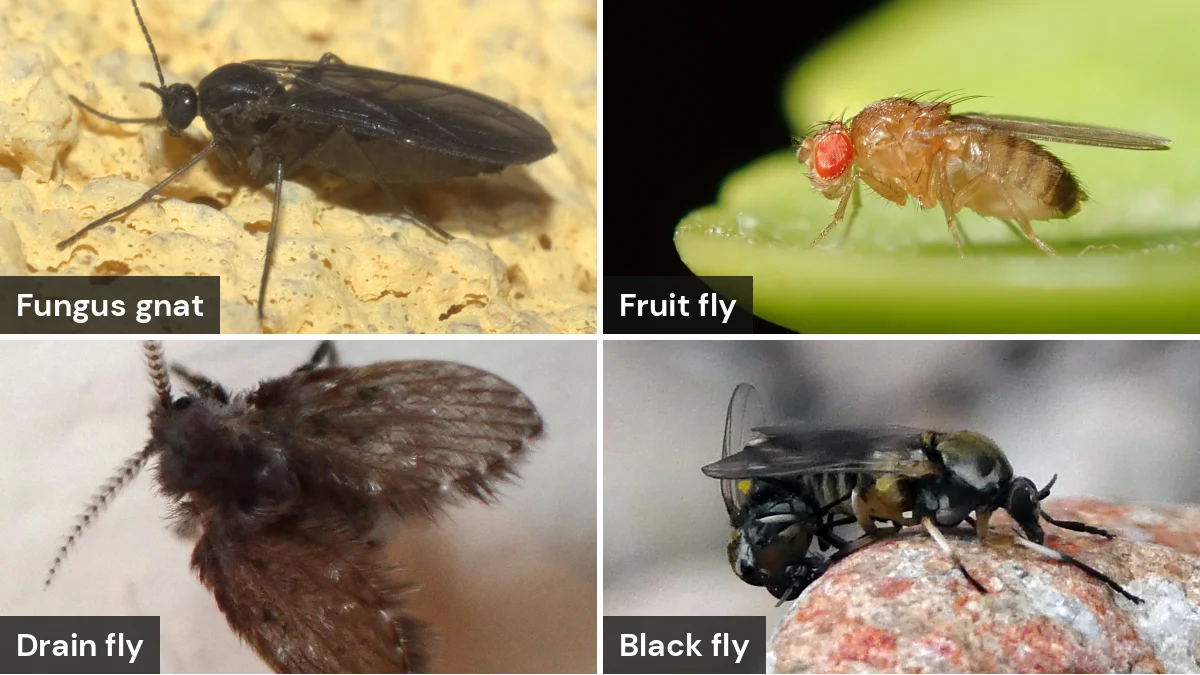
Gnats are not one kind of insect. “Gnat” is an everyday name for many tiny flies. Indoors they are usually fungus gnats from damp houseplant soil, fruit flies from ripe or fermenting food, drain flies from the slime inside drains, or phorid flies from rotting matter. Outdoors, the gnats that bite are black flies and biting midges (no-see-ums). Each kind breeds somewhere different, so the fix is to find and remove that breeding spot; traps and sprays only deal with the adults.
This guide draws on US extension services, the EPA and MedlinePlus, linked where we use them, plus our own count of iNaturalist records. We make no claim of personal experience with these insects. It is general information, not medical advice. Always follow a pesticide’s label.
Key Takeaways
- “Gnat” is not a scientific group. Kentucky Extension names four common indoor small flies: fruit flies, fungus gnats, drain flies and phorid flies. None of them bites.
- Where they gather is the best clue: houseplants mean fungus gnats, the fruit bowl or trash means fruit flies, bathroom walls near a drain mean drain flies.
- For fungus gnats, let the top 1 to 2 inches of potting mix dry between waterings (Colorado State).
- For drain flies, scrub the drain with a stiff brush and flush it with hot water. Texas A&M says bleach does little against the film the larvae live in.
- Bti, a bacterial larvicide, targets the larvae of fungus gnats, black flies and mosquitoes. The EPA says it has minimal toxicity to honey bees.
- In our count of 5,147 US iNaturalist black fly records, 40.7% fall in April and May.
Table of Contents
- What Are Gnats?
- Which Gnat Do You Have?
- Why Are There Gnats in My House?
- When Gnats Show Up: iNaturalist Records
- Fungus Gnats in Houseplants
- Fruit Flies
- Drain Flies (Moth Flies)
- Phorid Flies
- Biting Gnats: Black Flies and No-See-Ums
- Gnats, Bees and Pollinators
- Frequently Asked Questions
What Are Gnats?
PestWorld, the National Pest Management Association’s site, says gnats are not an official group or species, and Wikipedia calls the word “a loose descriptive category.” Entomologists mostly use it for small, slender flies in the suborder Nematocera. At home, people use it for almost any tiny fly, including fruit flies and phorid flies.
Kentucky says these small indoor flies do not bite or transmit diseases, but they can carry bacteria onto food. Texas A&M AgriLife says they are generally under 1/8 inch (4 mm) long and can all breed entirely indoors.
Which Gnat Do You Have?
Start with where the gnats gather, then check how they look and move.
| Gnat type | Looks / flight | Where you see it | What it breeds in | Bites? | Source |
|---|---|---|---|---|---|
| Fungus gnat (Sciaridae) | Dark, delicate and mosquito-like; 1/16 to 1/8 in; a weak flier | On and around houseplants, and at nearby windows | Moist potting mix rich in organic matter | No | UC IPM, Texas A&M |
| Fruit fly (Drosophilidae) | Stout; brown-black body with red or black eyes; about 1/8 in | Fruit bowls, kitchens, trash and recycling bins | Overripe or fermenting produce, spilled juice, wine or beer | No | Kentucky, Texas A&M |
| Drain fly, or moth fly (Psychodidae) | Fuzzy and moth-like; 1/16 to 3/16 in; short, hopping flights | Resting on walls near sinks, tubs and floor drains | The slimy film in drains, rarely used toilets and drain pans | No | Kentucky, Texas A&M |
| Phorid fly (Phoridae) | Humpbacked; about 1/8 in; runs over surfaces instead of flying off | Garbage, drains and leaking appliances | Moist, decaying matter, including soil soaked by sewer leaks | No | Kentucky, Texas A&M |
| Black fly, or buffalo gnat (Simuliidae) | Stout, dark and humpbacked; 1/16 to 1/8 in; swarms around the head | Outdoors near rivers and streams, mostly in spring | Rivers, streams and other running water | Yes, females | Minnesota, Illinois |
| Biting midge, or no-see-um (Ceratopogonidae) | Minute, usually under 1/8 in; passes through porch screens | Outdoors near ponds, swamps and wet ground, often at dusk | Damp ground at the edges of ponds, swamps and manure lagoons | Yes | Colorado State |
Adult body lengths from each source. Texas A&M gives drain flies as 1/16 to 1/5 inch.
Four quick tests
- Potato slice (fungus gnats). Colorado State says to push 1/4-inch slices of raw potato into the mix. Larvae move to the potato within a few days; turn the slices over and look underneath.
- Tape over the drain (drain flies). Texas A&M suggests clear packing tape across a drain without covering the whole opening. Flies stuck to it mean that drain is a source.
- Vinegar bowl (fruit flies). Texas A&M uses apple cider vinegar with a few drops of soap. Wisconsin Extension notes vinegar traps do not work for monitoring fungus gnats.
- Watch it move. Phorids run over surfaces, drain flies make short hops, and fungus gnats stay near the plants.
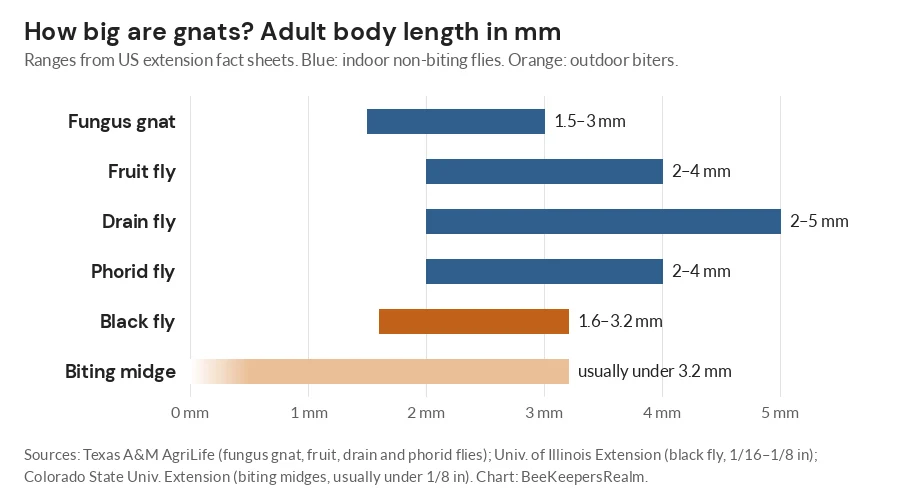
Size alone will not settle it: the four indoor flies and black flies all overlap at 2 to 3 mm.
Why Are There Gnats in My House?
Texas A&M says moisture is critical for fly breeding, and the key to any indoor fly problem is finding where excess moisture and organic debris have built up. The usual sources:
- Overwatered houseplants. Colorado State says moist mix high in peat moss is especially attractive to egg-laying fungus gnats.
- Plants brought back inside. Wisconsin says fungus gnats are often worse in fall, when infested plants that summered outdoors come back in. Colorado State adds that plants use less water in fall and winter, so the mix stays wet.
- Ripe produce and recycling. Texas A&M lists overripe bananas, bags of potatoes or onions, wet trash-can bottoms and unrinsed bottles. Fruit flies can pass through window screens.
- Drains after a trip. Kentucky says drain flies are most often seen after a vacation, because they develop in standing water.
- Bagged potting soil. Texas A&M notes that some infestations start with soil already infested in storage or at the manufacturer.
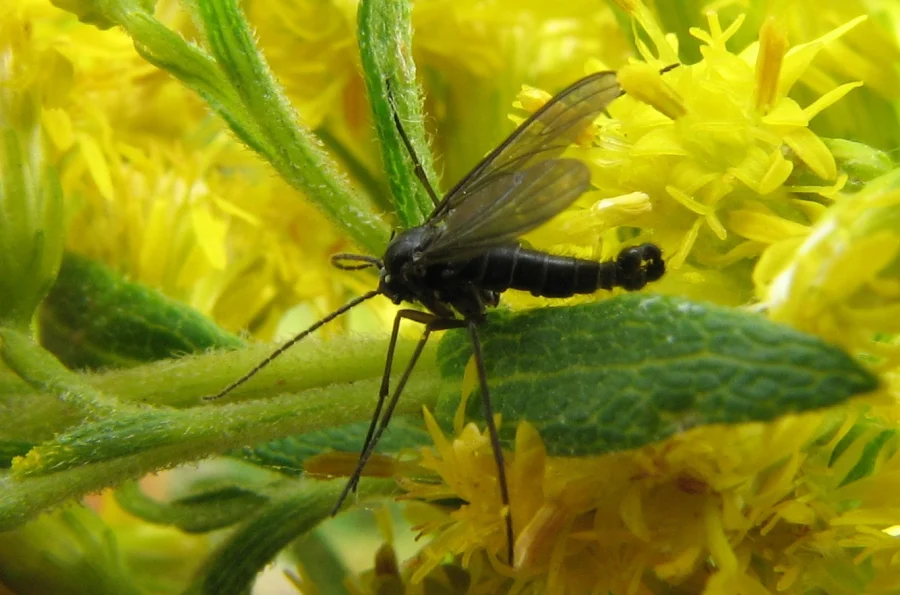
Short life cycles make gnats seem to appear overnight. Kentucky says a fruit fly goes from egg to adult in 8 to 10 days at 77°F, and one female can lay more than 500 eggs.
When Gnats Show Up: iNaturalist Records
We pulled US records for six gnat families from iNaturalist, the community photo-observation platform, on 17 November 2026. Only 62 of 16,822 fungus gnat records (0.37%) are research grade, and 76.5% are identified only to family, because research grade needs species-level agreement or a community vote that the ID is as good as it can be. So we used all verifiable records (photo, date and place), counted by family.
| Family | US records | Research grade | Peak month | Dec to Feb |
|---|---|---|---|---|
| Fungus gnats (Sciaridae) | 16,822 | 0.37% | May, 12.7% | 10.6% |
| Black flies (Simuliidae) | 5,147 | 1.2% | May, 21.3% | 7.7% |
| Moth flies and sand flies (Psychodidae) | 31,877 | 52.0% | September, 13.5% | 9.3% |
| Biting midges (Ceratopogonidae) | 11,380 | 2.9% | June, 15.7% | 7.1% |
| Fruit flies (Drosophilidae) | 20,952 | 22.3% | September, 14.7% | 9.0% |
| Phorid flies (Phoridae) | 7,318 | 1.5% | July, 13.7% | 7.7% |
Source: iNaturalist API, verifiable US observations, all years, pulled 17 November 2026. Percentages are shares of each family’s own records. Fungus gnats and black flies both have exactly 62 research-grade records; we rechecked each count separately.
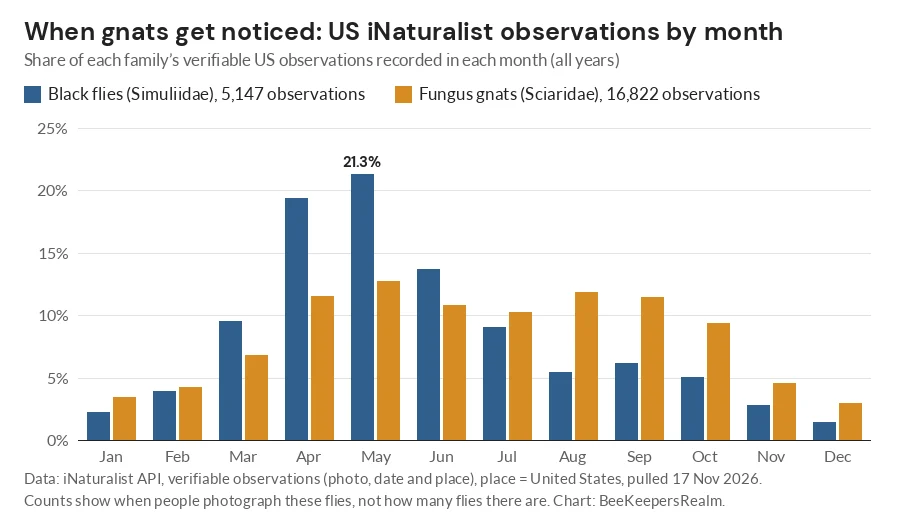
- Black fly season is spring. April and May hold 2,095 of 5,147 black fly records (40.7%), which fits Minnesota Extension’s note that bites are most common in spring.
- Photographed drain flies are almost all one species. The bathroom moth fly (Clogmia albipunctata) makes up 15,697 of 16,572 research-grade US moth fly records (94.7%).
- Most midge records are not the biters. None of the eight most-recorded research-grade midge species is a Culicoides, one of the two biting groups Colorado State names. Stilobezzia coquilletti leads with 97.
These counts show when people photograph gnats, not how many there are, and they mix indoor and outdoor sightings.
Fungus Gnats in Houseplants
UC IPM describes fungus gnats as dark, delicate-looking flies similar in appearance to mosquitoes, with a Y-shaped wing vein. The larvae have a shiny black head and a whitish-to-clear, legless body. Colorado State says they live in the top 2 to 3 inches of mix and feed on fungi, algae, decaying plant matter and roots.
“Adult fungus gnats don’t damage plants or bite people; their presence is primarily considered a nuisance.”
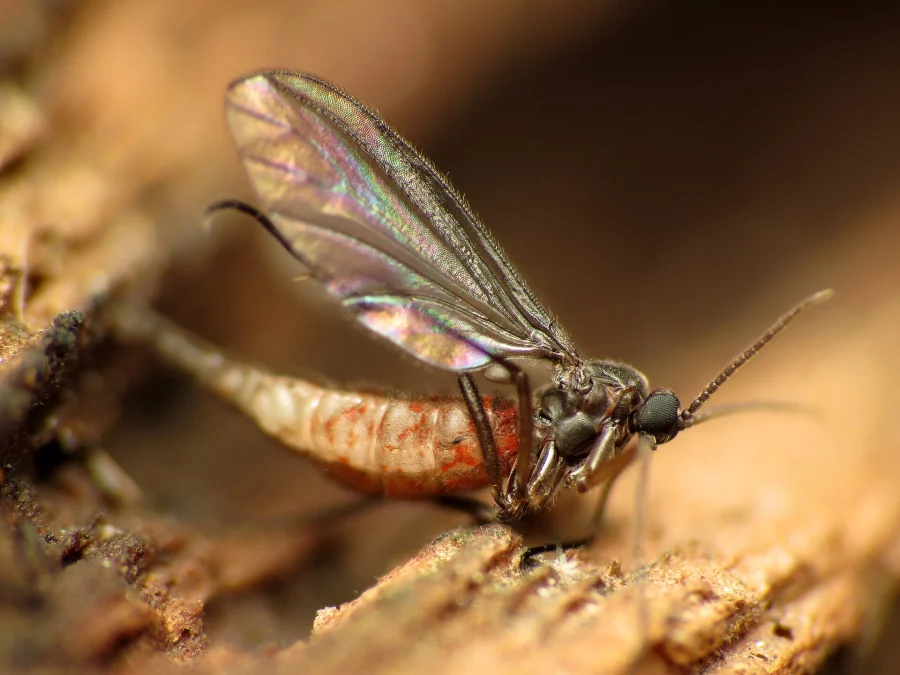
Fungus gnat life cycle
At 75°F, UC IPM says eggs hatch in about 3 days, larvae take about 10 days to pupate, and adults emerge about 4 days later: a generation in about 17 days. Colorado State says a female lays up to 200 eggs in her 7 to 10 days as an adult, and puts the cycle at three to four weeks at 65°F to 75°F, year-round on indoor plants.
Can fungus gnats hurt plants?
Sometimes. UC IPM says significant root damage and even plant death have been seen when large numbers of larvae lived in moist, organically rich soil, and Clemson Extension says a heavily infested plant may lose leaves. But UC IPM adds that wilting more commonly comes from other root problems, such as poor drainage or waterlogging. In greenhouses, Purdue says the larvae can spread root diseases such as Pythium.
How to get rid of fungus gnats
- Let the surface dry. Colorado State calls this the most important step: let the top 1 to 2 inches dry between waterings. Clemson says dry conditions kill the larvae and warns against water standing in the saucer. Wisconsin suggests watering from the bottom or a 1/2- to 1-inch layer of coarse sand or fine gravel.
- Use yellow sticky cards at the pot edge or under the leaves. Colorado State says they may help mass-trap egg-laying females.
- Trap larvae with potato. UC IPM says raw potato chunks draw larvae away from the roots; after a few days, replace them with fresh ones.
- Drench with Bti. Bti (Bacillus thuringiensis subspecies israelensis) kills fungus gnat larvae when watered into the soil. UC IPM says it does not persist indoors, so repeat applications about five days apart may be needed, and that Bt labeled for caterpillars does not work on fly larvae.
- Try nematodes. UC IPM and Colorado State both name Steinernema feltiae as effective against the larvae.
- Repot when old mix has broken down and holds too much moisture (Colorado State), using pasteurized mix.
- Skip the fogger. UC IPM says insecticides are rarely warranted for these flies in and around homes, and not to fog indoors or spray gnats in flight.
Wisconsin Extension says it may take three to four weeks of changed watering and a sand or gravel layer to get fungus gnats in check.
Fruit Flies
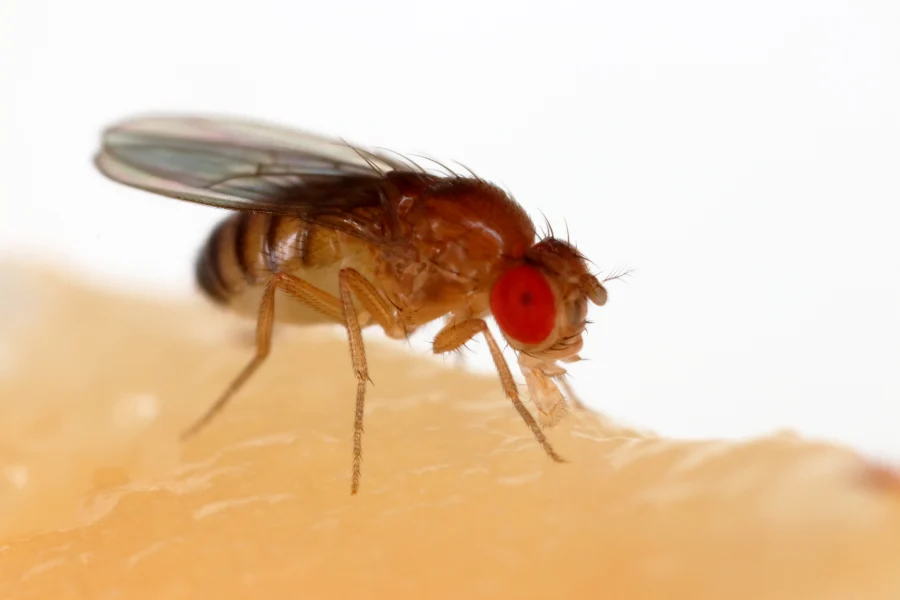
Gnats circling the fruit bowl or trash are probably fruit flies: about 1/8 inch long, brown-black, with red or black eyes, according to Kentucky, which says adults live about a month. Texas A&M notes that dark-eyed fruit flies breed more often in drains, so they get mixed up with drain flies.
Find the food source. Throw out overripe produce, refrigerate fruit, rinse bottles and cans before recycling, and clean trash bins. Then catch stragglers with Kentucky’s jar of vinegar and a drop of dish soap. Texas A&M says bait traps alone rarely give adequate control but help you find the source. The same sweet spills can draw sugar ants.
Drain Flies (Moth Flies)
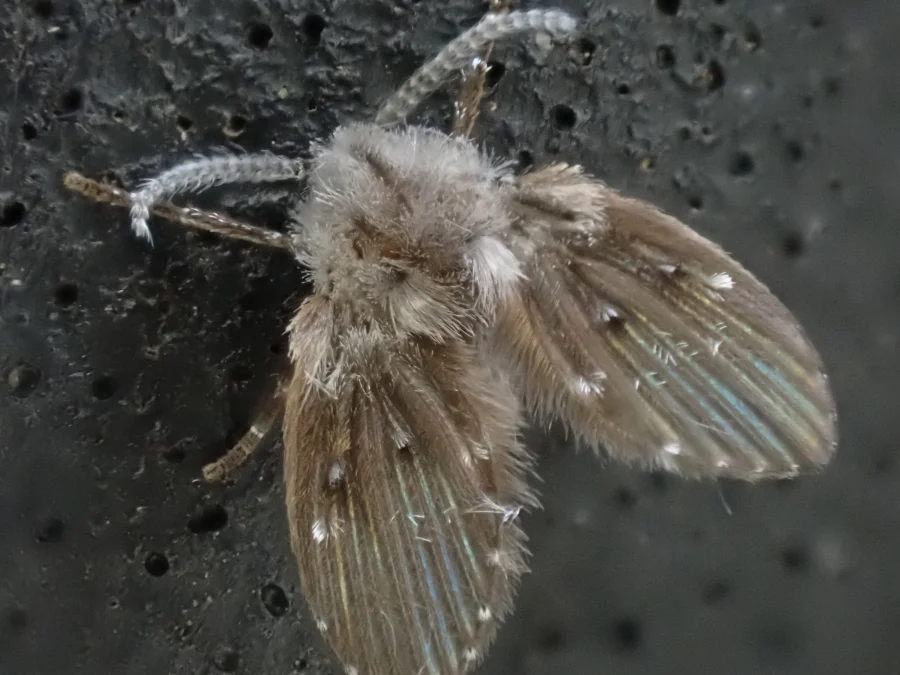
Drain flies look like tiny fuzzy moths. Kentucky says their wings are covered with scales, so they “disappear in a cloud of fine dust” when swatted. The larvae live in the slime film in sink and floor drains, rarely used toilets and refrigerator drain pans; Texas A&M adds condensate pans, cracked tile and sliding-door tracks.
Texas A&M says to scrub pipes and traps with a stiff brush, then flush with hot to boiling water. Its alternative is a drain product designed to biodegrade the film, which usually needs repeat applications over several weeks. Kentucky lists enzyme cleaners, baking soda or vinegar followed by a hot-water flush, warns that larvae can trap air bubbles and survive underwater for a day or more, and says not to pour insecticides down drains.
“Chlorine bleach or drain cleaner is largely ineffective at removing such films.”
Phorid Flies
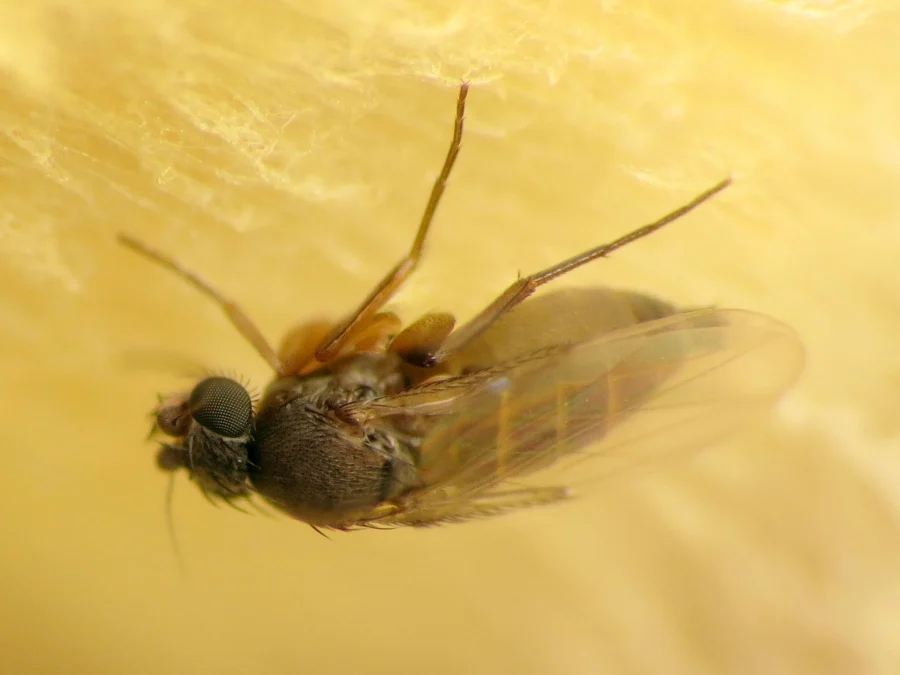
Phorid flies look like humpbacked fruit flies. Kentucky says they run rapidly over surfaces when disturbed, hence the name scuttle flies, and breed around garbage, clogged drains and decaying matter. Texas A&M says large numbers usually point to unsanitary conditions, and soil soaked by leaking sewer lines can be a hidden source.
Outdoors, Kentucky notes phorids that parasitize fire ants and bumble bees; one North American phorid, the zombie fly, lays its eggs in honey bees.
Biting Gnats: Black Flies and No-See-Ums
Indoor gnats don’t bite. Tiny biters outdoors are usually black flies or biting midges. For larger biting flies, see our horse fly and deer fly guide; for night bites in bed, one possible cause is covered in our kissing bug guide.
Black flies (buffalo gnats)
University of Illinois Extension describes buffalo gnats as humpbacked black flies 1/16 to 1/8 inch long; both sexes take nectar, but females need blood to produce eggs. Minnesota Extension says eggs are laid in rivers, streams and other running water, and most adults can fly about 10 miles. Bites land on exposed skin, especially the hairline, feet, ankles and arms, with reactions from small red spots to a lot of swelling. Some species only swarm around heads and crawl into the nose, ears, eyes and mouth.
Purdue Extension says about six black fly species in eastern North America feed on humans, and none are known to transmit disease agents to humans in the US; elsewhere they spread river blindness. Heavy biting can cause “black fly fever,” with headache, nausea, fever and swollen lymph nodes in the neck. Black flies do not enter buildings to seek blood, Purdue adds.
Biting midges (no-see-ums)
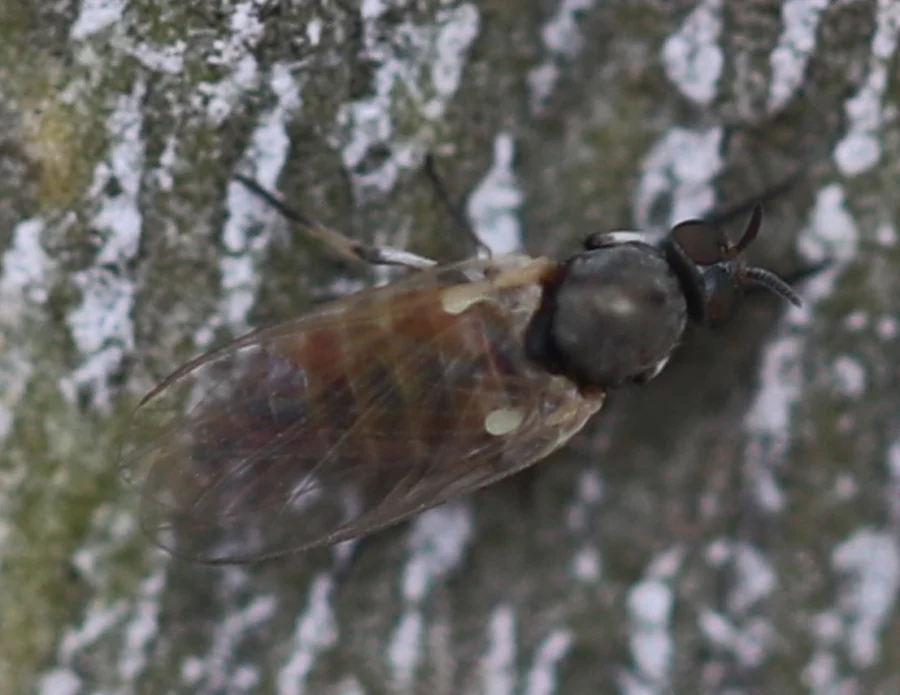
Colorado State says biting midges, usually under 1/8 inch, can pass through typical porch screening. Culicoides midges breed in damp areas at the edges of ponds, swamps and manure lagoons, and bite mostly at dusk, with a second peak at dawn. On Colorado’s West Slope, Leptoconops midges bite by day. Colorado State says no biting fly other than the mosquito is known to transmit a human disease in that state.
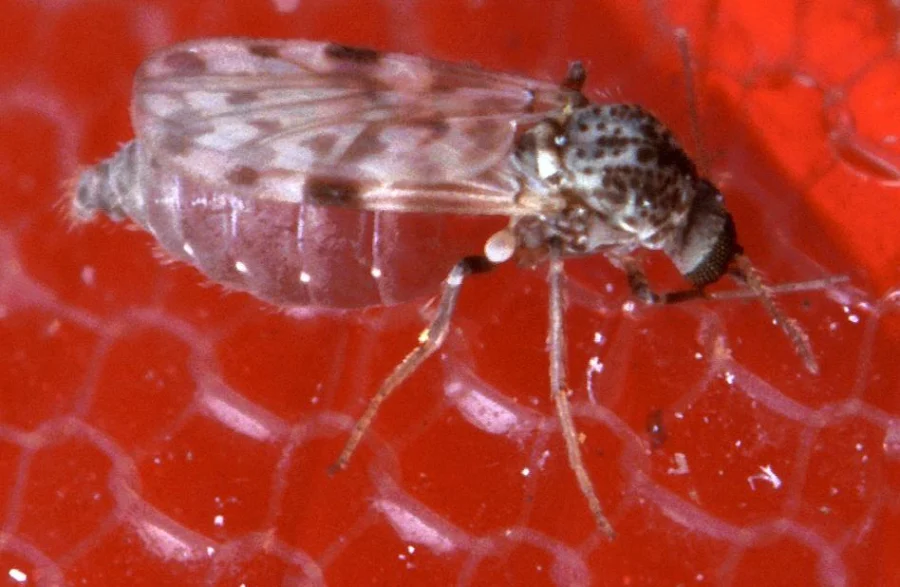
How to avoid gnat bites
- Time it. Minnesota says black flies are most active a few hours after sunrise and before sunset, on calm days and in sheltered areas. Midges peak at dusk and dawn.
- Wear light colors. Black flies are attracted to dark colors such as navy blue (Minnesota).
- Cover up. Illinois says buffalo gnats won’t bite through clothing and zippers beat buttons. Minnesota suggests a head net, “similar to a bee keeper’s veil.”
- Use a fan. Buffalo gnats are not strong fliers (Illinois).
- Expect mixed results from repellent. Colorado State calls DEET somewhat effective against black flies and only marginally effective against midges; Illinois says studies have shown DEET repellents give the most effective protection; Minnesota says repellents “are not always effective but may provide some help.” Pick an EPA-registered repellent and follow the label.
Gnat bite care
MedlinePlus says to wash the area with soap and water and apply ice wrapped in a washcloth, 10 minutes on and 10 off. An antihistamine or anti-itch cream can help. Watch for infection over the next several days, and call 911 for trouble breathing, swelling of the face or mouth, or throat tightness.
Gnats, Bees and Pollinators
Gnats are a poor reason to spray a garden. Illinois says fogging does not give effective long-term control of buffalo gnats, and Minnesota says no control measure reduces black flies in an area because they fly in from 10 miles away or more. UC IPM notes that pyrethroids are more toxic to beneficial insects, and advises avoiding broad-spectrum insecticides to protect natural enemies such as predatory hunter flies. For products that spare bees, see our pollinator-safe pest control guide.
“Bti produces toxins that specifically affect the larvae of only mosquitoes, black flies and fungus gnats. These toxins do not affect other types of insects including honey bees.”
Elsewhere on that page, the EPA words it more cautiously: studies indicate Bti has minimal toxicity to honey bees.
Gnats are also prey: praying mantises eat flies and gnats, though bees too. And tiny insects landing on sweaty skin may be sweat bees, which are often mistaken for gnats.
Frequently Asked Questions
Do gnats bite?
Most don’t. Fungus gnats, fruit flies, drain flies and phorid flies do not bite. Black flies (females only) and biting midges do, outdoors.
How long do gnats live?
Kentucky gives adult fungus gnats 7 to 10 days, drain flies 3 to 4 days, fruit flies about a month and phorid flies about 1 to 2 months. Minnesota says adult black flies live about three to six weeks.
What attracts gnats?
Moisture and decaying organic matter: wet potting mix, fermenting fruit, vinegar, beer and drain slime. UC IPM says fungus gnats are attracted to light, so they gather at windows. Illinois says buffalo gnats are drawn to exhaled carbon dioxide, sweat and dark moving objects.
Why do gnats fly in your face?
Outdoors, black flies swarm around heads and may crawl into the eyes, ears and nose. Indoors, Kentucky says fungus gnats are usually reported flying around people’s faces and computer screens.
What is the difference between gnats and fruit flies?
Fruit flies are stout, often red-eyed and found near ripe fruit and trash. Fungus gnats are slender, dark and long-legged, and stay near potted plants.
How do I get rid of gnats fast?
A vacuum or sticky card removes the adults you see, but Kentucky says killing adult flies usually provides only temporary relief. Lasting control means removing the breeding source.
Are gnats harmful?
Indoor gnats are mostly a nuisance, though Kentucky says small flies can carry bacteria onto food. Black fly bites can swell badly, but Purdue says no black flies are known to transmit disease agents to humans in the US.
The Bottom Line
A gnat problem is a breeding-site problem: match the gnat to its source, then dry the potting mix, clear the produce or scrub the drain. Damp spots also draw millipedes, and fall brings boxelder bugs indoors. More in our garden and household insects guides.
Sources
- Bethke, J.A. and Dreistadt, S.H. “Pest Notes: Fungus Gnats,” UC IPM Publication 7448.
- Colorado State University Extension, “Fungus Gnats as Houseplant and Indoor Pests” (5.584) and “Biting Flies” (5.582).
- University of Kentucky Entomology, “Small Flies” (ENTFACT-657) and “Drain Flies or Moth Flies” (ENTFACT-615).
- Merchant, M. “Indoor Flies and Their Control,” Texas A&M AgriLife Extension.
- University of Wisconsin-Madison Extension, “Fungus Gnats on Houseplants.”
- Clemson HGIC, “Common Houseplant Insects & Related Pests.”
- Purdue Extension, “Fungus Gnats and Shore Flies” (E-111) and “Black Flies.”
- University of Minnesota Extension, “Black Flies.”
- University of Illinois Extension, “Buffalo Gnats and How to Avoid Being Bitten.”
- US EPA, “Bti for Mosquito Control” and “Find the Repellent That Is Right for You.”
- MedlinePlus, “Insect bites and stings.”
- PestWorld, “Gnats“; Wikipedia, “Gnat.”
- iNaturalist API, verifiable US observations of six families, pulled 17 November 2026; iNaturalist, “Data Quality Assessment.”
Image credits: Featured image (montage, cropped) by BeeKeepersRealm from Wikimedia Commons photos: fungus gnat by xpda (file, CC BY-SA 4.0), fruit fly by Alexis (file, CC BY 4.0), drain fly by Cricket Raspet (file, CC BY 4.0) and black flies by Syrio (file, CC BY-SA 4.0). Other photos are credited in their captions.