Reviewed by Sofia T. · How we review
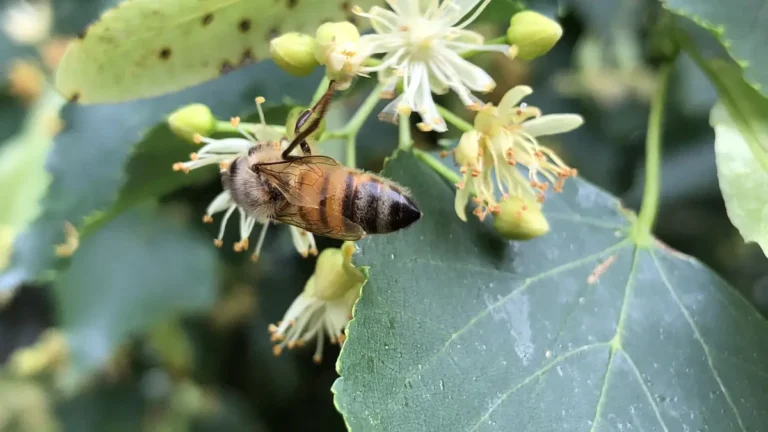
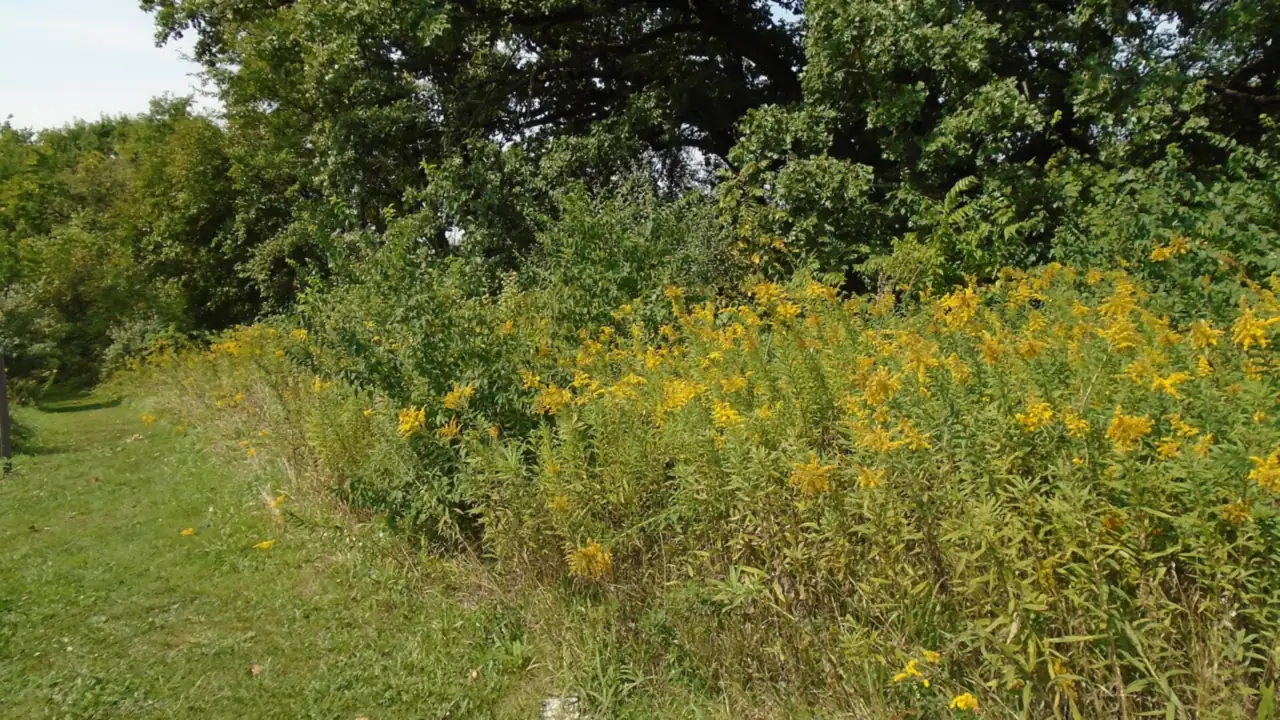
Goldenrod (Solidago) is a group of yellow-flowered perennials in the daisy family, most of them native to North America, that bloom from late summer into fall. Goldenrod is not the main cause of fall hay fever. Its pollen is heavy and sticky and travels on insects. Ragweed, which flowers at the same time, is wind-pollinated and is the usual culprit. Goldenrod is also one of the most important late-season plants for honey bees, bumble bees and dozens of pollen-specialist native bees.
Key Takeaways
- Sources count about 100 to 138 goldenrod species. Iowa State says over 70 are native to the US and Canada.
- In US iNaturalist records annotated as flowering, goldenrod peaks in September (40.8%) and the hay-fever ragweeds peak in August (44.9%). Both bloom from August to October.
- Goldenrod pollen moves on insects, not on the wind. Rare reactions are mostly in people who handle the flowers at work.
- In a 2020 list of 200 pollen-specialist bees of the eastern US, goldenrod hosts 40 species, more than any other plant genus.
- Canada goldenrod spreads hard. For gardens, choose clump-formers such as stiff, gray or seaside goldenrod, or the cultivar ‘Fireworks’.
Table of Contents
- What Is Goldenrod?
- Types of Goldenrod
- Goldenrod vs Ragweed: Does Goldenrod Cause Allergies?
- Goldenrod and Bees
- Monarchs, Crab Spiders and Other Goldenrod Insects
- Goldenrod Galls
- How to Grow Goldenrod
- Goldenrod Tea and Herbal Use
- Frequently Asked Questions
- The Bottom Line
What Is Goldenrod?
Goldenrod is the common name for the genus Solidago, part of the aster family (Asteraceae). Each plumy yellow spray is made of hundreds of tiny flower heads. Most species are clump-forming perennials with upright to arching stems and alternate leaves. A few rare forms are white (Iowa State University Extension).
The species count depends on the source and on how botanists split the group. NC State Extension’s Plant Toolbox gives about 138 species. Iowa State says more than 120, the Chicago Botanic Garden more than 100, and the Lady Bird Johnson Wildflower Center about 125 in the United States. Some former goldenrods now sit in other genera, such as stiff goldenrod (Oligoneuron). The genus is mainly North American, with a few species in Central and South America, the Caribbean, North Africa and Eurasia. The name comes from the Latin for “to make whole,” a nod to old healing claims.
Goldenrods grow in meadows, prairies, woodland edges, swamps, roadsides and coastal dunes. South Carolina made tall goldenrod its state wildflower in 2003 (Clemson HGIC).
Is goldenrod a weed? It is a native wildflower, but some species colonize fields fast. NC State’s Plant Toolbox tags the genus as both “Native Plant” and “Weed.” Where it has been introduced outside North America, Canada goldenrod is classed as an invasive alien plant (Poljuha et al., Plants, 2024).
Types of Goldenrod
These eight are common in the trade or in native plantings. Ranges and sizes are from the Lady Bird Johnson Wildflower Center database unless noted.
| Species | Range | Habit | Garden use | Source |
|---|---|---|---|---|
| Canada goldenrod (S. canadensis) | Across Canada and throughout the US | Up to about 6 ft; blooms Sep to Nov; spreads by rhizomes and colonizes disturbed ground | Large meadows only. University of Illinois Extension would not put it in a home garden | LBJWC; UW-Madison; Illinois Extension |
| Tall goldenrod (S. altissima) | Most of southern Canada and Alaska, south to VA, LA and CA | Up to about 6 ft; Aug to Nov; height depends on soil fertility and moisture | Meadow or pocket prairie; divide using strong outer rhizomes | LBJWC |
| Showy goldenrod (S. speciosa) | MA to the GA mountains, west to WY, e. CO, n.e. NM and central TX | Up to about 6 ft; Aug to Sep; can become aggressive in moist soils | Open woods and prairie plantings in rocky or clay soil | LBJWC |
| Stiff goldenrod (S. rigida, now Oligoneuron rigidum) | Alberta to Ontario, south to GA, west to TX | Up to about 5 ft; Aug to Oct; flat-topped clusters, gray-green leaves | Sunny prairie gardens; copes with all soil types | LBJWC; Iowa State |
| Seaside goldenrod (S. sempervirens) | Coast from Newfoundland to FL, TX and Mexico | Up to about 6 ft; Aug to Oct; does not spread by rhizomes | Coastal and sandy gardens; resists salt spray; pinch tips in June for a compact plant | LBJWC |
| Zigzag goldenrod (S. flexicaulis) | Quebec to e. ND, south to GA, AR and n.e. KS | 2 to 4 ft; Jul to Oct; broad toothed leaves, zigzag stem | Shade and woodland gardens; sun to full shade | LBJWC; Illinois Extension |
| Gray goldenrod (S. nemoralis) | Southern Canada and much of the US east of the Rockies | Up to about 3 ft; Jun to Oct; dry sandy or rocky soil | Low meadows and sunny beds; shorter and less aggressive than tall goldenrod | LBJWC |
| ‘Fireworks’ (S. rugosa cultivar) | Cultivar of rough goldenrod; zones 4 to 8 | 24 to 36 in (Iowa State); arching sprays Sep to Oct; slow spreader | Borders; top-rated goldenrod in the Chicago Botanic Garden trial | Iowa State; Chicago Botanic Garden; Illinois Extension |
Trial results do not always agree. The Chicago Botanic Garden trial began in 1993 and ran five years. In it, zigzag goldenrod sat near the top. In the newer Mt. Cuba Center trial it ranked 57th of 62. Local conditions matter as much as the species.
In this University of Illinois Extension Good Growing episode, Chris Enroth, Ken Johnson and Emily Swihart compare the Chicago Botanic Garden and Mt. Cuba Center trials. They name ‘Fireworks’ the top Chicago performer, a slow spreader that stays under five feet. They warn against Canada goldenrod in home landscapes and finish with ways to control spreaders. This summary is from the episode transcript published by Illinois Extension.
Goldenrod vs Ragweed: Does Goldenrod Cause Allergies?
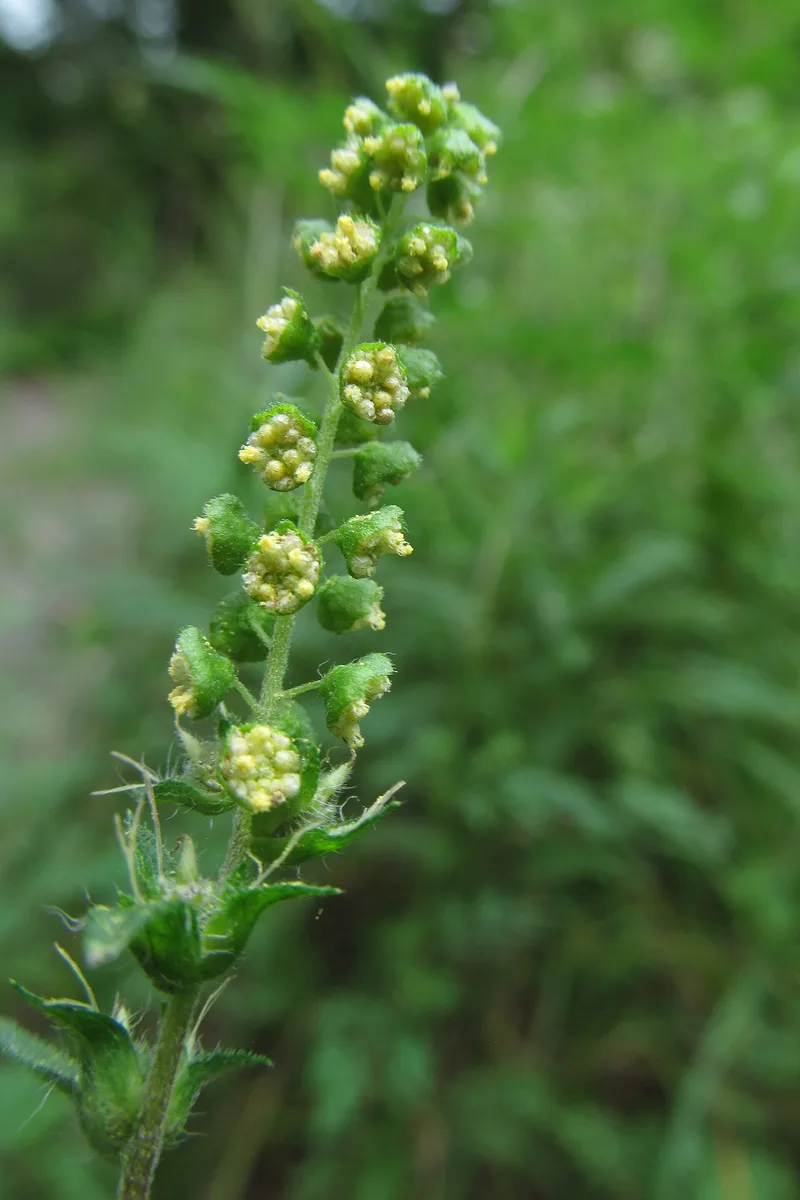
Goldenrod gets the blame for fall hay fever because it is bright and in plain sight when symptoms start. The real source is usually ragweed (Ambrosia), a green, easy-to-miss plant that blooms in the same weeks. The Asthma and Allergy Foundation of America sets out the differences:
| Claim | Evidence | Source |
|---|---|---|
| Goldenrod pollen causes hay fever | Goldenrod pollen is heavy and carried by insects. Hay fever comes from pollen breathed in from the air, and ragweed pollen is wind-blown | AAFA; Clemson HGIC |
| The two plants look alike | Ragweed has greenish flowers on tall spikes and branches from the bottom up. Goldenrod has bright yellow flowers on a single stem that branches at the top | AAFA |
| Both come back every year | Ragweed is an annual that grows and dies within a year. Goldenrod is a perennial | AAFA |
| They flower at different times | They overlap. In our iNaturalist data, 90.8% of flowering ragweed records and 83.6% of flowering goldenrod records fall in August to October | iNaturalist data, this article |
| A ragweed plant makes little pollen | One ragweed plant may produce a billion pollen grains, and the light grains can stay airborne for days | Penn State Extension |
| Goldenrod can never cause a reaction | Rare cases exist, mostly in people who handle flowers at work, plus contact dermatitis reports | PubMed case reports |
When goldenrod and ragweed bloom: our iNaturalist data
We pulled every verifiable US iNaturalist observation that observers annotated as “Flowering” and grouped them by month observed. Goldenrod (genus Solidago) gave 39,215 records. For ragweed we used only the three hay-fever species: common, giant and western ragweed (2,136 records). The whole genus Ambrosia peaks in March, because it includes desert shrubs such as cheesebush and burrobush that flower in spring.
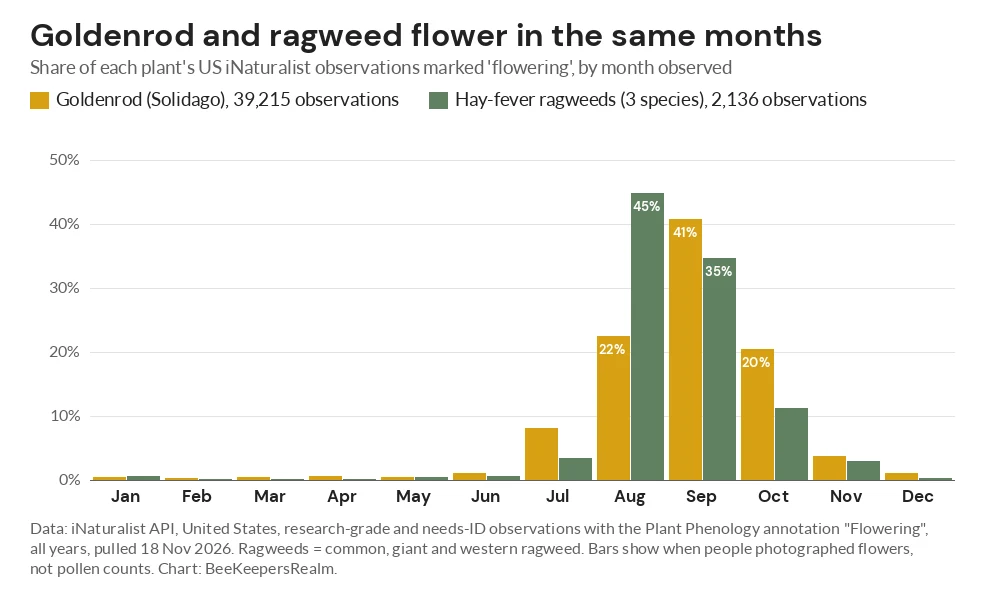
Ragweed comes first: 44.9% of its flowering records are from August and 34.7% from September. Goldenrod peaks a month later, with 40.8% in September, 22.4% in August and 20.4% in October. So the yellow flowers are most visible just as ragweed pollen is already in the air. These are records of when people photographed flowers, not pollen counts, but the timing fits the extension advice.
Can goldenrod ever cause allergy? Rarely, and mainly through close contact. A 1998 Dutch study described 14 patients with flower-handling symptoms, most in the flower trade, and tested them against goldenrod among other flowers. Most of them changed jobs. A Cleveland Clinic team put it this way:
“Although not an airborne allergen, it may be an important occupational sensitizer.”
The same study found that goldenrod and natural rubber latex share allergenic proteins. If you react to goldenrod in a vase, or have a latex allergy, ask an allergist. If your eyes run in September, ragweed is the more likely cause.
Goldenrod and Bees
Goldenrod blooms when much of the landscape has gone to seed, which makes it a key plant in any list of fall-blooming flowers for bees. Penn State Extension calls it a prolific nectar and pollen producer. In the Wildflower Center database, Xerces Society ratings mark six of the seven wild species in the table as of special value to both native bees and honey bees.
Honey bees
For honey bees, goldenrod is late-season nectar and pollen. Penn State describes the pollen as high quality and rich in protein, fats and minerals. It is one of the native staples in our list of honey production plants.
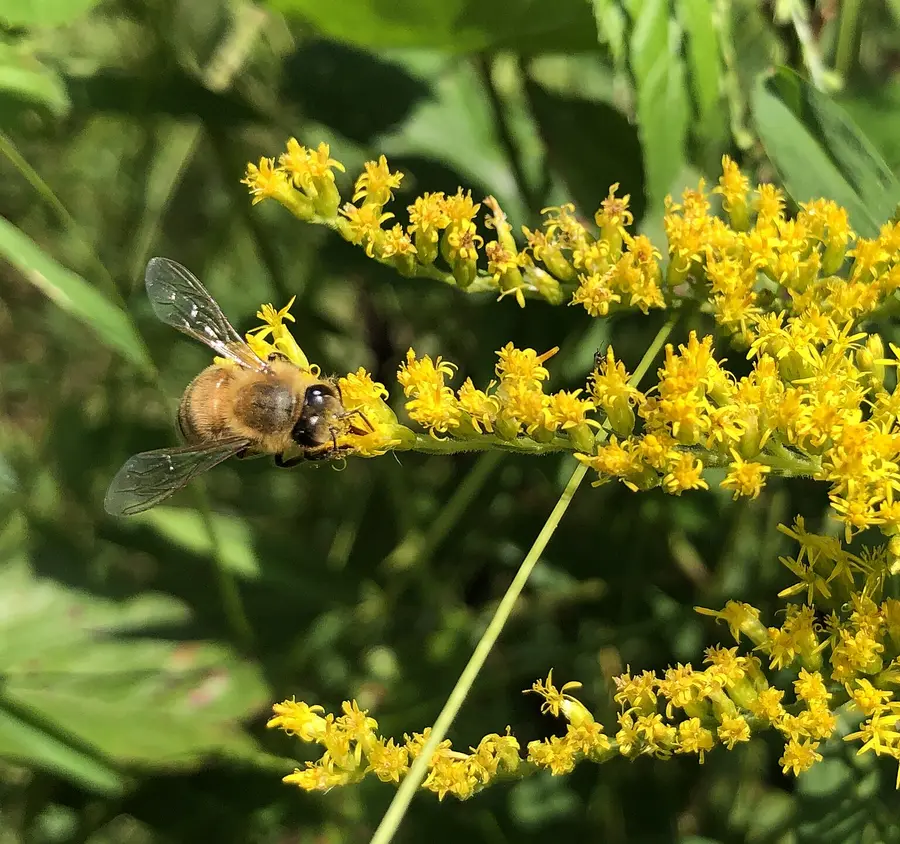
The “dirty socks” smell. During a strong goldenrod flow, many beekeepers notice a sour odor across the apiary. Carolina Honeybees says the smell comes from goldenrod nectar during curing, and that the finished honey does not smell bad. In Keeping Backyard Bees, one beekeeper describes it as “stinky feet,” “dirty gym socks,” yeast or cheese. She first feared American foulbrood, which she later learned smells more like a dead, rotting animal. If you are unsure, check the brood. See our guide to what foulbrood really smells like. Flavor, color and how fast the honey sets are covered in our page on goldenrod honey.
Bumble bees and specialist native bees
Goldenrod matters even more to wild bees. Some native bees collect pollen from only one plant group. Jarrod Fowler and Sam Droege (2020) listed 200 such pollen-specialist bee species in 20 eastern states, from Maine to Louisiana. Goldenrod was the host genus for 40 of them, the most of any genus.
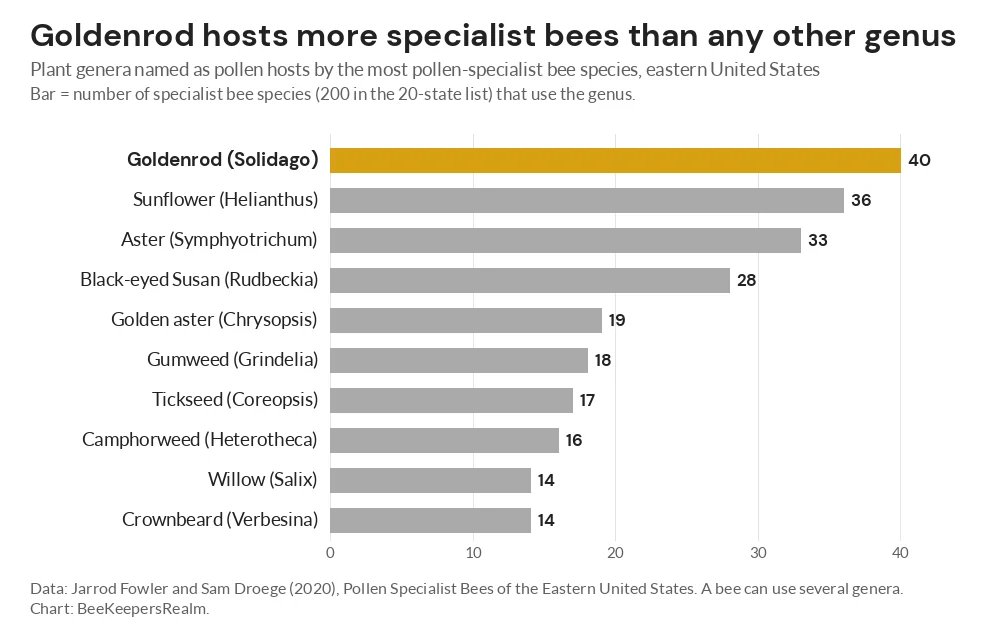
Other sources give lower numbers because they count differently. Penn State says eleven native bee species specialize on goldenrod, and the National Wildlife Federation says more than 11. NC State Extension names nine. Most are Andrena mining bees, plus Perdita octomaculata, Melissodes fumosus and two Colletes, including Colletes solidaginis, named for the plant. Fowler’s separate list for the central US puts goldenrod fourth, with 58 specialists, after sunflowers, gumweeds and camphorweeds.
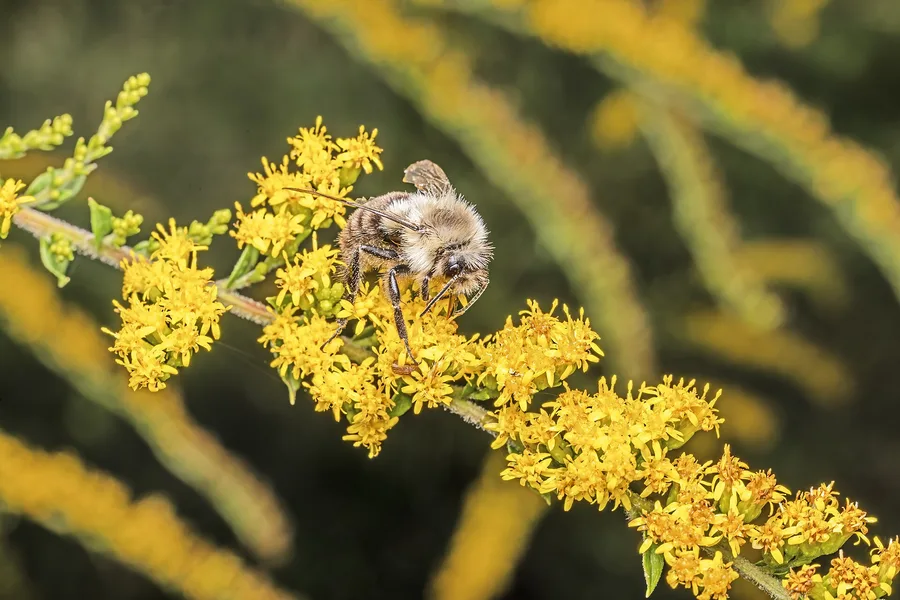
Generalists use it too. Bumble bees work goldenrod late in the season, along with wasps, flies, beetles and butterflies. For more on the wider cast, see our guide to native bee species.
“It’s one of the best herbaceous native perennials for attracting and feeding wildlife.”
Monarchs, Crab Spiders and Other Goldenrod Insects
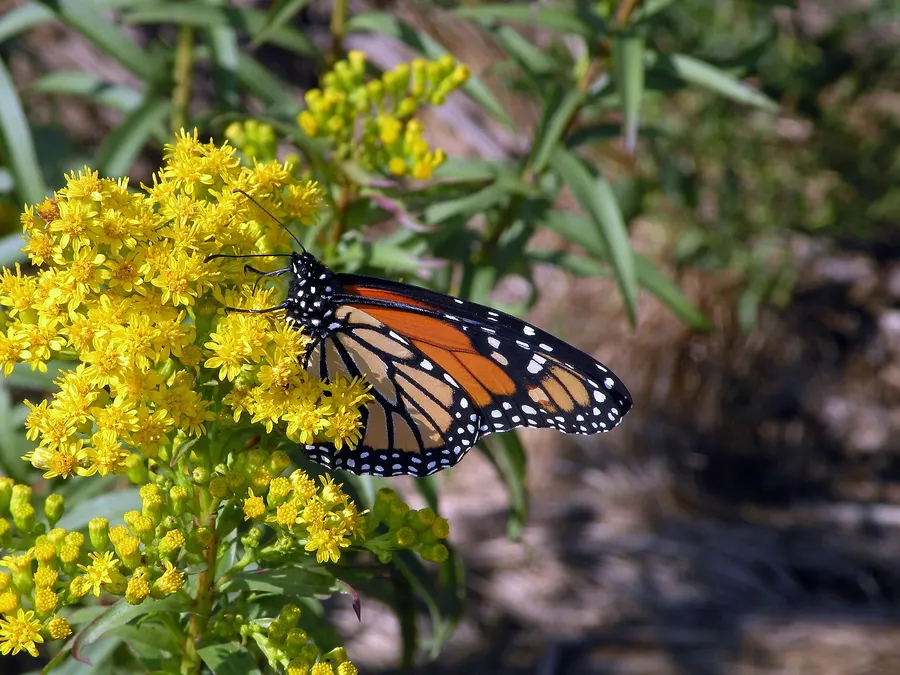
Penn State calls goldenrod critical for migratory insects like the monarch butterfly. The National Wildlife Federation says monarchs depend on it for nectar in fall to fuel their long migration. Goldenrod feeds the adults. The caterpillars still need milkweed. Tallamy’s research, as reported by the NWF, found that goldenrods feed and shelter 115 butterfly and moth species in the Mid-Atlantic alone. Among them is the wavy-lined emerald moth, whose caterpillar uses goldenrod as a host.
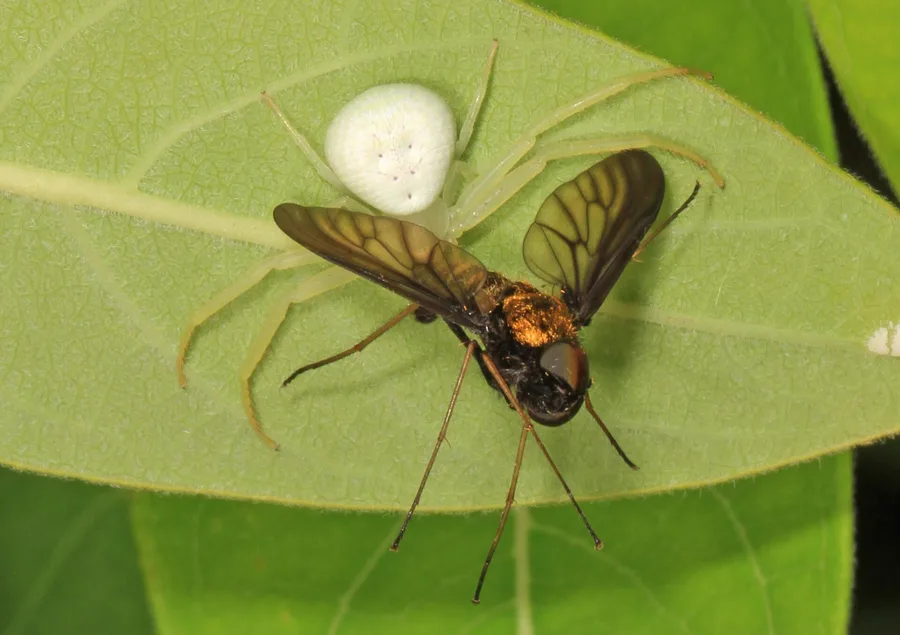
Goldenrod crab spider (Misumena vatia). This small spider sits in flowers and ambushes visiting insects, bees included. University of Minnesota Extension puts it at 1/10 to 1/3 inch long, usually yellow or white, and harmless to people. Oregon State University Extension notes that it changes color to match its flower. Going from yellow to white takes about six days. Going back to yellow takes 10 to 25 days, because the spider has to make the yellow pigment again.
Goldenrod soldier beetle (Chauliognathus pensylvanicus). These orange beetles with dark wing spots crowd goldenrod from July to September, most of all in August (University of Wisconsin-Madison Extension). They eat pollen and nectar and sometimes small insects such as aphids. They do not damage plants and do not bite or sting.
Goldenrod Galls
Round swellings on goldenrod stems are galls: plant tissue that grows around an insect larva. Penn State says goldenrod hosts around 50 gall-making insect species. Three are easy to spot:
- Ball gall from the goldenrod gall fly (Eurosta solidaginis). The gall shows about three weeks after the eggs are laid and grows to nearly the size of a golf ball. One larva lives in the center and overwinters there.
- Elliptical, spindle-shaped stem gall from a moth, Gnorimoschema gallesolidaginis.
- Bunch gall, a tight rosette of leaves at the stem tip, from the midge Rhopalomyia solidaginis, on Canada goldenrod only.
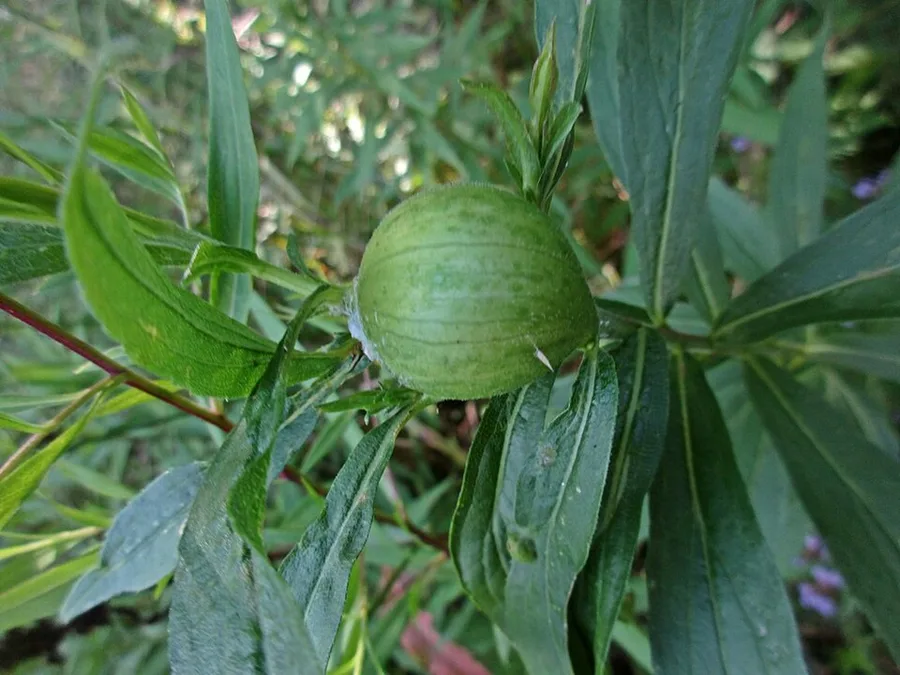
Galls do not need treatment. University of Wisconsin-Madison Extension notes that galled plants still bloom. The galls also feed wildlife in winter. Downy woodpeckers and black-capped chickadees break into ball galls to eat the larva. Parasitic wasps and small Mordellistena beetles feed on the larvae too. Leaving some stems standing through winter keeps that food supply in place.
How to Grow Goldenrod
Goldenrod is easy to grow. NC State Extension recommends full sun and average, dry to medium, well-drained soil. It tolerates poor soil, clay and drought, and is generally deer-resistant. Pick the species by its native habitat: seaside goldenrod for sand and salt spray, zigzag for shade, stiff or gray goldenrod for dry, sunny spots. For more native picks, see our list of native plants for pollinators.
- Choose clump-formers for small beds. Iowa State says most goldenrods form clumps. Species that reseed freely or spread by rhizomes, like Canada goldenrod, belong in meadows.
- Divide on a schedule. Iowa State suggests dividing spreading species every two to three years and others every four to five. Do it in early spring as growth starts. Tip cuttings in spring also root easily.
- Control spreaders. Illinois Extension lists digging, smothering and repeated mowing. One educator cuts the flower heads off with a hedge trimmer just before they open. That stops the seed, though it also removes the forage. Herbicides labeled for Canada goldenrod are the last resort.
- Shape and cut back. Pinching seaside goldenrod tips in June gives a more compact plant (LBJWC). Deadheading can bring more blooms (NC State). Leave the seed heads and galled stems standing until spring if you can, for birds.
Goldenrod pairs well with asters, which bloom alongside it. More planting ideas are in our pollinator gardening section.
Goldenrod Tea and Herbal Use
NC State Extension notes that young goldenrod leaves are edible and that the plant is used for herbal teas. Most research is on European goldenrod (Solidago virgaurea), long used in Europe for urinary tract conditions and inflammation. A 2020 review of that research was cautious:
“The evidence concerning its potential benefits is mainly derived from non-clinical studies, some effects are rather modest, whereas others are more promising, but need more confirmation in both non-clinical models and clinical trials.”
Allergic contact dermatitis has been reported after taking goldenrod as a remedy (Contact Dermatitis, 1998). People with daisy-family or latex allergies have extra reason to be careful. Talk to a doctor before using goldenrod as a remedy, especially if you are pregnant or take medicines.
This section is educational information, not medical advice.
Pair goldenrod with upright sedum for a dry, sunny fall border that bees work into October.
Frequently Asked Questions
Is goldenrod the same as ragweed?
No. They are different plants that bloom at the same time. Ragweed has green flower spikes and wind-blown pollen. Goldenrod has bright yellow flowers and heavy, insect-carried pollen.
When does goldenrod bloom?
Mostly from July to October. In our iNaturalist data, 91.7% of US flowering records fell in those months, with September the peak. Gray goldenrod can start in June, and Canada goldenrod runs into November.
Is goldenrod invasive?
Not in North America, where it is native, though Canada goldenrod can take over a field or garden. Where it has been introduced on other continents, Canada goldenrod is classed as an invasive alien plant.
Does goldenrod spread?
Some species do, by rhizomes and wind-blown seed. Canada and showy goldenrod can be aggressive. Seaside goldenrod does not spread by rhizomes, and most others form clumps.
Can goldenrod grow in shade?
Most goldenrods want full sun. Zigzag goldenrod grows in sun, part shade or shade. Gray goldenrod is rated for all three as well.
Is goldenrod deer resistant?
Generally, yes. NC State Extension calls it generally deer-resistant, and the Chicago Botanic Garden lists ‘Fireworks’ as resistant to deer.
Is goldenrod edible?
NC State Extension says the young leaves are edible and the plant is used for herbal teas. Be sure of your identification, and see the herbal cautions above.
Is goldenrod good for bees?
Yes. It is one of the most valuable fall plants for honey bees and wild bees. It hosts more pollen-specialist bee species in the eastern US than any other plant genus.
The Bottom Line
Goldenrod is a native fall wildflower, not the cause of fall hay fever. Ragweed is the usual culprit. Goldenrod feeds honey bees, bumble bees, dozens of specialist bees and migrating monarchs, and its galls feed birds in winter. For gardens, pick a clump-forming species suited to your site and keep Canada goldenrod for meadows.
Image credits: featured photo of goldenrod along the Prairie Creek Woods Trail by the USDA Forest Service, Eastern Region, public domain, via Wikimedia Commons, cropped, resized and lightly softened. Other photos are credited in their captions. Charts by BeeKeepersRealm.