Reviewed by Daniel M. · How we review
Sunflowers are North American wildflowers in the genus Helianthus, a group of about 50 species that includes the common sunflower (Helianthus annuus) of gardens and farm fields. Sow the seed outdoors in full sun after the last frost, and most varieties mature in 70 to 95 days. Sunflowers that carry pollen are a major summer food for bees: some native bees specialize on them, and their pollen cuts a common bumble bee gut parasite in lab and farm studies.
Below: what a sunflower is, why mature heads face east, the bees that depend on them, the main types, and how to plant, protect and harvest them.
Key Takeaways
- Young plants follow the sun; mature heads stop and face east. In UC Davis experiments, east-facing heads warmed faster and drew five times as many pollinating insects as heads turned west.
- Sunflower pollen reduced the gut parasite Crithidia bombi in common eastern bumble bees in lab trials, and on 20 Massachusetts farms more sunflower meant lighter infections and more queens.
- It is not a complete bee food: the pollen is low in protein, and honey bees fed only sunflower pollen had four times the mortality of bees fed buckwheat pollen.
- Pollenless cut-flower hybrids still make nectar, but wild bees visit pollen-bearing plants more. Grow some pollen-bearing sunflowers for bees.
- In our pull of US iNaturalist records, 54.4% of common sunflower observations fall in July to September; 64.8% of records for three perennial natives fall in September and October.
Table of Contents
- What a Sunflower Is: Florets, Seeds and Spirals
- Do Sunflowers Follow the Sun?
- Sunflowers and Bees
- Types of Sunflowers Compared
- When Sunflowers Bloom: US Observation Data
- When and How to Plant Sunflowers
- Pests, Birds and Bee-Safe Fixes
- Harvesting Sunflower Seeds
- Sunflower Honey
- Frequently Asked Questions
- The Bottom Line
What a Sunflower Is: Florets, Seeds and Spirals
Sunflowers belong to the aster family, Asteraceae. The Missouri Department of Conservation counts about 50 Helianthus species, all native to North America; other references give higher totals. The wild common sunflower is native from Manitoba and Minnesota to Texas and westward, and has naturalized to the Atlantic, according to the Lady Bird Johnson Wildflower Center. A 2011 genetic study in PNAS (Blackman and colleagues) supports a single domestication of the cultivated sunflower in eastern North America, rather than a second center in Mexico.
What looks like one flower is a head of hundreds or thousands of tiny flowers called florets. The yellow “petals” around the edge are ray florets, which are sterile. The disk florets in the center are fertile, and each one that is pollinated becomes a single seed, botanically an achene.
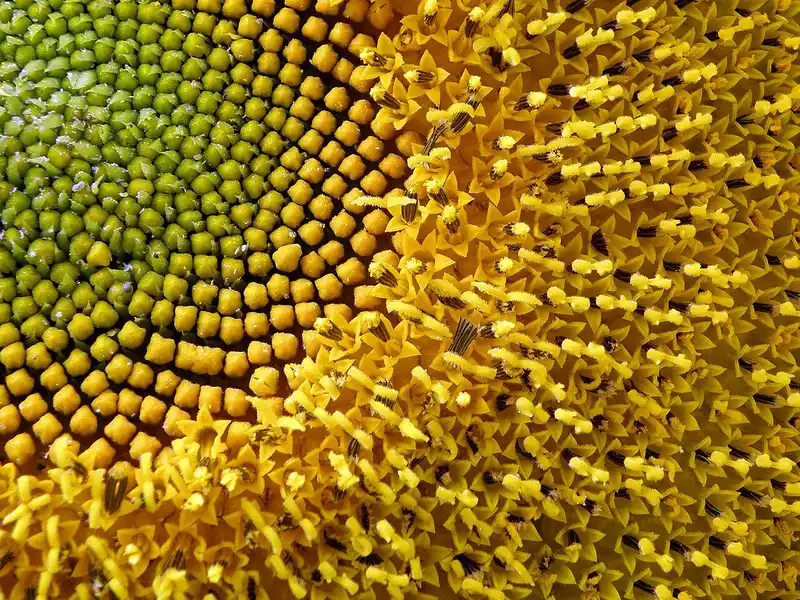
The florets do not all open at once. As KQED’s Deep Look explains (video below), just before dawn the plant’s internal clock signals florets at the outside edge to bloom, and they push pollen out to their tips. Later in the day each floret’s style extends and splits open, ready to receive pollen carried from other flowers. That is why bees matter so much to the plant.
The seeds sit in interlocking spirals. In a citizen-science study of 657 sunflowers (Swinton and Ochu, Royal Society Open Science, 2016), 565 of 768 spiral counts in the most reliable data were Fibonacci numbers and 67 more had a related Fibonacci structure, but some heads had none. The famous rule is common, not universal.
Do Sunflowers Follow the Sun?
Young sunflowers do; mature ones don’t. A team led by Hagop Atamian and Stacey Harmer at UC Davis, working with Benjamin Blackman’s lab, showed in Science (2016) that growing plants face east at dawn, swing west during the day and turn back east overnight. The east side of the stem grows faster by day and the west side by night, under the control of the plant’s circadian clock. Plants staked so they could not move had less biomass and leaf area.
“The plant anticipates the timing and the direction of dawn, and to me that looks like a reason to have a connection between the clock and the growth pathway.”
As the flower opens, growth slows and the head settles facing east. That pays off with bees. When the researchers turned some potted plants to face west, the east-facing heads warmed up faster in the morning and attracted five times as many pollinating insects; warming west-facing heads with a portable heater brought pollinators back. “Bees like warm flowers,” Harmer said.
Video: KQED’s Deep Look (October 2024) follows young sunflowers as they track the sun by day and grow back toward the east overnight, and describes the experiment in which heads turned west got far fewer bee visitors. It also shows florets opening before dawn, pushing out pollen and later raising the style that receives pollen from other plants. Summary from the episode’s published transcript.
Sunflowers and Bees
Amy Galloway of the Lady Bird Johnson Wildflower Center notes that the size and shape of sunflower florets make them accessible to a wide range of pollinators. For bees, four things stand out: specialist bees, a parasite-fighting pollen, crop pollination, and pollenless hybrids.
Sunflower specialist bees
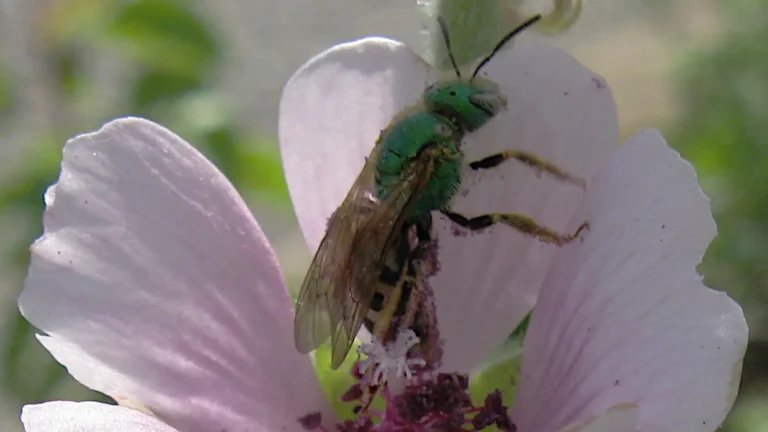
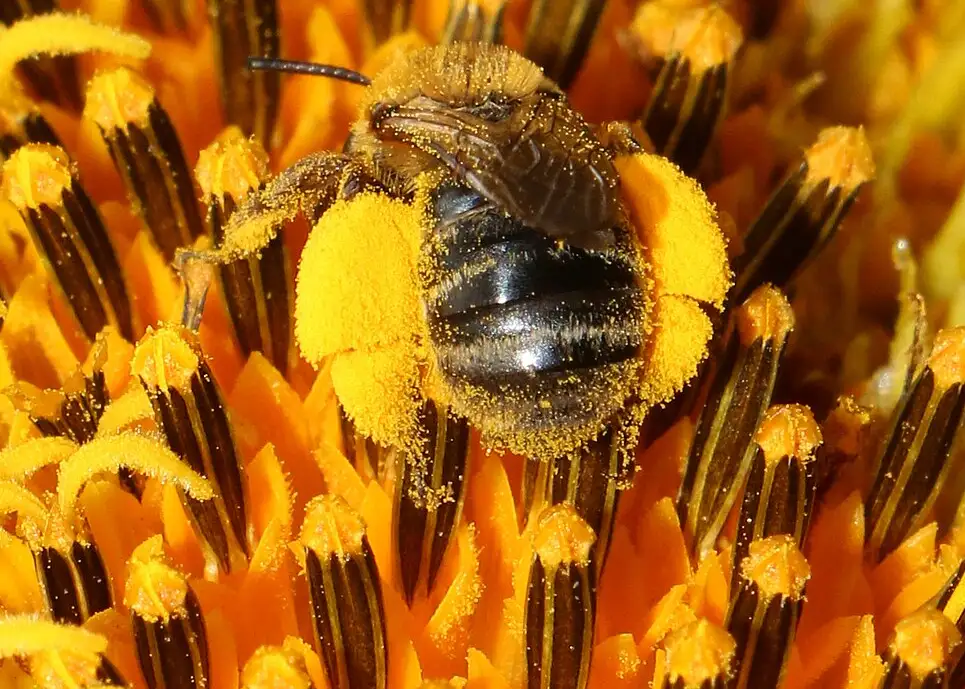
Some native bees collect pollen only, or mainly, from sunflowers. Illinois Wildflowers lists Andrena helianthi, Andrena accepta, Andrena aliciae, Andrena duplicata, Dufourea marginatus and Melissodes agilis as pollen specialists on Helianthus. The Vermont Center for Ecostudies notes that two long-horned bee species (genus Melissodes) turn up most often on sunflowers, particularly the large heads of the common sunflower, and describes the sunflower mining bee (Andrena helianthi) as a widespread, relatively common specialist.
In South Dakota sunflower fields, SDSU Extension found native bees were the most abundant pollinators, with Melissodes trinodis and Lasioglossum species observed most; honey bees were present in limited numbers. Our guide to long-horned bees covers the genus in detail, and the wider cast is in native bee species of the United States.
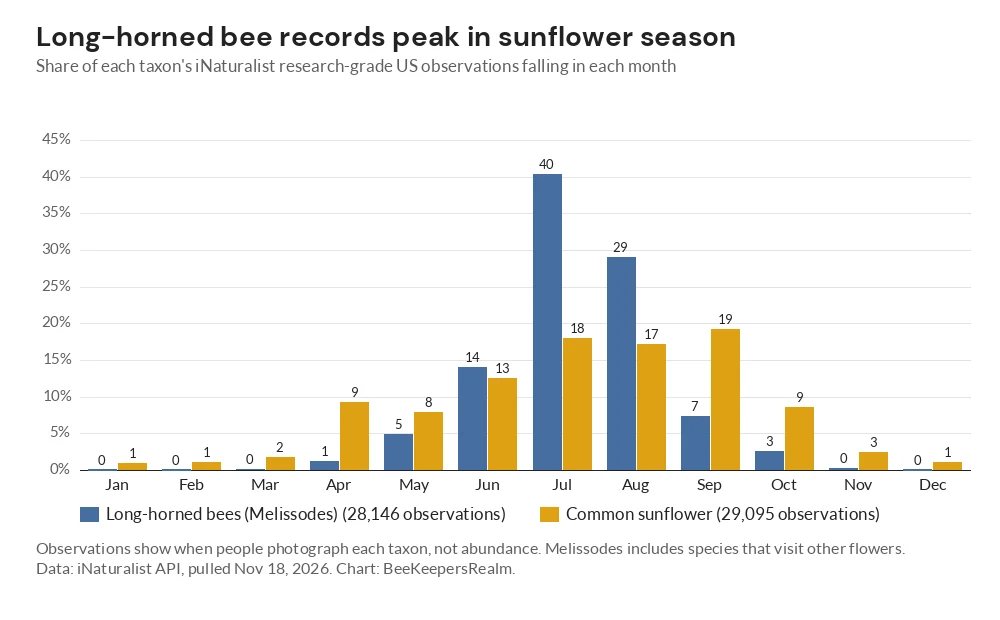
Our pull of US iNaturalist data shows the timing. Research-grade observations of Melissodes (28,146 records) peak in July, with 40.4% of them, and July and August together hold 69.5%. Common sunflower records run mainly from June to September. These show when people photograph each group, not abundance, and Melissodes includes species that visit other flowers too. To add records yourself, see citizen science for pollinators.
Sunflower pollen and a bumble bee gut parasite
The best-studied benefit involves Crithidia bombi, a common gut parasite of bumble bees. A series of studies from NC State University and UMass Amherst built the case step by step:
| Study | What was tested | Main result |
|---|---|---|
| Giacomini et al. 2018, Scientific Reports | Sunflower pollen diets in the lab | Reduced Crithidia in common eastern bumble bees and Nosema ceranae in honey bees. |
| LoCascio et al. 2019, Royal Society Open Science | Pollen of nine cultivars, wild sunflowers, two other Helianthus species and two goldenrods | All Helianthus and goldenrod pollen cut Crithidia 20- to 40-fold compared with buckwheat pollen. |
| Fowler et al. 2022, Proc. R. Soc. B | Wild bumble bees of four species | Strong effect in Bombus impatiens, weaker in B. bimaculatus and B. vagans, none in B. griseocollis; a 50% sunflower diet reduced reproduction. |
| Malfi et al. 2023, Proc. R. Soc. B | Colonies on 20 Massachusetts farms | Infection intensity an order of magnitude lower at high-sunflower sites, and more queens; no effect on other pathogens. |
Sources: each study’s published abstract, plus the full text of Malfi et al. 2023.
The researchers are clear about the limits. Sunflower pollen is low in protein and some amino acids, so it should not be a standalone diet, NC State’s Rebecca Irwin said. In the 2018 study, honey bees fed only sunflower pollen had mortality roughly equal to bees given no pollen, and four times higher than bees fed buckwheat pollen; bumble bees did not show that effect. Irwin’s summary is the practical one:
“But sunflower could be a good addition to a diverse wildflower population for bees.”
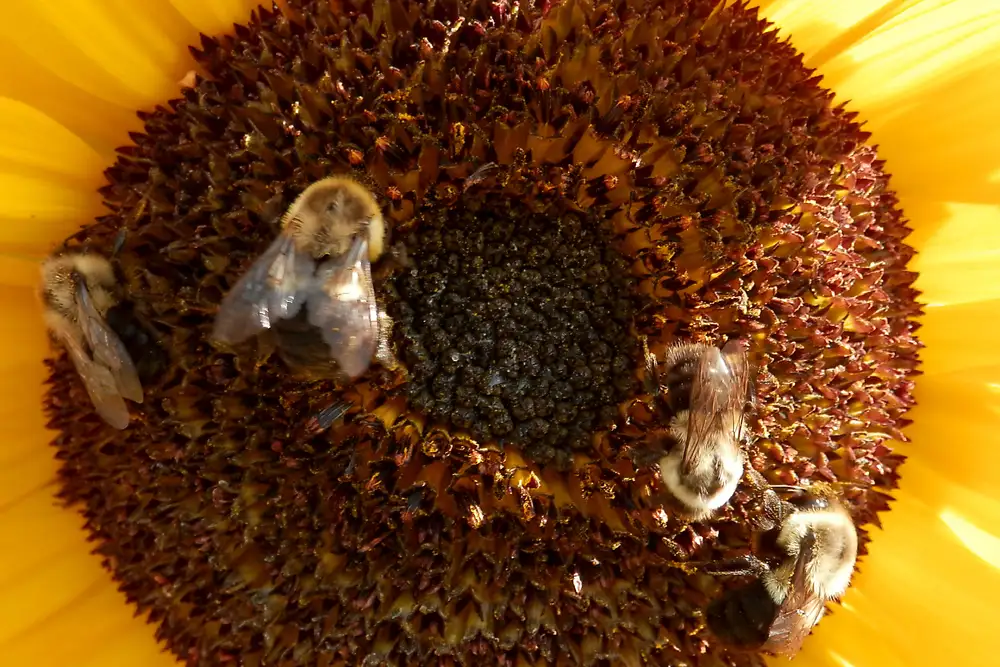
For identification and the life cycle of these bees, see our bumble bee guide.
Honey bees, wild bees and the sunflower crop
Modern US sunflower hybrids are bred to be self-fertile, yet SDSU Extension and Texas A&M AgriLife Extension both report that pollinators still raise yields; Texas A&M lists higher seed set, oil content and yields. In hybrid sunflower fields, Greenleaf and Kremen (PNAS, 2006) found that encounters with wild bees made honey bees up to five times more efficient, roughly doubling honey bee pollination on the average field.
Our guide to beekeeping on the Great Plains treats sunflower as part of that region’s short summer nectar flow, and our list of the best plants for honey production covers other strong nectar sources.
Are pollenless sunflowers bad for bees?
Not useless, but less useful. Pollenless cut-flower hybrids, such as the single-stem ‘Sunrich’ and ‘ProCut’ series, shed no pollen, which is why florists like them. Lynn Byczynski, writing for Johnny’s Selected Seeds, notes that they still have abundant nectar and will form seeds if pollen-bearing sunflowers grow nearby.
In a 2017 study of sunflower inbred lines (Mallinger and Prasifka, Journal of Applied Entomology), wild bees made more visits to pollen-bearing (male-fertile) plants, while honey bees preferred pollenless (male-sterile) ones. A 2023 UMass study (Roch and colleagues, Environmental Entomology) found different bee communities on the two kinds, with female bees, which gather pollen for their nests, usually more abundant on pollen-fertile cultivars. So if you grow pollenless sunflowers for vases, plant a pollen-bearing variety or a native perennial nearby.
Types of Sunflowers Compared
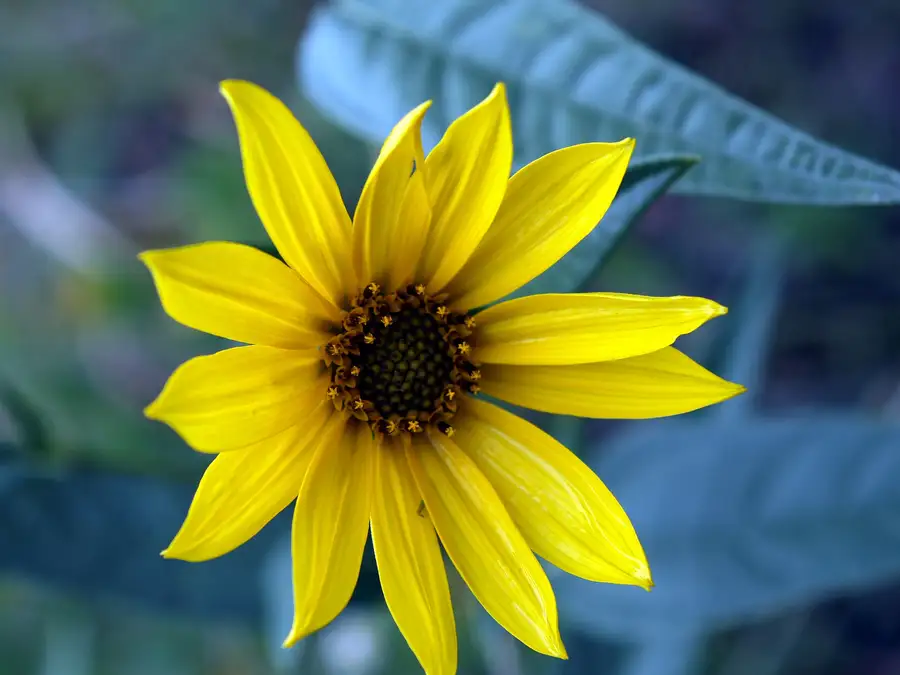
Garden sunflowers are almost all forms of the common sunflower, an annual. The native perennial species return from their roots each year and bloom later. The Mexican sunflower belongs to a different genus.
| Type | Examples | Height | Pollen? | Best for | Bee value | Source |
|---|---|---|---|---|---|---|
| Giant single-head annual | ‘Mammoth’ | Over 12 ft | Yes, unless sold as pollenless | Seeds for snacks and birds | High: pollen and nectar | Old Farmer’s Almanac |
| Branching annual | ‘Autumn Beauty’ | Up to 7 ft | Yes, unless sold as pollenless | Many blooms over a long season | High: many heads over time | Old Farmer’s Almanac; Johnny’s |
| Dwarf annual | ‘Teddy Bear’ | 2 to 3 ft | Check the label | Small gardens and containers | Depends on pollen | Old Farmer’s Almanac |
| Pollenless cut-flower hybrid | ‘Sunrich’ and ‘ProCut’ series; ‘Sunrich Gold’ | About 5 ft (‘Sunrich Gold’) | No | Vases, no pollen mess | Nectar only; fewer wild bee visits | Johnny’s; Almanac; Mallinger and Prasifka 2017 |
| Common sunflower, wild form | Helianthus annuus | 1.5 to about 10 ft | Yes | Dry, open native plantings | High; specialist bees | Lady Bird Johnson Wildflower Center |
| Maximilian sunflower (perennial) | H. maximiliani | 2 to 10 ft | Yes | Prairies, meadows, fall bloom | High; larval host of the silvery checkerspot butterfly | NC State Plant Toolbox |
| Swamp sunflower (perennial) | H. angustifolius | 5 to 8 ft | Yes | Wet sites, rain gardens, late color | High; nectar from July to frost | NC State Plant Toolbox |
| Jerusalem artichoke (perennial) | H. tuberosus | 6 to 10 ft | Yes | Edible tubers | Nectar from July to frost | NC State Plant Toolbox |
| Mexican sunflower (not Helianthus) | Tithonia rotundifolia | 3 to 6 ft | Yes | Heat, drought, butterflies | Bees, butterflies, hummingbirds | NC State Plant Toolbox |
Heights are the ranges each source gives; cultivars vary. Bee value summarizes the studies in this article and each source’s wildlife notes.
For autumn bees, the perennials are the stars. The Lady Bird Johnson Wildflower Center lists swamp and Maximilian sunflowers as blooming from August into November, and NC State says swamp sunflower flowers when little else is blooming, though it spreads aggressively. Both fit a fall-blooming garden for bees or a planting of native plants for pollinators.
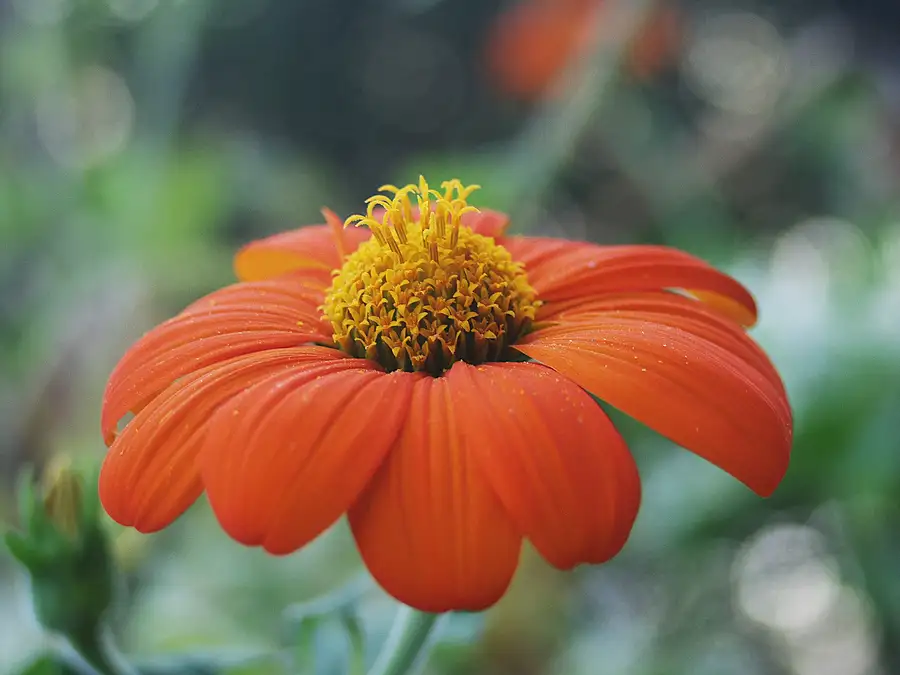
The Mexican sunflower (Tithonia rotundifolia) is an annual from Mexico and Central America with orange-red flowers on 3- to 6-foot plants. NC State says it attracts butterflies, bees and hummingbirds and tolerates deer, drought, heat and dry soil, which also puts it on the list of drought-resistant flowers for bees.
When Sunflowers Bloom: US Observation Data
We pulled every research-grade US iNaturalist observation by month on November 18, 2026. Common sunflower has 29,095 records, and 54.4% fall in July, August and September. The three perennial natives in the table (Maximilian, swamp and Jerusalem artichoke) total 18,194 records, and 64.8% fall in September and October.
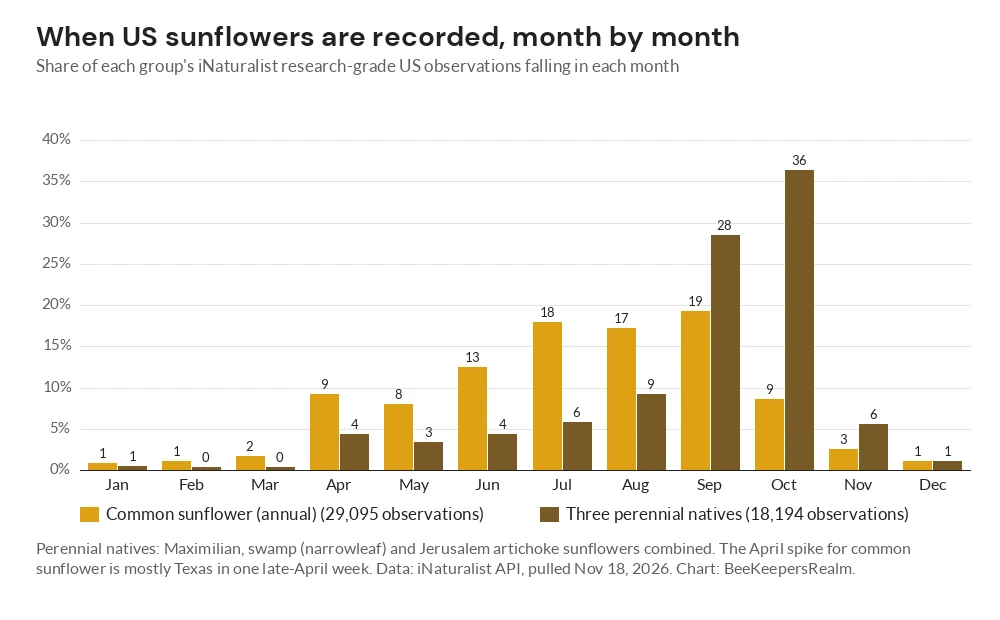
One oddity: 9.2% of common sunflower records fall in April. Texas accounts for 2,173 of those 2,683 April records, and a single late-April week produced 1,523 Texas records against 144 the week before. That looks like a burst of observer activity rather than a bloom peak. These counts measure when people photograph sunflowers, not how many plants are in flower.
When and How to Plant Sunflowers
Sunflowers dislike root disturbance, so the Old Farmer’s Almanac recommends sowing them where they will grow, after frost danger has passed and the soil is at least 50°F: usually mid-March or early April in the South and April to mid-June in the northern half of the country. University of Georgia Extension sets a stricter target of 60°F soil, several weeks after the last frost.
- Sun: 6 or more hours of direct sunlight a day (NC State).
- Depth and spacing: plant 1 to 2 inches deep (deeper in sandy soil), about 6 inches apart, then thin to 12 to 15 inches between plants, with rows 2 to 3 feet apart.
- Water: water lightly for the first seven to 10 days, then a couple of times a week when it does not rain.
- Succession: sow again every couple of weeks for blooms all season.
- Support: tall varieties need staking; the Almanac suggests bamboo stakes for strong single stems.
Unless noted, these steps come from UGA Extension Circular 1121, Growing Sunflowers in the Home Garden (Bob Westerfield, 2022).
Pests, Birds and Bee-Safe Fixes
Because sunflowers draw so many bees, favor physical controls.
- Sunflower moth (Homoeosoma electellum): the larvae feed inside the heads and damage developing seeds. Texas A&M calls it the single most important sunflower pest in Texas. The Almanac suggests inspecting heads for larvae and removing damaged heads.
- Sunflower head-clipping weevil: clipped heads hang from the stem or fall off. Ohio State’s Joe Boggs, writing about the same weevil on coneflowers, advises removing and destroying dangling and fallen heads so the larvae cannot finish developing, and says insecticides are not a viable option.
- Bugs and caterpillars: UGA lists leaf-footed bugs, stink bugs, aphids and caterpillars, and urges caution before spraying because sunflowers attract so many beneficial insects and pollinators.
- Birds and squirrels: cover maturing heads with garden fleece or mesh (Almanac), or try scarecrows, shiny spinning pans or an owl decoy (UGA).
If a spray is unavoidable, SDSU Extension advises the early morning or late afternoon to evening, to avoid direct contact with pollinators, and notes that broad-spectrum insecticides harm every insect they reach.
Harvesting Sunflower Seeds
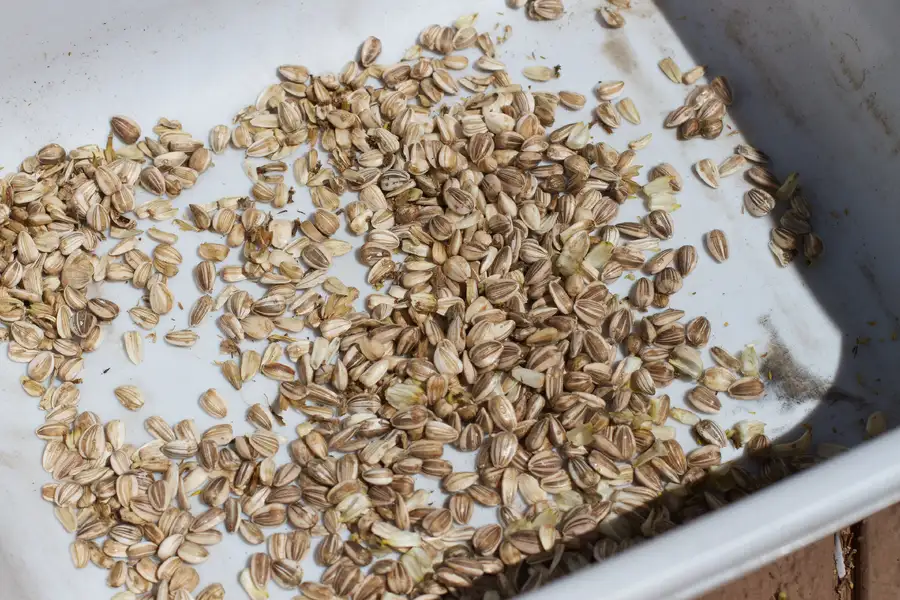
Check the heads in early fall. Seeds are ready when the back of the head turns from green to yellow-brown, the head nods downward and the tiny petals covering the seeds have dried and fallen out. UGA’s method:
- Cut each head with a foot or so of stem attached.
- Hang it in a warm, dry, well-ventilated place protected from rodents and insects, out of high humidity, and let it cure for several weeks.
- When the seeds are thoroughly dry, rub two heads together or brush the seeds out with your fingers or a stiff brush.
- Keep the seeds in airtight glass jars in the refrigerator to hold their flavor.
If you can, leave a few heads standing. The Missouri Department of Conservation notes that goldfinches rely on the seeds of sunflowers and other composites to feed their nestlings, and that most sunflowers bloom in step with goldfinch nesting.
Sunflower Honey
Sunflower honey is mainly a European product: sunflower is grown widely in eastern and southern Europe, where it is an important nectar and pollen source. In their 2004 descriptive sheets of European single-flower honeys, Persano Oddo and Piro describe it from 358 samples as bright yellow, with a weak floral, fruity, warm and vegetal aroma, strong acidity and a short aftertaste. It is high in glucose, so it crystallizes quickly and often hard. Its average color was 52.4 mm on the Pfund scale.
For why glucose-rich honeys set so fast, see why some honeys crystallize faster than others; for varietals US shoppers are more likely to find, see popular US honey varieties.
Frequently Asked Questions
Do sunflowers grow back year after year?
The common sunflower is an annual, so you sow it again each spring. Perennial natives such as Maximilian sunflower and swamp sunflower come back from their roots every year.
When is the best time to plant sunflowers?
After the last frost, once the soil reaches at least 50°F (Almanac) or 60°F (UGA): about mid-March to early April in the South, April to mid-June farther north.
How tall do sunflowers grow?
Wild common sunflowers reach 1.5 to about 10 feet. ‘Mammoth’ can top 12 feet, the Almanac says the largest varieties exceed 16 feet, and dwarf ‘Teddy Bear’ stays at 2 to 3 feet.
When do sunflowers bloom?
The Almanac puts most varieties at 70 to 95 days to maturity. On iNaturalist, US common sunflower records peak from July to September and the perennial natives in September and October.
Why do sunflower heads face one direction?
Once a sunflower blooms, it stops tracking the sun and faces east, where its head warms faster in the morning and gets more pollinator visits (Atamian and colleagues, 2016).
Are sunflowers self-pollinating?
Modern hybrids are bred to be self-fertile and depend less on insects than older, self-incompatible varieties, Texas A&M notes, but pollinators still raise seed set and yields. Pollenless types need pollen from other sunflowers to make seed.
Do honey bees like sunflowers?
Yes, for nectar and pollen; in one study they even preferred pollenless lines. But sunflower-only pollen is a poor diet for honey bees, as NC State’s 2018 mortality results show.
The Bottom Line
Plant at least some pollen-bearing sunflowers, add a native perennial for fall, and skip broad-spectrum sprays while they bloom. For more plant and bee ideas, browse our pollinator gardening and native bees section.
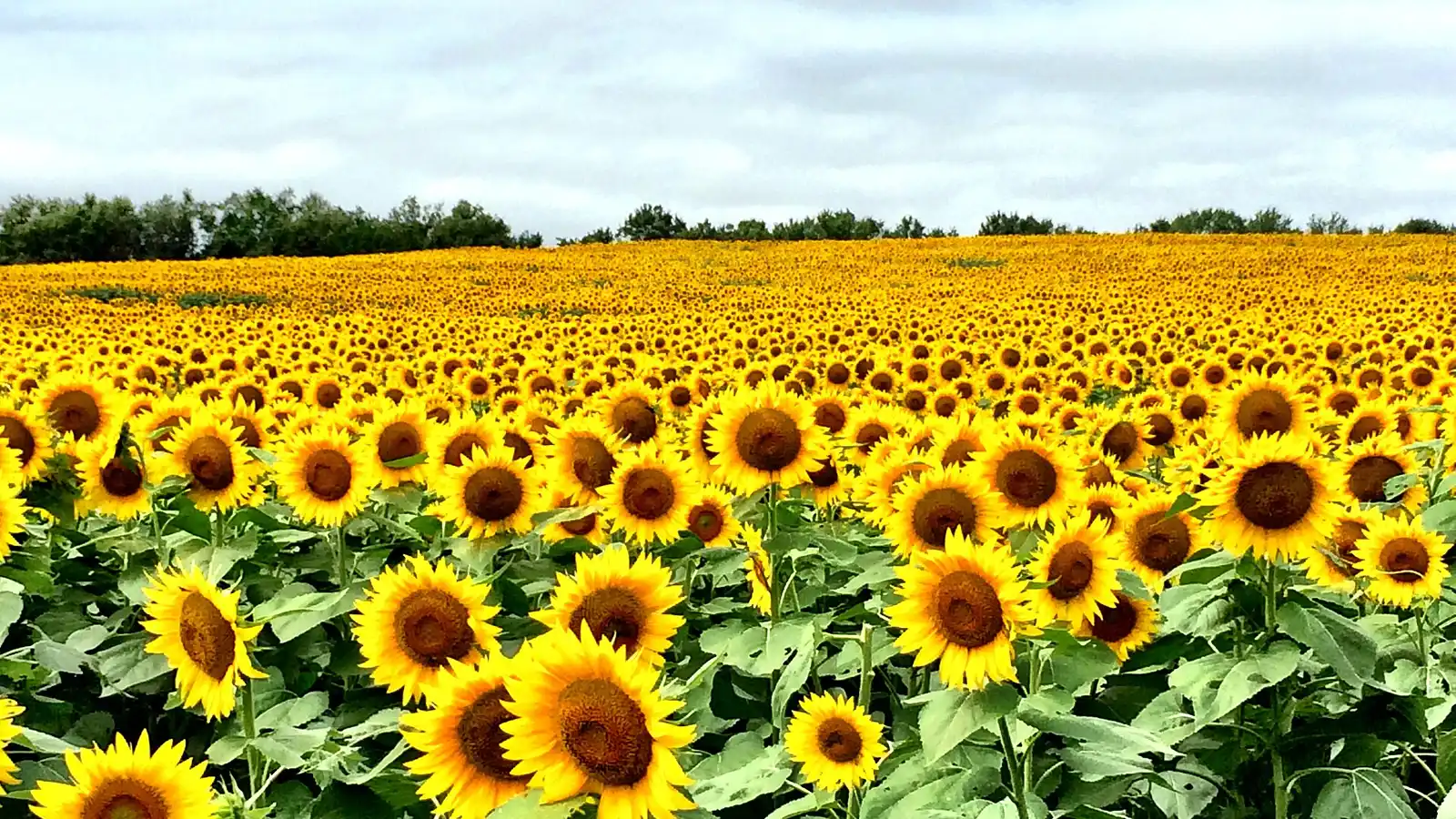
Image credits: featured photo of a Kansas sunflower field by Ben Smith, via Wikimedia Commons, CC BY 2.0, cropped and resized. Other photos are credited in their captions. Charts by BeeKeepersRealm.