Reviewed by Michael R. · How we review
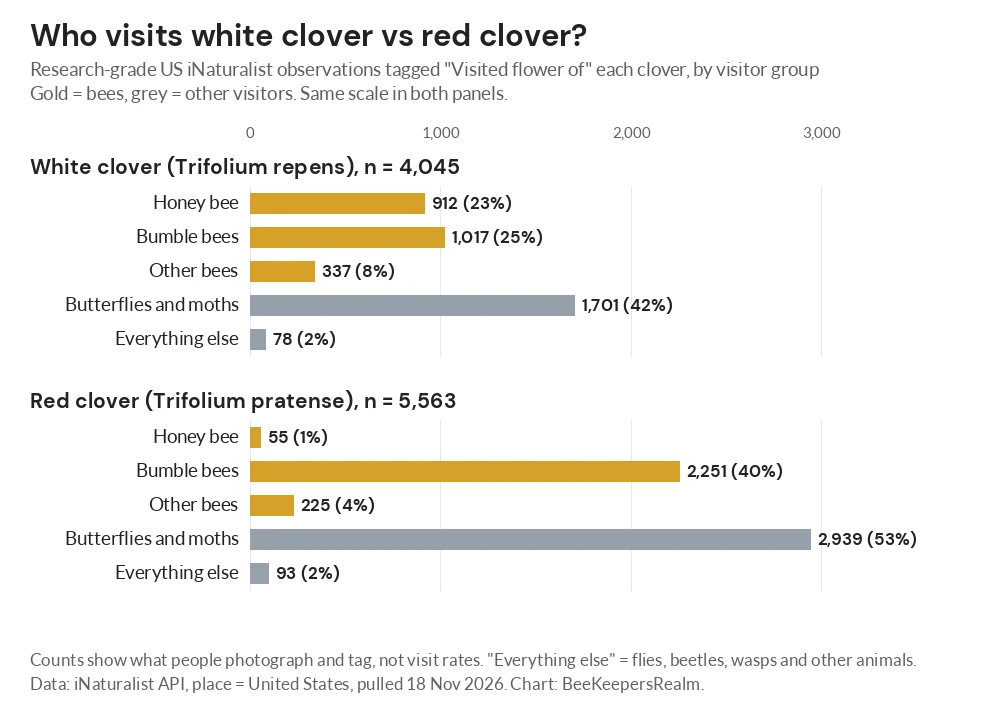
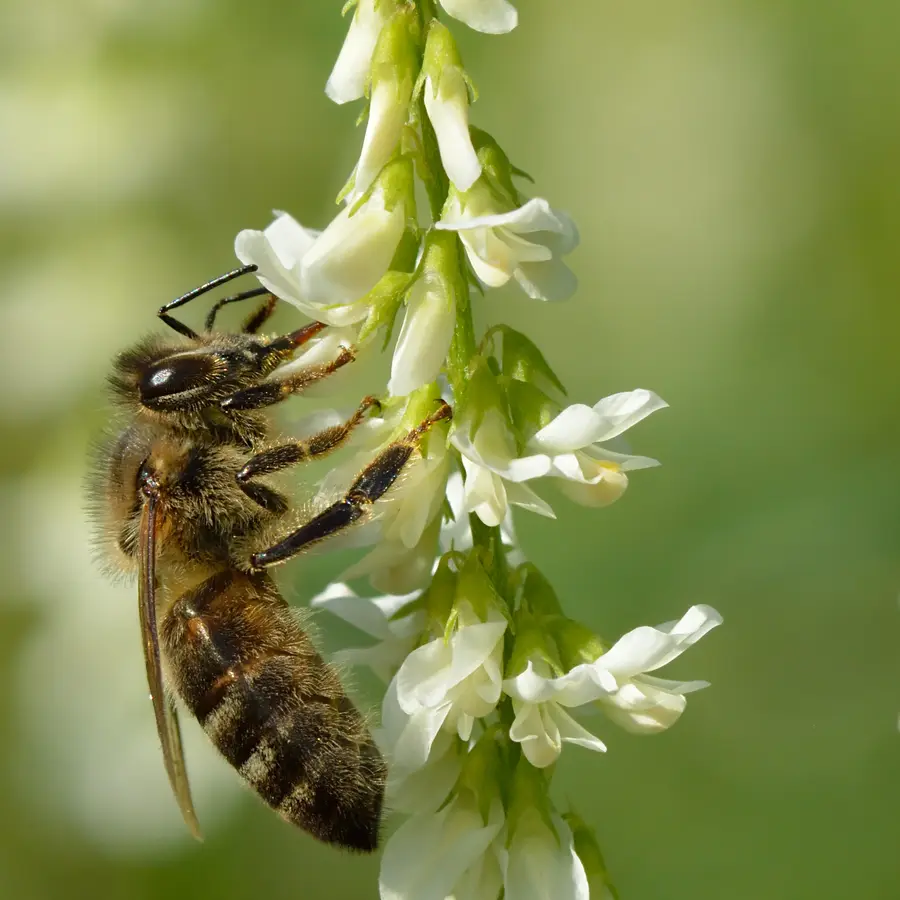
Yes, clover is good for bees, but the type matters. White clover and crimson clover have short flowers that honey bees work easily. Red clover’s deep flowers suit long-tongued bumble bees far better than honey bees. Sweet clover, a different genus, is a heavy nectar plant but can invade prairies. In US iNaturalist records of insects visiting white clover, honey bees and bumble bees appear in similar numbers; on red clover, bumble bees outnumber honey bees about 41 to 1.
The bloom and visitor figures below are our own counts of research-grade US iNaturalist observations.
Key Takeaways
- White (Dutch) clover is the best all-round clover for bees in lawns; University of Minnesota Extension rates its forage quality as excellent.
- Red clover florets are 7.5 to 12.4 mm long, but a honey bee’s tongue is about 6 mm (USDA), so bumble bees do most of the work.
- Crimson clover is an annual cover crop; 51% of its US flowering records fall in April.
- For a bee lawn, mow at 3 inches or higher every 2 to 3 weeks and skip mowing during full bloom.
- Broadleaf lawn herbicides, including some weed-and-feed products, kill clover.
- The common US clovers are all introduced, and the Minnesota DNR lists sweet clover as a grassland invader.
Table of Contents
- What Counts as Clover?
- Types of Clover for Bees Compared
- Which Bees Use Which Clover
- When Does Clover Bloom?
- Clover Lawns and Bee Lawns
- Clover as a Cover Crop
- Frequently Asked Questions
- The Bottom Line
What Counts as Clover?
True clovers are the genus Trifolium in the legume family. The four that matter most for US bees are white clover (T. repens), red clover (T. pratense), crimson clover (T. incarnatum) and alsike clover (T. hybridum). Like other legumes, they fix their own nitrogen.
- Sweet clover is a separate genus, Melilotus: tall, fragrant biennials with flowers in long spikes.
- Microclover is a selection of white clover (‘Pirouette’ and ‘Pipolina’) with smaller leaves and slower growth, per University of Illinois Extension.
- Dutch white clover is the intermediate-size white clover sold for lawns; ‘Ladino’ is a large pasture type.
Native or introduced? USDA plant guides say white clover came from Europe and crimson clover from southeastern Europe and southwestern Asia Minor, arriving as a crop in the 1800s. iNaturalist lists all six clovers in this article as introduced in the US. The US does have native clovers: running buffalo clover (T. stoloniferum), once thought extinct, was removed from the endangered species list in 2021 after it recovered.
Types of Clover for Bees Compared
Bloom peaks come from research-grade US iNaturalist observations marked as flowering; local timing varies with latitude.
| Clover | Species | Life cycle | Bloom time | Best use | Bee value | Source |
|---|---|---|---|---|---|---|
| White (Dutch) | Trifolium repens | Perennial | Late May to October in Minnesota; US peak April | Lawns, pasture | Excellent; nectar and pollen for honey bees and bumble bees | UMN Extension; USDA; iNaturalist |
| Microclover | T. repens selections | Perennial; may need reseeding | As white clover | Lawns | Flowers feed bees; no extension bloom data | Illinois Extension |
| Red | T. pratense | Short-lived perennial or biennial | US peak June | Hay, pasture, rotations | Mainly long-tongued bumble bees | USDA; Oregon State; iNaturalist |
| Crimson | T. incarnatum | Annual | April to August by climate; US peak April | Cover crop | Shallow flowers; rated high as a honey plant | USDA; SARE |
| Alsike | T. hybridum | Usually biennial | US peak June | Hay, pasture | “Quite attractive to bees, especially honey bees” | USDA; iNaturalist |
| Sweet (white, yellow) | Melilotus albus, M. officinalis | Biennial | June to August; US peak July (white), June (yellow) | Not for prairies | Heavy nectar plant; invades native grasslands | Minnesota DNR; iNaturalist |
This Pioneer PBS episode of Prairie Yard & Garden shows the clover-and-grass “bee lawn” covered later.
What the video covers: University of Minnesota horticulture professor Mary Meyer appears in the 2022 episode, per Pioneer PBS. Its official chapters cover what a bee lawn is, pros and cons, establishment, plant choice, maintenance and Minnesota’s Lawns to Legumes program.
Which Bees Use Which Clover
Flower tube depth decides which bees reach the nectar. Oregon State University Extension, which serves the state’s clover seed industry, puts it plainly:
“In contrast, white clover and crimson clover have relatively shallow flowers that are highly accessible and attractive to honey bees.”
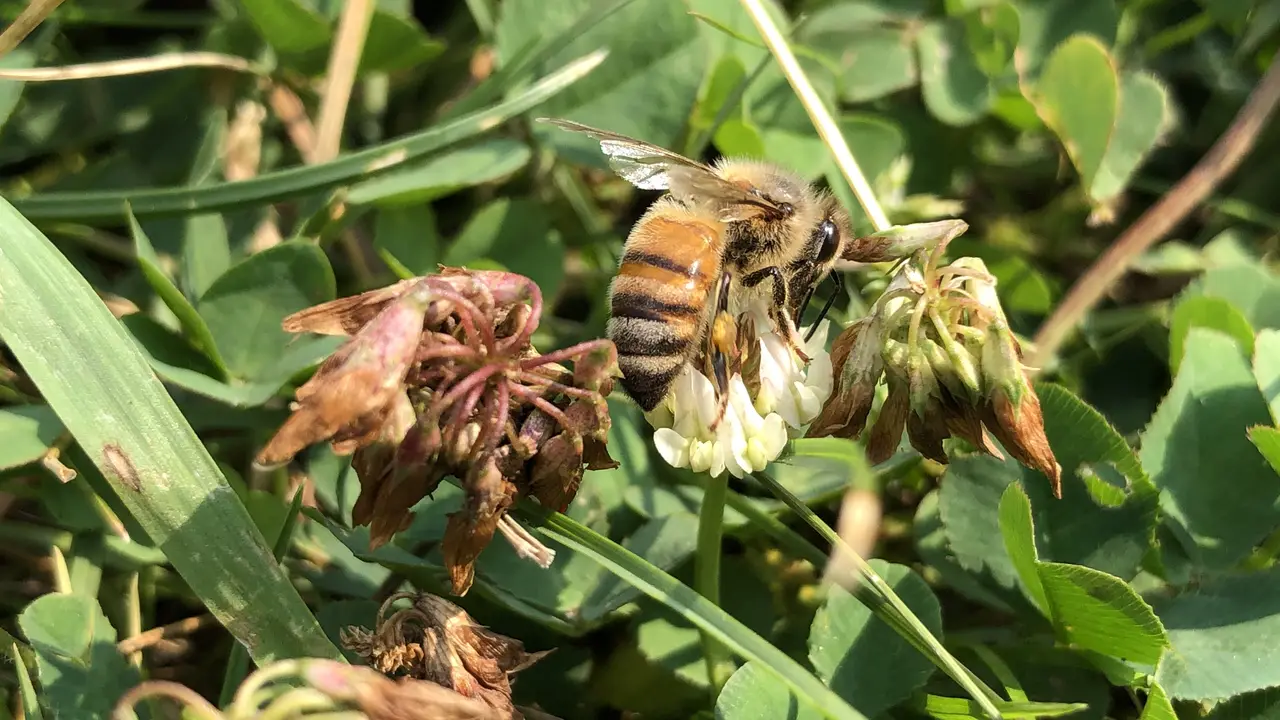
White clover: honey bees and bumble bees
The USDA pollination handbook, by bee scientist S.E. McGregor, is direct about white clover’s value:
“The intermediate and small types of white clover constitute probably the most important honey producing crop in the United States, and provide also a good source of pollen for the bees.”
UMN Extension adds that white clover pollen is high in protein and its nectar high in sugar. In central Kentucky lawns in 2011 and 2012, entomologist Dan Potter and Jonathan Larson collected more than 2,100 pollinators from dandelions and white clover, covering 50 species including 37 bees. Honey bees and native bumble bees were the most common white clover visitors, especially in late summer.
Our iNaturalist count agrees. Of 4,045 research-grade US records of animals visiting white clover, 912 are honey bees, 1,017 are bumble bees and 1,701 are butterflies and moths, with 51 bee species in all. Our bumblebee identification guide covers the bumble bees you are likely to see.
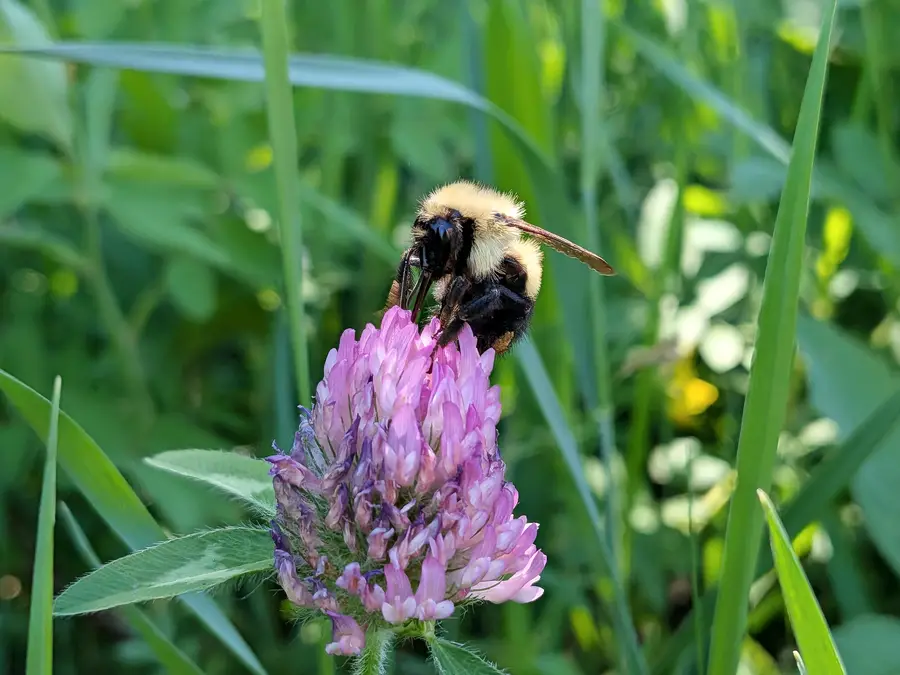
Red clover: a bumble bee flower
The USDA handbook explains why honey bees often pass red clover by. Its florets are 7.5 to 12.4 mm long, nectar fills only the bottom 1.35 to 1.47 mm, and a honey bee’s tongue is 5.90 to 6.25 mm. Only the shortest, fullest florets are in reach. Late-season florets are shorter, and beekeepers often see bees working red clover then, but surplus red clover honey is uncommon.
Oregon State names long-tongued bumble bees that keep visiting red clover when other bees do not: the yellow-faced, golden northern, white-shouldered and Nevada bumble bees. In hot, dry weather consistently above 95°F, though, honey bees keep foraging alongside them. The USDA plant guide says honey bees tend to prefer sweet clover, white clover and alsike clover when those grow nearby.
In iNaturalist, 2,251 of 5,563 research-grade US red clover visit records are bumble bees and only 55 are honey bees. The golden northern bumble bee has 409 records, close behind the common eastern bumble bee (417).
Crimson and alsike clover
The USDA handbook says honey bees are attracted to crimson clover, though they have some difficulty forcing their mouthparts into the floret. It cites three authors who rated crimson clover high as a honey plant and notes that bees collect its pollen in large amounts, which is unusual for a legume. iNaturalist has only 59 research-grade US crimson clover visit records, too few to compare. Alsike’s flowers, the handbook says, are “quite attractive to bees, especially honey bees, for the nectar and pollen.”
Sweet clover: big nectar, invasive habits
Of 660 research-grade US records of animals visiting white sweet clover, 332 are bees. The catch is ecological. The Minnesota DNR says sweet clover “invades and degrades native grasslands” by shading out sun-loving native plants, and one plant can make more than 100,000 seeds that stay viable for 40 years. Keep it away from prairies and check your state’s invasive list.
When Does Clover Bloom?
In Minnesota, UMN Extension says white clover blooms from the end of May to October, peaking in June. Nationally, research-grade iNaturalist flowering records peak as follows:
- Crimson: April (51% of 1,940 records); March to May hold 90%.
- White: April (23% of 13,506); April to June hold 59%. Southern lawns bloom early, northern ones later.
- Red: June (26% of 10,451); May to September hold 85%.
- Alsike: June (34% of 1,141).
- Sweet clover: July for white (35% of 4,002), June for yellow (46% of 2,628).
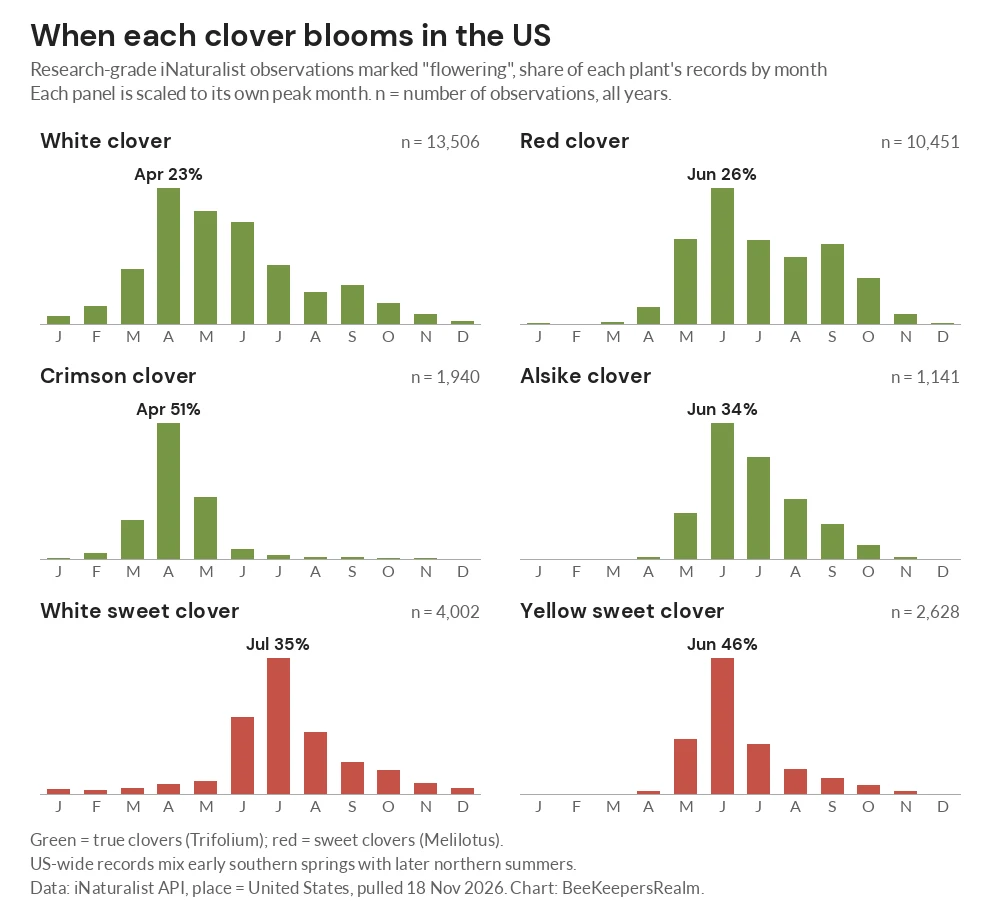
A mix gives bees a longer season: crimson in spring, white through summer, red into September. For what follows, see our fall-blooming flowers for bees.
Clover Lawns and Bee Lawns
White clover was common in lawns until broadleaf weed herbicides arrived in the 1950s, says Illinois Extension. Many homeowners now add it back, often in a “bee lawn” of fine fescue or Kentucky bluegrass mixed with white clover and self-heal. UMN Extension says a bee lawn can attract over 50 species of native bees. For the wider project, see how to turn a lawn into pollinator habitat.
White clover vs microclover
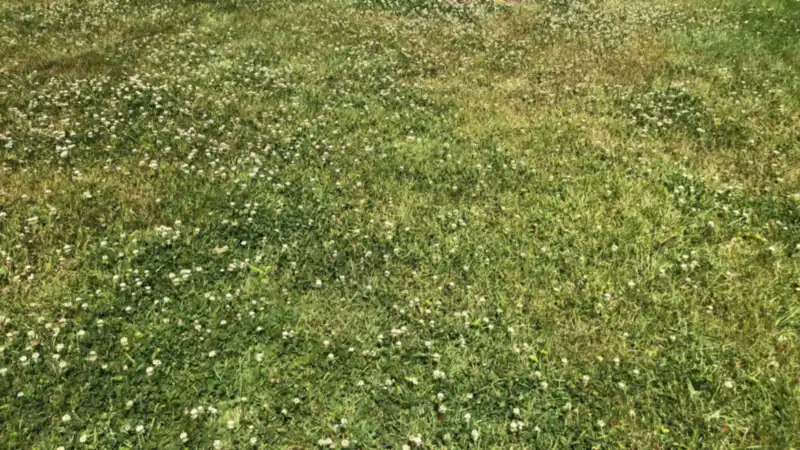
Common white clover can form clumps that look patchy. Illinois Extension reports preliminary research finding that microclover, seeded at appropriate rates, mixes better with most turfgrasses. Its limits: it does not tolerate high heat, drought or shade, may need reseeding, dies back in winter, has expensive seed, and is killed by most broadleaf lawn herbicides. Seed sellers often say microclover flowers less; we found no extension trial measuring that, so for bees, common Dutch white clover is the proven choice.
How to plant a clover lawn
UMN Extension’s bee lawn guide gives these steps for Minnesota:
- Pick the spot. Light to moderate foot traffic and soil pH 6.0 to 7.0; white clover tolerates pH 5.5 and may bloom sparsely in shade.
- Time it. Dormant seeding, early November to mid-December, is best. Spring seeding, mid-May to early June, is second best and needs more watering. Fall is not the best time for bee lawn flowers.
- Prepare. Mow to about 1 inch, aerate compacted soil and rake to expose soil.
- Seed. Per 1,000 square feet: 4 lb fine fescue, 1.1 oz Dutch white clover and 1.2 oz self-heal, or about 4 to 5 lb of a premixed blend. Rake lightly.
- Wait. Expect mostly grass in year one and many more flowers in year two.
For microclover, Illinois Extension suggests planting from early spring to late summer and watering every day for the first 7 to 10 days.
Mowing to protect foraging bees
“Hold off on mowing when bee lawn flowers are in full bloom to allow pollinators time to forage.”
UMN also advises mowing at 3 inches or higher about every 2 to 3 weeks and leaving the clippings. The Kentucky researchers found that mowing flowering weeds before or soon after a lawn insecticide treatment greatly reduces bees’ exposure. Our look at whether No Mow May helps bees covers mowing less.
Herbicides kill clover
Broadleaf herbicides are designed to harm plants that are not grasses, and UMN warns that some weed-and-feed products contain them. If you must spray, spot-treat and avoid times when pollinators are present and flowers are in bloom.
Pros and cons
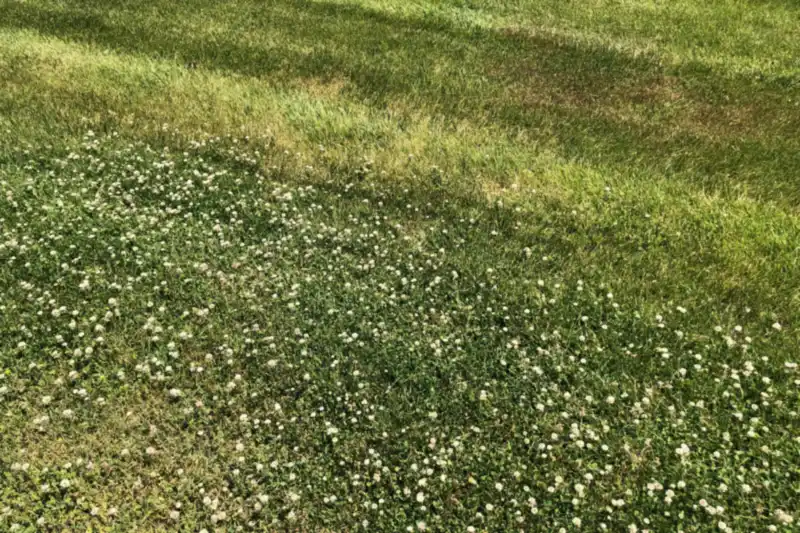
- Pros: months of bee forage; clover fixes its own nitrogen; UMN says an established bee lawn takes similar or less work than a regular lawn.
- Cons: bees underfoot during bloom, so stings are possible; not for heavy traffic; clumps can look patchy.
If a sting happens, our bee sting first aid guide explains what to do and when to seek emergency care.
Clover as a Cover Crop
SARE’s Managing Cover Crops Profitably gives these nitrogen figures: crimson clover 70 to 150 lb per acre as a winter annual; full-season, overwintered red clover 70 to 150 lb; and a healthy white clover stand 80 to 130 lb when killed the year after establishment.
Crimson clover in the South. SARE describes a “crimson clover zone” east of the Mississippi, from southern Pennsylvania and southern Illinois south. SARE’s crimson clover chapter advises seeding six to eight weeks before the average first frost, at 15 to 18 lb per acre drilled or 22 to 30 lb broadcast. Gardeners can see our guide to companion planting for pollinators.
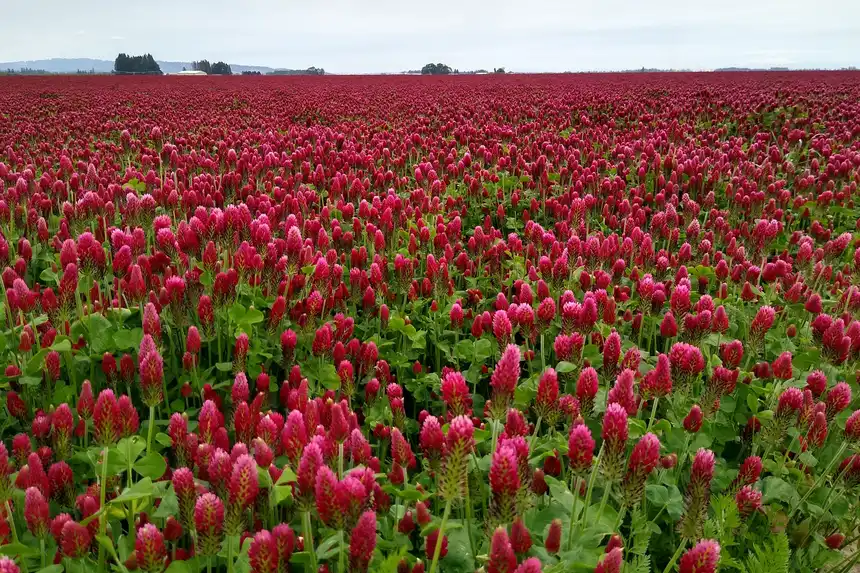
Red clover in rotations. The USDA plant guide calls red clover the most widely grown true clover and the most important legume hay crop in the northeastern US. SARE notes that root rots and leaf diseases typically kill medium red clover in its second year.
Clover seed needs bees. Oregon is the largest US producer of seed for many clover species, and Oregon State says all commercial clover species require bee pollination to set seed. Growers rent about 7,000 honey bee colonies for it in the Pacific Northwest.
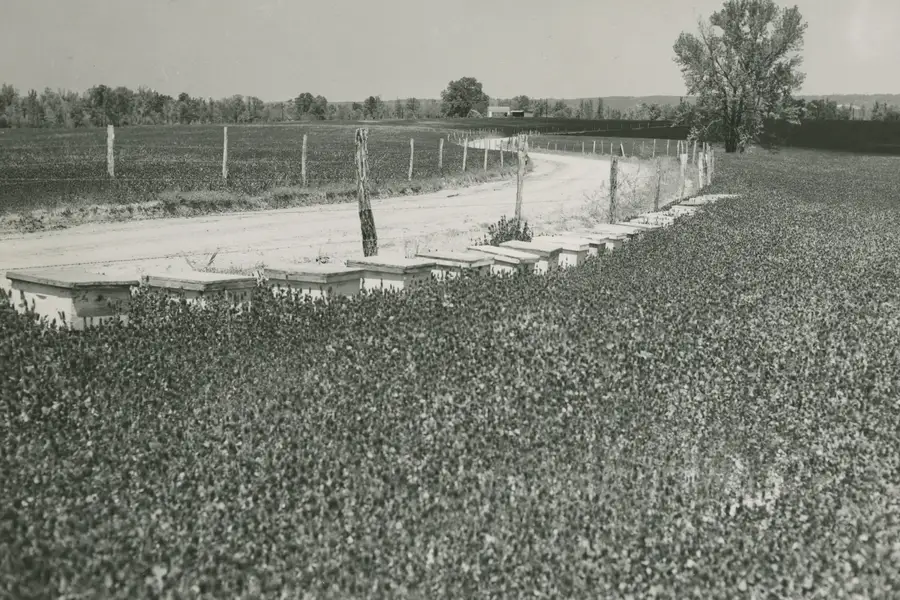
A note on honey. The USDA plant guide says honey bees make a light, good quality honey from crimson clover. This page is about the plants; for more honey crops, see the best plants for honey production in the USA.
Frequently Asked Questions
Do honey bees like red clover?
Not much. Most red clover florets are deeper than a honey bee’s tongue reaches, so honey bees prefer white, alsike or sweet clover nearby. They work red clover more in hot, dry weather and late in the season.
Is crimson clover the same as red clover?
No. Crimson clover is a spring-blooming annual with tall scarlet spikes. Red clover is a short-lived perennial with round pink heads that peaks in June. Crimson’s shallower flowers suit honey bees better.
Is micro clover good for bees?
Its flowers feed bees, says Illinois Extension. Sellers say it flowers less than common white clover, though we found no extension data on that, so plain Dutch white clover is the safer pick for bees.
When does white clover bloom?
From the end of May to October in Minnesota, peaking in June. Nationally, iNaturalist flowering records peak in April because southern clover blooms early.
Does a clover lawn attract bees?
Yes, while it flowers. If stings worry you, put clover in lower-traffic areas, as UMN suggests, and keep a mowed play area.
Is clover an annual or a perennial?
White clover is perennial, red is a short-lived perennial or biennial, alsike usually acts as a biennial, crimson is an annual, and sweet clover is a biennial.
Can you plant clover in the fall?
Crimson clover, yes: sow six to eight weeks before first frost. For a bee lawn, UMN prefers dormant seeding once the soil is too cold to germinate seed, or spring seeding.
The Bottom Line
Keep Dutch white clover in the lawn, add crimson clover where you want a spring cover crop, and leave red clover to the bumble bees. Mow high, skip broadleaf herbicides and keep sweet clover away from prairies. For more bee plants, browse our pollinator gardening and native bee guides.
Image credits: featured photo of a honey bee on white clover by Famartin, via Wikimedia Commons, CC BY-SA 4.0, cropped. Other photos are credited in their captions. Charts by BeeKeepersRealm from iNaturalist data.