Reviewed by Sofia T. · How we review
Black-eyed Susan (Rudbeckia hirta) is a native North American wildflower in the aster family, with golden-yellow petals around a dark brown, domed center. It is usually a biennial or short-lived perennial that self-seeds, flowers mainly in June and July, and grows 1 to 3 feet tall in sun. It is Maryland’s state flower. Its genus, Rudbeckia, feeds sweat bees, butterflies and 28 pollen-specialist bee species in the eastern US, and its seeds feed finches in fall.
Key Takeaways
- “Black-eyed Susan” usually means Rudbeckia hirta. The name is also used for perennial orange coneflower (R. fulgida, the parent of ‘Goldsturm’) and for an unrelated African vine, Thunbergia alata.
- In 17,306 US iNaturalist research-grade records marked as flowering, 58.8% of R. hirta records fall in June and July. Orange coneflower peaks a month later, in August.
- In 2,497 US iNaturalist records of insects visiting R. hirta flowers (all quality grades), bees make up 1,079. Sweat bees lead with 656. Honey bees account for 25.
- A 2020 list of 200 pollen-specialist bees of the eastern US names Rudbeckia as a host for 28 species, fourth among all plant genera.
- ASPCA’s plant lists do not include black-eyed Susan. Poison Control says there is no evidence it poisons people, but its hairs can irritate skin and it has been known to poison grazing animals.
Table of Contents
- What Is a Black-Eyed Susan?
- Types of Black-Eyed Susan
- When Do Black-Eyed Susans Bloom?
- Black-Eyed Susans and Bees
- Butterflies, Flies, Beetles and Birds
- How to Grow Black-Eyed Susan
- Problems and Pollinator-Safe Fixes
- Black-Eyed Susan vs Coneflower and Other Look-Alikes
- Is Black-Eyed Susan Toxic?
- Frequently Asked Questions
- The Bottom Line
What Is a Black-Eyed Susan?
Black-eyed Susan is the common name of Rudbeckia hirta, a member of the aster family (Asteraceae). Each “flower” is really a head of many small flowers: a ring of yellow ray florets around a dark dome of disk florets. The species name hirta means hairy, and the stems and leaves are covered in stiff, bristly hairs that feel rough to the touch (Lady Bird Johnson Wildflower Center).
The genus Rudbeckia holds about 31 species, all native to North America, commonly called coneflowers or black-eyed Susans (NC State Extension). Carl Linnaeus named it in 1753 after Olav Rudbeck and his son, both professors at Uppsala University. Maryland made black-eyed Susan its official “Floral Emblem” in 1918 (Chapter 458, Acts of 1918), according to the Maryland State Archives.
The Lady Bird Johnson Wildflower Center gives its native range as western Massachusetts to Manitoba and Wyoming, south to Florida and New Mexico. It has been widely naturalized elsewhere. Its native habitats include prairies, plains, meadows, pastures, savannas and woodland edges. Penn State Extension adds that Rudbeckia species thrive in disturbed landscape areas.
One name, three plants. Penn State Extension points out that “black-eyed Susan” is used for R. hirta and R. fulgida, and also for Thunbergia alata, a tropical East African vine grown as a summer annual. The vine is not a Rudbeckia and is not covered here.
Types of Black-Eyed Susan
These are the Rudbeckia species and cultivars US gardeners meet most often. Heights, bloom months and ranges are from the Lady Bird Johnson Wildflower Center (LBJWC) unless noted.
| Species / cultivar | Life cycle | Height | Bloom time | Native range | Pollinator notes | Source |
|---|---|---|---|---|---|---|
| Black-eyed Susan (R. hirta) | Annual, biennial or short-lived perennial; often blooms the first year from early-spring seed | 1 to 3 ft | Jun to Oct | W. MA to MB and WY, south to FL and NM | Visited by many bees and flies; caterpillar host for the silvery checkerspot | LBJWC; NC State Extension; Illinois Wildflowers |
| Orange coneflower (R. fulgida) | Perennial; spreads by rhizomes | Up to about 4 ft | Jul to Oct | NJ to IN, south to FL and e. TX | Rated “Special Value to Native Bees” (Xerces Society data) | LBJWC; NC State Extension |
| ‘Goldsturm’ (R. fulgida cultivar) | Perennial; zones 4 to 9 | 23 to 29 in | Mid to late summer into fall | Cultivar | 1999 Perennial Plant of the Year; prone to leaf spots | Clemson HGIC; Penn State Extension |
| Brown-eyed Susan (R. triloba) | Biennial or short-lived perennial | 2 to 5 ft | Jun to Oct | NY to GA, west to s. MN, w. IA, e. NE and OK | Many small heads; takes some shade | LBJWC; NC State Extension |
| Cutleaf or green-headed coneflower (R. laciniata) | Perennial; can spread hard by rhizomes | 3 to 10 ft | Jul to Oct | Quebec to n. FL, west to ID and AZ | Butterflies take nectar; native bees nest in the hollow dead stems | LBJWC; NC State Extension |
| Sweet coneflower (R. subtomentosa) | Perennial | Up to about 6 ft | Jul to Sep | IN to LA, west to WI, IA and OK | Rated “Special Value to Native Bees” | LBJWC |
| ‘Indian Summer’, ‘Cherry Brandy’, ‘Autumn Colors’ (R. hirta cultivars) | Biennial, usually grown as annuals | 1.5 to 2 ft (‘Autumn Colors’, ‘Cherry Brandy’) | Summer | Cultivars | Penn State researchers found the Rudbeckia cultivars they studied drew a wide variety of bees | Penn State Extension; NC State Extension |
Is black-eyed Susan an annual or a perennial?
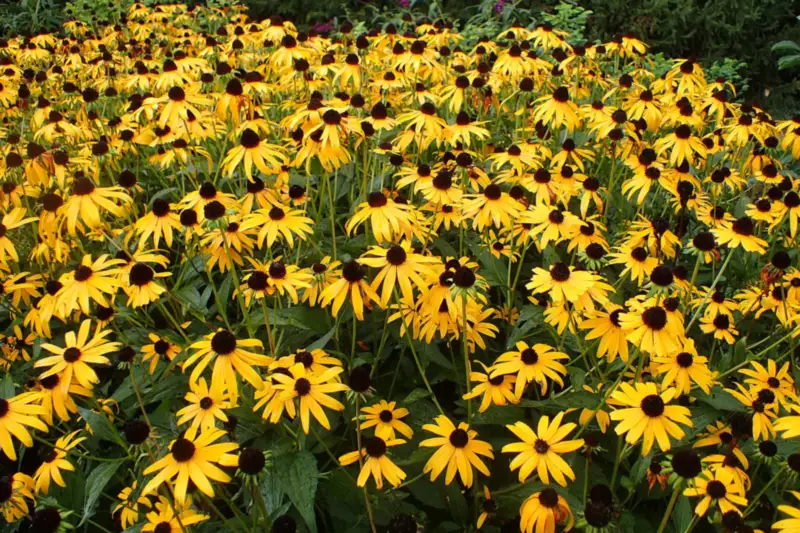
It depends on the species. R. hirta may act as an annual, a biennial or a short-lived perennial, depending on growing conditions (LBJWC). NC State Extension notes that it blooms in the first year when sown in early spring, so people often mistake it for an annual. It keeps coming back mainly because it self-seeds. Illinois Wildflowers says it has a taproot and no rhizomes and reproduces entirely by seed. For a true perennial clump that widens each year, choose R. fulgida (including ‘Goldsturm’), R. laciniata or R. subtomentosa.
When Do Black-Eyed Susans Bloom?
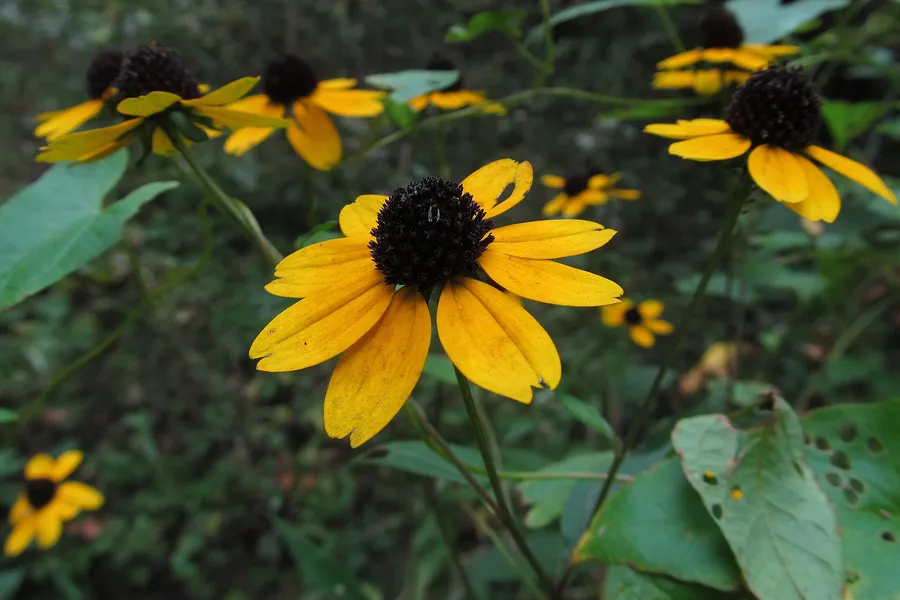
Most black-eyed Susans flower from early summer into fall, but the species do not peak together. To measure this, we pulled every research-grade US iNaturalist observation carrying the “Flowering” annotation for R. hirta (17,306 records) and R. fulgida (809 records), counted by month observed.
- R. hirta peaks in July (32.8%) after a strong June (26.0%). June and July together hold 58.8% of its flowering records, and June to September hold 81.6%.
- R. fulgida peaks in August (39.9%), with July and September close behind. July to September hold 90.2% of its flowering records.
- A few R. hirta flowering records turn up in every month, including 28 in January and 79 in December.
This matches the field guides. Illinois Wildflowers says R. hirta blooms mainly in early to mid-summer for about a month, and that R. fulgida “usually blooms later.” NC State Extension adds that deadheading keeps R. hirta flowering into mid-fall. Planting both gives bees a Rudbeckia bloom from June into September.
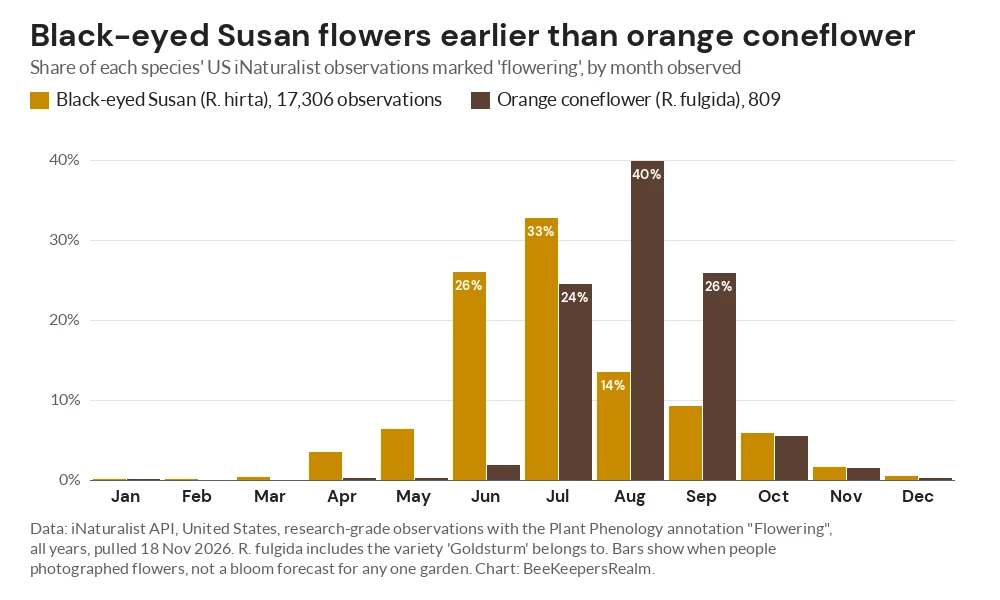
A note on the data: iNaturalist files R. amplexicaulis (clasping coneflower) inside Rudbeckia, and many US R. fulgida records are garden plants (4,827 of 6,843 verifiable records are flagged as cultivated). That is why the chart uses species, not the whole genus, and research-grade wild records only.
Black-Eyed Susans and Bees
Yes, bees like black-eyed Susans, and some bees depend on them. Penn State Extension explains why the flower works so well for small insects:
“A close examination of the center “eye” reveals that it is actually hundreds of individual small flowers, each holding nectar sipped by bees, small wasps, flies, butterflies, and moths.”
The same article notes that research shows a drift of several Rudbeckia plants draws more pollinating insects than a single plant.
Pollen-specialist bees
About a quarter of the roughly 770 bee species native to the eastern US are pollen specialists: they collect pollen from only one plant family or a few related genera. In their 2020 list of 200 specialist bees from 20 eastern states, Jarrod Fowler and Sam Droege rank Rudbeckia fourth among host genera, with 28 bee species. Only goldenrod (40), sunflowers (36) and asters (33) host more. Our goldenrod guide covers the top of that list.
Two of those bees are named for the plant. In the Fowler and Droege list, the coneflower mining bee (Andrena rudbeckiae) uses only Rudbeckia and prairie coneflowers (Ratibida) and flies from May to August. Pseudopanurgus rudbeckiae is listed with Rudbeckia as its only host and is rated rare. The Illinois Wildflowers profile of R. hirta, written by botanist John Hilty, says the same:
“Some Andrenid bees, such as Andrena rudbeckiae and Heterosarus rudbeckiae, prefer visiting the flowers of Black-Eyed Susan and closely related plants.”
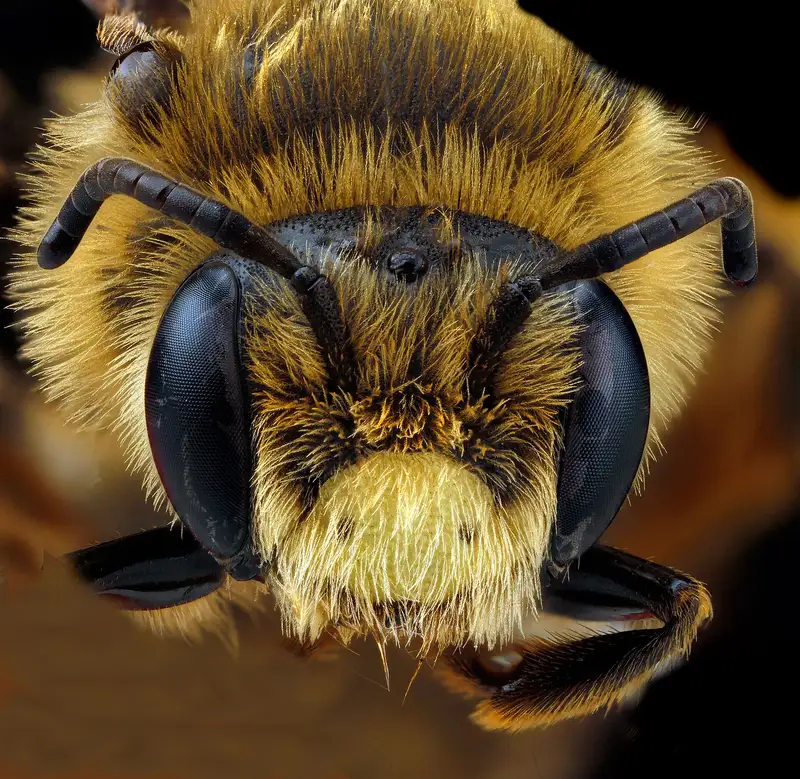
Most of these specialists are small, dark ground-nesting mining bees, plus several long-horned bees (Melissodes) and leafcutter bees (Megachile) that use many daisy-family plants. Leaving bare, sunny soil near your plants and skipping fall cleanup helps the ground- and stem-nesters.
What iNaturalist records show
iNaturalist users can tag an insect photo with the field “Visited flower of.” On 18 November 2026 there were 2,497 US records tagged as visiting R. hirta (all quality grades; 1,571 research grade). Of these:
- Bees: 1,079 records. Sweat bees lead with 656, more than half of them the ligated furrow bee (Halictus ligatus, 353). Long-horned bees follow with 130, leafcutter and mason bees with 87, and bumble bees with 68.
- Specialists on the list: Andrena rudbeckiae (16 records), the dark-veined longhorn bee Melissodes trinodis (24) and the pugnacious leafcutter bee Megachile pugnata (19) all appear. Each is on Fowler and Droege’s list of Rudbeckia hosts.
- Honey bees: 25 records, or 2.3% of bee records. Honey bees do visit, but in this data black-eyed Susan is mainly a native-bee flower. Beekeepers planting for a honey crop should start with our list of best plants for honey production.
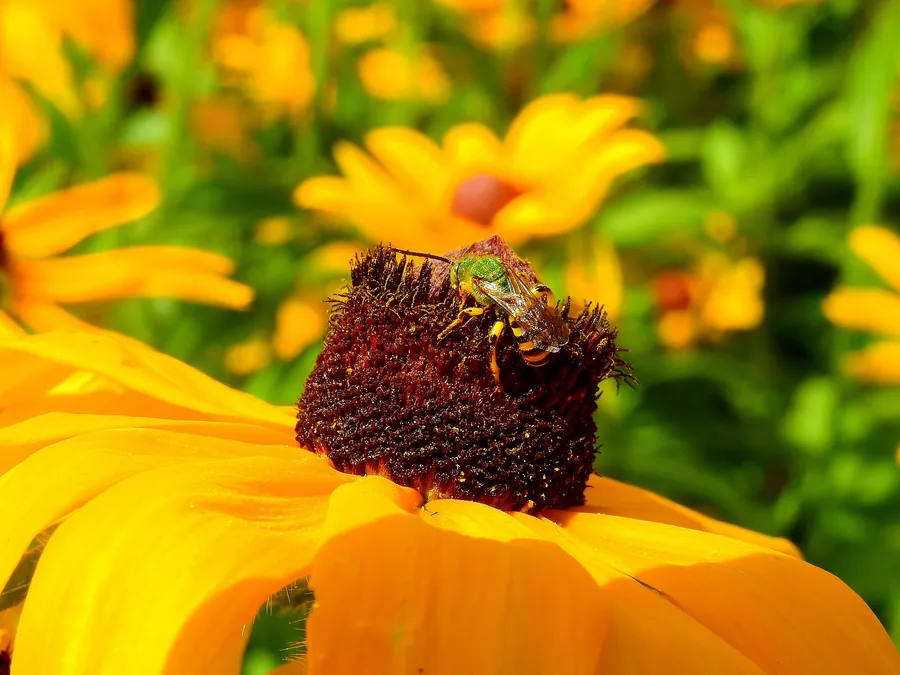
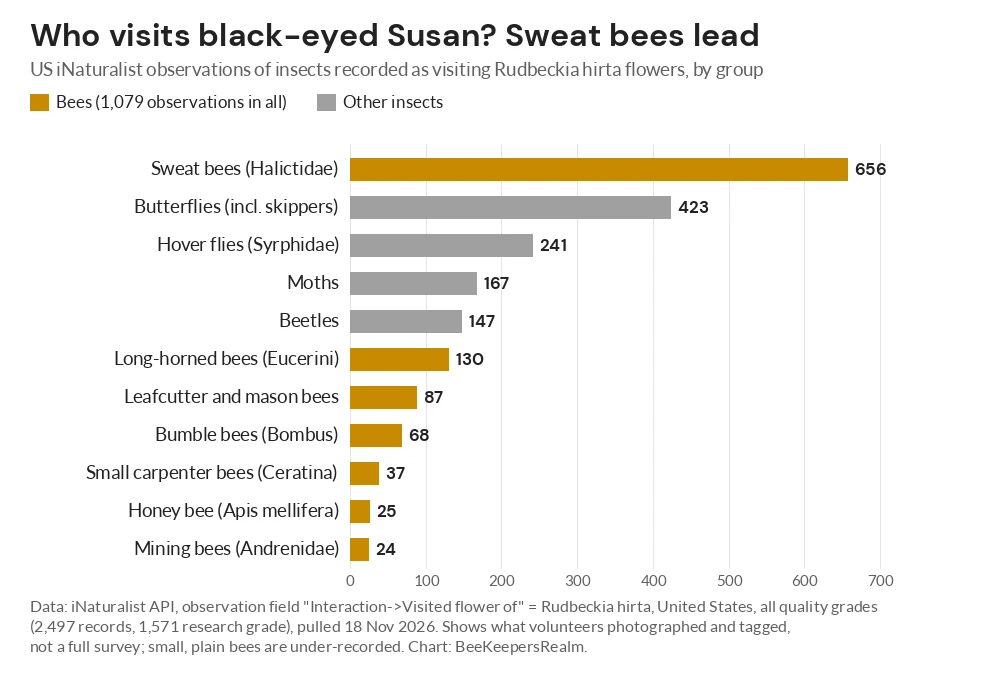
These counts show what volunteers photographed and tagged. They are not a field survey, and tiny dark bees are under-recorded because they are hard to photograph and identify. Bee visit records peak in July (478), the same month the plant does.
Butterflies, Flies, Beetles and Birds
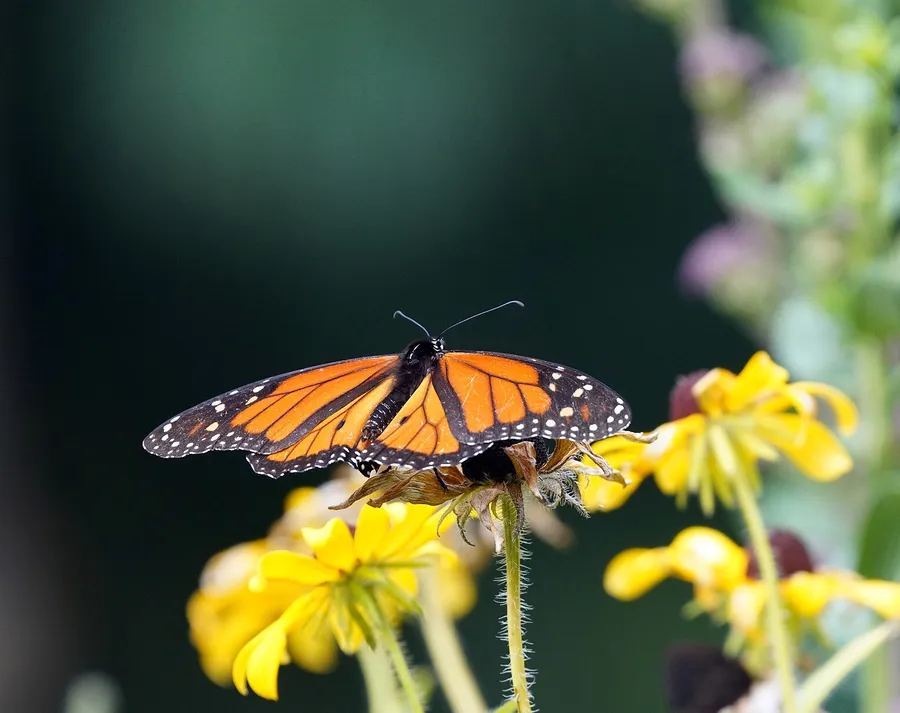
Butterflies and moths make up 590 of the visitor records. The pearl crescent is the most-recorded butterfly (79), and the monarch butterfly appears 13 times. Black-eyed Susan is also a caterpillar food plant. NC State Extension and Illinois Wildflowers both name it as a host for the silvery checkerspot (Chlosyne nycteis), and NC State adds the wavy-lined emerald moth (Synchlora aerata). Penn State Extension counts 18 species that use Rudbeckia as a host plant in Pennsylvania.
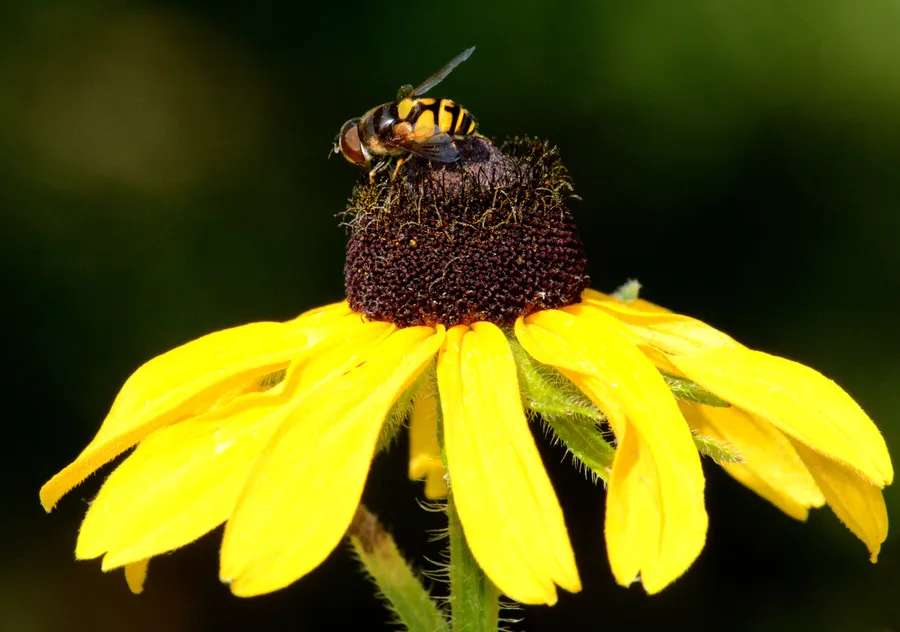
Flies account for 400 records, 241 of them hover flies. The transverse-banded flower fly (Eristalis transversa, 136) is the single most-recorded fly. Clemson HGIC notes that Rudbeckia also draws hover flies and minute pirate bugs, whose young prey on aphids, thrips and whiteflies. Beetles add 147 records, led by a blister beetle, Nemognatha nemorensis (47).
Birds come last in the season. Several species eat the ripe seeds if the heads are left standing (Penn State Extension), and Illinois Wildflowers notes goldfinches among them. NC State Extension suggests leaving R. fulgida seed heads on as winter food.
How to Grow Black-Eyed Susan
Sun and soil
Give black-eyed Susans full sun, at least 6 hours of direct light, though they tolerate partial shade (Clemson HGIC). The NC State Extension Plant Toolbox lists moist, well-drained clay, loam or sandy soil. It also warns that rich soil is a problem: moderate fertility gives the best flowers, so avoid lawn edges where fertilizer adds extra nitrogen. Once established, plants handle heat and drought, which is why they are a staple of drought-resistant flowers for bees.
Sowing seed
Like many native plants, Rudbeckia seed germinates best after a cold period (Penn State Extension). You have two options:
- Fall sowing outdoors: sow seed outside in fall (or in a container left outdoors) and let winter do the chilling.
- Spring sowing: chill the seed first. Clemson HGIC gives 3 months at 40°F, a covering of 1/4 to 1/2 inch of soil, and about 2 weeks to germinate. Penn State suggests sowing chilled seed indoors under lights about ten weeks before your last frost.
Sown early in spring, R. hirta often flowers the same year (NC State Extension). Clemson HGIC notes that plants started from seed may take 2 years or more to reach a good size. Penn State Extension calls buying transplants probably the better option; check that the label says Rudbeckia.
Planting, spacing and division
- When: Clemson HGIC calls early fall the best time to plant perennial Rudbeckia, with mid-April as an alternative. Penn State gives late spring, or fall about six weeks before first frost.
- Spacing: clumps reach about 1 to 2 feet wide (Clemson HGIC). Clemson notes that good spacing keeps air moving and leaves dry, which cuts down disease.
- Division: divide perennial clumps every 3 to 4 years in early spring or fall (Clemson HGIC). This applies to rhizome-forming species such as R. fulgida, not to taprooted R. hirta.
Deadheading vs leaving seed heads
Both have a place. Deadheading encourages new blooms (Clemson HGIC). Leaving heads feeds birds and lets R. hirta reseed, which it does freely (NC State Extension). A practical middle path is to deadhead through midsummer, then let the last flush go to seed. Penn State Extension advises saving cleanup until spring. For tall species, NC State recommends cutting dead stems back to 12 to 24 inches and leaving them standing, because native bees nest in the hollow stems.
Black-eyed Susans pair well with the plants in our guide to native plants for pollinators. A drift of them fits the research Penn State cites better than a single plant. For a non-native annual to fill gaps between them, see our zinnia growing guide.
Problems and Pollinator-Safe Fixes
Black-eyed Susans have few serious problems (Penn State Extension). The common ones:
- Septoria leaf spot (Septoria rudbeckiae): University of Minnesota Extension describes irregular purplish-black spots, often with one flat side along a leaf vein. The spots start low and can blacken the whole plant. Thin crowded plants and avoid overhead watering (Penn State). The cultivar ‘American Gold Rush’ resists Septoria. ‘Goldsturm’ is especially prone to angular leaf spot, a bacterial disease.
- Powdery mildew: a white, powdery coating on leaves, more common in moist conditions and in fall (Illinois Wildflowers; University of Minnesota Extension). Good spacing and drip watering lower the risk (Clemson HGIC).
- Aphids: Clemson HGIC points first to natural predators such as green lacewing larvae and parasitic wasps. If a spray is truly needed, it suggests horticultural oil or insecticidal soap, used by the label.
- Japanese beetles and caterpillars: Clemson HGIC lists both. It calls caterpillar damage usually minor. Remember that some caterpillars, like the silvery checkerspot, are native butterflies using their host plant.
- Rabbits, slugs and snails: rabbits find newly planted Rudbeckia hard to resist, so protect young plants (Penn State). Watch for slugs and snails on seedlings (NC State Extension).
Clemson HGIC says there is no cure for the viruses and phytoplasma diseases that deform flowers or leaves. Remove and destroy those plants.
Black-Eyed Susan vs Coneflower and Other Look-Alikes
Black-eyed Susans are sometimes called coneflowers, and the names overlap. Here is how to tell the common ones apart.
| Plant | Petals (rays) | Center | Leaves and stems | Source |
|---|---|---|---|---|
| Black-eyed Susan (R. hirta) | 8 to 20, bright yellow, 2 to 3 in heads, one per stem | Dark brown, flattened cone | Bristly hairs; lance-shaped leaves | Illinois Wildflowers; LBJWC |
| Orange coneflower (R. fulgida) | Yellow-orange, each toothed at the tip | Dark brown (‘Goldsturm’) | Bristly hairs; usually flowers later than R. hirta | LBJWC; Illinois Wildflowers; Penn State Extension |
| Brown-eyed Susan (R. triloba) | Fewer, shorter rays; more numerous heads | Dark purple-brown | Leaves often three-lobed; much-branched | LBJWC; NC State Extension |
| Green-headed coneflower (R. laciniata) | Yellow, pointing downward | Greenish-yellow | Deeply cut leaves; 3 to 10 ft | LBJWC |
| Purple coneflower (Echinacea purpurea) | Purple to lavender (rarely white), drooping | Spiny, purplish-brown dome | Smooth stems, rough leaves | LBJWC |
| Black-eyed Susan vine (Thunbergia alata) | Not a daisy flower head | Not a cone | Vining, heat-loving plant from East Africa, often grown in containers | Penn State Extension |
Purple coneflower is in the same aster family but a different genus. Our echinacea guide covers its species and bees. The easy field check is color: black-eyed Susans are yellow to orange, purple coneflowers are pink to purple, and the purple coneflower’s center feels prickly.
Is Black-Eyed Susan Toxic?
For people, the risk is low but not zero. The National Capital Poison Center’s Poison Control service says:
“Currently, there is no evidence that the flowers can poison humans when swallowed, but they have been known to poison grazing animals.”
The same page says the hairs can irritate skin, from redness and itching up to blistering and hives, and that the plant has been reported to trigger asthma in people with existing lung conditions or allergies. Wear gloves and long sleeves if you are sensitive. The LBJWC adds a skin-irritation warning for sweet coneflower (R. subtomentosa).
- Dogs, cats and horses: black-eyed Susan does not appear on the ASPCA’s toxic or non-toxic plant lists for dogs, cats or horses. A search for it in the ASPCA plant database returns no results. That means no rating, not a clean bill of health.
- Livestock: Illinois Wildflowers mentions occasional reports of the plant poisoning cattle and pigs. Poison Control cites a 1932 veterinary study on golden glow (R. laciniata) and swine.
This section is educational information, not medical or veterinary advice. If a person or pet has eaten a plant and has symptoms, call Poison Control at 1-800-222-1222, the ASPCA Animal Poison Control Center at (888) 426-4435, or your veterinarian.
Frequently Asked Questions
Is black-eyed Susan a perennial?
R. hirta is usually a biennial or short-lived perennial that returns by self-seeding. Orange coneflower (R. fulgida) and its cultivar ‘Goldsturm’ are true perennials that come back from the same roots each year.
When do black-eyed Susans bloom?
Mostly June to September. In our iNaturalist data, R. hirta peaks in July and R. fulgida in August. Deadheading can stretch flowering into mid-fall.
Do black-eyed Susans spread?
R. hirta spreads by seed and can reseed heavily, though it tends to lose ground as longer-lived perennials fill in (Illinois Wildflowers). R. fulgida and R. laciniata spread by rhizomes, and cutleaf coneflower can be aggressive.
Do black-eyed Susans need full sun?
They flower best with at least 6 hours of direct sun but tolerate partial shade. Brown-eyed Susan copes with light shade, and cutleaf coneflower grows in sun to shade.
Are black-eyed Susans deer resistant?
Mostly. NC State Extension tags R. hirta as moderately resistant to deer, and Penn State says the coarse, hairy leaves give some protection. Cutleaf coneflower is the exception: NC State says deer readily eat it to the ground.
Is black-eyed Susan toxic to dogs and cats?
It is not on the ASPCA’s toxic or non-toxic lists, so there is no official rating either way. Call your vet or the ASPCA Animal Poison Control Center if your pet eats a lot of it or shows symptoms.
Are black-eyed Susans coneflowers?
Yes, in the broad sense. Rudbeckia species are commonly called coneflowers. They are not the same as purple coneflower (Echinacea), a different genus.
Is black-eyed Susan vine the same plant?
No. Black-eyed Susan vine is Thunbergia alata, a climbing plant native to tropical East Africa that is grown as an annual in much of the US. It shares only the name.
The Bottom Line
Black-eyed Susan is an easy, native, sun-loving wildflower that pays its way in a pollinator garden. Plant R. hirta for a June and July bloom and R. fulgida for August. Leave some seed heads and stems standing for birds and nesting bees. If you want to help specialist bees, plant natives in drifts rather than single specimens. More plant profiles are in our pollinator gardening and native bees section.
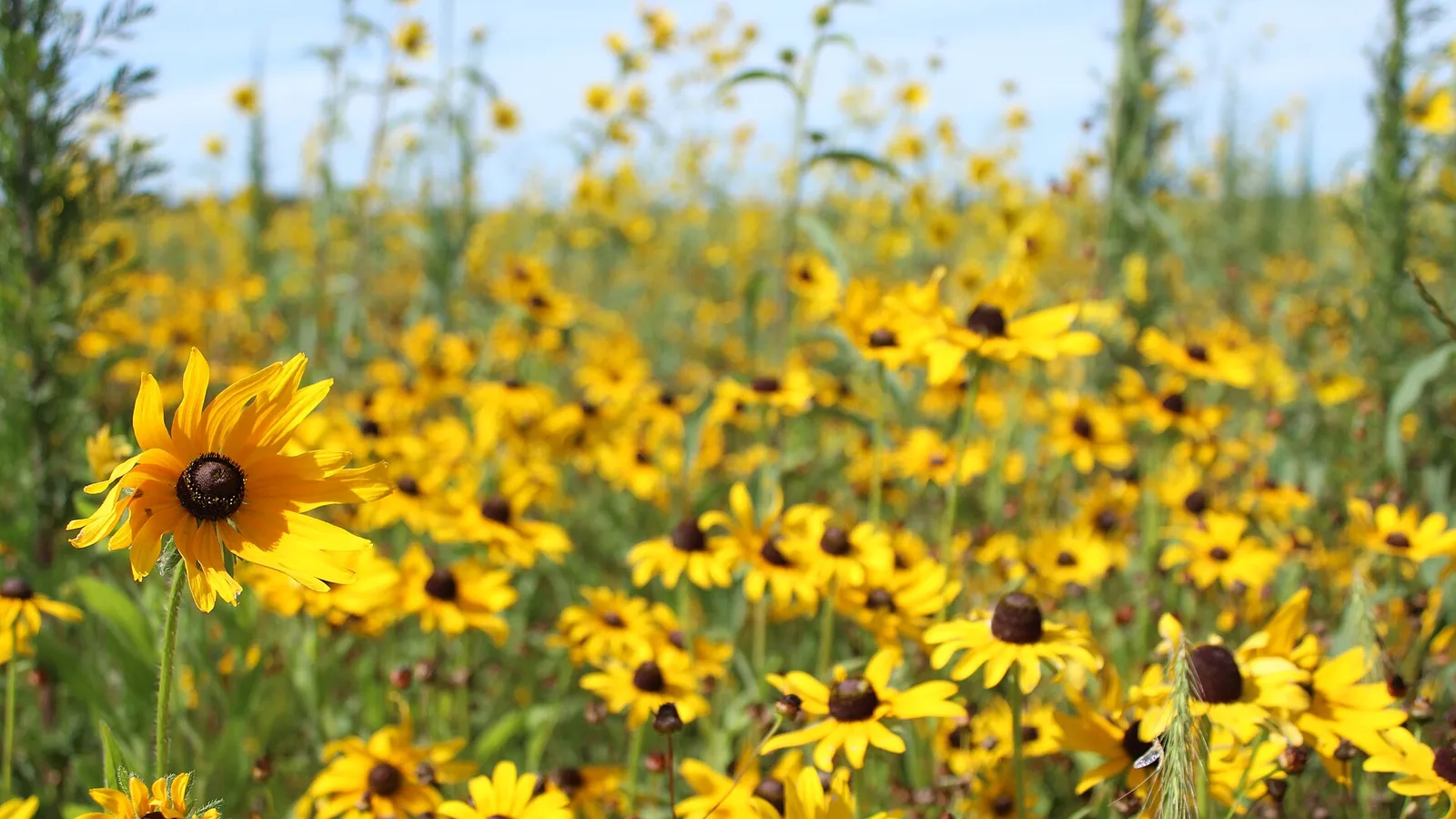
Image credits: featured photo of black-eyed Susans in a prairie reconstruction on the Todd Waterfowl Production Area, North Dakota, by Krista Lundgren, U.S. Fish and Wildlife Service, public domain, via Wikimedia Commons, cropped and resized. Other photos are credited in their captions. Charts by BeeKeepersRealm.