Reviewed by Michael R. · How we review
Echinacea is a small genus of North American wildflowers, the coneflowers, best known for the purple coneflower (Echinacea purpurea): a tough, sun-loving perennial that blooms in midsummer and draws bumble bees, sweat bees and butterflies. Echinacea is also sold as an herbal supplement for colds, and there the evidence is weak. The NIH says it may slightly lower your chance of catching a cold, and it is unclear whether it shortens one.
Below: the species, the supplement evidence, the insects that visit coneflowers and how to grow them. The bloom and pollinator figures are our own counts of US iNaturalist records.
Key Takeaways
- Echinacea has nine species, all North American. Purple coneflower (E. purpurea) is the common garden plant.
- A 2014 Cochrane review of 24 trials found the evidence for treating colds weak; NCCIH says echinacea may slightly reduce the chance of catching one.
- Allergic reactions can be severe, and echinacea may interact with some medicines. Ask a health care provider first.
- Of 10,364 US iNaturalist records of insects visiting purple coneflower, 5,129 are bees and 3,008 bumble bees.
- Flowering records peak in July; June to September holds 93% of them. Leave seed heads for goldfinches and hollow stems for nesting bees.
- Tennessee coneflower left the federal endangered list in 2011 after recovering. Smooth coneflower is still federally threatened.
Table of Contents
- What Is Echinacea?
- Echinacea as a Supplement: What the Evidence Shows
- Types of Echinacea: Native Coneflower Species
- When Do Coneflowers Bloom?
- Are Coneflowers Good for Bees?
- How to Grow Coneflowers
- Frequently Asked Questions
- The Bottom Line
What Is Echinacea?
Echinacea is a genus in the aster family (Asteraceae), the same family as sunflowers, daisies and ragweed. The National Center for Complementary and Integrative Health (NCCIH) describes the species as native to the area east of the Rocky Mountains. The Chicago Botanic Garden counts nine species. “Echinacea” and “coneflower” name the same plants, although black-eyed Susans (Rudbeckia) and prairie coneflowers (Ratibida) are also called coneflowers.
Each “flower” is really a head of many small flowers. The colored petals are ray florets, and the spiny cone in the middle is made of many tiny disk florets. Ohio State’s Secrest Arboretum notes that the name comes from the Greek echinos, meaning “hedgehog,” a fair description of that prickly cone.
Purple coneflower is the species gardeners know. The Lady Bird Johnson Wildflower Center gives its native range as Georgia to extreme northeast Texas, north to North Carolina, Ohio, Illinois and Iowa, and its height as up to about 4 feet. It is one of the plants we list among the best US native plants for pollinators.
Echinacea as a Supplement: What the Evidence Shows
This section is educational information from NIH and Cochrane sources, not medical advice. Ask a doctor or pharmacist before taking any herbal product.
Most top search results for “echinacea” are about the supplement. NCCIH says echinacea products are promoted mainly for colds and other respiratory infections, on the idea that some species may stimulate the immune system.
Does echinacea work for colds?
“Taking echinacea may slightly reduce your chances of catching a cold. It’s still unclear whether echinacea can shorten the length of a cold.”
The main systematic review is Cochrane’s Echinacea for preventing and treating the common cold (Karsch-Völk and colleagues, 2014). It pooled 24 double-blind trials with 4,631 participants, with evidence current to July 2013. The authors found the overall evidence for clinically relevant treatment effects weak, although some products may beat a placebo. Prevention trials showed no statistically significant reductions, although nearly all pointed toward small preventive effects. One reason results vary is that the trials tested many different products, made from different species and plant parts.
So the honest summary is neither “it works” nor “it is useless”: a possible small benefit for prevention, and no proven effect on how long a cold lasts. For honey, see our review of honey and immune support research.
Safety, allergies and drug interactions
- Allergy: NCCIH says some people have allergic reactions to echinacea, which may be severe. Cleveland Clinic advises against it for people allergic to chrysanthemums, daisies, marigolds or ragweed, its relatives in the aster family.
- Side effects: the most common are digestive, such as nausea or stomach pain (NCCIH).
- Medicines: evidence is conflicting on interactions with drugs processed by the liver, and there are theoretical reasons to suspect interactions with immunosuppressants and caffeine. NCCIH asks anyone taking medicine to talk to a provider first.
- Children: some children in a clinical trial developed rashes. Talk to the child’s health care provider before giving it.
- Pregnancy and breastfeeding: some studies suggest it is possibly safe for up to 7 days in the first trimester; little is known about breastfeeding. Ask a provider first.
- Regulation: in the US, dietary supplements are not approved by the FDA before they are sold.
We do not give doses. Products differ too much, and a pharmacist who knows your medicines is the right person to ask.
Types of Echinacea: Native Coneflower Species
Of the nine species, five are grown or discussed most often. All are perennials of prairies, glades and open woods, and all have pink to purple rays except one.
| Species | Native range | Height / colour | Garden notes | Pollinator value | Source |
|---|---|---|---|---|---|
| Purple coneflower (E. purpurea) | Georgia to northeast Texas, north to North Carolina, Ohio, Illinois and Iowa | Up to about 4 ft; pink to purple | Sun or part shade; drought tolerant once established; Zones 3 to 8; parent of most cultivars | Long-tongued bees (bumble bees, honey bees, long-horned and leafcutter bees), sweat bees, bee flies, butterflies and skippers | Lady Bird Johnson Wildflower Center (LBJ); Illinois Wildflowers; NC State |
| Pale purple coneflower (E. pallida) | Wisconsin to eastern Kansas, south to Georgia and east Texas; rare east of the Mississippi | 2 to 4.5 ft; very pale pink to rose, drooping rays | Sun, dry soil; short-lived, often 2 to 3 years; Zones 4 to 8; blooms 2 to 4 weeks before purple coneflower | Bumble bees, large carpenter bees, leafcutter bees, butterflies and skippers; bees are 241 of its 288 US iNaturalist visit records | LBJ; Clemson HGIC; Illinois Wildflowers; iNaturalist |
| Narrow-leaved coneflower (E. angustifolia) | Western Minnesota to Saskatchewan and Montana, south to Texas and New Mexico | Up to about 28 in; pink to purple | Low water use; more drought tolerant than pale or purple coneflower; Zones 2 to 8 | “Special value to native bees” (Xerces Society, via LBJ); pollinated most effectively by a specialist mining bee | LBJ; Clemson HGIC; American Journal of Botany (2019) |
| Yellow coneflower (E. paradoxa) | South-central Missouri and north-central Arkansas (the Ozarks) | 2.5 to 3 ft; yellow rays (typical variety), unlike any other species | Drought tolerant, dislikes wet soil; Zones 4 to 7; listed as threatened in Arkansas | 8 of its 19 US iNaturalist visit records are bees, too few to compare | LBJ; Clemson HGIC; Illinois Wildflowers |
| Tennessee coneflower (E. tennesseensis) | Cedar glades of Davidson, Rutherford and Wilson Counties, Tennessee | Purple heads in late summer | Federally endangered 1979 to 2011, then delisted as recovered; buy nursery-grown plants | Not measured in our sources (2 iNaturalist visit records) | Federal Register, 76 FR 46632 (2011) |
Zones and garden notes from Clemson Cooperative Extension HGIC 1182 and the NC State Plant Toolbox; ranges and heights from the LBJ plant database, saved November 17, 2026. iNaturalist visit counts are US observations tagged “visited flower of,” pulled November 17 to 18, 2026.
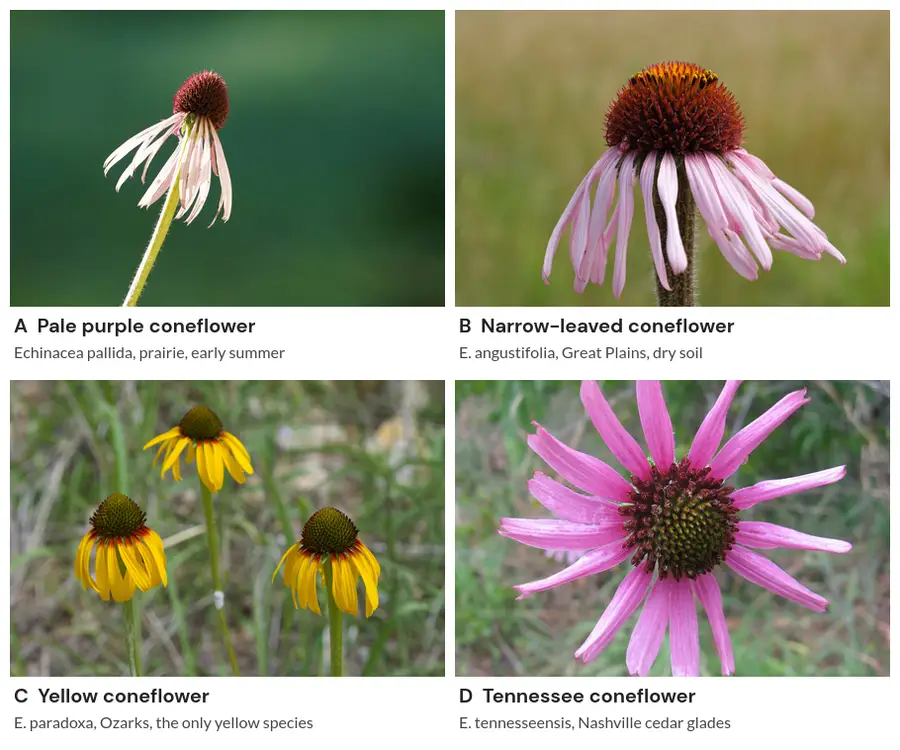
Tennessee and smooth coneflower: two federal recovery stories
Tennessee coneflower was listed as endangered in 1979, when it was known from only three locations in three counties around Nashville. In 2011 the U.S. Fish and Wildlife Service removed it from the list, effective September 2, 2011, stating in the Federal Register delisting rule that the species “has recovered.” The rule counts 19 secure, self-sustaining colonies in six populations on protected conservation lands.
Smooth coneflower (E. laevigata), a light pink to purplish species of Virginia, North Carolina, South Carolina and Georgia, was listed as endangered in 1992. A 2022 rule (87 FR 40100, effective August 5, 2022) downlisted it to threatened, with 44 known populations. Some extension pages still call it endangered, so check the date of anything you read.
Hybrids and cultivars
Breeders have produced red, orange, gold, yellow and white coneflowers, plus shaggy double “pompom” forms. Ohio State’s Secrest Arboretum counted 190 taxa on the market when it planned its 2019 trial, and names purple, pale, yellow and Tennessee coneflower as the four species commonly used in breeding. Their value to bees is covered below.
When Do Coneflowers Bloom?
Purple coneflower blooms mainly from June into September, with a sharp peak in July. We counted US research-grade observations of E. purpurea that observers annotated as “flowering”: 1,808 records, of which 740 (41%) fell in July and 1,687 (93%) between June and September.
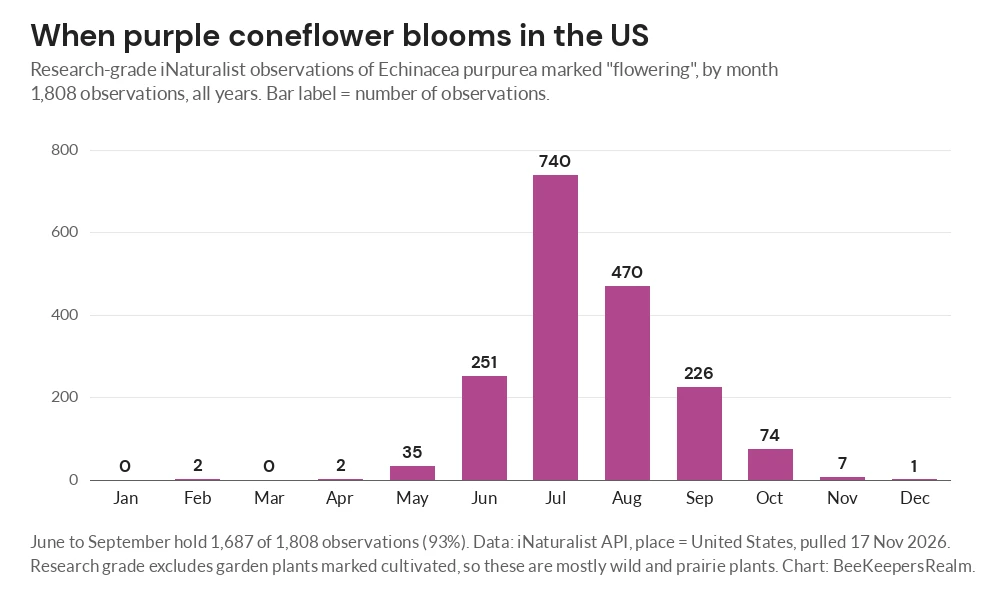
These are observations, not a survey, and people photograph more in summer. We used only research-grade records, which exclude the 20,019 US records marked as planted (captive). Pale purple coneflower opens 2 to 4 weeks earlier, according to Illinois Wildflowers, so mixing species stretches the season. For flowers that take over after coneflowers fade, see our list of fall-blooming flowers for bees.
Are Coneflowers Good for Bees?
Yes. The LBJ database, citing the Xerces Society, rates purple coneflower of “special value to native bees,” and Illinois Wildflowers lists honey bees, bumble bees, long-horned bees, leafcutter bees and sweat bees among its visitors.
To put numbers on that, we counted every US iNaturalist observation in which the observer recorded the insect “visited flower of” purple coneflower. That gave 10,364 observations from 2,939 observers; no single observer contributed more than 301.
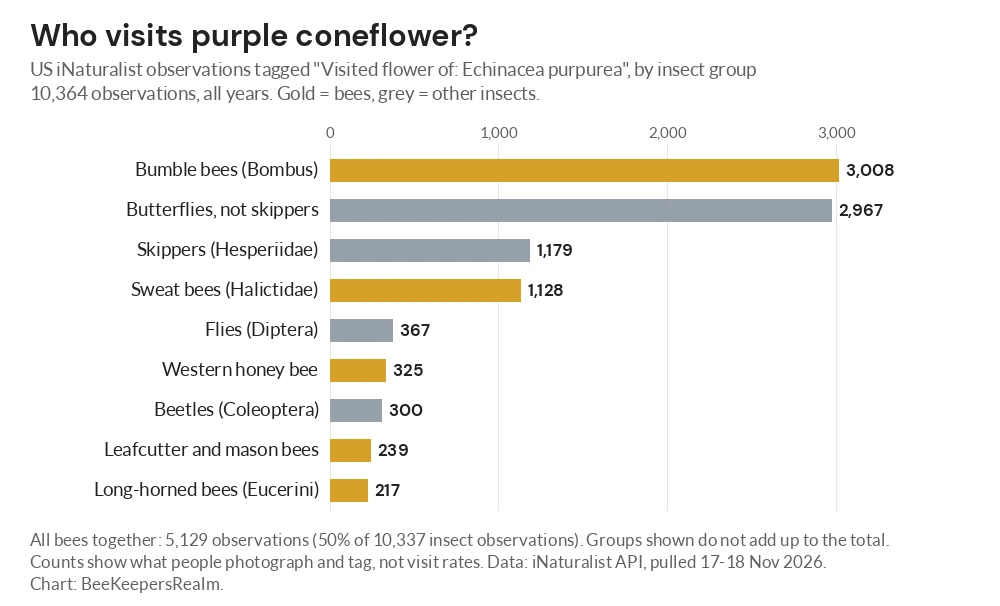
- Bumble bees: 3,008 observations, the largest single group. The brown-belted bumble bee (Bombus griseocollis) led every species with 1,529, ahead of the common eastern bumble bee with 643. Read more about North American bumblebees.
- Sweat bees: 1,128 observations, led by the bicolored striped sweat bee (Agapostemon virescens) with 629. See our guide to metallic sweat bees.
- Butterflies and skippers: 2,967 butterfly and 1,179 skipper observations, with the great spangled fritillary (466) and the monarch butterfly (383) on top.
- Honey bees: 325 observations of the western honey bee.
- Long-horned bees: 217 observations, mostly Melissodes, led by the two-spotted long-horned bee (83). See our guide to long-horned bees and their antennae.
- Others: 367 flies (234 of them hover flies), 300 beetles and 239 leafcutter and mason bees.
Bee visits were concentrated in summer: 3,219 of the 5,129 bee records come from July alone. The counts reflect what people photograph: bumble bees and butterflies are easy to record, while small mining bees are hard to identify from photos, and only 5 records are mining bees (Andrenidae).
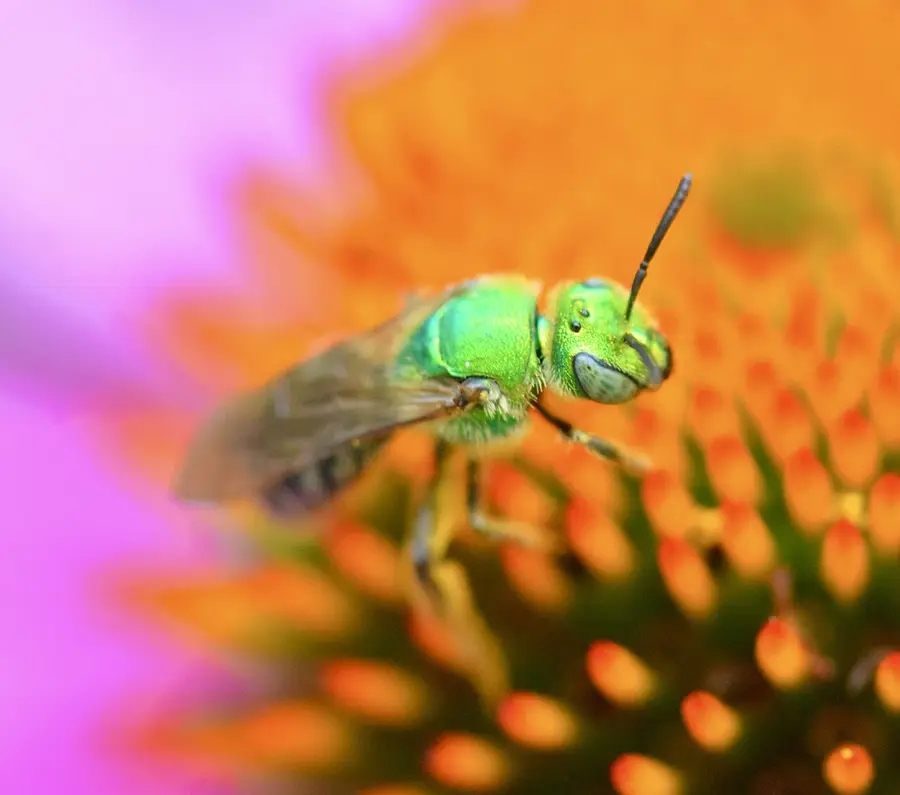
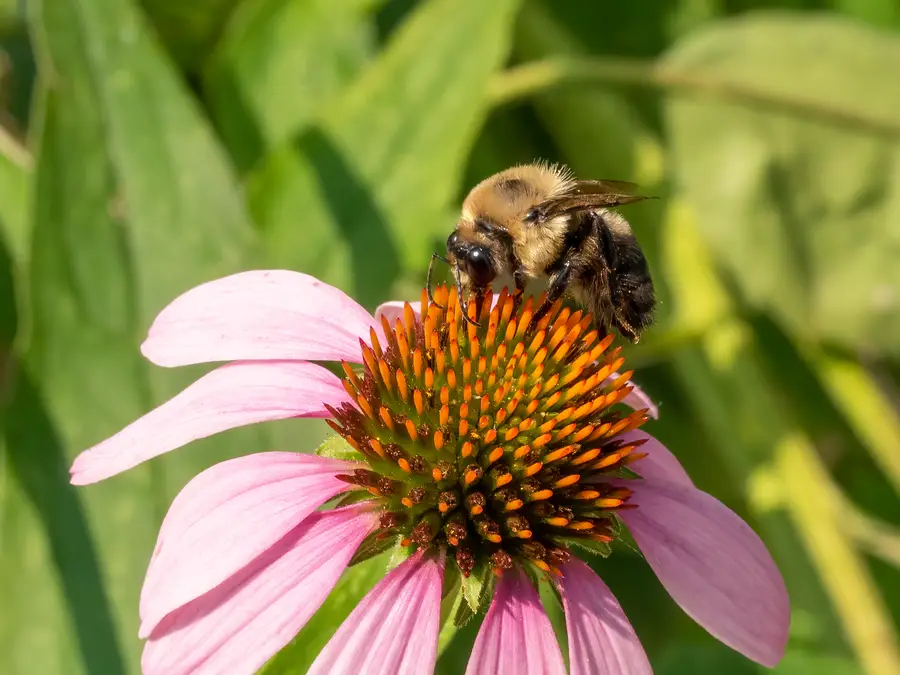
A specialist bee on narrow-leaved coneflower
Some bees depend on coneflowers and their relatives. A 2019 study in the American Journal of Botany (Page and colleagues) filmed insect visits to narrow-leaved coneflower in two prairie restorations. The mining bee Andrena helianthiformis, a specialist on the sunflower tribe, was the most effective pollinator, shriveling more than twice the proportion of styles as all other visitors. A 2023 follow-up in the same journal called it a “coneflower-specialist bee.” That is one more reason to plant wild species where they are native. More in our guide to native bee species in the US.
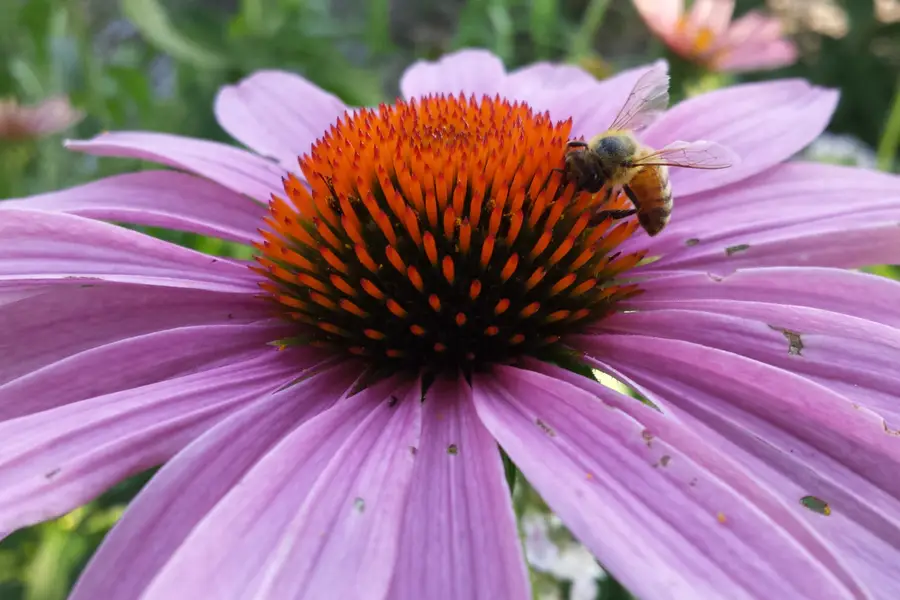
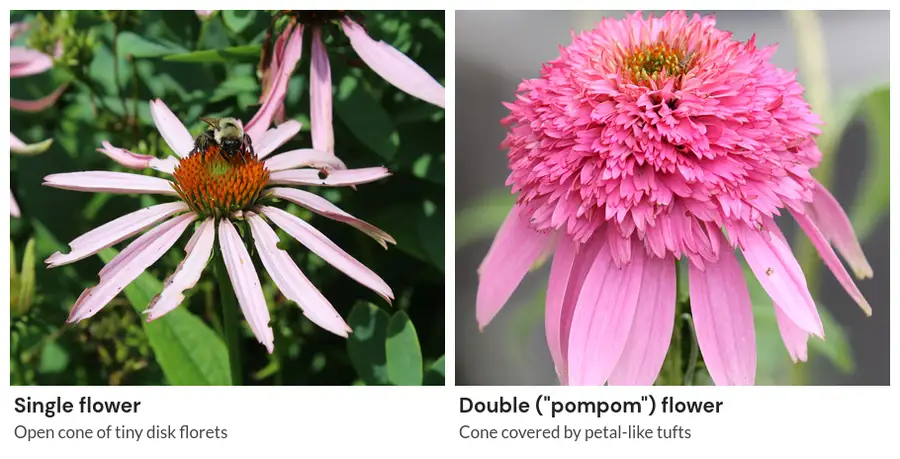
Single or double flowers?
For bees, choose single-flowered coneflowers with an open cone. In double and “pompom” forms the cone is covered by extra petal-like florets. Ohio State’s Secrest Arboretum, which trialed coneflowers from 2019 to 2022, says many such flowers have reduced pollinator visitation. The Chicago Botanic Garden picked single-flowered cultivars for its 2019 to 2023 trial for their “greater ecological significance,” citing Mt. Cuba Center’s pollinator study. Neither trial tested straight species against single-flowered cultivars, and several of the Chicago trial’s top cultivars made Mt. Cuba’s list of the 15 best coneflowers for pollinators.
Leave the stems for nesting bees
“Native bees nest in the dead, hollow stems, so gardeners are encouraged to cut back dead stems to 12 to 24 inches and allow them to remain standing until they disintegrate on their own.”
Plant them alongside other summer natives such as milkweed and bee balm, then goldenrod for fall.
How to Grow Coneflowers
Sun, soil and hardiness
Plant coneflowers in full sun to part shade in well-drained soil. Clemson Extension says they prefer evenly moist soil but tolerate drought and heat once established, and the genus covers Zones 3 to 9 depending on species. Drainage matters: Clemson warns that some hybrids may not be reliably hardy in poorly drained soils. That toughness puts purple coneflower on our list of drought-resistant flowers for bees.
Sources disagree on deer. NC State lists purple coneflower as deer resistant, while the LBJ database answers “Deer Resistant: No.” Expect some browsing where deer are hungry; Clemson also lists rabbits as a pest.
Growing from seed
Sow seed outdoors in late fall, or give it cold, moist stratification for about two months before a spring sowing; the LBJ database says this improves germination. Indoors, Clemson says seedlings appear 10 to 20 days after sowing, and plants grown from seed can take 2 or more years to reach a good size.
Division and lifespan
Clemson suggests dividing clumps every 3 to 4 years, in spring or fall, to prevent overcrowding. Even so, expect plants to come and go:
“Purple coneflower is short-lived—two or three years is common—but reseeds readily and often vigorously so.”
Hybrids vary. In the Chicago Botanic Garden trial, nearly half of the cultivars survived well for five years; 14 taxa kept all five plants and 11 kept four of five.
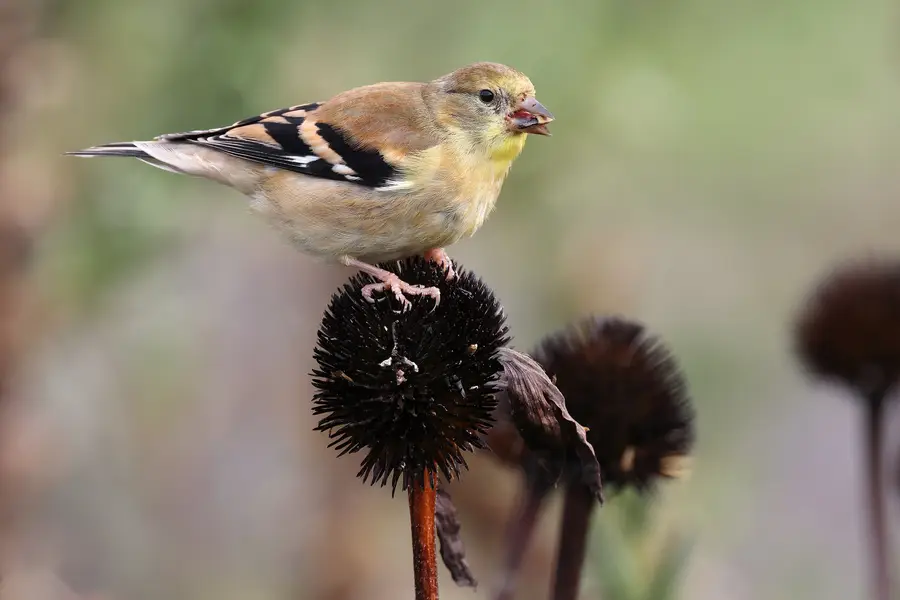
Deadheading or seed heads for goldfinches?
Deadheading (cutting off spent flowers) improves the display, the Chicago Botanic Garden says, but it also removes a seed source for birds. The Chicago Botanic Garden saw American goldfinches feeding often in its trial garden, and Clemson advises delaying deadheading because the seed heads attract goldfinches in winter. A middle path: deadhead early flowers, then leave the late summer heads standing.
Pests and diseases
- Aster yellows: a disease spread by leafhoppers. Clemson describes a witches’ broom in the flower head, greening of the petals, stunting and possible death. The Chicago Botanic Garden notes there is no preventive or curative treatment; remove and destroy infected plants promptly.
- Japanese beetles: NC State and Clemson list them as occasional pests; see our Japanese beetle guide for bee-safe control.
- Others: leaf spot, powdery mildew, aphids and eriophyid mites, which live inside flower buds. Clemson says symptoms are usually mild and good spacing helps.
Yellow coneflowers in the genus Rudbeckia have their own guide: see our page on black-eyed Susan.
Frequently Asked Questions
Is echinacea the same as coneflower?
Yes. Echinacea is the scientific name of the coneflower genus, and purple coneflower is Echinacea purpurea. Black-eyed Susans and prairie coneflowers are related plants in other genera.
Do coneflowers come back every year?
Yes, they are perennials, but individual plants are often short-lived. The Chicago Botanic Garden says two or three years is common for purple coneflower, which then reseeds.
Do coneflowers spread?
They form clumps and spread by seed rather than by running roots. Leave seed heads standing and expect seedlings nearby.
Do coneflowers bloom the first year?
Plants grown from seed often do not. Clemson says plants started from seed can take two or more years to reach a good size, so a young seedling may not flower in its first summer.
Can echinacea grow in shade?
Part shade, yes; full shade, no. The LBJ database lists purple coneflower for sun or part shade, and Clemson gives full sun to part shade.
Are coneflowers toxic to dogs and cats?
The ASPCA’s toxic and non-toxic plants list has no entry for coneflower or Echinacea, so it gives no rating either way. The ASPCA warns that eating any plant material may cause vomiting and stomach upset in dogs and cats.
Does echinacea interact with medications?
Possibly. NCCIH reports conflicting evidence about drugs processed by the liver and theoretical concerns with immunosuppressants and caffeine. Ask a doctor or pharmacist first.
The Bottom Line
Grow purple coneflower for the bees and butterflies, choose single flowers, and leave the stems and seed heads standing over winter. If you are thinking about the supplement, talk to your provider first; the cold evidence is weak. For more native plants that feed bees, browse our pollinator gardening and native bee guides.
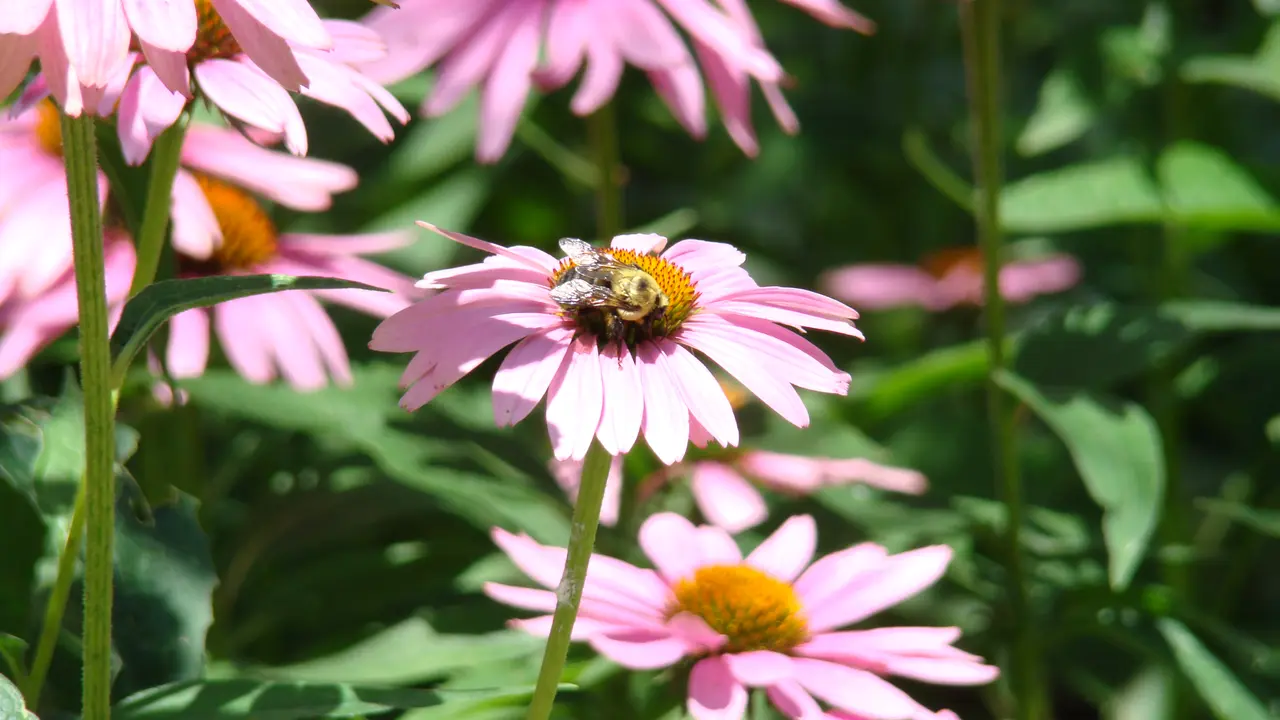
Image credits: featured photo of purple coneflowers with a bumble bee at Chadwick Arboretum, Ohio State University, by Dan Keck, CC0, via Wikimedia Commons. All other photos are credited in their captions, with links to each file page and licence; all were cropped or resized. Charts by BeeKeepersRealm from iNaturalist data.