Reviewed by Michael R. · How we review
Sedum, also called stonecrop, is a group of hardy succulent perennials in the family Crassulaceae. Gardeners grow two kinds: upright sedums such as ‘Autumn Joy’, now classed as Hylotelephium, which grow 1 to 2 feet tall and bloom pink from late summer into fall, and creeping sedums that form 1- to 6-inch mats and flower in spring or summer. Both want full sun, sharp drainage and lean soil, and most survive USDA zones 3 to 9. The upright kinds are a late-season nectar plant for bees and butterflies.
A naming note: many upright “sedums” are now botanically Hylotelephium, and some creepers are Phedimus or Petrosedum, but this guide calls them all sedum, as gardeners do. Plant facts come from university extension services and published studies, named in each section; our charts use iNaturalist records pulled on November 19, 2026.
Key Takeaways
- Upright sedums bloom late: 594 of 1,145 dated US iNaturalist flowering records of Hylotelephium (52%, all quality grades) were made in September, while genus Sedum peaked in May.
- In research-grade US iNaturalist records, the eastern carpenter bee is the insect most often recorded on upright sedum; in a UK trial, honey bees made up 88% of showy sedum’s visitation.
- Cultivars differ: in a 2025 Dutch study, Sedum telephium had most of the cultivars bees ignored completely.
- Sun, drainage and lean soil prevent rot and flopping. Leave the dried heads over winter and cut back in early spring.
- Deer resistance is mixed: Rutgers rates showy sedum “Occasionally Severely Damaged.”
Table of Contents
- What Sedum Is: Upright, Creeping and Native Stonecrops
- How to Grow Sedum
- Types of Sedum Compared
- Do Bees Like Sedum? What the Records Show
- Problems: Rot, Pests, Deer and Pets
- Sedum vs Other Drought-Tolerant Ground Covers
- Sedum in Pots and on Green Roofs
- Frequently Asked Questions
- The Bottom Line
What Sedum Is: Upright, Creeping and Native Stonecrops
Sedum is a genus of succulents with thick, water-storing leaves. University of Missouri horticulturist David Trinklein puts it at as many as 400 species, mostly from the Northern Hemisphere; the name comes from the Latin sedeo, “to sit,” for the way many sprawl over the ground. Sedums withstand heat and drought, and some are winter hardy to USDA zone 3.
The tall border sedums now sit in their own genus, Hylotelephium, first proposed by a Japanese scientist in 1977. Gerald Klingaman, a retired University of Arkansas Extension horticulturist, explains that hybridization studies and DNA analysis later confirmed the split of 35 species from Sedum, but gardeners have been slow to follow:
“So, if you prowl the web looking for information about your favorite upright sedums, you will find about half the websites list the plant under the old name and half use the new name.”
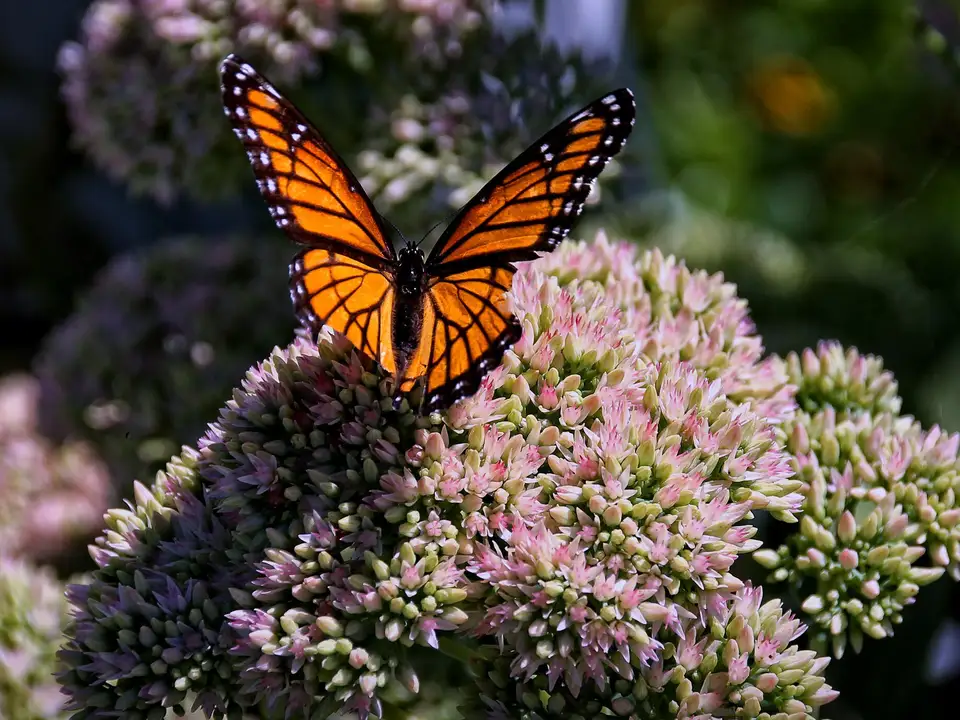
Upright sedums and creeping sedums
Upright sedums form clumps of stout stems up to about 2 feet tall that die back to the ground each autumn, the Royal Horticultural Society notes. Klingaman writes that the flower heads look like a green bunch of broccoli before they open and bloom under the short days of late summer.
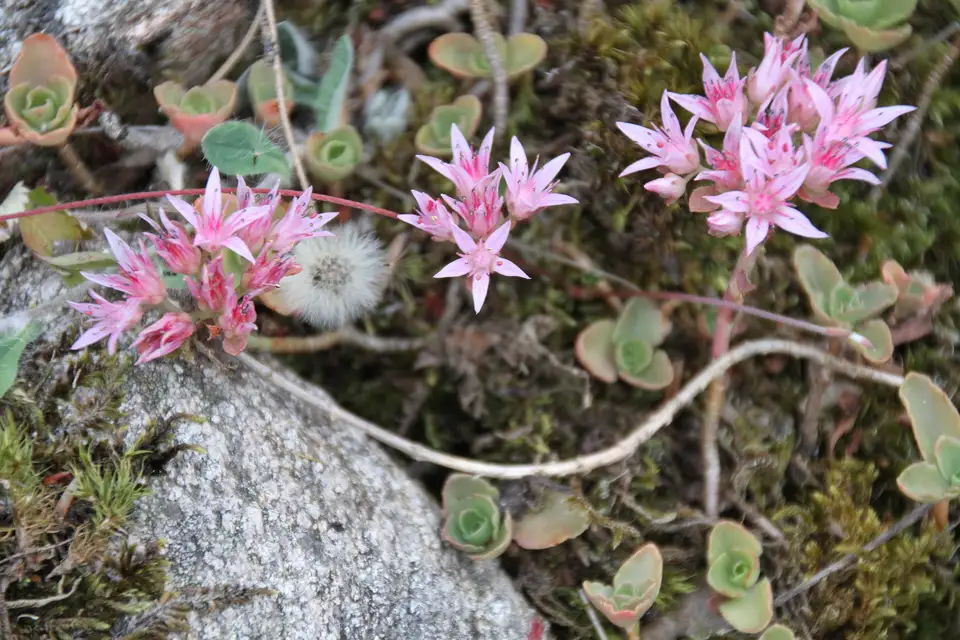
Creeping sedums grow about 1 to 6 inches tall, and some, such as stringy stonecrop, spread by branches that root at the nodes. Trinklein lists sunny slopes, rock gardens, low-maintenance ground covers and green roofs as their uses, with one caution: they take only light foot traffic.
Native US stonecrops
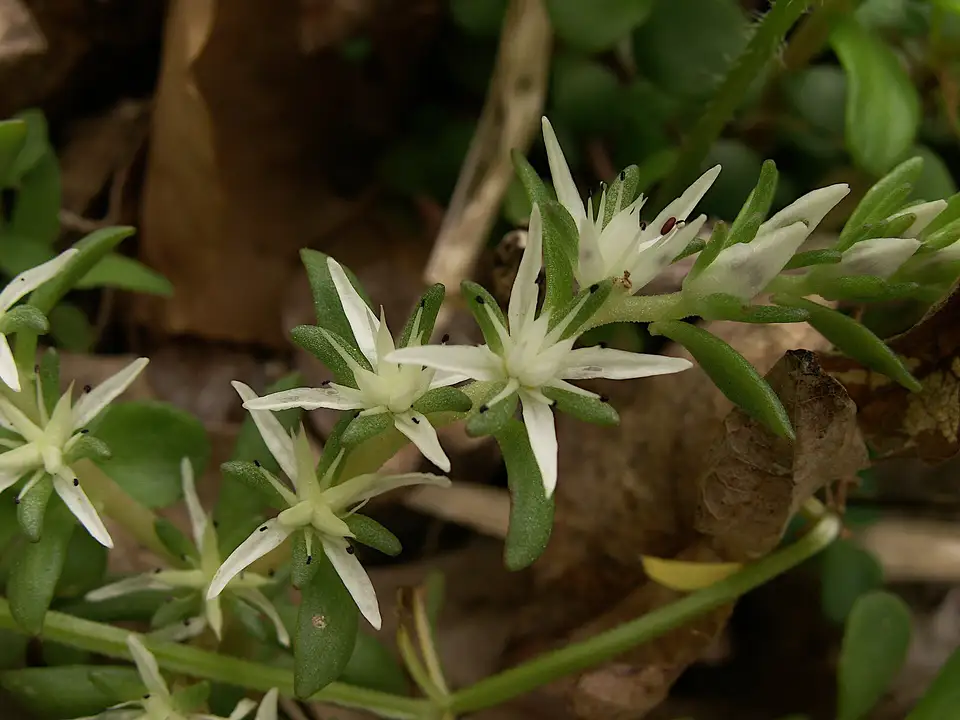
Most garden sedums come from Europe and Asia, but the US has its own. Wild or woodland stonecrop (Sedum ternatum) grows from Maine to Georgia and west from Michigan to Iowa and Arkansas, according to NC State Extension, in moist woods and on shaded rock outcrops, and it tolerates shade better than most sedums. Illinois Wildflowers describes small flowers with four narrow white petals in late spring and early summer.
Allegheny stonecrop (Hylotelephium telephioides) is, per NC State, the only North American native Hylotelephium. It grows mostly at high elevations in the Appalachians from North Carolina to Pennsylvania, reaches 12 to 15 inches and carries white or pale pink flowers in summer and fall. For more choices, see our list of native plants for pollinators.
How to Grow Sedum
- Sun: full sun, 6 or more hours of direct light. ‘Autumn Joy’ accepts some morning or afternoon shade (NC State); wild stonecrop prefers shade.
- Soil: sandy to gravelly, of average to moderate fertility, with good drainage (University of Missouri).
- Water: once established, sedum is drought tolerant. “Overwatering is a bigger risk than underwatering,” notes NC Cooperative Extension in Beaufort County.
- Fertilizer: skip it. Trinklein writes that overly rich soil or too much shade produces weak, floppy growth.
How to stop upright sedum from flopping
Tall hybrids with large flower heads are prone to flopping. Trinklein’s cure is full sun, soil that is not too moist or rich, and pinching in spring to force thicker, bushier stems. NC Cooperative Extension suggests dividing upright sedums every three to four years in early spring to rejuvenate them and prevent flopping.
When to cut back sedum
NC Cooperative Extension’s advice is “don’t rush to cut sedum back,” because the dried heads add winter texture. The Royal Horticultural Society says to cut the dead stems to the ground in spring, as succulent new growth emerges from the base. For plants to grow alongside sedum, see our fall-blooming flowers for bees.
What the video covers: In this 2-minute, 51-second clip from Oklahoma Gardening, the Oklahoma State University Extension TV program, host Casey Hentges cuts back sedum to get it ready for new growth. This summary is based on the video’s official description; it was posted in April 2018.
How to propagate sedum
Klingaman writes that propagation is easy by springtime division. NC State notes that showy stonecrop roots easily from stem cuttings, and that sedum leaves fall off easily but can themselves be used to start new plants.
Types of Sedum Compared
Heights, bloom seasons and hardiness zones are from NC State Extension’s Plant Toolbox unless another source is named.
| Sedum | Species / cultivar | Group | Height | Bloom time | Hardiness (USDA zones) | Native to | Pollinator notes | Source |
|---|---|---|---|---|---|---|---|---|
| ‘Autumn Joy’ | Hylotelephium ‘Herbstfreude’, an interspecific hybrid (NC State lists it under H. spectabile) | Upright | 18 to 24 in | Late summer to early fall | 3 to 10 | Garden hybrid from Germany, 1950s | Flowers “quite attractive to butterflies and bees” | NC State; University of Missouri; NC Cooperative Extension |
| Showy stonecrop | Hylotelephium spectabile | Upright | 1 to 2 ft | Summer to fall | 4 to 9 | China and Korea | 11th of 111 plants for insect visitation in a UK trial; mostly honey bees | NC State; Rollings and Goulson 2019 |
| Orpine, live-forever | Hylotelephium telephium | Upright | 2 to 2.5 ft | August to October | 3 to 9 | Europe, Russia, northern China | Attracts bees and butterflies; cultivars vary widely in bee appeal | NC State; Verweij et al. 2025 |
| Allegheny stonecrop | Hylotelephium telephioides | Upright | 12 to 15 in | Summer to fall | Not listed | Eastern US (Appalachians) | The only native North American Hylotelephium | NC State |
| Two-row stonecrop (cultivars include ‘Dragon’s Blood’) | Phedimus spurius (syn. Sedum spurium) | Creeping | 2 to 6 in | Spring to summer | 3 to 9 | Northeastern Turkey to northern Iran | Flowers attract bees and butterflies | NC State |
| White stonecrop | Sedum album | Creeping | 3 to 6 in | Spring to summer | 3 to 9 | Europe, western Asia, North Africa | Attracts butterflies; spreads aggressively | NC State |
| Moss, goldmoss or biting stonecrop | Sedum acre | Creeping | 1 to 4 in | Summer | 3 to 9 | Europe, the Mediterranean and the Caucasus | Attracts butterflies; “weedy and aggressive in some situations” | NC State |
| ‘Angelina’ | Petrosedum rupestre ‘Angelina’ | Creeping | 4 to 6 in | Summer | 5 to 9 | Europe, Turkey | Yellow-leaved cultivar; deer resistant | NC State; University of Missouri |
| Stringy stonecrop | Sedum sarmentosum | Creeping | Mat-forming; branches spread about 10 in | Summer | 3 to 9 | East and Southeast Asia | Nectar attracts bees; 7,541 research-grade (wild) US records | NC State; iNaturalist |
| Wild or woodland stonecrop | Sedum ternatum | Creeping | 3 to 6 in | Spring | 3 to 9 | Eastern US and southeastern Canada | Stonecrop flowers attract bees such as Andrena forbesii | NC State; Illinois Wildflowers |
Two creepers deserve a warning: NC State says white and moss stonecrop spread aggressively and can overwhelm other plants of similar height. Stringy stonecrop has escaped too. iNaturalist holds 7,541 research-grade US records of it, and research grade excludes cultivated plants.
Do Bees Like Sedum? What the Records Show
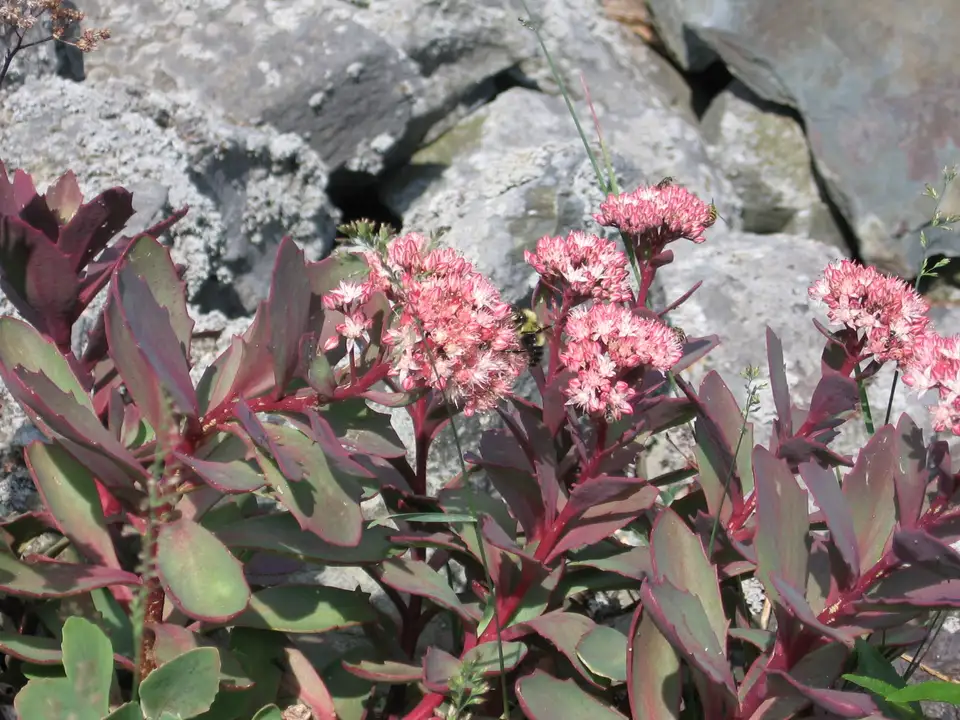
Yes, especially the upright kinds, mainly because of timing. NC Cooperative Extension calls their late-season blooms a crucial nectar source when many other flowers have faded.
“Because they tend to bloom in late summer and into fall, they are excellent for extending the flowering season of a pollinator garden.”
To check timing, we pulled US iNaturalist records annotated as “flowering.” One caveat: iNaturalist excludes cultivated plants from research grade, and 17,043 of 27,300 US Hylotelephium records (62%, all grades) are flagged as cultivated. Garden sedums therefore appear mainly in all-grades counts, which is what we chart.
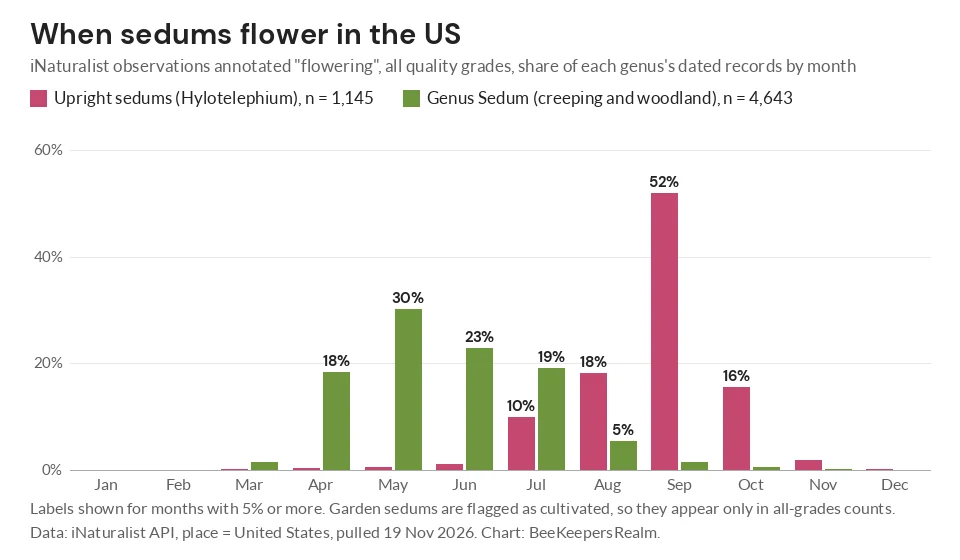
Of 1,145 dated flowering records of upright Hylotelephium, 594 (52%) were made in September and 981 (86%) from August through October. Genus Sedum, which includes the creeping imports and native woodland stonecrop, peaked in May with 1,400 of 4,643 records (30%), and 90% fell between April and July. Research-grade upright records (367) peak in August instead; 278 of them are wild Allegheny stonecrop, which flowers mostly in July and August.
Which insects visit sedum
iNaturalist users can tag an insect photo with the flower it was visiting. US records whose “Visited flower of” field names the genus Hylotelephium total 1,231 from 586 observers (all grades), 1,084 of them research grade. Another 145 name showy stonecrop and 62 name orpine at species level; they are not charted.
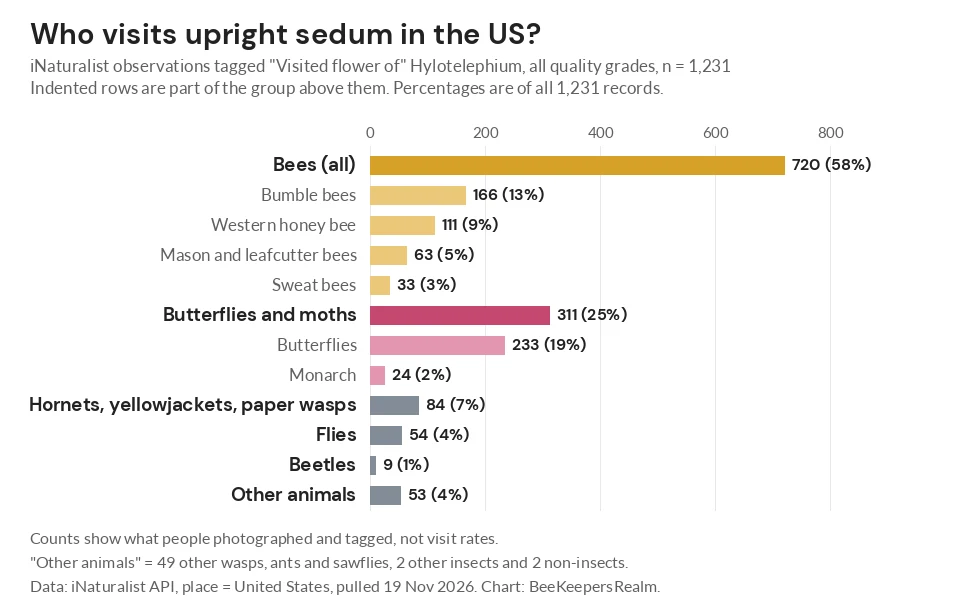
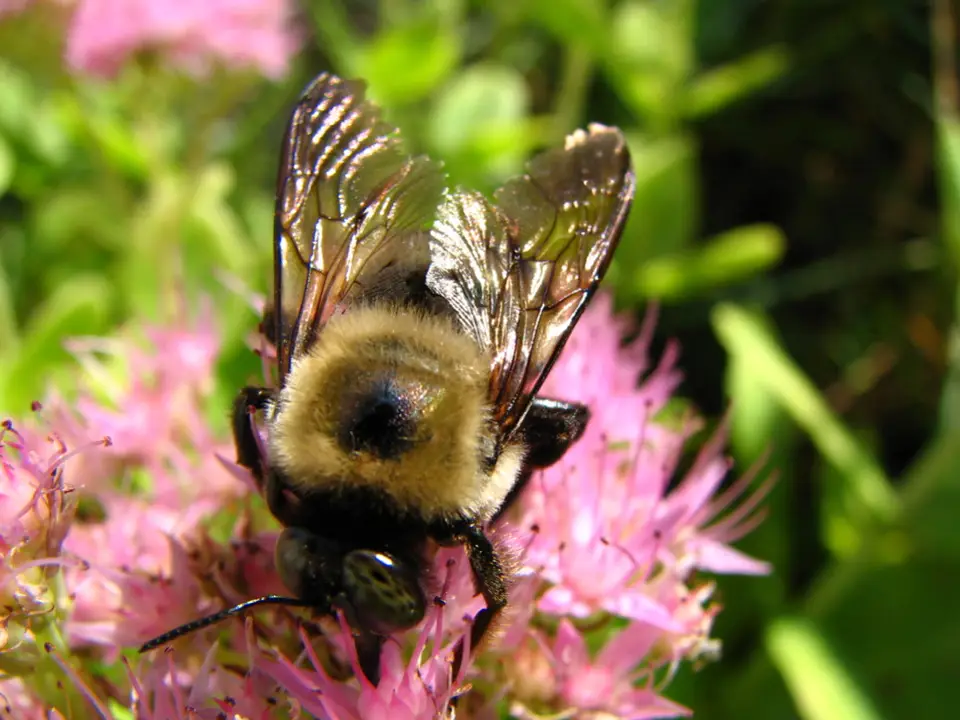
Bees made up 720 of the 1,231 records (58%), butterflies and moths 311 (25%), hornets, yellowjackets and paper wasps 84 (7%) and flies 54 (4%). In research-grade records, the eastern carpenter bee led by far, with 336 of 1,084 (31%) from 271 observers, ahead of the common eastern bumble bee (121), western honey bee (110), Huron skipper (44) and painted lady (35); 138 insect species appear in all. Our bumble bee guide covers the US species. These counts show what people photograph, not visit rates: honey bees are only 9% of all records, yet they dominated the controlled trial below.
What the field trials found
Rosi Rollings of the Rosybee Plants for Bees nursery and Dave Goulson of the University of Sussex counted insects on square-metre plots of 111 garden plant cultivars in central UK from 2014 to 2018, more than 9,000 observations (Journal of Insect Conservation, 2019). Showy sedum ranked 11th for visitation, and honey bees made up 63.7 of its score of 72.5, or 88%; the authors list it among plants with the lowest diversity of visitors. Four honey bee hives sat on the site throughout.
Cultivar matters too. A 2025 Leiden University study in the Journal of Pollination Ecology counted bees on 119 cultivars from eight ornamental genera. Sedum telephium had the majority of the completely unattractive cultivars; ‘Crystal Pink’ and SE08 drew no honey bees or bumble bees at all, and four S. telephium and ice plant cultivars produced no nectar. Buy a sedum you have seen bees working.
Butterflies and the fall migration
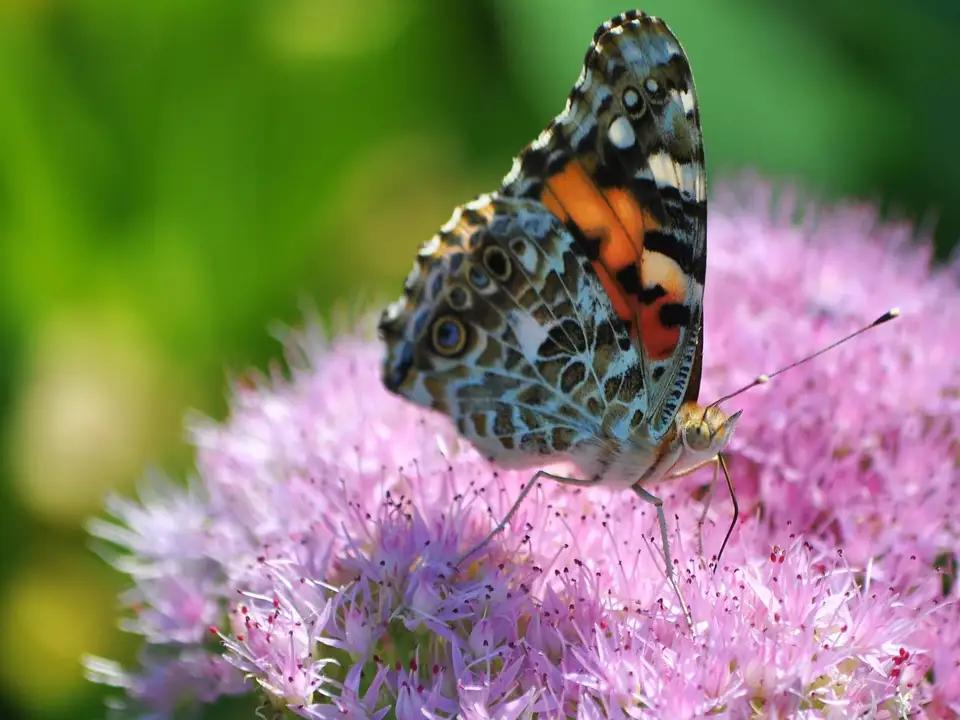
“In particular, migrating butterflies like painted ladies and monarchs are drawn to upright sedum varieties in September and October.”
Our research-grade records include 35 painted ladies and 24 monarchs on Hylotelephium, and butterflies make up 220 of the 1,084.
Creeping sedum and spring bees
Creeping sedums flower in spring and early summer and have far fewer visit records: 192 name the genus Sedum (145 research grade), bumble bees appear in 52, and the research-grade list includes three rusty patched bumble bees. Some may be upright plants filed under the old name. For native woodland stonecrop, Illinois Wildflowers notes that stonecrop nectar and pollen attract various bees, including the mining bee Andrena forbesii.
Problems: Rot, Pests, Deer and Pets
Rot. Root rot is possible in wet or poorly drained conditions, the University of Missouri notes, and NC State says wet soils cause rot in ‘Autumn Joy’. Improve drainage and water less.
Pests. NC State lists aphids, mealybugs, nematodes, scale, slugs and weevils on upright sedums. Hose aphids off first and spot-spray insecticidal soap only if needed; our guide to bee-safe ways to get rid of aphids explains which sprays to keep off plants in bloom.
Deer. Rutgers rates showy sedum “Occasionally Severely Damaged,” the third of four levels, on its deer-resistant plants list, and NC State says showy stonecrop resists browsing by rabbits “but not by deer.” NC State does list white, moss, two-row and wild stonecrop, and ‘Angelina’, as deer resistant.
Pets and people. The ASPCA lists white stonecrop (Sedum album), burro’s tail (S. morganianum) and S. weinbergii as non-toxic to dogs and cats, but that does not cover every species. NC State rates ‘Autumn Joy’, showy stonecrop and two-row stonecrop as low-severity poisons for people, with possible gastrointestinal symptoms, and flags contact dermatitis for moss stonecrop. If a pet eats a lot, call your vet or the ASPCA Animal Poison Control Center.
Sedum vs Other Drought-Tolerant Ground Covers
| Ground cover | Native to the US? | Height | Bloom | Hardiness (USDA zones) | Visitors and notes | Source |
|---|---|---|---|---|---|---|
| Two-row stonecrop (Phedimus spurius) | No | 2 to 6 in | Spring to summer | 3 to 9 | Bees and butterflies; light foot traffic only | NC State; University of Missouri |
| Wild stonecrop (Sedum ternatum) | Yes, eastern US | 3 to 6 in | Spring | 3 to 9 | The shade-tolerant choice | NC State |
| Creeping phlox (Phlox subulata) | Yes, central and eastern US | 4 to 6 in | Spring | 3 to 9 | Hummingbirds, butterflies, skippers and bees; rabbits eat it | NC State |
| Creeping thyme (Thymus serpyllum) | No | 2 to 3 in | Summer | 4 to 9 | Bees and butterflies; rots if overwatered | NC State |
| Plantain-leaf pussytoes (Antennaria plantaginifolia) | Yes, eastern US | 4 to 6 in | Spring | 3 to 8 | Bees and butterflies; host of the American lady butterfly | NC State |
| Hardy ice plant (Delosperma cooperi) | No | 3 to 6 in | Summer to fall | 6 to 10 | Pink-purple daisy-like flowers; may struggle to return after wet winters | NC State |
For a native spring carpet in the East, see our guide to creeping phlox. For more water-wise plants, see drought-resistant flowers for bees, and if you are replacing turf, read how to turn a lawn into pollinator habitat.
Sedum in Pots and on Green Roofs
In pots. NC State lists ‘Autumn Joy’ as working well in containers, indoors or out, and recommends coarse, well-drained soil, preferably a cactus mix, for potted moss stonecrop. The Royal Horticultural Society notes that potted upright sedums need watering to keep the compost moist, since their roots cannot search far for water.
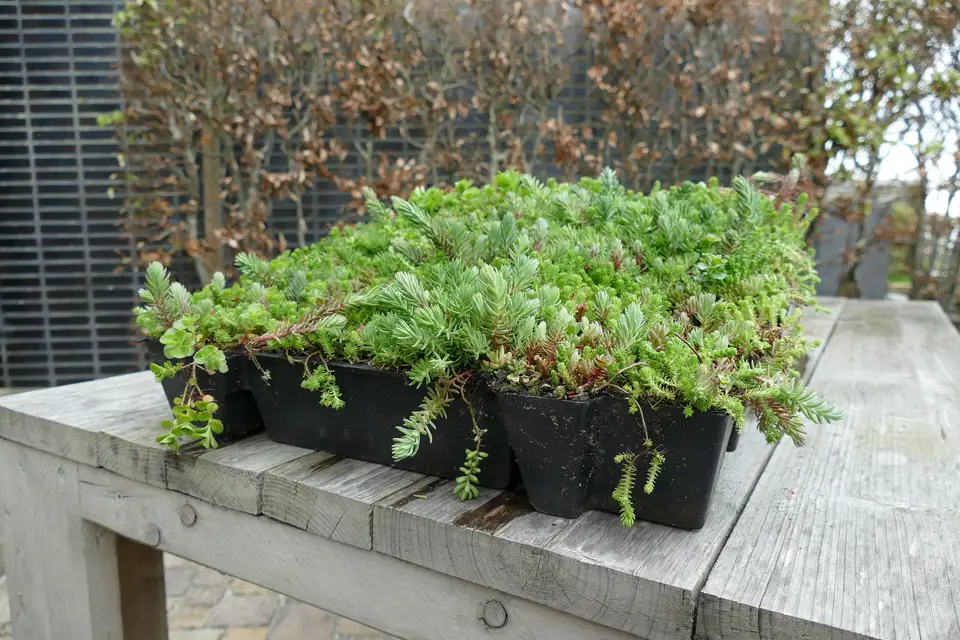
On green roofs. NC State lists white stonecrop as recommended for green roofs in North Carolina’s Triangle area. In a three-year Michigan State University trial, all nine Sedum species tested were judged suitable for Midwestern green roofs, against four of the eighteen Michigan natives tested for unirrigated roofs (Monterusso, Rowe and Rugh, HortScience, 2005). Planning hives up there too? Start with our guide to rooftop beekeeping.
Frequently Asked Questions
Does sedum like sun or shade?
Sun. Too much shade gives weak, floppy growth. ‘Autumn Joy’ accepts some morning or afternoon shade, and native wild stonecrop tolerates shade better than most sedums.
Will sedum come back every year?
Yes, garden sedums are perennials. Upright kinds die back each autumn and regrow from the base in spring; NC State lists moss, white and two-row stonecrop as evergreen.
Are sedums the same as succulents?
Sedums are succulents, but not all succulents are sedums. Sedum is one genus in the stonecrop family, Crassulaceae.
Does sedum spread quickly?
Some creeping kinds do: NC State says white and moss stonecrop spread aggressively. Upright sedums are clump-forming.
Should you cut back sedum in the fall?
You can, but you do not have to. The Royal Horticultural Society says stems can be cut after flowering or left for winter structure and cut to the ground in spring; NC Cooperative Extension favors leaving them.
What to do when sedum gets leggy?
Give it more sun and leaner soil, stop fertilizing, pinch the stems next spring and divide old, splayed clumps in early spring.
What animal will eat sedum?
Deer browse upright sedums at times, slugs and snails chew the leaves (University of Missouri), and the eastern chipmunk eats the roots of wild stonecrop, according to Illinois Wildflowers.
What are the downsides of using sedum as a ground cover?
It takes only light foot traffic, can rot in wet or poorly drained soil, and moss and white stonecrop can overwhelm neighboring plants. Most garden kinds are also not native to the US.
The Bottom Line
Plant upright sedum in your sunniest, driest spot for late-season forage, leave the heads standing until spring, and choose a cultivar you have seen bees working. For a native option, try wild stonecrop in shade or Allegheny stonecrop in a sunny, rocky spot, and pair sedum with goldenrod and asters for fall.
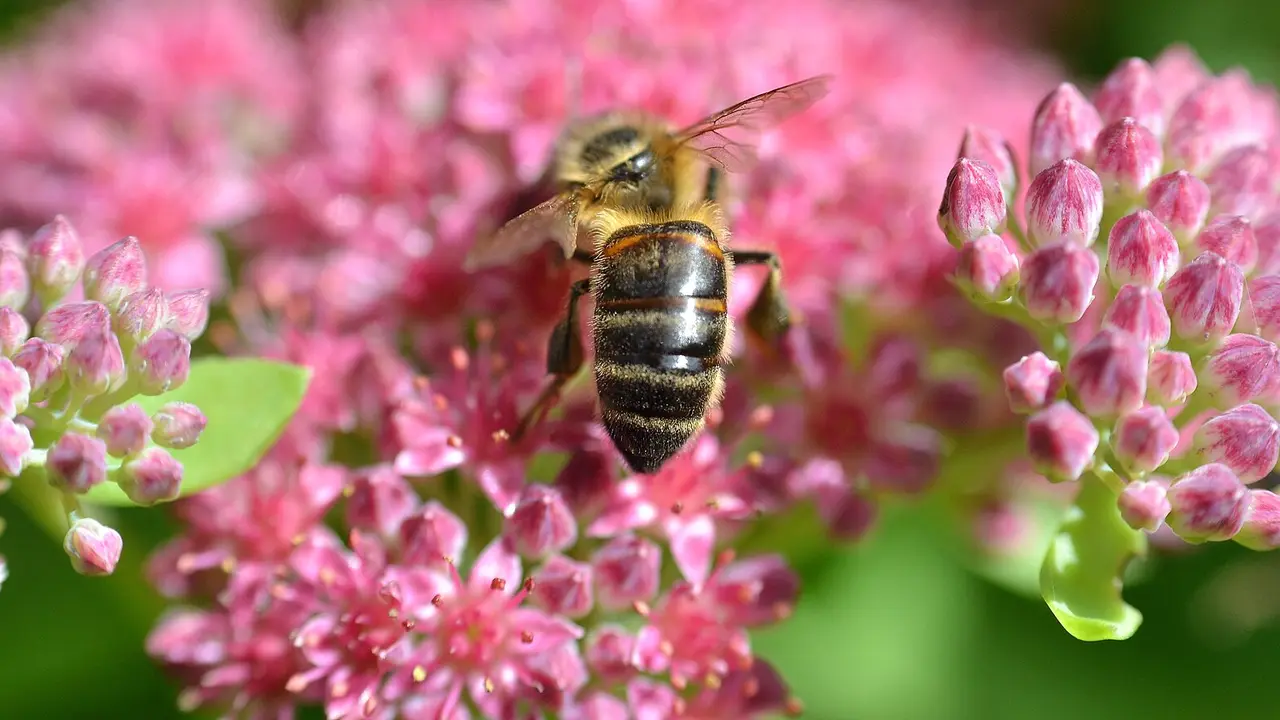
Image credits: featured photo of a honey bee on showy sedum (Hylotelephium spectabile) at Botanic Gardens, Belfast, by Conall McCaughey, via Wikimedia Commons, CC BY 2.0, cropped and resized. Other photos are credited in their captions. Charts by BeeKeepersRealm from iNaturalist data.