Reviewed by Elena P. · How we review
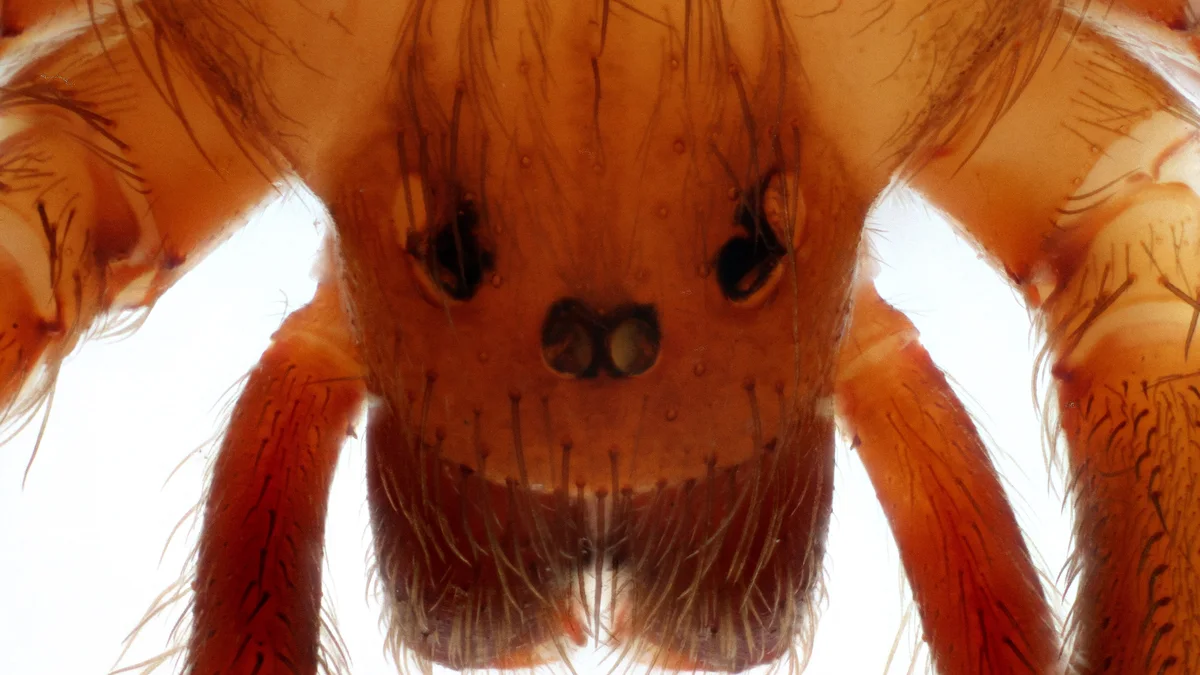
The brown recluse spider (Loxosceles reclusa) is a small, plain tan-to-brown spider of the central and south-central United States, best known for a dark violin-shaped mark behind its eyes. The reliable way to identify one is not the violin but its eyes: six, arranged in three pairs, where most spiders have eight. Brown recluses are shy, hide in undisturbed spots indoors and bite only when pressed against skin. Most bites heal without serious harm, and many wounds blamed on recluses turn out to be something else.
Below: the university “rule it out” test, the spiders most often mistaken for a recluse, where verified brown recluses are actually recorded (from our count of 8,732 iNaturalist records), where they hide, what a bite does and how to keep them out of your clothes, shoes and bed.
Key Takeaways
- Check the eyes first: six eyes in three separated pairs. Then rule out anything with banded or spiny legs, a patterned abdomen or a body longer than 1/2 inch (UC Riverside; UC IPM).
- The violin mark alone is not proof. Arachnologist Rick Vetter calls it unreliable for non-experts because people see “violins” on many harmless spiders.
- In our count of US research-grade iNaturalist records, 80.5% of 8,732 verified brown recluses come from six states (Missouri, Texas, Oklahoma, Tennessee, Kansas, Arkansas). California and 22 other states plus DC have none.
- UC IPM says about 10% of brown recluse bites cause moderate or worse tissue damage; the vast majority heal well. Children and older or immunocompromised people are at higher risk.
- Shake out stored clothes and shoes, keep bedding off the floor, store items in sealed bins and use sticky traps. If you think you were bitten, call Poison Control at 1-800-222-1222.
Table of Contents
- What a Brown Recluse Is
- How to Identify a Brown Recluse by Ruling It Out
- Spiders Mistaken for a Brown Recluse
- Where Brown Recluses Live in the US
- Where Brown Recluses Hide Indoors and When They Turn Up
- Brown Recluse Bites: What Is Known
- How to Prevent Bites and Get Rid of Brown Recluses
- Frequently Asked Questions
What a Brown Recluse Is
The brown recluse belongs to the recluse spiders, genus Loxosceles, family Sicariidae. Over the years these spiders have been called violin spiders, fiddleback spiders, recluse spiders and brown spiders, according to UC IPM’s Pest Note on recluses, written by Rick Vetter of UC Riverside. UC IPM counts 11 recluse species native to the United States, plus two non-native ones established in very limited areas. “Brown recluse” is the proper common name for only one of them, Loxosceles reclusa, the most widespread.
Like all spiders, it is an arachnid, not an insect (our guide to whether bees are insects sets out the difference). It hunts at night for insects, alive or dead, instead of catching them in a web (University of Kentucky; Missouri Department of Conservation). Recluses mature in about a year, live 2 to 4 years on average and can go 6 to 12 months without food (UC IPM).
Many wasps hunt spiders, the Missouri Department of Conservation notes; mud dauber wasps, for one, stock their nests with paralyzed spiders.
How to Identify a Brown Recluse by Ruling It Out
The quickest route is to prove a spider is not a recluse. Rick Vetter’s identification page at UC Riverside was written for exactly that, because so many spiders sent to him as brown recluses were something else.
“Because so many people have mistaken markings on a spider as violins, this is NOT a reliable characteristic for a non-arachnologist.”
UC IPM says a spider must have all five of these traits to be a recluse:
- Six eyes in pairs: one pair in front and one on each side, with a space between the pairs. Most spiders have eight eyes, usually in two rows of four. Vetter says the pattern is easy to see with minor magnification.
- Uniformly colored abdomen: covered in fine hairs, from light beige to dark brown depending on what the spider has eaten, but never two colors or a pattern.
- No spines on the legs: only fine hairs. Thick spines sticking out of the legs rule a recluse out.
- Uniformly colored legs: no stripes, rings, bands or spots.
- Small body: about 3/8 inch long without legs. A body longer than 1/2 inch is not a recluse (UC Riverside).
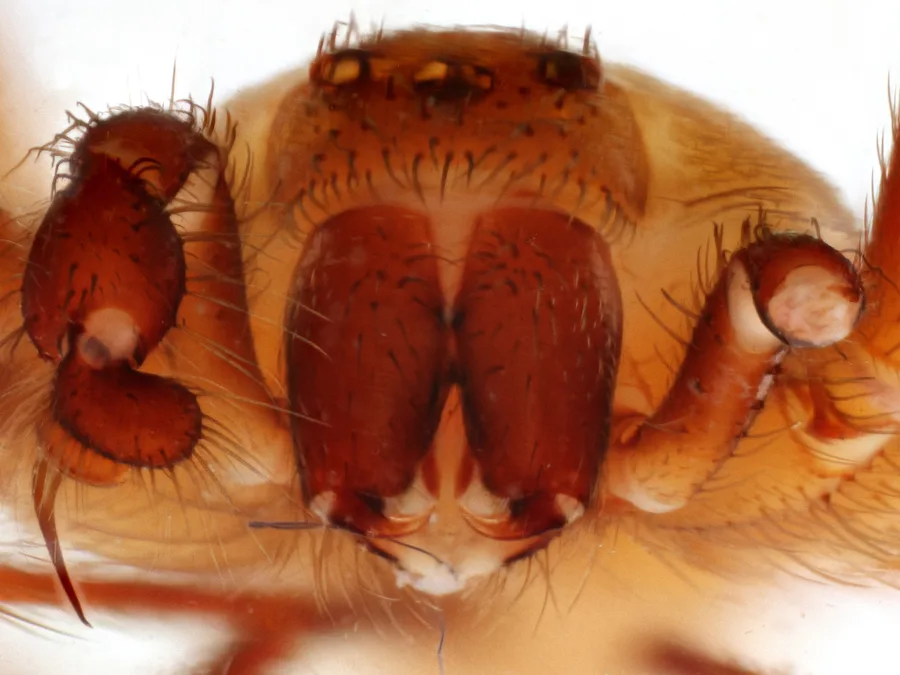
Recluses also make only small retreat webs behind or under objects, never a web in the open. UC IPM notes that the violin, on the front body part where the legs attach, is fairly consistent in mature brown recluses but faint or missing in several southwestern recluses, and that physicians, pest control operators and even some entomologists have “seen” violins on harmless spiders.
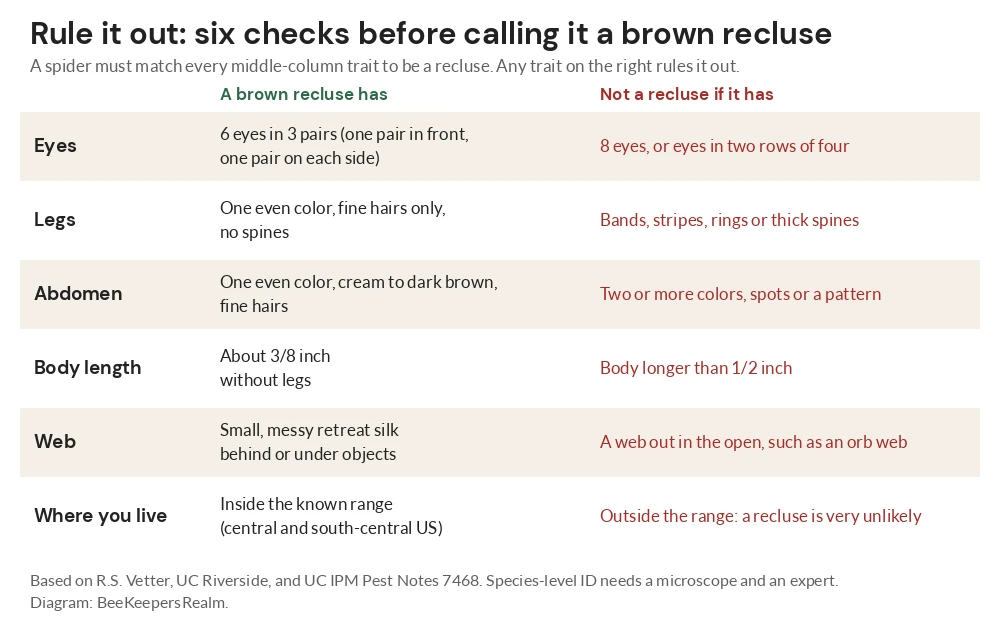
Size estimates vary: about 3/8 inch of body (UC Riverside), or about as big as a US quarter with the legs (National Capital Poison Center). Naming a recluse to species takes a microscope and an arachnologist (UC IPM), so the University of Kentucky advises having specimens confirmed by an entomologist or a knowledgeable pest control firm.
Video: In this Oklahoma Gardening segment from Oklahoma State University (aired October 31, 2015), associate extension specialist Andrine Shufran talks about the brown recluse as a misunderstood arachnid. Going by the video’s chapter list, it covers common brown recluse myths, the “dead spot” wound the spider is blamed for, the fiddleback mark and the spider’s reclusive habits, and closes with a book recommendation.
Spiders Mistaken for a Brown Recluse
Almost every tan or brown spider gets reported as a recluse. UC IPM lists ground, sac, wolf, grass, orb-weaving, cellar and male crevice spiders among the usual mix-ups. The table sorts the common ones by the feature that rules each out.
| Spider | Why it gets mistaken | What rules it out | Source |
|---|---|---|---|
| Wolf spider (Lycosidae) | Brown and often found in the same places | 8 eyes, two much larger than the rest; usually bigger, about 1/2 to 2 inches | Missouri Poison Center, UC IPM |
| Southern house spider, male (Kukulcania) | A slight darkening near the eyes looks like a violin | 8 eyes clumped together; black spines on the legs | UC Riverside |
| Cellar spiders (Pholcus, Psilochorus, Physocyclus) | Dark marks on a pale head region | 8 eyes; more than one pigment on the abdomen | UC Riverside, UC IPM |
| Woodlouse spider (Dysdera crocata) | Also has 6 eyes and no markings | Eyes in two groups of three, not three pairs | UC IPM |
| Spitting spiders (Scytodes) | 6 eyes in a similar pattern; close relatives | Many black spots or lines; strongly domed front body; no violin | UC IPM, UC Riverside |
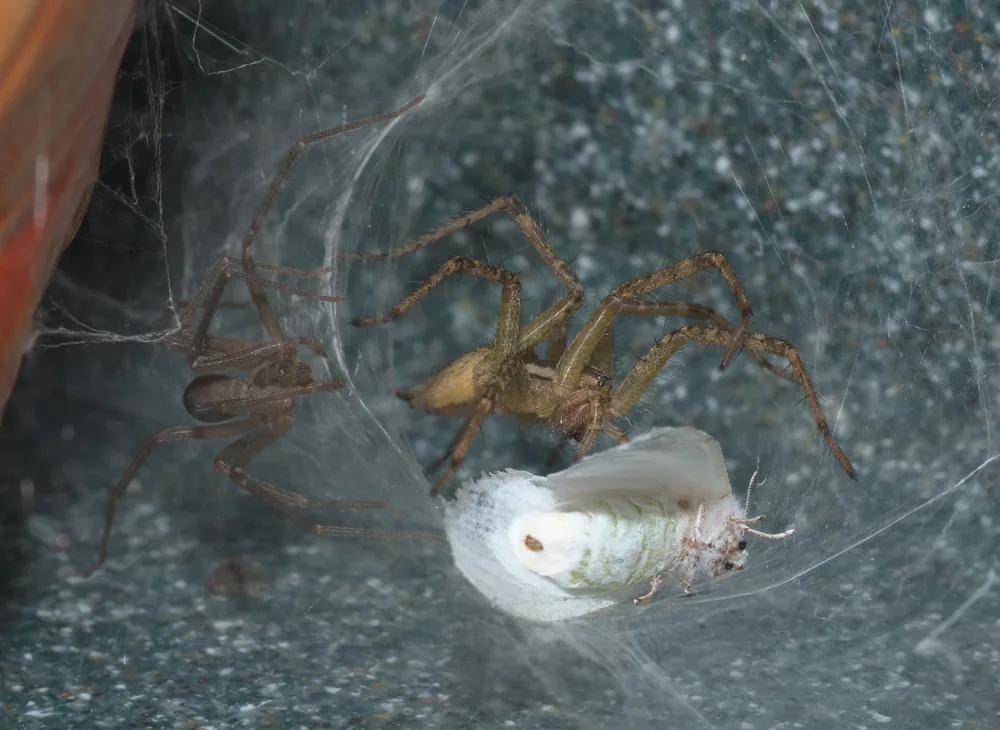
| Grass spiders and other funnel weavers (Agelenidae) | Brown and very common | 8 eyes; banded legs or a striped abdomen; a sheet web out in the open | UC Riverside, UC IPM |
| House spiders | Similar places and coloring | Higher abdomen and rounder body | Missouri Poison Center |
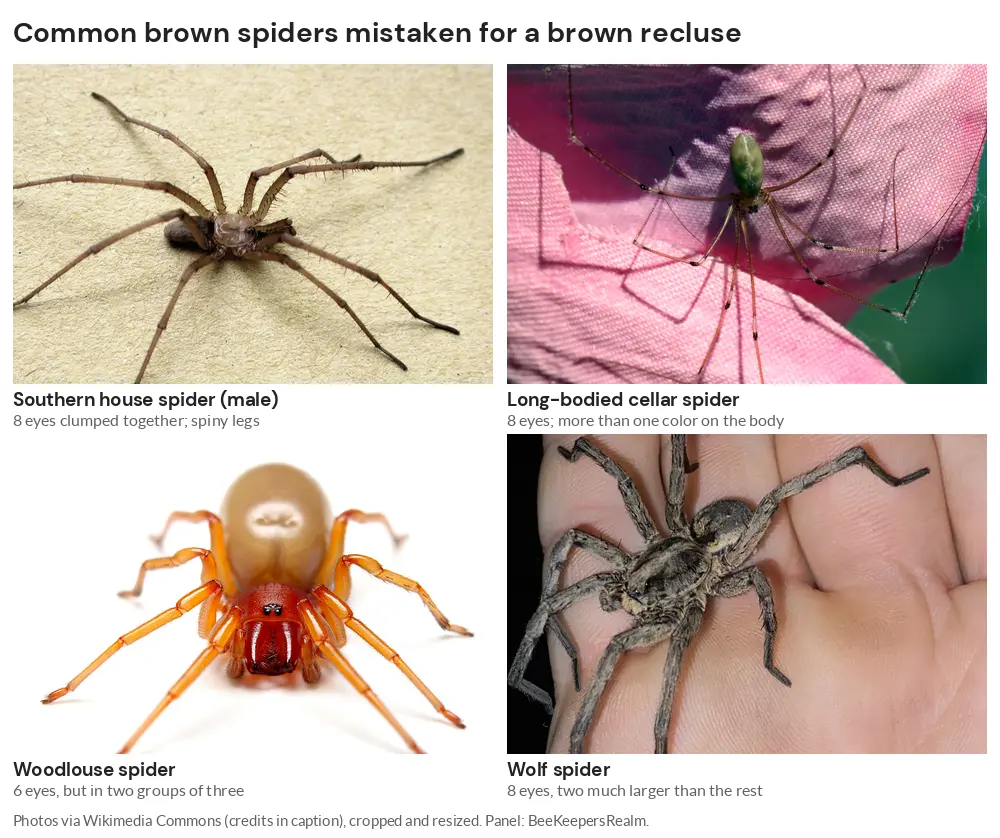
Behavior is a clue too. The Missouri Poison Center points out that brown recluses shrink away from people, so a spider that does not flee from you is unlikely to be one. For two other common eight-eyed spiders, see our wolf spider identification guide, which shows both eye layouts side by side, and our guide to jumping spiders.
If the spider is glossy black with a round abdomen instead, see our black widow spider guide for identification and bite symptoms.
Where Brown Recluses Live in the US
UC IPM puts the brown recluse in the south-central Midwest, from southeastern Nebraska to southwestern Ohio and south through Texas to north Georgia. MedlinePlus names Missouri, Kansas, Arkansas, Louisiana, eastern Texas and Oklahoma as the states where it is most common. Recluses do not balloon on the wind like many spiders, so they move outside that range almost only when people carry them in goods or furniture, and those stowaways rarely start a population (UC IPM; University of Kentucky).
To see where verified brown recluses actually turn up, we counted every research-grade US observation of Loxosceles reclusa on iNaturalist through its public API on November 22, 2026 (“research grade” means a photo with a date and location on which at least two people agreed about the species). There were 8,732.
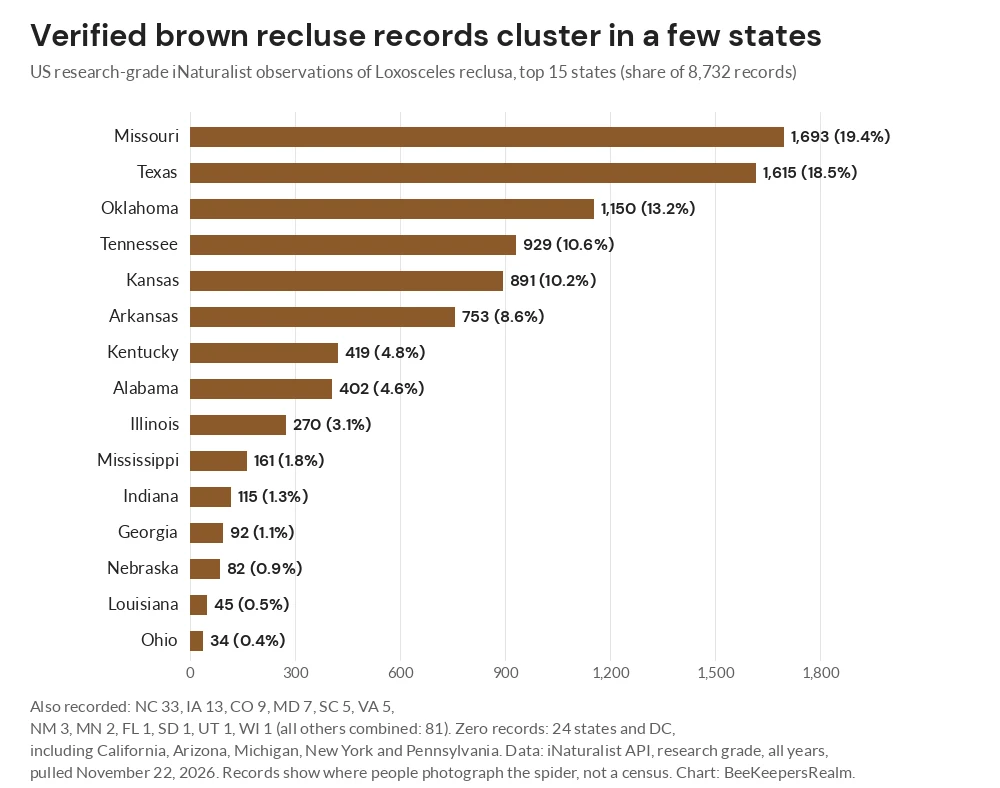
Six states (Missouri 19.4%, Texas 18.5%, Oklahoma 13.2%, Tennessee 10.6%, Kansas 10.2% and Arkansas 8.6%) hold 80.5% of the records. Kentucky, Alabama, Illinois, Mississippi, Indiana, Georgia, Nebraska, Louisiana and Ohio follow, all inside or on the edge of the range UC IPM describes. Only 81 records (0.9%) come from the other 12 states with any at all, such as North Carolina (33), Iowa (13) and Colorado (9), and Florida has exactly 1. Twenty-three states and DC have none, including California, Arizona, Michigan, New York and Pennsylvania.
That matches the best-known study on the question. In 2005 Vetter reported in the Journal of Medical Entomology that people mailed him 1,773 arachnids from 49 states as suspected brown recluses; from 25 of the 29 states completely or almost completely outside the range, not one recluse arrived. UC IPM adds that of nearly 600 California submissions in that project, only one was a brown recluse, from a family that had moved from Missouri.
Two caveats. iNaturalist records follow where people look and post photos, so a low count (Louisiana has 45) does not prove recluses are scarce. And other recluses live in the West: we found 322 US research-grade records of the desert recluse, the most common recluse in California according to UC IPM.
| Recluse species (Loxosceles) | US research-grade iNaturalist records | Notes |
|---|---|---|
| Brown recluse (L. reclusa) | 8,732 | Central and south-central states |
| Desert recluse (L. deserta) | 322 | Sonoran and Mojave deserts (UC IPM) |
| Texas recluse (L. devia) | 87 | Violin fairly consistent, like the brown recluse (UC IPM) |
| Apache recluse (L. apachea) | 50 | |
| Mediterranean recluse (L. rufescens) | 42 | Non-native; turns up in shipped goods (UC IPM) |
| Big Bend recluse (L. blanda) | 42 | |
| Arizona recluse (L. arizonica) | 21 | |
| Other species (L. sabina, L. laeta, L. palma, L. russelli) | 14 | Chilean recluse (L. laeta) is confined to part of Los Angeles County (UC IPM) |
Where Brown Recluses Hide Indoors and When They Turn Up
Outdoors, recluses live under rocks, logs, woodpiles, loose bark and debris. Indoors, UC IPM says they have “very much benefited” from people and are found under trash cans, plywood, tarps and tires and in storage boxes. The University of Kentucky’s list of hiding places includes:
- Garages, attics, basements and crawl spaces, along joists, sills and rafters and under rolled insulation, where egg sacs and shed skins are often found.
- Behind and beneath beds and furniture, in closets, clothing, shoes and stored items.
- Behind baseboards, above suspended ceilings, inside ducts and in wall and concrete-block voids.
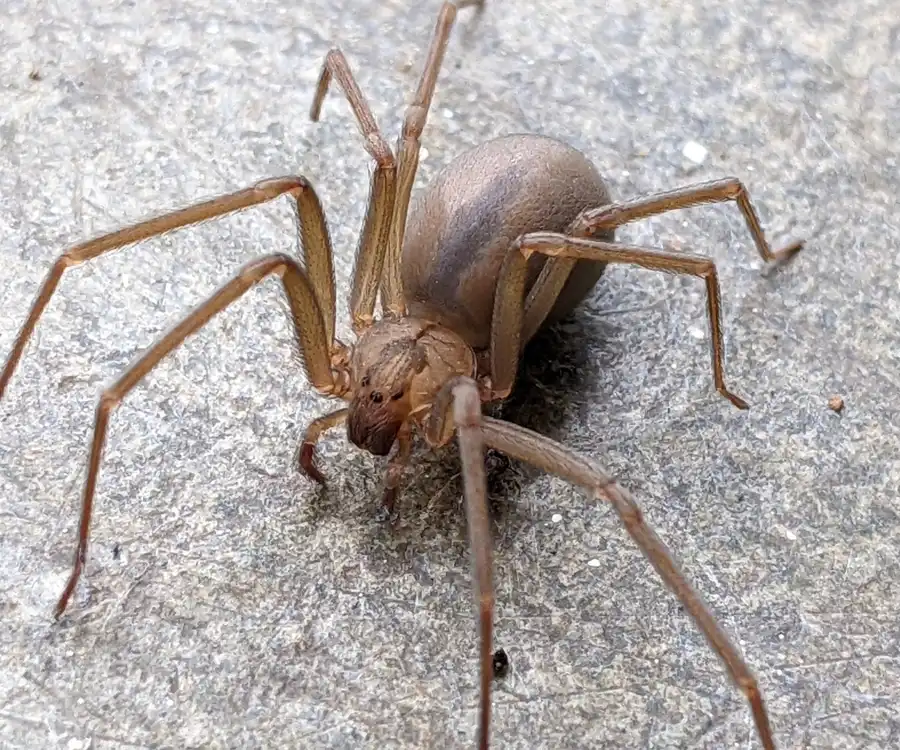
“If you find recluses, you do not find one, you find many.”
UC IPM gives examples: 44 caught on sticky traps in a Tennessee home in one day, and 2,055 collected over six months in a 19th-century house in Lenexa, Kansas. In that Kansas home, described by Vetter and Barger in the Journal of Medical Entomology in 2002, nobody living there was bitten during the study, and UC IPM says the family recorded only one minor bite in about 10 years.
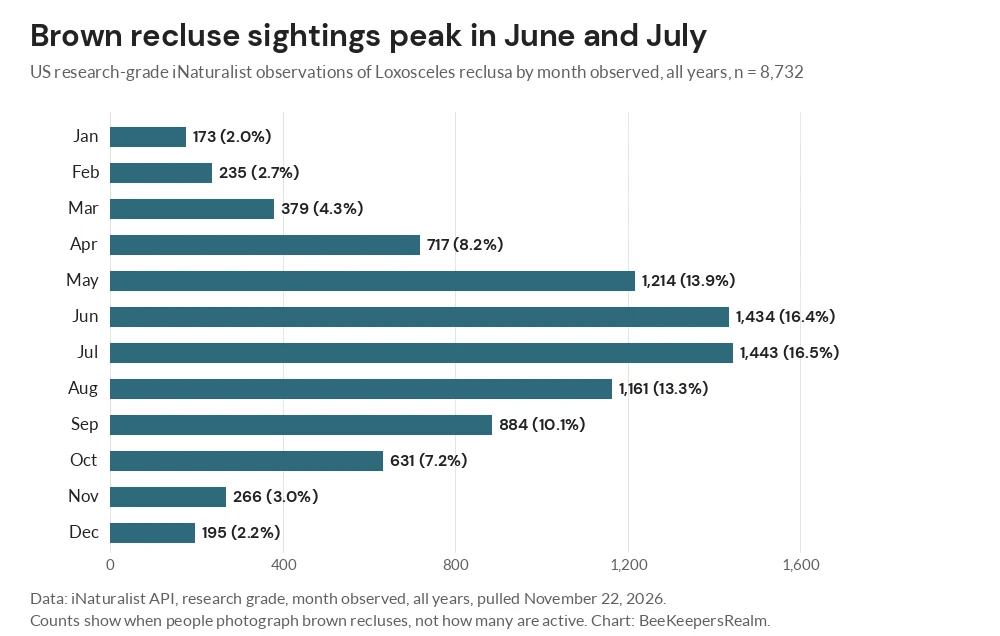
Our iNaturalist count also shows when people find them. June (1,434 records, 16.4%) and July (1,443, 16.5%) are the peak, April through October holds 85.7% of all US records, and December through February only 6.9%. UC IPM says mature males roam in search of females and recluses may shelter in clothing or shoes toward dawn, the two habits that bring them into contact with people.
Brown Recluse Bites: What Is Known
This section is educational information, not medical advice. If you think you or a child was bitten, call Poison Control at 1-800-222-1222 or seek medical care; call 911 for trouble breathing or a severe reaction.
“It is quite common, in fact, to live in a building that is heavily infested and never be bitten.”
The brown recluse is not aggressive. Most bites happen when a spider is trapped against bare skin, by rolling onto one in bed, putting on clothing it hid in or moving stored items, and its fangs are too small to bite through clothing (University of Kentucky). CDC’s National Institute for Occupational Safety and Health (NIOSH) likewise says a recluse cannot bite a person without counterpressure, as when it is accidentally trapped against the skin.
What a bite does over time
The bite is usually painless or a sharp sting. The University of Kentucky says the person often notices nothing until 3 to 8 hours later, when the spot turns red, swollen and tender, and that most bites stay localized and heal within 3 weeks. NIOSH says a small white blister usually forms; MedlinePlus adds chills, itching, fever, nausea and a reddish or purplish ring. In a minority of cases the venom kills skin tissue (necrosis): UC IPM estimates about 10% of bites cause moderate or greater tissue damage and scarring, and such wounds can ulcerate, blacken and leave a crater-like scar (National Capital Poison Center). Whole-body effects such as kidney failure are rare, and deaths are rare and occur mainly in children (MedlinePlus; UC IPM).
Why many “recluse bites” are something else
There is no test for a brown recluse bite (Cleveland Clinic), and the National Capital Poison Center says one is very difficult to diagnose unless the person felt it and correctly identified the spider. UC IPM lists conditions often misdiagnosed as recluse bites:
- MRSA and other bacterial skin infections. In one national study of 11 university medical centers, 29% of patients who came in for a “spider bite” had MRSA.
- Group A streptococcal infection (necrotizing fasciitis), which can be fatal if diagnosis is delayed.
- Bites of blood-feeding arthropods, including mites, fleas, bed bugs, ticks and conenose bugs, better known as kissing bugs. For the itchy welts that larval mites leave after a walk in tall grass, see our guide to chiggers.
- Several sores at once, or on several people in one house: spiders bite once in defense, so that points to an infection or a blood-feeding pest.
The Missouri Poison Center adds fungal infections, diabetic wounds, melanoma and herpes, and summarizes the “NOT RECLUSE” checklist from a 2017 JAMA Dermatology paper (Stoecker, Vetter and Dyer). Each letter argues against a recluse bite: Numerous lesions, Occurrence away from where recluses hide, Timing outside April to October, a Red rather than dark center, Elevated more than 1 cm, Chronic beyond three months, Large over 10 cm, Ulcerating before 7 to 14 days, Swollen (except on the face or feet) and Exudative (oozing pus). Location matters too: the University of Kentucky calls suspected bites outside the native range particularly unlikely, and UC IPM notes recluse bites diagnosed in Alaska and Canada, where no brown recluse has ever been found.
What to do if you think you were bitten
Follow official first-aid advice and get professional help rather than treating a wound yourself:
- Stay calm, wash the bite with soap and water and apply a cloth dampened with cold water or wrapped around ice; elevate the area if possible (NIOSH). Do not try to remove venom.
- Call Poison Control at 1-800-222-1222 (free and confidential) or use the online tool from the National Capital Poison Center, which notes there is no antidote for brown recluse venom.
- If it is safe, bring the spider or a clear photo; MedlinePlus suggests taking the spider to the emergency room.
- Seek care promptly for a child, an older or immunocompromised person, or anyone with fever, chills, dizziness, rash or vomiting after a suspected bite (Missouri Poison Center; University of Kentucky). NIOSH says a necrotic skin lesion requires professional medical attention.
How to Prevent Bites and Get Rid of Brown Recluses
Because bites come from spiders trapped against skin, most prevention is about not giving them a chance to be trapped. UC IPM, the University of Kentucky and NIOSH recommend:
- Shake out clothing, shoes, towels and gloves before use, and keep clothes and shoes off the floor.
- Move the bed away from the wall, remove bed skirts and do not store items under the bed.
- Store seldom-used clothing, gardening gloves, boots and seasonal gear in tightly closed plastic bags or bins, especially in garages and storage areas.
- Wear gloves and long sleeves when sorting boxes or handling stacked materials.
- Seal cracks and holes in the exterior and between an attached garage and the house, including gaps around conduits and plumbing.
- Place flat sticky traps along baseboards, out of reach of pets and children. UC IPM calls them a non-insecticidal way to catch spiders and gauge numbers; the University of Kentucky recommends dozens, since they catch the wandering males most likely to bite.
- Remove a single spider with a jar and a piece of paper slid underneath.
Pesticides are a limited tool. UC IPM says spider control with pesticides is difficult unless you actually see the spider and spray it. For an established infestation, the University of Kentucky says elimination often requires insecticides placed into cracks and voids where recluses hide (dusts are especially effective in attics, crawl spaces and wall voids), that adult females hide and often escape traps, and that treatment is best done by professionals. Ask for that kind of targeted, indoor crack-and-crevice treatment rather than a broadcast spray around the yard: broad-spectrum insecticides also kill bees and other pollinators, as our guide to pollinator-safe pest control explains, and a yard spray does not reach spiders hiding in boxes and wall voids.
Most large spiders people find in garden webs in late summer are orb weavers, not recluses; see our orb weaver spider guide.
In the Pacific Northwest, where brown recluses do not live, many bite scares have blamed the hobo spider instead; our hobo spider guide explains what the bite research found.
Bed bugs also hide in and around beds; our bed bug guide explains how to inspect a mattress, box spring and headboard for them.
"Daddy longlegs" can mean a cellar spider, a harvestman or a crane fly; our crane fly guide covers the winged one.
Several small bites in a row point more to bed bugs than to a recluse; our bed bug bites guide explains the pattern.
Cellar spiders, often called daddy longlegs, are a common brown recluse look-alike; our daddy long legs guide shows how to tell them from harvestmen.
Frequently Asked Questions
Are brown recluse spiders aggressive?
No. The University of Kentucky says they are not aggressive and bite mainly when trapped against skin, and the Missouri Poison Center says they shrink away from people.
Do brown recluses make webs?
Only small, irregular retreat webs behind or under objects, never a web out in the open. They hunt at night instead of trapping prey (UC Riverside; Missouri Department of Conservation).
Are there brown recluse spiders in California?
UC IPM says there are no populations; fewer than 20 verified specimens have been found there over several decades, typically stowaways in shipped goods or moved belongings. Our iNaturalist count found zero research-grade California records. California does have native recluses, mainly the desert recluse in desert areas.
Can a brown recluse bite kill you?
Deaths are rare and reported mostly in children (UC IPM; MedlinePlus). Most bites heal on their own, but call Poison Control at 1-800-222-1222 for any suspected bite.
Do brown recluse bites hurt?
Usually not at first. The University of Kentucky says the bite is usually painless, and redness, swelling and tenderness appear 3 to 8 hours later.
What attracts brown recluses into a house?
Dark, undisturbed clutter: boxes, stored clothes, shoes, attics, basements and garages. They feed on insects, alive or dead (University of Kentucky), and spread to new houses mostly in moved belongings.
The Bottom Line
Check the eyes and the legs before anything else, and remember that a recluse outside the central and south-central states is very unlikely. If you live inside the range, shake out stored clothes and shoes, use sticky traps and call Poison Control for any suspected bite. For other household creatures, see our guides to silverfish and house centipedes, or browse the garden and household insects section.
Image credits: featured photo of a brown recluse seen from above by Christopher Johnson, Insects Unlocked project, University of Texas at Austin, via Wikimedia Commons, CC0, cropped and resized. Other photos are credited in their captions. Charts and the rule-out diagram: BeeKeepersRealm, from iNaturalist API data pulled November 22, 2026 and the UC Riverside and UC IPM identification criteria.