Reviewed by Sofia T. · How we review
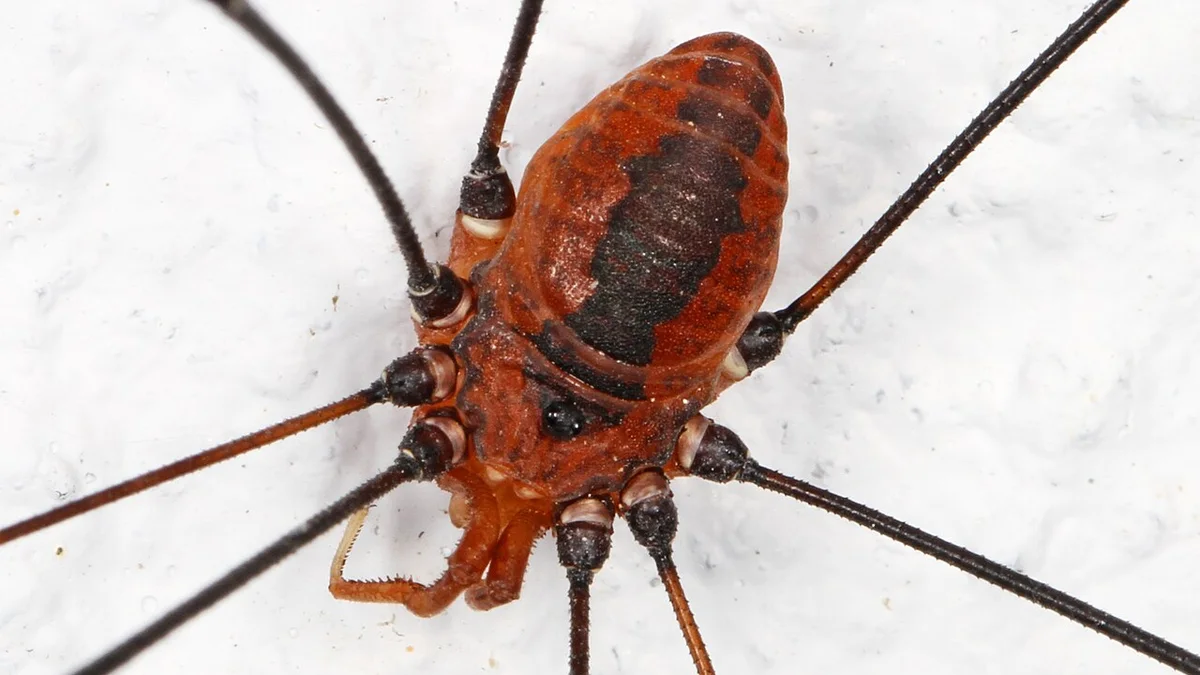
“Daddy long legs” is a common name for three different animals: harvestmen (order Opiliones), which are arachnids but not spiders; cellar spiders (family Pholcidae), which are true spiders; and crane flies, which are winged insects. None of them is dangerous to people. Harvestmen have one oval body, no silk and no venom glands; cellar spiders have two body parts and spin webs; crane flies have wings and six legs.
Below: how to tell the three apart in seconds, what each one eats, why the “most venomous spider” story is false, and what to do about them in a garden or a house, plus our count of 110,410 US iNaturalist records showing which daddy long legs turns up in which months.
Key Takeaways
- Most Americans who spend time outdoors mean harvestmen, says the Burke Museum. People who seldom go outdoors may know only the cellar spider, and the British use the name for crane flies.
- Harvestmen do not make silk or venom (Ohio State, Missouri Department of Conservation). Cellar spiders do have venom, but there is no record of one harming a person (UC Riverside).
- Harvestmen are garden helpers: Ohio State calls them “beneficial predators in the garden,” and Cornell lists aphids, caterpillars, leafhoppers, beetle larvae, mites and small slugs among their prey.
- In our count, 71.2% of US research-grade harvestman records fall in June to October and only 5.8% in December to February. Cellar spider records are much flatter, with 11.6% in winter, because they live indoors all year.
- No spray is needed for either. A vacuum or broom removes harvestmen and cobwebs; Clemson says chemical control of harvestmen is not necessary in nearly all situations.
Table of Contents
- Three Animals Called Daddy Long Legs
- How to Tell Them Apart
- Harvestmen: The Garden Daddy Long Legs
- Cellar Spiders: The Daddy Long Legs in the Basement
- Crane Flies: The Daddy Long Legs With Wings
- When Each One Shows Up: Our Count of US Records
- The “Most Venomous Spider” Myth
- Can They Bite or Harm People and Pets?
- Daddy Long Legs in the Garden
- Daddy Long Legs in the House: What to Do
- Frequently Asked Questions
Three Animals Called Daddy Long Legs
The Burke Museum at the University of Washington sums up the confusion: most Americans who spend time outdoors use “daddy-longlegs” for long-legged harvestmen; people who seldom go outdoors may only know the long-legged house spider Pholcus phalangioides; and the British, some Canadians and some southeastern Americans use it for crane flies. Virginia Tech Extension adds that crane flies get the name mainly in English-speaking countries outside the US.
- Harvestmen (order Opiliones) are arachnids, like spiders, ticks and scorpions, but they are not spiders. Clemson Extension puts them at more than 6,500 species worldwide; Virginia Tech says more than 5,900, a sign of how unsettled the count still is. Other names include harvest spiders, shepherd’s spiders, reapers and granddaddy longlegs.
- Cellar spiders (family Pholcidae) are true spiders, also called daddy longlegs spiders, vibrating spiders and pholcids (MDC). Clemson’s Home and Garden Information Center counts about 20 species in the United States and Canada.
- Crane flies (family Tipulidae) are true flies with two wings and six legs. They are covered in full in our crane fly guide, so this page only shows how to rule them in or out.
Where the names come from: Ohio State says Opiliones comes from the Latin opilo, roughly “shepherd,” perhaps because the animal on its long legs reminded people of European shepherds on stilts, and that in the United States, where long-legged species dominate, the common name is daddy longlegs. Clemson says “harvestman” comes from the large numbers seen in fall around harvest time, though they are out from May to November.
How to Tell Them Apart
Look at three things: the body, the wings and whether there is a web. Every trait below comes from an extension service or museum.
| Feature | Harvestman | Cellar spider | Crane fly |
|---|---|---|---|
| What it is | Arachnid, order Opiliones; not a spider | True spider, family Pholcidae | Insect, a true fly (family Tipulidae) |
| Body | One oval body; no visible waist (MDC, Ohio State) | Two distinct parts, head region and abdomen (MDC) | Head, thorax and abdomen; slender |
| Legs | 8 | 8 | 6 |
| Wings | None | None | One pair |
| Eyes | Usually 2, on a raised bump (Ohio State); 0 to 4 across the order (Virginia Tech) | Often 8, in three groups (MDC) | Not stated |
| Silk and webs | No silk; never in a web unless being eaten (UC Riverside) | Messy, non-sticky cobwebs in corners (MDC) | None |
| Venom | No venom glands (MDC, Ohio State) | Yes, but mild (MDC) | None |
| Body size | 2 to 10 mm (Ohio State); to about 1/2 inch (MDC) | Usually no more than about 1/4 inch (MDC) | About 1/2 to 1 1/2 inches (see our crane fly guide) |
| Where you find it | Gardens, leaf litter, tree bark, house walls | Basements, garages, ceiling corners | Lawns, porch lights, walls near lights |
| How it eats | Swallows small chunks of solid food (MDC) | Bites, wraps prey in silk, then eats (MDC) | Adults eat little or nothing |
The quickest field test is the waist. If the body looks like a single pea or pill on stilts, it is a harvestman; if it looks like a peanut, with a small front part joined to a longer abdomen, it is a spider. Spiders and insects are built quite differently, as our explainer on why bees are insects, not bugs or spiders explains.
Harvestmen: The Garden Daddy Long Legs
Harvestmen are the daddy long legs of gardens, woodpiles and tree trunks. MDC describes the body as a simple oval in which it is hard to tell where the “head” ends and the segmented “abdomen” begins. The second pair of legs, usually the longest, works like a pair of feelers as they walk, “like a blind person tapping a cane” (MDC). The mouthparts work like a crab’s or a scorpion’s, holding food while they eat (Clemson).
Video: KQED’s Deep Look series (PBS Digital Studios) follows UC Berkeley researcher Ignacio Escalante’s work on harvestmen: how they drop legs on purpose to escape predators, and how they learn new ways of walking with fewer legs, going by the video’s official chapter list and KQED’s companion article. Escalante told KQED that harvestmen have a 60 percent probability of losing a leg during their lifetime.
Which harvestmen Americans find most
US research-grade iNaturalist records include 176 harvestman species. Two account for half of the 38,435 records:
| Species | Common name | Records | Share |
|---|---|---|---|
| Phalangium opilio | European harvestman | 9,694 | 25.2% |
| Leiobunum vittatum | Eastern or banded harvestman | 9,539 | 24.8% |
| Libitioides sayi | Say’s armored harvestman | 3,126 | 8.1% |
| Leiobunum townsendi | None listed | 1,948 | 5.1% |
| Eumesosoma roeweri | None listed | 1,607 | 4.2% |
Clemson says the eastern harvestman is common in South Carolina, and the University of Kentucky says most daddy longlegs seen there belong to Leiobunum, present around trees, shrubs and thick vegetation in warm months. Ohio State names Phalangium opilio and Leiobunum species as common in Ohio yards, with P. opilio often in garden beds. Whether the European harvestman is native here is not settled: a 2016 review in Zootaxa says it is “not entirely determined” whether it was introduced to North America or is naturally found across the northern hemisphere.
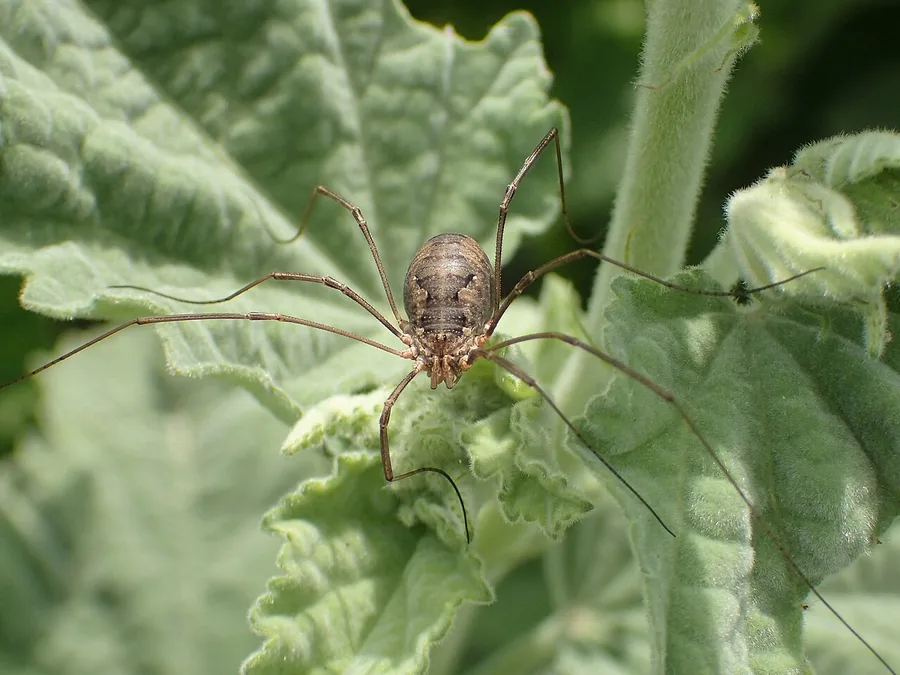
What harvestmen eat
Harvestmen are omnivores and scavengers. MDC says they eat a variety of organic material, including droppings and dead animals, and that some prey on aphids and other small insects; unlike spiders, they swallow small chunks of solid food instead of sucking up liquid. Kentucky adds slow-moving or dead insects, insect eggs, earthworms and decaying plant matter, and Ohio State notes they may eat pollen when prey is scarce. MDC puts their role plainly: they clean up “dung and dead things.”
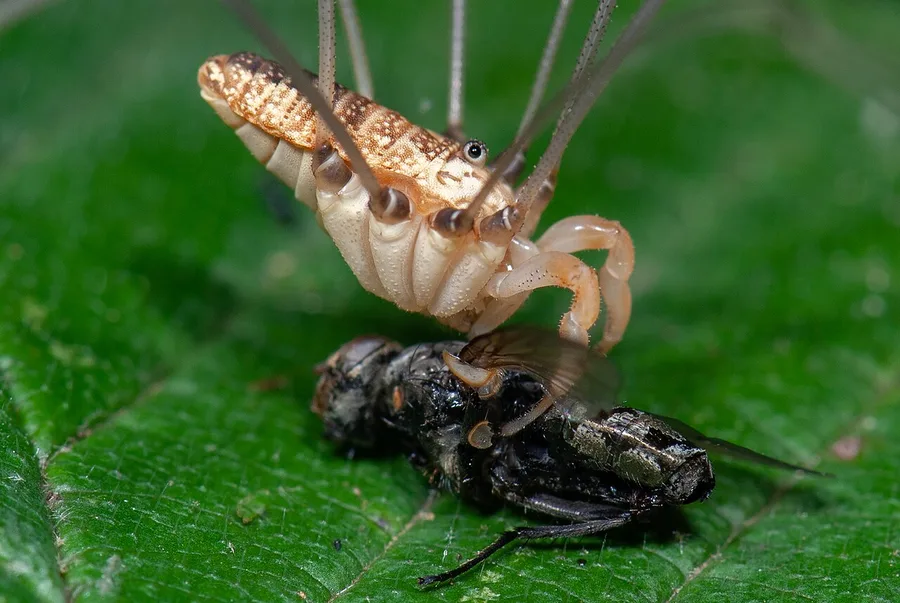
Dropped legs, smells and other defenses
A harvestman’s legs come off easily and keep twitching, which distracts a predator while the animal escapes; unlike spiders, it does not regrow lost legs when it molts (Virginia Tech). Many species also release bad-smelling defensive chemicals from scent glands, and some play dead (Virginia Tech, Kentucky, MDC). Kentucky lists birds, large spiders and predatory insects such as assassin bugs as predators. The tiny red dots often seen on harvestmen are parasitic young mites (University of Kentucky).
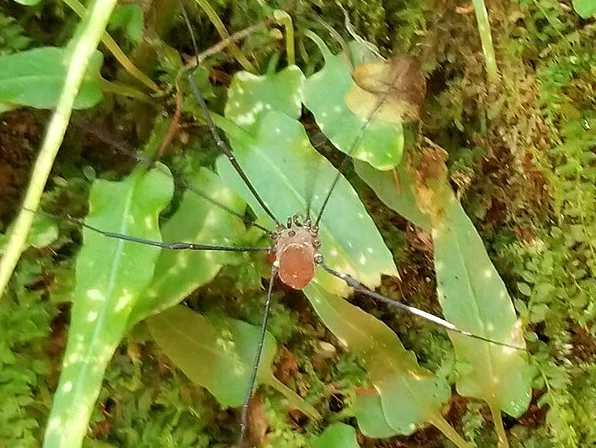
Why harvestmen cluster on houses in fall
Clemson says harvestmen can become a nuisance in fall when they gather in large clusters on trees and homes, usually around eaves and windows, but the clustering lasts only a short time and does not damage the house. Kentucky agrees: they may gather by the dozens around buildings, but they are “not harmful to humans, animals, buildings, or crops.” They rarely come into finished living spaces (Clemson).
Life span: Clemson says harvestmen in the northern US live for only one year, while in the Southeast they can overwinter as adults and live up to two years. Females lay eggs in soil, under stones or in cracks in wood in autumn, and they hatch in spring.
Cellar Spiders: The Daddy Long Legs in the Basement
If your daddy long legs hangs upside down in a messy web in a basement corner, it is a cellar spider. MDC describes them as harmless, fragile spiders with extremely long, thin legs, a gray, tan or whitish color and a habit of “vibrating” or bouncing so fast in the web when disturbed that they become a blur. The Penn State Extension fact sheet calls the longbodied cellar spider the most common cellar spider in the United States and says it is found in buildings all year.
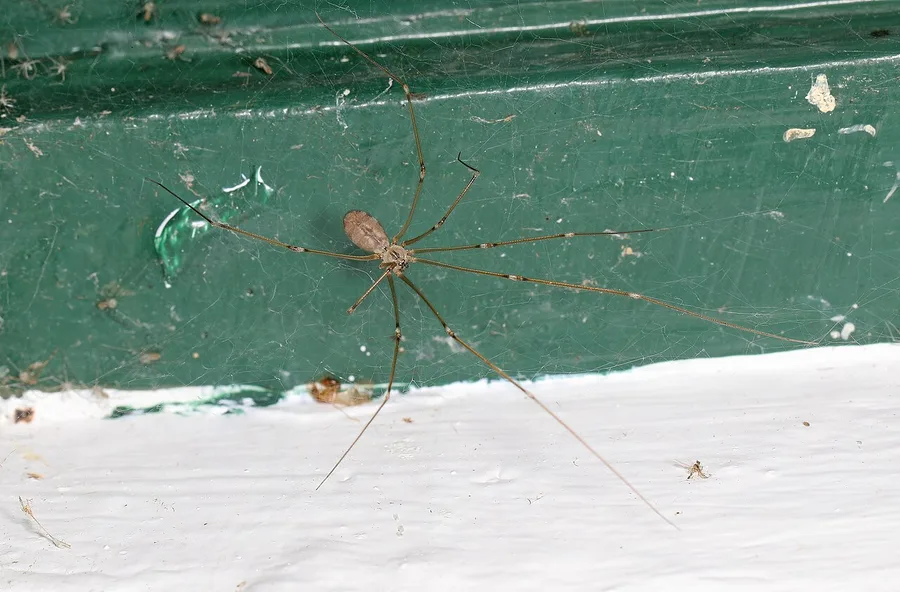
- Size: the female longbodied cellar spider is about 1/4 to 5/16 inch long, with legs extending about another 2 inches; the shortbodied cellar spider has a body about 1/16 inch long (Clemson HGIC).
- Webs: loose, irregular, non-sticky webs that keep growing, because unlike many spiders they do not eat and rebuild old webs (Clemson HGIC). That tangle looks nothing like the wheel-shaped webs in our orb weaver spider guide.
- Eggs: females carry a loose cluster of eggs, wrapped in a thin layer of silk, in their jaws (MDC, Penn State).
- Life span: about a year to mature, then two or more years as adults (Penn State).
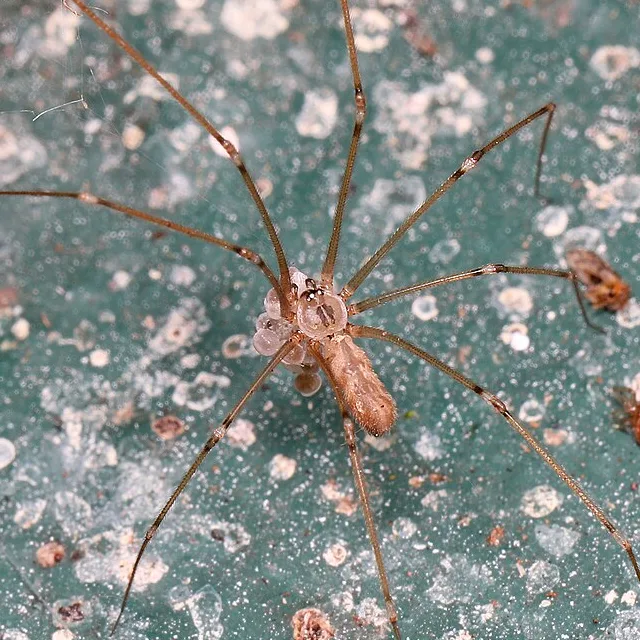
Cellar spiders eat other spiders
Cellar spiders eat small insects such as moths, flies, gnats and mosquitoes (University of Kentucky), and they often take prey much larger than themselves, including wolf spiders and crane flies (MDC). Virginia Tech says they have been found to eat brown recluses and black widows; MDC explains that they throw long swaths of silk over the prey from a safe distance. Some even enter another spider’s web and tap it like a trapped insect, then eat the owner when it comes to check (Kentucky, MDC). That makes them an unlikely ally against the spiders in our brown recluse and black widow guides.
“Because they devour so many other kinds of spiders and insects, many people tolerate their presence in their cellars.”
Which cellar spiders live in US homes
US research-grade iNaturalist records include 32 cellar spider species, but two make up 77% of the 25,177 records:
| Species | Common name | Records | Share |
|---|---|---|---|
| Pholcus phalangioides | Longbodied cellar spider | 13,452 | 53.4% |
| Holocnemus pluchei | Marbled cellar spider | 5,934 | 23.6% |
| Crossopriza lyoni | Tailed cellar spider | 1,891 | 7.5% |
| Pholcus manueli | Manuel’s cellar spider | 1,407 | 5.6% |
| Spermophora senoculata | Shortbodied cellar spider | 416 | 1.7% |
UC Riverside’s spider research site says the marbled cellar spider, Holocnemus pluchei, is very common along the Pacific Coast and has a brown stripe on its underside, which faces up because the spider hangs upside down. For eyes, MDC is careful to say that “many” common cellar spiders, not all, have eight eyes in three groups.
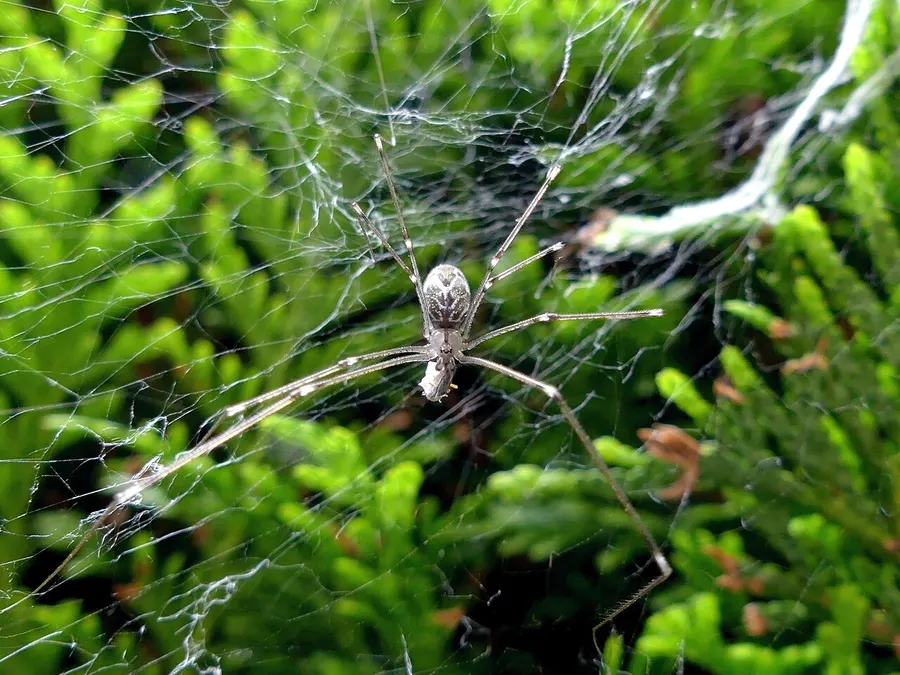
Crane Flies: The Daddy Long Legs With Wings
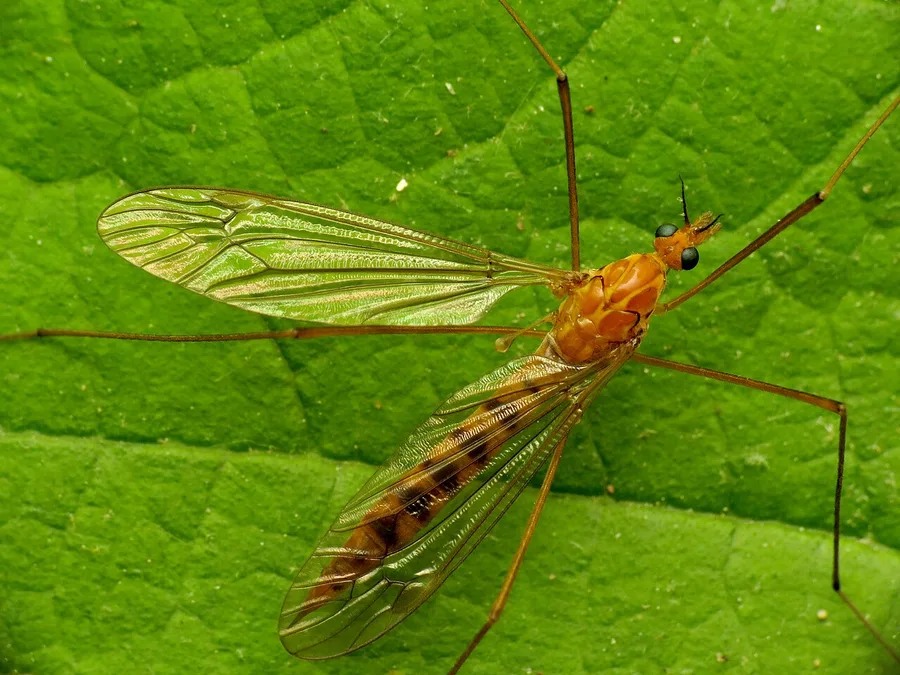
If it flies, it is a crane fly. Crane flies are slender true flies that look like giant mosquitoes, bump into lights and walls, and cannot bite. Our guide to crane flies, the mosquito hawk myth and leatherjackets covers identification, season and lawn damage; the two points that matter here are that a crane fly has wings and six legs, and that crane flies have no venom at all, so the venom legend is plainly false for them (UC Riverside).
When Each One Shows Up: Our Count of US Records
To see which daddy long legs people actually meet through the year, on November 22, 2026, we pulled every US research-grade iNaturalist observation of harvestmen (order Opiliones, 38,435 records), cellar spiders (family Pholcidae, 25,177) and large crane flies (family Tipulidae, 46,798) from the iNaturalist API and grouped them by month observed. Research grade means the record has a photo, date and place and the community agreed on a species identification.
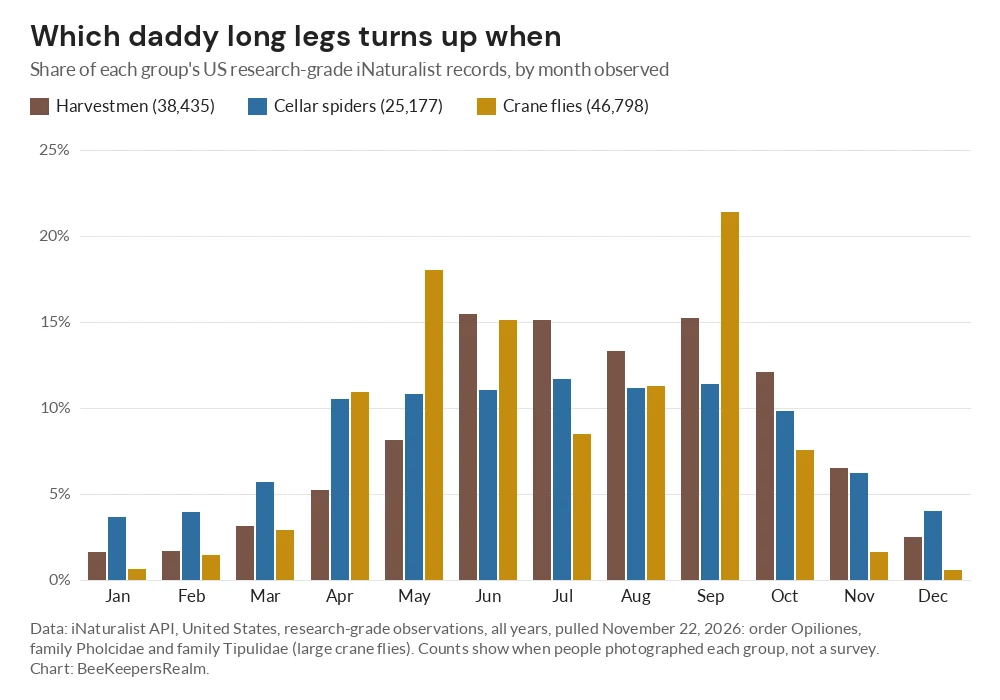
- Harvestmen are a warm-season animal. 71.2% of records fall in June to October, peaking in June (15.5%), September (15.2%) and July (15.1%). December to February holds only 5.8%, and the busiest month has 9.6 times the records of the quietest.
- Cellar spiders barely have a season. Their busiest month (July, 11.7%) has only 3.2 times the records of the quietest, and 11.6% fall in December to February. That fits Penn State’s note that they are found in heated buildings all year.
- In winter, the daddy long legs you find is most likely a cellar spider. In December to February there were 2,927 cellar spider records against 2,231 for harvestmen, even though harvestmen outnumber cellar spiders by about 1.5 to 1 over the whole year.
- Crane flies come in waves, with peaks in September (21.4%) and May (18.0%) and just 2.6% of records in winter.
These counts show when people photographed each animal, so they also reflect when iNaturalist users are outdoors and where they live. Only 19.3% of the 199,236 verifiable US harvestman records reached research grade, against 39.0% of the 64,568 cellar spider records; MDC notes that Missouri’s Leiobunum species are hard to tell apart without a microscope, so many harvestman photos never get a species name.
The “Most Venomous Spider” Myth
The playground story says daddy long legs have the deadliest venom of any spider but fangs too short to bite you. The Burke Museum calls it “a full-fledged Urban Legend,” and it fails for each animal in a different way:
- Harvestmen have no venom glands, fangs or any other means of chemically subduing food (UC Riverside). Ohio State calls the legend “simply not true.” Their defense is a smelly secretion from scent glands (Virginia Tech), which Live Science describes as a poison that works by contact or ingestion, not an injected venom.
- Crane flies are insects with no venom (UC Riverside).
- Cellar spiders are venomous, like nearly all spiders, but MDC says studies show pholcid venom is “comparatively rather mild,” and the Burke Museum reports that a study found it unusually weak in its effect on insects. UC Riverside’s department of entomology describes a 2004 “Mythbusters” test, later documented in a 2019 study, in which arachnologist Charles Kristensen injected mice with cellar spider or black widow venom; the black widow venom had a much more potent effect.
“I’m not aware of any publication showing that pholcid spiders cause a toxic effect in humans”
Where did the story start? Virginia Tech suggests people watched cellar spiders kill highly venomous spiders such as black widows and assumed the killer must be even more venomous, and the idea then spread to everything else called daddy long legs. MDC gives the same explanation.
Can They Bite or Harm People and Pets?
- Harvestmen: MDC says their mouthparts are too small to bite people, and Clemson says they cannot and will not bite you. Kentucky says they are not harmful to humans or animals, and the University of Minnesota Extension calls them harmless to people.
- Cellar spiders: Penn State says they are not known to bite people and are not a medically important species, and Kentucky says they are not known to bite. Live Science, drawing on UC Riverside’s Rick Vetter, says they can bite humans, since their fangs are similar to a brown recluse’s, but Vetter knows of no publication showing a toxic effect.
- Crane flies: cannot bite or sting (see our crane fly guide).
For pets, the only source we found that addresses animals directly is Kentucky’s statement that harvestmen are not harmful to animals; Penn State says the longbodied cellar spider is not known to be harmful in any way. If a pet eats one, none of our sources reports a problem.
Daddy Long Legs in the Garden
For gardeners, harvestmen are worth keeping. Cornell’s guide to biological control lists aphids, caterpillars, leafhoppers, beetle larvae, mites and small slugs among the soft-bodied pests they eat in crops such as corn, potatoes, cabbage and strawberries, and Ohio State shows one feeding on an invasive brown marmorated stink bug. Neither source oversells it: Cornell says Phalangium opilio alone cannot keep any pest under control but is one of a team of general predators that together help keep pest numbers low.
“Harvestmen are beneficial predators in the garden and very common in residential landscapes.”
Ohio State’s advice for keeping them around:
- Give them shelter. Harvestmen dry out easily, so rocks, mulch and logs that shade them from heat and direct sun help.
- Grow flowers through the season. A long run of bloom offers pollen, which may feed harvestmen when prey is scarce.
- Skip broad-spectrum insecticides. Cornell says Phalangium opilio is highly susceptible to at least some broad-spectrum insecticides, while some more targeted products such as Bt appear less harmful.
There is no special bee connection; no source we read links harvestmen to bees or hives. But the garden that suits harvestmen, with flowers, ground cover and few sprays, is also friendlier to bees, and the same products to avoid come up in our guide to pollinator-safe pest control. For the pests themselves, see our aphid guide; harvestmen in turn feed birds, large spiders and assassin bugs (Kentucky).
Daddy Long Legs in the House: What to Do
A harvestman indoors is usually a stray; cup it and put it outside. For fall clusters on siding, Clemson’s daddy longlegs fact sheet says most can be removed with a vacuum or broom, and that chemical control is not necessary in nearly all situations.
For cellar spiders, Clemson HGIC recommends non-chemical steps first:
- Remove webs, egg sacs and spiders with a broom or vacuum, which works quickly and lets you see new activity.
- Cut their food supply by controlling the insects they eat, and lower the humidity with a dehumidifier or better ventilation, which keeps insects out.
- Swap white outdoor lights for yellow or sodium vapor lamps, which draw fewer insects.
- Seal cracks around doors and windows, and add weatherstripping and door sweeps.
Clemson says labeled insecticides only reduce cellar spiders temporarily and should not replace cleaning and maintenance. Many people simply leave a few in the basement as free pest control.
Frequently Asked Questions
Is a daddy long legs a spider or an insect?
It depends which one you mean. Harvestmen are arachnids but not spiders, cellar spiders are true spiders, and crane flies are insects. Count the body parts and check for wings.
Is a daddy long legs harmless?
Yes. Harvestmen have no venom and cannot bite people, cellar spiders are not known to harm people, and crane flies cannot bite or sting.
Is the daddy long legs the most venomous spider in the world?
No. Harvestmen and crane flies have no venom, and cellar spider venom is mild; UC Riverside’s Rick Vetter knows of no publication showing a toxic effect in humans.
Can a daddy long legs bite you?
Harvestmen cannot, according to MDC and Clemson. Cellar spiders are not known to bite people (Penn State), though Live Science says their fangs could; no harm to humans has been published. Crane flies cannot bite.
Should I get rid of daddy long legs in my house?
There is no health reason to. Cellar spiders eat other spiders and insects; if their webs bother you, vacuum them up and reduce humidity and outdoor lighting.
Why are they called daddy long legs?
For their long legs on a small body, says Clemson. “Harvestman” comes from the crowds seen in fall at harvest time.
Why do daddy long legs cluster together?
Harvestmen gather in large clusters on trees and houses in fall, usually around eaves and windows. Clemson says it happens only briefly and causes no damage.
How long do daddy long legs live?
Harvestmen live about a year in the northern US and up to two years in the Southeast (Clemson). Cellar spiders take about a year to mature and can live two or more years as adults (Penn State).
The Bottom Line
Outdoors in summer and fall, your daddy long legs is almost certainly a harmless, web-free harvestman that eats garden pests; in a basement web, especially in winter, it is a cellar spider; if it has wings, it is a crane fly. None needs a spray. More garden visitors are in our garden and household insects guides.
Image credits: Featured image: eastern harvestman (Leiobunum vittatum) in Woodbridge, Virginia, by Judy Gallagher, Wikimedia Commons, CC BY 2.0, cropped and resized. European harvestman: Zygy, CC0. Harvestman eating a fly: Marshal Hedin, CC BY-SA 2.0. Harvestman missing a leg: ONUnicorn, CC BY-SA 4.0. Longbodied cellar spiders: Judy Gallagher, CC BY 2.0. Marbled cellar spider: Florian Pépellin, CC BY-SA 4.0. Tiger crane fly: Katja Schulz, CC BY 2.0. All via Wikimedia Commons and resized; links to each file page and licence are in the captions. Chart: BeeKeepersRealm, from iNaturalist API data pulled November 22, 2026.