Reviewed by Elena P. · How we review
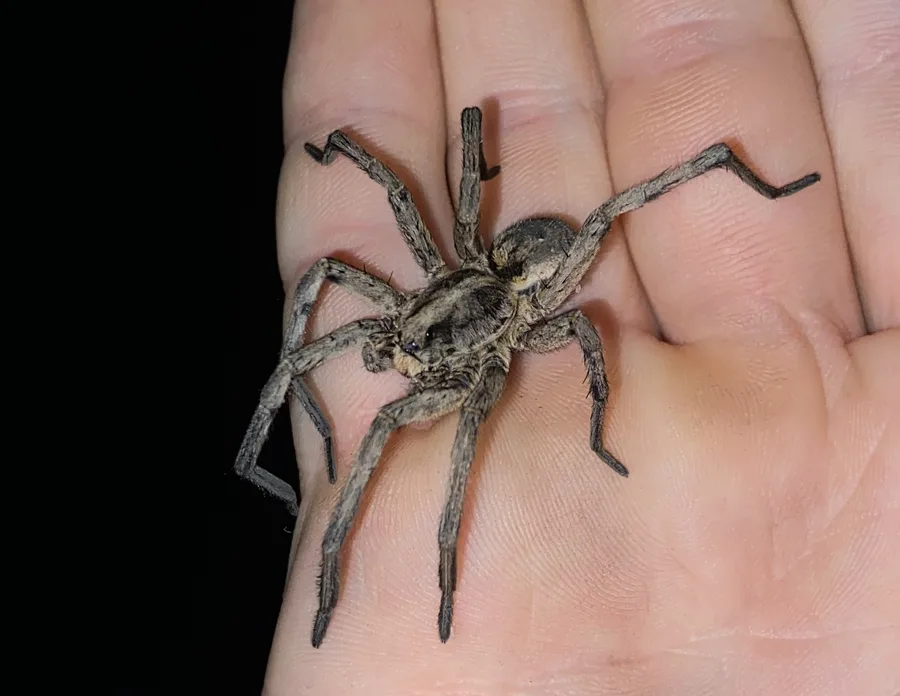
A wolf spider is a hairy, brown or gray ground spider of the family Lycosidae that hunts by running prey down instead of trapping it in a web. It is told apart by its eyes: eight, in three rows, with two large ones in the middle. Wolf spiders are not dangerous to people, and a bite is rare and usually mild. Most are found outdoors at night, and the ones that wander indoors are mainly adult males in search of a mate.
Below: how to identify one, how it differs from a brown recluse, which species Americans photograph (from 110,240 iNaturalist records we counted), why they come inside, and how to keep them out without spraying.
Key Takeaways
- Spiders are arachnids, not insects. A wolf spider has eight legs, and no antennae or wings (our are bees insects guide has the comparison).
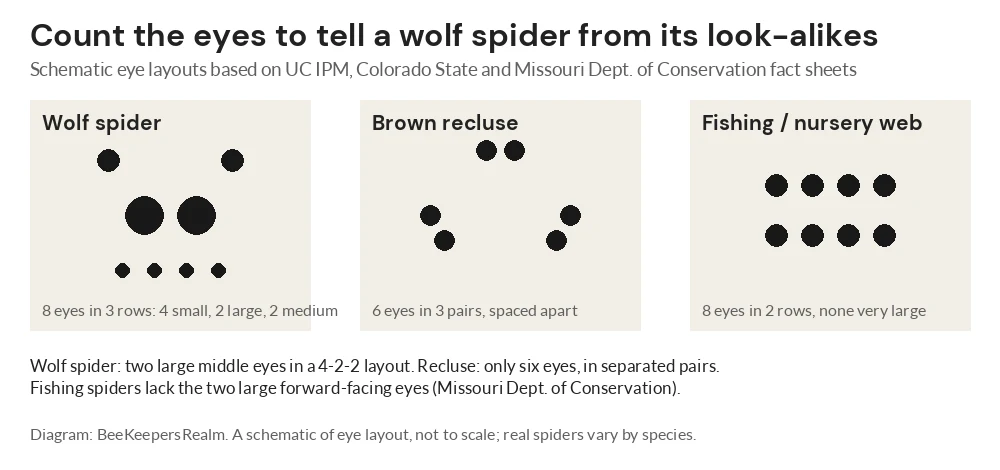
- Eyes settle it: a wolf spider has eight in three rows (four small, two large, two medium); a brown recluse has six, in three pairs (UC IPM; Colorado State Extension).
- Penn State Extension says wolf spiders bite only if mishandled or trapped against the skin, with pain and redness that usually fade within 24 hours.
- In our iNaturalist count, 89.3% of US wolf spider records fall between March and October, and the rabid wolf spider (22.4%) is the most recorded species.
- UC IPM says insecticides give no long-term control of spiders outdoors; sealing gaps and vacuuming work and spare bees.
Table of Contents
- What a Wolf Spider Is
- How to Identify a Wolf Spider
- Wolf Spider vs Brown Recluse and Other Look-Alikes
- Which Wolf Spiders Live Where in the US
- How Wolf Spiders Hunt, Breed and Raise Young
- Why Wolf Spiders Come Indoors and When
- Wolf Spider Bites: What to Expect
- Keeping Wolf Spiders Out Without Spraying
- Frequently Asked Questions
What a Wolf Spider Is
Wolf spiders (family Lycosidae) are active hunters. Penn State Extension counts roughly 240 species in 21 genera in the United States, and the Missouri Department of Conservation lists nearly 250 north of Mexico; Cleveland Clinic puts the worldwide total above 2,400. The name comes from chasing prey rather than waiting in a web, though unlike wolves they hunt alone (Live Science).
They are not insects. Wolf spiders are arachnids, relatives of chiggers, ticks and scorpions, and the Missouri Department of Conservation says they eat many insect pests.
How to Identify a Wolf Spider
- Eyes: UC IPM describes four small eyes in a straight row at the front, a middle pair of larger eyes, and a rear pair set wide apart on top of the head.
- Size: body length about 1/4 to 1 inch without legs (Missouri Department of Conservation); Carolina wolf spider females measure 22 to 35 mm (Penn State).
- Color and build: robust, hairy, gray, brown, black or tan, often striped (Missouri Department of Conservation, Virginia Cooperative Extension).
- No capture web: only a small, thick web where they rest (UC IPM).
- Eyeshine: a flashlight held beside your head at night makes their eyes reflect green (UC IPM), like a cat’s.
Wolf Spider vs Brown Recluse and Other Look-Alikes
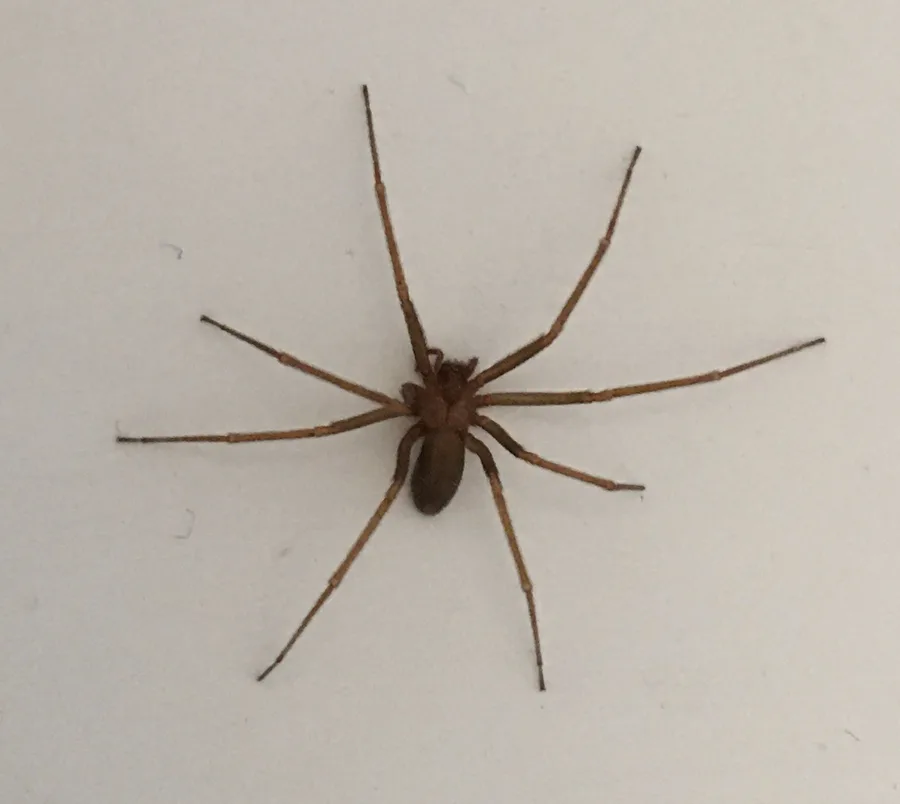
Many large brown spiders get called wolf spiders, and many wolf spiders get called brown recluses. (In the table, “Missouri” is the Missouri Department of Conservation and “Virginia Extension” is Virginia Cooperative Extension.) Colorado State Extension calls recluses by far the most commonly misidentified spiders in that state and points to the eyes as the reliable test:
“The quickest way to positively identify if a spider might be a recluse spider is to examine the arrangement of the eyes.”
Colorado State adds that the dark stripes on wolf spiders are sometimes mistaken for the recluse’s violin mark, and that a recluse has three pairs of eyes where most spiders have four. The brown recluse is a real medical concern: Colorado State says most recluse venom can cause tissue death, and the species lives mainly in central and south-central states.
| Spider | Telltale sign | Where and how it lives | Source |
|---|---|---|---|
| Wolf spider | 8 eyes in 3 rows (4 small, 2 large, 2 medium); egg sac on the spinnerets, spiderlings on her back | Ground, leaf litter and burrows; runs down prey; no capture web | UC IPM, Missouri |
| Brown recluse | 6 eyes in 3 pairs; violin-shaped mark on the head | In and around homes in central and south-central states | Colorado State |
| Fishing spider (Dolomedes) | All 8 eyes about the same size; egg sac carried in the jaws | Near water and in moist woods; up to 3 inches; swims and walks on water | Virginia Extension, Missouri |
| Nursery web spider | All 8 eyes about the same size; sac carried in the jaws, then hung in a silk tent | Foliage, tall grass and gardens; sometimes wanders into houses | Virginia Extension, Missouri |
| Grass spider | Two long spinnerets easily seen from above | Flat sheet web with a funnel hole, which no wolf spider builds | Missouri |
Which Wolf Spiders Live Where in the US
“Wolf spider” covers a lot of species. To see which ones Americans actually meet, we pulled every research-grade US observation of the family Lycosidae from the iNaturalist API (“research grade” means at least two people agreed on the identification). That gave 110,240 records covering 142 species.
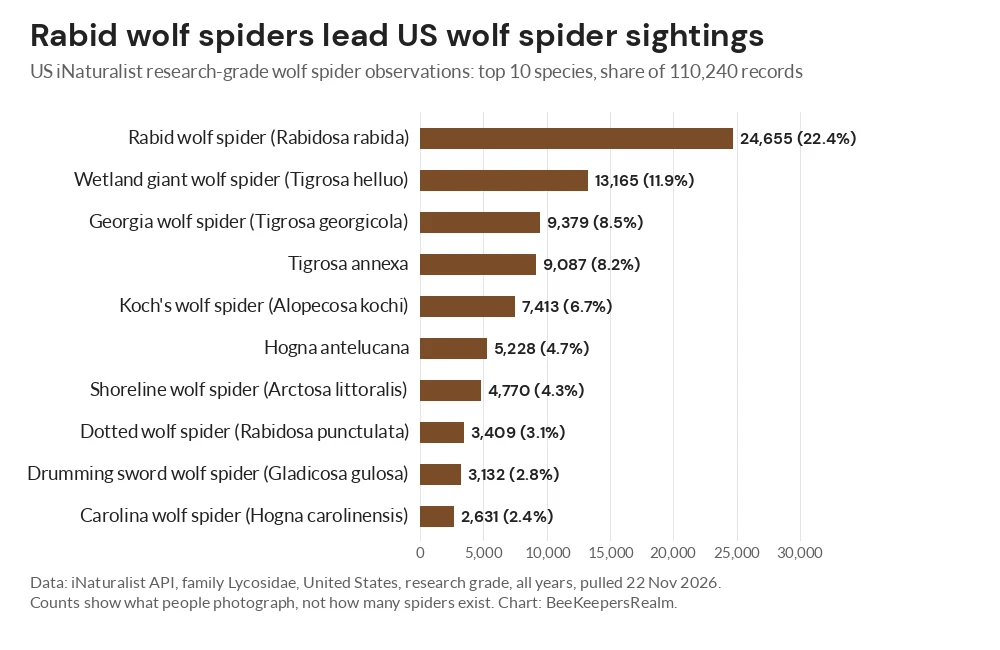
The rabid wolf spider (Rabidosa rabida) leads with 24,655 records (22.4%); the Missouri Department of Conservation points out that it is “absolutely not rabid.” The Carolina wolf spider, South Carolina’s state spider under Section 1-1-701 of the state code, is only tenth with 2,631 (2.4%). The top species change by state:
| State | Records | Most-recorded species (records) |
|---|---|---|
| Texas | 27,536 | Rabid wolf spider 11,045; Hogna antelucana 4,052; Tigrosa annexa 2,453 |
| California | 9,692 | Koch’s wolf spider 6,638; McCook’s split wolf spider 1,037; shoreline wolf spider 621 |
| Virginia | 5,611 | Georgia wolf spider 1,270; rabid wolf spider 1,199; Tigrosa annexa 813 |
| North Carolina | 5,225 | Rabid wolf spider 1,533; Tigrosa annexa 1,144; Georgia wolf spider 906 |
| Ohio | 4,999 | Wetland giant wolf spider 2,229; rabid wolf spider 625; shore spider 396 |
Texas alone holds 25% of the US records, and Koch’s wolf spider makes up 68.5% of California’s. Records reflect where iNaturalist users look, so treat them as a guide to which species are common, not a census.
How Wolf Spiders Hunt, Breed and Raise Young
For the two big species it covers, Penn State Extension says wolf spiders build retreats in soil, under boards, stones and firewood, and come out only at night to hunt. UC IPM says wolf spiders are active day and night, and the Missouri Department of Conservation adds that some dig burrows and some have no home. Their prey is ground insects and other spiders, and wasps hunt spiders too: mud daubers pack their nests with paralyzed ones (see our mud dauber guide).
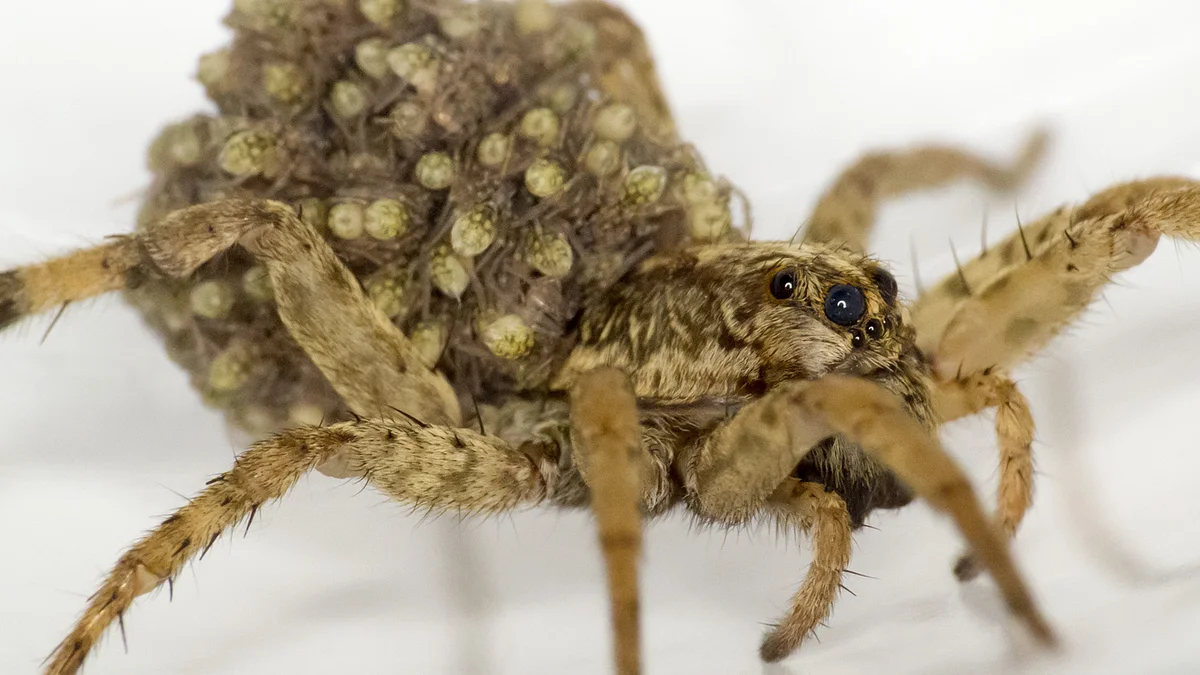
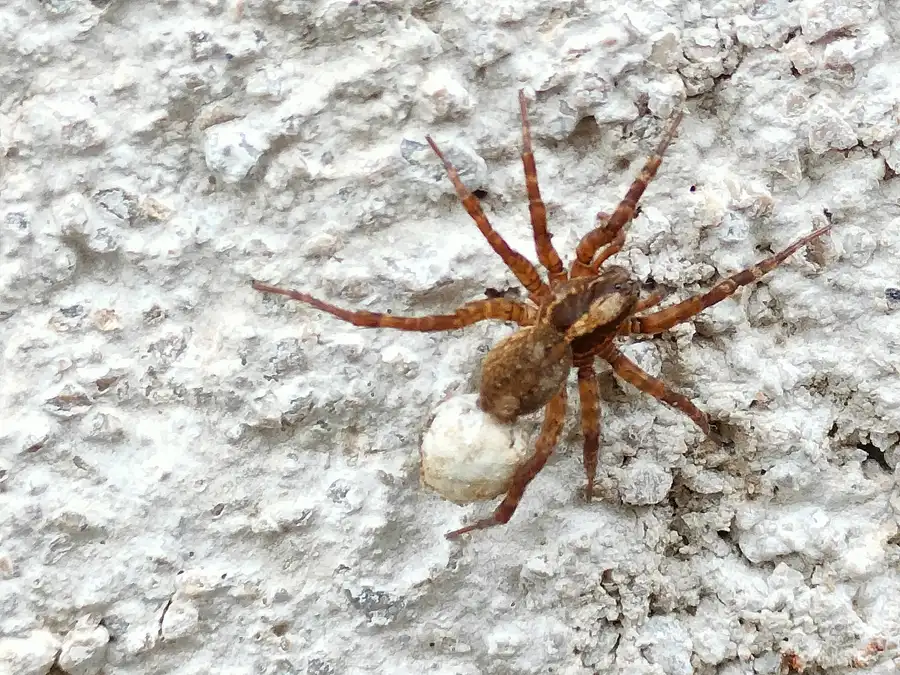
The life cycle is unusual. For those same two species, Penn State describes mating in autumn, with males dying before winter. Fertilized females overwinter in protected spots, including buildings, make egg sacs the following May or June, and the spiderlings hatch in June and July. The mother keeps the pea-sized sac attached to her spinnerets and, per the Missouri Department of Conservation, searches “frantically” if separated from it. The spiderlings then climb onto her abdomen and stay up to two weeks or more.
Why Wolf Spiders Come Indoors and When
Wolf spiders do not colonize houses; they wander in. UC IPM lists the usual reasons: adult males searching for females, burrow-living spiders flooded out in wet weather, new developments that destroyed their habitat, and buildings with plenty of insects to eat. Virginia Cooperative Extension says they are common indoors in fall, when they look for a warm winter spot near doors, windows, basements and garages.
Our iNaturalist count by month shows when people photograph wolf spiders, mostly outdoors.
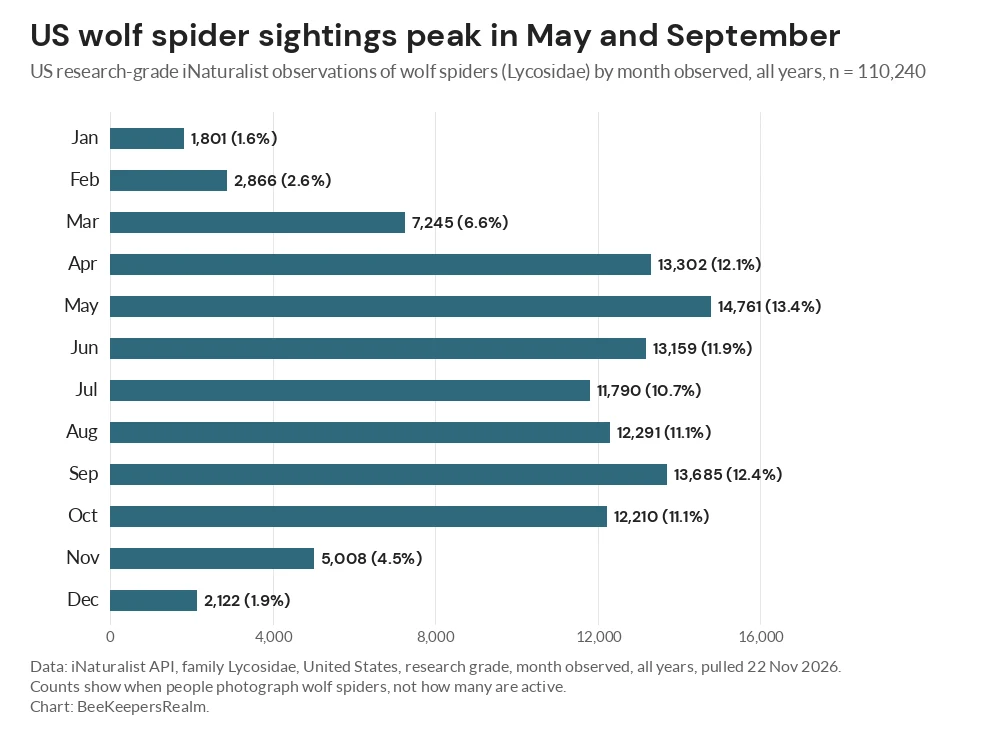
May is the peak (14,761 records, 13.4%), with a second high in September (13,685, 12.4%); March to October holds 89.3% of records, and December and January only 3.6%. These counts show when people photograph wolf spiders, not how many are active.
Wolf Spider Bites: What to Expect
This is educational information, not medical advice; call Poison Control at 1-800-222-1222 or a doctor for anything severe.
“Wolf spiders will bite if mishandled or trapped next to the skin.”
Penn State says typical reactions are pain, redness and some local swelling that generally subside within 24 hours, with no serious medical consequences noted. Virginia Cooperative Extension says wolf spiders are not considered medically important. Cleveland Clinic advises washing with soap and water, applying a cold pack, and using an antihistamine or over-the-counter pain reliever, and seeing a provider if symptoms persist or worsen. It lists a red line from the bite, hives, facial swelling and trouble breathing as signs of an allergic reaction. If you are not sure it was a wolf spider, the brown recluse is the one to rule out.
Keeping Wolf Spiders Out Without Spraying
Because wolf spiders wander rather than infest, exclusion works better than pesticides. UC IPM and the National Pesticide Information Center recommend:
- Seal cracks in the foundation and gaps around doors and windows, and keep screens in good repair.
- Clear leaf litter, trash and dense vegetation from the foundation, and trim plants back from the house.
- Keep outdoor lights off the structure and away from doors, because light attracts the insects spiders eat.
- Keep boxes off the floor and taped shut, and declutter basements and garages.
- Vacuum often, including egg sacs and webs; UC IPM says soft bodies rarely survive the hose.
- Catch single spiders under a jar with paper and release them outdoors, or use sticky traps where pets and children cannot reach them.
“Insecticides will not provide long-term control and should not generally be used against spiders outdoors.”
The retail sprays that UC IPM lists for spiders are pyrethrins and pyrethroids. Our guide to pollinator-safe pest control explains that these broad-spectrum products cannot tell a pest from a beneficial insect, so a perimeter spray around a garden risks bees and other pollinators for a result UC IPM says is only temporary. Virginia Cooperative Extension also advises against a general spray unless an infestation seems severe. UC IPM adds that buildings with more insects are more likely to hold spiders, so fixing damp spots that draw silverfish and house centipedes removes prey too. Beekeepers can read when to leave spiders alone in our guide to common bee pests and predators. More guides are in our garden and household insects section.
A brown recluse has six eyes in three pairs and a plain body; our brown recluse spider guide shows how to rule one out and where verified US records come from.
If a big hairy spider in the Southwest or Great Plains looks far heavier than a wolf spider, our guide to US tarantulas covers the 29 species and where they live.
If the spider is shiny black with a round abdomen rather than hairy and brown, see our black widow spider guide for the hourglass and other field marks.
Orb weavers take the opposite approach to wolf spiders, sitting in a wheel-shaped web and waiting for prey, as our orb weaver spider guide explains.
In the West, the hobo spider is a funnel weaver often mistaken for a wolf spider; our hobo spider guide shows how to tell them apart.
Ticks are arachnid relatives of wolf spiders that do bite and can spread disease; see our tick identification guide.
Cellar spiders sometimes catch prey as large as wolf spiders, as our daddy long legs guide explains.
Frequently Asked Questions
Are wolf spiders dangerous?
Not to people. They are venomous, like most spiders, and bite only if trapped or mishandled, but Penn State Extension and Virginia Cooperative Extension report no serious medical consequences, and the Missouri Department of Conservation calls North American wolf spider bites harmless.
How can you tell a wolf spider from a brown recluse?
Count the eyes: a wolf spider has eight in three rows, a recluse six in three pairs, and a recluse also has a violin mark on its head. Colorado State says wolf spiders are hairy, with abdomens longer than wide.
Why do wolf spiders carry babies on their backs?
After the egg sac hatches, the spiderlings climb onto the mother’s abdomen and ride there for up to two weeks or more while she keeps hunting.
Do wolf spiders make webs?
Not to catch prey. They only spin a small, thick web where they rest (UC IPM).
Why do wolf spiders’ eyes glow at night?
Their eyes reflect light; a flashlight held beside your head makes them shine green (UC IPM).
Are wolf spiders good to have around?
Outdoors, yes: the Missouri Department of Conservation says they eat many insect pests.
How do I get rid of wolf spiders?
Seal entry points, remove clutter and harborage, turn outdoor lights away from doors, vacuum or release spiders you find, and skip broad-spectrum sprays.
The Bottom Line
A wolf spider is a nocturnal ground hunter that eats pests and is nothing to fear. Check the eyes if you are unsure, seal the gaps it would use to get in, and let the ones in the yard hunt.
Image credits: featured photo of a wolf spider mother with spiderlings by Ralph Arvesen, via Wikimedia Commons, CC BY 2.0, cropped. Other photos are credited in their captions. Charts and the eye diagram: BeeKeepersRealm, from iNaturalist API data pulled November 22, 2026.