Reviewed by Elena P. · How we review
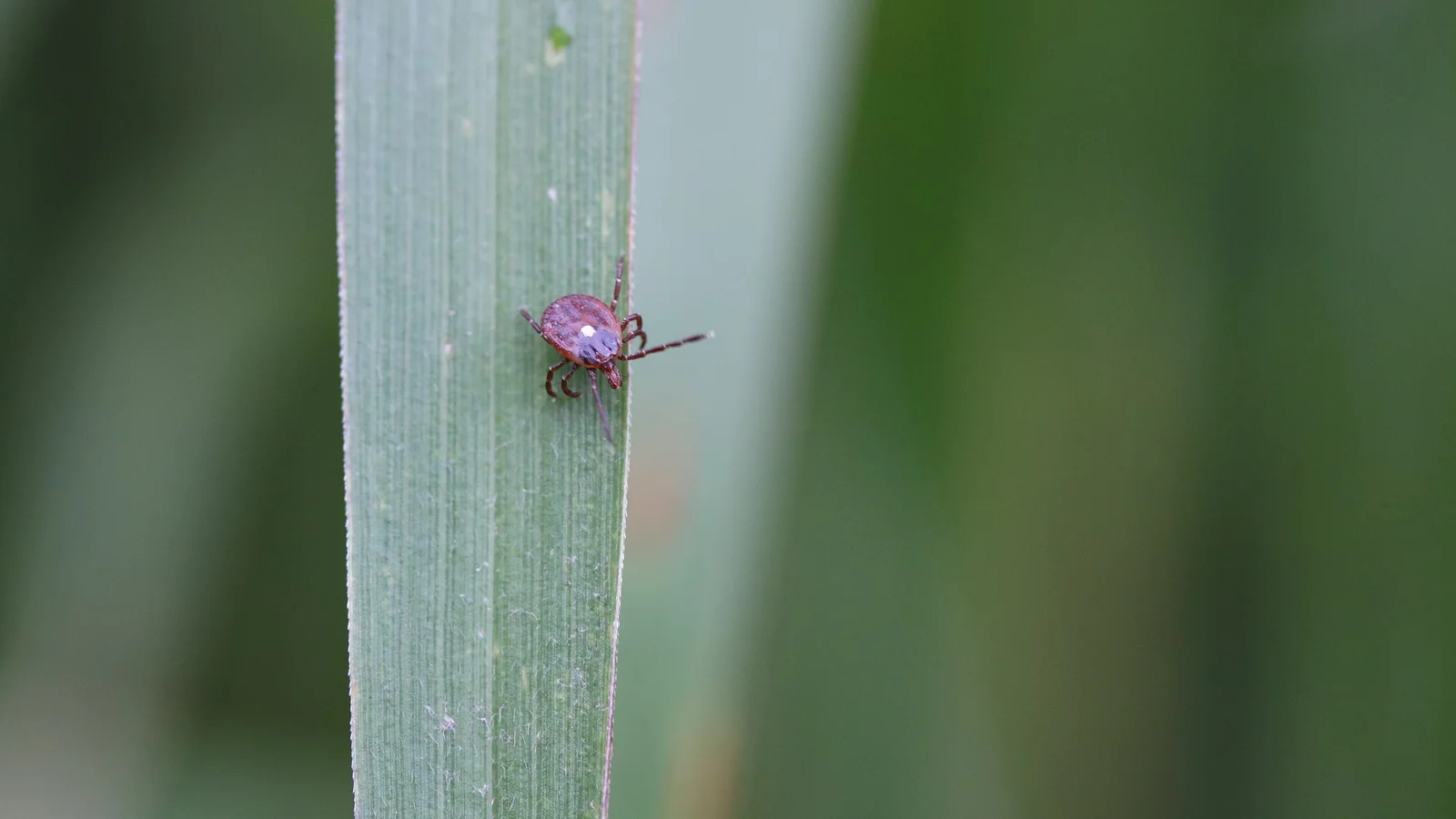
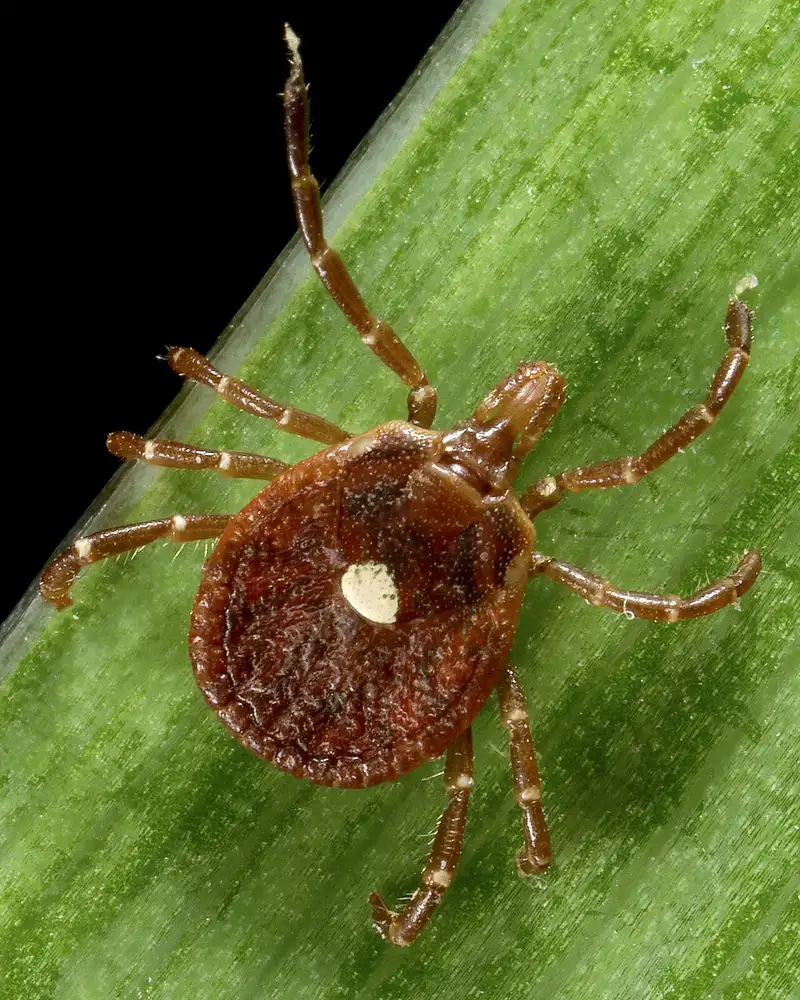
The lone star tick (Amblyomma americanum) is a fast-moving, aggressive hard tick of the eastern and central United States. The adult female carries a single white spot on her back; males have faint white marks around the edge instead. Its bite can spread ehrlichiosis, tularemia and Heartland virus, probably Bourbon virus too, and it is the tick most linked to alpha-gal syndrome, a red meat allergy. It does not spread Lyme disease. Nymphs and adult females bite people most often, according to the CDC, and researchers have reported the tick farther north and west in recent decades.
This guide covers identification by stage and sex, range, season, diseases and what the CDC says to do, plus our own count of 12,347 US research-grade iNaturalist records. Health statements come from the CDC, its MMWR reports and state health departments, each named where used. We make no claim of personal field experience. This is educational information, not medical advice; if you feel ill after a tick bite or react to red meat, see a healthcare provider.
Key Takeaways
- Only the adult female has the single white “lone star.” Adult males have white streaks or spots around the rear edge, and nymphs and larvae have no spot at all.
- All three active stages bite people. Larvae, often called seed ticks, can climb onto a person by the hundreds at once.
- The CDC lists ehrlichiosis, tularemia, Heartland virus, Bourbon virus and STARI with this tick. A 30-year review found it is not a vector of the Lyme disease bacterium.
- Alpha-gal syndrome can follow a bite. Symptoms usually start 2 to 6 hours after eating red meat or dairy, the CDC says, and diagnosis needs a clinician and a blood test.
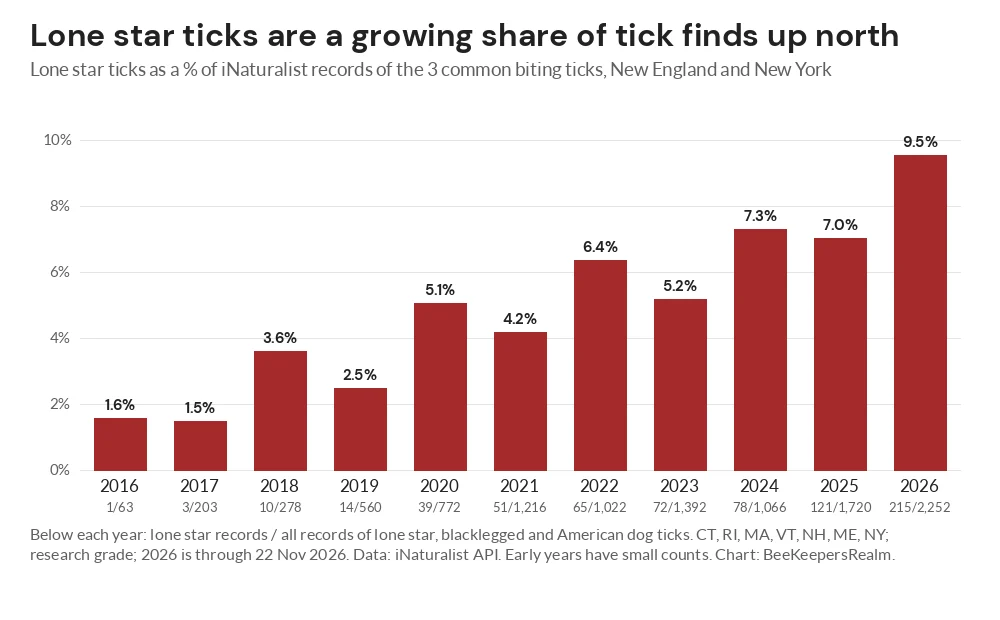
- In our iNaturalist count, 78.1% of US records fall in April, May and June. In New England and New York, lone star ticks rose from 2.6% of records of the three common biting ticks in 2016 to 2018 to 9.5% in 2026.
Table of Contents
- What the Lone Star Tick Is
- How to Identify a Lone Star Tick by Sex and Life Stage
- Where Lone Star Ticks Live and How Far North They Have Spread
- When Lone Star Ticks Are Active
- Diseases Linked to the Lone Star Tick
- Alpha-Gal Syndrome: The Red Meat Allergy
- What to Do After a Lone Star Tick Bite
- How to Prevent Lone Star Tick Bites
- Frequently Asked Questions
What the Lone Star Tick Is
The lone star tick is a hard tick in the family Ixodidae. Ticks are arachnids, closer to spiders and mites than to insects; our page on why a bee is an insect and a spider is not explains the split. The University of Rhode Island’s TickEncounter Resource Center notes that it was the first North American tick species to be formally described, with reports going back to the late 1700s.
It behaves differently from the ticks many northerners know. A 2018 review in the International Journal of Environmental Research and Public Health calls it a “hunter tick” that will crawl rapidly across many meters toward host odors, rather than waiting on a grass tip. The CDC also describes it as very aggressive toward people. Penn State Extension says all life stages are aggressive biters of people and pets, and that larvae and nymphs prefer medium and large mammals such as deer and foxes and ground-nesting birds such as turkeys.
The Indiana Department of Health says the life cycle runs through four stages, egg, larva, nymph and adult, and usually takes two years. Each active stage needs one blood meal before it can move on, the University of Kentucky adds. A fed female can lay 2,500 to 3,000 eggs, according to URI.
How to Identify a Lone Star Tick by Sex and Life Stage
The first question is whether the tick has the white dot, and only one of the four forms you might find on you has it.
Video: in this two-minute Penn State Extension “Know Your Vector” clip, Michael Skvarla, an assistant research professor of arthropod identification, explains how the tick has moved north into Pennsylvania over the last 10 to 20 years, when each stage is active and how to recognize the spotted female and the marked or all-red male (summary from Penn State’s transcript).
Adult female: one white spot
Ohio State University’s tick fact sheet, written with the Ohio Department of Health, gives the unfed adult female as about 3/16 inch long and brown, with a distinctive silvery spot on the upper surface of the scutum, the hard shield behind the head. The spot sits at the tip of that shield. Penn State adds that the female’s legs, mouthparts and body are dark red, and says no other tick in the Northeast has this color pattern. Once she has fed, the female swells to an almost round body about 7/16 inch long.
Adult male: white marks around the edge
Males are about the same size, roughly 3/16 inch, and brown, with whitish markings along the rear edge, according to Ohio State. URI describes them as “spots or streaks of white pigment around the outer edge of the body.” Penn State warns that some males can be entirely red, so the absence of marks does not rule one out. Ohio State notes that males, unlike females, do not grow much when they feed.
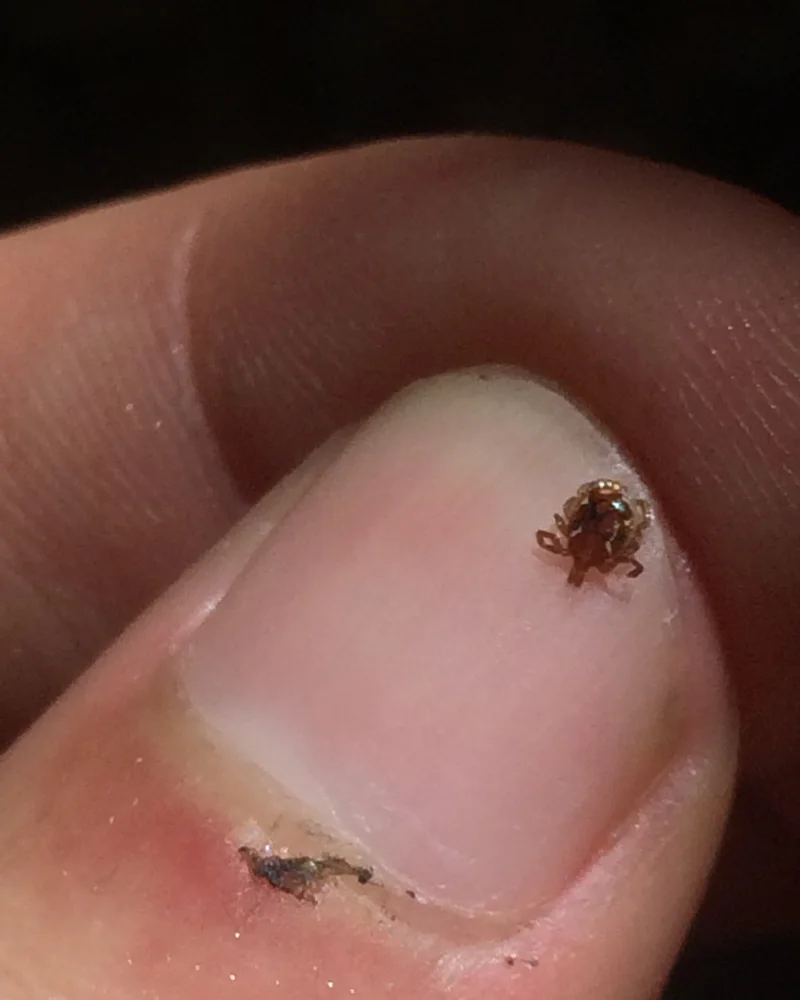
In our iNaturalist count, 5,063 US research-grade records carry a “female” annotation and 1,054 a “male” one, so 82.8% of sexed records are females. That fits the CDC’s note that nymphs and adult females are the stages that most often bite people, though the white spot also makes females easier to recognize and tag.
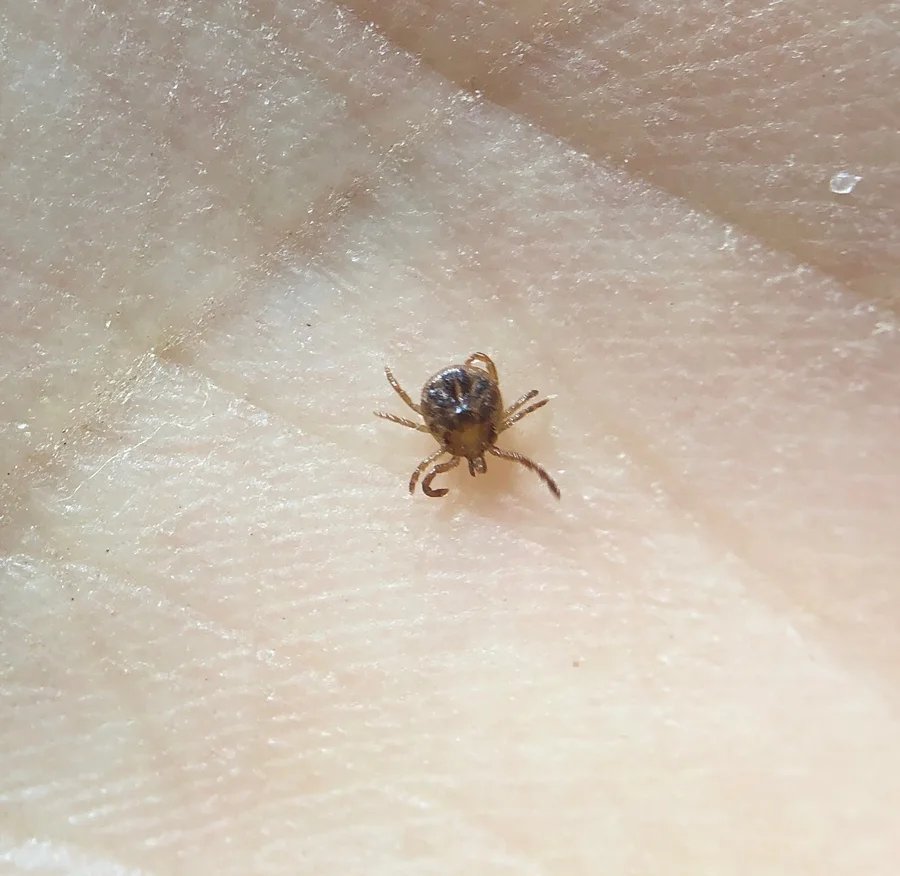
Nymphs: eight legs, no spot
Nymphs have eight legs like adults but no white spot and no male markings; URI’s TickEncounter says the shield of a lone star nymph “is always plain.” A fed nymph can show a white spot on its underside, which confuses many people. URI explains that this is not the lone star mark but guanine crystals collecting in the tick’s rectal sac as it digests blood. Ohio State says immature ticks are entirely tan or brown and hard to identify to species, so a clear photo from above, or a trained identifier, helps. URI says nymphs usually latch on from shoe to shin level but crawl fast, so by the time you notice one it may be at your waist.
Larvae: the “seed ticks”
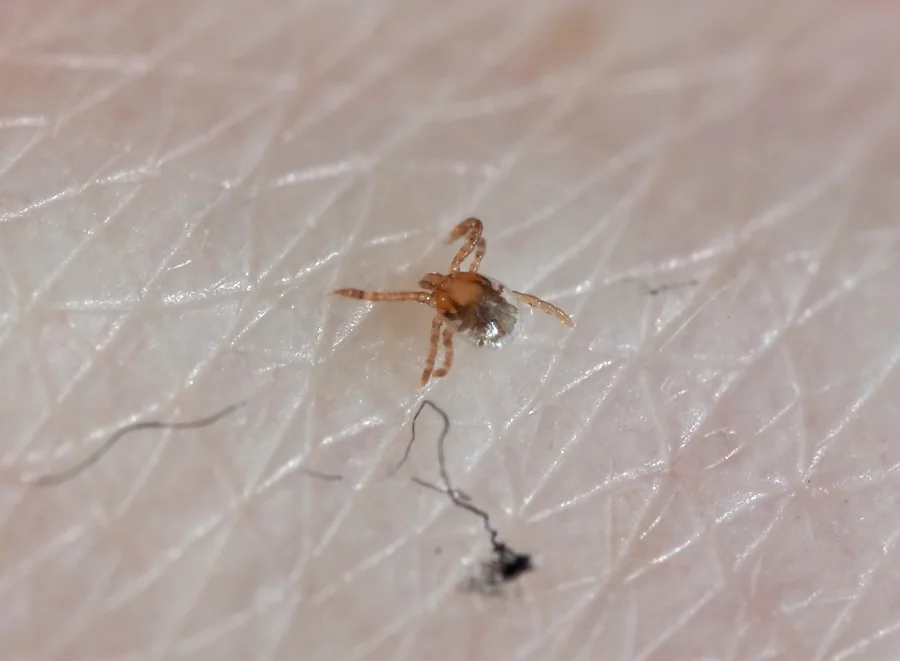
Larvae are the smallest stage and have six legs. They hatch in large batches and wait together on vegetation, and the University of Wisconsin-Madison’s tick lab says it is not uncommon for a person to pick up 20 to several hundred seed ticks at a time. Ohio State and URI suggest the sticky side of masking or duct tape to lift them off skin and clothing before they attach. The University of Kentucky says they are also called “turkey mites” and shows a partly fed one on the head of a pin.
Lone star tick life stages compared
| Stage | Legs | Size (unfed) | Markings | Main season | Bites people? |
|---|---|---|---|---|---|
| Larva (“seed tick”) | 6 | About the size of a pinhead | None | Late summer; abundant in August and September (UK Entomology) | Yes, often dozens or hundreds at once |
| Nymph | 8 | Between larva and adult | None; plain tan to brown shield | Spring (UK Entomology) through fall (Penn State) | Yes; a main biter and disease carrier (CDC) |
| Adult male | 8 | About 3/16 inch | White streaks or spots along the rear edge; some all red | April to late August (URI) | Yes, less often than females |
| Adult female | 8 | About 3/16 inch; about 7/16 inch when fed | One white or silvery spot at the tip of the shield | April to late August (URI) | Yes; a main biter and disease carrier (CDC) |
Sources: Ohio State University and Ohio Department of Health fact sheet HYG-2073; URI TickEncounter; University of Kentucky ENTFACT-648; CDC “Where Ticks Live.” The sources give no inch figures for larvae and nymphs; the pinhead comparison comes from the University of Kentucky’s photo.
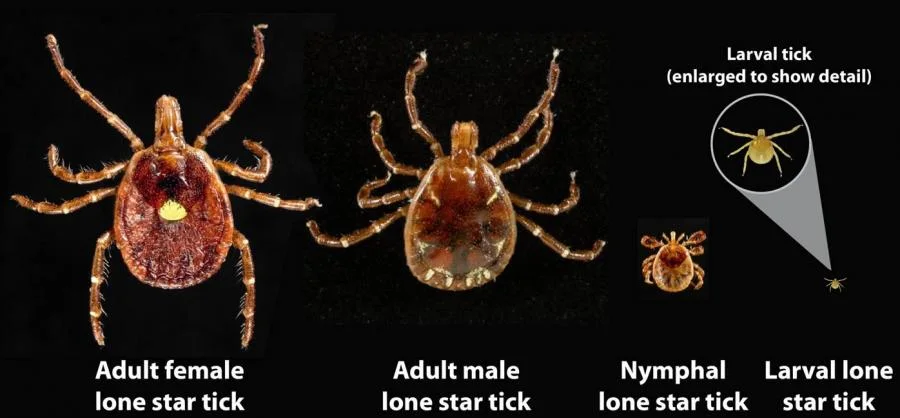
If the tick on you has no white anywhere, it may be another species. Our chiggers guide covers the far smaller red mites that cause itchy welts after time in grass.
To compare it with the blacklegged tick, the American dog tick and the other US ticks that bite people, see our tick identification guide.
Where Lone Star Ticks Live and How Far North They Have Spread
The CDC’s tick range page says the lone star tick is widely distributed in the Northeast, South and Midwest. Its surveillance page (May 26, 2026) maps counties with established populations through 2025, defined as six or more ticks of one life stage, or more than one life stage, collected in a county within 12 months.
The same page says the tick ranged across the eastern US in the 1750s, retreated as forests were cleared and white-tailed deer declined, and has been repopulating its historical range since deer recovered from the 1940s. It also cautions that many counties turning “established” are simply being sampled for the first time.
Researchers do report real expansion. URI cites a 2014 study that found lone star ticks as far west as Colorado and Wyoming and as far north as Maine, and the 2018 review says populations have been reported as far west as Nebraska and South Dakota. The University of Wisconsin-Madison says the tick is not yet established in Wisconsin; most likely a few arrive on migrating birds each year and survive the summer but not the winter.
Habitat matters too. Penn State Extension notes that lone star and American dog ticks favor open places with tall grass, such as pastures, while the blacklegged tick prefers forest leaf litter.
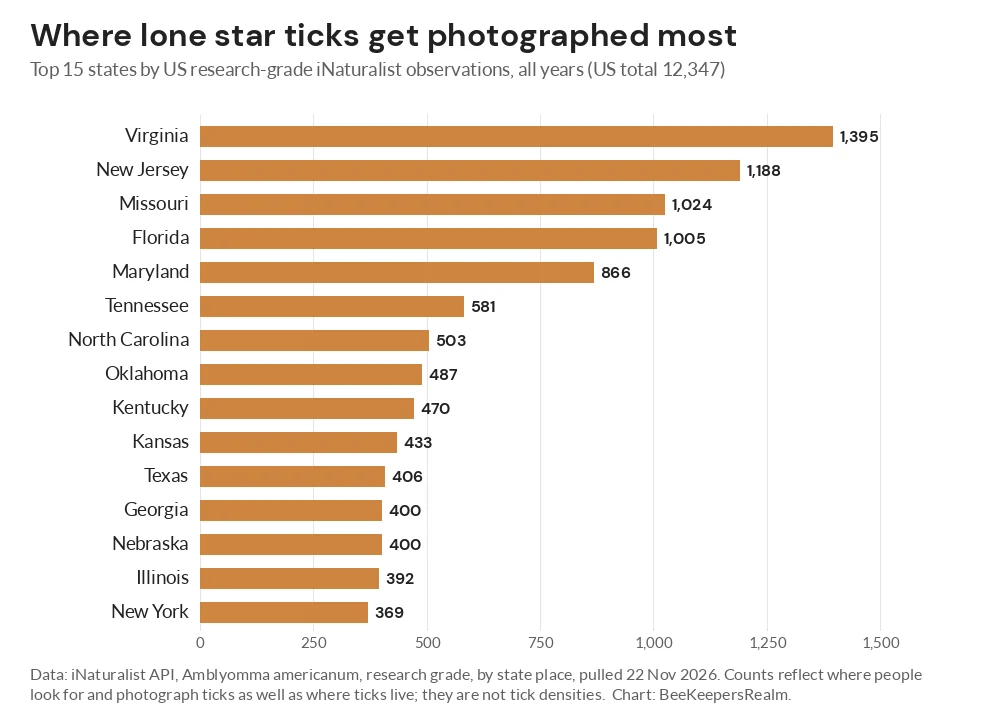
Our state count follows that map. Virginia (1,395 records), New Jersey (1,188), Missouri (1,024), Florida (1,005) and Maryland (866) lead the US. Sixteen states, mostly in the West, have three or fewer research-grade records, and seven have none at all.
What our iNaturalist data shows about the northward spread
Raw counts rise everywhere because more people use iNaturalist each year, so we compared lone star ticks with the two other common human-biting ticks in the same places and years: the blacklegged tick and the American dog tick. In New England and New York, lone star ticks made up 14 of 544 research-grade records of the three species from 2016 to 2018 (2.6%). In 2025 they were 121 of 1,720 (7.0%), and in 2026, through November 22, 215 of 2,252 (9.5%).
| State | US research-grade records, all years | Earliest research-grade record |
|---|---|---|
| Massachusetts | 212 | May 2014, Groton |
| New York | 369 | August 2016, Staten Island |
| Wisconsin | 20 | July 2018, Shorewood |
| Rhode Island | 43 | March 2020, Warwick |
| Connecticut | 37 | April 2020, Stratford |
| Michigan | 23 | May 2020, Lincoln Charter Township |
| Minnesota | 16 | June 2020, Cannon Falls |
| New Hampshire | 2 | July 2023, Star Island, Rye |
| Maine | 5 | May 2024, Camden |
| Vermont | 3 | July 2025, Peru |
Source: iNaturalist API, Amblyomma americanum, research grade, by state, pulled November 22, 2026. The earliest iNaturalist record is not the first time the tick reached a state, and one record does not mean an established population.
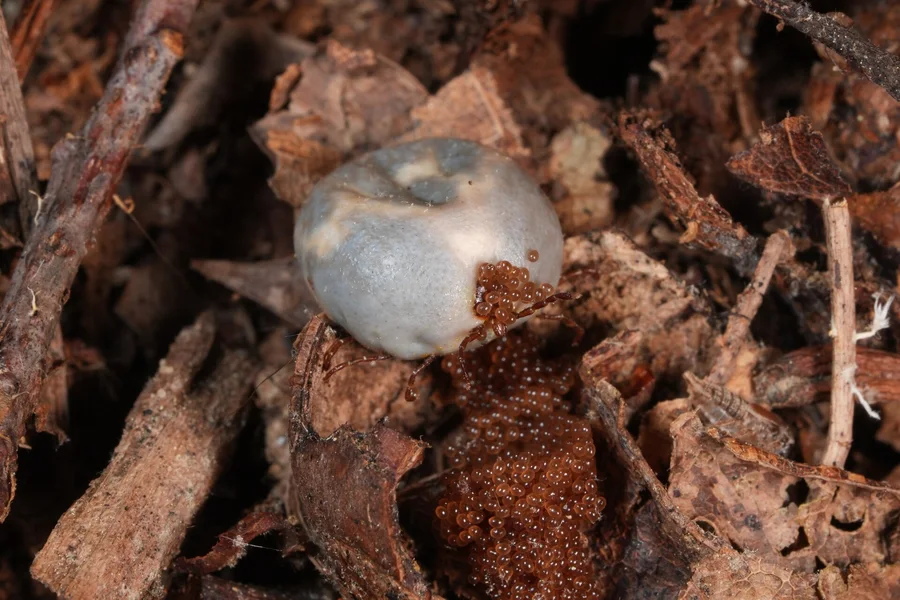
This is not a tick survey, only where people photographed ticks and had them confirmed, but a rising share against two ticks people photograph just as readily points the same way as the research. In June 2026, one observer in Heckscher Park, New York, photographed a fed female with her eggs.
When Lone Star Ticks Are Active
Spring and early summer are the high-risk months. The University of Kentucky says lone star ticks are active from March through September, with nymphs and adults in spring and larvae most abundant in August and September. URI gives adults from April to late August.
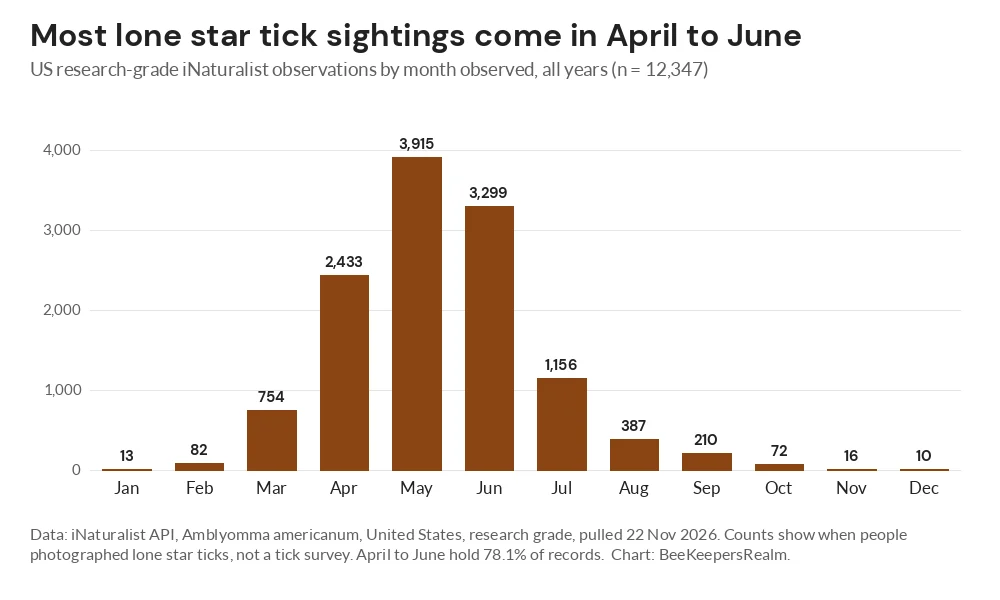
Our count agrees. Of 12,347 US research-grade iNaturalist records, May alone holds 3,915 (31.7%), and April through June hold 78.1%. Records tagged as adults almost vanish after July: only 1.2% fall in August or September. Among records tagged as juveniles, which on iNaturalist covers both nymphs and larvae, 19.7% come in those two months, the seed-tick season. Only 1.6% of all records fall between October and February.
Diseases Linked to the Lone Star Tick
The CDC says lone star tick saliva can be irritating, and that redness and discomfort at a bite does not necessarily mean an infection. The conditions below are the ones the CDC ties to this tick.
| Condition | Cause | What the CDC says |
|---|---|---|
| Ehrlichiosis | Bacteria (Ehrlichia chaffeensis, E. ewingii) | Spread mainly by lone star and blacklegged ticks; fever, chills, headache and muscle aches 1 to 2 weeks after the bite; doxycycline is the recommended treatment for all ages |
| Southern tick-associated rash illness (STARI) | Unknown | A red, expanding rash, usually within 7 days, about 3 to 12 inches across; not known whether antibiotics are needed |
| Tularemia | Bacteria | Spread by tick and deer fly bites, among other routes; most infections can be treated successfully with antibiotics |
| Heartland virus disease | Virus | Spread mainly by lone star ticks; symptoms a few days to several weeks after a bite; no vaccine or medicine to prevent or treat it |
| Bourbon virus disease | Virus | Rare; discovered in 2014 in Bourbon County, Kansas; likely spread by lone star ticks; no medicine to treat it |
| Alpha-gal syndrome | Allergy to a sugar (alpha-gal) | Most often linked to lone star tick bites in the US; see the next section |
Sources: CDC disease pages for ehrlichiosis, STARI, tularemia, Heartland virus and Bourbon virus, read November 22, 2026.
Deer flies are the other biting route for tularemia; our horse fly and deer fly guide covers how to tell those flies apart and avoid their bites.
Do lone star ticks carry Lyme disease?
No. The CDC says lone star ticks have not been shown to transmit Borrelia burgdorferi, the bacterium behind Lyme disease, and that STARI is not caused by it. A 2018 review in the Journal of Medical Entomology pulled together 54 surveys of more than 52,000 lone star ticks and at least nine transmission experiments, none of which showed the tick could pass the bacterium on. Its conclusion:
“This body of research overwhelmingly indicates that A. americanum is not a vector of B. burgdorferi.”
That does not make a lone star bite harmless, and Lyme disease can still come from a blacklegged tick picked up on the same walk. The STARI rash looks like the Lyme rash, so a clinician, not the tick’s species, should decide what an expanding rash needs.
Alpha-Gal Syndrome: The Red Meat Allergy
The CDC’s alpha-gal syndrome page describes AGS as a serious, potentially life-threatening allergy that can develop after a tick bite. Alpha-gal is a sugar molecule found in most mammals but not in people. A tick bite can transfer it into a person’s blood, and some people then react to red meat such as beef or pork, or to other mammal products such as dairy and some medications, including gelatin-coated ones.
- Which ticks: in the US, AGS is mostly linked to lone star tick bites, with fewer cases tied to blacklegged and western blacklegged ticks. Not everyone bitten develops it, and the CDC says the reason is unknown.
- Timing: the CDC says symptoms usually appear 2 to 6 hours after eating red meat or dairy, and that AGS itself can take weeks to months after a tick bite to develop.
- Symptoms: the CDC lists hives or an itchy rash, nausea or vomiting, stomach pain, heartburn, diarrhea, breathing problems, a drop in blood pressure, swelling of the face or throat, dizziness and anaphylaxis. For a severe reaction, it says to seek immediate emergency care.
- How common: more than 110,000 suspected cases were identified from 2010 to 2022. AGS is not nationally notifiable, and the CDC estimates as many as 450,000 people may be affected.
Where cases turn up tracks the tick. A 2023 CDC analysis in MMWR of 90,018 people who tested positive for alpha-gal antibodies from 2017 to 2022 found the highest county rates in Virginia and Kentucky, and a nearly contiguous high-rate region from Oklahoma and Kansas east to Maryland and Delaware.
“Suspected AGS cases were predominantly located in areas where the lone star tick (Amblyomma americanum) is known to be established or reported.”
The same report also found clusters in Minnesota and Wisconsin, outside the tick’s established range, and said more information is needed to confirm where those cases were acquired.
Getting a diagnosis. The CDC says a healthcare provider diagnoses AGS from an exam, a detailed history and a blood test for alpha-gal antibodies, and that an allergist or other provider should manage it. A companion 2023 MMWR survey of 1,500 US healthcare providers found that 42% had never heard of AGS, so say “alpha-gal” out loud at the appointment. The CDC’s main prevention advice is the same as for every disease above: avoid tick bites.
What to Do After a Lone Star Tick Bite
The CDC’s after-a-tick-bite page (updated June 9, 2026) gives these steps for any attached tick:
- Grasp the tick as close to the skin’s surface as possible with clean, fine-tipped tweezers.
- Pull it away from the skin with steady, even pressure. Do not twist or jerk it.
- Clean the bite area and your hands with soap and water, rubbing alcohol or hand sanitizer.
- Dispose of a live tick by putting it in a sealed container or alcohol, wrapping it tightly in tape, or flushing it. Do not crush it with your fingers.
- Check the rest of your body, because there may be other ticks.
The CDC says not to use petroleum jelly, heat, nail polish or other substances to make a tick let go. It does not generally recommend testing the tick. If a rash or fever develops within several days to weeks of removing a tick, see a healthcare provider and tell them about the bite, when it happened and where you most likely picked up the tick.
How to Prevent Lone Star Tick Bites
The CDC’s tick bite prevention page lists these steps:
- Treat clothing, not skin, with permethrin. Use products with 0.5% permethrin on clothing and gear, or buy pre-treated items.
- Use an EPA-registered repellent on skin. Look for DEET, picaridin, IR3535, oil of lemon eucalyptus (OLE), para-menthane-diol (PMD) or 2-undecanone, and follow the label. The EPA’s repellent search tool compares products by protection time.
- Stay in the middle. Walk in the center of trails and avoid brushy areas with high grass and leaf litter.
- Dry, then wash. Tumble dry clothes on high heat for 10 minutes to kill ticks on dry clothing.
- Shower and check. Shower soon after coming indoors, ideally within two hours, then check under the arms, in and around the ears, inside the belly button, behind the knees, in and around the hair, between the legs and around the waist.
The same repellents work against mosquitoes; our mosquito guide covers bites, West Nile virus and bee-safe yard control. If you spray the yard for ticks, keep products off flowering plants; our guide to pollinator-safe pest control explains how to read the bee-hazard box on a label.
Tick checks for beekeepers
Spring hive inspections fall in the same months our chart shows as peak lone star season. Penn State Extension, which says lone star ticks in Pennsylvania are most often found questing for a host from early spring through summer, has a fact sheet just for this:
“When you visit the beeyard, many things that help you to avoid stings will also help you to avoid ticks.”
Its advice: a light-colored bee suit or jacket makes dark ticks easy to spot; permethrin on the suit, pants and socks affects only arthropods that touch the treated fabric, so few bees are likely to meet it during routine work; keep the beeyard and paths mowed short; and put clothes straight into the dryer when you get home. Check the suit’s surface before you leave the apiary, too. If you let part of the yard grow for No Mow May, keep a mowed path to the hives. Ticks join the list of things in our beekeeping safety guide for beginners, and beekeepers already know one tiny parasitic arachnid well, the varroa mite. Lone star ticks feed on mammals and birds, not on bees.
The kissing bug is another southern biter worth knowing, and more outdoor creatures are in our garden and household insects section.
Frequently Asked Questions
Are lone star ticks dangerous?
They can be. The tick can spread ehrlichiosis, tularemia, Heartland virus and Bourbon virus, is linked to STARI, and is the main US tick tied to alpha-gal syndrome. See a healthcare provider if you get a fever or rash in the days to weeks after a bite.
Do male lone star ticks have a white spot?
No. Only the adult female has the single white spot. Males have white streaks or spots around the rear edge of the body, and Penn State notes some males are entirely red.
Do lone star ticks carry Lyme disease?
No. The CDC says they have not been shown to transmit the Lyme disease bacterium, and a 2018 review of 54 surveys and nine transmission experiments concluded the tick is not a vector of it.
What does a lone star tick bite look like?
Usually a small red, irritated spot, since the saliva is irritating, the CDC says. A red rash that keeps expanding within about 7 days may be STARI and is a reason to see a provider.
Can a lone star tick bite make you allergic to red meat?
Yes, in some people. The CDC says a bite can trigger alpha-gal syndrome, with reactions usually 2 to 6 hours after eating red meat or dairy. A provider diagnoses it with a history, an exam and a blood test.
What are seed ticks?
Lone star tick larvae: six-legged, pinhead-sized ticks that hatch in large batches. Ohio State suggests masking tape to lift them off before they attach.
When are lone star ticks most active?
Spring through summer. The University of Kentucky gives March through September; in our iNaturalist count, 78.1% of US records fall in April to June.
Where are lone star ticks found?
Across the South, the East and the Midwest, and increasingly farther north. Our iNaturalist count is highest in Virginia, New Jersey, Missouri, Florida and Maryland, with recent records in Maine and Vermont.
The Bottom Line
A white spot means an adult female lone star tick; no spot can still mean a male, a nymph or a seed tick. Remove any attached tick with fine-tipped tweezers, watch for fever or a spreading rash, and mention any delayed reaction after red meat to a clinician. Permethrin-treated clothing, a skin repellent and a full tick check after spring yard or beeyard work prevent most bites.
Sources
- CDC, “Where Ticks Live” (July 30, 2025) and “Lone Star Tick Surveillance” (May 26, 2026).
- CDC, “About Alpha-gal Syndrome” and “Symptoms of Alpha-gal Syndrome” (both updated January 5, 2026).
- CDC, “About Ehrlichiosis,” “About Southern Tick-Associated Rash Illness” (March 24, 2026), “About Tularemia,” “About Heartland Virus” and “About Bourbon Virus.”
- CDC, “What to Do After a Tick Bite” (June 9, 2026) and “Preventing Tick Bites.”
- Thompson JM, Carpenter A, Kersh GJ, Wachs T, Commins SP, Salzer JS, “Geographic Distribution of Suspected Alpha-gal Syndrome Cases, United States, January 2017 to December 2022,” MMWR 72(30):815, 2023.
- Carpenter A, Drexler NA, McCormick DW, et al., “Health Care Provider Knowledge Regarding Alpha-gal Syndrome, United States, March to May 2022,” MMWR 72(30):809, 2023.
- Stromdahl EY, Nadolny RM, Hickling GJ, et al., “Amblyomma americanum (Acari: Ixodidae) Ticks Are Not Vectors of the Lyme Disease Agent, Borrelia burgdorferi,” Journal of Medical Entomology 55(3):501, 2018.
- Sonenshine DE, “Range Expansion of Tick Disease Vectors in North America: Implications for Spread of Tick-Borne Disease,” International Journal of Environmental Research and Public Health, 2018.
- Indiana Department of Health, “Amblyomma americanum” (reviewed September 2026).
- Ohio State University Extension and Ohio Department of Health, “Ticks and Tick-Borne Diseases” (HYG-2073).
- University of Kentucky Entomology, “The Lone Star Tick in Kentucky” (ENTFACT-648).
- University of Rhode Island TickEncounter Resource Center, “Lone Star Tick.”
- University of Wisconsin-Madison, “The Lone Star Tick (Amblyomma americanum).”
- Penn State Extension, “Know Your Vector: Lonestar Ticks” (video and transcript) and “Tick Prevention for Beekeepers.”
- US EPA, “Find the Repellent That Is Right for You.”
- iNaturalist API, Amblyomma americanum (taxon 83744), Ixodes scapularis and Dermacentor variabilis, United States, research grade, queried November 22, 2026.
Image credits: featured photo of a female lone star tick collected in Maryland by NIAID, via Wikimedia Commons, CC BY 2.0, cropped to 16:9 and resized. Other photos are credited in their captions, with links to each source page and licence. Charts by BeeKeepersRealm from iNaturalist API data pulled November 22, 2026.