Reviewed by Michael R. · How we review
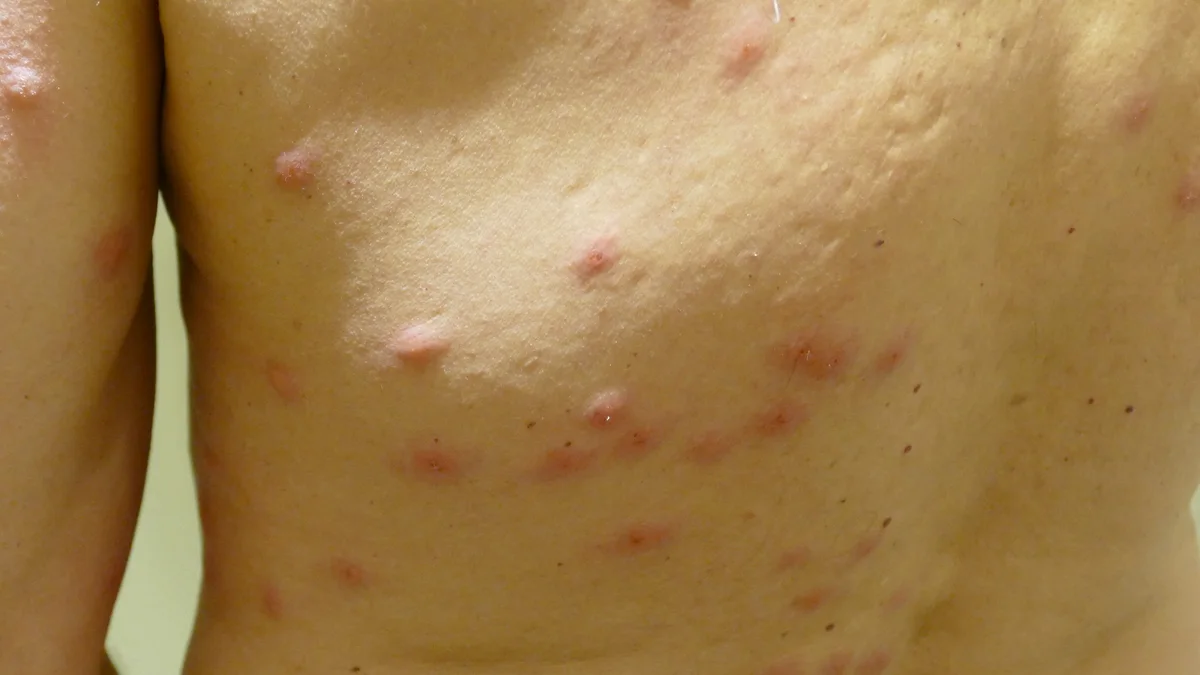
Bed bug bites are itchy red bumps or welts on skin that was exposed while you slept, such as the face, neck, arms and hands. They often run in a line or zigzag, or sit in clusters of three to five. Most people do not notice them until one to several days after the bite, and a first reaction can take up to 14 days. The bites are not known to spread disease and usually heal within one to two weeks.
This guide is built from the CDC, the American Academy of Dermatology (AAD), Cleveland Clinic, the NHS and peer-reviewed medical reviews, each named where we use it, plus our own count of iNaturalist records. We make no claim of personal experience with bed bug bites.
This is educational information, not medical advice. Ask a doctor or pharmacist about treatment for you or a child. Call 911 for trouble breathing, a swollen tongue or throat, or other signs of a severe allergic reaction; Poison Control (1-800-222-1222) can advise if someone swallows a cream or other medicine.
Key Takeaways
- Bites look like mosquito or flea bites: a slightly swollen, red, itchy area, random or in a straight line (CDC). On black or brown skin they may look brown, red or purple and be harder to see (NHS).
- Timing varies. The first bites may not itch for days, up to 14, while people bitten again and again can get itchy welts within seconds (AAD).
- Some people never react. A Cleveland Clinic Journal of Medicine review puts it at about 30% of patients, so one person in a bed may have bites and another none.
- Bites alone cannot confirm bed bugs. The “breakfast, lunch and dinner” row of three is also typical of flea bites; finding the bugs or their signs is what confirms it.
- Wash the bites with soap and water, try not to scratch, and ask a pharmacist about a mild corticosteroid cream or an antihistamine. See a doctor for many bites, blisters or signs of infection.
- In our count of US iNaturalist records, 18.0% of bed bug sightings fall in December to February, against 4.4% for mosquitoes.
Table of Contents
- What Bed Bug Bites Look Like
- Where on the Body Bed Bugs Bite
- Why You Don’t Feel the Bite
- When Bites Appear and How Long They Last
- Why Some People Get No Marks
- The “Breakfast, Lunch and Dinner” Pattern
- Bed Bug Bites vs Other Bites
- When Each Biter Turns Up: Our iNaturalist Count
- Why Bites Alone Can’t Confirm Bed Bugs
- How to Treat Bed Bug Bites at Home
- Bed Bug Bites on Babies and Children
- When to See a Doctor
- Bed Bug Bite Myths vs the Evidence
- Frequently Asked Questions
What Bed Bug Bites Look Like
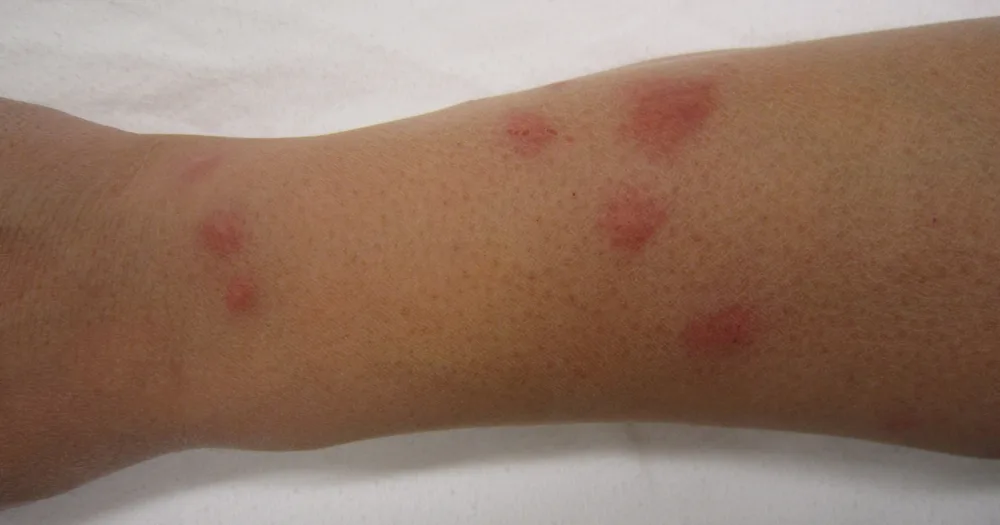
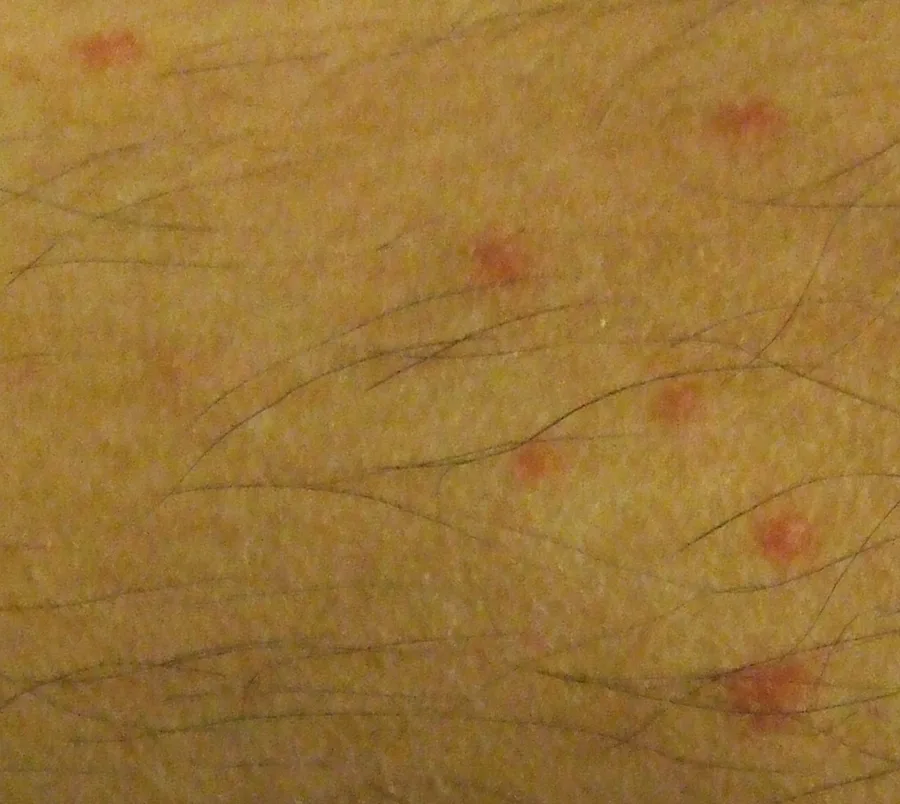
The CDC says bed bug bites look much like mosquito or flea bites: a slightly swollen red area that may itch and be irritating. Cleveland Clinic lists the most common forms:
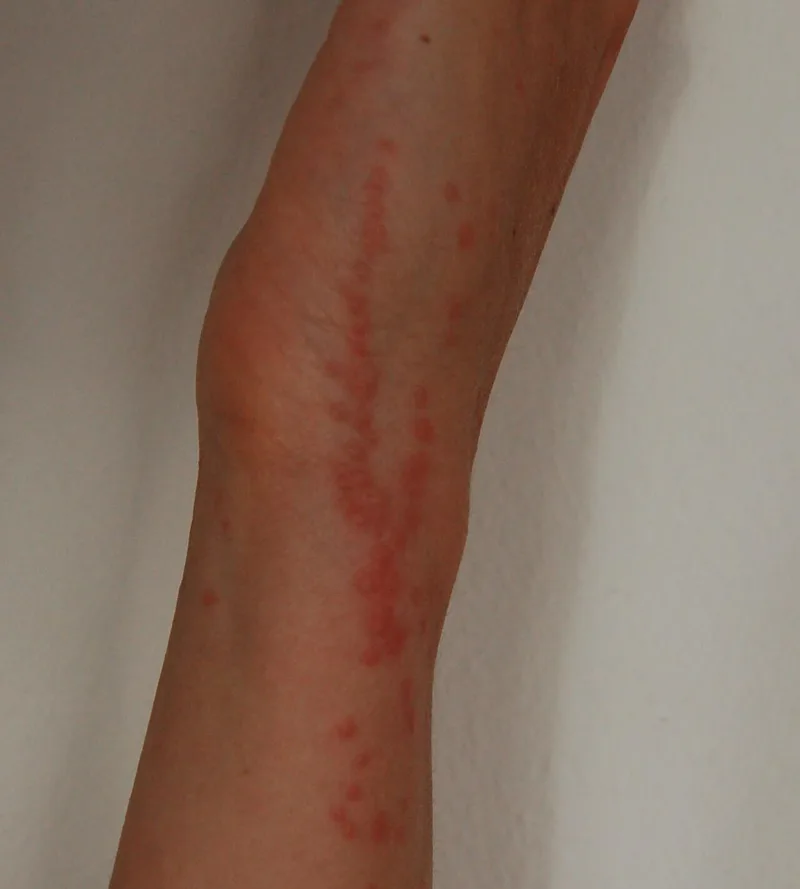
- raised bumps in a line, zigzag or random pattern;
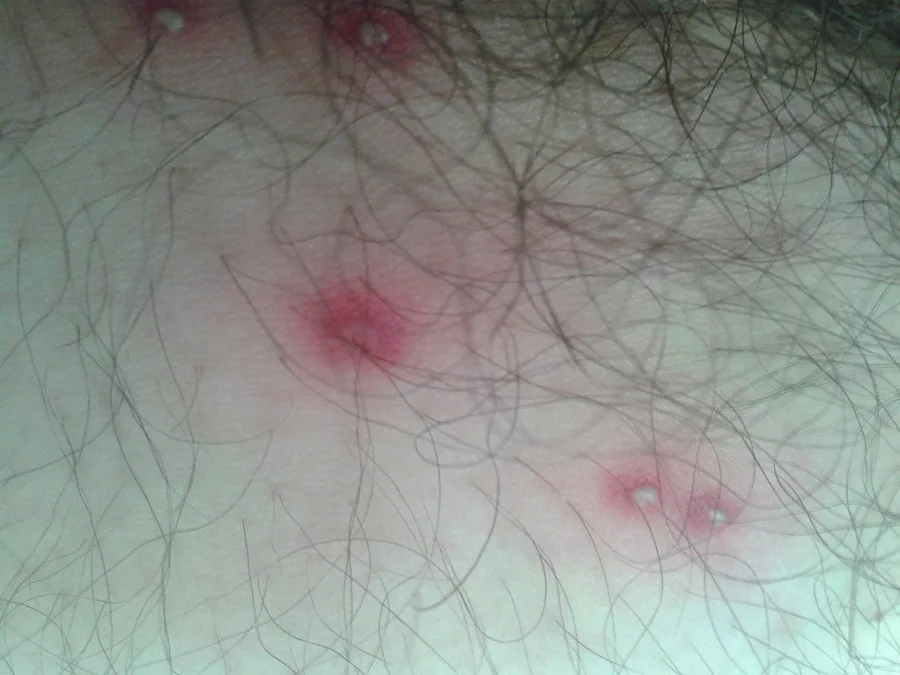
- a pimple-like bump with a dark red center and lighter skin around it;
- a round bump filled with clear fluid (a blister);
- a raised patch of several small bumps, often red or purple (hives).
Size varies a lot. A review in American Family Physician describes a typical lesion as 2 to 20 mm across, itchy and reddened, sometimes with a small crust or blister in the middle. The AAD adds that the welts often itch intensely.
On lighter and darker skin
Color depends on skin tone, which matters because most bite photos online show light skin.
“On white skin, bedbug bites usually look red or pink. On black or brown skin, bedbug bites may look brown, red or purple and may be harder to see.”
On darker skin, the raised feel of the bumps, the itch and the pattern are often more useful clues than color. We could not find a freely licensed photo of bed bug bites on dark skin, so none is shown here.
Where on the Body Bed Bugs Bite
Bed bugs bite skin they can reach while you sleep. The CDC names the face, neck, arms and hands; Cleveland Clinic adds the back and legs, meaning any skin in contact with the bed. The NHS describes bites on skin exposed while sleeping, often in a line or grouped together.
One detail helps separate them from other biters: the American Family Physician review notes that, unlike many other insect bites, bed bug bites are rarely found in the backs of the knees or the armpits.
Why You Don’t Feel the Bite
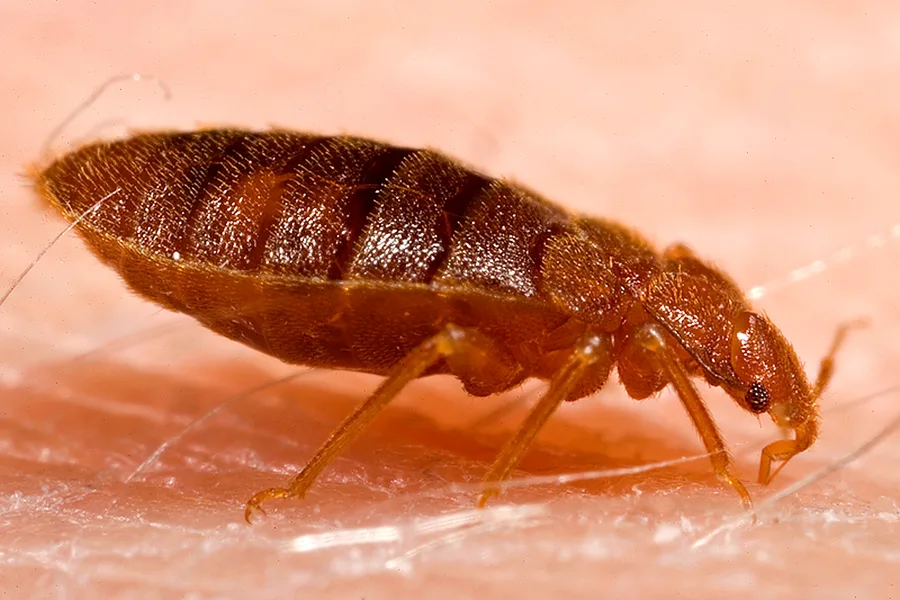
A bed bug pierces the skin with a straw-like beak. Cleveland Clinic explains that it injects a numbing agent and an anticoagulant as it bites, which is why the bite itself goes unnoticed. The AAD says a feeding lasts about 4 to 12 minutes, after which the bug returns to its hiding place; it does not live on your body the way lice or scabies mites do.
Timing at night is part of the picture. A 2017 review in the Cleveland Clinic Journal of Medicine says bed bugs typically feed between 1 and 5 a.m., and notes the rash often looks most swollen in the morning and flattens during the day.
When Bites Appear and How Long They Last
This is where bed bug bites differ most from mosquito bites. The CDC says most people do not see marks until one to several days after the bite, and in some people they take as long as 14 days to develop. The Merck Manual gives a range from the morning after to 10 days.
“The first time you are bitten, the bites may not itch right away. It can take time for your body to develop a reaction to the bites.”
The reverse happens with repeated bites. The AAD says people tend to become more sensitive over time, and someone living with an infestation may get itchy welts within seconds. The American Family Physician review describes the same shift from delayed to immediate reactions.
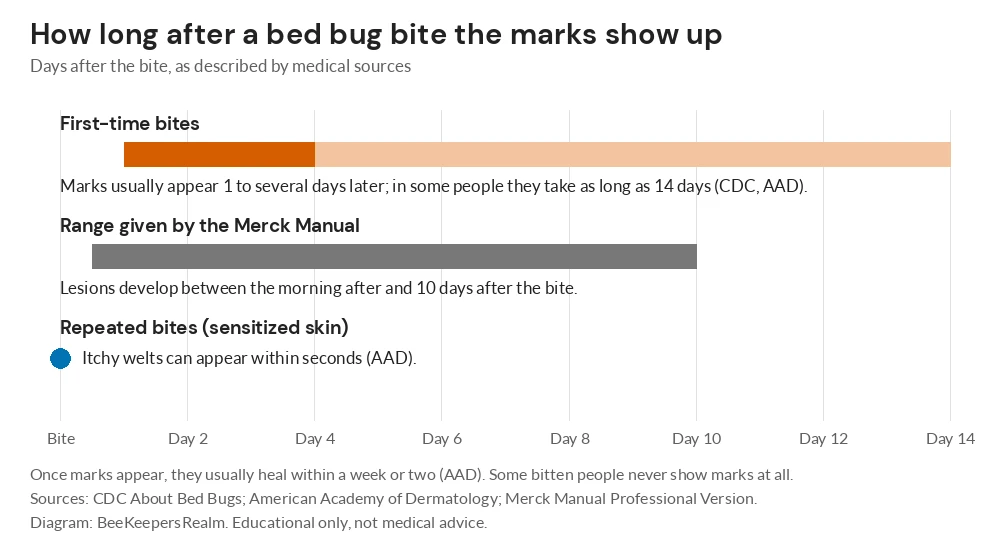
Once they appear, the AAD says the bites usually heal within a week or two; the NHS says about a week. Cleveland Clinic notes that new bites will keep coming until the bugs are gone.
Why Some People Get No Marks
Not everyone reacts. The Cleveland Clinic Journal of Medicine review says about 30% of patients may have no skin reaction, which makes a diagnosis from the skin impossible for them. The Merck Manual adds that older adults develop symptoms less often than younger people.
That is why two people can share a bed and only one wakes up with bites. The Utah Department of Health and Human Services lists “it can’t be bed bugs because nobody else in my house gets bitten” as a myth: people simply react differently.
The “Breakfast, Lunch and Dinner” Pattern
Doctors use a nickname for a row of three bites. The Cleveland Clinic Journal of Medicine review calls bites clustered in groups of three, often in a line and sometimes over blood vessels, the “breakfast, lunch, and dinner” sign, and says it can help a clinician tell bites from a widespread hive-like rash. The AAD describes clusters of 3 to 5 bites in a zigzag.
The sign has a limit that most bite pages skip. A 2018 paper in Anais Brasileiros de Dermatologia by Peres, Yugar and Haddad Junior calls the same pattern characteristic of human, dog and cat fleas as well as bed bugs. A row of three points to a crawling blood-feeder, not to bed bugs in particular, and the Merck Manual warns that the look of bed bug bites is usually nonspecific.
Bed Bug Bites vs Other Bites
Where the bites are, when they appear and what else is going on narrow it down. Each row below uses the named source’s own description.
| Cause | Usual spots | Look and pattern | Timing | Source |
|---|---|---|---|---|
| Bed bug | Skin exposed in bed: face, neck, arms, hands, back, legs | Red, swollen, itchy bumps or welts; random, in a line or zigzag, often 3 to 5 together | 1 to several days later; up to 14 days the first time; seconds once sensitized | CDC; AAD; Cleveland Clinic |
| Flea | Legs, and where clothes fit close: waist, buttocks, thighs, lower abdomen | Small red bumps, often three together, very itchy | Not stated | MedlinePlus |
| Mosquito | Skin not covered by clothing, such as arms and legs | A puffy, reddish bump; usually a single bite | Bump within minutes; hard, itchy bump a day or so later | CDC; Cleveland Clinic |
| Chigger | Waist, ankles, warm skin folds | Red pimple-like bumps or hives; severe itch | Itch several hours after; summer and fall | MedlinePlus |
| Scabies (mites that burrow) | Between fingers and toes, wrists, knees, waist | Itchy rash, bumps and raised skin-colored lines; itch worse at night | Up to six weeks for a first infestation | Cleveland Clinic |
| Horse fly | Skin the fly lands on, outdoors | A raised red or discolored bump; usually one or a couple | Painful at once; heals within days | Cleveland Clinic |
| Spider | Not stated | A single bite; most are minor, but some turn into a wound | Not stated | Cleveland Clinic |
Sources: CDC, American Academy of Dermatology, Cleveland Clinic and MedlinePlus pages listed under Sources.
A single painful wound is not a typical bed bug bite; our pages on the brown recluse spider and the hobo spider bite myth explain why many “spider bites” turn out to be something else. In the southern US, a painless night-time biter may also be a kissing bug. And carpet beetles do not bite at all, but our carpet beetle guide covers a rash from the larvae’s hairs that doctors have mistaken for bites.
When Each Biter Turns Up: Our iNaturalist Count
Season is a clue the comparison pages leave out. We pulled every research-grade US observation of the common bed bug (Cimex lectularius), fleas, mosquitoes and kissing bugs (Triatoma) from the iNaturalist API and charted the share of each group’s records by month. “Research grade” means at least two people agreed on the identification. The bed bug line uses the same 922 records as the monthly chart in our bed bug guide; here it is set against the other biters.
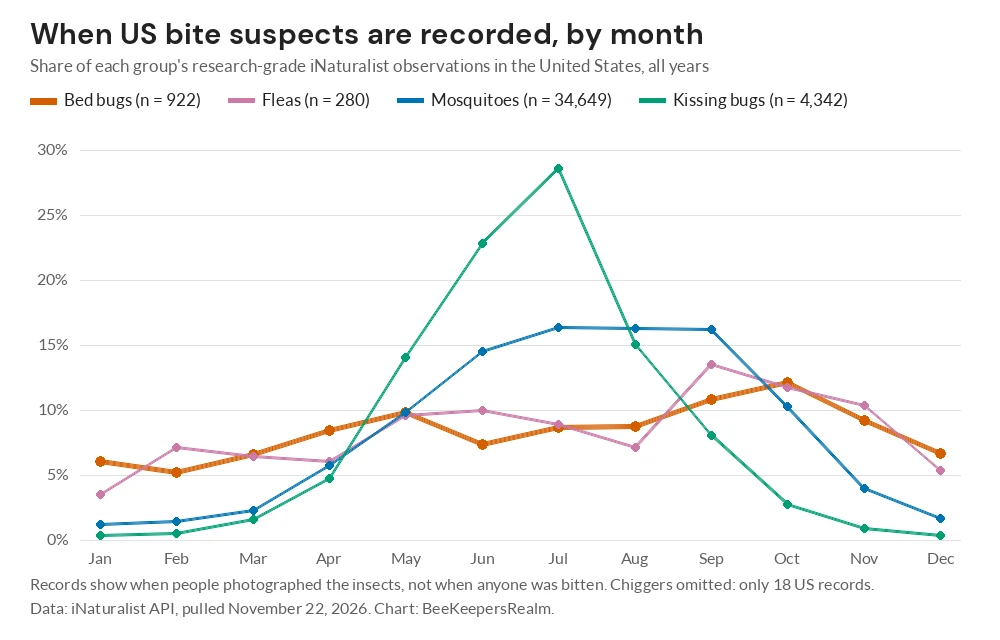
Bed bug records are spread across the year: 166 of 922 (18.0%) fall in December, January and February, and the busiest month, October, holds only 12.1%. Mosquitoes are summer insects by comparison, with 4.4% of 34,649 records in those three winter months and 47.2% in June to August. Kissing bugs are even more seasonal, with 1.3% of 4,342 records in winter. Fleas look closer to bed bugs (16.1% of 280 records in winter).
These records show when people photographed the insects, not when anyone was bitten, and they are not a diagnosis. Still, new bites that keep appearing after nights in bed in January make mosquitoes a less likely suspect than a biter that lives indoors.
Why Bites Alone Can’t Confirm Bed Bugs
The AAD says many people mistake bed bug bites for mosquito, flea or spider bites, or for an itchy rash, hives or chickenpox, and that to be sure “you’ll need to look for signs of bedbugs.” Cleveland Clinic agrees that the diagnosis is confirmed by finding and identifying a bed bug where you sleep.
“The key to a definitive diagnosis in these cases is identification of the suspected bug in characteristic locations.”
The signs dermatologists list are live bugs, shed skins, tiny blackish specks of excrement, specks of blood on sheets or mattress seams, eggs, and sometimes a sweet, musty odor (AAD). Our bed bug guide shows what each sign looks like, where the bugs hide and what to do if you find them. The AAD also points out that getting rid of the bugs is the only way to stop the bites, and it advises against bug sprays and foggers, which it says have little effect on bed bugs. Not every insect in a bedroom bites, either: silverfish, for example, cannot bite people.
How to Treat Bed Bug Bites at Home
The CDC says bed bug bites usually do not need medical treatment and that minimal treatment to stop the itch is enough for most cases. The steps medical sources agree on:
- Wash the bites with soap and water, which the AAD says helps prevent infection and reduce itchiness.
- Cool them. The NHS suggests a clean, damp cloth on the area for itching and swelling.
- Calm the itch. The AAD says a weak corticosteroid cream is sold without a prescription; the NHS suggests asking a pharmacist about a mild steroid cream or an antihistamine for very itchy bites that keep you awake. The NHS says children under 10 and pregnant women should ask a doctor before using hydrocortisone cream.
- Don’t scratch. The CDC warns that heavy scratching can lead to a secondary skin infection.
The CDC notes that treatments for bite reactions have not been tested in clinical trials, so the aim is comfort while the bites heal on their own.
Bed Bug Bites on Babies and Children
Seattle Children’s Hospital’s pediatric care guide (Schmitt Pediatric Guidelines, reviewed May 2025) describes the same itchy red bumps in a group or line on a child’s arms, legs and face, usually first noticed in the morning. It reassures parents on two points: a large, hive-like bump is a normal reaction and does not mean the child has an allergy, and redness by itself does not mean infection.
Its timeline for a normal bite is that pinkness usually lasts about 3 days, swelling up to 7 days and itching up to 2 weeks. Cutting a child’s fingernails short helps prevent scratching and infection. Before giving any cream or allergy medicine to a baby or young child, ask your pediatrician or pharmacist which product and dose are right for their age; the NHS gives the same advice for children under 10.
The guide says to call a doctor if redness keeps spreading or gets larger more than 48 hours after the bite, a scab looks infected (draining pus or getting bigger), or bites are not gone after 14 days, and to seek care at once for a spreading red area or streak with fever. Call 911 for sudden trouble breathing or swallowing.
When to See a Doctor
The AAD advises seeing a dermatologist for many bites, blisters, or a bite that looks infected. Cleveland Clinic warns that sores that turn puffy, red and oozing may be infected, and the NHS says to see a doctor if pain or swelling around the bites is spreading, because antibiotics may be needed. Harvard Health adds an allergic reaction to the list.
Severe reactions are rare but real. The CDC says allergic symptoms can include enlarged bite marks, painful swelling and, on rare occasions, anaphylaxis. Cleveland Clinic lists difficulty breathing, a swollen tongue, blisters, fever, an irregular heartbeat and feeling extremely sick as signs of a serious reaction. Call 911 for trouble breathing or throat or tongue swelling. The AAD also notes that anemia can develop, rarely, in people who get a very large number of bites.
Bed Bug Bite Myths vs the Evidence
| Common belief | What the sources say |
|---|---|
| Bed bugs spread disease. | The CDC says they are not known to spread diseases to people. A 2017 review notes some 45 pathogens have been found in bed bugs, but no evidence they pass them to humans. |
| A row of three bites proves bed bugs. | Fleas leave the same “breakfast, lunch and dinner” pattern (Peres et al., 2018). |
| If only one person gets bites, it can’t be bed bugs. | People react differently, and about 30% may show no reaction (Utah DHHS; Cleveland Clinic Journal of Medicine). |
| You would feel a bed bug biting. | Their saliva numbs the skin, so the bite usually goes unnoticed (Cleveland Clinic). |
| A light left on stops the bites. | Bed bugs prefer darkness, but a light will not stop them from biting (Utah DHHS). |
| Insect repellent keeps bed bugs from biting. | Repellents on skin or clothing do not stop bed bug bites, according to Seattle Children’s pediatric guide. |
| Bites spread or are contagious. | Bites do not multiply when scratched and are not contagious (Cleveland Clinic). |
Frequently Asked Questions
How do you tell if bites are from bed bugs?
Look for itchy bumps on skin exposed in bed, in a line, zigzag or cluster, that keep appearing after sleep. Then check the mattress seams, sheets and bed frame for bugs, shed skins, black specks or blood spots; only those confirm it.
What part of the body do bed bugs bite the most?
Skin that is uncovered while you sleep: the face, neck, arms and hands, plus the back and legs where they touch the bed. Bites in the armpits or backs of the knees are unusual for bed bugs.
How long do bed bug bites last?
Usually one to two weeks once they appear, according to the AAD. Scratching and infection can make them last longer.
Why am I the only one getting bitten?
Your partner may be bitten too but not react. About 30% of people show no skin reaction, and older adults react less often.
Can bed bug bites look like hives or a rash?
Yes. Cleveland Clinic lists hive-like patches among the common forms, and the AAD says bites are often mistaken for an itchy rash, hives or chickenpox.
Are bed bug bites contagious?
No. Bed bugs do not carry or spread disease, and the bites do not spread from person to person or multiply when scratched.
Do bed bugs bite every night?
Not necessarily. Cleveland Clinic says a bed bug usually feeds every three to seven days, so bites may come in waves rather than every night.
Can bed bug bites make you sick?
Not by passing on a disease. The CDC says bed bugs are not known to spread diseases to people. The real health risks are skin infection and allergy. The CDC warns that intense itching can lead to heavy scratching and possibly a secondary skin infection, and it lists enlarged bite marks, painful swelling and, rarely, anaphylaxis as allergic symptoms. Its advice for clinicians is that avoiding scratching and keeping the skin clean are the main ways to prevent infection, and that antibiotics may be needed only if an infection develops. If a bite turns warm, more painful, oozes or is surrounded by spreading redness, see a doctor.
Can bed bugs affect your sleep and mood?
Yes, and for some people that is the hardest part. Cleveland Clinic lists insomnia and anxiety alongside skin infection as possible effects, and says bites often lead to lost sleep from itching, stress and anxiety in the bedroom once an infestation is found. If worry about bites is keeping you awake for weeks, it is worth mentioning to your doctor along with the skin symptoms.
The Bottom Line
Bites in a line on skin that touched the bed are a reason to inspect the bed, not proof of bed bugs. Treat the itch, watch for infection or a severe reaction, and confirm the bugs before paying for treatment; our guide to the signs of bed bugs is the place to start.
For more indoor and outdoor biters, see our garden and household insects guides.
Sources
- CDC, “About Bed Bugs” (April 26, 2024), “Caring for Patients with Bed Bug Bites” (April 30, 2024) and “About Mosquito Bites” (June 21, 2024).
- American Academy of Dermatology, “Bedbugs: Signs and symptoms” and “Bedbugs: Diagnosis and treatment.”
- Cleveland Clinic, “Bed Bugs and Bed Bug Bites” and “Scabies.”
- NHS, “Bedbugs” (reviewed May 1, 2026).
- Harvard Health Publishing, Jenette Restivo, reviewed by Howard E. LeWine, MD, “Bed bug bites: How to identify them, get relief, and prevent future bites” (January 3, 2024).
- Seattle Children’s Hospital, “Bed Bug Bite” (Schmitt Pediatric Guidelines; last reviewed May 6, 2025).
- MedlinePlus, “Fleas” and “Chiggers.”
- Merck Manual Professional Version, “Bedbugs.”
- Ibrahim O, Syed UM, Tomecki KJ, “Bedbugs: Helping your patient through an infestation,” Cleveland Clinic Journal of Medicine 84(3):207-211, 2017.
- Studdiford JS, Conniff KM, Trayes KP, Tully AS, “Bedbug Infestation,” American Family Physician 86(7):653-658, 2012.
- Peres G, Yugar LBT, Haddad Junior V, “Breakfast, lunch, and dinner sign: a hallmark of flea and bedbug bites,” Anais Brasileiros de Dermatologia, 2018.
- Utah Department of Health and Human Services, “Bed Bug Myths.”
- iNaturalist API, US research-grade observations by month observed, pulled November 22, 2026.
Image credits: Featured image of bed bug bites on a back by Hermann Luyken, via Wikimedia Commons, CC0 (public domain dedication), cropped and resized. Other photos are credited in their captions, with links to each file page and licence. Charts and diagram: BeeKeepersRealm, from iNaturalist API data and the medical sources listed above.