Reviewed by Elena P. · How we review
A dung beetle is a beetle that lives on animal manure: adults drink the liquid in fresh dung, and their larvae grow up inside balls of it that the parents roll away, bury in tunnels or leave in the pat. Most belong to the scarab subfamily Scarabaeinae, with slightly over 5,000 described species worldwide. In the United States they bury cattle dung, cut pasture flies and feed the soil, and they are harmless to people.
This guide covers the three ways dung beetles handle dung, the native and introduced US species you are most likely to see, what they do for pastures and which livestock treatments harm them. It also includes our own count of 26,863 research-grade iNaturalist observations of true dung beetles in the United States, which shows which species Americans actually find and where.
Key Takeaways
- Dung beetles come in three working types: rollers (tumblebugs) roll a ball away, tunnelers bury dung under the pat, and dwellers live inside it.
- In our iNaturalist count, the native rainbow scarab is the most recorded US dung beetle (7,112 records) and the introduced gazelle scarab is second (4,755). Texas and Florida hold 44.6% of all US records.
- Cornell IPM says dung beetles can reduce horn and face flies by as much as 95 percent.
- Some livestock dewormers, ivermectin in particular, can kill dung beetle larvae in treated dung.
- Texas A&M calls dung beetles medically harmless, and they do not damage homes or gardens.
Table of Contents
- What a Dung Beetle Is
- Rollers, Tunnelers and Dwellers
- What Dung Beetles Do for Pastures and Soil
- Common US Dung Beetles, Native and Introduced
- Where Americans Find Dung Beetles: Our iNaturalist Count
- What Harms Dung Beetles: Dewormers in Dung
- How Farms and Gardens Can Help Dung Beetles
- How Dung Beetles Navigate by the Milky Way
- The Sacred Scarab of Ancient Egypt
- Frequently Asked Questions
What a Dung Beetle Is
“Dung beetle” is a job description more than a single family. The true dung beetles are the subfamily Scarabaeinae of the scarab family, Scarabaeidae. The University of Nebraska State Museum counts slightly over 5,000 described species in 234 genera worldwide, close to 1,800 of them in the genus Onthophagus. They are cousins of the Hercules beetle and the June bug, which are scarabs too but feed on wood, roots and leaves rather than manure. Two other groups also work dung: the small dung beetles (subfamily Aphodiinae) and the earth-boring dung beetles (family Geotrupidae). Like bees, they are true insects, as our explainer on how insects are classified shows.
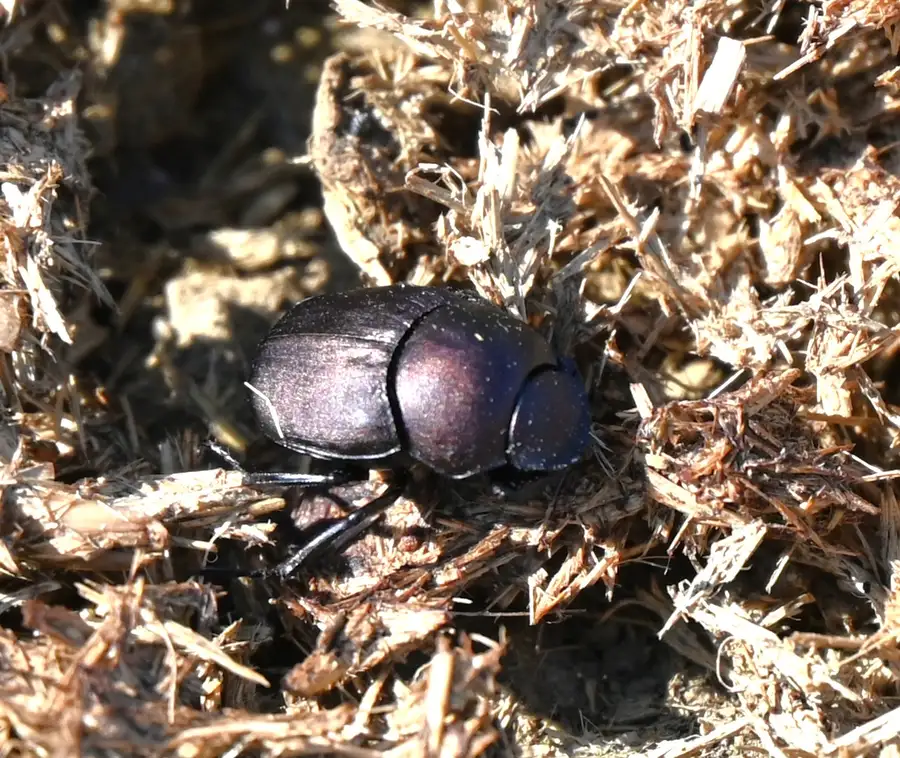
Washington State University (WSU) Extension puts their size at 0.1 to 2.5 inches and notes that all dung beetles use the liquid portion of manure for nourishment. National Geographic Kids adds that the larvae eat the solid dung and that most species prefer dung from plant-eating animals. The Missouri Department of Conservation (MDC) describes most as dull or shiny black, with spined front legs for digging, and says males of many species carry horns.
Rollers, Tunnelers and Dwellers
Scientists group dung beetles by what they do with a fresh pat, and the difference decides how fast a pat disappears.
- Rollers, also called tumblers or tumblebugs, shape a ball of manure, roll it away from the pile and bury it. MDC says the tumblebugs of the genus Canthon make two kinds: brood balls to lay eggs in, and food balls for the adults.
- Tunnelers dig straight down under the pat and pack dung into chambers below it. Cornell IPM says they lay their eggs in brood balls built in those tunnels.
- Dwellers live in the pat itself and do little digging.
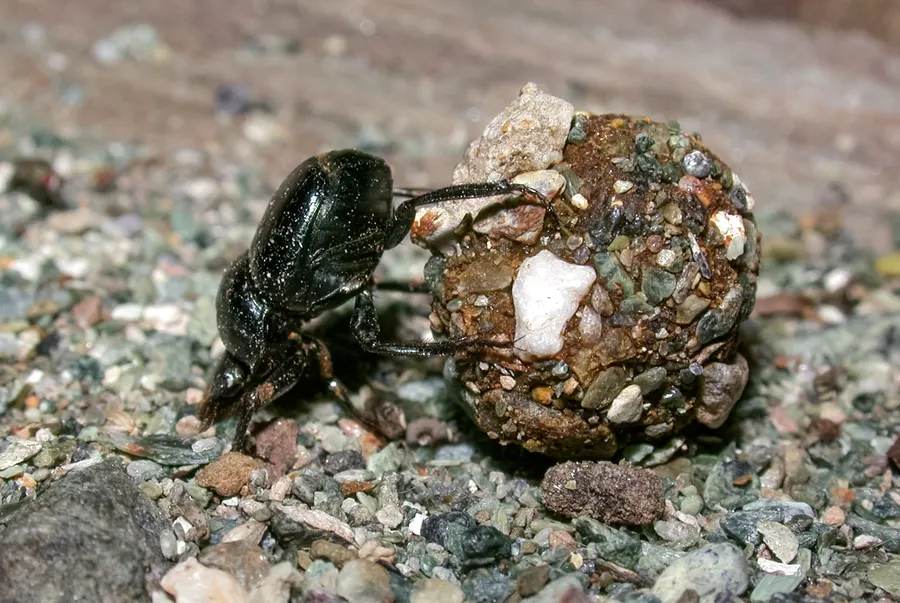
WSU says dwellers break dung pats down in a few weeks, while tunnelers and tumblers can break down dung within hours or days. That is why tunnelers and rollers do most of the real burial.
What Dung Beetles Do for Pastures and Soil
Video: Kansas rancher Bill Sproul, a 2015 Leopold Conservation Award winner, explains what tumblers and tunnelers do on his prairie ranch. Going by the video’s chapter list and description, he covers nutrient cycling, water management and grazing, and keeping flies off cattle without harming the beetles.
A cow pat left on the surface can smother grass and breed flies for weeks. Extension services credit dung beetles with four kinds of help:
- Fewer pest flies. Horn flies and face flies breed in fresh manure. Cornell IPM, which says dung beetles are present on all New York beef and dairy farms, credits them with reducing those flies by as much as 95 percent.
- Fewer livestock worms. WSU notes they have been reported to significantly reduce internal parasites whose eggs hatch in the pat.
- Better soil and water. Burying manure improves soil fertility, water infiltration rates and water quality, WSU says.
- More usable grass. Pats that disappear in days no longer cover forage for weeks.
In a 2006 BioScience paper, Cornell entomologist John Losey and Mace Vaughan of the Xerces Society put a price on those services. As the Cornell Chronicle summarized it, insects clean up grazing lands, saving ranchers some $380 million a year, and the authors called their numbers “very conservative.” The same study valued crop pollination at $3 billion, which is why the Xerces Society (see our Xerces Society history) works on dung beetles as well as bees. Dung beetles do not pollinate crops, but the pasture habits that protect them, fewer broad-spectrum chemicals and well-managed grazing, also help bees, as we cover in bees in regenerative farming.
Common US Dung Beetles, Native and Introduced
MDC puts about 20 tumblebug species of the genus Canthon in North America north of Mexico, and 77 species of true dung beetles have research-grade US records on iNaturalist. These are the ones you are most likely to meet.
| Beetle | Origin | Type | Size | US iNaturalist records (top state) | Source |
|---|---|---|---|---|---|
| Rainbow scarab (Phanaeus vindex) | Native; eastern and central US to northern Mexico | Tunneler | About 3/4 in | 7,112 (Florida 1,997) | MDC, Mississippi State Extension |
| Gazelle scarab (Digitonthophagus gazella) | Introduced; native range Afro-Asian | Not stated | Not stated | 4,755 (Texas 3,460) | Texas A&M AgriLife, iNaturalist |
| Eastern tumblebug (Canthon pilularius) | Native; New World genus | Roller | 1/4 to 3/4 in (genus) | 236 (South Dakota 38) | MDC |
| Scooped scarab (Onthophagus hecate) | Not stated | Tunneler | Not stated | 2,256 | Cornell IPM |
| Bull-headed dung beetle (Onthophagus taurus) | Introduced; European origin | Tunneler | 8 to 10 mm (about 3/8 in) | 337 (California 118) | Cornell IPM |
“Not stated” means the sources we read do not give it. Counts are research-grade iNaturalist observations in the United States, all years, pulled November 22, 2026.
Rainbow scarab
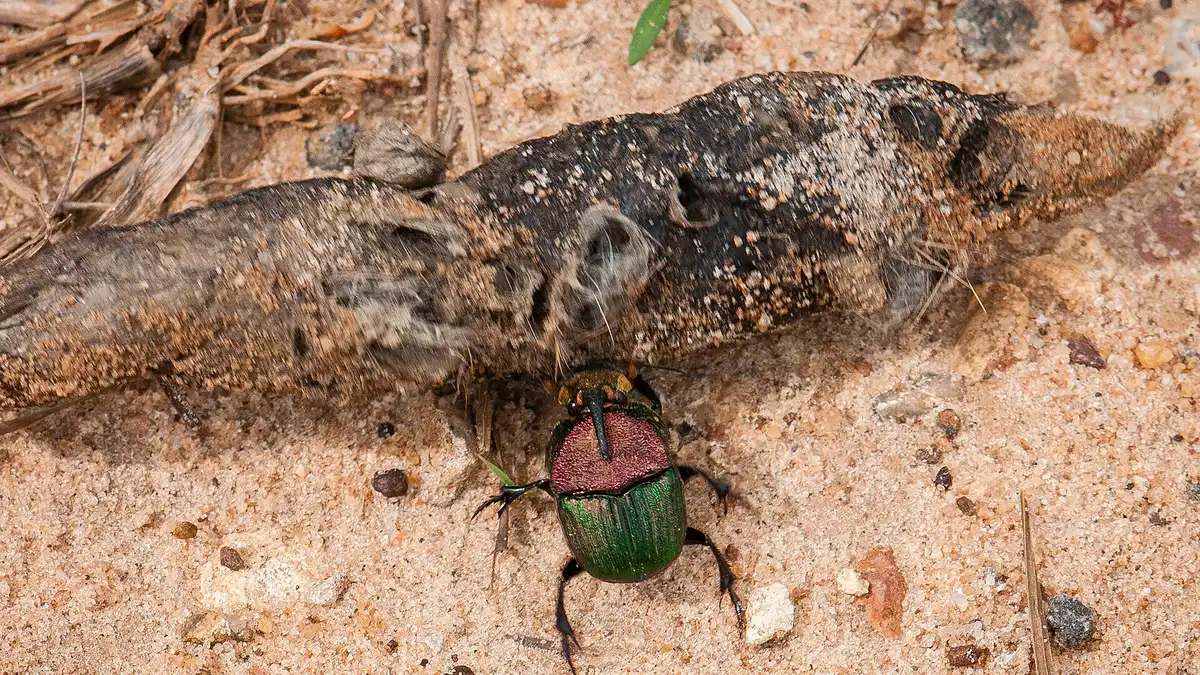
MDC calls the rainbow scarab “a living jewel of bright metallic green and copper.” It is stocky, about 3/4 inch long, and males have a backward-pointing horn on the head. Instead of rolling a ball, it buries dung beneath the pile.
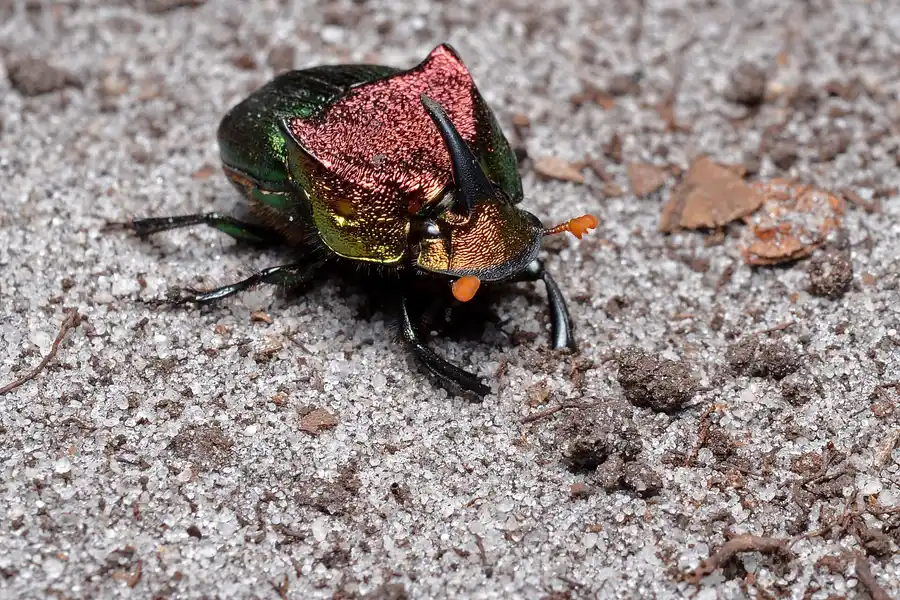
“Despite their striking appearance, rainbow scarabs are rarely seen, even though they are fairly common.”
Layton explains that they dig holes several inches deep directly under the dung pile, so a pat ringed with small piles of fresh soil may be their work.
Introduced dung beetles
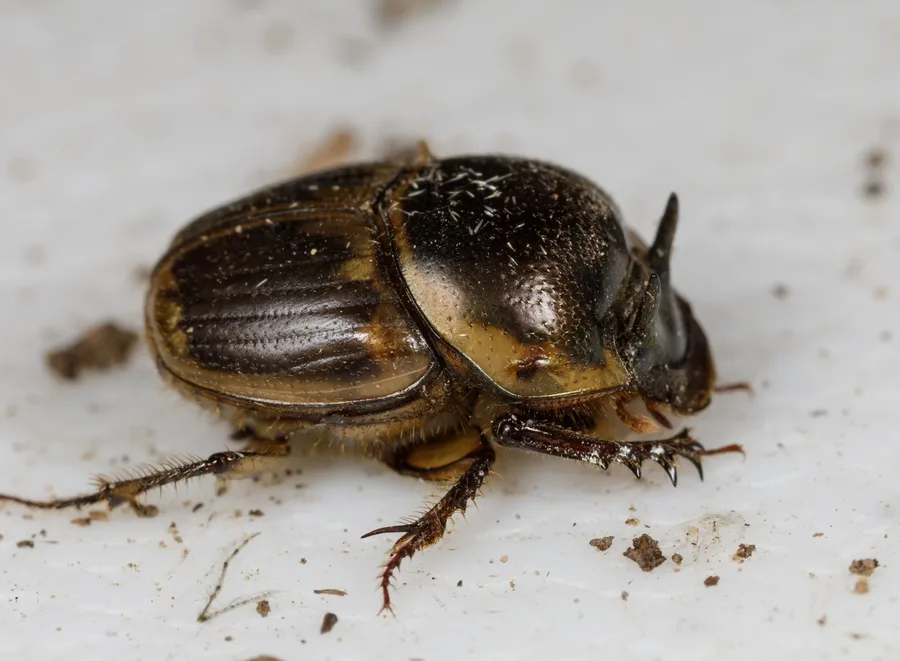
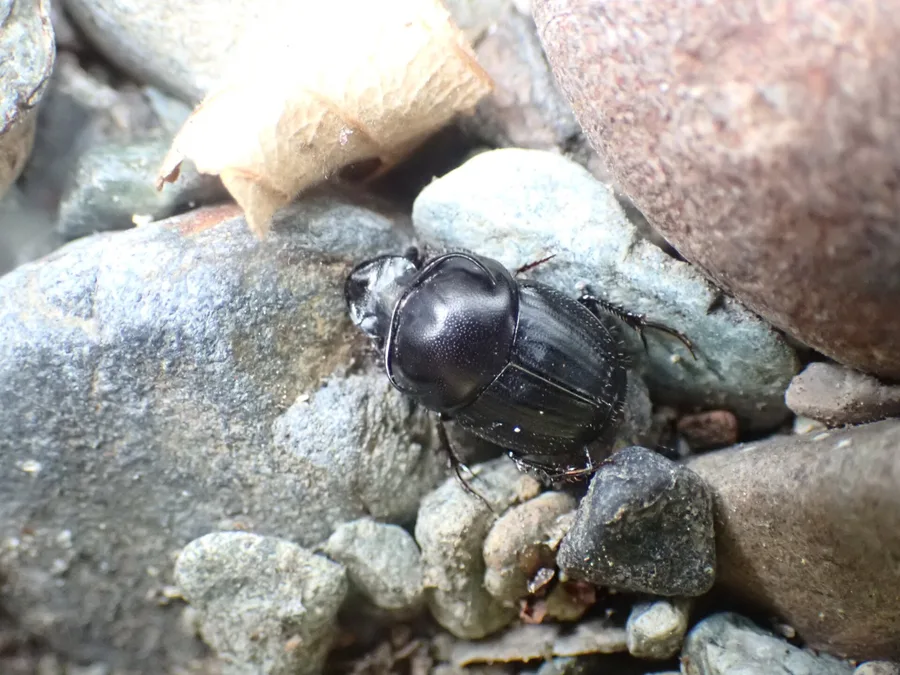
Several Old World species were brought in to help bury cattle dung. Texas A&M AgriLife’s field guide says the gazelle scarab, then called Onthophagus gazella, was introduced by USDA scientists in the 1970s and is now common throughout Texas. Cornell IPM says the European bull-headed dung beetle has expanded its range across eastern North America since its introduction in the 1970s; its first US sighting was in Florida in 1971. It is also the beetle behind the strength record in our Hercules beetle guide: the strongest males pulled 1,141 times their own body weight.
Where Americans Find Dung Beetles: Our iNaturalist Count
None of the top search results we read says which dung beetles Americans actually encounter. So we pulled every research-grade iNaturalist observation of true dung beetles (subfamily Scarabaeinae) in the United States: 26,863 records of 77 species, as of November 22, 2026. Research grade means other users agreed on the identification from the photo. Our guide to citizen science projects shows how records like these get made.
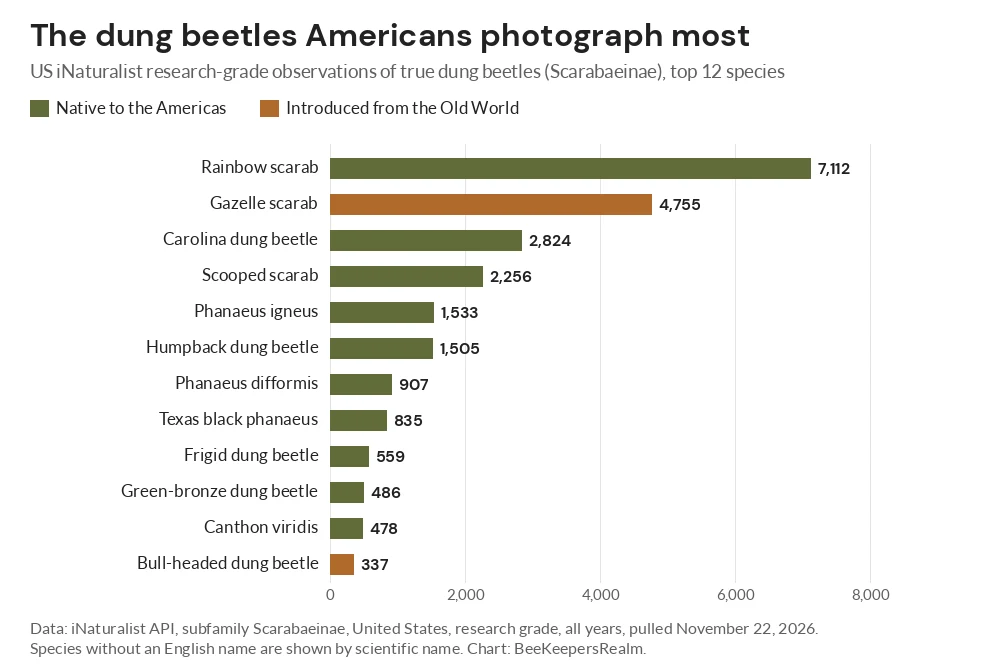
The native rainbow scarab leads with 7,112 records (26.5%). The introduced gazelle scarab is second with 4,755 (17.7%), and 72.8% of those come from Texas, where it makes up 44.1% of all dung beetle records. The bull-headed dung beetle is twelfth nationally but the top species in California, with 118 of the state’s 242 records.
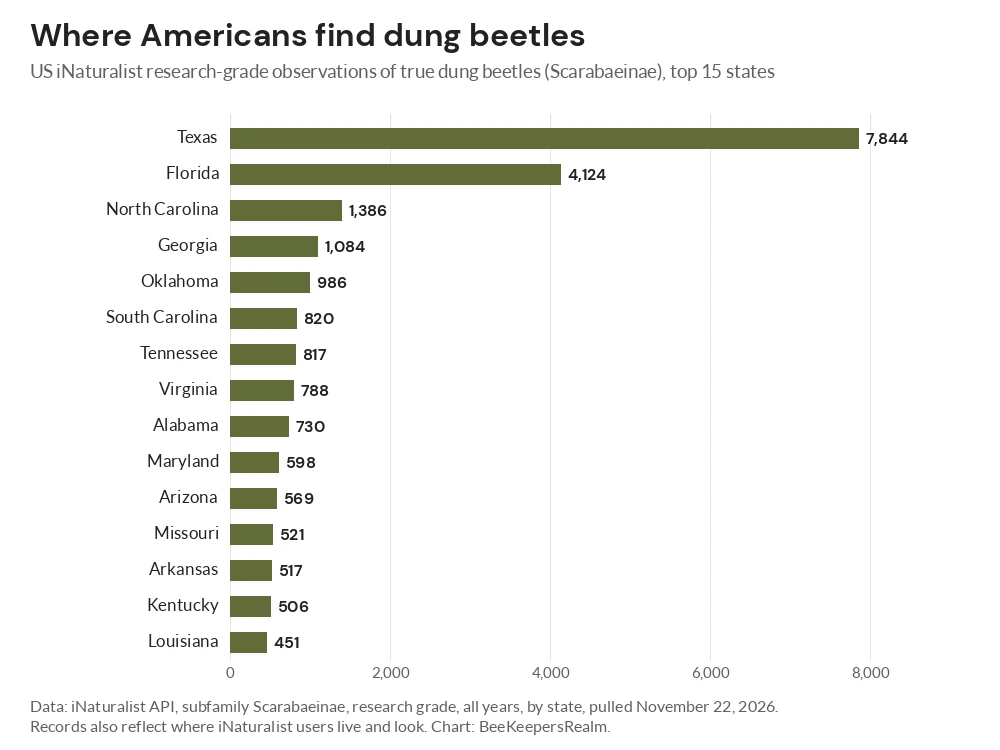
Texas (7,844 records, 29.2%) and Florida (4,124, 15.4%) together hold 44.6% of all US observations, and Texas has the most species, 45. Records thin out to the north and west: Washington has 67, Idaho 12, Utah 4 and Alaska none. Nationally, 97.2% of records fall between March and November, peaking in May. These counts follow where iNaturalist users live and look, so they show encounters, not population size.
What Harms Dung Beetles: Dewormers in Dung
The threat most specific to dung beetles is livestock medicine. WSU Extension explains that animals break these products down at different rates, so some of the active ingredient can pass into manure, where beetle larvae feed.
- South Dakota State University Extension says ivermectin has been shown to be toxic to dung beetle larvae. In the grazing research it summarizes, conventionally managed systems had a 66% decrease in dung beetle occurrence compared with regenerative systems, and conventional pastures had roughly twice as much residual ivermectin in dung pats as intermediate ones.
- WSU Extension says adults are typically not affected and that slow-release products given as a bolus have predictably more harmful effects. Fenbendazole breaks down in the animal to metabolites that are harmless to beetles.
- The Iowa Beef Center reported in June 2025 that, in a preliminary study on a central Iowa cow-calf farm of about 274 cows, some given a doramectin pour-on, it found no evidence that doramectin decreases the dung beetle population.
“There is debate over the extent to which these products have contributed to the decline in dung beetle populations in the last half century, but we know that larval survival may be affected for 1 to 3 weeks after application.”
So the answer depends on the product, the dose form and the timing, and US results are still mixed. Broad-spectrum insecticides used around the yard can also kill dung beetles that contact them.
This is educational information, not veterinary advice. Choose and time any livestock treatment with your veterinarian, following the product label.
How Farms and Gardens Can Help Dung Beetles
WSU Extension lists practical steps for livestock owners:
- Treat based on fecal tests (regular fecal float analyses) rather than treating every animal by the calendar.
- Treat in cooler months, when the beetles are less active.
- Rotate pastures often to reduce trampling of manure pats.
- Favor targeted fly control such as back rubbers, ear tags and occasional dusts or sprays.
- Avoid slow-release boluses.
- Use a holding pasture. Keep newly treated animals in one pasture for one to two weeks so contaminated manure stays in one place.
Gardeners have less to do. Dung beetles do not eat plants, and they are not the white grubs that chew turf roots, which are the larvae of beetles such as the Japanese beetle. MDC notes that adults often fly to lights at night, so a beetle at the porch light can simply be carried outside. A big beetle with antler-like jaws at the light is more likely a stag beetle, which is just as harmless. If you must spray, our pollinator-safe pest control guide explains how to choose narrow products that spare bees and other beneficial insects.
How Dung Beetles Navigate by the Milky Way
A roller has to get its ball away from the crowd at the dung pile in a straight line, so rivals cannot steal it. In 2013, Marie Dacke and colleagues showed that one African species manages this even on moonless nights. Science News reported that the team borrowed the Johannesburg planetarium to test the nocturnal beetle Scarabaeus satyrus.
“This finding represents the first convincing demonstration for the use of the starry sky for orientation in insects and provides the first documented use of the Milky Way for orientation in the animal kingdom.”
The beetles oriented equally well under the full starry sky and under the Milky Way alone. The study did not include North American dung beetles.
The Sacred Scarab of Ancient Egypt
Elaine Altman Evans of the University of Tennessee’s McClung Museum writes that “by far the most important amulet in ancient Egypt was the scarab.” The model was mainly the Egyptian dung beetle Scarabaeus sacer, which Egyptians linked to Khepri, the rising sun, believed reborn each morning. Honey bees had their own place in that culture, as our page on beekeeping in ancient Egypt describes.
Frequently Asked Questions
Are dung beetles harmful or dangerous to people?
No. Texas A&M AgriLife describes them as beneficial and medically harmless. They do not sting, and they feed on manure, not on plants, wood or fabric.
Do dung beetles live in the United States?
Yes. In our iNaturalist count, every state except Alaska has at least one research-grade record, with most from Texas and Florida.
Are dung beetles native to North America?
Many are, including the rainbow scarab and the tumblebugs. The gazelle scarab and the bull-headed dung beetle were introduced from the Old World in the 1970s.
What do dung beetles eat?
Adults drink the liquid in fresh manure, mostly from plant-eating animals. Their larvae eat the solid dung their parents prepared.
Why do dung beetles roll dung?
Rolling moves food away from competitors at the pile. Rollers bury the ball to eat it or to lay an egg in it.
Can dung beetles fly?
Yes. They fly to find fresh dung, and MDC notes that adults often fly to lights at night.
Are dung beetles decomposers?
Yes. They break manure down and bury it, returning nutrients to the soil and helping water soak in.
Is a dung beetle a scarab?
Most are. True dung beetles belong to the scarab family, and the sacred scarab of Egypt is itself a dung beetle.
The Bottom Line
A dung beetle on a pasture or trail is doing free work: burying manure, cutting flies and feeding the soil. If you keep livestock, ask your vet about beetle-friendly deworming. For more beneficial and nuisance insects, see our garden and household insects guides.
Image credits: featured photo of a rainbow scarab moving dung in Chickasawhatchee Wildlife Management Area, Dougherty County, Georgia, by Roy Cohutta, via Wikimedia Commons, CC BY-SA 2.0, cropped and resized. Other photos: Alex Wild (CC0), EB3658 (CC0), Geoff Gallice (CC BY 2.0), Meghan Cassidy (CC BY-SA 4.0, cropped) and Lee Cain (CC BY 4.0), all via Wikimedia Commons, resized; links to each file page and licence are in the captions. Charts: BeeKeepersRealm, from iNaturalist API data pulled November 22, 2026.