Reviewed by Daniel M. · How we review
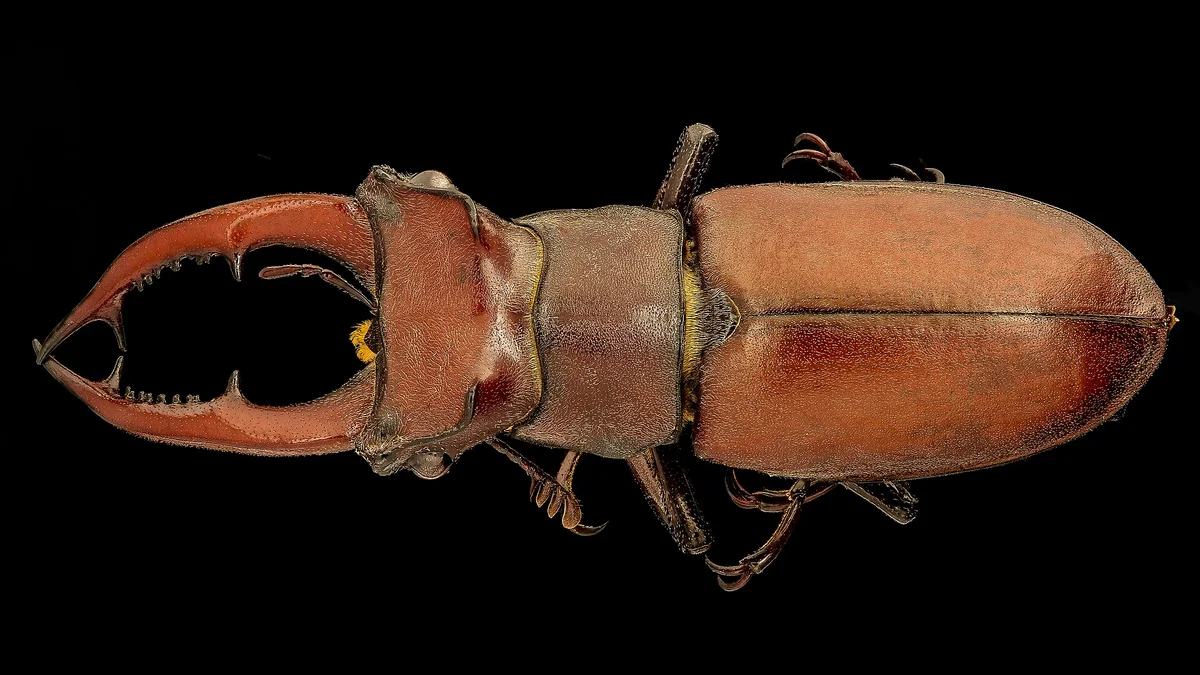
A stag beetle is any beetle in the family Lucanidae, named for the antler-like jaws of the males, which they use to wrestle rival males. Stag beetles are harmless apart from a pinch if handled, and their grubs spend a year or more recycling rotting wood. The one most Americans meet is the reddish-brown stag beetle, not the famous giant stag beetle.
Below: the main US species, the life cycle, whether they pinch, and our count of 34,183 US iNaturalist records showing when and where Americans find them.
Key Takeaways
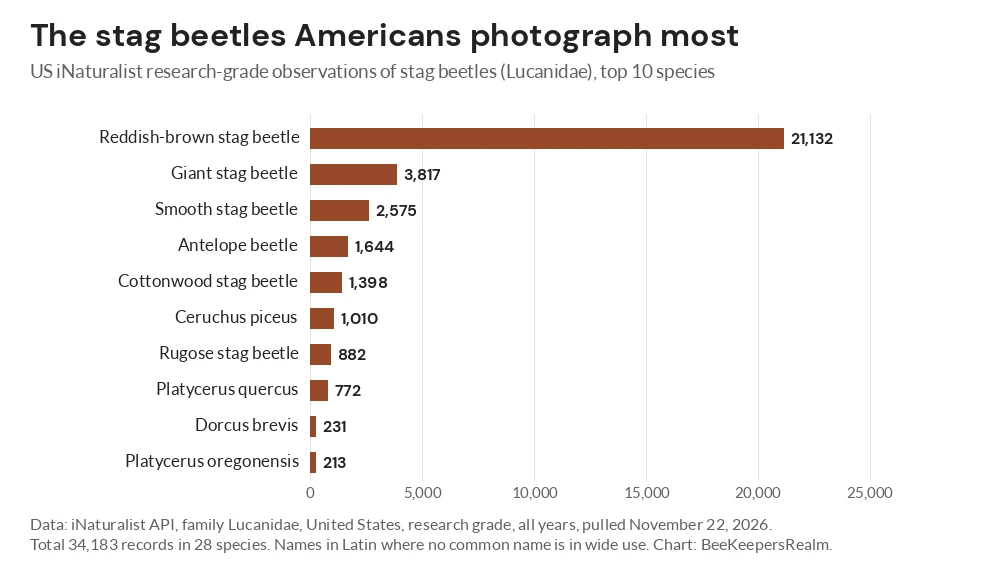
- In our count, the reddish-brown stag beetle (Lucanus capreolus) made up 61.8% of 34,183 US research-grade stag beetle records; the giant stag beetle made up 11.2%.
- US stag beetles are a midsummer insect: 53.6% of records were made in July and 81.0% in June and July.
- Male giant stag beetles reach nearly 2 1/2 inches with their jaws (Missouri Department of Conservation).
- Grub time varies by species and source: 1 to 2 years for the giant stag beetle in a USDA Forest Service study, up to 7 years for some species.
- They are not pests, and the giant stag beetle has no IUCN or federal listing (Animal Diversity Web). The European stag beetle is protected in the UK and listed under the EU Habitats Directive.
Table of Contents
- What a Stag Beetle Is
- Why Male Stag Beetles Have Huge Jaws
- US Stag Beetle Species Compared
- When and Where Americans Find Stag Beetles
- Stag Beetle Life Cycle: Grubs in Rotting Wood
- What Stag Beetles Eat
- Do Stag Beetles Pinch or Bite?
- Are Stag Beetles Rare or Protected?
- How to Help Stag Beetles and Wood-Nesting Bees
- Frequently Asked Questions
What a Stag Beetle Is
Stag beetles are a beetle family, Lucanidae, related to the scarabs. The world has about 1,200 species (Wikipedia) or about 1,500 (University of Nebraska State Museum). North American counts range from 24 species (USDA Forest Service) to about 30 (University of Kentucky, US only) and about 40 north of Mexico (Missouri Department of Conservation). US iNaturalist research-grade records cover 28 species.
Look for a strong, elongated, black to reddish-brown beetle whose antennae, elbowed in many species, end in a club of leaf-like segments (Missouri). Kentucky’s entomologists say adults are up to 60 mm (2.4 inches) long, most between 15 and 35 mm. Bess beetles look similar, but their antennae are not elbowed and they have a horn. A Hercules beetle is a different family: its males carry horns on the head and thorax, while a stag beetle’s “antlers” are its jaws.
Why Male Stag Beetles Have Huge Jaws
The jaws (mandibles) of male stag beetles are used for fighting over females, the Missouri Department of Conservation says. Males compete for the best mating sites, where females feed or lay eggs, and grapple with rivals much as elk and deer do. Females have shorter jaws. Jaw size grows with body size, so a large “major” male carries far bigger jaws than a small “minor” male of the same species (University of Nebraska State Museum).
“While they are also called pinching bugs by some, they are quite harmless.”
Video: In this PBS Michiana clip, host Evie identifies a viewer’s beetle from Bremen, Indiana, as a female smooth stag beetle, named for its shiny, smooth wing covers. She explains that adults feed on tree sap and aphid honeydew, that females lay eggs in rotting logs or mulch, and that males use their larger jaws to grapple with each other.
US Stag Beetle Species Compared
Five species account for 89.4% of US records. The table combines sourced size and range with the peak month and record share from our iNaturalist count.
| Species | Size (adult) | Where | How to tell it | US peak (share of records) |
|---|---|---|---|---|
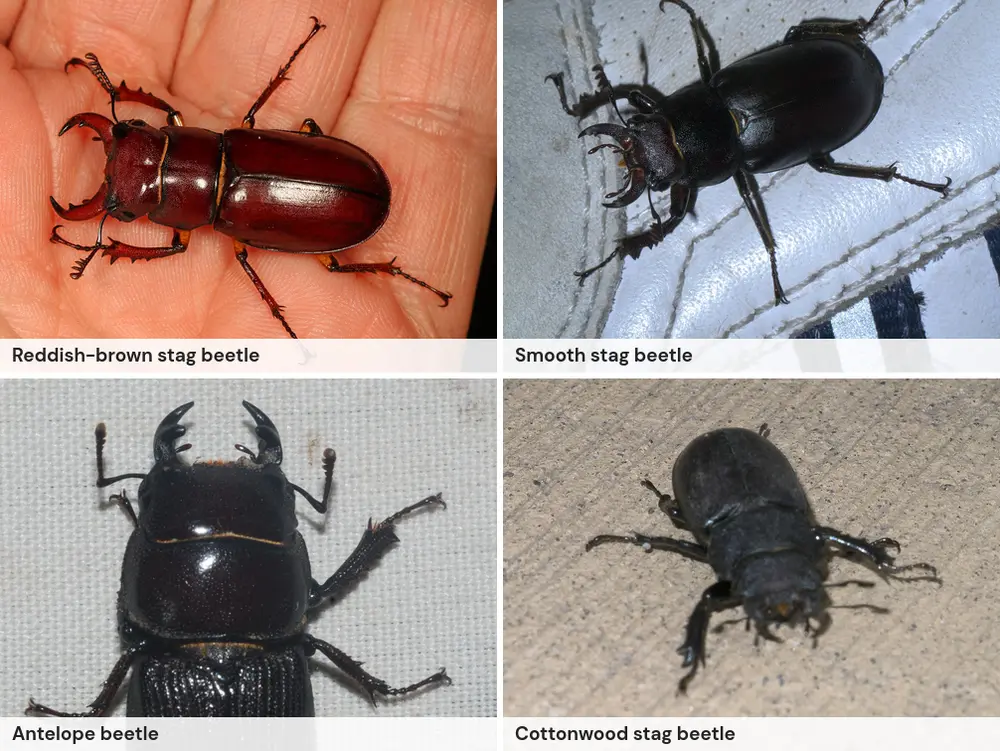
| Reddish-brown stag beetle (Lucanus capreolus) | About 1 in (Missouri); 22 to 40 mm (Kentucky) | In or near hardwood forests (Missouri) | Reddish brown; male jaws much smaller than a giant stag beetle’s (Kentucky); the “pinching beetle” of porch lights | July, 71.1% (61.8% of all US records) |
| Giant stag beetle (Lucanus elaphus) | Males 45 to 60 mm, females 30 to 35 mm (Animal Diversity Web) | Southeast and lower Midwest; 20 states in our records | Male jaws can be as long as the head and thorax combined (Animal Diversity Web); females have darker legs than reddish-brown females (Missouri) | June, 57.3% (11.2%) |
| Smooth stag beetle (Lucanus placidus) | 3/4 to 1 1/4 in (University of Minnesota) | Yards and gardens near decaying stumps (Minnesota); sandy areas (Wisconsin) | Chunkier than most stag beetles, with relatively short jaws (Wisconsin) | June, 59.4% (7.5%) |
| Antelope beetle (Dorcus parallelus) | Not stated in the sources we used | East and Midwest: 33 states in our records, led by New York, none in the West | See the photo panel below | June, 50.7% (4.8%) |
| Cottonwood stag beetle (Lucanus mazama) | 20 to 41 mm (Animal Diversity Web) | Southwest US and Mexico, especially riparian cottonwood forests (Animal Diversity Web) | Black to dark brown; also found in wood chip beds in urban parks (Animal Diversity Web) | July, 64.9% (4.1%) |
Giant stag beetle
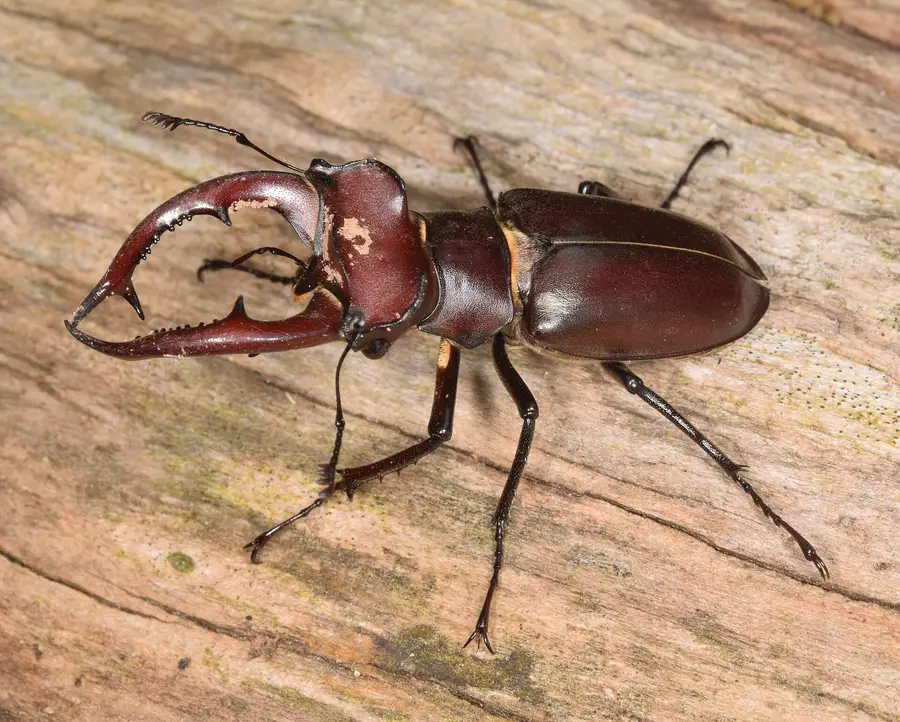
The giant, or elk, stag beetle is the biggest US species: males reach 1 1/2 inches without the jaws and nearly 2 1/2 inches with them, according to the Missouri Department of Conservation, which notes that elaphus is Greek for “stag,” not “elephant.” The USDA Forest Service calls it the largest insect associated with dead wood in the US. Females are easy to mix up with reddish-brown females; the giant’s have darker legs and a smooth thorax shield.
When and Where Americans Find Stag Beetles
To see when and where people actually find stag beetles, we pulled every US research-grade stag beetle observation from the iNaturalist API on November 22, 2026 (“research grade” means at least two people agreed on the identification): 34,183 records in 28 species.
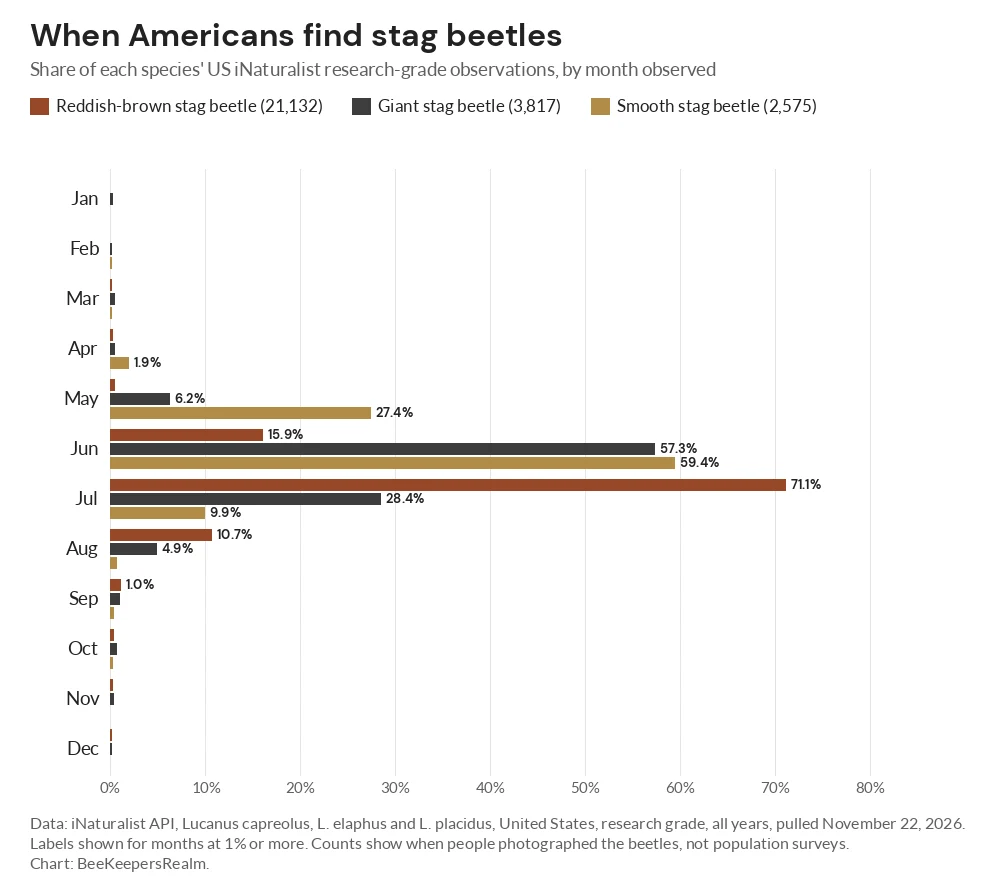
Across all species, June held 27.4% of records, July 53.6% and August 8.6%, in line with Clemson’s adult season of mainly May to August. Smooth stag beetles start earliest, with 27.4% of their records in May, matching the University of Minnesota’s note that they turn up in yards in May and June. Giant stag beetles peak in June (57.3%), reddish-brown stag beetles in July (71.1%).
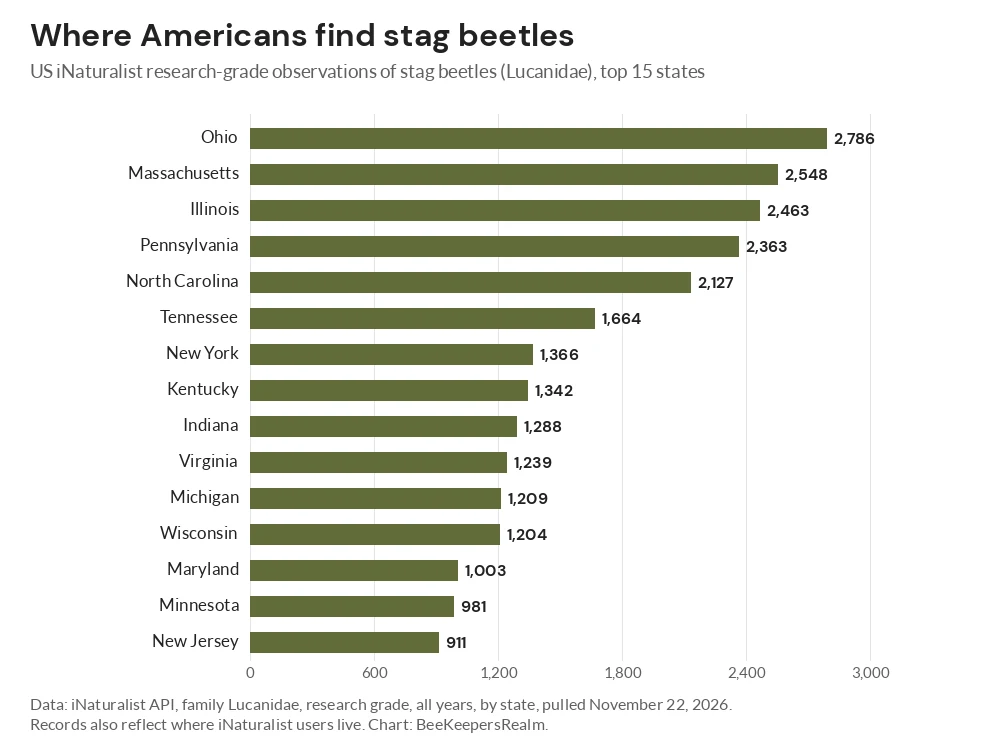
Records came from 49 states and Washington, D.C.; Alaska had none. Ohio (2,786), Massachusetts (2,548), Illinois (2,463), Pennsylvania (2,363) and North Carolina (2,127) lead. The interior West is nearly empty: Wyoming and South Dakota had 1 record each, Montana and North Dakota 2. Florida had only 4, all giant stag beetles, and Hawaii’s 11 records are all flightless Apterocyclus stag beetles, which iNaturalist calls Kauai flightless stag beetles.
The giant stag beetle is more southern than some guides suggest. Animal Diversity Web gives its range as Virginia and North Carolina to the northeastern US, but its 3,817 records came from 20 states, led by North Carolina (1,295, 33.9%), Tennessee (441) and Georgia (353). Maryland (124) and Ohio (39) were the northern edge, with none from Pennsylvania, New Jersey, New York or New England. Records follow where iNaturalist users look, so an absence is a lead, not proof.
Stag Beetle Life Cycle: Grubs in Rotting Wood
Stag beetles go through complete metamorphosis. Kentucky’s entomologists describe females laying eggs on or under the bark of dead, fallen trees; the grubs chew into the wood, feed on the juices of decay and pupate in the soil nearby. The whitish, C-shaped grubs look much like June bug grubs, and Missouri notes they turn up in deep hardwood mulch on trails and playgrounds.
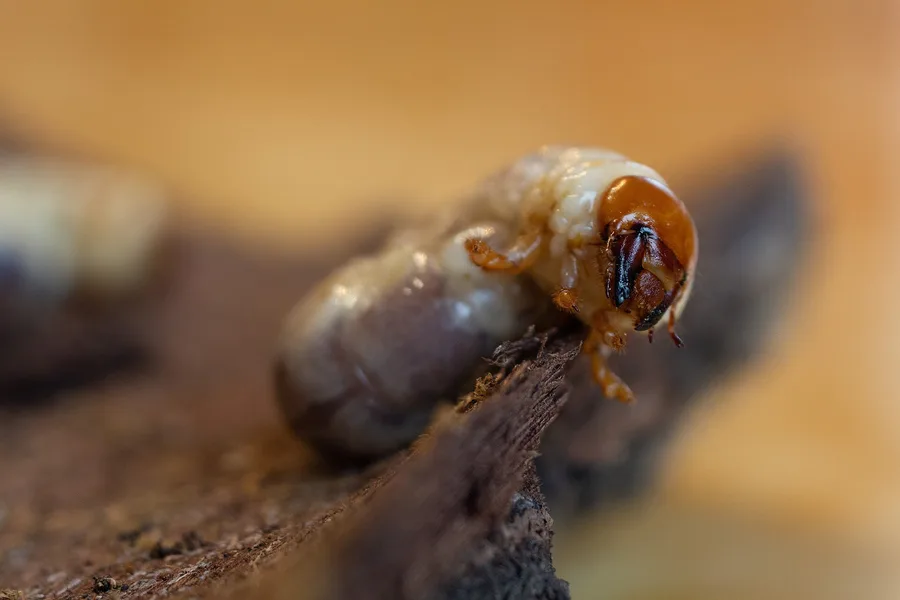
How long the grub stage lasts is where sources disagree most:
- Giant stag beetle, measured: In a USDA Forest Service study that surveyed Mississippi forests, the species “appears to require 1–2 years to complete development” (Ulyshen and colleagues, Insect Conservation and Diversity, 2017). The team found 75 larvae, most in extremely decomposed wood, and a parasitic tachinid fly, Zelia vertebrata.
- Giant stag beetle, extension: Clemson says 3 to 5 years; Missouri says at least one year.
- Cottonwood stag beetle: usually two years, recorded up to seven (Animal Diversity Web).
Adult life is short but also disputed: Animal Diversity Web says giant stag beetles live three to five weeks after emerging, the Missouri Department of Conservation says a few months, and Kentucky’s entomologists give 1 to 2 years depending on the species. Grubs are seldom seen: only 37 of the US records are tagged as larvae, against 7,420 tagged as adults.
What Stag Beetles Eat
Grubs eat rotting wood and its juices. Adults eat tree sap where bark has been injured, and may also take rotting fruit and the sweet honeydew that aphids excrete (Missouri Department of Conservation). Animal Diversity Web adds that adults cannot chew food. Raccoons and woodpeckers dig grubs out of logs, birds, bats and skunks eat adults (Missouri), and Kentucky lists centipedes among the predators.
Do Stag Beetles Pinch or Bite?
They can, but only in defense. A cornered male rears back with jaws open, which Animal Diversity Web calls “mainly a bluff,” since the jaws can pinch but not inflict a painful bite. Kentucky’s entomologists say stag beetles “can do little more than give a mild pinch.” London’s Natural History Museum notes that females’ shorter jaws are a bit stronger and capable of biting, though they are not aggressive. Like an earwig’s pincers, the jaws look worse than they are. Stag beetles have no sting and, unlike termites, “do not damage living wood or timber,” as the UK’s People’s Trust for Endangered Species puts it.
Are Stag Beetles Rare or Protected?
Animal Diversity Web calls the giant stag beetle uncommon but not in need of special conservation efforts, with no IUCN or federal listing. Ulyshen notes that dead-wood beetles are among the most threatened insects in Europe, yet very little is known about their conservation status in North America.
“We do know that giant stag beetles are highly dependent on dead wood.”
Europe is different. The European stag beetle (Lucanus cervus) is listed as Near Threatened in Europe on the IUCN Red List and in Annex II of the EU Habitats Directive. In the UK, the Natural History Museum says it is protected under the Wildlife and Countryside Act 1981 to stop collection for sale. It disappeared from Latvia and Denmark and has been reintroduced to Denmark. Most “rare” and “protected” claims online are about this species.
How to Help Stag Beetles and Wood-Nesting Bees
Stag beetles need dead wood. A few low-effort steps help:
- Leave hardwood stumps rather than grinding them, and keep a few logs lying undisturbed on the ground, as the 2017 study recommended for forests (Missouri Department of Conservation).
- Partially bury some logs; London’s Natural History Museum advises this because the larvae need damp, rotten wood.
- Skip pesticides. Stag beetles are beneficial decomposers, not pests (University of Kentucky).
- Turn off unneeded outdoor lights in June and July; almost all species fly to lights at night (University of Kentucky), as luna moths do.
Dead wood helps bees too, though not in the same spot. Every giant stag beetle grub in the 2017 study was in wet or damp wood. Many native bees nest above ground: UGA Extension says they make nests in abandoned beetle tunnels in dead logs and in hollow stems, and that such material is “often quickly removed from yards.” So logs and stems left above ground can serve cavity nesters such as mason bees, while a partly buried log feeds stag beetle grubs. The link is shared habitat, not pollination; see our guide to wild bee habitats.
Frequently Asked Questions
Are stag beetles dangerous?
No. They have no sting or venom and are not pests. A handled beetle may give a mild pinch.
Is it safe to pick up a stag beetle?
Yes. Kentucky’s entomologists say they can be handled with little fear of injury, and London’s Natural History Museum says you can safely pick them up to move them out of harm’s way.
What happens if a stag beetle bites you?
You get a pinch. Animal Diversity Web says the giant stag beetle can pinch hard if handled carelessly, but there is no venom and they only bite in self-defense.
How rare is it to find a stag beetle?
Not rare in summer in most of the East and Midwest: iNaturalist users logged 18,306 US records in July alone. Records are scarce in Florida and the interior West.
How long do stag beetles live?
Mostly as grubs, for 1 to several years depending on the species. Sources give adults anywhere from a few weeks to 1 or 2 years.
Can stag beetles fly?
Yes. Adults fly at dusk and at night and come to lights; Missouri notes giant stag beetles are sometimes found on their backs under streetlights.
What is the biggest stag beetle in the US?
The giant stag beetle, Lucanus elaphus: males reach nearly 2 1/2 inches including the jaws.
The Bottom Line
A big jawed beetle at your porch light in July is almost certainly a reddish-brown stag beetle, and it is harmless. Put it on a tree trunk and leave old stumps for its grubs. Beekeepers who find a beetle inside a hive should think of the small hive beetle instead. For more, see our garden and household insects guides.
Image credits: Featured image: giant stag beetle specimen from California, Maryland, USGS Bee Inventory and Monitoring Lab, Wikimedia Commons, public domain, resized and padded to 16:9. Other photos: Christina Butler, Judy Gallagher, xpda, Smithsonian Environmental Research Center and Dimaoleksii, via Wikimedia Commons; file pages, licences and edits are in the captions. Charts: BeeKeepersRealm, from iNaturalist API data pulled November 22, 2026.